Apparently,
112 events featuring extremist speakers took place on UK
campuses in the academic year 2016/2017, according to a recent
report
by Britain's Henry Jackson society:
"The vast majority of the extreme
speakers recorded in this report are Islamist extremists, though one
speaker has a background in Far-Right politics...." That one speaker was
Tommy Robinson both of whose events were cancelled, one due to hundreds
of students planning to demonstrate to protest his appearance. The
report does not mention student protests at any of the Islamist events.
The
topics of the Islamist speakers included:
"Dawah Training... to teach students the fundamentals of
preaching to others... Western foreign policy towards the Islamic world
in general... Grievances...perceived attacks on Muslims and Islam in the
UK... [calling for] scrapping of Prevent and other government
counter-extremism measures [critiquing] arrest and detention of
terrorism suspects... [challenging] ideas such as atheism and
skepticism... religious socio-economic governance, focusing on the role
of religion in fields such as legislation, justice... finance...
religious rulings or interpretations, religious verses or other texts,
important historical or scriptural figures..."
London was the region with the highest number of events, followed by
the South East, according to the report. The most prolific speakers were
affiliated to the Muslim Debate Initiative, the Islamic Education and
Research Academy (iERA), the Muslim Research and Development Foundation
(MRDF), the Hittin Institute, Sabeel, and CAGE. Most speakers were
invited by Islamic student societies, and a high proportion of the talks
took place during campus events such as "Discover Islam Week", "Islam
Awareness Week" and "Islamophobia Awareness Month".
One of the most prolific speakers, Hamza Tzortis, is a senior member of iERA. He has
said
that apostates who "fight against the community[...] should be killed"
and that, "we as Muslims reject the idea of freedom of speech, and even
the idea of freedom".
That so many extremist speaker events continue to take place
at British universities should be cause for alarm. In March 2015, the
Counter-Terrorism and Security Act (CTSA) imposed a duty
on universities, among other public bodies, to pay "due regard to the
need to prevent individuals from being drawn into terrorism", yet at 112
events last year, the number of extremist Islamist events on campuses have not dropped significantly. In comparison, there were 132 events in 2012, 145 events in 2013 and 123 events in 2014.
Evidence
shows that the danger of becoming an actual Islamic terrorist while
studying at British university campuses is also extremely real.
According to one
report, also by the Henry Jackson society:
"Since 1999, there have been a number of acts of
Islamism-inspired terrorism... committed by students studying at a UK
university at the time of their offence...there have also been a
significant number of graduates from UK universities convicted of
involvement in terrorism, and whom... were at least partially
radicalised during their studies".
The most well known case is probably that of Ahmed Omar Saeed Sheikh,
who in 2002 was found guilty of the kidnapping and murder of journalist
Daniel Pearl. He is believed to have been radicalized while studying at
the London School of Economics and Political Science in the early
1990s.
While removing extremist speakers from campuses might possibly reduce
the risk of radicalization, extremist speakers are readily available to
talk to Muslim youths outside of campuses. The issue is not hate
preachers visiting the UK from abroad. While banning them from campuses
will leave them with fewer venues, it by no means solves the larger
issue, which is that they will continue their
dawah or proselytizing elsewhere.
What, then, have been recent responses by the British government to the issues of Islamic radicalization and terrorism?
One response has been a
proposal
to tighten existing law on viewing 'terrorist content' online. People
who repeatedly view terrorist content online could now face up to 15
years jail, Home Secretary Amber Rudd has announced. The law will also
apply to terrorists who publish information about members of the armed
forces, police and intelligence services for the purposes of preparing
acts of terrorism. Tightening the law around viewing terrorist material
is part of the counter-terrorism strategy the government is reviewing
after the increased frequency of terrorist attacks in Britain this year.
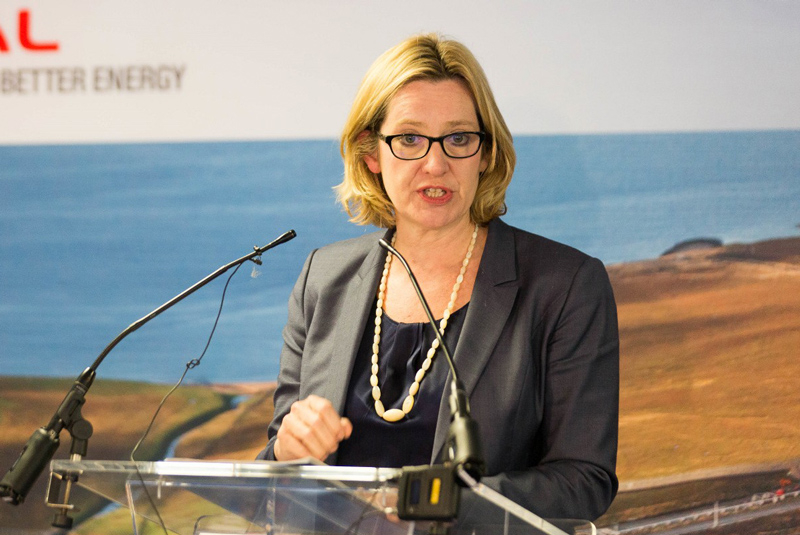
Britain's
Home Secretary Amber Rudd has announced that people who repeatedly view
"terrorist content" online could now face up to 15 years jail. (Image
source: UK Government/Flickr)
|
Amber Rudd has
included 'far-right propaganda' in the new law, saying:
"I want to make sure those who view despicable terrorist
content online, including jihadi websites, far-right propaganda and
bomb-making instructions, face the full force of the law."
What is 'far right propaganda?' Based on previous British policies,
'far right propaganda' would likely include reading Robert Spencer's
Jihad Watch or Pamela Geller's 'Geller Report'. While local hate
preachers from legal Muslim organizations freely roam UK campuses,
Robert Spencer and Pamela Geller were both forbidden entry to the UK in
2013 by the British Home Secretary, because their presence would "not be
conducive to the public good". This is what Geller was
told:
"After careful consideration...you should be excluded
from the United Kingdom on the grounds that your presence here is not
conducive to the public good...You have brought yourself within the
scope of the list of unacceptable behaviours by making statements that
may foster hatred, which might lead to inter-community violence in the
UK...You co-founded Stop Islamization of America, an organization
described as an anti-Muslim hate group... You are reported to have
stated the following: 'Al-Qaeda is a manifestation of devout Islam ...
it is Islam' [and] 'If the Jew dies, the Muslims will die as well: their
survival depends on their constant jihad, because without it they will
lose the meaning and purpose of their existence.' The Home Secretary
considers that should you be allowed to enter the UK you would continue
to espouse such views...".
The letter to Robert Spencer was in almost identical
form:
"The Home Secretary notes that you are the founder of the
blog Jihad Watch (a site widely criticized for being Islamophobic). You
co-founded the Freedom Defense Initiative and Stop Islamization of
America, both of which have been described as anti-Muslim hate groups.
You are reported to have stated the following: "... it [Islam] is a
religion and is a belief system that mandates warfare against
unbelievers... for establishing a societal model that is ...incompatible
with Western society..."
The question probably should be: Based on available evidence, are
those assessments of Islam accurate? Particularly compared to current
messages that seemingly are considered "conducive to the public good."
It is also conceivable that reading quotes from Winston Churchill's
book about Islam online would be seen as 'far right' and therefore
punishable by up to 15 years in jail. In 2014, Paul Weston, chairman of
the Liberty GB party, was
arrested
on suspicion of religious/racial harassment for quoting an excerpt on
Islam from Churchill's book, 'The River War' -- written in 1899 while he
was a British army officer in Sudan -- in a public speech.
Another recent government response to terrorism has been to
outlaw two far-right groups: Scottish Dawn and NS131, which are aliases for the group National Action, a fringe neo-Nazi group,
banned
in 2016. Being a member of these groups or merely supporting them is
now a criminal offense that carries a sentence of up to 10 years'
imprisonment. Amber Rudd
said in September:
"National Action is a vile racist, homophobic and
anti-Semitic group which glorifies violence and stirs up hatred... Our
priority as Government will always be to maintain the safety and
security of families and communities... we will continue to identify and
ban any terrorist group which threatens this, whatever their ideology".
Apparently, however, to paraphrase George Orwell, some terrorist
groups "are more equal than others."
Amber Rudd recently refused to ban
the political wing of Hezbollah, an equally racist, homophobic and
anti-Semitic group that has actually committed terror attacks all over
the world, as opposed to the banned neo-Nazi groups. Banning Hezbollah's
political wing would have closed a legal loophole that allows
demonstrations in support of the political wing of Hezbollah, while its
military wing is banned in the UK. Hezbollah itself, obviously, does not
distinguish between its 'political' and 'military' wings.
The Mayor of London, Sadiq Khan, had
written
to Amber Rudd asking her to close the legal loophole after Jewish
groups pleaded with him to stop a large Al Quds day march, which
nevertheless took place in London in June 2017 and featured Hezbollah
flags.
While the British government decided that supporters of fringe
neo-Nazi groups should be jailed for up to 10 years, it apparently
thought that supporting Hezbollah is just fine. In response to Khan,
Amber Rudd
wrote :
"The group that reportedly organised the parade, the
Islamic Human Rights Commission, is not a proscribed terrorist
organisation. This means they can express their views and demonstrate,
provided that they do so within the law. The flag for the organisation's
military wing is the same as the flag for its political wing.
Therefore, for it to be an offence under Section 13 of the Terrorism Act
2000, for an individual to display the Hizballah flag, the context and
manner in which the flag is displayed must demonstrate that it is
specifically in support of the proscribed elements of the group",
In other words, you can go ahead and support Hezbollah in the UK, no
problem. Support the far right and you can end up in jail for a decade.
Evidently, free speech in the UK has become extremely selective.
Judith Bergman is a columnist, lawyer and political analyst.


