.

.
Library of Professor Richard A. Macksey in Baltimore

POSTS BY SUBJECT

Labels

Showing posts with label RUSSIA. Show all posts

Monday, September 19, 2022

Why Putin Must Be Defeated


Why Putin Must Be Defeated

by

https://www.gatestoneinstitute.org/18740/putin-must-be-defeated

  • The Ukrainian military urgently needs long-range air defenses and longer-range artillery. It does not have them.

  • [Zelensky] said he wanted the war over before Russia could rebuild its forces, and that each additional day of war meant more death and destruction. Above all, he said, not only Ukraine is at stake, but the security and values ​​of the West.

  • "History teaches that prolonged conflicts bleed both sides, but dictatorships have an advantage over democracies. They are not accountable to their societies and can pay the price of blood, even with opposition from their citizens.... Does the transatlantic free world still want to occupy a position of leadership? Do we still believe in the universality of values ​​such as freedom and the right of national self-determination?" — Polish Prime Minister Mateusz Morawiecki, Politico, June 27, 2022.

  • The almost total destruction of entire cities... has no precedent in Europe since the end of the Second World War. Neither do the horrific war crimes committed in Bucha and other towns on the outskirts of Kyiv and Kharkiv. Nearly two million Ukrainians have been deported and sent to Russia, with some in detention camps in Siberia.... The invasion of Ukraine without a declaration of war is itself a war crime.

  • The Baltic states, Finland, Sweden and Poland have every reason to feel threatened: if Putin is not defeated, he will not stop at Ukraine.

  • Russia, in 1994, signed the Budapest Memorandum, committing itself to respect the borders of Ukraine. Twenty years later, in 2014, Russia annexed Crimea and created secessionist militia in the Donbass. In 2022, Putin showed that the Budapest Memorandum had absolutely no meaning for him.

  • Putin is leading a campaign of annihilating Ukraine's infrastructure and industrial base. He appears to want Ukraine to become a ruined, non-viable country, virtually impossible to rebuild because the costs would be too high. The more time passes, the higher the costs.

  • To achieve his ends, Putin is apparently perfectly willing to hold hundreds of millions of innocent people hostage, and even sentence them to death by starvation. Meanwhile, his propaganda services cynically claim to the countries concerned that the risk of famine results from the Western sanctions against Russia.

  • Failing to give Ukraine every means to win... or letting a stalemate set in -- or even worse -- rewarding Russian aggression by ceding Ukraine's Donbass and declaring that Russia had "won", would effectively be announcing to China and all the enemies of the Western world that the power of the West and its ability to command respect belong in the past. Such an outcome would also be telling them that the rules of international law established after the Second World War, and the values ​​that the Western world claims to embody, are now rules and values ​​that the West is incapable of defending.

  • A war only ends when there is a winner and a loser. In the present situation, Putin is the ruthless aggressor who tramples all the rules and values of the West. He must be defeated. If he is not, the consequences will not be limited to Ukraine. They will be devastating.

  • The Russian military is not invincible. On the contrary, it has shown itself to be extremely deficient and vulnerable. It is the army of a weak state: Russia's GDP is lower than that of Italy. The Russian army can be crushed and the murderous destruction inflicted on Ukraine can end. What is missing is the clear and concrete will from the West. The United States must lead.

  • In Madrid, Biden said, "We are going to stick with Ukraine, and all of the alliance is going to stick with Ukraine as long as it takes to, in fact, make sure that they are not defeated". He did not say what he should have said, had he wanted to show some strength: Ukraine must win. If it receives the required armaments, Ukraine will win.

  • Only an American president has the political and military means to show strength in a credible way. It is tragic that the United States has a weak president just when the future of the world is threatened by so many predatory regimes -- all doubtless aware of the small but irresistible window they have at this time.

  • "We must aid Ukraine, for to do so in part is our first duty to America and to Americans.... By supporting Ukraine, we prevent larger European conflict. A war that would almost certainly involve America's military because we have a deep commitment to the NATO treaty and Article Five therein." — Former US Secretary of State Mike Pompeo.

  • "Putin will not stop, unless he is stopped... if the West is aware of what is at stake and sees this war as its own, then this price is not too high. After all, Ukrainians are paying a much higher price. Ukrainians have no choice, since they are defending their country. But the West has no choice either—it is about its future as a community, driven by values ​​and the ability to project these values ​​globally." — Iryna Solonenko, Senior Fellow at the Zentrum Liberale Moderne (LibMod), Berlin, Internationale Politik Quarterly, April 13, 2022.
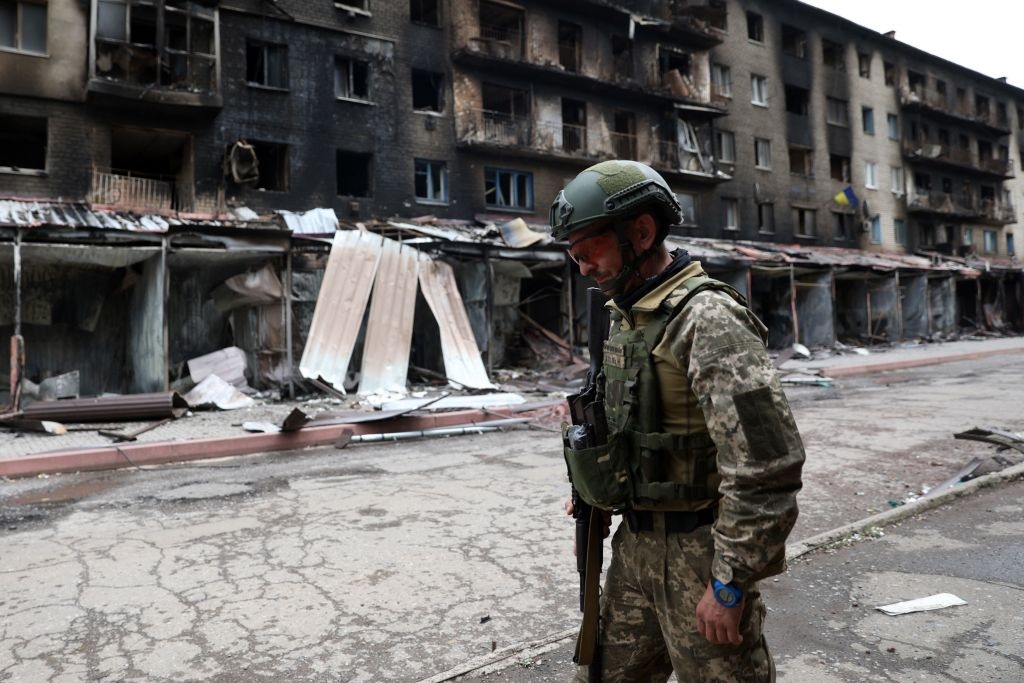
The almost total destruction of entire cities in Ukraine has no precedent in Europe since the end of the Second World War. The Ukrainian military urgently needs long-range air defenses and longer-range artillery. It does not have them. Pictured: A Ukrainian soldier passes by a destroyed building in the Ukrainian town of Siversk, Donetsk region on July 22, 2022. (Photo by Anatolii Stepanov/AFP via Getty Images)

May 9, Moscow. The annual military Victory Day Parade was held in Red Square, but with fewer soldiers and military vehicles than in other years. The parade had been cut by 35%. Russian President Vladimir Putin's short, sober speech tried to justify the war of aggression he had launched against Ukraine on February 24.

Putin seemed on the verge of defeat. A month earlier, in an apparent debacle, the Russian Army had hastily left the Kyiv area. Countless Russian soldiers had been wounded and killed; the loss of military equipment was unimaginable. A report from the UK Ministry of Defence on May 15 said that Russia had lost a third of its combat forces and much of its heavy equipment.

On May 14, Russian troops withdrew from ​​Kharkiv, Ukraine's second-largest city; they had been pushed back by Ukrainian forces to the Russian border. Russia's only "victory" was the total destruction of the city of Mariupol, by the Sea of ​​Azov. Communications intercepted by American intelligence services showed that the Russian military had a low morale and that cases of insubordination, mutiny, and refusal to obey orders had multiplied. Russian generals had been killed at the front.

Russian forces then began concentrating their efforts on the Donbass and has been waging a war of attrition ever since. Much of Russia's modern military equipment has been destroyed; its older equipment dates from the 1960s, but Putin has lots of bombs. Russia has now been bombing Ukrainian positions for weeks. It advances just a little but destroys everything in its path. It has razed not only much of Mariupol, but also Severodonetsk and Lysychansk.

The Ukrainian Army courageously resists, but does not have enough heavy weapons to end the destruction, stop Russia's offensive or carry out an effective counter-offensive.

Putin seems to be counting on time; he seems betting that the Western world will lose interest in Ukraine and turn to other matters.

The Biden administration at first seemed ready endorse regime change in Kyiv, and US officials even offered Zelensky safe passage out of the country. Zelensky famously answered, "I need ammunition, not a ride."

When it appeared that the Russian Army was failing and that Zelensky had succeeded in mobilizing the opinion of the Western world, Biden finally supported Ukraine -- but certain categories of American weapons that Ukraine had asked for were supplied late or not at all. Ukraine, for instance, had requested HIMARS (High Mobility Artillery Rocket System) -- essential to countering Russian artillery -- as early as March. Biden sent four units, but before sending them asked that their range be limited to 50 miles. Recently, four additional HIMARS units were sent, and four more are reportedly to be sent soon. That makes 12 units in all -- far too few to reverse the balance of power on the battlefield. The Ukrainian military urgently needs long-range air defenses and longer-range artillery. It does not have them.

European NATO member countries also supported Ukraine and sent weapons, but no European country has a sufficiently powerful military or a significant amount of materiel. While the countries of Central Europe, the Baltic states and the United Kingdom took a firm stand from the start and said that Putin had to be defeated, the large countries of Western Europe -- France, Germany and Italy -- initially sought to appease Putin. They gave Ukraine only part of the materiel and with extreme reluctance. French President Emmanuel Macron opined that Putin should not be "humiliated," although Macron, German Chancellor Olaf Scholz and Italian Prime Minister Mario Draghi traveled to Kyiv on June 16 supposedly to show support.

Two international meetings recently took place. The leaders of the Group of Seven (G7) -- Canada, France, Germany, Italy, Japan, the United Kingdom and the United States -- meeting in Germany on June 27, reaffirmed their support for Ukraine "for as long as it takes". A NATO summit was held two days later in Madrid, Spain, where the summit's Final Communiqué stated:

"We condemn Russia's war of aggression against Ukraine in the strongest possible terms. It gravely undermines international security and stability. It is a blatant violation of international law... Russia must immediately stop this war and withdraw from Ukraine... We reiterate our unwavering support for Ukraine's independence, sovereignty, and territorial integrity within its internationally recognised borders extending to its territorial waters... The Russian Federation is the most significant and direct threat to Allies' security and to peace and stability in the Euro-Atlantic area."

The Communiqué also defined Ukraine as a "close partner" of NATO.

An international conference was organized on July 4 in Lugano, Switzerland to envision the reconstruction of Ukraine. The destruction perpetrated by Russia has so far been valued at $750 billion. Discussing reconstruction when the war is not even over is, to say the least, a bit premature. The destruction continues.

The statements made in Germany and Spain, albeit important, will remain just statements if they do not lead to acts fully consistent with their words.

Ukrainian President Volodymyr Zelensky spoke at both the G7 and NATO summits. He said he wanted the war over before Russia could rebuild its forces, and that each additional day of war meant more death and destruction. Above all, he said, not only Ukraine is at stake, but the security and values ​​of the West.

Similar ideas were recently expressed in a June 27 column written by Poland's Prime Minister Mateusz Morawiecki:

"Without more forceful intervention in Ukraine's war, the consequences for the U.S. and Europe could be devastating....

"History teaches that prolonged conflicts bleed both sides, but dictatorships have an advantage over democracies. They are not accountable to their societies and can pay the price of blood, even with opposition from their citizens...

"The war in Ukraine puts before us one crucial question: Does the transatlantic free world still want to occupy a position of leadership? Do we still believe in the universality of values ​​such as freedom and the right of national self-determination?"

The security and values ​​of the Western world are unquestionably at stake, as are the leadership of the transatlantic free world and values ​​such as freedom and the right of national self-determination. If they are not defended with force and conviction in Ukraine, they may well not survive.

The near total destruction of entire cities, along with civilian homes, has no precedent in Europe since the end of the Second World War. Neither do the horrific war crimes committed in Bucha and other towns on the outskirts of Kyiv and Kharkiv. Nearly two million Ukrainians have been deported and sent to Russia, with some in detention camps in Siberia, thousands of miles from their homes and country. The accumulation of crimes committed by Russia since February 24 has led legal scholars to say that Russia is committing genocide, and the New Lines Institute for Strategy and Policy in America and the Raoul Wallenberg Center for Human Rights in Canada published a damning report on the subject. The invasion of Ukraine without a declaration of war is itself a war crime.

Putin, in a recent speech, compared himself to Tsar Peter the Great and equated Russia's invasion of Ukraine with Peter's expansionist wars three centuries ago. The Baltic states, Finland, Sweden and Poland have every reason to feel threatened: if Putin is not defeated, he will not stop at Ukraine.

The statements made by propagandists of the Putin regime on Russian state television daily, in a hateful tone, evoke extremely bad associations -- as, to deter the West, they are doubtless intended to do. They imply the destruction and enslavement of the whole of Europe, as well as nuclear attacks against France, the United Kingdom and the United States. Former Russian President Dmitry Medvedev went so far as to say that Russia can end the existence of mankind.

Russia, in 1994, signed the Budapest Memorandum, committing itself to respect the borders of Ukraine. Twenty years later, in 2014, Russia annexed Crimea and created secessionist militia in the Donbass. In 2022, Putin showed that the Budapest Memorandum had absolutely no meaning for him.

Putin is leading a campaign of annihilating Ukraine's infrastructure and industrial base. He appears to want Ukraine to become a ruined, non-viable country, virtually impossible to rebuild because the costs would be too high. The more time passes, the higher the costs.

Putin is preventing the export of Ukrainian wheat and is threatening to create widespread famine and major unrest in many of the poorest countries in the Arab world, sub-Saharan Africa and Asia. He is exercising unprecedented blackmail, telling Western countries that he will allow the delivery of wheat only if the sanctions on Russia are lifted. To achieve his ends, Putin is apparently perfectly willing to hold hundreds of millions of innocent people hostage, and even sentence them to death by starvation. Meanwhile, his propaganda services cynically claim to the countries concerned that the risk of famine results from the Western sanctions against Russia.

China did not and will not intervene militarily in Ukraine, yet it remains Russia's helpful ally. Chinese President Xi Jinping does not hide his ambitions of world domination and servitude for the rest of us. The agreement signed by Putin and Xi on February 4 in Beijing, three weeks before Putin attacked Ukraine, draws the contours of a new world order within which the notions of freedom, democracy and rule of law would no longer have any meaning. The enemies of the Western world are watching. Several of them -- North Korea, Venezuela, Cuba and Iran – have allied with Russia and China.

The Biden administration, since coming to power, has shown little but weakness; America's spectacular debacle in Afghanistan revealed extreme weakness. The Western world is losing ground. In 1975, when the G7 was created, its members accounted for 70% of the world's GDP. Today, they represent just over 40% of it.

The words spoken in Germany and Spain were filled with strength. Failing to give Ukraine every means to win, however, or letting a stalemate set in -- or even worse -- rewarding Russian aggression by ceding Ukraine's Donbass and declaring that Russia had "won", would effectively be announcing to China and all the enemies of the Western world that the power of the West and its ability to command respect belong in the past. Such an outcome would also be telling them that the rules of international law established after the Second World War, and the values ​​that the Western world claims to embody, are now rules and values ​​that the West is incapable of defending.

A war only ends when there is a winner and a loser. In the present situation, Putin is the ruthless aggressor who tramples all the rules and values of the West. He must be defeated. If he is not, the consequences will not be limited to Ukraine. They will be devastating.

The Russian military is not invincible. On the contrary, it has shown itself to be extremely deficient and vulnerable. It is the army of a weak state: Russia's GDP is lower than that of Italy. The Russian army can be crushed and the murderous destruction inflicted on Ukraine can end. What is missing is the clear and concrete will from the West. The United States must lead.

In Madrid, Biden said, "We are going to stick with Ukraine, and all of the alliance is going to stick with Ukraine as long as it takes to, in fact, make sure that they are not defeated". He did not say what he should have said, had he wanted to show some strength: Ukraine must win. If it receives the required armaments, Ukraine will win.

That Biden could show some strength is far from certain. Only an American president has the political and military means to show strength in a credible way. It is tragic that the United States has a weak president just when the future of the world is threatened by so many predatory regimes -- all doubtless aware of the small but irresistible window they have at this time.

"Russia's invasion of Ukraine is an inflection point in the post-Cold War politics", former Secretary of State Mike Pompeo recently said.

"Vladimir Putin's utter lack of basic humanity ensures that as long as he remains in power, Russia will be virtual prison and no nation that borders its expanse will ever be safe... We can do what President Zelenskyy has asked. We must aid Ukraine, for to do so in part is our first duty to America and to Americans.... By supporting Ukraine, we prevent larger European conflict. A war that would almost certainly involve America's military because we have a deep commitment to the NATO treaty and Article Five therein. By helping Ukraine, we prevent Russia's reconstitution of the Soviet Empire... In 2005, Putin declared the demise of the Soviet Union as one of the greatest tragedies in history. In 2007, he enunciated his rationale for conquest in terms that would be familiar to dictators who ruled Europe almost 90 years ago. Putin's been consistent. He's been consistent in his revanchist objectives. In Grozny in 1999. In Georgia in 2008. And in Ukraine in 2014... A mass murderer is someone who kills a large number of people at one time. A serial killer murders sequentially. Only in war therefore can a man be both a mass murderer and a serial killer. Putin is that. I pray that Russia will reclaim its soul, its country's soul. But it cannot do so as long it is led by a man who does not evince any concern for the horrific carnage he has wrought, or any concern for his own people."

"Ukraine's fight is also a fight for the West's future...", wrote Iryna Solonenko, Senior Fellow at the Zentrum Liberale Moderne (LibMod) in Berlin.

"Putin will not stop, unless he is stopped... Economic inconvenience and stress, resulting from the need to go beyond the usual bureaucratic procedures, are part of the price that needs to be paid. Yet, if the West is aware of what is at stake and sees this war as its own, then this price is not too high. After all, Ukrainians are paying a much higher price. Ukrainians have no choice, since they are defending their country. But the West has no choice either—it is about its future as a community, driven by values ​​and the ability to project these values ​​globally."

Dr. Guy Millière, a professor at the University of Paris, is the author of 27 books on France and Europe.


When German Environmentalists and Putin's Government Had a Burning Love Affair


When German Environmentalists and Putin's Government Had a Burning Love Affair

by

https://www.gatestoneinstitute.org/18829/german-environmentalists-gazprom-putin

  • In 2011, the German Baltic Sea Nature Conservation Foundation was established as a result of an agreement between three of Germany's leading environmental organizations - WWF, BUND and NABU - and the company Nord Stream, which is a subsidiary of the government of Vladimir Putin.

  • These environmental organizations were, moreover, at the same time fiercely opposed to German civil nuclear power, to the exploitation of shale gas in Europe and to the import of American gas via the construction of liquefied petroleum gas terminals in Germany.

  • Those were three issues where the views of the environmental organizations were totally congruent with those of the Russian Federation. This meant betting everything on "red" -- as in a casino -- but in this instance, on Russian gas.

  • Right after these contractual commitments by Nord Stream AG, the environmental organizations withdrew the lawsuit they had initiated against Nord Stream...

  • The German press reported last month that, inspired by the success of the first foundation, the same State of Mecklenberg-Western Pomerania was setting up a new foundation as recently as January 2021, the Mecklenberg-Western Pomerania Foundation for Climate and Environmental Protection, this time endowed with 192 million euros from the Russian government.

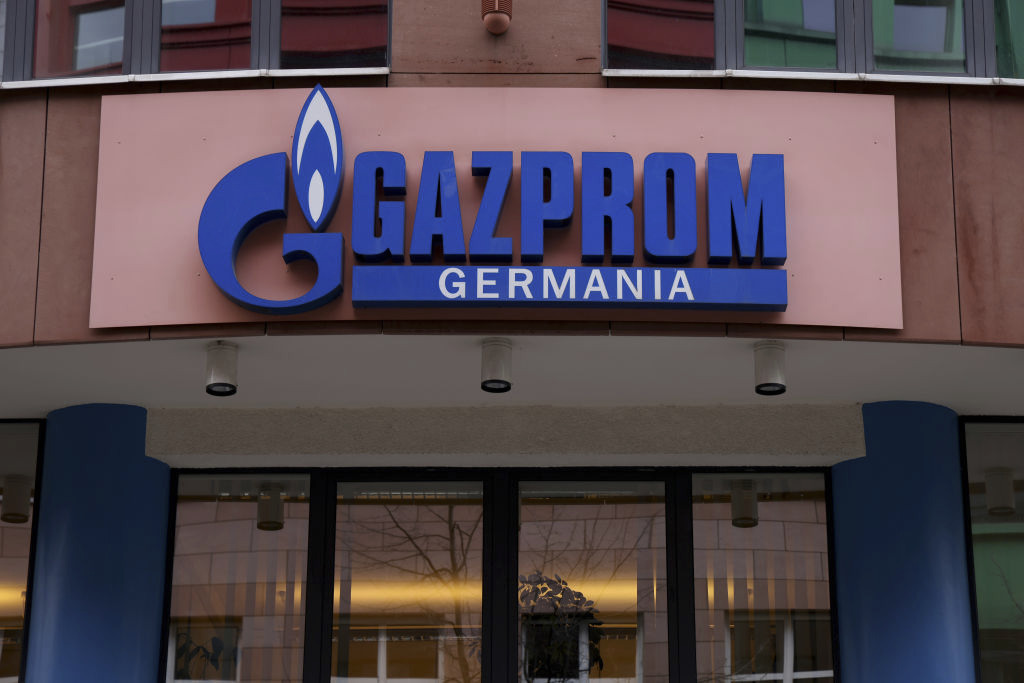
Those were... issues where the views of the environmental organizations were totally congruent with those of the Russian Federation. This meant betting everything on 'red' -- as in a casino – but in this instance, on Russian gas. Pictured: The corporate headquarters of Gazprom Germania, the German unit of Russian natural gas company Gazprom, photographed on March 30, 2022 in Berlin, Germany. (Photo by Sean Gallup/Getty Images)

In 2011, the German Baltic Sea Nature Conservation Foundation (Naturschutzstiftung Deutsche Ostsee) was created as a result of an agreement between Nord-Stream, the three main environmental organisations in Germany — WWF, BUND ("Friends of the Earth"), NABU — and the state of Mecklenburg-Western Pomerania. This foundation was immediately provided with a lucrative budget of ten million euros by Nord Stream.

Based in Zug, Switzerland, Nord Stream AG is an international consortium of five major companies established in 2005 for the planning, construction and subsequent operation of two 1,224-kilometres long gas pipelines across the Baltic Sea. The five shareholders of the consortium are Gazprom International Projects LLC, Wintershall Dea AG, PEG Infrastruktur AG, N.V. Nederlandse Gasunie and ENGIE. Gazprom International Projects LLC holds a 51% stake in the project.

Gazprom International Projects LLC is wholly owned by Gazprom, the world's largest publicly listed natural gas company, which is majority-owned and fully controlled by the Russian government.

The top management positions at the German Baltic Sea Nature Conservation Foundation were offered to the CEOs of these three largest German environmental organizations who were quick to accept, which is hardly surprising, given that this was part of the original agreement with the Moscow Bear.

These environmental organizations are trying to escape their overwhelming historical responsibilities by arguing, as BUND explained, that the agreement with Nord Stream on the creation of the German Baltic Sea Nature Conservation Foundation was only intended to "promote the implementation of complex nature conservation measures":

"In order to implement the complex measures as effectively as possible for nature and to secure them permanently, Nord Stream made the agreed compensation funds available in March 2011 for the establishment of the German Baltic Sea Nature Conservation Foundation... With the Baltic Sea Foundation, it is possible to develop, support and implement suitable projects in a professionally sound manner and with great expertise, and thus also to effectively compensate for the damage caused by the Baltic Sea pipeline. The non-profit Baltic Sea Foundation acts independently of the founder and is solely committed to its statutory objectives of promoting practical nature conservation and environmental protection measures at the Baltic Sea. To ensure that these funds are actually used to implement meaningful nature conservation work, WWF, NABU and BUND participate in the foundation's committees."

Let us try to see it clearly.

The reality of this agreement was stated by Nord Stream at the time of the foundation's creation in 2011:

"From today, the environmental organizations WWF, BUND and NABU will work closely together with the State of Mecklenburg-Western Pomerania and Nord Stream AG in the German Baltic Sea Nature Conservation Foundation (...) Jochen Lamp from WWF Germany will chair the board. The first deputy is Corinna Cwielag from BUND Mecklenburg-Western Pomerania."

The website of the German Baltic Sea Nature Conservation Foundation states:

"The German Baltic Sea Nature Conservation Foundation... was established in 2011 following an agreement between Nord Stream AG and the environmental organizations BUND Mecklenburg-Western Pomerania and WWF Germany."

Finally, the official statement from the state government concerned, Mecklenburg-Western Pomerania, reads:

"The creation of the foundation is the consistent realisation of the agreements for more nature conservation that the environmental organizations BUND and WWF Germany concluded with the company Nord Stream last year. In the foundation, representatives of BUND and WWF form the board of directors together with the State Secretary of the Ministry of Agriculture, Environment and Consumer Protection. (...) WWF CEO Jochen Lamp regards the establishment of the foundation as a great success for the protection of the marine environment (...) Representatives of NABU, the State Chancellery of Mecklenburg-Western Pomerania and the founder also work together in the 'curatorium', the strategic supervisory body of the new foundation."

To sum up, it is therefore a matter of fact and established law that in 2011, the German Baltic Sea Nature Conservation Foundation was established as a result of an agreement between three of Germany's leading environmental organizations - WWF, BUND and NABU - and the company Nord Stream, which is a subsidiary of the government of Vladimir Putin. Fact.

These environmental organizations were, moreover, at the same time fiercely opposed to German civil nuclear power, to the exploitation of shale gas in Europe and to the import of American gas via the construction of liquefied petroleum gas terminals in Germany.

Those were three issues where the views of the environmental organizations were totally congruent with those of the Russian Federation. This meant betting everything on "red" -- as in a casino -- but in this instance, on Russian gas.

Right after these contractual commitments by Nord Stream AG, the environmental organizations withdrew the lawsuit they had initiated against Nord Stream, as stated by BUND at the time. Quid pro quo, anyone?

Finally, the German press reported last month that, inspired by the success of the first foundation, the same State of Mecklenberg-Western Pomerania was setting up a new foundation as recently as January 2021, the Mecklenberg-Western Pomerania Foundation for Climate and Environmental Protection (Stiftung Klima- und Umweltschutz Mecklenburg-Vorpommern), this time endowed with 192 million euros from the Russian government. To quote the centre-left German daily Die Zeit:

"The Foundation for Climate and Environmental Protection was established at the beginning of 2021 by the government of [Mecklenberg-Western Pomerania's] Minister-President Manuela Schwesig (SPD). Officially, it was to promote environmental protection projects in the country... [and] received a total of 192 million euros from Nord Stream 2 AG, a subsidiary of Gazprom. The money was paid out between February and November 2021."

The German newspaper Die Welt wrote that the 192 million euros "benefited 80 service providers, who received 119 orders worth 165 million euros from the business enterprise set up within the environmental foundation." In its principles, this new foundation states that "the Foundation is interested in cooperating with the numerous initiatives, associations and foundations in climate protection... with a great deal of expertise." In Russian money?

The case is currently being examined by a commission of inquiry of the Mecklenburg-Western Pomerania state parliament, which was scheduled to begin its work at the end of August 2022. It is likely that, considering the seriousness of the facts, Germany's Chancellor Olaf Scholz and his predecessor, Angela Merkel, will be questioned.

The members of state parliament, Die Welt continues, also want to shed light on the role that the Russian secret services have played in the background. The current Interior Minister of Mecklenberg-Western Pomerania state, Christian Pegel (SPD), is particularly targeted:

"As Minister of Energy, this lawyer had once been instrumental in drawing up the foundation's statutes. In order to do this, Pegel met with representatives of the Russian-dominated Nord Stream 2 AG in circumstances that seem suspicious, without keeping any records. It is therefore not possible to know what agreements and arrangements were made on this occasion. For its part, Pegel claims that he no longer knows exactly what happened at the time. Through a spokeswoman, the minister told this newspaper: 'Insofar as he was involved in informal or formal discussions, he has no concrete recollection due to the passage of time."

A real short-term memory problem: the foundation was created last year.

Drieu Godefridi is a jurist (Saint-Louis University of Louvain), a philosopher (Saint-Louis University of Louvain) and a doctor in legal theory (Paris IV-Sorbonne).


Sunday, September 18, 2022

Iran and Russia: The New Alliance


Iran and Russia: The New Alliance

by

https://www.gatestoneinstitute.org/18903/iran-russia-alliance

  • Significantly, Russia and Iran's cooperation extends to the military and space fields, with Russia recently helping Iran to launch a new satellite into space.

  • Iran's Khayyam satellite "will greatly enhance Tehran's ability to spy on military targets across the Middle East... [and give] Tehran "unprecedented capabilities, including near-continuous monitoring of sensitive facilities in Israel and the Persian Gulf." — The Washington Post, August 4, 2022.

  • "Iran could share the imagery with pro-Iranian militia groups across the region, from the Houthi rebels battling Saudi-backed government forces in Yemen to Hezbollah fighters in southern Lebanon and Shiite militias in Iraq and Syria." — Unnamed Middle Eastern official, The Washington Post, June 10, 2021.

  • "As Iran perfects its missile arsenal... alongside its growing UAV capability throughout the Middle East –being able to sync those capabilities with satellite capabilities and surveillance will only increase the lethality of the Iranian threat." — Richard Goldberg, former Iran analyst in the Trump administration's National Security Council, The Washington Post, August 4, 2022.

  • Iran has also become a major developer and producer of drones.... Most recently, Iran claimed that it had developed a long-range suicide drone "designed to hit Israel's Tel Aviv, Haifa."

  • Despite this acknowledged "profound threat" emanating from the mutually beneficial alliance between Russia and Iran, the Biden administration nevertheless has been making dangerous concessions to revive the nuclear deal, which would only deepen the threat and benefit not only Iran, but also Russia.

  • Let us hope that the new "Iran nuclear deal," reportedly "off the table for the time being" is off the table for good.

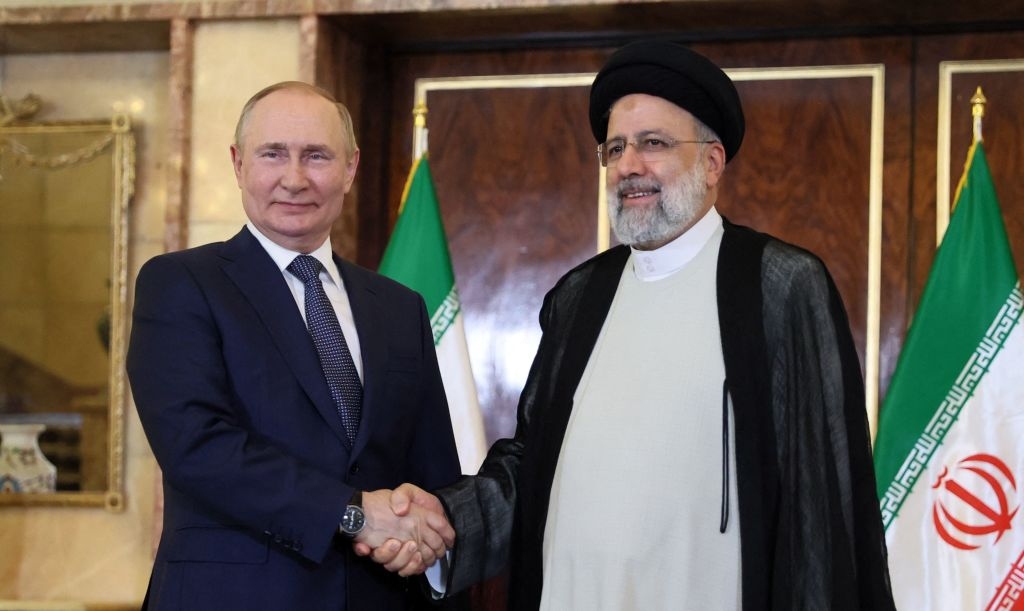
Russia and Iran's cooperation extends to the military and space fields, with Russia recently helping Iran to launch a new satellite into space. Pictured: Russian President Vladimir Putin and Iran's President Ebrahim Raisi hold a meeting in Tehran on July 19, 2022. (Photo by Sergei Savostyanov/Sputnik/AFP via Getty Images)

Iran and Russia have been strengthening their alliance recently, growing it gradually to such an extent that the Wall Street Journal wrote on August 27 that the two countries were "forging tighter ties than ever," as both countries face continued international isolation.

In recent months, Russia and Iran have signed a multitude of agreements, especially in trade, oil and gas, and military cooperation.

In June, an agreement on the establishment of mutual trade centers in St. Petersburg and Tehran was signed, to generate further trade between the two countries in the sectors of energy, transportation, electronics, agriculture, food, pharmaceuticals and construction, by helping Iranian and Russian businessmen establish contacts and conduct financial transactions.

In May, Russia and Iran signed agreements on settling their trade and energy payments in their national currencies instead of the US dollar. In addition, they agreed to continue talks to connect their electronic payment systems as well as their financial messaging systems. Since then, Russia and Iran have gradually begun trading in their national currencies.

In 2021, the volume of bilateral trade between Russia and Iran increased by 81% from the previous year, rising to $3.3 billion. In January, after a two-day visit to Moscow, Iranian President Ebrahim Raisi said that the two countries would increase trade even further.

"We agreed to remove trade barriers and boost the economic exchanges between the two countries. Currently, the level of mutual trade is not acceptable, so the two countries agreed to increase trade to $10 billion a year. The two countries can take steps to break the dominance of the dollar over monetary and banking relations and trade with the national currency."

During Raisi's visit, the two countries also signed agreements to deepen energy cooperation and in July, Russia announced that it would invest $40 billion in Iran's oil industry, Russia's largest ever investment in Iran. Russia announced the investment deal as Russian President Vladimir Putin was visiting Iran for talks.

According to Iranian state news outlet IRNA, Putin and Raisi "discussed ways for expansion of bilateral relations in different areas, including energy, transit, trade exchanges and regional developments as well."

Significantly, Russia and Iran's cooperation extends to the military and space fields, with Russia recently helping Iran to launch a new satellite into space: On August 9, Russia launched Iran's new Khayyam surveillance satellite from the Baikonur space station in Kazakhstan.

The launch of the satellite is a telling example of the kind of dangers that a strengthened Russian-Iranian alliance poses to US interests.

Iran's Khayyam satellite "will greatly enhance Tehran's ability to spy on military targets across the Middle East," according to unnamed Western and Middle Eastern officials quoted by the Washington Post. The satellite's high-resolution camera apparently gives Tehran "unprecedented capabilities, including near-continuous monitoring of sensitive facilities in Israel and the Persian Gulf."

Iran will also be able to "task" the new satellite to spy on locations of its choosing, as often as it wishes, according to the officials.

"It's not the best in the world, but it's high resolution and very good for military aims," a Middle Eastern official familiar with the hardware of the satellite told the Washington Post in June 2021.

"Iran could share the imagery with pro-Iranian militia groups across the region, from the Houthi rebels battling Saudi-backed government forces in Yemen to Hezbollah fighters in southern Lebanon and Shiite militias in Iraq and Syria."

"This is obviously a clear and present danger to the United States and our allies in the Middle East and abroad," said Richard Goldberg, a former Iran analyst in the Trump administration's National Security Council.

"As Iran perfects its missile arsenal – from short-, medium- to longer-range missiles, alongside its growing UAV capability throughout the Middle East –being able to sync those capabilities with satellite capabilities and surveillance will only increase the lethality of the Iranian threat."

For the time being, however, the Iranian satellite is meant to be helping Russia's war effort in Ukraine, another example of the mutual benefits accruing to both Russia and Iran from their alliance.

"Russia, which has struggled to achieve its military objectives during its five-month-old assault on Ukraine, told Tehran that it plans to use the satellite for several months, or longer, to enhance its surveillance of military targets in that conflict," the Washington Post wrote.

Equally significantly, Iran is now actively helping Russia with its war effort in Ukraine, which puts on display the extremely negative effects of the new Russian-Iranian alliance.

Russia has ordered hundreds of Iranian military drones as Russia suffers from a severe lack of attack drones that are precision-capable. Russia has bought at least two kinds of drones from Iran, the Mohajer-6 and the Shahed-series drones. The first batch of drones, according to the Washington Post, was picked up by Russian cargo flights in late August. Iran reportedly has been training Russian soldiers in using them in Russia's war in Ukraine. On September 13, Ukraine said that it had shot down an Iranian-produced Shahed drone.

Iran has become a major developer and producer of drones. In October 2021, the Wall Street Journal reported the concern of defense officials from the United States, Israel and Europe that Iran's progress in developing, building and deploying drones was changing the security situation in the Middle East region.

"The drones themselves are often made with widely available components used in the ever-growing commercial drone market and by hobbyists, the officials say," the Wall Street Journal reported.

"Some mimic the designs of Israeli and American military drones... Tehran's engineers rely on imported components to create aerial vehicles that can accurately strike targets at long distance and rapidly change direction to avoid air defenses and radar, say European and Middle Eastern security officials who have studied wreckages of the drones."

Most recently, Iran claimed that it had developed a long-range suicide drone "designed to hit Israel's Tel Aviv, Haifa."

In July, US National Security Adviser Jake Sullivan denounced the new cooperation between Russia and Iran:

"Russia deepening an alliance with Iran to kill Ukrainians is something that the whole world should look at and see as a profound threat."

Despite this acknowledged "profound threat" emanating from the mutually beneficial alliance between Russia and Iran, the Biden administration nevertheless has been making dangerous concessions to revive the nuclear deal, which would only deepen the threat and benefit not only Iran, but also Russia.

"Several of Russia's top state-controlled nuclear companies stand to gain billions of dollars in revenue as part of a new nuclear accord with Iran that will waive sanctions on these firms so that they can build up Tehran's nuclear infrastructure," the Washington Free Beacon reported in April.

"Russia's state-controlled Rosatom energy firm and at least four of its major subsidiaries will receive sanctions waivers under a new accord so that they can complete nuclear projects in Iran worth more than $10 billion, according to the 2019 document, which details all the Russian entities involved in these projects. With a new nuclear accord being finalized, the Biden administration has repeatedly guaranteed Russia that it will not face sanctions for its work on Iranian nuclear sites, even as Moscow faces a barrage of international penalties for its unprovoked war in Ukraine. The Biden administration renewed a series of sanctions waivers to permit Russia's nuclear work in Iran as part of a package of concessions meant to entice both countries into signing a new accord."

Let us hope that the new "Iran nuclear deal," reportedly "off the table for the time being" is off the table for good.

Judith Bergman, a columnist, lawyer and political analyst, is a Distinguished Senior Fellow at Gatestone Institute.


Monday, June 13, 2022

IRISH SAVANT: Ukraine: An utter disaster for Russia?


Ukraine: An utter disaster for Russia?

The Russian military intervention in Ukraine is turning into a strategic disaster of such monumental scale as to to bring into question the motives of Putin’s Government in launching the intervention. For a start it’s quite clear after sifting the tsunami of lies from all sides that it is indeed a disaster militarily. In fact anything other than a quick comprehensive victory involving minimal casualties and physical destruction equaled failure. Despite the claims of many experts that Ukraine’s defense infrastructure had been disabled by early precision weapon attacks the resistance not alone survives but seems to be pushing the Russians back months after hostilities began. It’s taken weeks to capture a single steel plant, for God’s sake, the defenders of which were able to see the Russian Black Sea flagship sunk in humiliating fashion a few miles off shore. Surely restive regions with non-Russian ethnic majorities (Chechnya, Dagestan, Ingushetia) are reconsidering their chances of a new violent rebellion in the light of these events? Russian military failure and ineptitude will also embolden adjacent states such as Georgia into more adventures.

The expansion and improved cohesion of what had been a declining and fissiparous NATO must surely represent the biggest single strategic disaster for Russia. Initiatives inconceivable even a few months ago such as Sweden and Finland joining that organisation have now become established fact while its constituent members are ramping up military expenditure. Russia now faces an adversary that is bigger, more hostile, more unified, better armed and more confident than ever before. The damage done to Russian-European relations will take literally generations to repair, assuming it can be repaired. The Russian action also encourages irredentism, still a powder keg in much of Europe where so many countries have historical and/or ethnic claims to parts of neighbouring countries. Hungary with parts of Serbia and Romania, Romania with Moldova and Transnistria, Poland with Ukraine and, well, remember Germany used to stretch all the way up to the Lithuanian border and indeed beyond. Rumours persist of eagerness on the part of Poles, Hungarians and Romanians to recover parts of Ukraine in the (now increasingly unlikely) event of the that country’s dismemberment. Whatever the merits of such claims the potential geopolitical ramifications are horrific. Bear in mind that both Latvia and Lithuania have very large Russian populations, located conveniently near the Russian border. How must the authorities there feel about the events in Ukraine? And by now every country in Europe which had been dependent on Russian energy and agricultural exports must be frantically seeking out alternative long-term suppliers. And finally, the Visigrad Alliance which promised so much in the fight against globohomo has been destroyed in the fallout.

So what happens now? It appears – again, to the extent that we can believe anything emanating from official sources – that Putin expected a quick victory, the surrender of Zelenksy and the scattering of the so-called Nazis. None of these objectives were achieved and almost certainly never will be, short of a protracted meat-grinder war of attrition, if then. Such an imbroglio would suit NATO down to the ground. The most likely outcome will see Russia withdraw under cover of some face-saving form of words. Such an outcome could threaten Putin’s survival. And even were Donbas and the whole Black Sea coast to come under Russian control it’s hard to see any major advantages accruing other than greater control over access to Crimea.

Could Russia have responded in any other way to the endless NATO provocations, ongoing as they have been for decades? The military option may have been hopeless but the economic one has been very different – the full impact on Europe most certainly has not been seen yet. Yet this weapon was deployed only after active hostilities had commenced. Could it have been deployed prior to that with the clear message to NATO: “Cut off and roll back the de facto NATOisation of Ukraine or sanctions will commence”. It’s an option that could have been implemented on a gradual basis to underline Putin’s seriousness. Existing NATO facilities in Ukraine plus the biolabs could have been taken out by those advanced precision weapons we’ve been hearing so much about. Same with the artillery shelling Donbas. I don’t claim any special knowledge and could be totally wrong but it does seem to me that had such options been applied over the last year or so a military invasion would have been unnecessary. Then again maybe Russia thought that this would be another Crimea operation, that Ukraine and the West would just stand by and do nothing of any significance.

This assumes of course that Putin’s real objectives were as stated. I believe they were but what if they’re not? The scale and comprehensiveness of the disaster from a Russian perspective are so great as to suggest the possibility, I put it no stronger than that, of other motives at play. In this post a few weeks ago I wrote “Jews in the West may hate Putin and Russians generally but that country’s Jews proclaim Putin as the best Russian leader ever for their community. Many of the Jewish oligarchs are still in power with their loot intact and enjoy privileged access to the President. Many other factors give us pause for thought. Russia was all on board with the Covid hoax, the mass MRNA vaccination program and the Mark Of The Beast digital ID. Putin’s daughter plays a major role in the transhumanist CRISPR project. His association with the WEF and Schwab goes back thirty years and they refer to one another by their first names. Kissinger has been described as “a valued friend” and is accorded the almost unique distinction of dining at Putin’s private quarters when he visits Russia. Is this the guy saving us from the NWO? Seriously?”

Again, I don’t know. But Putin does seem as committed to the NWO, the Fourth Industrial Revolution, the Great Reset and transhumanism as are his enemies (?) in the West. Or is he destroying Ukraine so as to reestablish the Khazarian Kingdom in time for the Moshiach’s imminent appearance? Crazy? Insane? Maybe. Probably. But ask yourself this. Had anybody predicted twenty years ago the situation we now find ourselves in would you have dismissed them as lunatics as well?


Saturday, June 4, 2022

Points that Putin Apologists Miss


  • The second charge related to NATO's alleged rush to included Ukraine, or what [Professor John] Mearsheimer calls "reckless expansion", provoked Putin is equally absurd.

  • For almost two decades, Russia made no objection to NATO enlargement that included former members of the Warsaw Pact. Under Putin, Russia even concluded a deal for cooperation with NATO on issues of mutual security with the Helsinki Accords as historic reference. In 2002, Putin met NATO Secretary-General George (Lord) Robinson and quipped that "maybe it is time NATO invited Russia to become a member."

  • In NATO's 2008 Bucharest summit, both Georgia and Ukraine expressed the desire to apply for membership but were quietly told not to submit formal applications. The undeclared reason was the persistence of irredentist problems both had with Russia. Putin interpreted that as a rebuff to Kiev and Tbilisi by NATO and invaded Georgia, snatching South Ossetia and Abkhazia.

  • What would Putin do if China invaded Russia to regain control of territory that was once Chinese?

  • If we accept that what once belonged to one state can never belong to another, Crimea must be handed over to Turkey as successor to the Ottoman caliphate....

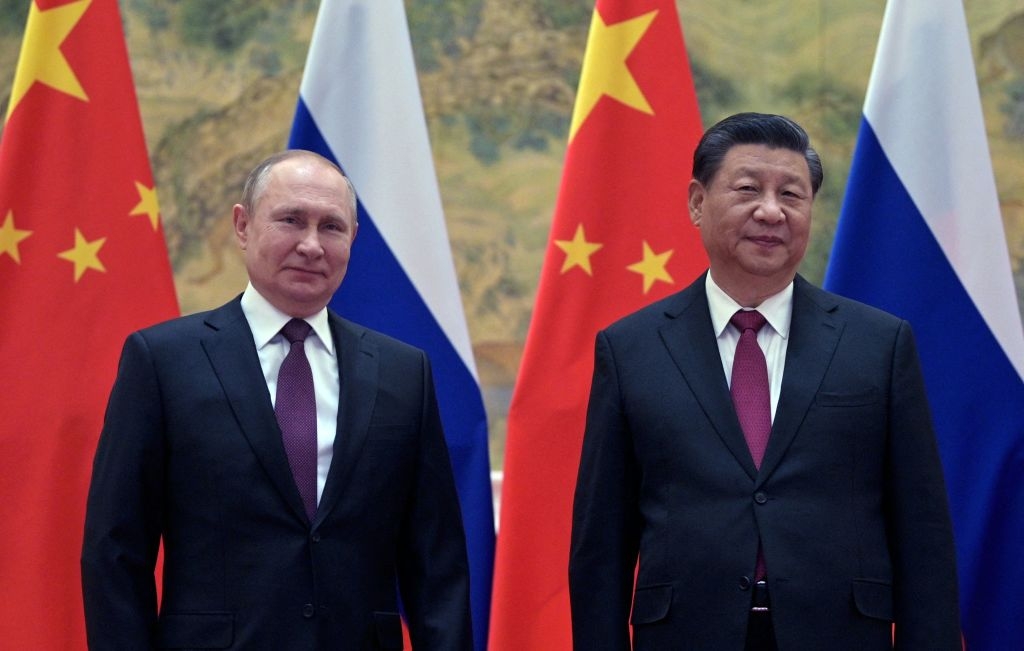
What would Russian President Vladimir Putin do if China invaded Russia to regain control of territory that was once Chinese? If we accept that what once belonged to one state can never belong to another, Crimea must be handed over to Turkey as successor to the Ottoman caliphate, or, even better, the Tatar khans who ruled it before the Ottomans. Pictured: Putin (L) and Chinese President Xi Jinping meet in Beijing on February 4, 2022. (Photo by Alexei Druzhinin/Sputnik/AFP via Getty Images)

Who do you think is to blame for the war in Ukraine?

For the Blame-America-International the answer is simple: the culprit is the United States.

At one end of the Blame-America International (BAI), we find usual suspects such as the Khomeinist mullahs, the Sudanese and Burmese jackboots, the Maoists of Eritrea, the Assad clan in Damascus and the bad boys of Belarus. These one could dismiss if only because their mercenary status is clear.

It is at the other end of the spectrum that one finds a potentially more dangerous narrative at a time that what is euphemistically referred to as the world order is facing its biggest challenge since World War II. For here we find individuals and groups that try to use, or rather abuse, such labels as "public intellectuals" and/ or "elder statesmen" to legitimize Vladimir Putin's invasion.

That narrative is peddled by people like former UK Foreign Secretary David Lord Owen, professors John Mearsheimer and Stephen Walt, French presidential candidates Marine Le Pen, Éric Zemmour and Jean-Luc Mélenchon, British columnist Peter Hitchens, and a string of lesser known figures in Europe and the United States.

They all build their narrative around three charges.

The first is that Putin and his Russia must be seen as victims of the United States' insatiable quest for global hegemony by constantly trying to downgrade Russia's status.

The second is that, by trying to include Ukraine in its ranks, the North Atlantic Treaty Organization (NATO) posed a direct threat to Russia's national security, a threat that no Russian leader could ignore.

The third is that Ukrainian leaders, prompted by Washington, refused to recognize Russia's right to "reintegrate" the Crimean Peninsula, a part of Russian homeland that Nikita Khrushchev, a Ukrainian chauvinist disguised as a Bolshevik, snatched away from Mother Russia.

As for the first charge, the opposite may be nearer to the truth.

Four successive US administrations starting with George WH Bush's went out of their way not only to soften the shock caused by the collapse of the Soviet Empire but also to recognize Russia as its legitimate successor with "superpower" status.

Although post-Soviet Russia was diminished in terms of demographic, economic, diplomatic and military power, all treaties and procedural agreements concluded with the USSR remained in force. The US worked closely with Moscow to smooth the difficult transition that Europe faced as the Warsaw Pact was dissolved and the European Union enlarged.

Anxious to keep Russia "on board," the US campaigned for Russia's membership of the G7 (which became G8) and the World Trade Organization (WTO), helped open global capital markets to Russia, and encouraged American businesses to heavily invest in developing the post-Soviet economy.

It is no exaggeration to suggest that the American stamp of approval played a key role in encouraging other foreign investment, especially European, followed by the biggest transfer of technology witnessed in Russian history.

The second charge related to NATO's alleged rush to included Ukraine, or what Mearsheimer calls "reckless expansion", provoked Putin is equally absurd.

To start with, NATO never invites any state to join. It is up to other states to apply for membership and, to this day, Ukraine has not done so and, if it did, it is clear that its application would be unacceptable under NATO's rules, which exclude any country with unresolved irredentist and/or other territorial disputes with any other nation.

For almost two decades, Russia made no objection to NATO enlargement that included former members of the Warsaw Pact. Under Putin, Russia even concluded a deal for cooperation with NATO on issues of mutual security, with the Helsinki Accords as historic reference. In 2002, Putin met NATO Secretary-General George (Lord) Robinson and quipped that "maybe it is time NATO invited Russia to become a member."

Robinson wasn't sure whether that was a serious approach or Russian black humor but reminded Putin that NATO never issues invitation but would consider applications.

In NATO's 2008 Bucharest summit, both Georgia and Ukraine expressed the desire to apply for membership but were quietly told not to submit formal applications. The undeclared reason was the persistence of irredentist problems both had with Russia. Putin interpreted that as a rebuff to Kiev and Tbilisi by NATO and invaded Georgia, snatching South Ossetia and Abkhazia.

The "provocation" charge is equally nonsensical.

However, even if there was provocation shouldn't one apportion blame between the provoker and the provoked? Isn't the rapist who claims he was provoked because his victim wore provocative dress at least as much to blame as the victim?

Without saying so, the pro-Putin chorus is advocating a new concept, that of limited sovereignty for countries that were once part of the Tsarist and/or Soviet empires. That concept would apply not only to Ukraine and Georgia but also to the Baltic republics and the Eastern European members of the defunct Warsaw Pact. In his latest rhetoric, Putin has extended that concept to Central Asian republics, Serbia, Macedonia, Kosovo and Albania in the Balkans.

More importantly, perhaps, should the "threat to national security" be regarded as an excuse exclusive to Vladimir Putin?

The Montevideo Convention of 1933-34, in its Article 8, stipulated that "no state has the right to intervene in the internal and external affairs of another." Later, it became a fundamental principle of the United Nations and the world order that has shaped the global system for seven decades.

Mercifully, not even Éric Zemmour repeats Putin's absurd claim that Ukraine is governed by neo-Nazis, implying that the current war is a sequel to World War II.

However, the claim that Ukraine's refusal to accept the loss of Crimea, and presumably also of Donbas, left Putin with no choice but to invade is equally questionable. What would Putin do if China invaded Russia to regain control of territory that was once Chinese?

If we accept that what once belonged to one state can never belong to another, Crimea must be handed over to Turkey as successor to the Ottoman caliphate, or, even better, the Tatar khans who ruled it before the Ottomans. As for Donbas and chunks of southern Russia returning to "original owners", this means the revival of the Cossack state that once controlled both.

It is a pity, not to say a shame, that hatred for America has led so many otherwise sane people to endorse Putin's authorship of a great tragedy.

Amir Taheri was the executive editor-in-chief of the daily Kayhan in Iran from 1972 to 1979. He has worked at or written for innumerable publications, published eleven books, and has been a columnist for Asharq Al-Awsat since 1987.

This article was originally published by Asharq al-Awsat and is reprinted by kind permission of the author.


Saturday, March 5, 2022

A European View on the War in Ukraine

 March 4, 2022 

A European View on the War in Ukraine

Olli Huovinen

The Finnish army on maneuvers.


I am a Finnish nationalist who has been following the American Dissident Right for many years. I greatly admire and regularly follow many of the superb writers and sites in this milieu. However, I feel that at least some American dissidents do not fully understand the European point of view on the Russo-Ukrainian war.

Some prominent American nationalists support Russia in their war with Ukraine, while among European nationalists, especially in Eastern Europe, there is widespread support for Ukraine. I have seen arguments from the American side that people on the Ukrainian side are simply victims of liberal propaganda, while European nationalists see the support of some Americans for Russia as a sign of ignorance about European affairs.

I am arguing that it is in fact in the national interest of certain European nations to oppose Russia in their war with Ukraine. It is not my intention to turn Americans into supporters of Ukraine, but simply to show that Europeans have legitimate reasons for siding with it. I shall also look at this war in the larger context of the Pan-Western cultural war. I will not make any arguments about the war’s morality and instead focus solely on why it is in the interests of many European nationalists to support Ukraine.

It is logical for an American nationalist to support Russia. Ukraine is in the liberal sphere of influence, and the global liberal democratic system is an enemy of the Historic American Nation, Western civilization, and white nations everywhere. Therefore, supporting an enemy of the liberal regime seems like the right thing to do. The enemy of my enemy is my friend, as the old saying goes. For many Americans, this war between Russia and Ukraine is a battle between a healthy conservative state and the degenerate liberal order. This is not the perspective of many in Europe, however.

My country of Finland shares a long border of approximately 830 miles with Russia. We still have conscription, with most males serving in the military for a period from half a year to a year, depending on the conscript’s role. With a population of only 5.5 million, our defense forces have an official wartime strength of 280,000 soldiers, with hundreds of thousands more in reserve to replenish losses. Our military is focused almost completely on conventional ground war, and there is only one reason why it exists at all: Russia.

Finland is not part of NATO, but does cooperate with it and is a European Union Member State. Our current government, as well as all the major parties except for one and the permanent bureaucracy, are firmly in the liberal, pro-United States camp. This means that in Russia’s eyes, we are a hostile state. In essence we have all the liabilities of being in NATO without the security guarantees that would act as a deterrent. Consequently, I conclude that there is a real chance that Russia could use military force against us.

Even if we were actually in NATO, like many Eastern European countries bordering Russia, the Russian threat would still not be completely dissipated. It is possible that the Russians might gamble that if they quickly take the Baltic countries or Finland, NATO will break up instead of going to full-scale war against Russia to liberate them. It might well turn out that there is no political will to fight for a few small European countries if the cost is a new world war that, in the worst case, could go nuclear.

Our regime upholds anti-white policies, like all the other liberal regimes. A Russian occupation is not a preferable alternative, however, nor is a puppet government or protectorate status. Losing the ability to control one’s national destiny is not something that any nationalist could accept. It is therefore in the interests of Finnish nationalists to reduce the chance of a Russian invasion, and the war in Ukraine offers a way to do this.

If the war goes badly for Russia, it will reduce Russia’s capability to wage war in the future. Firstly, there are the direct casualties and losses in equipment. Western sanctions could also cause the Russian economy to falter, likely forcing them to reduce their defense budget. Finally, large casualties and a failure to achieve their objectives reduces the government’s political capital and the desire for further wars among the population. Iraq and Afghanistan killed any desire for more war among the American population, and the same could happen to the Russians if the invasion of Ukraine ends in disaster.

An American could easily make the counterargument that this is petty European nationalism, and that it is detrimental to the larger culture war being waged throughout the West. Putting national interests above civilizational and racial interests is indeed counterproductive. Let us therefore look at what the war in Ukraine means for the larger struggle.

Ukraine is a sideshow. Whatever happens, it will not have any major impact on the global culture war. The satanic mills of the liberal leviathan will continue grinding just like before. A Russian victory will not diminish their media power, financial resources, or their hold on our institutions. Likewise, a Ukrainian victory will not increase their power in any significant way. The fight taking place within America will not be affected by whether a poor Eastern European country is retained in the liberal sphere of influence or not, just as the Taliban victory in Afghanistan did not have any real effect, either. The only consequence of a Russian victory will be a few liberal tears, which is undeniably enjoyable but quite unimportant in the culture war.

Another claim is that Russia is a conservative ally of ours. The argument is that while the war itself might be unimportant, a weak Russia will mean the loss of an important ally. It is not true that Russia is our ally. They are an old-fashioned imperial state and are only interested in expanding their own power and sphere of influence. They have no desire to see our side win, and I suspect it would in fact be in their long-term interests to see the West’s decline advance to final collapse. Russia itself is not even a real nation-state, but rather a multiethnic empire with a decreasing population of white Russians and an increasing population of non-white Muslims due to birthrates and immigration.

Contrary to liberal propaganda, Russia has not provided any significant aid to European or American nationalists. Russian officials sometimes make critical comments about the West’s wokeness, but that is basically the only extent of their support. A weakening of the Russian state would not therefore affect our side adversely or deprive us of resources.

To conclude, it is in the legitimate interest of many European nationalists to support Ukraine in this war. But while the war is important for many Europeans, in terms of the larger culture war it is an unimportant sideshow. A Ukrainian victory will not adversely affect the culture war in America nor in Europe. American dissidents do not lose anything if Ukraine wins, while many European nations have much to gain.