.

.
Library of Professor Richard A. Macksey in Baltimore

POSTS BY SUBJECT

Labels

Showing posts with label Indonesia. Show all posts

Wednesday, July 18, 2018

Lawrence A. Franklin : Indonesia: Falling to Radicals


  • If Indonesia's repatriated foreign fighters have their way, all of the country's churches will be destroyed.
  • If the repatriated foreign fighters are able to radicalize Indonesia's Muslims, all of the country may eventually resemble Aceh Province, where, after a lengthy reign of terror by Islamic militias, most Christians have been driven out.
An Indonesian family of six, repatriated from former Islamic State (ISIS)-controlled territory in Syria, separately targeted three Christian sites in Surabaya, Indonesia, in May. The suicide bombings killed at least 11 people, as well as all of the attacking family members. Indonesian authorities suspect the bombers are affiliated with Jamaah Ansharut Daulah (JAD), the Congregation of the Islamic State. While anti-Christian incidents are common in majority-Muslim Indonesia, until now, suicide bombings by Islamists were not often seen there.
The same day, May 14, a second family, affiliated with the same terrorist JAD cell, also staged a suicide attack at Surabaya's police headquarters. A third family was killed in a town outside Surabaya when bombs prematurely exploded inside their home. All three families met regularly for radical Islamic religious sessions.
Indonesia's National Police Chief, Tito Karnavian, indicated that the suicide family that attacked the churches were among an estimated 500 people who had been deported from former ISIS-occupied land in Syria back to Indonesia.
A sizeable Indonesian terrorist group, JAD, designated a terrorist entity by the U.S. Department of State, has already pledged loyalty to ISIS, which, through their Amaq News Agency, claimed responsibility for the Surabaya attack. A JAD terrorist cell was also behind the May prison riot in Jakarta, an incident that claimed the lives of five policemen. JAD's leader, Aman Abdurrahman (a.k.a. Oman Rochman), is currently in prison, facing the death penalty for urging his followers to attack a Starbucks and a police post in Jakarta in 2016.
Indonesian author and counterterrorism expert Al Chaidar believes that some of Indonesia's ISIS volunteers to Syria are legacy terrorists, following in the paths of their Jihadi fathers. He also claims that some of these jihadists favor the al-Qaeda linked Al-Nusra, while others favor ISIS. Police Chief Karnavian describes JAD as even more radical than Indonesia's al-Qaeda-affiliated Jaamah Islamiyah (JI/Islamic Congregation), the terrorist group responsible for killing 200 people in Bali in 2002.
On another ominous note, Suhardi Alius, Indonesia's Chief of Counterterrorism Operations, said that about 40 JAD volunteers who joined the Jihad in the Philippines in 2017, gained combat experience in the process. These Indonesian JAD terrorists had evidently joined with Filipino terrorists to fight against Philippine army troops who were trying to liberate the town of Marawi in the southern Philippines from terrorist control. JAD's decision to dispatch some of its members to fight in the Philippines indicates that, like its predecessor, Jaamah Islamiyah, it might be interested in re-establishing the 15th century Sulu Islamic Sultanate throughout the archipelagos of Southeast Asia.
Other mostly non-violent but conservative Indonesian Muslim organizations groups -- such as the Islamic People's Forum and the Islamic Defenders Front -- can simply count on Indonesia's restrictive religious legislation to block Christian interests. These include the 2006 JOINT Decree on Houses of Worship, which requires the signatures of 60 neighboring households of non-Christian families to approve initiating church construction. Occasionally, however, the Islamic Defenders Front, through vigilante action, harasses Muslims who it accuses of not being sufficiently orthodox.
Both Christians and moderate Muslims are also often accused of violating Indonesia's blasphemy law. However, Islam's watchdog agency for doctrinal unity, the Council of Indonesian Ulama, continues to stir up intolerant feelings by issuing restrictive religious judgments concerning the rights of minorities. These judgements include helping convicting people who convert from Islam to Christianity of blasphemy despite Indonesia's civil Constitution, which pledges to protect the interests of minority religions.
Only one of Indonesia's provinces, Aceh is governed by Sharia law. In Aceh, Koranically approved physical punishments are meted out to "sinners" -- Christians and Muslims alike.
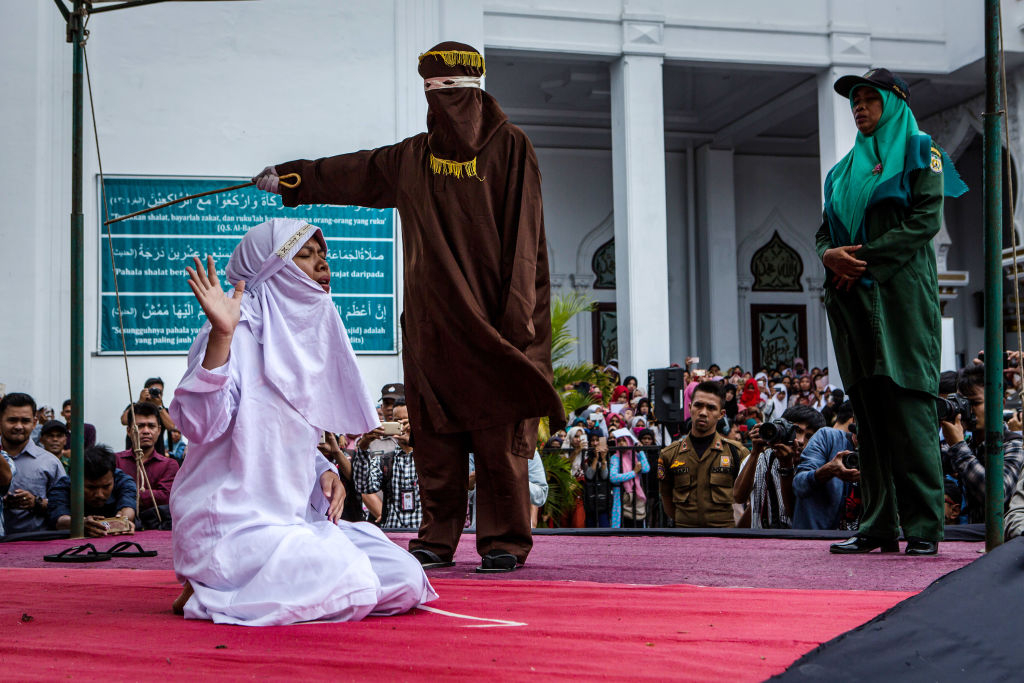
Pictured: A woman receives a public caning in Aceh, Indonesia -- a sentence for spending time with a man who is not her husband, which is a violation of Sharia law. (Photo by Ulet Ifansasti/Getty Images)

Nevertheless, both of Indonesia's largest Islamic organizations, Nahdlatul Ulama and Muhammadiyah, roundly condemned JAD's murderous assault on Christians.
JAD might not be successful in attracting many Indonesian Muslims to join its ranks; suicide bombings may be too extreme for most Indonesian Muslims. As more Indonesian foreign volunteers navigate their way back to this Southeast Asian nation, however, acts of terror, like these recent attacks, may become the new normal. Because of JAD's affiliation with ISIS and its global resources, the terrorist group is likely to have a much larger impact than its numbers indicate.
Finally, Indonesian General Gatot Nurmantyo predicts a dark future for the Indonesian state's rendezvous with terrorism. He says there are sleeper terrorist cells in virtually every one of Indonesia's provinces except Papua. If Indonesia's repatriated foreign fighters have their way, all of the country's churches could well be destroyed. If the repatriated foreign fighters are able to radicalize Indonesia's Muslims, all of the country may eventually resemble Aceh Province, where, after a lengthy reign of terror by Islamic militias, most Christians have been driven out.
Dr. Lawrence A. Franklin was the Iran Desk Officer for Secretary of Defense Rumsfeld. He also served on active duty with the U.S. Army and as a Colonel in the Air Force Reserve.

Monday, May 15, 2017

Jacobus E. Lato : Indonesia: Free Speech vs. Treason


  • On April 19, the campaign of Jakarta's radicals chanting, "We want a Muslim governor!" paid off, as Ahok was defeated in the gubernatorial election. Exit polls on election day indicated that religion was the main factor behind the voting.
  • On May 10, Indonesia's radicals scored a second victory, when Ahok was found guilty of blaspheming Islam and sentenced to two years in prison.
  • The verdict came as a surprise even to the prosecutors of the case -- they had requested only a suspended sentence for the offense of "inciting hatred".
In the two decades since the fall of Indonesian President Suharto's 32-year reign in 1998, the use of the accusation of "treason" as a governmental tool to quash political opposition gradually reemerged in the world's largest Muslim-majority country.

Today, however, those trying to overthrow the leadership are Islamists intent on unraveling the fabric of a pluralistic society.

This situation has led to the debate over freedom of speech and the separation of church and state -- or, here, mosque and state.

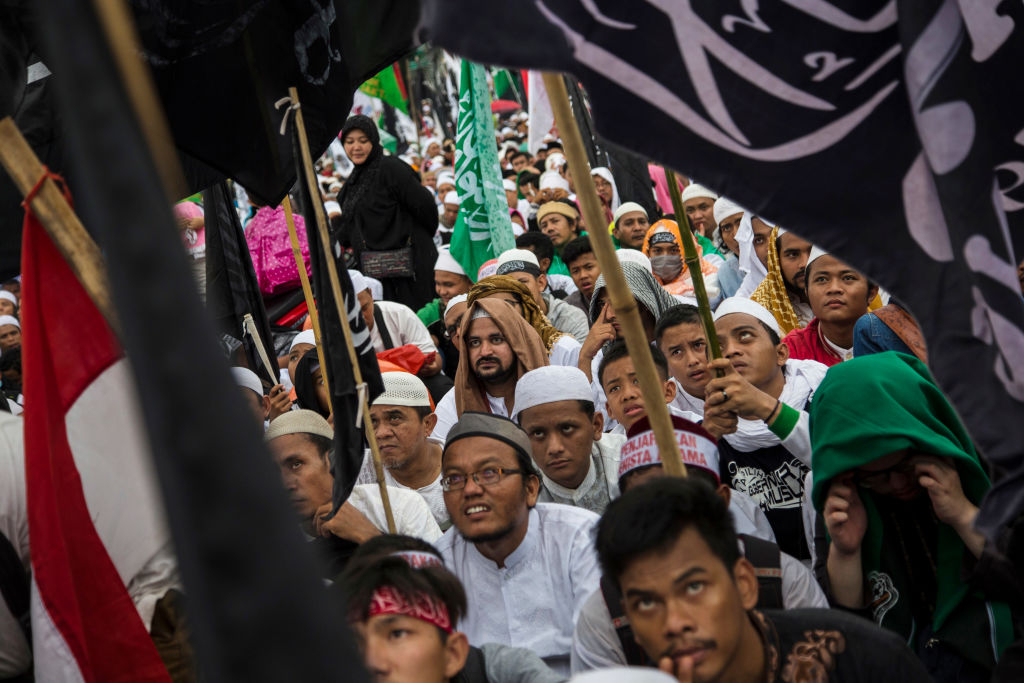
Four recent rallies in the capital city of Jakarta illustrate the nature of what has become a full-blown controversy. In each case, protesters gathered outside mosques after Friday prayers for what they claim are "spontaneous" demonstrations made necessary by their clerics' lack of financial resources to plan and stage such events. But evidence collected by Indonesian authorities indicates otherwise.

The first such protest took place on October 14, 2016. Its purpose was to demand that criminal proceedings be launched against Jakarta Governor Basuki Tjahaja Purnama -- familiarly known as Ahok -- for "blasphemy."

Ahok, a Christian of Chinese descent, was appointed to his position in 2014, when Joko Widodo became president of Indonesia. Hardline Muslim groups argued that a Christian should not be allowed to govern a Muslim-majority city. To back up their claim, they cited the Quran.

Their fury grew even greater when Ahok was running for reelection: he asked fishermen in Pulau Seribu not to be "deceived" by politicians using the Quranic verse, al-Maidah 51 ("...do not take the Jews and the Christians as allies"), to dissuade them from supporting him.

Although Ahok subsequently apologized for his statement, he was put on trial for blasphemy. Thousands of Islamists, shouting "Burn Ahok!" and "We want a Muslim governor!", marched from the Istiqlal Mosque through the city. This ostensible eruption of emotions, according to deputy head of the Islamic Defenders Front (Front Pembela Islam, or FPI), had nothing to do with the upcoming gubernatorial election. It was, he said, religiously motivated.
However, the presence at the rally of former House Speaker Amin Rais indicated that politics played just as big a role as faith.

The second rally took place less than three weeks later, on November 4. According to the head of the FPI, some 7.5 million Muslims turned out that day. At the end of it, one protester had died of an asthma attack and two police trucks had been set on fire by an angry mob.

Hours before the third rally, on December 2, police arrested 11 people on suspicion of treason for trying to overthrow the government. Among these were: the daughter of former President Suharto; prominent economist and activist Sri Bintang Pamungkas and two brothers, Jamran and Rizal Khobar, both members of the Islamic Students Association, a group responsible for an attack on security officials during the previous rally.

In addition to the allegation of treason, Pamungkas was detained over social media posts, particularly a YouTube video from the previous month. Rizal and Jamran were accused of violating Indonesia's 2008 Electronic Information and Transactions Law.

Ahead of the fourth rally in question, on March 31, a second batch of arrests was carried out by police. Among those detained was Muhammad Al Khaththath, a leader of the hardline Islamic People's Forum.


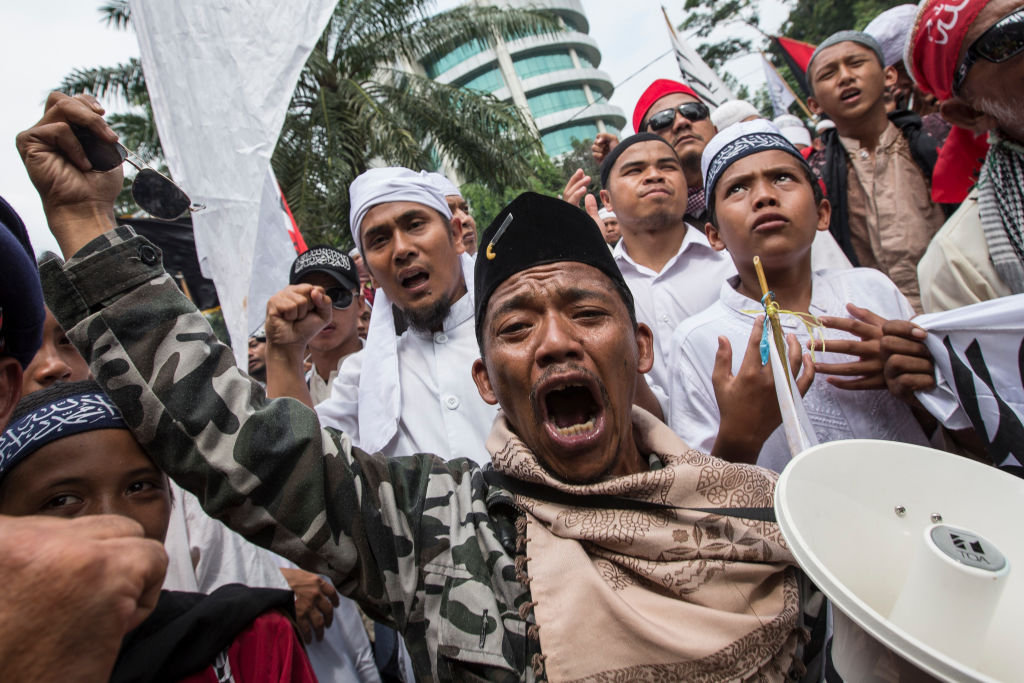
Indonesian Islamists listen to a speech by an imam during a protest against Jakarta governor Ahok, on March 31, 2017 in Jakarta, Indonesia. (Image source: Ed Wray/Getty Images)

Although the case can be made, as it is in the West, for distinguishing between treason and the right to criticize one's government, the issue in Indonesia is currently more complex, due to the extremist religious agenda of the opposition.

Rather than looking to their religious leaders to determine matters of faith, many are using Islam as a political weapon, and breaking laws that were written to protect the very minorities who are now being treated as second-class citizens.

On April 19, the campaign of Jakarta's radicals, chanting "We want a Muslim governor!" paid off, as Ahok was defeated in the gubernatorial election. On May 10, Indonesia's radicals scored a second victory, when Ahok was found guilty of blaspheming Islam and sentenced to two years in prison, effective immediately.

The verdict, which came as a surprise even to the prosecutors of the case, who had requested only a suspended sentence for the offense of "inciting hatred," was handed down by a five-judge panel of the North Jakarta District Court.

One of the judges, Abdul Rosvad, explained the decision by saying, "...[A]s a public officer, the defendant should have known that religion is a sensitive issue so he should have avoided talking about [it]." Rosvad also denied allegations that Ahok's arrest, trial and imprisonment were politically motivated.
"This is a pure criminal case," he said.

However, the popular Christian governor was defeated by rival Anies Baswedan, a Muslim, and exit polls on election day indicated that religion was the main factor behind the voting.

Dr. Melissa Crouch, of Australia's University of New South Wales, told the Sydney Morning Herald that the verdict should not have come as a surprise. "To be accused of blasphemy in Indonesia is effectively to be found guilty," she said. "This gives a lot of power to those -- such as religious leaders -- who may make the initial complaint to police regarding blasphemy charges."
Ahok's lawyers say they will be appealing the verdict.
Jacobus E. Lato is a writer and former editor, based in Surabaya, Indonesia.

Raymond Ibrahim : The Great Price of "Blaspheming" against Muhammad


  • Because the word of a Christian "infidel" is not valid against the word of a Muslim, accusations of blasphemy, often with little or no evidence, routinely lead to the beating, imprisonment, and possible killing of Christians and other minorities every month in Pakistan.
  • "The available evidence in all these cases suggests that charges were brought as a measure to intimidate and punish members of minority religious communities... hostility towards religious minority groups appeared in many cases to be compounded by personal enmity, professional or economic rivalry or a desire to gain political advantage." — Amnesty International.
  • "Iran sentences a 21-year-old man to death for 'insulting Islam' ... after confessing when police promised he would be pardoned if he came clean." — Daily Mail.
A few days ago in Pakistan, a Christian pastor who has been "tortured every day in prison" since 2012 when he was first incarcerated, was sentenced to life in prison. Zafar Bhatti, 51, is accused of sending "blasphemous" text messages from his mobile phone; but human rights activists contend that the charge "was fabricated to remove him from his role as a Pastor." His wife, Nawab Bibi, says:
"Many Muslim people hated how quickly his church was growing; they have taken this action to undermine his work. Yet despite their actions the church grows. I wish our persecutors would see that Christians are not evil creatures. We are human beings created by God the same God that created them although they do not know this yet."
She adds, "There have been numerous attempts to kill my husband — he is bullied everyday and he is not safe from inmates and prison staff alike." In 2014, he "narrowly escaped assassination after a rogue prison officer," Muhammad Yousaf, went on a shooting spree "to kill all inmates accused of blasphemy against Islam."
Bhatti is one of countless Christian minorities to suffer under Pakistan's blasphemy law, which has helped make that country the fourth-worst nation in the world in which to be Christian.

Asia Bibi, a Christian wife and mother, has been on death row since 2010 on the accusation that she insulted the Islamic prophet Muhammad. According to Section 295-C of Pakistan's penal code:
"Whoever by words, either spoken or written or by visible representation, or by any imputation, innuendo, or insinuation, directly or indirectly, defiles the sacred name of the Holy Prophet Muhammad (PBUH) shall be punished with death, or imprisonment for life, and shall also be liable to fine."
Because the word of a Christian "infidel" is not valid against the word of a Muslim, accusations of blasphemy, often with little or no evidence, routinely lead to the beating, imprisonment or killing of Christians and other minorities every month in Pakistan.[1] An Amnesty International report from 1994 summarizes the situation:
Several dozen people have been charged with blasphemy in Pakistan over the last few years; in all the cases known to Amnesty International, the charges of blasphemy appear to have been arbitrarily brought, founded solely on the individuals' minority religious beliefs... The available evidence in all these cases suggests that charges were brought as a measure to intimidate and punish members of minority religious communities... hostility towards religious minority groups appeared in many cases to be compounded by personal enmity, professional or economic rivalry or a desire to gain political advantage. As a consequence, Amnesty International has concluded that most of the individuals now facing charges of blasphemy, or convicted on such charges, are prisoners of conscience, detained solely for their real or imputed religious beliefs in violation of their right to freedom of thought, conscience and religion.
Other Christians accused of blasphemy never get the chance for even a mock trial and are dealt "justice" at the hands of angry mobs -- such as the young Christian couple burned alive on a spurious accusation of blasphemy in November 2014. A report from 2012 found that "Since 1990 alone, fifty-two people have been extra-judicially murdered on charges of blasphemy" in Pakistan.
Last month, three burqa-wearing sisters shot and killed a man accused of committing blasphemy in 2004. "[W]e couldn't kill him at the time because we were too young then," they explained.

Also last month, a 23-year-old college student "was killed and another seriously injured by a vigilante mob for allegedly 'publishing blasphemous content online.'" The incident occurred on campus; the mob was yelling "Allahu Akbar" throughout.
Although Islam's blasphemy law is most associated with Pakistan, several other Muslim nations use it to persecute Christians and other minorities. Days ago, around the same time Bhatti was being sentenced to life in Pakistan, in Indonesia, Ahok, the Christian governor of Jakarta, was sentenced to two years in prison on the charge of insulting Islam and desecrating the Koran.[2] Similarly, on March 30, a report appeared saying, "Iran sentences a 21-year-old man to death for 'insulting Islam' ... after confessing when police promised he would be pardoned if he came clean."


Members of various Islamist groups celebrate in Jakarta, Indonesia on May 9 after Ahok, the Christian governor of Jakarta, was convicted of committing blasphemy. (Image source: Ed Wray/Getty Images)

Earlier this year in Algeria, Samir Chamek, a 34-year-old Christian man, was sentenced to a year in prison after a court found him "guilty of insulting Islam and its prophet over items he posted on his Facebook page." They were described as "accusing the prophet Muhammad of terrorism and murder and comparing the prophet to Hitler, mentioning the persecution and massacre of the Jews." Also in Algeria, last August, a Muslim convert to Christianity was sentenced to the maximum five years in prison for saying that the light of Jesus will outshine Islam and its prophet Muhammad on social media, which the court ruled as "blasphemous."

In October, in Ethiopia, four Christian girls -- aged 18, 15, 14, and 14 -- handed out a booklet entitled, "Let's speak the truth in love." Because it challenged Islamic accusations against Christianity, local Muslims deemed the book blasphemous and rioted. They attacked a church and assaulted Christians. The girls were arrested and, after a brief court hearing on November 15, sentenced to a month in prison.
As in Pakistan, Muslims mobs and "vigilantes" often take "the law" into their own hands. In March, in India, a Muslim-turned-atheist "was hacked to death by a four-member gang" of Muslims. Last September, a Christian writer and activist was murdered outside of a courthouse in Jordan. The 56-year-old man was earlier arrested for sharing a "blasphemous" cartoon about the Islamic prophet Muhammad. As he was walking into court to stand trial for "contempt of religion" and "inciting sectarian strife," a man dressed in traditional Muslim garb shot him to death.

Last August, in Nigeria, after two university students got into an argument, the Muslim student accused the Christian student of insulting Muhammad. Soon a mob of Muslims assembled and said the Christian must die. Then they savagely beat and nearly killed him. The following day, mobs of Muslims rioted and vandalized Christian campuses and churches.
Such nonstop accusations, incarcerations, murders, torture and death penalties meted out to non-Muslims on the mere accusation of "blasphemy" -- at the hands of mobs, vigilantes, and court judges -- call into question any claims of tolerance, modernity or pluralism in many Muslim-majority nations.
Raymond Ibrahim is the author of Crucified Again: Exposing Islam's New War on Christians (published by Regnery with Gatestone Institute, April 2013).

[1] At least one but often more blasphemy-related cases appear practically every month in Pakistan and are documented in the monthly "Muslim Persecution of Christians" reports. The following are incidents that occurred in the last report, January 2017:
  • An evangelical Christian was arrested on charges of blasphemy and faces the death penalty. According to a complaint by a Muslim, Haji Nadeem, Shahbaz Babu desecrated the Koran by writing his name on some pages, tearing them up and then scattering them on the street in front of a mosque. Although the Muslim admits he did not see the accused in the act, Babu—whom rights activists say is "completely illiterate"—was nonetheless arrested. In a nation where the mere accusation that an infidel insulted Islam could get the non-Muslim killed by the mob, executed by the state or simply imprisoned, Babu's defenders wonder at the notion that he "is supposed to have desecrated the Qurʾān in secret, but then left the evidence for everyone to see." Others say that he was disliked by the mosque because several members had stopped attending it and listening to the evangelist who is popular in his region.
  • An imam in Lambanwali accused an elderly Christian of writing and sending to him a series of "derogatory letters" in which he defamed Islamic prophet Muhammad. Once the blasphemy accusation was made, police promptly stormed the Christian's home in the night and arrested his entire family. Although the man denies the accusation—correctly pointing out that only a suicide would do what he is accused of doing in Pakistan—he "is likely to face an imprisonment of 10 years while there are assumptions that Section 295-C might be invoked in order to aggravate the punishment to death penalty," said the report.
  • A blasphemy case was registered against Shaan Taseer—son of Salman Taseer, a human rights activist and defender of persecuted Christians who was assassinated by Muslims—for saying "Merry Christmas."
  • Five Christian rights activists were known for their public opposition to the country's blasphemy laws all went missing within the same week.
[2] The blasphemy controversy erupted when a video appeared online of Ahok saying that many Muslims misunderstand Koran 5:51 -- which commands Muslims not to befriend Jews and Christians. That a Christian would dare try to distort the Koran's call for hostility against Christians and Jews in order to boost his chances at reelection was deemed blasphemous enough to prompt mass riots and calls for his death in Indonesia.

Sunday, March 26, 2017

Jacobus E. Lato : What They Do Not Tell You about Indonesia


  • The doctrine, "all Muslims are your brothers and sisters," was now everywhere.
  • Community prayers, Friday prayers, newspapers and television programs started roaring the idea of Islamic supremacy.
  • At community prayer meetings, one often hears discussion on how to behave as Muslims. Now many seminars, conventions, and newspapers, especially during Ramadan, discuss the greatness of Muslims and Islam.
My kampong [village] lies in the suburbs of Surabaya, the second biggest city in Indonesia. Densely packed in a narrow alley, it consists of more than forty houses, stacked like logs, with no gaps at all to sneak in between. A handful of residents work for the government or public schools; some run small household shops. Most residents are Muslim, except for three families who are Christian.
A handful of plants provide us with green, but just down the road scattered stores have been soaring: a big franchise department store, a gas station, banks with long rows of automatic teller machines and facilities that make us feel like a small part of growing Indonesia.
When we first moved here, it seemed ideal. There were only twelve families; they got together at events; we felt close. Communal meetings were held each month; the host would prepare snacks and even sometimes meals. If one of us were in the nearby hospital, we would usually drive together in groups to pay a visit after collecting small contributions to give the sick person. Only one lady, a convert to Islam, wore a headscarf; others only wore it when necessary: at public meetings, celebrations, or Independence Day, August 17.
Saturday nights were the long night. People sat outside on paving stones or rough and humble chairs, and discussed many matters, especially before elections. Indonesia was then under President Susilo Bambang Yudhoyono, a graduate of America's Webster University.
Religious days were marked as moments of happiness and joy. People opened wide their hearts; heaven was coming down and moving us. We visited each other after Eid al Fitr's early morning prayer. Everyone said, "Minal Aidin Wal Fa Idzin" ("Many happy returns") and "Mohon Maaf Lahir Batin" ("Please forgive my wrongdoings"). The long-held tradition of Megengan, when families exchange food or snacks -- not just Muslims but Christians, Catholics, Hindus and Buddhists -- always preceded Ramadan.
On Christmas, the three Christian families would welcome visitors. Visits to our house by our Muslim friends inspired us to see how great our nation was, and of course our religions. Our Muslim friends would say, "Merry Christmas".
"Islam with a smiling face," was what Newsweek called Indonesian Islam in 1996. The statement made us proud of our cultural hospitality (about 90% of Indonesians are Muslim): Everyone was kind; everyone was moderate; everyone respected humanistic values and a harmonious life.
But, along with the fall of Suharto after 32 years in power, a few Indonesian Muslims, who apparently share some worldwide dreams, began to try to realize this dream. Hardliner clerics, who had lived in exile under Suharto, returned. They made their way into the masses, into the power blocs supported by their networks and their donors. The dream, particularly among a handful of the educated elite, of establishing a Muslim state, or at least a Muslim society, began rushing to the surface.
There is no need for the innocent majority to have a "great idea"; their only needs are leaders and direction. The new leaders then disseminated their ideas: the greatness of Islam, the greatness of Muslims, the greatness of Islamic kinship. The doctrine, "all Muslims are your brothers and sisters," was now everywhere.
Some hardliner clerics moved out from their traditional boarding schools and started climbing the political ladder. Some of them, including those clerics belonging to the Council of Indonesian Clerics (MUI) -- the highest Islamic body in the country -- and some of the descendants of Saudi or Yemeni clerics, bluntly displayed their new aroma of Islam: Middle East Islam. Community prayers, Friday prayers, newspapers and television programs started roaring the idea of Islamic supremacy.
Many changes took place. In 1980, under Suharto and his powerful, bureaucratic Golkar Party, women almost never wore a headscarf, let alone the monotonous hijab or niqab. Many women then were on the lookout for brand new colorful scarves and cosmetics. These women are lucky: new branded products, armed with halal certifications from our MUI, are on the rise in shops. Arabian-style dresses are on display in boutiques. Arab-style long coats with headscarves are commonplace. A sea of white dresses inundates the public squares, communal prayer meetings, mosques. A leading figure in Surabaya, who requested anonymity, said, "Nowadays Muslim women feel uncomfortable if they do not wear a headscarf. They might be considered unfaithful or not sufficiently devout."
Men with long and loose beards, marked foreheads and Arabian-style dress hold a Muslim type of rosary; they chant various names of God as their lips move silently -- are now common. At community prayer meetings, one often hears discussions on how to behave as Muslims. Seminars, conventions and newspapers, especially during Ramadan, discuss the greatness of Muslims and Islam.
Unfortunately, along with those developments, our happy moments are disappearing at high speed. Being Muslim, for some, means excluding others. A polarization happens; some people do not want to deal with people of another religion.
There are stories of raids on churches, Christian shrines and mosques run by the small Ahmadiya sect. Other religious days, especially Christmas, are now marked by those for and against them, thanks to fatwas.
MUI, Indonesia's highest Islamic body, says it no longer wants Muslims to greet Christians during Christmas; it is considered a sin. Many people are afraid of being labeled unfaithful or blamed for being kind to Christians. We still can shake hands, but anything else is now forbidden. "Saying 'Merry Christmas' is against my religion," a friend explained to me. "The greeting acknowledges Jesus Christ as Allah."
Valentine's Day is another of many concerns about the supposed "Christian influence." Some department heads at educational agencies have issued circulars, banning students from celebrating it (here, here, here).
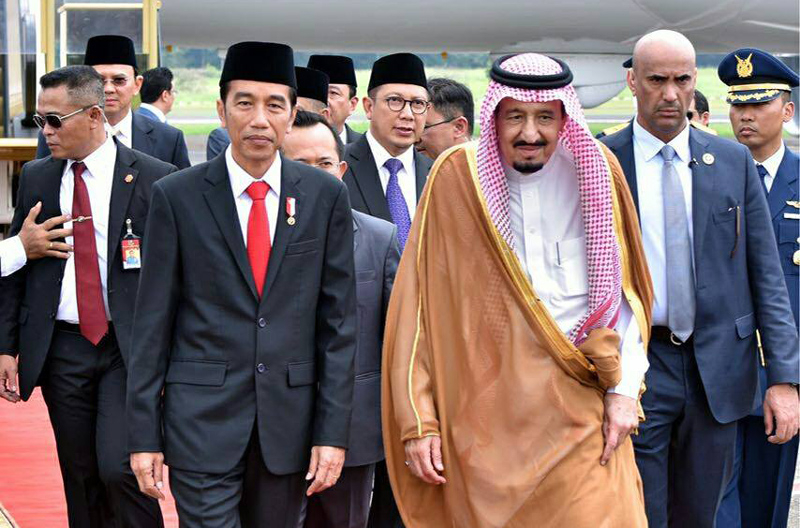
On March 12, King Salman of Saudi Arabia ended his visit to Indonesia; he boarded his royal airline and headed to Japan. Ash around the runway blew into the air. All memories of His Highness's visit reside in our people's mind, even while we were wishing His Majesty farewell.
After the oil boom, Iran's Revolution and the 444 days of the U.S. Embassy hostage crisis in Iran, Indonesian Muslims believed Muslim power was returning.

President Joko Widodo of Indonesia (foreground, left) meets with King Salman of Saudi Arabia (foreground, right), at Halim Perdanakusuma Airport in Indonesia. (Image source: Indonesian Presidential Palace)
Jacobus E. Lato, a writer, is based in Surabaya, Indonesia.
================

Thursday, September 27, 2012

Indonesia is No Model for Muslim Democracy


Indonesia is No Model for Muslim Democracy

Saturday, May 26, 2012

By Andreas Harsono 

It is fashionable these days for Western leaders to praise Indonesia as a model Muslim democracy. Secretary of State Hillary Rodham Clinton has declared, “If you want to know whether Islam, democracy, modernity and women’s rights can coexist, go to Indonesia.” And last month Britain’s prime minister, David Cameron,lauded Indonesia for showing that “religion and democracy need not be in conflict.” 

Tell that to Asia Lumbantoruan, a Christian elder whose congregation outside Jakarta has recently had two of its partially built churches burned down by Islamist militants. He was stabbed by these extremists while defending a third site from attack in September 2010. 

This week in Geneva, the United Nations is reviewing Indonesia’s human rights record. It should call on President Susilo Bambang Yudhoyono to crack down on extremists and protect minorities. While Indonesia has made great strides in consolidating a stable, democratic government after five decades of authoritarian rule, the country is by no means a bastion of tolerance. The rights of religious and ethnic minorities are routinely trampled. While Indonesia’s Constitution protects freedom of religion, regulations against blasphemy and proselytizing are routinely used to prosecuteatheists, Bahais, Christians, Shiites, Sufis and members of the Ahmadiyya faith — a Muslim sect declared to be deviant in many Islamic countries. By 2010, Indonesia had over 150 religiously motivated regulations restricting minorities’ rights. 

In 2006, Mr. Yudhoyono, in a new decree on “religious harmony,” tightened criteria for building a house of worship. The decree is enforced only on religious minorities — often when Islamists pressure local officials not to authorize the construction of Christian churches or to harass and intimidate those worshiping in “illegal” churches, which lack official registration. More than 400 such churches have been closed since Mr. Yudhoyono took office in 2004. 

Although the government has cracked down on Jemaah Islamiyah, an Al Qaeda affiliate that has bombed hotels, bars and embassies, it has not intervened to stop other Islamist militants who regularly commit less publicized crimes against religious minorities. Mr. Yudhoyono’s government is reluctant to take them on because it rules Indonesia in a coalition with intolerant Islamist political parties. 

Mr. Yudhoyono is not simply turning a blind eye; he has actively courted conservative Islamist elements and relies on them to maintain his majority in Parliament, even granting them key cabinet positions. These appointments send a message to Indonesia’s population and embolden Islamist extremists to use violence against minorities. 

In August 2011, for example, Muslim militants burned down three Christian churches on Sumatra. No one was charged and officials have prevented the congregations from rebuilding their churches. And on the outskirts of Jakarta, two municipalities have refused to obey Supreme Court orders to reopen two sealed churches; Mr. Yudhoyono claimed he had no authority to intervene. 

Christians are not the only targets. In June 2008, the Yudhoyono administration issued a decree requiring the Ahmadiyya sect to “stop spreading interpretations and activities that deviate from the principal teachings of Islam,” including its fundamental belief that there was a prophet after Muhammad. The government said the decree was necessary to prevent violence against the sect. But provincial and local governments used the decree to write even stricter regulations. Muslim militants, who consider the Ahmadiyya heretics, then forcibly shut down more than 30 Ahmadiyya mosques. 

In the deadliest attack, in western Java in February 2011, three Ahmadiyya men were killed. A cameraman recorded the violence, and versions of it were posted on YouTube. An Indonesian court eventually prosecuted 12 militants for the crime, but handed down paltry sentences of only four to six months. Mr. Yudhoyono has also failed to protect ethnic minorities who have peacefully called for independence in the country’s eastern regions of Papua and the Molucca Islands. During demonstrations in Papua on May 1, one protester was killed and 13 were arrested. And last October, the government brutally suppressed the Papuan People’s Congress, beating dozens and killing three people. While protesters were jailed and charged with treason, the police chief in charge of security that day was promoted. 

Almost 100 people remain in prison for peacefully protesting. Dozens are ill, but the government has denied them proper treatment, claiming it lacks the money. Even the Suharto dictatorship allowed the International Committee of the Red Cross to visit political prisoners, yet the Yudhoyono government has banned the I.C.R.C. from working in Papua. 

Instead of praising Indonesia, nations that support tolerance and free speech should publicly demand that Indonesia respect religious freedom, release political prisoners and lift restrictions on media and human rights groups in Papua. 

Mr. Yudhoyono needs to take charge of this situation by revoking discriminatory regulations, demanding that his coalition partners respect the religious freedom of all minorities in word and in deed, and enforcing the constitutional protection of freedom of worship. He must also make it crystal clear that Islamist hard-liners who commit or incite violence and the police who fail to protect the victims will be punished. Only then will Indonesia be deserving of Mr. Cameron and Mrs. Clinton’s praise. 

Andreas Harsono is a researcher for the Asia division at Human Rights Watch.