.

.
Library of Professor Richard A. Macksey in Baltimore

POSTS BY SUBJECT

Labels

Showing posts with label Mahatma Gandhi. Show all posts

Saturday, September 29, 2012

ISLAM-Gandhi’s Muslim Appeasement


Gandhi’s Muslim Appeasement


Muslim appeasement was an inseparable part of Gandhi’s quack doctrine of Non-violence
It is now well known that Muslim appeasement was an inseparable part of Gandhi’s quack doctrine of Non-violence. But many do not know why he, while he was in South Africa, adopted, or compelled to adopt this dirty policy in 1908.

At that time the South African government imposed an unjust tax of £ 3 on every Indian living in South Africa and Gandhi initiated talks with South African government on this matter. But the Muslims did not support this move and were displeased with Gandhi. In addition to that Gandhi, in one occasion, Gandhi made some critical comments on Islam while he was speaking at a gathering. Furthermore, he tried to make a comparative estimate of Hinduism, Islam and Christianity, which made the Muslims furious.

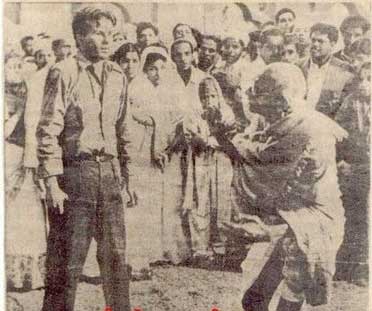
A few days later, on 10th February 1908, a group of Muslims under the leadership of a Pathan called Mir Alam entered Gandhi’s house and beat him mercilessly. When Gandhi fell on the ground the Muslim attackers kicked him right and left and beat him with sticks.

They also threatened to kill him. From this incident onward, Gandhi stopped to make any critical comment on Muslims as well as on Islam. According to Dr. B.R. Ambedkar, this incident was a milestone in Gandhi’s life and afterwards Gandhi began to over look even the most heinous crime committed by the Muslims.

An example would help the reader to understand the matter. On 23rd December 1926, a Muslim assassin called Abdul Rashid stabbed Swami Shraddhananda to death, when the swami was ill and lying on his bed. The reader may recall that Swami Shraddhananda was a pracharak (whole time worker) of Arya Samaj and he started a Suddhai Yajna to bring the converted Muslims of this country back to Hinduism.

But his activity was detested by the Muslims. A couple of months earlier a Muslim woman came to the Swami and expressed her desire to return to Hinduism with her children. However her husband brought an allegation of abduction in the court of law against the Swami. But the court quashed the allegation and set the Swami free. The incident turned the Muslims extremely furious and within a few days Abdul Rashid assassinated him.

After a few days of this incident, Gandhi went to Gauhati to deliver his speech at the national conference of Indian National Congress. The atmosphere was depressed and gloomy due to unusual death of Shraddhananda.

But Gandhi made everyone dumbfounded and began his speech by addressing the assassin Abdul Rashid as “Bhai Abdul Rashid”. Without caring for the reaction of the listeners, he continued, “Now you will perhaps understand why I have called Abdul Rashid a brother, and I repeat it. I do not even regard him as guilty of Swami’s murder. Guilty indeed are those who excited feeling of hatred against one another.” Thus he indirectly held Swami Shraddhananda responsible for his murder, as he was propagating hatred through his Suddhi Yajna.

Moreover, he wrote in the obituary note, “He (the Swami) lived a hero. He died a hero.” In other words, if a Hindu falls victim to the knife of a Muslim’s assassin, Hindus should consider it a heroic death.

It should be pointed out here that the said policy of Muslim appeasement originated by Gandhi, under the garb of (pseudo) secularism was responsible for the Partition of the country in 1947. Many of our countrymen, still today, firmly believe that Gandhi was against partition as in the public meetings, he used to say, “Vivisect me, before you vivisect India”.

When he was saying this in public meetings, he was expressing just the opposite view through his writings. The reader may recall that, on March 26, 1940, the leaders of the Muslim League raised the issue of creation of Pakistan as a separate homeland for them. Hardly a couple of weeks later, supporting demand, Gandhi wrote, “Like other group of people in this country, Muslims also have the right of self determination.

We are living here as a joint family and hence any member has the right to get separated.” (Harijan, April 6, 1940). A couple of years later, he also wrote, “If majority of the Muslims of this country maintain that they are a different nation and there is nothing common with the Hindus and other communities, there is no force on the earth that can alter their view. And if on that basis, they demand partition that must be carried out. If Hindus dislike it, they may oppose it”, (Harijan, April 18, 1942).

The reader should also recall that the Congress Working Committee, in its session on June 12, 1947, decided to place the partition issue to be placed before the All India Congress Committee (AICC) for a debate and the AICC approved the issue in its session held on June 14-15, 1947.

In the beginning of the debate, veteran Congress leaders like Purusottamdas Tandon, Govindaballav Panth, Chaitram Gidwani and Dr S Kichlu etc. placed their very convincing speeches against the motiom. Then Gandhi, setting aside all other speakers, spoke for 45 minutes supporting partition. The main theme of his deliberation was that,

If Congress did not accept partition (1) other group of people or leaders would avail the opportunity and throw the Congress out of power and (2) a chaotic situation would prevail throughout the country. Many believe that, in the name of ‘chaotic condition’, he tacitly asked the Muslims to begin countrywide communal riot, if the Congress did not accept the partition.

Till then, Sardar Ballavbhat Patel was on the fence regarding the partition. But Gandhi’s speech turned him into a firm supporter of partition and he influenced other confused members to support the issue. In this way, Congress approved the partition issue (History of Freedom Movement in India, R C Majumdar, Vol-III, p-670).

It may appear to many that, up to partition, Gandhi’s policy of nonviolence and Muslim appeasement in the name of secularism indeed harmed the country a lot. But a close look will reveal, it has done severe damage even after partition, or to speak the truth, it is causing serious damage even today. During independence, the Muslim population in undivided India was 23 per cent and this 23 per cent Muslims, got 32 per cent land area as Pakistan. The most appropriate step after partition was to carry out population transfer, or send the entire Muslim population of the divided India to Pakistan and bring all Hindus from Pakistan to India. This population transfer was included in the proposal for Pakistan by the Muslim League and after communal riot in Bihar, M A Jinnah requested the Government of India to carry out population transfer as early as possible. But Gandhi was hell bent not to undertake out the process and said that it was an impractical and fictitious proposal.

Mount Batten, the then Governor General of India, was a staunch supporter of the said population exchange and advised Jawaharlal Nehru to do the same without delay. But Nehru submitted to the will of Gandhi and refrained from doing so. It is needless to say that, from the practical point of view, the said population exchange was urgently necessary and had it been carried out at that time, many problems of today would not have arisen. But due to the policy of Muslim appeasement of Gandhi, Muslims happily stayed back in this country, while Hindus had no alternative but to come to India as refugees or penniless beggars.


Many of us perhaps do not know that due to strong opposition by Gandhi, “Bande Mataram” could not be accepted as the National Anthem” of this country. In his early life, Gandhi had a great affinity for the song and while he was in South Africa, he wrote “It is nobler in sentiment and sweeter than the songs of other nations. While other anthems contain sentiments that are derogatory to others, Bande Mataram is quite free from such faults. Its only aim is to arouse in us a sense of patriotism. It regards India as the mother and sings her praise.” But later on when he could discover that the Muslims dislike the song, he at once stopped singing or reciting the same at public places. Hence ultimately the “Jana Mana Gana” was selected as the National Anthem. During the debate over the matter in the Constituent Assembly, Nehru argued that Bande Mataram is not suitable to sing along with military band while Jana Gana Mana is free from this difficulty.

In the present context, it should also be pointed out that Gandhi was not pleased with Tri Color, the National Flag of today’s India because the Muslims disliked the same. In this regard,

Sri Nathuram Godse has narrated an incident in his “Why I Assassinated Gandhi”,which deserves to be noted in this context. During his Noakhali tour in 1946, a Congress worker put a tricolor over the temporary house where Gandhi was staying. One day an ordinary Muslim passer by objected to it and Gandhi immediately ordered his men to bring flag down.

So, to please an ordinary Muslim, Gandhi did not hesitate to disgrace and dishonor the flag revered by millions of Congress workers. (pp-75-76). It should also be pointed out here that in his early life, Gahdhi was very fond of the Hindi language and used to say that it was the only language having the potentiality to play the role of the national language. But to please the Muslim, he, later on tried his best to make Urdu, under the garb of Hindustani, the National Language of India. (Koenrad Elst, Gandhi and Godse, Voice of India, p – 89).

A few months before the partition, when Hindu and Sikh refugees started to come from West Punjab in droves and crowding the refugee camps of Delhi, one day Gandhi visited a refugee camp and said, “Hindus should never be angry against the Muslims even if the latter might make up their minds to undo their (Hindus’) existence. If they put all of us to the sword, we should court death bravely. … We are destined to be born and die, then why need we feel gloomy over it?” (speech delivered on April 6, 1947

In a similar occasion he said, “The few gentlemen from Rawalpindi who called upon me, asked me, “What about those who still remain in Pakistan?” I asked, why they all came here (Delhi)? Why they did not die there? I still hold on to the belief that we should stick to the place where we happen to live, even if we are cruelly treated, and even killed. Let us die if the people kill us, but we should die bravely with the name of God on our tongue.”

He also said, “Even if our men are killed, why should we feel angry with anybody? You should realize that even if they are killed, they have had a good and proper end” (speech delivered on November 23, 1947)

In this context, Gandhi also said, “If those killed have died bravely, they have not lost anything but earned something. ...They should not be afraid of death. After all, the killers will be none other than our Muslim brothers.” (Shri Nathuram Godse, Why I Assassinated Gandhi, p-92,93; as quoted by Koenrad Elst in Gandhi versus Godse, Voice of India, p-121).

In another occasion when he was talking to a group of refugees, said, “If all the Punjabis were to die to the last man without killing (a single Muslim), Punjab will be immortal. Offer yourselves as nonviolent willing sacrifices.” (Collins and Lapierre, Freedom at Midnight, p-385). There is no doubt that if someone reads all these utterances of Gandhi, he would take him either a fool or a lunatic, but we are worshiping him as a Mahatma or a Great Soul.

Gandhi believed that Muslims were brothers of the Hindus and hence they should never take arms or wage a war against the Muslims. He used to say that the foreign policy of independent India should always be respectful to Islam and the Muslims. Moreover, independent India should never invade a Muslim country like Arabia, Turkey etc.

Gandhi also said that Rana Pratap, Guru Govinda Singh, Raja Ranjit Singh and Raja Shivaji were misguided patriots because they fought war with the Muslims. In his eyes Goerge Washington, Garibaldi, Kemal Pasha, D Valera, Lenin etc. were misguided patriots as they encouraged violence.

Gandhi’s utterances painting respected Hindu heroes as misguided patriots aroused widespread commotion among the Hindus. Most importantly, calling Raja Shivaji a misguided patriots put entire Maharastra on boil. Later on, Nehru could pacify their anger partially by begging apology on behalf of Gandhi.

The Muslims whenever attack a Hindu settlement, they, in addition killing innocent people, setting their houses on fire, loot and burglary as their routine work, rape Hindu women. It is evident that, they commit all such oppressions according to the instructions of the Koran, revealed by Allah. During the Muslim rule that lasted for nearly 800 years, raping Hindu women became a common affair. To save their honour and sanctity from the lecherous Muslims, millions of Hindu women used to sacrific their lives in flames.

In the wake of partition most of the Hindu families became victims of Muslim oppression and raping Hindu women was an inseparable part of their attacks. When Hindus were butchered in Noakhali in 1946, thousands of Hindu women were raped by the Muslims.

Many Hindus of this country do not know, what Gandhi, the Great Soul and the Apostle of nonviolence, thought about this behavior of the Muslims. In the 6th July, 1926, edition of the Navajivan, Gandhi wrote that “He would kiss the feet of the (Muslim) violator of the modesty of a sister” (Mahatma Gandhi, D Keer, Popular Prakashan, p-473). Just before the partition, both Hindu and Sikh women were being raped by the Muslims in large numbers. Gandhi advised them that if a Muslim expressed his desire to rape a Hindu or a Sikh lady, she should never refuse him but cooperate with him. She should lie down like a dead with her tongue in between her teeth. Thus the rapist Muslim will be satisfied soon and sooner he leave her. (D Lapierre and L Collins, Freedom at Midnight, Vikas, 1997, p-479).

From the above narrations, it becomes evident that Gandhi was never moved by the sufferings and miseries of the Hindus and, on the contrary, he used to shed tears for the Muslims. His idea of Hindu-Muslim amity was also extremely biased and prejudiced. Only Hindus are supposed to make all sacrifices for it and they should endure all the oppressions and heinous crimes of the Muslims without protest. 
And that was the basis of Gandhian nonviolence and secularism. So a Muslim called Khlifa Haji Mehmud of Lurwani, Sind, once said “Gandhi was really a Mohammedan” (D Keer, ibid, p-237).

Saturday, July 21, 2012

Nathuram Godse Killed Mahatma Gandhi to Save Hindus and India!


Nathuram Godse Killed Mahatma Gandhi to Save Hindus and India?

by MTN

Most people know the name of Nathuram Godse as a killer of Mahatma Gandhi. This is how the whole world remembers him every year on death anniversary of Mahatma Gandhi on 30th January. However, there has been lots of contradictions about why Godse had to kill Gandhi and what were the real reasons behind Mahatma Gandhi’s assassination. Most of these reasons haven indeed been talked about in the past as well but not so openly. That is to only to make Godse always look like a accused and Gandhi as a mere victim. However, when the whole story and underlying reasons are seen with a different perspective, then it ofcourse leads to unearthing of newer facts and analysis. This is what which has been kept hidden from being talked openly so as to keep the image of Mahatma Gandhi and his ideology of non-violence unquestionable always. However, the very fact that lots of plays, dramas and even movies have been released on this controversial topic itself proves that there is indeed other side of story remained untold. Let us try to go through the who background, story and real motives behind Mahatma Gandhi’s murder by Nathuram Godse. Well, whole analysis is based upon the existing information on the topic as available in various online and offline resources.
why-Nathuram-godse-killed-mahatma-gandhi

NATHURAM GODSE – BACKGROUND, FAMILY, EARLY LIFE

Nathuram Godse’s full name was Nathuram Vinayak Godse and he was born on 19th May 1910 in the city of Pune, India and died on 15 November 1949. He was a Hindutva activist and journalist, who was the assassin of Mahatma Gandhi. Along with his brother Gopal Godse and six other co-conspirators, he executed a plot to assassinate Gandhi.
Nathuram Godse was born in Baramati बारामती, Pune District in a Chitpavan Brahmin family. His father, Vinayak Vamanrao Godse, was a post office employee and his mother was Lakshmii (née Godavari). At birth, he was named Ramachandra.

How Nathuran Godse Got His Name

There is quite an interesting story on how Nathuram Godse got his name. Nathuram was given his name because of an unfortunate incident. Before he was born, his parents had three sons and a daughter, with all three boys dying in their infancy. Fearing a curse that targeted male children, young Ramachandra was brought up as a girl for the first few years of his life, including having his nose pierced and being made to wear a nose-ring (“Nath” in Marathi). It was then that he earned the nickname “Nathuram” (literally “Ram with a nose-ring”). After his younger brother was born, they switched to treating him as a boy.

Nathuram Godse was a Homosexual?

However, other biographers dismiss the above story, together with claims that Godse was a homosexual, as a fabrication by the Congress Party of India, meant to exploit the prejudices against transvestites and homosexuals in conservative Indian society in order to demonize Godse.

Nathuram Godse Schooling and Education

Nathuram Godse attended the local school at Baramati through the fifth standard, after which he was sent to live with an aunt in Pune so that he could study at an English-language school. During his school days, he highly respected Gandhi. In 1930, Nathuram’s father was transferred to the town of Ratnagiri.

GODSE’S ENTRY TO POLITICS

Godse dropped out of high school and became an activist with Hindu nationalist organizations such as the Hindu Mahasabha, and the Rashtriya Swayamsevak Sangh (RSS), although the RSS has claimed he left during the mid-1930s, almost 20 years prior to the assassination. They were particularly opposed to the separatist politics of the All India Muslim League. Godse started a Marathi newspaper for Hindu Mahasabha called Agrani, which some years later was renamed. Hindu Rashtra. The Hindu Mahasabha had initially backed Gandhi’s campaigns of civil disobedience against the British government.

WHAT MADE NATHURAM GODSE AGAINST MAHATMA GANDHI

Nathuram Godse rejected Gandhi, after what he saw as Gandhi’s repeated sabotage against the interests of Hindus by using the “fasting unto death” tactic on many issues. In Godse’s view, Gandhi was giving into Muslim interests in ways that seemed unfair and anti-national. He blamed Gandhi for the Partition of India, which left hundreds of thousands of people dead in the wake of religious unrest.

Gandhi’s Non-Violence Made Godse so Violent that He Killed Bapu

Godse was against Gandhi’s personal teachings of extreme or absolutist non violence. He thought that such non-violent ideology would lead to Hindus losing the will to fight against other religions, which he saw as a matter of self-defense, and thereby becoming permanently enslaved. This has been said to be one of the major reasons behind his decision to kill Gandhi.

ASSASSINATION OF MAHATMA GANDHI [HOW GODSE KILLED GANDHI]

Godse approached Gandhi on January 30, 1948 during the evening prayer and bowed. One of the girls flanking and supporting Gandhi, Abha Chattopadhyay, said to him, “Brother, Bapu is already late” and tried to put him off but he pushed her aside and shot Gandhi in the chest three times at point-blank range with a semi-automatic pistol. Gandhi died almost immediately. After shooting, Godse did not try to run or threaten anyone else. He was attacked and pinned to the ground by the crowd around him and was subsequently arrested when a small group of police officers arrived on the scene a few minutes later.
nathuram-godse-killing-mahatma-gandhi-photos

GODSE’S COURT TRIAL

Following the assassination of Mohandas Gandhi, he was put on trial beginning May 27, 1950 at Peterhoff, Shimla which housed the Punjab High Court.
On November 8 1950, Godse delivered his statements in court enunciating the reasons and motives for the assassination.

GODSE’S REPLY ON WHY HE KILLED GANDHI (AS ANSWERS TO THE CHARGE SHEET FILED)

Godse narrated all the reasons that led to killing of Mahatma Gandhi in the form of his answers to the charge sheet filed against him. Below are the excerpts from different but main sections of his answers to the charge sheet.
nathuram-godse-reply-speech-on-how-and-why-killed-gandhi

Nathuram Godse’s Answer to Charge Sheet (Excerpts from Para. 26, 27)

Below is an excerpt of Godse’s answer to the charge sheet filed against him on Mahatma Gandhi’s assassination.
As I grew up I developed a tendency to free thinking unfettered by any superstitious allegiance to any isms, political or religious. That is why I worked actively for the eradication of untouchability and the caste system based on birth alone. I openly joined anti-caste movements and maintained that all Hindus are of equal status as to rights, social and religious, and should be considered high or low on merit alone and not through the accident of birth in a particular caste or profession. I used publicly to take part in organized anti-caste dinners which thousands of Hindus, Brahmins, Vaishyas, Kshatriyas, Chamars and Bhangis participated. We broke the caste rules and dined in the company of each other.
He listed Dadabhai Naoroji, Swami Vivekananda, Gopal Krishna Gokhale, Bal Gangadhar Tilak as his influences, along with the ancient and modern histories of India, England, France, America and Russia, and the tenets of Socialism and Marxism.
Below is the para 28 of his answer to the charge sheet;
All this reading and thinking brought me to believe that above all it was my first duty to serve the Hindudom and the Hindu people, as a patriot and even as a humanitarian. For, is it not true that to secure the freedom and to safeguard the just interests of some thirty crores of Hindus constituted the freedom and the well-being of one fifth of human race ? This conviction led me naturally to devote myself to the new Hindu Sanghatanist ideology and programme which alone I came to believe, could win and preserve the national independence of Hindusthan, my Motherland and enable her to render true service to humanity as well.

Nathuram Godse Dismissed Gandhi’s Non-Violence Policy

He dismissed Gandhi’s policies of truth and non-violence as “nothing new or original” and considered them “implicit in every constitutional public movement”. He defended the use of righteous violence against aggression and quoted the examples of Shivaji, Rana Pratap and Guru Govind Singh. He rebuked Gandhi for his “self-conceit” for condemning them as misguided patriots. However, Gandhi had referred to the issue in a completely different way.

He accused Gandhi of paradoxically being a “violent pacifist” who brought calamities to the country through non-violence. According to Godse, Gandhi developed a “subjective mentality under which he alone was to be the final judge of what was right or wrong” and accused him of having too much power.

Nathuram Godse, Answer to the Charge Sheet (Excerpt from Para. 69)

Below is an excerpt from Para 69 of Godse’s answer to the charge sheet;
If the country wanted his leadership, it had to accept his infallibility; if it did not, he would stand aloof from the Congress and carry on in his own way. Against such an attitude there can be no halfway house. Either Congress had to surrender its will to his and had to be content with playing second fiddle to all his eccentricity, whimsicality, metaphysics and primitive vision, or it had to carry on without him. He alone was the judge of everyone and everything; he was the master brain guiding the Civil Disobedience movement; no other could know the technique of that movement. He alone knew when to begin it and when to withdraw it. The movement might succeed or fail, but that could make no difference to the Mahatma’s infallibility. ‘A Satyagrahi can never fail’ was his formula for his own infallibility and nobody except himself knew what a Satyagrahi is.

Godse Accused Gandhi of Insane and Pro-Muslim Policies

Godse rebuked Gandhi’s “childish insanities and obstinacies”. According to Godse, Gandhi did not allow any room for people to disagree with his “irrational” policies. Thus, Godse held Gandhi’s irresponsibility as the cause of “blunder after blunder, failure after failure, and disaster after disaster”. He also accused Gandhi of having a blatant pro-Muslim policy and quoted Gandhi’s support for Hindustani (Hindi-Urdu) (which was synonymous to Urdu) as the national language of India after the Muslims objected to Hindi and claimed that all of Gandhi’s experiments were at the expense of the Hindus.

Nathuram Godse, Answer to the Charge Sheet (Para. 35)

Gandhiji began to hold his prayer meetings in a Hindu temple in Bhangi Colony and persisted in reading passages from Quoran as a part of the prayer in that Hindu temple in spite of the protest of the Hindu worshippers there. Of course he dared not read the Geeta in a mosque in the teeth of Muslim opposition. He knew what a terrible Muslim reaction would have been if he had done so. But he could safely trample over the feelings of the tolerant Hindu. To this belief I was determined to prove to Gandhiji that the Hindu too could be intolerant when his honour was insulted.
He explained that Gandhi’s unfair treatment and hypocrisy was the cause of his anger.

Nathuram Godse, Answer to the Charge Sheet (Para. 48)

The fact that Gandhiji honoured the religious books of Hindus, Muslims and others or that he used to recite during his prayers verses from the Geeta, the Quoran and Bible never provoked any ill will in me towards him. To my mind it is not at all objectionable to study comparative religion. Indeed it is a merit.

Gandhi’s Bias towards Muslims, Pakistan and Support for Separation of Sind

He quoted numerous examples of Gandhi’s bias such as the fast for the payment of Rs. 55 crores to Pakistan, his support for the Khilafat movement and the invasion of India by the Amir of Afghanistan, his denunciation of the Arya Samaj which included several nationalist leaders, his silence over the subsequent murder of Swami Shraddhanand by a Muslim, his support for the separation of Sind, his placation of Jinnah and the Muslim League, his denial of slaughter and forced conversion of Hindus by Muslims in the Moplah Riots despite evidence to the contrary, opposition to the singing of Vande Mataram, his contrasting treatment of Hindu and Muslim princes, support for cow-slaughter, opposition to Shivaji’s Flag, his hypocrisy over the violent Quit India movement (by his call to “Do or Die”), among others. (Para. 69).
Godse firmly believed in a secular State and was opposed to the supremacist demands of the Muslim League (Para 51).
Godse accused Gandhi of infatuation with the Muslim League even after the massacre of Hindus by Muslims after Direct Action Day and despite their increasing disloyalty and treason to the Interim Government. He also denounced the Congress, which had boasted of its “nationalism and secularism”, of surrendering to Jinnah and accepting Pakistan at the “point of the bayonet”.

What Gandhi Called Non-Violence was the Most Violent Time in History

Godse accused Gandhi for much of the violence that happened in the country during 1960 and 1948 and tried to make a point that Gandhi’s non-violence policy was nothing more than a fake. This is what he answered in the charge sheet in Para 69w.
Nathuram Godse, Answer to the Charge Sheet (Para. 69w, 91, 140)
This is what Gandhiji had achieved after thirty years of undisputed dictatorship and this is what the Congress Party calls ‘Freedom’. Never in the history of the world has such slaughter been officially connived at or the result described as Freedom, and ‘Peaceful Transfer of power’ If what happened in India in 1946, 1947 and 1948 is to be called peaceful one wonders what would be the violent. Hindu Muslim Unity bubble was finally burst and a theocratic and communal State dissociated from everything that smacked of United India was established with the consent of Nehru and his crowd and they have called it `Freedom won by them at sacrifice’. Whose sacrifice?

Godse Accused Gandhi of being Father of Pakistan and not of India

According to Godse, Gandhi did not impose any conditions on Muslims because Jinnah and the Muslim League were not at all perturbed or influenced by his fasts and attached no value to his voice. He also criticized Gandhi’s epithet “The Father of India” for failing in his paternal duty as he consented to its partition. He claimed Gandhi failed in his duty and proved to be the father of Pakistan.
His inner-voice, his spiritual power, his doctrine of non-violence of which so much is made of, all crumbled against Jinnah’s iron will and proved to be powerless.
He criticized Gandhi’s non-violent policy during the communal clashes:
“We should with a cool mind reflect when we are being swept away. Hindus should never be angry against the Muslims even if the latter might make up their minds to undo even their existence. If they put all of us to the sword, we should court death bravely, may they, even rule the world, we, shall inhabit the world. At least we should never fear death. We are destined to be born and die; then why need we feel gloomy over it? If all of us die with a smile on our lips, we shall enter a new life. We shall originate a new Hindustan.”

Godse Killed Gandhi to save Hindus

Had this act not been done by me, of course it would have been better for me. But circumstances were beyond my control. So strong was the impulse of my mind that I felt that this man should not be allowed to meet a natural death so that the world may know that he had to pay the penalty of his life for his unjust, anti-national and dangerous favouritism towards a fanatical section of the country. I decided to put an end to this matter and to the further massacre of lacs of Hindus for no fault of theirs. May God now pardon him for his egoistic nature which proved to be too disastrous for the beloved sons of this Holy Land.
— Nathuram Godse, Answer to the Charge Sheet (Para. 140)
Godse foresaw that he would be hated by the people, his future would be totally ruined, and that he would lose all his honour, which he held more valuable than his life, if he were to assassinate Gandhi. However, he considered that Indian politics in Gandhi’s absence would be practical, able to retaliate and be powerful with the armed forces, and that “the nation would be saved from the inroads of Pakistan”.
He then confessed that he fired the shots at Gandhi on January 30 1950, on the prayer-grounds in Birla House.
I do say that my shots were fired at the person whose policy and action had brought rack and ruin and destruction to millions of Hindus. There was no legal machinery by which such an offender could be brought to book and for this reason I fired those fatal shots. I bear no ill will towards anyone individually, but I do say that I had no respect for the present government owing to their policy, which was unfairly favourable towards the Muslims. But at the same time I could clearly see that the policy was entirely due to the presence of Gandhi.
— Nathuram Godse, Answer to the Charge Sheet (Excerpt from Para. 135)

Godse Accused Nehru as well for being Instrumental in creation of Pakistan

He then accused Prime Minister Nehru of hypocrisy with his speeches of secularism, because he was instrumental in creating the Islamic state of Pakistan along with Gandhi’s persistent policy of appeasement towards the Muslims.

GODSE’S CONFESSION OF GANDHI’S MURDER

This is what Godse said while confessing on why he killed Gandhi and denying any mercy or help for this from any one in this matter.
Finally, I now stand before the court to accept the full share of my responsibility for what I have done and the judge would, of course, pass against me such orders of sentence as may be considered proper. But I would like to add that I do not desire any mercy to be shown to me, nor do I wish that anyone should beg for mercy on my behalf. My confidence about the moral side of my action has not been shaken even by the criticism levelled against it on all sides. I have no doubt that honest writers of history will weigh my act and find the true value thereof someday in future.
— Nathuram Godse, Answer to the Charge Sheet (Para. 150)

COURT’S DECISION AND STATEMENT OVER GODSE’S TRIAL AND STATEMENTS (BY JUSTICE KHOSLA)

In the light of the statement, Justice Khosla commented :
The highlight of the appeal before us was the discourse delivered by Nathuram Godse in his defence. He spoke for several hours, discussing, in the first instance, the facts of the case and then the motive, which had prompted him to take Mahatma Gandhi’s life.
The audience was visibly and audibly moved. There was a deep silence when he ceased speaking. Many women were in tears and men coughing and searching for their handkerchiefs. The silence was accentuated and made deeper by the sound of an occasional subdued sniff or a muffled cough…
I have however, no doubt that had the audience of that day been constituted into a jury and entrusted with the task of deciding Godse’s appeal, they would have brought in a verdict of ‘not guilty’ by an over-whelming majority.’

EXECUTION – GODSE WAS HANGED ON 15 NOVEMBER 1949

On November 8, 1949, Godse was sentenced to death. Among those calling for commutation of the death sentence for the defendants were Jawaharlal Nehru, as well as Gandhi’s two sons, who felt that executing their father’s killers would dishonour his memory and legacy which included a staunch opposition to the death penalty. Godse was hanged at Ambala Jail on November 15, 1949 along with Narayan Apte, the other conspirator. Savarkar was also charged with conspiracy in the assassination of Gandhi, but was acquitted and subsequently released.

AFTERMATH – RSS BAN AND DENIAL ABOUT GODSE’S RSS MEMBERSHIP

Millions of Indians mourned Gandhi’s assassination. The Hindu Mahasabha was vilified and the Rashtriya Swayamsevak Sangh, the RSS, was temporarily banned. However, investigators could find no evidence that the RSS bureaucracy had formally sponsored or even knew of Godse’s plot. The RSS ban was lifted by Prime Minister Nehru and Sardar Vallabhbhai Patel in 1949.
The RSS, to this day denies any connection with Godse, and disputes the claim that he was a member.
After the assassination, many criticized the Indian government for not doing more to protect Gandhi who, earlier in the week, had been the target of a bomb plot by the same conspirators who later shot him. Of particular concern, was the fact that a Bombay detective had wired the names and descriptions of the assassins along with the fact that they were known to be in Delhi stalking Gandhi. On the other hand, Gandhi had repeatedly refused to cooperate with his own security and had resigned himself to a violent death which he accepted as an inevitable part of his destiny.

PLAYS, DRAMAS AND MOVIES ON MAHATMA GANDHI’S ASSASSINATION BY NATHURAM GODSE (FROM GODSE’S POINT OF VIEW)

Till date, there have been many instances when this topic has been dramatized in the form of plays and movies. Below are the some of the plays and movies which were created from the point of view of Godse again hinting that there indeed was the other side of the story.
A film, Nine Hours to Rama, was made in 1963 and was based on the events leading up to the assassination, seen mainly from Godse’s point of view. The film Hey Ram, made in 2000, also briefly touches upon events related to the assassination. The popular Marathi language play Mee Nathuram Godse Boltoy (Marathi: मी नथुराम गोडसे बोलतोय)(“I am Nathuram Godse, Speaking”) was also made from Godse’s point of view.

BOOKS ON NATHURAM GODSE’S POINT OF VIEW [BUY AND DOWNLOAD]

Three books were based on Nathuram Godse in which the author narrated his life story and why he assassinated Gandhi. But the books were banned by government. The books were: 1. Why I assassinated Mahatma Gandhi, published by Surya Bharti, Delhi, India, 2003. ISBN 1-375-09979-6 2. May it Please your Honor!, published by Surya Bharti, India, 2003 3. Gandhi Vadh aur Main(Gandhi Hatya Aani Me) by his brother Gopal Godse in 1989.

Nathuram Godse’s Final Address to the Court.


Gandhiji’s assassin, Nathuram Godse’s Final Address to the Court.

WHY I KILLED GANDHI - Nathuram Godse's Final Address to the Court.
Nathuram Godse was arrested immediately after he assassinated Gandhiji, based on a F. I. R. filed by Nandlal Mehta at the Tughlak Road Police staton at Delhi . The trial, which was held in camera, began on May 27, 1948 and concluded on February 10, 1949. He was sentenced to death.
An appeal to the Punjab High Court, then in session at Simla, did not find favour and the sentence was upheld. The statement that you are about to read is the last made by Godse before the Court on the May 5, 1949.
Such was the power and eloquence of this statement that one of the judges, G. D. Khosla, later wrote, “I have, however, no doubt that had the audience of that day been constituted into a jury and entrusted with the task of deciding Godse’s appeal, they would have brought a verdict of ‘not Guilty’ by an overwhelming majority”
WHY I KILLED GANDHI
Born in a devotional Brahmin family, I instinctively came to revere Hindu religion, Hindu history and Hindu culture. I had, therefore, been intensely proud of Hinduism as a whole. As I grew up I developed a tendency to free thinking unfettered by any superstitious allegiance to any isms, political or religious. That is why I worked actively for the eradication of untouchability and the caste system based on birth alone. I openly joined RSS wing of anti-caste movements and maintained that all Hindus were of equal status as to rights, social and religious and should be considered high or low on merit alone and not through the accident of birth in a particular caste or profession.
I used publicly to take part in organized anti-caste dinners in which thousands of Hindus, Brahmins, Kshatriyas, Vaisyas, Chamars and Bhangis participated. We broke the caste rules and dined in the company of each other. I have read the speeches and writings of Ravana, Chanakiya, Dadabhai Naoroji, Vivekanand, Gokhale, Tilak, along with the books of ancient and modern history of India and some prominent countries like England , France , America and Russia . Moreover I studied the tenets of Socialism and Marxism. But above all I studied very closely whatever Veer Savarkar and Gandhiji had written and spoken, as to my mind these two ideologies have contributed more to the moulding of the thought and action of the Indian people during the last thirty years or so, than any other single factor has done.
All this reading and thinking led me to believe it was my first duty to serve Hindudom and Hindus both as a patriot and as a world citizen. To secure the freedom and to safeguard the just interests of some thirty crores (300 million) of Hindus would automatically constitute the freedom and the well-being of all India , one fifth of human race. This conviction led me naturally to devote myself to the Hindu Sanghtanist ideology and programme, which alone, I came to believe, could win and preserve the national independence of Hindustan , my Motherland, and enable her to render true service to humanity as well.
Since the year 1920, that is, after the demise of Lokamanya Tilak, Gandhiji’s influence in the Congress first increased and then became supreme. His activities for public awakening were phenomenal in their intensity and were reinforced by the slogan of truth and non-violence which he paraded ostentatiously before the country. No sensible or enlightened person could object to those slogans. In fact there is nothing new or original in them.. They are implicit in every constitutional public movement. But it is nothing but a mere dream if you imagine that the bulk of mankind is, or can ever become, capable of scrupulous adherence to these lofty principles in its normal life from day to day.
In fact, honour, duty and love of one’s own kith and kin and country might often compel us to disregard non-violence and to use force. I could never conceive that an armed resistance to an aggression is unjust. I would consider it a religious and moral duty to resist and, if possible, to overpower such an enemy by use of force. [In the Ramayana] Rama killed Ravana in a tumultuous fight and relieved Sita.. [In the Mahabharata], Krishna killed Kansa to end his wickedness; and Arjuna had to fight and slay quite a number of his friends and relations including the revered Bhishma because the latter was on the side of the aggressor. It is my firm belief that in dubbing Rama, Krishna and Arjuna as guilty of violence, the Mahatma betrayed a total ignorance of the springs of human action.
In more recent history, it was the heroic fight put up by Chhatrapati Shivaji that first checked and eventually destroyed the Muslim tyranny in India . It was absolutely essentially for Shivaji to overpower and kill an aggressive Afzal Khan, failing which he would have lost his own life. In condemning history’s towering warriors like Shivaji, Rana Pratap and Guru Gobind Singh as misguided patriots, Gandhiji has merely exposed his self-conceit. He was, paradoxical as it may appear, a violent pacifist who brought untold calamities on the country in the name of truth and non-violence, while Rana Pratap, Shivaji and the Guru will remain enshrined in the hearts of their countrymen for ever for the freedom they brought to them.
The accumulating provocation of thirty-two years, culminating in his last pro-Muslim fast, at last goaded me to the conclusion that the existence of Gandhi should be brought to an end immediately. Gandhi had done very good in South Africa to uphold the rights and well-being of the Indian community there. But when he finally returned to India he developed a subjective mentality under which he alone was to be the final judge of what was right or wrong. If the country wanted his leadership, it had to accept his infallibility; if it did not, he would stand aloof from the Congress and carry on his own way.
Against such an attitude there can be no halfway house. Either Congress had to surrender its will to his and had to be content with playing second fiddle to all his eccentricity, whimsicality, metaphysics and primitive vision, or it had to carry on without him. He alone was the Judge of everyone and every thing; he was the master brain guiding the civil disobedience movement; no other could know the technique of that movement. He alone knew when to begin and when to withdraw it. The movement might succeed or fail, it might bring untold disaster and political reverses but that could make no difference to the Mahatma’s infallibility. ‘A Satyagrahi can never fail’ was his formula for declaring his own infallibility and nobody except himself knew what a Satyagrahi is. Thus, the Mahatma became the judge and jury in his own cause. These childish insanities and obstinacies, coupled with a most severe austerity of life, ceaseless work and lofty character made Gandhi formidable and irresistible.
Many people thought that his politics were irrational but they had either to withdraw from the Congress or place their intelligence at his feet to do with as he liked. In a position of such absolute irresponsibility Gandhi was guilty of blunder after blunder, failure after failure, disaster after disaster. Gandhi’s pro-Muslim policy is blatantly in his perverse attitude on the question of the national language of India . It is quite obvious that Hindi has the most prior claim to be accepted as the premier language. In the beginning of his career in India , Gandhi gave a great impetus to Hindi but as he found that the Muslims did not like it, he became a champion of what is called Hindustani.. Everybody in India knows that there is no language called Hindustani; it has no grammar; it has no vocabulary. It is a mere dialect, it is spoken, but not written. It is a bastard tongue and cross-breed between Hindi and Urdu, and not even the Mahatma’s sophistry could make it popular. But in his desire to please the Muslims he insisted that Hindustani alone should be the national language of India . His blind followers, of course, supported him and the so-called hybrid language began to be used. The charm and purity of the Hindi language was to be prostituted to please the Muslims. All his experiments were at the expense of the Hindus.
From August 1946 onwards the private armies of the Muslim League began a massacre of the Hindus. The then Viceroy, Lord Wavell, though distressed at what was happening, would not use his powers under the Government of India Act of 1935 to prevent the rape, murder and arson. The Hindu blood began to flow from Bengal to Karachi with some retaliation by the Hindus. The Interim Government formed in September was sabotaged by its Muslim League members right from its inception, but the more they became disloyal and treasonable to the government of which they were a part, the greater was Gandhi’s infatuation for them. Lord Wavell had to resign as he could not bring about a settlement and he was succeeded by Lord Mountbatten. King Log was followed by King Stork. The Congress which had boasted of its nationalism and socialism secretly accepted Pakistan literally at the point of the bayonet and abjectly surrendered to Jinnah. India was vivisected and one-third of the Indian territory became foreign land to us from August 15, 1947.
Lord Mountbatten came to be described in Congress circles as the greatest Viceroy and Governor-General this country ever had. The official date for handing over power was fixed for June 30, 1948, but Mountbatten with his ruthless surgery gave us a gift of vivisected India ten months in advance. This is what Gandhi had achieved after thirty years of undisputed dictatorship and this is what Congress party calls ‘freedom’ and ‘peaceful transfer of power’. The Hindu-Muslim unity bubble was finally burst and a theocratic state was established with the consent of Nehru and his crowd and they have called ‘freedom won by them with sacrifice’ – whose sacrifice? When top leaders of Congress, with the consent of Gandhi, divided and tore the country – which we consider a deity of worship – my mind was filled with direful anger.
One of the conditions imposed by Gandhi for his breaking of the fast unto death related to the mosques in Delhi occupied by the Hindu refugees. But when Hindus in Pakistan were subjected to violent attacks he did not so much as utter a single word to protest and censure the Pakistan Government or the Muslims concerned. Gandhi was shrewd enough to know that while undertaking a fast unto death, had he imposed for its break some condition on the Muslims in Pakistan , there would have been found hardly any Muslims who could have shown some grief if the fast had ended in his death. It was for this reason that he purposely avoided imposing any condition on the Muslims. He was fully aware of from the experience that Jinnah was not at all perturbed or influenced by his fast and the Muslim League hardly attached any value to the inner voice of Gandhi.
Gandhi is being referred to as the Father of the Nation. But if that is so, he had failed his paternal duty inasmuch as he has acted very treacherously to the nation by his consenting to the partitioning of it. I stoutly maintain that Gandhi has failed in his duty. He has proved to be the Father of Pakistan. His inner-voice, his spiritual power and his doctrine of non-violence of which so much is made of, all crumbled before Jinnah’s iron will and proved to be powerless. Briefly speaking, I thought to myself and foresaw I shall be totally ruined, and the only thing I could expect from the people would be nothing but hatred and that I shall have lost all my honour, even more valuable than my life, if I were to kill Gandhiji. But at the same time I felt that the Indian politics in the absence of Gandhiji would surely be proved practical, able to retaliate, and would be powerful with armed forces. No doubt, my own future would be totally ruined, but the nation would be saved from the inroads of Pakistan . People may even call me and dub me as devoid of any sense or foolish, but the nation would be free to follow the course founded on the reason which I consider to be necessary for sound nation-building.
After having fully considered the question, I took the final decision in the matter, but I did not speak about it to anyone whatsoever. I took courage in both my hands and I did fire the shots at Gandhiji on 30th January 1948, on the prayer-grounds of Birla House. I do say that my shots were fired at the person whose policy and action had brought rack and ruin and destruction to millions of Hindus. There was no legal machinery by which such an offender could be brought to book and for this reason I fired those fatal shots. I bear no ill will towards anyone individually but I do say that I had no respect for the present government owing to their policy which was unfairly favourable towards the Muslims. But at the same time I could clearly see that the policy was entirely due to the presence of Gandhi.
I have to say with great regret that Prime Minister Nehru quite forgets that his preachings and deeds are at times at variances with each other when he talks about India as a secular state in season and out of season, because it is significant to note that Nehru has played a leading role in the establishment of the theocratic state of Pakistan, and his job was made easier by Gandhi’s persistent policy of appeasement towards the Muslims. I now stand before the court to accept the full share of my responsibility for what I have done and the judge would, of course, pass against me such orders of sentence as may be considered proper. But I would like to add that I do not desire any mercy to be shown to me, nor do I wish that anyone else should beg for mercy on my behalf. My confidence about the moral side of my action has not been shaken even by the criticism levelled against it on all sides. I have no doubt that honest writers of history will weigh my act and find the true value thereof some day in future.