The Axis of Moderation vs. the Axis of Resistance in the Middle East

- "We are just returning to the Islam we are used to... The moderate Islam". — Saudi Crown Prince, Prince Mohammed bin Salman, at the Future Investment Initiative in Riyadh on October 26, 2017.
- Saudi Arabia's complaints against Iran's interference and spreading extremism cannot sound credible if extremism is being practiced inside Saudi Arabia.
- There urgently needs to be a unified American position to confront the Axis of Resistance. Iran continues to be the world's leading sponsor of terrorism, empowering these armed militias and extremist groups -- the basis of terrorism both in the region and across the world. It makes death threats, cooperates with a nuclearized North Korea, and all the while races toward nuclear weapons capability itself.
The dispute between the Arab states, often known as the Axis of Moderation, and the officially designated terrorist regime in Iran often known as the Axis of Resistance, is no longer just a political disagreement but a threat to the national security of Arab countries.
While the Arab states seem pro-statehood and work with other states, Iran and the Axis of resistance seems not to. Even though Iran calls itself Republic, it has a militia mentality and rarely deals with states. In general, rather than dealing with governments, it instead establishes militias, as it has in Lebanon and Yemen. Even in Iraq, where the government is considered its ally, Iran has established more than 15 militias. Qatar, by supporting Hamas and Hezbollah, as well as Syria under the Assad regime, seem to have the same mentality as Iran. If you trace the Axis of Resistance, all of them appear to have adopted the concept of supporting militias and extremist groups under the slogan of "resistance."
The Iranian regime's long history has now culminated in Saudi Arabia being targeted by Iranian missiles located in Yemen. They are coordinated in Lebanon by the Hezbollah militia, who train the Houthis in Yemen. It is important to understand that these violations and proxy wars carried out by the Iranian regime not only threaten the Arab Gulf states but also pose a threat to a regional and international security.
The Axis of Resistance is led by Iran, and includes Syria, Qatar, Hezbollah, Hamas, Arab Shiites loyal to Wilayat al-Faqih ("The Guardianship of the Islamic Jurist") in Iran and Arab nationalists. Its slogans consist of fighting imperialism, empowering the (supposedly) vulnerable -- mainly Muslim Shiites -- and furthering "Arab nationalism," which usually manifests itself in support for Palestinians against Israelis.
The expansionist objectives of the Axis of Resistance -- in its drive to build a "Shiite Crescent" from Iran to the Mediterranean, are clear, compared to the objectives of the Axis of Moderation, which have not announced any specific aims, except to denounce Iran's interference in the Arab countries' affairs.
The Axis of Moderation comprises Saudi Arabia, Egypt, Jordan and the Arab Gulf countries, except for Qatar. The great mistake that the Axis of Moderation has made in confronting the Iranian regime -- to try to curb its export of the its "Revolution" -- has been to fall into the trap of propagating sectarianism. While Iran portrayed itself as the defender of all the Shiites in the world, Saudi Arabia, as a result, acted as the defender of all the Sunnis in the Muslim world -- accordingly, sectarianism was propagated.
This polarization, however, has only furthered the interests of the Iranian regime, whose chief objective seems to be to continue igniting this division in an apparent policy of divide and conquer.
Instead of the members of the Axis of Moderation confronting Iran politically or militarily, they challenged it on religious and sectarian grounds, such as publishing countless books against Shiites that describe them as the enemies of Islam and labelling all Shiites as subordinate to Iran, as if all Shiites were Iran's puppets, which not all of them are.
This divisiveness has brought extremism and terrorism to the region, and has only harmed everyone.
Now the Axis of Moderation has become shrewder in its confrontation with the Iran and has employed a greater number of experts in Iranian affairs. The Axis of Moderation, especially Saudi Arabia, has realized that it cannot face down the threat of Iran without radical internal reforms. Saudi Arabia's complaints against Iran's interference and spreading extremism cannot sound credible if extremism is being practiced inside Saudi Arabia. These internal reforms, and liberalizing the society, are important internally: they will boost the economy by creating an attractive investment environment, especially for foreign investors. As importantly, reforms will stop any adversary from saying that Saudi Arabia is a state supporter of terrorism or a land that exports terrorists.
SAUDI ARABIA
The most obvious changes are Saudi Arabia's internal reforms that cover "social openness" in the form of concerts and festivals, coordinated by an entertainment body, and the country's attempts to undermine clerical control, both by arresting extremists and establishing a committee at the Islamic University in Medina to codify the interpretation of Quranic verses that call for extremism, especially against other religions.
Saudi Arabia has also clamped down on corruption by arresting suspected businessmen, princes and former ministers. The kingdom has also raised the status of women by giving them more of their human rights, such as the recent lifting of the ban on women driving. In another important change, Saudi Arabia will also allow women to be clerics to confront all the patriarchal interpretations of verses in Quran related to women. Eventually, that could mean that lifting the ban requiring male guardians for women might also coming soon. The Saudi crown Prince, Mohammed bin Salman, has also said that he will allow women to take sports classes in school, attend sporting event for women and to permit music. His wish, he has said, is to "restore Islam."
The most important matter of all was pointed out by the Saudi Crown Prince, at the Future Investment Initiative in Riyadh on October 26, 2017: "We are just returning to the Islam we are used to... The moderate Islam." He also said, "We will not continue to be in the post-1979 era."
This is essentially a confession that the approach that Saudi Arabia followed after 1979 to try to oppose the Khomeini Revolution was not helpful, and that now it is time for real reform to face both internal and external challenges.
What Saudi Arabia is doing will eventually contribute towards clarifying the aims of the Axis of Moderation, which will be to support countries whose primary objectives are development, modernity and stability. The most important goal is to stamp out terrorism by supporting a "moderate" Islam or, more specifically, supporting the approach that Saudi Arabia took before 1979. This approach was echoed by the UAE ambassador to the United States, Yousef Al Otaiba, who said that the moderate countries boycotting Qatar are heading towards secularism -- in contrast to Qatar's support for Islamist militias such as Hezbollah, and radical groups in the Axis of Resistance, such as the Muslim Brotherhood.
QATAR
What has complicated the situation has been an exploitation of the conflict in the United States between the Republican Party and the Democratic Party over how to fight terrorism by countries in the Axis of Resistance such as Qatar.
The double face of Qatar is revealed in many ways. Al Jazeera in English, for instance -- as mentioned the article, "Al Jazeera: Non-Arabs Should Not Be Fooled" -- is totally different from Al Jazeera in Arabic.
Ahmed Mansour, for example, one of Al Jazeera's anchors, tweeted about Hurricane "Irma" in Florida by citing a Koranic verse to say that what is happening in America is God's curse: "Twenty million Americans fled out of fear from Hurricane Irma," he wrote; then he cited a verse from Quran saying,
Qatar also pretends to the US that it is supportive of its values, but in fact has close ties with all the enemies of the US. Sultan Saad Al-Muraikhi, Qatar's permanent envoy to the Arab League, for example, has called Iran, which the US has officially designated as a terrorist state, an "honorable state". Qatar also disagrees with designating Hamas and Hezbollah as terrorist organizations and calls them, instead, "resistance movements" against Israel.
Qatar has, moreover, used that dispute for its own ends by way of an alliance with the Democratic Party's allies and supporters.
Many Qatari writers and Qatar's supporters, especially the Muslim Brotherhood, have written articles against the Trump administration, as opposed to the previous administration which clearly had a soft spot for the Muslim Brotherhood. From the beginning, the administration of US President Barack Obama overruled Egypt's President, Hosni Mubarak, by insisting that the Muslim Brotherhood attend Obamas speech in Cairo, thereby setting the stage for the fall of Mubarak; and also strongly supported the subsequent regime then Egyptian President Mohamed Morsi (who was a member of the Muslim Brotherhood). Obama also openly counted the Muslim Brotherhood-affiliated Turkish President, Recep Tayyip Erdogan, among his "best friends."
These opinion-makers in the US, evidently nostalgic for the previous administration, and known, especially during the Iran Deal, as not exactly aligned with the Axis of Moderation, seem to have been exploiting the rift between the Democrats and Republicans, apparently hoping for the impeachment of Donald Trump. As a Saudi academic and researcher, Ahmad Al-faraj, wrote in his article, "Qatar: The dream of isolating Trump!," they possibly think that a Democrat President, like Obama, would again support them.
While Qatar makes itself out to be tolerant and a supporter of democratic Americans and Westerners, anyone who watches Al Jazeera in Arabic will find nothing other than pure hatred of Western values and enormous support for armed militias such as Hezbollah and terrorist groups such as Hamas.
There urgently needs, therefore, to be a unified American position to confront the Axis of Resistance. Iran continues to be the world's leading sponsor of terrorism, empowering these armed militias and extremist groups -- the basis of terrorism both in the region and across the world. It makes death threats, cooperates with a nuclearized North Korea, and all the while races toward nuclear weapons capability itself. The United States would also do well to advocate a unified European position, and draw support from across the political spectrum. Unfortunately, European governments, for their own economic interests, have turned a blind eye to all the terrorism, extremism and sectarianism that Iran is fomenting. European countries should be warned that if they continue to put these economic interests ahead of global security, not only will the decision undermine the already-fragile national security of their own countries but also those of the region.
It is in the interest of the United States and world peace to support the pillars of an Axis of Moderation that would:
The region and the world as a whole have suffered from the actions of the Iranian regime and its allies. There should be no justification for the existence of militias and extremist groups under the banner of resistance or similar pretexts. The international community needs to be firm in challenging states that allow or support such groups and should stress that states can only protect themselves with armies and armed forces, not with militias.
A unified American and European position needs to help the Axis of Moderation to prevent countries in turmoil from becoming cantons of militias and extremist groups. That seems a more constructive way to fight terrorism and build global stability.
While the Arab states seem pro-statehood and work with other states, Iran and the Axis of resistance seems not to. Even though Iran calls itself Republic, it has a militia mentality and rarely deals with states. In general, rather than dealing with governments, it instead establishes militias, as it has in Lebanon and Yemen. Even in Iraq, where the government is considered its ally, Iran has established more than 15 militias. Qatar, by supporting Hamas and Hezbollah, as well as Syria under the Assad regime, seem to have the same mentality as Iran. If you trace the Axis of Resistance, all of them appear to have adopted the concept of supporting militias and extremist groups under the slogan of "resistance."
The Iranian regime's long history has now culminated in Saudi Arabia being targeted by Iranian missiles located in Yemen. They are coordinated in Lebanon by the Hezbollah militia, who train the Houthis in Yemen. It is important to understand that these violations and proxy wars carried out by the Iranian regime not only threaten the Arab Gulf states but also pose a threat to a regional and international security.
The Axis of Resistance is led by Iran, and includes Syria, Qatar, Hezbollah, Hamas, Arab Shiites loyal to Wilayat al-Faqih ("The Guardianship of the Islamic Jurist") in Iran and Arab nationalists. Its slogans consist of fighting imperialism, empowering the (supposedly) vulnerable -- mainly Muslim Shiites -- and furthering "Arab nationalism," which usually manifests itself in support for Palestinians against Israelis.
The expansionist objectives of the Axis of Resistance -- in its drive to build a "Shiite Crescent" from Iran to the Mediterranean, are clear, compared to the objectives of the Axis of Moderation, which have not announced any specific aims, except to denounce Iran's interference in the Arab countries' affairs.
The Axis of Moderation comprises Saudi Arabia, Egypt, Jordan and the Arab Gulf countries, except for Qatar. The great mistake that the Axis of Moderation has made in confronting the Iranian regime -- to try to curb its export of the its "Revolution" -- has been to fall into the trap of propagating sectarianism. While Iran portrayed itself as the defender of all the Shiites in the world, Saudi Arabia, as a result, acted as the defender of all the Sunnis in the Muslim world -- accordingly, sectarianism was propagated.
This polarization, however, has only furthered the interests of the Iranian regime, whose chief objective seems to be to continue igniting this division in an apparent policy of divide and conquer.
Instead of the members of the Axis of Moderation confronting Iran politically or militarily, they challenged it on religious and sectarian grounds, such as publishing countless books against Shiites that describe them as the enemies of Islam and labelling all Shiites as subordinate to Iran, as if all Shiites were Iran's puppets, which not all of them are.
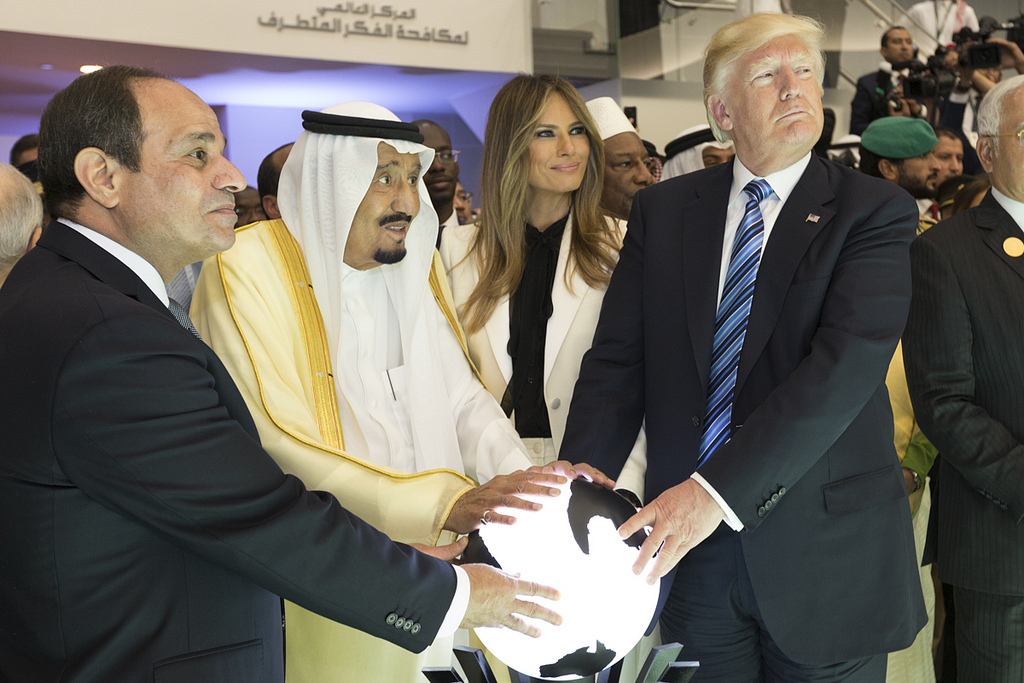
U.S.
President Donald Trump and First Lady Melania Trump join King Salman
bin Abdulaziz Al Saud of Saudi Arabia, and the President of Egypt, Abdel
Fattah al-Sisi, in the inaugural opening of the Global Center for
Combating Extremist Ideology, May 21, 2017. (Official White House Photo
by Shealah Craighead)
|
This divisiveness has brought extremism and terrorism to the region, and has only harmed everyone.
Now the Axis of Moderation has become shrewder in its confrontation with the Iran and has employed a greater number of experts in Iranian affairs. The Axis of Moderation, especially Saudi Arabia, has realized that it cannot face down the threat of Iran without radical internal reforms. Saudi Arabia's complaints against Iran's interference and spreading extremism cannot sound credible if extremism is being practiced inside Saudi Arabia. These internal reforms, and liberalizing the society, are important internally: they will boost the economy by creating an attractive investment environment, especially for foreign investors. As importantly, reforms will stop any adversary from saying that Saudi Arabia is a state supporter of terrorism or a land that exports terrorists.
SAUDI ARABIA
The most obvious changes are Saudi Arabia's internal reforms that cover "social openness" in the form of concerts and festivals, coordinated by an entertainment body, and the country's attempts to undermine clerical control, both by arresting extremists and establishing a committee at the Islamic University in Medina to codify the interpretation of Quranic verses that call for extremism, especially against other religions.
Saudi Arabia has also clamped down on corruption by arresting suspected businessmen, princes and former ministers. The kingdom has also raised the status of women by giving them more of their human rights, such as the recent lifting of the ban on women driving. In another important change, Saudi Arabia will also allow women to be clerics to confront all the patriarchal interpretations of verses in Quran related to women. Eventually, that could mean that lifting the ban requiring male guardians for women might also coming soon. The Saudi crown Prince, Mohammed bin Salman, has also said that he will allow women to take sports classes in school, attend sporting event for women and to permit music. His wish, he has said, is to "restore Islam."
The most important matter of all was pointed out by the Saudi Crown Prince, at the Future Investment Initiative in Riyadh on October 26, 2017: "We are just returning to the Islam we are used to... The moderate Islam." He also said, "We will not continue to be in the post-1979 era."
This is essentially a confession that the approach that Saudi Arabia followed after 1979 to try to oppose the Khomeini Revolution was not helpful, and that now it is time for real reform to face both internal and external challenges.
What Saudi Arabia is doing will eventually contribute towards clarifying the aims of the Axis of Moderation, which will be to support countries whose primary objectives are development, modernity and stability. The most important goal is to stamp out terrorism by supporting a "moderate" Islam or, more specifically, supporting the approach that Saudi Arabia took before 1979. This approach was echoed by the UAE ambassador to the United States, Yousef Al Otaiba, who said that the moderate countries boycotting Qatar are heading towards secularism -- in contrast to Qatar's support for Islamist militias such as Hezbollah, and radical groups in the Axis of Resistance, such as the Muslim Brotherhood.
QATAR
What has complicated the situation has been an exploitation of the conflict in the United States between the Republican Party and the Democratic Party over how to fight terrorism by countries in the Axis of Resistance such as Qatar.
The double face of Qatar is revealed in many ways. Al Jazeera in English, for instance -- as mentioned the article, "Al Jazeera: Non-Arabs Should Not Be Fooled" -- is totally different from Al Jazeera in Arabic.
Ahmed Mansour, for example, one of Al Jazeera's anchors, tweeted about Hurricane "Irma" in Florida by citing a Koranic verse to say that what is happening in America is God's curse: "Twenty million Americans fled out of fear from Hurricane Irma," he wrote; then he cited a verse from Quran saying,
"And He shows you His signs. So which of the signs of Allah do you deny?" (40:81, Sahih International)After his tweet in Arabic was read by American journalists, he apologized in a very sweet tweet in English.
Qatar also pretends to the US that it is supportive of its values, but in fact has close ties with all the enemies of the US. Sultan Saad Al-Muraikhi, Qatar's permanent envoy to the Arab League, for example, has called Iran, which the US has officially designated as a terrorist state, an "honorable state". Qatar also disagrees with designating Hamas and Hezbollah as terrorist organizations and calls them, instead, "resistance movements" against Israel.
Qatar has, moreover, used that dispute for its own ends by way of an alliance with the Democratic Party's allies and supporters.
Many Qatari writers and Qatar's supporters, especially the Muslim Brotherhood, have written articles against the Trump administration, as opposed to the previous administration which clearly had a soft spot for the Muslim Brotherhood. From the beginning, the administration of US President Barack Obama overruled Egypt's President, Hosni Mubarak, by insisting that the Muslim Brotherhood attend Obamas speech in Cairo, thereby setting the stage for the fall of Mubarak; and also strongly supported the subsequent regime then Egyptian President Mohamed Morsi (who was a member of the Muslim Brotherhood). Obama also openly counted the Muslim Brotherhood-affiliated Turkish President, Recep Tayyip Erdogan, among his "best friends."
These opinion-makers in the US, evidently nostalgic for the previous administration, and known, especially during the Iran Deal, as not exactly aligned with the Axis of Moderation, seem to have been exploiting the rift between the Democrats and Republicans, apparently hoping for the impeachment of Donald Trump. As a Saudi academic and researcher, Ahmad Al-faraj, wrote in his article, "Qatar: The dream of isolating Trump!," they possibly think that a Democrat President, like Obama, would again support them.
While Qatar makes itself out to be tolerant and a supporter of democratic Americans and Westerners, anyone who watches Al Jazeera in Arabic will find nothing other than pure hatred of Western values and enormous support for armed militias such as Hezbollah and terrorist groups such as Hamas.
There urgently needs, therefore, to be a unified American position to confront the Axis of Resistance. Iran continues to be the world's leading sponsor of terrorism, empowering these armed militias and extremist groups -- the basis of terrorism both in the region and across the world. It makes death threats, cooperates with a nuclearized North Korea, and all the while races toward nuclear weapons capability itself. The United States would also do well to advocate a unified European position, and draw support from across the political spectrum. Unfortunately, European governments, for their own economic interests, have turned a blind eye to all the terrorism, extremism and sectarianism that Iran is fomenting. European countries should be warned that if they continue to put these economic interests ahead of global security, not only will the decision undermine the already-fragile national security of their own countries but also those of the region.
It is in the interest of the United States and world peace to support the pillars of an Axis of Moderation that would:
- Eliminate political Islam because it exploits religion for radical political goals in both the Sunni and Shiite sects. The Shiite version of political Islam failed in Iraq and the Sunni version of the Muslim Brotherhood failed in Egypt and Tunisia. In both versions of political Islam, violence and terrorism are exacerbated.
- Undermine Iran's influence among armed militias in the region such as the militia Hezbollah in Lebanon, the Houthi in Yemen and the sectarian militias in Iraq. These should be classified as terrorist organizations. Hamas in the Gaza Strip has already been classified as such by the United States on October 31, 2001. Any country that supports Hamas or defends it, even in its media, should be classified as terrorist too.
- Prevent the existence of armed militias operating as a state within a state; they are the beginning of the collapse of states and therefore a serious threat to peace and stability.
- Consolidate the principles of secularism in internal and external dealings. Incitement to sectarian and racial hatred must be prevented as well as the use of Quranic verses to spread violence and extremism. To keep Iraq out of Iran's control, non-sectarian neighborly relations need to be maintained.
- Instill the principles of tolerance and respect for all religions and sects and guarantee the free practice of religions and the protection of minorities.
The region and the world as a whole have suffered from the actions of the Iranian regime and its allies. There should be no justification for the existence of militias and extremist groups under the banner of resistance or similar pretexts. The international community needs to be firm in challenging states that allow or support such groups and should stress that states can only protect themselves with armies and armed forces, not with militias.
A unified American and European position needs to help the Axis of Moderation to prevent countries in turmoil from becoming cantons of militias and extremist groups. That seems a more constructive way to fight terrorism and build global stability.
Najat AlSaied is a Saudi American academic and the author of "Screens of Influence: Arab Satellite Television & Social Development". She is an Assistant Professor at Zayed University in the College of Communication and Media Sciences in Dubai-UAE.
This article was first published in Arabic at Al Hurra.