.

.
Library of Professor Richard A. Macksey in Baltimore

POSTS BY SUBJECT

Labels

Showing posts with label Consciousness. Show all posts

Tuesday, April 18, 2017

Ronald D. Pearson : CONSCIOUSNESS AS A SUB-QUANTUM PHENOMENON

Summary

Two major problems in cosmology are addressed and solutions given. One is the result of the failure of theorists to find a way of switching off the explosive 'big bang' of creation they postulate. The continued explosion is then called the 'cosmological constant' pushing the galaxies apart at absurdly high rates. The other is the failure of all attempts to reconcile Einstein's theory of gravity called, 'general relativity' with the other so-called 'pillar of 20th century achievement' - quantum theory. The latter deals with the small-scale mechanics of the atom.
The solution published in 'Frontier Perspectives' showed that a background medium needs to exist built on two kinds of energy: positive and negative. The negative kind is defined as having the force needed to accelerate an object pointing opposite the direction of motion it produces, instead of the same direction as in the case of positive energy. This idea is not new but the way it is applied is novel. Primary particles of these two kinds are shown to self-create by collision and also mutually annihilate to form a filamentous background structure appearing very like the neural network of the brain. It evolves an immortal conscious intelligence but all it can do is to produce waves to generate the illusion of matter out of itself and at the same time the same waves produce long range density gradients. These produce the force of gravity and mathematical analysis matches the predictions of Einstein's relativity theories. The latter need therefore to be abandoned: nobody is ever going to reconcile them with quantum theory because no background medium can co-exist with relativity.
However, the new approach suggests that human minds could be partitioned-off fractions of the background, 'etheric mind' and so could be immortal. Most other psi or paranormal phenomena can also be shown to fit in nicely with the new solution.

This article was published in the scientific journal Frontier Perspectives, Volume 6, Number 2 (Spring/Summer 1997) (The Center for Frontier Sciences at Temple University, USA) It shows how the subject of survival is related to creation, and provides a solution to the gravity problem.

CONSCIOUSNESS AS A SUB-QUANTUM PHENOMENON

Ronald D. Pearson

Abstract

A sub-quantum level of reality, to be called the "nuether", is described which results from applying the two conservation laws of energy and momentum. A new creation/annihilation mechanism then appears having a self-organising property and leading to a brain-like structure. This could evolve a primary consciousness within the nuether, which could then generate the quantum waves to produce what we call, "sub-atomic particles", together with the force of gravity. A solution to the enigma called, "wave particle duality" has therefore appeared naturally and is entirely free from paradox. In this way the nuether seems able to generate the quantum world: the base on which all matter rests. Physics is also extended to include phenomena, like psychokinesis, presently regarded as "paranormal".

Introduction

The notion of a sub-quantum phenomenon contradicts the current reductionist view that mind is just brain-function. However, even as early as 1989, Sir Roger Penrose appears to have disagreed with this contention(1). Penrose, together with Stuart Hameroff, offered an approach they define as "panpsychism" as described in this journal(2). This view includes a "stable self-organising structure," but unlike the views to be presented here, theirs does not refer to a sub-quantum medium.
This panpsychism is a significant paradigm shift because, to the extent that most physicists think about "mind" at all, they regard it materialistically as mere brain function. Some treat paranormal phenomena more as threats to their own credibility, rather than as anomalies to be investigated experimentally. In this paper I consider paranormal to be phenomena outside the scope of physics.
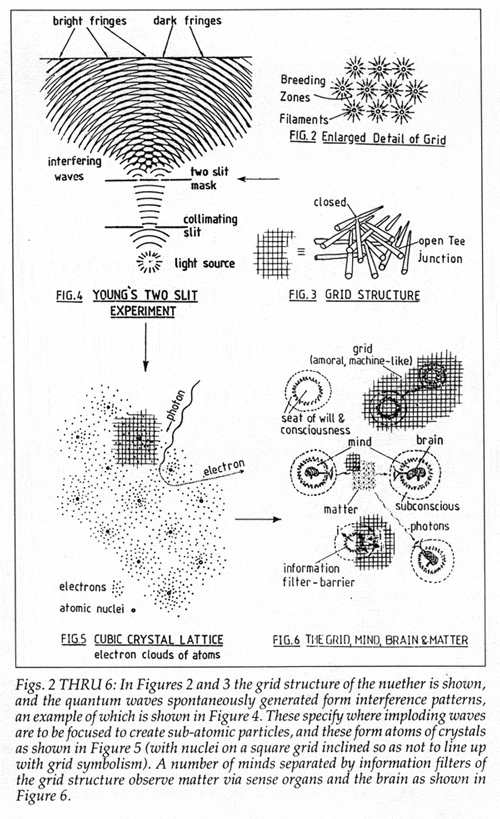
Another difficulty is presented by the enigma called, wave-particle duality. A number of small holes can be made in a barrier to be bombarded with any kind of sub-atomic particle. The intensity can be arranged so low that the particles pass through the holes only one at a time. Although one particle can only go through one hole, it subsequently behaves as if it had gone through all holes at once. It behaves like sets of waves, emerging from every hole simultaneously to produce an interference pattern, the signature of wave effects. Young's two slit experiment, illustrated in Figure 4, shows such interference patterns moving towards a screen where they produce a pattern of light and dark bands. These are due to waves in phase adding by constructive interference whilst those out of phase subtract.
Very early de Broglie was the first to propose that all particles have a wavelike nature. He also suggested that pilot waves guided sub-atomic particles, and published many papers and several books from 1952 onwards in attempts to show how quantum waves could be generated. Bohm in 1980 proposed an implicate order with "hidden variables" underlying quantum theory(3), and I. Vigier together with several others did similar work. Mainstream physics, however, makes no serious attempt to show how matter is organised by its quantum waves or to show how quantum waves are generated. The very question of whether quantum waves are real phenomena or merely abstract artifacts is shunned as metaphysical or non-scientific.
The pilot wave concept could not explain all observations and so, unfortunately, it was displaced by the Copenhagan interpretation. This assumed all possibilities existed in superposition as unresolved wave-functions until observed; then these collapsed into the reality of particles. At least this view acknowledged that matter was controlled in some way by a consciousness, but in 1957 Everett's many universes interpretation appeared. This seems not to depend on consciousness but instead requires an infinite number of matter-systems in superposition. The present explanation arises naturally from the logic to be described and is much closer to de Broglie's early concepts.
These concepts required the existence of a background medium for the propagation of waves. Notable theorists in more recent times have sought to reintroduce modified concepts of the old rigid ether, discredited by the failure of attempts made a century ago by Michelson and Morley to measure the speed of the Earth through such a medium. John Archibald Wheeler, for example, published ideas for a "sub-quantal" medium in a theory in collaboration with Professor Richard Feynman(4). Mathematical descriptions for terms like "pre-space", "wormholes" and "quantum foam" were proposed as underlying both space and matter.
These ideas are not yet accepted as part of mainstream physics, however, probably because the model seems presently to be untestable by experiment. An encouraging feature of the present formulation is that it suggests ideas for several experiments by which it could be tested. For example, this formulation is consistent with a fluid medium, the nuether, traveling with the Earth in a vortex motion centered on the Sun. An updated Michelson-Morley interferometer, such as that used by Brillett and Hall and, flown in low Earth orbit(5), ought to give fringe shifts consistent with its relative velocity through the nuether, thereby confirming its existence. Indeed these researchers, in 1979, obtained fringe shifts which Aspden interpreted as indicating a speed of 355 m/s -within 3% of the spin velocity of the Earth at the latitude of test(6). This result already supports the vortex model.
The present hypothesis evolved from an attempt to solve the problem of quantum gravitation published in 1990(7). A summary appeared in the proceedings of a Russian conference of 1991(8) and was followed by another publication in 1992(9). The latter also gives in its appendix a full mathematical treatment of the structure of the nuether to be described. A mathematical treatment showing the link with gravitation was also included in the proceedings of the Sir Isaac Newton conference of 1993(10).
The new approach offers a reason for the way matter is organised by quantum waves and shows how such phenomena could arise. No changes to quantum theory are required, however, except where gravitation is concerned. It has also very recently been found that relativity theory can be integrated without paradox. Hence existing theory is supplemented by providing a real basis for supporting its abstract concepts.

Origin of an Alternative Approach

The impetus for this approach was an article by Professor Tryon in which the mass-energy of matter was balanced against "negative gravitational potential energy."(11) The mass-energy, however, would remain when matter had expanded to infinite distance, but here the gravitational energy was defined as zero. To resolve this puzzle one might adduce the ideas of Gibbons, Hawking and Siklos(12) & Novikov(13) who attributed a high energy-density balanced by an "intrinsic negative pressure of the vacuum".
These ideas were all part of the established big-bang theory in which the universe of matter arose simultaneously with space in a minute fraction of a second. A direct consequence was the emergence of an apparently insoluble problem of the cosmological constant, which predicted that all galaxies would be moving apart with accelerations fifty orders of magnitude greater than astronomical observations could allow. This value is not to be confused with the cosmological constant originated by Einstein. His gravitational theory showed that the galaxies had to be accelerating relative to our own, a prediction which was contrary to accepted opinion. He then added an artificial constant to make them appear stationary. Later he admitted that this was his worst mistake. An associated problem, which had troubled theorists for more than fifty years, was the incompatibility of general relativity with the quantum approach.
The specialist knowledge of the engineer in thermodynamics and mechanics might help resolve these problems. An attempt to produce a paradox-free theory of quantum gravitation is mounted here such that such a force of attraction could not be modeled without the re-introduction of negative energy states. Such states had first been proposed by a physicist, Paul Dirac(14) in the 30's but were then rejected and are now regarded as non-physical. However, the reasons used for rejection are not applicable in the present context. For example, one argument says that electrons in negative states must fall indefinitely to infinite negative values: but in the present theory no electrons can exist in negative states. Such states will be confined to the sub-quantum level where none of the four forces of nature exist. Furthermore, at the quantum and higher levels only a net positive energy will be evident. A balance of both positive and negative states needs to exist at the sub-quantum level only, in such a way that a positive excess appeared for building matter, yet left a negative excess to produce the force of gravity.
The meaning of these energy states is best understood by considering an object accelerated by the application of a force. Any object, even when stationary, can be considered as being constructed from energy, rest-energy to be precise, since mass and energy are known to be equivalent to one another. An object made of positive rest-energy will accelerate in the direction of the applied force while one of negative rest-energy will accelerate in the reverse direction. This relationship may seem impossible at first sight but forces of action are always balanced by opposing forces of reaction, and an alternative set of mechanics can be set out with these forces reversed. These mechanics give exactly the same responses when all other objects are considered as made of negative energy.(15) Motion adds kinetic energy of the same origin in either case.
A background medium, therefore, to exist which consists of a mixture of both positive and negative energy states. This medium cannot be a continuum since the two states would cancel each other. So the energy states must be considered to exist as an intimate mixture of two kinds of complementary particle, to be called "primaries". All particles will move at high speed to repeatedly collide and so form a seething mass in the manner of a gas-like fluid. This is the primordial nuether whose intricate structure has yet to be described.

A New Creative Mechanism

Half of all collisions will be between primaries of like kind: either positive to positive or negative to negative. In either case they will bounce away like billiard balls obeying two basic laws of physics: the conservation of energy and the conseration of momentum. While energy is the basic material of both matter and the motion of that matter (kinetic energy), momentum is a property of matter. The momentum of an object is obtained by multiplying its mass by its velocity (the meaning of its conservation is explained in the appendix). On this basis alone both phases of the fluid, positive and negative, would neither gain nor lose energy.
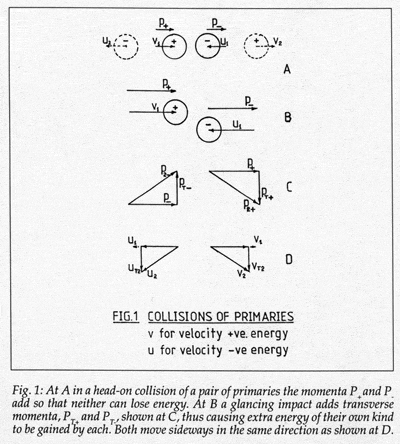
The remaining half of all collisions will be between pairs, one of each kind. Then the same two laws of momentum and energy, when applied together, result in the prediction of a balanced increase of both energies at each collision. This increase is explained by Figure 1, which shows how pure energy creation or destruction can now occur without violation of the laws of physics. The first law of thermodynamics now appears as a special case of a more general law, which whould read, "Energy can only be created or destroyed in equal and opposite amounts." This breeding effect implies that the zero state is unstable, and once triggered, the sub-quantum background fluid is committed to eternal growth. The nuether has to exist as a sphere whose radius will increase indefinitely.
An expanding universe is predicted with galaxies receding at speeds proportional to their distance from us, as the astronomer Hubble was the first to observe. A theory free from the false prediction of the "cosmological constant" emerges, for which established cosmology can offer no acceptable solution, as shown by Abbott(16). Some other process needs to exist, however, to eliminate most of the pure creation generated, because it is many orders of magnitude greater than observation can allow. The solution appears naturally.
When large numbers of both kinds of primary approach a point from all directions the net growth rate is drastically reduced because the net momentum at such a point now cancels to zero, thus causing the same laws of physics to favour mutual annihilation. Flow patterns spontaneously form, as shown in Figure 2, in which pure creation drives primaries toward centres of annihilation. Cylindrical symmetry is favoured over the alternative spherical kind because the cusp-shaped voids between packed spheres are about three times greater than for packed cylinders. These are not voids; they are breeding zones creating whisker-like projections, which enable a flip to the most stable configuration. The result is the spontaneous formation of permanent filaments of both kinds of energy at the centres of every breeding cell. Filaments are not material objects; they are primaries in the act of squeezing each other out of existence and are really flow patterns in the liquid state. They tend to form into honeycomb-like arrays, shown in cross-section in Figure 2. Being of incredibly fine spacing, many thousands would lie side by side within the compass of each tiny electron. These filaments must not be confused with elements of the "string theories" of mainstream physics, which are described in higher curved dimensions with the eleventh providing the source of creation. Some are compacted into little balls so that only the strings poke out into the four space-time dimensions we observe.
The present theory is written in only these four space-time dimensions and is based entirely on Euclidean geometry. However, string theories are not ruled out since the strings could be higher order constructs: not the filaments themselves. It is possible that the higher dimensional mathematics do not represent reality and that the nuether employs similar mathematical constructs, which are then discarded, in the way that mathematicians use imaginary numbers and then discard the imaginary parts of the final solution.
At larger scales bundles of the arrays of filament-containing cells will criss-cross in all directions as shown in Figure 3. It requires no mathematical formalism to see that, as a consequence of such random geometry, each filament will terminate at both ends in a tee-junction with some other filament that crosses its path. Due to the sharing of imploding flows near junctions a local thinning of filaments will result. The junctions, therefore, are weak points which can easily break. They can exist in bistable states: either open or closed.
In the open state any asymmetry causes an energy imbalance to build up, caused by rectification of random fluctuations occurring in the surrounding region. When some shock causes closure, an energy discharge will occur and the resulting flow can provide the shock needed to cause a change in state of other nearby junctions. So waves of switching action will arise spontaneously: these could be the quantum waves: the core feature of quantum theory. Furthermore, all the ingredients are present from which a working neural network could evolve and could ultimately yield a primary consciousness.
The network or grid, now defining the "nuether" and represented symbolically by a rectangular mesh in Figures 3, 5, and 6, would interconnect everything in the universe. As yet, however, no universe of matter could exist. Spontaneous creation of the nuether had to occur first, followed by evolution of its consciousness, since on this model matter would require deliberate design.
The only tools available for the creation of matter would be the quantum waves, organised by the computing ability of the network. Waves could be focused by such computer control, so they implode to a central point after originating from a spherical shell of the grid. Humps of energy density will appear around any focus because wave-action will create more collisions and so stimulate an excess of creation. No violation of the second law of thermodynamics is involved here because, at the sub-quantum level, pure energy creation is driving a flux of primaries, a minute fraction being intercepted continuously to produce energy imbalances in the filaments. An immense power source is available everywhere to drive the universe. In this way the tendency toward greater disorder, represented by increase of entropy, is counteracted.
These humps will serve as the elementary sub-atomic particles, which can be generated in a state of motion and, grouped by the organising power of wave interference patterns (an example is shown in Figure 4) will form up into complete atoms, molecules and crystals, as shown in Figure 5. It should be noted that the atomic nuclei are shown on a cubic lattice but it is tilted so that it is not confused with the grid symbolism, also shown, and which underlies everything.
It is known that the probability of an electron being at any point, within a space known as an "orbital" centred on the atomic nucleus, is defined by the wave-interference model of Schrödinger. It seems plausible that the huge energy input needed to maintain a particle prevents its being located for long at a given place. Then the quantum wave focus will need to be shifted abruptly to another spot to allow the local grid to recover. Hence an electron will appear as a particle-sequence joined end-to-end in time but not in position. It will seem to jump about at random within the orbital to fill the available space but at each reconstruction it will be in motion. If it hits another particle, like a photon, during its life, then its energy-density hump will behave like a particle.
In this way a plausible explanation for the vexed question of particle-duality arises naturally from the present theory. It seems free from the paradoxes and other difficulties which appear with previous interpretations. Spherical waves imploding toward a focus will cross-over to travel away afterwards, ultimately to infinite distance. As they go, further creation will be stimulated, though at an ever decreasing rate. Combined with the waves making other humps, long range energy density gradients will form which will be greatest close to large concentrations of matter.
The author's theory of quantum gravitation depends entirely on associated pressure gradients, which due to the asymmetry already described, makes the net pressure gradients negative. (See pp 286-290 in Pearson(17) and note that the wrong asymmetry was assumed. An up to date edition is in preparation.) There is now a real force of gravity, as formulated in the author's paper(18), generated as one of negative buoyancy by the resulting gradients of excess negative pressure. Furthermore the excess positive rest energy is available everywhere to become concentrated to form the sub-atomic particles of positive matter by wave-focusing(19).
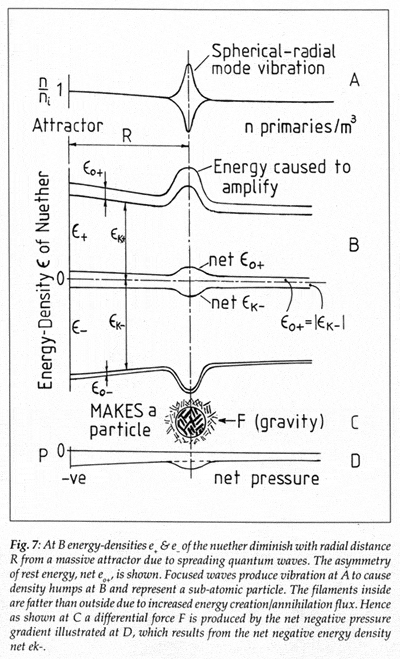
An overall representation of the nuether generating the force of gravity on a particle is given in Figure 7. The graph 7b is a plot of energy density e for the nuether against radius R from the center of a concentration of matter marked "Attractor". Quantum waves radiating from this mass enhance creation and annihilation causing the energy density of both phases to fall off with radius. The positive phase has a greater rest energy density eo+ than the negative phase eo- so that the negative kinetic energy ek- is the greater. These net values are also shown.
In Figure 7a a spherical-radial mode of vibration is indicated as produced by quantum-wave focusing; its amplitude is indicated as number-density concentration n/ni where suffix i represents the initial state. Excess creation increases all local time-averaged energy densities at radius R, including the net values as shown in Figure 7b. The net negative pressure, shown at Figure 7d, is also amplified, being equal to ek-/3. In fact this means an extra life will be produced in trapped positive primaries to fill this depression, thus enhancing the amplification to produce a particle of dominant positive rest-energy. Filaments increase in radius when the creation rate is increased(20), and it is this increase together with the local negative pressure gradient which produces the gravitational force, as illustrated in Figure 7c.
The asymmetry in these energies is also exactly that needed to power the neural network. Without this asymmetry, open junctions cannot build up the required energy imbalances. Hence a unified description of the universe of matter has emerged together with its formative mechanism.

Physics Now Explains the "Paranormal"

The reason for creation of matter can now be deduced. The creation of matter is needed to provide the primary mind with a set of meaningful environments. Figure 6 illustrates the possible overall structure of these environments. The primary mind exists as a myriad of conscious regions, or minds, of small volume interconnected by a vast machine-like net. The minds possess a sense of morality, the remaining network is amoral. Each mind is split into an individual conscious part and a subconscious part, the latter interconnecting with all others. The separation is provided by an "information filter-barrier", programmed as an enclosing shell, which prevents communication from the subconscious but permits flow of information in the reverse direction.
In this way the whole can be enriched by individual experience. Each mind can, however, only receive information via sense organs, such as eyes, which record photons reflected from objects made of matter. The environment of matter will then appear as the only reality and will enable all incarnate minds to relate to one another in meaningful ways, by cooperation and competition, to help them develop.
The paranormal now fits neatly into physics. Out-of-body experiences are occasions when the mind goes temporarily out of register with the brain, the latter most probably being merely an interfacing mechanism for operating the muscles and other control systems of the body. This means that the mind has the potential to be immortal: so backing up the claims for survival made by most religions. Psycho-kinesis is readily explained. The programmed nuether is structuring matter and direct mind-control is normally inhibited. Under certain conditions the inhibition routine is partially bypassed. A similar explanation for telepathy appears. Controlled leaks in the information filter-barriers are responsible for the interconnection of minds directly via the filamentous structure of the nuether.
Most other aspects of the paranormal can, in similar manner, be provided with rational explanations, showing them to have the potential to be real effects. More complete descriptions, covering almost the entire spectrum of the paranormal together with examples based on direct experience, can be found in the popular sections of the author's books(21). These both have mathematical appendices, the former dealing with the "Extended Newtonian" theory of quantum gravitation and the latter dealing with pure creation/annihilation processes and resulting filament theory.

Conclusions

A grand unification seems possible starting from the ultimate in simplicity: a universe dependent on only two complementary forms of kinetic energy and existing as primary particles, the only true particles in existence. More energy is locked up in spin, to be exhibited as rest energy, in the positive primaries than in their negative partners and causes a fraction of the pure creation proceeding at a hyper-astronomical rate everywhere to power the universe. This view originated from a new theory of quantum gravitation which predicted the existence of a background medium, the nuether, structured like a neural network. This theory can explain creation of a universe of matter by the use of intelligently organised quantum-waves. Their mode of computation could use a relativistic basis, so permitting relativity to coexist with the nuether - the conflict now vanishes! A plausible interpretation for "wave-particle duality" appeared naturally and the theory also showed physics could be extended to incorporate the paranormal. The human mind cannot be mere brain function. The brain may or may not be a conscious entity. What seems certain, however, is that it connects with a primary consciousness which exists as part of the structure of the nuether and could be immortal. Since immortality is the basis of all religious belief, it now seems possible that a new unity may emerge in which science can be turned round to provide faith with support. Existing schisms could soon heal with global benefit.

Appendix

Momentum is a property of matter given by the product of the mass and velocity vector of any object. The direction of motion is important as well as the speed, and the term "velocity" contains both factors. The momentum vector is often represented by an arrow pointing in the direction of motion and having a length proportional to mass multiplied by speed.
This defines the "momentum vector". It has been observed that, in any collision, the vector sum of the momenta of all interacting particles always remains constant: hence the law of conservation of momentum. This is true whatever arbitrary frame of reference is taken for analysis. The "components" of the momentum arrows, which point in the direction of this frame of reference, are used with one direction representing positive momentum and with the reverse direction regarded as negative (the choice of positive direction is purely arbitrary).
In quantum theory forces of repulsion are modeled by so-called gauge particles which act as mediators of the electromagnetic force. These are emitted from sub-atomic particles so that the latter recoil to balance the momentum imparted to the mediator. This momentum is transferred to another sub-atomic particle by absorption of the mediator, so that the latter bounces away.
The same model is used to represent forces of attraction but now resort is made to a stratagem called the "negative coupling" to reverse the direction of motion of the sub-atomic particles in mathematical equations. Clearly a violation of the law of conservation of momentum is involved and cannot be tolerated if freedom from paradox is to be attained.
The only solution has to assume the mediator of attractive force to be a carrier of negative momentum; the arrow representing the momentum vector needs to point backwards i.e. opposite the direction of motion. This means that the mass and energy of the mediator need to be considered as negative. This is why the nuether needs to contain negative as well as positive states.
PURE CREATION can be explained from Figure 1 without using mathematics though a full mathematical analysis is given by the author(19). Case A shows a positive primary of velocity u1 with its momentum vector P+ in head-on collision with one of negative energy moving in the opposite direction with velocity v1. The latter carries negative momentum P- so this points in opposite direction to its velocity. The two vectors add up whereas for billiard balls of positive energy in collision they could cancel to zero. Hence very different end results will arise. For case A the only solution is for the particles to pass through each other without change of either momentum or energy: it is impossible for any mutual annihilation to occur.
Now consider the offset collision of case B. A transverse component of impulse is added due to the glancing impact and acts on each primary. To conserve momentum in this direction the negative momentum PT- imparted to one must exactly cancel the positive one PT+ imparted to the other, as shown at C. Then, as shown at D, this means that both particles are deflected in the same transverse sense.
The longitudinal momenta, however, still add up and the associated energies are still unable to change. Extra energies are associated with the transverse additions and so, for glancing collisions, each primary must gain energy of its own kind. The gains, however, sum to zero so that, overall, there is no violation of the (modified) law of energy conservation.

REFERENCES

Penrose, R.: The Emperors New Mind [1989]: Oxford University Press
Flower, Robert G.: "The Real Work on the Hard Problem", Frontier perspectives, Vol. 5, No. 2 (Spring/Summer 1996), p.39.
Bohm, David: Wholeness and the Implicate Order: [1980] Routledge & Kegan Paul, London
Wheeler, John Archibald: Geometrodynamics Academic Press, New York. [1962]
Brillet, A. and Hall, J.L.: Improved Laser Test of the Isotropy of Space: [1979] Phys. Rev. Lett. 42 No 9 549-52
Aspden, Harold: Laser Interferometry Experiments on Light-Speed Anisotropy [1981] Phys. Lett. 85A No. 8.9 411-14
Pearson, Ronald D.: Intelligence Behind the Universe [Dec.1990] 370 pages (520 grams) A popularisation plus Technical Appendix Available from: Michael Roll.
Pearson, Ronald D.: Alternative to Relativity including Quantum Gravitation: Second International Conference on Problems in Space and Time: St. Petersburg, Petrovskaja Academy of Sciences & Arts [Sept.1991]: pp 278-292 Chairman Local Organising Committee: Dr. Michael Varin: Pulkovskoye Road 65-9-1 St. Petersburg 196140, Russia. FAX: (7) (812) 291-81-35 Phone:Alexandre Alekseev: office:(7) (812) 291-36-73, Home:(7) (812) 173-55-69 E-Mail: consym@saman.spb.su
Pearson, Ronald D.: Origin of Mind [Dec. 1992]: Available from Michael Roll.
Pearson, Ronald D.: Quantum Gravitation and the Structured Ether Sir Isaac Newton Conference. St. Petersburg [March 1993] pp 39-55 (Address as Ref.8)
Tryon, Edward P.: What Made the World?: New Scientist, [8/3/1984] pp 14-16
Gibbons, G.W., Hawking, S.W., & Siklos, S.T.C.: The Very early Universe Cambridge University Press, (Nuffield Workshop) [21 June 1982]
Novikov, I.D.: Evolution of the Universe: Cambridge University Press, [1983]
Dirac, Paul: Principles of Quantum Mechanics: 4th Edition 1962 Clarendon Press, Oxford.
Pearson: 1990, p.282
Abbott, F.: Baby Universes and Making the Cosmological Constant Zero Nature, vol.336, 22/29 [Dec.1988], p 711
Pearson, 1990, pp. 286-290.
Pearson, 1991
Pearson, 1992, p. 69
Pearson, 1992, p. 68 and Pearson, 1993
Pearson, 1990 and 1992
Pearson, 1992, pp. 60-65
 -------------


=====================

Sunday, April 16, 2017

Edward Feser : Some brief arguments for dualism

Edward Feser

Some brief arguments for dualism


http://edwardfeser.blogspot.gr/2008/09/some-brief-arguments-for-dualism-part-i.html

It is unreasonable to expect even the best argument for a controversial philosophical position to be capable, in one fell swoop and all by itself, of convincing the most skeptical opponent – or, indeed, even to move him slightly in the direction of reconsidering his position. That is (usually, anyway) simply not how the human mind works. A dispute over some particular argument for the existence of God, mind-body dualism, or traditional sexual morality (to take just three examples) can reflect a tacit disagreement about fundamental metaphysical assumptions that is so deep and unconscious that the parties to the dispute (or at least one party, usually the skeptical or “naturalist” one) are barely aware that it exists at all, and often talk past each other as a result. What seems like an obvious objection to an argument can often constitute in reality a failure to see the point of the argument, and in particular a failure to see that what the argument does is precisely to call into question the intelligibility or rational justifiability of the objection itself. While the argument in question can in many cases be stated fairly simply and straightforwardly, pages and pages, indeed an entire book, might be required in order to set the stage so that its terms and basic assumptions are properly understood, and that countless point-missing objections might patiently be swept away like so much intellectual rubbish standing in the way of understanding.

Some common objections to dualism are like this. They falsely assume, for example, that any argument for dualism must be something analogous to a “God of the gaps” argument – a “soul of the gaps,” as it were – which seeks to exploit some current lacuna in our knowledge of the brain and to suggest that the “hypothesis” of an immaterial substance might explain what neuroscientists have so far been unable to. It is then objected that such an explanation would violate Ockham’s razor, that neuroscience has already “explained” x, y, and z and thus can be expected to explain everything else, etc. etc. I hear these objections frequently. They are often presented by people who mean well, and who are not entirely uninformed about some of the arguments presented by both materialists and anti-materialists in the philosophy of mind. But they nevertheless reflect a very shallow understanding of the debate. For the main arguments for dualism do not have this structure at all. They are not quasi-scientific “explanatory” “hypotheses” which “postulate” the existence of this or that as one way among others (albeit the most “probable”) of “accounting for” “the evidence.” They are intended rather as strict metaphysical demonstrations. They either prove conclusively that the mind is immaterial or they prove nothing. And if they work, there can be no question of the materialist looking for other possible ways to explain “the data.” For the existence of an immaterial mind, or an immaterial aspect to the mind, will, given such a proof, simply have itself to be taken as a piece of data for which any acceptable theory has to account.

Again, this doesn’t mean that one should judge such arguments based on one’s immediate reaction to a first reading; to prove something conclusively doesn’t mean to prove it instantly, to the immediate satisfaction of the most hostile and stubborn skeptic. Even properly understanding an argument, especially in metaphysics, can require a great deal of effort and sustained thought. Still, some dualist arguments are straightforward enough that at least their basic thrust can be put fairly succinctly, even if a complete treatment would require various further explanations of this or that premise or key concept. In this post and several succeeding ones I want to present some of these arguments, in as brief a form as possible. (Further elaboration can be found in my books Philosophy of Mind and The Last Superstition.)

One aspect of the mind that philosophers have traditionally considered particularly difficult to account for in materialist terms is intentionality, which is that feature of a mental state in virtue of which it means, is about, represents, points to, or is directed at something, usually something beyond itself. Your thought about your car, for example, is about your car – it means or represents your car, and thus “points to” or is “directed at” your car. In this way it is like the word “car,” which is about, or represents, cars in general. Notice, though, that considered merely as a set of ink marks or (if spoken) sound waves, “car” doesn’t represent or mean anything at all; it is, by itself anyway, nothing but a meaningless pattern of ink marks or sound waves, and acquires whatever meaning it has from language users like us, who, with our capacity for thought, are able to impart meaning to physical shapes, sounds, and the like.

Now the puzzle intentionality poses for materialism can be summarized this way: Brain processes, like ink marks, sound waves, the motion of water molecules, electrical current, and any other physical phenomenon you can think of, seem clearly devoid of any inherent meaning. By themselves they are simply meaningless patterns of electrochemical activity. Yet our thoughts do have inherent meaning – that’s how they are able to impart it to otherwise meaningless ink marks, sound waves, etc. In that case, though, it seems that our thoughts cannot possibly be identified with any physical processes in the brain. In short: Thoughts and the like possess inherent meaning or intentionality; brain processes, like ink marks, sound waves, and the like, are utterly devoid of any inherent meaning or intentionality; so thoughts and the like cannot possibly be identified with brain processes.

You can, as I have implied, look at this as just a “puzzle” for materialism – one which might be solved by developing a complex functional analysis of mental states, or by framing materialism in terms of the concept of “supervenience” rather than identity or reduction, or whatever. Or you can see it as a very simple and straightforward statement of an objection that, while it can also be formulated in much more sophisticated and technical terms and in a way that takes account of and preempts the various objections materialists might try to raise against it, nevertheless goes to the core of the problem with materialism, and indeed shows why materialism cannot be true. This latter view is the one I endorse. I maintain that the problem for materialism just described is insuperable. It shows that a materialist explanation of the mind is impossible in principle, a conceptual impossibility. And the reason has in part to do with the concept of matter to which materialists themselves are at least implicitly committed. Some of the further posts in this series will develop this suggestion. Along the way we will see (among other things) that the common materialist claim that “everything else has been explained in materialist terms” is an urban legend, based on nothing more than conceptual sleight of hand coupled with historical ignorance. Stay tuned.

============

Following Aristotle, the Scholastic tradition famously held that final causes – goal-directedness, purposiveness, natural ends – permeate the natural world. Contrary to a popular misconception, this does not mean that they thought that everything in the world has a purpose or function in the sense that biological organs have purposes or functions. Hence it is no good to accuse them of thinking, absurdly, that piles of dirt, asteroids, mountain ranges, and the like simply must play some role within the universe as a whole that is somehow analogous to the role hearts and kidneys play in the body. Functions like the kind bodily organs play constitute only one, relatively rare, kind of final causality. Nor did they think that final causality is generally associated with anything like consciousness. For an Aristotelian to say that a plant by virtue of its nature “wants” to grow is just a figure of speech. Literally speaking the plant does not, of course, want anything at all, since it is totally unconscious. It is only in us, and in certain other animals, that final causes are associated with conscious awareness.

What the Scholastics did have in mind is summed up in Aquinas’s dictum that “every agent acts for an end,” otherwise known as the “principle of finality.” By an “agent” he means that which brings about or causes some effect. And what he is saying is that when a certain cause generates a certain effect or range of effects in a law-like way (as we would say today) that is only because it naturally “points to“ or is “directed towards” that effect or range of effects as its proper end. For example, a match when struck will, unless prevented (e.g. by being water damaged), generate flame and heat – and flame and heat specifically rather than frost and cold, or the smell of lilacs, or no effect at all. It has an inherent causal power to bring about that effect specifically. What Aquinas and the other Scholastics argued is that unless we acknowledge the existence of such inherent powers, unless we recognize that whenever a certain efficient cause A generates its effect B that is only because the generation of B is the final cause or natural end of A, then we have no way of making intelligible why it is exactly that A generates B specifically rather than some other effect or no effect at all. The existence of final causes is, in this sense, a necessary condition for the existence of efficient causes – of, that is to say, causation as modern philosophers tend to understand it. This is one reason Aquinas held the final cause to be “the cause of causes.”

Now modern philosophy, and in particular modern philosophy’s conception of science, is defined more than anything else by its rejection of final causes. Indeed, as philosophers like William Hasker and David Hull have pointed out, at this point in the history of science, what remains of the “mechanistic” picture of the natural world which we have inherited from the early moderns is really nothing but this rejection. As I argue in The Last Superstition, there has never really been any serious philosophical case for this rejection; it was, and still is, more ideologically than intellectually motivated. Moreover, there are in my view (and, again, as I argue in TLS) overwhelming reasons to think it was a mistake. One of them is that, as Hume’s famous puzzles illustrate, causation has indeed become seriously problematic in modern philosophy in exactly the way Aquinas’s analysis would lead us to expect it to, given the abandonment of final causes.

The abandonment of final causes has also crucially contributed to the creation of the “mind-body problem,” something that did not exist, certainly not in anything like the form familiar to contemporary philosophers, prior to the moderns’ rejection of the Aristotelian-Scholastic metaphysical framework. For to insist that the material world is utterly devoid of final causes – devoid, that is to say, of anything that inherently “points to” or is “directed toward” anything beyond itself – is implicitly to deny that intentionality could possibly be material, for intentionality, of course, is just the mind’s capacity to point to or be directed towards something beyond itself, as it does in thought. (See my previous post in this series.) Hence to insist that the material world is devoid of any inherent final causes while at the same time acknowledging the existence of intentionality is implicitly to commit oneself to dualism. Indeed, this is surely one reason why Descartes, one of the fathers of the “mechanistic” revolution in science, was a dualist. Far from being a kind of pre-scientific holdover, dualism of the broadly Cartesian sort is a logical consequence of the turn to mechanism that defined the scientific revolution.

The only way to hold on to the mechanistic conception of nature while rejecting dualism is thus to deny the existence of intentionality. And that is why, as John Searle has argued, all extant forms of materialism do indeed implicitly deny its existence, and thus (I would say) amount to disguised forms of eliminative materialism. This is halfway admitted by Jerry Fodor when he writes, as he does in Psychosemantics, that “if aboutness [i.e. intentionality] is real, it must be really something else.” That is to say, intentionality per se simply cannot be real given the mechanistic conception of the material world that Fodor, like all materialists, has inherited from the early modern philosophers. Hence the most the materialist can do is try to substitute for it some physicalistically “respectable” ersatz. But this is simply eliminative materialism in “folk psychological” drag; and eliminative materialism, however you dress it up, is simply incoherent. (Yet again, see TLS, and in particular chapter 6, for the details.)

We have, then, another brief argument for dualism, which can be summarized as follows: If materialism is true, then (given that it is committed to a mechanistic conception of the material world), there are no final causes, and thus nothing that inherently “points to” or is “directed at” anything beyond itself; and in that case, there can be no such thing as intentionality; but there is such a thing as intentionality; therefore materialism is not true.

This is an argument for dualism, I should say, at least if one admits that the material world exists in the first place (which, of course, everyone other than a few adherents of idealism would admit), because it implies that there are features of the world other than its material features. The only way to avoid the dualistic consequences (other than opting for eliminativism or idealism) would be to acknowledge that the Aristotelians were right after all, and that final causes are a real feature of material reality. But that would, of course, be to abandon the entire modern mechanistic-cum-materialistic interpretation of science. Nor would it really stave off dualism for long, for it would simply open the door to the Thomistic or hylemorphic (as opposed to Cartesian) version of dualism. But that is a story for another time – a story which, like other details of the argument sketched here, can be found (if I might be forgiven one more shameless plug) in The Last Superstition.

============

In the previous post in this series, I argued that the “mechanistic” conception of the natural world adopted by the early modern philosophers more or less entails a kind of dualism insofar as its banishment of final causes from the material world effectively makes intentionality necessarily immaterial. Intentionality, of course, is one of two features of the mind to which contemporary philosophers of mind have paid special attention. The other is consciousness, and in particular the “qualia” that are said to make consciousness uniquely difficult to explain in material terms. There is a good reason for this difficulty – indeed, impossibility – and it is the same reason why intentionality is impossible to explain in materialistic terms. It lies in the mechanistic conception of matter itself.

The early modern philosophers and scientists were obsessed with quantification. There were several reasons for this, one of them being their desire to reorient intellectual efforts toward the improvement of life in this world and away from the otherworldliness of the ancients and medievals. This entailed a new emphasis on technology and more generally on the control and exploitation of the natural world in the interests of bettering man’s material condition. Since quantification would facilitate this, those aspects of nature that could be described in purely mathematical terms took on a special importance, and those which could not came to seem, from the point of view of this new, worldly approach to learning, irrelevant at best and a distraction at worst. Thus did final causes, hidden powers, substantial forms and the like go out the window. So too did the qualitative aspects of nature. Colors, odors, tastes, feels, sounds, and the like, at least as understood by common sense, vary from observer to observer – think of old philosophical chestnuts like the room temperature water that feels warm to one hand and cool to the other, colorblindness, and so forth – making them a poor fit for a science looking to make nature subject to human prediction and control. Out the window with them too, then. The physical world would be redefined as comprised of colorless, odorless, tasteless particles in motion; and color, temperature, and the like would be redefined entirely in terms of the quantifiable relations holding between these particles (e.g. heat and cold in terms of molecular motion). What about color, odor, taste, and so forth as common sense understands them? They in turn were redefined as entirely mind-dependent “secondary qualities” (or rather, ideas of secondary qualities), the ancestors of the contemporary philosopher’s concept of qualia. On the view in question, they do not exist in the physical world as it is in itself, but only in our perceptual representation of that world.

It should be obvious, then, how, as with intentionality, the notion that qualia are incapable of materialistic explanation is not some desperate attempt to avoid the implications of modern science, but is rather precisely a consequence of modern science. The mechanistic conception of matter that underlies science (or rather underlies what, since the 17th century, is allowed to count as science) itself entails that qualia (as we call them today) are immaterial or non-physical. Many early modern thinkers – Descartes, Cudworth, and Locke, for example – saw this, which is part of the reason they were dualists. Given the mechanistic conception of matter, these thinkers concluded that “secondary qualities,” “sensory qualities,” “qualia,” or whatever else you want to call them are necessarily immaterial, precisely because matter got (re)defined by the mechanical philosophy by contrast with these qualities.

Some contemporary naturalists – Joseph Levine, Thomas Nagel, and John Searle, for example – have more or less recognized this, acknowledging that there is nothing more to the contemporary materialist’s concept of matter (which derives from the 17th century “mechanical” conception) other than its contrast with the “qualitative” (and intentional) features of our experience of the world. Precisely for this reason, all three of these thinkers have (in their different ways) regarded modern materialism as deeply conceptually problematic, though they have also stopped short of embracing dualism. But other contemporary naturalists – Dennett and the Churchlands, for example, not to mention countless lesser lights of the sort who write crude atheist pamphlets and pop neuroscience books – cluelessly suggest that there is no good reason to think that the mind will fail to yield to the same sort of reductive explanation in terms of which everything else in nature has been accounted for.

In fact there is a very good reason why the mind should be uniquely resistant to such “explanation,” and it precisely because everything that doesn’t fit the mechanistic-cum-quantificational picture of the natural world has not been “explained” by science at all, but simply swept under the rug of the mind and treated as a mere “projection.” This is true in particular of anything in nature that seems to smack of final causality or to have an irreducible qualitative (as opposed to quantitative) character. It is conceptually impossible that the mind itself should be “explained” in the same way – that is to say, by further sweeping – which is why modern philosophy has a “mind-body problem” of a sort that did not exist before the mechanistic revolution, and why all materialist attempts to “explain” the mind are really disguised versions of eliminative materialism. The tiresome canard that “everything else has already been explained in materialistic terms” is thus a gigantic shell game, pure sleight of hand, a complete fraud from start to finish. (This is a theme I first explored in my book Philosophy of Mind and develop at length in The Last Superstition.)

In any case, we have now a third brief argument for dualism, which can be summarized as follows: Given the materialist’s own (mechanistic-cum-quantificational) conception of matter, colors, odors, tastes and the like as we experience them do not exist in the material world itself; but these qualities do exist in our perceptual representations of the material world; therefore, there exist features of the world – namely these sensory qualities or “qualia” that characterize our perceptual experiences – that are not material or physical features.

Obviously this argument raises questions about how these immaterial features relate to the material ones – Are they basic or emergent? How can they causally interact with the material ones? Do they inhere in a physical or a non-physical substance? – but the fact that it raises them has no bearing on the cogency of the argument itself. My own view is that the standard (Cartesian) dualist answers to such questions are problematic precisely because they buy into the same mechanistic conception of matter to which materialists are beholden. The right approach is to challenge that conception of matter, and return to the Aristotelian-Scholastic picture it replaced. But whether I am right about this or not is also irrelevant to the argument just given, which does not assume any Aristotelian-Scholastic premises, but simply draws out the consequences of the very conception of matter to which materialists themselves are committed. Whatever the deficiencies of Cartesian dualism, they do not approach the sheer incoherence and cluelessness of contemporary materialism.

============

The arguments for dualism considered so far in this series (see here, here, and here) have been more or less “modern” rather than “classical.” They focus on those aspects of the mind most familiar to contemporary philosophers, namely intentionality (the meaningfulness or directedness beyond themselves of thoughts and the like) and qualia (those aspects of a conscious experience which are directly knowable only via introspection, and thus only by the one undergoing the experience). And they contend that, given the mechanistic conception of matter taken for granted by modern philosophers (dualists and materialists alike), these features of the mind are necessarily immaterial.

Classical arguments for the immateriality of the mind, by which I mean the sort common within Western philosophy prior to Descartes and defended by the likes of Plato, Aristotle, and Aquinas, are very different. You won’t find the latter thinkers going on about either qualia or intentionality, because the very notions of qualia and intentionality, as usually understood, are artifacts of the modern mechanistic re-conception of the material world. “Qualia” are what you get when you deny that matter can have anything like the sensible qualities it seems to have in ordinary experience. “Intentionality” is what you get when you insist that the material world is devoid of anything like final causality, when you go on accordingly to relocate all meaning and purpose within the mind, and when you also go on in turn to characterize mental states as internal “representations” of an external reality. I have said a little bit about all of this in earlier posts, and it is a theme I explore in great detail in The Last Superstition.

For Plato, Aristotle, Aquinas, and other ancients and medievals, the main reason why the mind has to be immaterial concerns its affinity to its primary objects of knowledge, namely universals, which are themselves immaterial. When properly fleshed out and understood, this sort of argument is in my view decisive. Yet it has received very little attention from contemporary philosophers, partly, I think, because of their general ignorance of what the ancients and medievals thought, and partly because the logic of the mechanistic revolution inaugurated by Galileo, Descartes, Hobbes, Locke, et al. has pushed them into so cramped and narrow a conceptual space that they can hardly even conceive any alternative to it. The result is that when they do address the arguments of the ancients and medievals (concerning this subject or any other), they almost always distort them in the most grotesque fashion, anachronistically reading into them assumptions that make sense only if one takes for granted conceptions of matter, mind, causation, etc. that the older thinkers in question would have regarded as deeply mistaken and muddleheaded. (Thus is Aristotle made out to be a “functionalist” vis-à-vis the mind, Aquinas’s Fifth Way is read as if it were an anticipation of Paley’s feeble “design argument,” etc.)

In The Last Superstition, I explain at length why some form of realism about universals is rationally unavoidable. (Whether it is the Platonic form of realism, the Aristotelian one, or the Scholastic one that we should endorse is a separate matter irrelevant to present purposes.) I am not going to attempt to summarize that case here, but the examples to follow should suffice to give a sense of how an argument from the reality of universals to the immateriality of the mind might proceed. Readers wanting a fuller treatment should consult TLS.

Consider that when you think about triangularity, as you might when proving a geometrical theorem, it is necessarily perfect triangularity that you are contemplating, not some mere approximation of it. Triangularity as your intellect grasps it is entirely determinate or exact; for example, what you grasp is the notion of a closed plane figure with three perfectly straight sides, rather than that of something which may or may not have straight sides or which may or may not be closed. Of course, your mental image of a triangle might not be exact, but rather indeterminate and fuzzy. But to grasp something with the intellect is not the same as to form a mental image of it. For any mental image of a triangle is necessarily going to be of an isosceles triangle specifically, or of a scalene one, or an equilateral one; but the concept of triangularity that your intellect grasps applies to all triangles alike. Any mental image of a triangle is going to have certain features, such as a particular color, that are no part of the concept of triangularity in general. A mental image is something private and subjective, while the concept of triangularity is objective and grasped by many minds at once. And so forth. In general, to grasp a concept is simply not the same thing as having a mental image. (Again, see TLS for more details.)

Now the thought you are having about triangularity when you grasp it must be as determinate or exact as triangularity itself, otherwise it just wouldn’t be a thought about triangularity in the first place, but only a thought about some approximation of triangularity. Yet material things are never determinate or exact in this way. Any material triangle, for example, is always only ever an approximation of perfect triangularity (since it is bound to have sides that are less than perfectly straight, etc., even if this is undetectable to the naked eye). And in general, material symbols and representations are inherently always to some extent vague, ambiguous, or otherwise inexact, susceptible of various alternative interpretations. It follows, then, that any thought you might have about triangularity is not something material; in particular, it is not some process occurring in the brain. And what goes for triangularity goes for any thought that involves the grasp of a universal, since universals in general (or at least very many of them, in case someone should wish to dispute this) are determinate and exact in a way material objects and processes cannot be.

As James F. Ross has argued, some of the best-known arguments of twentieth-century analytic philosophy reinforce this judgment. For instance, Quine’s arguments for the indeterminacy of translation and Kripke’s argument regarding “quaddition” show that there is in principle nothing in the facts about human behavior or physiology, or in any other physicalistically “respectable” set of facts, that can determine (say) whether by “gavagai” I mean “rabbit” or “undetached rabbit part,” or whether I am doing addition rather than “quaddition.” Indeed, these arguments show that this same indeterminacy afflicts everything I say or do. Yet it is simply false that everything I say or do is indeterminate in this way. For example, should I deploy modus ponens in defending a Quine- or Kripke-style argument, what I will be deploying is indeed modus ponens and not some mere approximation of modus ponens; certainly it had better be modus ponens and not some mere approximation, otherwise my arguments would all be invalid. Nor will it do to suggest that maybe all my arguments really are invalid, for even to deny that I ever really use modus ponens but only ever approximate it requires that I first grasp determinately what modus ponens is before judging that I never really engage in it. Similarly, if someone wanted to deny that we ever really grasp perfect triangularity, he would first have to grasp it himself before going on to judge (obviously falsely, in that case) that it is something we never grasp.

So, there is no coherent sense to be made of the suggestion that all of our thoughts are indeterminate. But if at least some of them are determinate, and no physical process or set of physical facts is ever determinate, it follows that at least some of our thoughts are not physical. (Ross’s argument, by the way, is elegantly developed in his article “Immaterial Aspects of Thought,” which appeared in the Journal of Philosophy in 1992. A later version of this article is available at his website, in the form of a chapter of his book manuscript Hidden Necessities.)

That is one way an argument from realism about universals to the immateriality of the mind can be developed. There are other ways too, which I will summarize in future posts.

Whatever one thinks of arguments like this, it is important to understand that (like the other arguments I’ve presented in this series) they are not the sort that might be undermined by the findings of neuroscience, or any other empirical science for that matter. They are not “soul of the gaps” arguments which purport to give a quasi-scientific explanation of some psychological phenomenon that we simply haven’t got enough empirical data to explain in a materialistic way. Rather, they purport to show that it is in principle impossible, conceptually impossible, for the intellect to be accounted for in a materialistic way. If such arguments work at all, they establish conclusively that the intellect could no more be identified with processes in the brain than two and two could make five. If they are mistaken, they would be mistaken in the way one might make a mistake in attempting to carry out a geometrical proof, and not by virtue of having failed to take account of this or that finding of brain research.

============

The next argument in our series is inspired by Karl Popper, and in particular by some ideas he first presented in his short article “Language and the Body-Mind Problem” (available in his collection Conjectures and Refutations) and repeated in The Self and Its Brain. As Popper originally formulated it, its immediate aim was to demonstrate the impossibility of a causal theory of linguistic meaning, but it is evident from some remarks he once made about F. A. Hayek’s book The Sensory Order that he also regarded it as a refutation of any causal theory of the mind. (See my essay “Hayek the Cognitive Scientist and Philosopher of Mind” in The Cambridge Companion to Hayek.) Hilary Putnam would later present a similar line of argument in his book Renewing Philosophy, though he does not seem to be aware of Popper’s version.

The argument as I will state it is somewhat different from anything either Popper or Putnam has said, though it is in the same spirit. Before stating the argument, it is worthwhile recalling the “mechanistic” conception of the natural world which, as I have emphasized in earlier posts in this series, implicitly or explicitly informs materialism. On this conception, the world is devoid of what Aristotelians call formal and final causes: there are in nature no substantial forms or inherent powers of the sort affirmed by the medieval Scholastics, and there is no meaning, purpose, or goal-directedness either. The physical world is instead composed entirely of inherently purposeless elements (atoms, corpuscles, quarks, or whatever) governed by inherently meaningless patterns of cause and effect. All the complex phenomena of our experience, from grapes to galaxy clusters, from mudslides to minds, must somehow be explicable in terms of these elements and the causal regularities they exhibit.

But in fact there can be no such explanation of the mind, not even in principle. In particular, there can be no such explanation of intentionality, the mind’s capacity to represent the world beyond itself – as it does, say, when your thought that the cat is on the mat represents the cat’s being on the mat.

The reason is this. As already indicated, any materialistic explanation of intentionality is bound to be a causal explanation. That is to say, it is going to be an attempt to show that the intentionality of a mental state somehow derives from its causal relations. The causal relations in question might be internal to the brain (as they are according to “internalist” theories of meaning); they might extend beyond the brain to objects and events in a person’s environment (as they do according to “externalist” theories); they may even extend backwards in time millions of years to the environment in which our ancestors evolved (as they do according to “biosemantic” theories). An adequate description of the relevant causal relations may require any number of technical qualifications (such as an appeal to Fodor’s notion of “asymmetric dependence”). In every case, though, a materialist is bound to appeal to some pattern of causal relations or other as the key to explaining intentionality. He’s got nothing else to appeal to, after all; the basic elements out of which everything in the physical world is made are by his own admission devoid of any meaning (“intentionality simply doesn’t go that deep,” as Fodor insists in Psychosemantics) and anything other than these elements exists only insofar as causal interactions between the elements generates it.

Now, specifying the relevant causal relation entails specifying a relevant beginning point to the series and a relevant end point. We have to identify some physical phenomenon as that which does the representing, and some other physical phenomenon as that which is represented; or in other words, we have to pick out one thing as the thought, and another thing as that which is thought about. To take a simple example, if we imagine that a certain brain process is associated with the thought that the cat is on the mat because it is caused in such-and-such a way by the presence of cats on mats, then we will have to take the cat’s presence on the mat as the beginning of the relevant causal chain (call it A) and the occurrence of the brain process in question (call it B) as the end. (Of course, specifying exactly what the “such-and-such a way” involves can get pretty complicated, as anyone familiar with the contemporary literature knows, but the complications are irrelevant for our purposes here.)

But what objective reason is there to identify A and B as “the beginning” and “the end” of a causal sequence? Consider what happens in a situation like the one in question. Someone flips on a light switch, which causes electrical current to flow through the wires in the wall up to a ceiling lamp. Light from the lamp travels to a cat sitting on a mat below, is reflected off of the cat, and travels to the retinas of a nearby observer. This in turn causes signals to be sent up the optic nerves to the brain, which results in the firing of a certain cluster of neurons, which in turn results in the firing of another cluster, which in turn results in the firing of yet another cluster, and so on and so forth. All this neural activity ultimately results in a behavioral response, such as walking over to the refrigerator to get the milk bottle out so as to give the cat a snack. And this is followed, say, by an accidental dropping of the milk bottle, which results in broken glass, a cut to the ankle, a yelp of pain, and the kicking of the cat.

Now, again, what is it about this complex chain of events that justifies picking out A and B specifically and labeling them “the beginning” and “the end” respectively? Why is it the cat’s presence on the mat that counts as “the beginning” – rather than, say, the flipping of the light switch, or the flow of the current to the ceiling lamp, or the arrival of such-and-such a photon at exactly the midpoint between the surface of the cat and the observer’s left retina? Why is it brain process B exactly that counts as “the end” of the causal chain – rather than, say, the brain process immediately before B or immediately after B, or the walk over to the refrigerator, or the motion of such-and-such a shard of glass from the broken milk bottle as it skips across the floor? Of course, we have an interest in picking out and identifying cats and not in picking out and identifying individual photons, and an interest in brain processes and their associated mental states that we don’t have in shards of glass. But that is a fact about us, not a fact about the physical world itself. Objectively, as far as the physical world itself is concerned, there is just the ongoing and incredibly complex sequence of causes and effects, which extends indefinitely forward and backward in time well beyond the events we have described. Objectively, that is to say, there is no such thing as “the beginning” or “the end,” and nothing inherently significant about any one event as compared to another.

Popper’s point, and Putnam’s, is that what count as the “beginning” and “end” points of such a causal sequence, and thus what counts as “the causal sequence” itself considered in isolation from the rest of the overall causal situation, are interest relative. These particular aspects of the overall causal situation have no special significance apart from a mind which interprets them as having it. But in that case they cannot coherently be appealed to in order to explain the mind. It is no good saying that the representational character of our mental states derives from their causal relations when the causal relations themselves cannot be specified except in terms of how they are represented by certain mental states. A vicious circularity afflicts any such “theory” of intentionality.

Now it is important to emphasize that the point is not that causation per se is interest relative or mind-dependent; the argument is not an exercise in idealism or anti-realism. The overall complex ongoing sequence of causes and effects is entirely mind-independent. The claim, again, is just that something’s counting as a “beginning” or “end” point within the series is interest-relative and mind-dependent. Still, even this much might seem to be too close to idealism or anti-realism for comfort. It might seem to make causal explanations somehow subjective and arbitrary. (Indeed, Putnam attributes something like this sort of objection to Noam Chomsky.) But to fear that the Popper/Putnam argument we’ve been considering might entail that causal explanations are somehow subjective or arbitrary doesn’t show that the argument is wrong.

Is there any way to reconcile the argument with the objectivity and non-arbitrariness of causal explanations? Absolutely. The way to do it is to show that certain physical phenomena really can objectively count as the beginning or end points of a causal sequence after all – that they can indeed be picked out in a way that is not mind-dependent or interest-relative. But how can that be done? By showing that natural objects and processes are by their natures inherently directed towards the generation of certain other natural objects and processes as an “end” or “goal.” That is to say, by showing that natural objects and processes have what Aristotelians call substantial forms and final causes. In short, the way to explain how causal explanations can be objective and non-arbitrary as opposed to subjective and interest-relative is to acknowledge that the mechanistic conception of the world is mistaken, and that the Aristotelian-Scholastic conception that it replaced is correct after all.

So, the Popper/Putnam argument shows that the mechanistic conception of nature to which materialists are explicitly or implicitly committed entails that there can be no materialistic explanation of the mind. (As we have seen in earlier posts in this series, other arguments tend to show the same thing.) And the only way to sidestep the argument is to abandon the mechanistic conception of nature, which entails rejecting materialism anyway. Either way, materialism is refuted.

What positive view results? That depends. If one holds on to the mechanistic conception of nature, the result would seem to be some broadly Cartesian form of dualism – either substance dualism or property dualism. (Popper himself opted for the former. Putnam does not consider what consequences his view might have for the dualism/materialism debate.) If instead on opts to return to an Aristotelian conception of nature – the right choice, in my view – then one is on the path toward hylemorphic or Thomistic dualism. (I examine these options in my book Philosophy of Mind and defend the latter at length in The Last Superstition.)

Hence, one way or the other dualism is vindicated. And as with the arguments presented in earlier posts in this series, it will not to do object to this one that it somehow “violates Ockham’s razor,” that materialism is the “simpler explanation,” and so forth. Such objections can only have force against attempts to present dualism as a “probable” “hypothesis” “postulated” as the “best explanation” of the “data.” That is not the sort of argument I have given. As I have already said, the argument just presented is an attempt to show that materialism fails in principle; it purports to be a metaphysical demonstration of the falsity of materialism, not a piece of quasi-empirical theorizing. If it fails (and obviously I don’t think it does), it does not fail for the sorts of reasons empirical hypotheses do.

============END

Tuesday, October 16, 2012

Reincarnation, the ‘Interlife’, Universal Consciousness & the Holographic Soul


Reincarnation, the ‘Interlife’, Universal Consciousness & the Holographic Soul

By IAN LAWTON

Modern studies repeatedly suggest that a significant proportion of people in the Western world now believe in reincarnation. Although this phenomenon can be traced back to various esoteric movements that flourished from the second half of the 19th century, it gained significant ground with the explosion of popular interest in Eastern spiritual approaches in the 60s. And it was reinforced by a proliferation of therapists offering to regress people into their past lives.
Yet now the tide seems to be turning again. For some years the emphasis has been moving more towards the idea that we are all part of the One, the All, the Source, the Absolute, the Ultimate, the Great Spirit or whatever we choose to call the ‘universal consciousness’. Of course this is not a new idea. But what is changing is that especially more intellectually minded spiritual seekers are tending towards the view that anything outside of the ‘One’ is mere ‘illusion’.
In fact this word illusion is used a great deal in spiritual circles these days, although actually in quite different contexts, and it is perhaps worth considering what these are. Of course readers would all agree that the physical world itself is to some extent an illusion, at least inasmuch as it is underpinned by the nonphysical planes and states of being that science is increasingly pointing towards. But what about the idea that we only reincarnate for as long as we fail to see through the ‘illusion’, and that as soon as we gain ‘enlightenment’ we can ‘break the bonds of karma’ and ‘reunite with the Source’? More radical still, what about the idea that any notion of individuality is completely illusory on all levels, and that as soon as we die there is no sense of continuation of any sort of individual soul consciousness?
Whether or not they make it explicitly clear, these latter two are the ‘illusion models’ supported by a significant proportion of our best-known spiritual commentators of modern times – be they proponents of, for example, the ‘power of now’, or of ‘cosmic ordering’, or of ‘quantum mysticism’. Yet to see the world in this way is entirely at odds with what we might call the ‘experience model’, which holds that we lead many lives in order to see all sides of every emotional coin, and to learn to deal with the manifest challenges that life on this planet provides. In other words, a model in which the emphasis is on an individual soul growing by experience over many lifetimes.
If we are to adopt a rational approach then, rather than relying on ‘revealed wisdom’ ancient or modern, it is surely sensible to consider which of these models is best supported by logical analysis and the available evidence.
We can start with the premise that there must exist some sort of ultimate force or energy that underlies the entire universe, both seen and unseen, which is the Origin or Source of everything in it. However ineffable it may be, this principle of a universal consciousness is almost a logical necessity, and it is certainly supported by scientific research at both the quantum and the macrocosmic level. The idea that ‘we are all one’ is also a common element of transcendental experiences, whether spontaneous, meditative or induced by hallucinogens. So our next step must be to investigate whether, at the same time, there is any real evidence to support the idea of an individual consciousness that exists or survives independent of the physical body.
The most relevant area of research here is near-death experiences. In particular we are interested in cases that involve subjects returning with factual information that is subsequently verified, and yet so obscure that they could not reasonably have acquired it in any ‘normal’ way.

Near-Death Experience & Reincarnation Cases

One of the most fascinating cases on record took place in the early 70s, and involves a gifted young Russian scientist called George Rodonaia. His work on chemical brain transmitters was sufficiently valued by the KGB that they were not prepared to lose his expertise to the US by letting him take up an invite to further his research at Yale. On the day of his departure, as he stood on the pavement in Tbilisi waiting for a taxi to the airport, he was deliberately mown down by a car and pronounced dead at the scene. His body lay in a morgue for three days, but as the autopsy began his eyelids flickered and he was rushed to surgery.
As a man of science George had never had any time for religion. So those close to him were bewildered when, three days into his lengthy recovery, he began to describe what had happened while he was ‘dead’. In fact his was a relatively non-typical and highly transcendental experience, but for our current purposes he also claimed he had also been able to travel anywhere he liked while ‘out of body’. In particular he was drawn to a newborn baby in the hospital adjoining the morgue because she would not stop crying, and doctors had been unable to diagnose the problem. Much to his surprise he found that he was able to communicate with her telepathically, and also to scan her body and establish that her hip had been broken, probably at birth. Incredibly, as soon as George was well enough to pass on this information, the doctors x-rayed the baby and found that she did indeed have a fractured hip.
There are other, similar cases of near-death experiences involving obscure, factual information that combine to strongly suggest that our individual awareness or consciousness does indeed continue to exist even when the physical brain is absolutely non-functional. So far so good. But is there any evidence to support the further idea that individual souls have many lives?
Here we encounter two important areas of research, the first involving children who have spontaneous memories of past lives. Although historically most of these cases have come from Asia, one of the finest involves a young American boy called James Leininger of Lafayette, Louisiana. Born in 1998, his fascination with toy planes from the earliest age took a more sinister turn as he approached his second birthday, when vivid nightmares began. He would thrash around in his sleep, kicking out with his legs up in the air and moaning: “Airplane crash, on fire, little man can’t get out.” His mother Andrea had no particular religious convictions but, when her mother suggested these might be memories of a past life, she began to encourage little James to talk about them. And he began to reveal startling details, such as that the pilot of the plane was also called James; that he had been shot down by the Japanese; that he had flown Corsairs; and that one of his fellow pilots went by the name of Jack Larsen. He also mysteriously mentioned the single word Natoma.
His father Bruce remained dubious about any sort of spiritual explanation, but he knew that neither he nor any other member of their family had any particular interest in aircraft or the war. So he began to research, and quickly established that an aircraft carrier called the USS Natoma Bay had been stationed in the Pacific during World War II and had taken part in the notorious battle for the Japanese island of Iwo Jima early in 1945. He ordered a book about this, and was flicking through it one day when James pointed to the island of Chichi Jima on a map and exclaimed, “Daddy, that is where my plane was shot down.” He then made contact with the ‘Natoma Bay Association’, who confirmed that Jack Larsen had been one of the pilots, and also that only one pilot had been lost at Chichi Jima: 21-year-old Lt James M. Huston Jr.
Bruce also knew that Huston had flown Wildcats, not Corsairs, on the Natoma Bay. But when he made contact with Huston’s elderly sister she kindly sent him some photos – including one of her brother standing proudly next to a Corsair. Military records then showed he had originally been part of an elite special squadron who test-flew these planes. But the real clincher involves three ‘GI Joe’ dolls. When Bruce asked his son why he called them Leon, Walter and Billie he replied, “Because they greeted me when I went to heaven.” Again military records confirmed that three of Huston’s fellow Natoma Bay pilots were LtLeon S. Conner, Ensign Walter J. Devlin and Ensign Billie R. Peeler – and that all three had died before Huston on other engagements. None of this detailed information is available on the internet pages about the Natoma Bay even now, let alone in popular books and so on.

Past Lives & Hypnotic Regression

The second area of past-life research is hypnotic regression. With this we must first appreciate that the human brain appears to store a complete record of everything we have ever been exposed to, no matter how briefly or how long ago, and that although most of these memories remain inaccessible to our normal consciousness they can be accessed in trance. So apparently authentic and detailed past lives, even including strong emotions and strange accents and so on, have sometimes been proved to come from perfectly normal sources – not least historical fiction, which is often overlooked by spiritual researchers. Nevertheless, there remain some cases involving information so obscure that only a paranormal explanation seems appropriate.
One of the finest involves a young woman dubbed Jane Evans, who was one of many subjects regressed by the Welsh hypnotherapist Arnall Bloxham. She first visited him in the late 60s and proved a responsive subject who, over the course of a number of sessions, regressed into six separate lives from Roman times onwards. She would go on to be the star of a 1976 documentary made by the initially sceptical BBC producer Jeffrey Iverson, entitled ‘The Bloxham Tapes’. Her most celebrated past life was that of a persecuted Jewess in 12th century York, but on close investigation this case is somewhat inconclusive. In fact her strongest life in terms of obscure evidence involved Alison, a young servant to the 15th century French financier and merchant, Jacques Coeur.
Some of the historical information Jane came up with in trance was relatively obscure, and could only be verified by professional French historians. For example, she said that Charles VII’s nickname was “heron legs”; that his son Louis had poisoned his wife; that his mistress Agnes Sorel had two pet dogs clothed in “coats of white fur with jewelled collars”; and that Coeur was Jewish and his father was a goldsmith. Perhaps more impressive was her knowledge that Coeur was an avid collector of art, with paintings by Jean “Fouquet,” the court painter to the king and one of Coeur’s debtors; by Jan “van Eyck,” the court painter to the nearby Duke of Burgundy; by “Giotto,” an Italian master from the previous century; and by the little-known “John of Bruges” who, Iverson established only with great difficulty, was also known as John Bondolf and was a Flemish court painter for the king’s grandfather. More impressive again was her report that Coeur had a “body servant” called Abdul, who was “dressed differently from the others” – because it was only from obscure French court records of the time that Iverson was able to confirm that he did indeed have an Egyptian body slave.
Impressive enough, yet the clincher in this case is Jane’s recall of a “beautiful golden apple with jewels in it” that she said had been given to Coeur by the Sultan of Turkey. All of Iverson’s initial attempts to verify the existence of such a piece drew a blank until his last night in Coeur’s home town of Bourges, when he returned to his hotel to find a message from a local historian. The latter reported that he had been searching through contemporary archives when he found “an obscure list of items confiscated by the Treasury from Jacques Coeur”; and in that list was a “grenade” of gold – a pomegranate. Of course this is so like an apple in shape and size that the English word contains the French root pomme. It is also worth noting that one sceptic’s supposed attempt to trace all these details to a historical novel is a complete travesty, because the novel has an entirely different plot and contains virtually none of these obscure details.
Again there are other, similar cases of both childhood recall and regression that involve equally obscure yet verifiable information about past lives. But could all these merely result from subjects tapping into some sort of universal memory, or even from possession by the deceased? Probably the strongest evidence that these are indeed memories from the subjects’ own, individual, past lives comes from subjects also being regressed into the time between lives, or ‘interlife’.
This stems from the research of a number of pioneering psychologists and psychiatrists around the world, who each stumbled on the interlife independently in the 70s and 80s. Their subjects’ reports are extremely consistent, so that the experience can be broken into five main elements: transition and healing, past-life review, soul group interaction, next-life planning and returning. This evidence from what now constitute thousands of subjects from diverse backgrounds suggests strongly that there is a continuity of individual soul identity across many lives.

The Holographic Soul

So how do we properly bring this evidence of individual soul survival and reincarnation together with the idea of a universal consciousness that underlies everything? Although the most profound spiritual sources have hinted at the truth throughout the ages, the most simple yet elegant solution has only become available to us in recent decades with the discovery of the hologram. And it involves applying this principle not to the brain, nor to memory, nor even to the universe as a whole, but instead to soul consciousness itself:
Soul consciousness is holographic. We are both individual aspects of the Source, and full holographic representations of it, all at the same time. However this does not mean that soul individuality is in itself an illusion. The principle of the hologram is that the part contains the whole, and yet is clearly distinguishable from it.
The other message that comes through loud and clear from interlife research, as well as from the most profound spiritual sources, is that free will and personal responsibility reign supreme. This is what allows us to learn from our mistakes, and to grow as souls. So any next-life previews seen between lives merely represent major probabilities and lesser possibilities, and there is no karmic punishment or predestiny. Indeed the idea of karma itself has arguably outlived its usefulness, because it is clear that the dynamics of how our attitudes, intentions and experiences feed into the futures we create for ourselves, both across and within lives, are far too complex to be reduced to simplistic ‘laws’.
In conclusion it appears that there are no ‘flaws in the grand plan’. The physical world is not an abomination created by fallen angels. Nor is the reincarnation cycle something to be escaped from at all costs, either by suddenly gaining the enlightenment to see through the illusion, or by learning to give up all ‘attachment’ so as to generate no more karma. Although we would do well to aim for a degree of emotional detachment and balance, and regular meditation is absolutely invaluable in trying to bring our ‘higher selves’ to the fore, life is to be lived and experienced!
So where does it all end? Interlife evidence, again backed by the most profound spiritual sources, suggests that we continue to reincarnate until we have exhausted all the possibilities for growth in the physical plane. And this is only the ‘end of the beginning’ of the soul’s journey, because there are many other opportunities for new experiences in other realms. As for the idea of ‘reuniting with the Source’, the concept of the Holographic Soul suggests that we never split off from It in the first place, and that It is always within us and us within It.
What about the million dollar question from which ‘illusionists’ tend to shy away? What is the whole point of the universe in the first place, and how do we humans fit into the ‘big picture’?
The Source’s primary aim, in diversifying into all the billions of holographic soul aspects of itself that operate in the various realms throughout the universe, is to experience all that is and can be. So as individualised aspects of the Source who have chosen to reincarnate on this planet, we are merely fulfilling a small part of that objective by gaining a balance of all the experiences available via this route.
James Leininger’s amazing story is documented in the book Soul Survivor: The Reincarnation of a World War II Fighter Pilot

.

IAN LAWTON is a spiritual philosopher, the architect of ‘Rational Spirituality’ and one of the world’s leading authorities on the interlife. Further case studies are available in the simple, pocket-size Little Book of the Soul (2007), while the full research for this article can be found in The Big Book of the Soul (2008). For further information and to order The Big Book of the Soul, see www.ianlawton.com.
The above article appeared in New Dawn No. 116 (Sept-Oct 2009).