.

.
Library of Professor Richard A. Macksey in Baltimore

POSTS BY SUBJECT

Labels

Showing posts with label Netherlands. Show all posts

Wednesday, April 12, 2017

Douglas Murray : Europe's New Blasphemy Courts


  • Europe is currently seeing the reintroduction of blasphemy laws through both the front and back doors, initiated in a country which once prided itself on being among the first in the world to throw off clerical intrusion into politics.
  • By prosecuting Wilders, the courts in Holland are effectively ruling that there is only one correct answer to the question Wilders asked. They are saying that if someone asks you whether you would like more Moroccans or fewer, people must always answer "more," or he will be committing a crime.
  • At no point would it occur to me that anyone saying he did not want an endless flow of, say, British people coming into the Netherlands should be prosecuted. Nor would he be.
  • The long-term implications for Dutch democracy of criminalising a majority opinion are catastrophic. But the trial of Wilders is also a nakedly political move.
  • The Dutch courts are behaving like a religious court. They are trying to regulate public expression and opinion when it comes to the followers of one religion. In so doing they obviously aspire to keep the peace in the short term, but they cannot possibly realise what trouble they are storing up for our future.
Europe is currently seeing the reintroduction of blasphemy laws through both the front and back doors. In Britain, the gymnast Louis Smith has just been suspended for two months by British Gymnastics. This 27-year old sportsman's career has been put on hold, and potentially ruined, not because of anything to do with athletics but because of something to do with Islam.
Last month a video emerged online of the four-time Olympic medal-winner and a friend getting up to drunken antics after a wedding. The video -- taken on Smith's phone in the early hours of the morning -- showed a friend taking a rug off a wall and doing an imitation of Islamic prayer rituals. When the video from Smith's phone ended up in the hands of a newspaper, there was an immediate investigation, press castigation and public humiliation for the young athlete. Smith -- who is himself of mixed race -- was forced to parade on daytime television in Britain and deny that he is a racist, bigot or xenophobe. Notoriously liberal figures from the UK media queued up to berate him for getting drunk or for even thinking of taking part in any mockery of religion. This in a country in which Monty Python's Life of Brian is regularly voted the nation's favourite comic movie.
After an "investigation," the British sports authority has now deemed Smith's behaviour to warrant a removal of funding and a two-month ban from sport. This is the re-entry of blasphemy laws through the back door, where newspapers, daytime chat-shows and sports authorities decide between them that one religion is worthy of particular protection. They do so because they take the religion of Islam uniquely on its own estimation and believe, as well as fear, the warnings of the Islamic blasphemy-police worldwide.
The front-door reintroduction of blasphemy laws, meantime, is being initiated in a country which once prided itself on being among the first in the world to throw off clerical intrusion into politics. The Dutch politician Geert Wilders has been put on trial before. In 2010 he was tried in the courts for the contents of his film "Fitna" as well as a number of articles. The trial collapsed after one of the expert witnesses -- the late, great Dutch scholar of Islam, Hans Jansen -- revealed that a judge in the case had tried in private to influence him to change his testimony. The trial was transparently rigged and made Dutch justice look like that of a tin-pot dictatorship rather than one of the world's most developed democracies. The trial was rescheduled and, after considerable legal wrangling, Wilders was eventually found "not guilty" of a non-crime in 2011.
But it seems that the Dutch legal system, like the Mounties, is intent on always getting its man. On Monday of this week the latest trial of Geert Wilders got underway in Holland. This time Wilders is being tried because of a statement at a rally in front of his supporters in March 2014. Ahead of municipal elections, and following reports of a disproportionate amount of crimes being committed in Holland by Muslims of Moroccan origin, Wilders asked a crowd, "Do you want more or fewer Moroccans in this city and in the Netherlands?" The audience responded, "Fewer, fewer." To which Wilders responded, "Well, we'll arrange that, then."
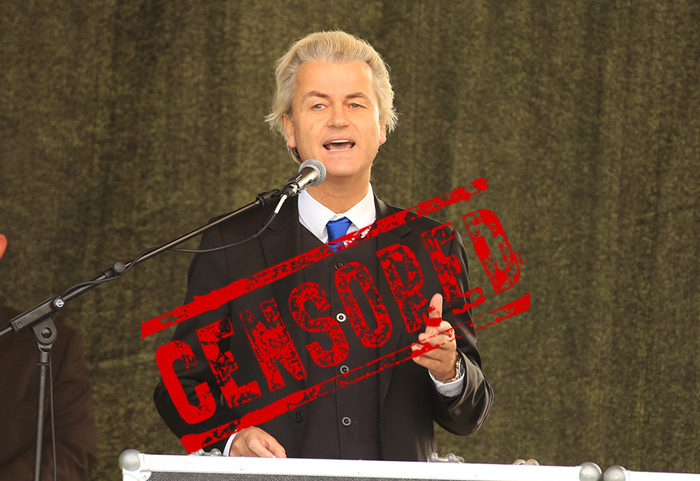

By prosecuting Dutch member of parliament Geert Wilders for making "politically incorrect" statements, Dutch courts are behaving like a religious court. They are trying to regulate public expression and opinion when it comes to the followers of one religion. (Source of Wilders photo: Flickr/Metropolico)

Opinion polls suggest that around half the Dutch public want fewer Moroccans in the Netherlands and many opinion polls going back decades suggest that the Dutch people want less immigration in general. So at the very least Wilders is being put on trial for voicing an opinion which is far from fringe. The long-term implications for Dutch democracy of criminalizing a majority opinion are catastrophic. But the trial of Wilders is also a nakedly political move.
Whether or not one feels any support for Wilders's sentiments is not in fact the point in this case. The point is that by prosecuting someone for saying what he said, the courts in Holland are effectively ruling that there is only one correct answer to the question Wilders asked. They are saying that if someone asks you whether you would like more Moroccans or fewer, people must always answer "more," or they will be committing a crime. What kind of way is that to order a public debate on immigration or anything else? People may say, "He wouldn't be allowed to say that about any other group of people." And Wilders himself may not say that about any group of people, because he has his own political views and his own interpretation of the problems facing his country.
It is worth trying a thought-experiment: If Wilders or any other politician got up and asked a crowd "Do you want more or fewer British people in Holland," I may not -- as a British person -- feel terribly pleased with him for asking the question, or terribly happy with the crowd if they chanted "Fewer." Although if British expats in Holland were responsible for a disproportionate amount of crime and disorder in the country, some mitigating sympathy for the sentiment may be forthcoming. But at no point would it occur to me that anyone saying he did not want an endless flow of British people coming into the Netherlands should be prosecuted. Nor would he be.
Like the behaviour of the British Gymnastics association, the Dutch courts are behaving like a religious court. They are trying to regulate public expression and opinion when it comes to the followers of one religion. In so doing, they obviously aspire to keep the peace in the short term, but they cannot possibly realise what trouble they are storing up for our future.
Douglas Murray, British author, commentator and public affairs analyst, is based in London, England.
=======================

Judith Bergman : Europe: Let's End Free Speech!


  • According to New Europe, in Leeuwarden, "about twenty opponents of the plans [to establish asylum centers] in the region received police visits at home." In other words, the Netherlands are engaging in state censorship, thereby raising the question: Is the Netherlands now a police state?
  • In the town of Sliedrecht, police came to Mark Jongeneel's office and told him that he tweeted "too much" and that he should "watch his tone": his tweets "may seem seditious". His offense? One tweet said: "The College of #Sliedrecht comes up with a proposal to take 250 refugees over the next two years. What a bad idea!"
  • In September 2015, Die Welt reported that people who air "xenophobic" views on social media, risk losing the right to see their own children.
  • While ordinary European citizens risk arrest and prosecution for "xenophobic" remarks, a German EU Commissioner, Günther Oettinger, called a visiting Chinese delegation of ministers "slant eyes" ("Schlitzaugen"). European Commission President Jean-Claude Juncker has promoted Oettinger to be in charge of the EU budget.
  • Clearly, the law is not equal. EU Commissioners can make "xenophobic" remarks and get a promotion; European citizens, for exercising their right to free speech, are arrested and prosecuted.
In Europe, is the enemy now the governments? Evidence is mounting that expressing even a mild opinion that runs counter to official government policy can land you in prison, or at least ensure a visit from your friendly local Kafkaesque police. Has Europe effectively become a police state?

Several European governments are making it clear to their citizens that criticizing migrants or European migrant policies is criminally off limits. People who go "too far," according to the authorities, are being arrested, prosecuted and at times convicted.

In the Netherlands, the police visited people who naïvely made critical comments about asylum centers on Twitter in October 2015. In the town of Sliedrecht, police came to Mark Jongeneel's office and told him that he tweeted "too much" and that he should "watch his tone": his tweets "may seem seditious". His offense? The town had held a citizens meeting about a refugee center in the region, and Jongeneel had posted a few tweets. One said: "The College of #Sliedrecht comes up with a proposal to take 250 refugees over the next two years. What a bad idea!" Earlier he had also tweeted: "Should we let this happen?!"

He was not the only one. In Leeuwarden, according to New Europe:
"...about twenty opponents of the plans [to establish asylum centers] in the region received police visits at home. It also happened in Enschede, and in some places in the Brabant, where, according to the Dutch media, people who had been critical of the arrival of refugees and ran a page on social media on the topic were told to stop".
A spokesperson for the national police explained that ten intelligence units of "digital detectives" monitor Facebook pages and Twitter accounts in real time, looking for posts that go "too far," so that they can visit with people to tell them "what effect a post or tweet on the internet can have." In other words, the Netherlands are engaging in state censorship, thus raising the question: Is the Netherlands now a police state?

In the United Kingdom, Scott Clark was arrested in February 2016 for writing on the Facebook page of the Scottish Defense League that Syrian refugees would "see the nasty side to us." According to a news report, he referred to sexual assaults on women in Cologne, Germany on New Year's Eve by men of Arab or North African appearance as justification for his online comments, in which he also wrote, "If anything happens to any young girl I will personally spit in the face of councilors who pushed and pushed to get them housed here..." He also wrote, "There's defo an Islamic invasion. Defo something going down. Just witnessed 15 Syrians in the local boozer... I opposed their arrival from the start."

Inspector Ewan Wilson from Dunoon police office told the Guardian:
"I hope that the arrest of this individual sends a clear message that Police Scotland will not tolerate any form of activity which could incite hatred and provoke offensive comments on social media."
In Germany, a married couple, Peter and Melanie M., were prosecuted in a criminal trial for creating a Facebook group that criticized the government's migration policy. According to news reports, the page stated, "The war and economic refugees are flooding our country. They bring terror, fear, sorrow. They rape our women and put our children at risk. Make this end!"

At the trial, Peter M. defended his remarks online and said, "One cannot even express a critical opinion of refugees without getting labelled as a Nazi. I wanted to create a discussion forum where you can speak your mind about refugees..." He said that in his role as an administrator of the group, he removed pro-Nazi or radical remarks, but since Facebook had deleted the page, he could not present the evidence to the court.
In his verdict, the judge said, "The description of the group is a series of generalizations with a clear right-wing background." Peter M. was sentenced to a nine-month suspended prison sentence and his wife to a fine of €1,200 with the judge adding, "I hope you understand the seriousness of the situation. If you sit in front of me again, you will end up in jail."

In Germany, being critical of migrants and the government's migrant policies can have other draconian consequences. In September 2015, Die Welt reported that people who air "xenophobic" views on social media, risk losing the right to see their own children. There need not even be a criminal offense for a court to consider the child's welfare to be endangered and to restrict the parents' right to see his or her child or to order "an educator" present during a meeting between parent and child, who can "intervene as required." It is also possible to forbid certain actions, expressions or meetings in the presence of the child. As a last resort, the court can take the child out of the parent's care entirely.

According to Eva Becker, Chairwoman of the Working Group on Family Law in the German Bar Association (DAV), "The decisive factor is a healthy understanding of people." Becker estimates that it would not be enough to consider the child's welfare endangered, if a parent said that he would rather not have any Syrian migrants living in his neighborhood.
On the other hand, if a father or a mother makes comments that contain verbal threats against refugees in the presence of the child, he or she would "clearly exceed the critical limit."
It is not even relevant whether those comments are criminal according to German law. Even a comment that is not punishable under German law can push a parent over the "critical limit." It is not crucial whether the act is criminal, but whether it "influences" the child in a way that endangers its welfare. If a court establishes that the child's welfare is at risk, the parent may have his or her rights of access to the child initially limited.
Actions, rather than talk, are considered even more incriminating. According to Becker, it is one thing to talk disparagingly with acquaintances about asylum seekers in the presence of the child, but much worse to take the child to "xenophobic" demonstrations.

Becker never defines what is meant by "xenophobic." 

It seems implied that the talk is of one-way xenophobia, not Islamic xenophobia against non-Muslims, for example, but no attempt is made at a definition, although this is clearly the most crucial part of the matter.

While ordinary European citizens risk arrest and prosecution for "xenophobic" remarks, it is an entirely different matter for those at the top echelons of the European Union.
In a speech in Hamburg in October, Germany's EU Commissioner for digital economy, Günther Oettinger, called a visiting Chinese delegation of ministers "slant eyes" ("Schlitzaugen"), an expression that is generally considered racist. Oettinger did not even bother to apologize, but told Die Welt that it was important to see his comments in a "larger context."
The European Commission also refused to apologize for, or investigate, Oettinger's remarks (which were apparently also disparaging of women and homosexuals). Commission Chief Spokesman Margaritis Schinas told incredulous reporters that, "We have nothing to add." Asked if there would be an investigation into the remarks, he said, "We do not have an FBI at the Commission."
As recent as October 28, European Commission President Jean-Claude Juncker promoted Oettinger to the highly coveted and powerful position of vice-president with responsibility for the EU budget.
Clearly, the law is not equal. EU Commissioners can make "xenophobic" remarks and get a promotion; European citizens, for exercising their right to free speech, are arrested and prosecuted.


While European citizens are arrested and prosecuted for exercising their right to free speech, an EU Commissioner such as Günther Oettinger (left) calls a visiting Chinese delegation "slant eyes" and is rewarded with a promotion by European Commission President Jean-Claude Juncker (right).
Judith Bergman is a writer, columnist, lawyer and political analyst.
============

Tuesday, April 11, 2017

Guy Millière : Geert Wilders and the Suicide of Europe


  • None of Wilders's speeches incites violence against anyone; the violence that surrounds him is directed only at him.
  • The only person talking about these problems is Geert Wilders. Dutch political leaders and most journalists seemingly prefer to claim that Geert Wilders is the problem; that if he were not there, these problems would not exist.
  • What adherents of this view, that the West is guilty, "forget" is that Islam long oppressed the West: Muslim armies conquered Persia, the Christian Byzantine Empire, North Africa and the Middle East, Spain, Greece, Hungary, Serbia and the Balkans, and virtually all of Eastern Europe. The Muslim armies were a constant threat until the marauding Ottoman troops were finally turned away at the Gates of Vienna in 1683.
Even if the Dutch politcian Geert Wilders had won and if the Party for Freedom (PVV) he established eleven years ago had become the first party in the country, he would not have been able to become the head of the government. The heads of all the other political parties said they would reject any alliance with him ; they maintain this position to this day.

For years, the Dutch mainstream media have spread hatred and defamation against Wilders for trying to warn the Dutch people - and Europe - about what their future will be if they continue their current immigration policies; in exchange, last December, a panel of three judges found him guilty of "inciting discrimination". Newspapers and politicians all over Europe unceasingly describe him as a dangerous man and a rightist firebrand. Sometimes they call him a "fascist".

What did Geert Wilders ever do to deserve that? None of his remarks ever incriminated any person or group because of their race or ethnicity. To charge him, the Dutch justice system had excessively and abusively to interpret words he used during a rally in which he asked if the Dutch wanted "fewer Moroccans." None of Wilders's speeches incites violence against anyone; the violence that surrounds him is directed only at him. He defends human rights and democratic principles and he is a resolute enemy of all forms of anti-Semitism.

His only "crime" is to denounce the danger represented by the Islamization of the Netherlands and the rest of Europe and to claim that Islam represents a mortal threat to freedom. 

Unfortunately, he has good empirical reasons to say that. Also unfortunately, the Netherlands is a country where criticism of Islam is particularly dangerous: Theo van Gogh made an "Islamically incorrect" film in 2004 and was savagely murdered by an Islamist who said he would kill again if he could. Two years earlier, Pim Fortuyn, who had hoped to stand for election, defined Islam as a "hostile religion" ; he was killed by a leftist Islamophile animal-rights activist. Geert Wilders is alive only because he is under around-the-clock police protection graciously provided by the Dutch government.


In 2004, Moroccan-Dutch terrorist Mohammed Bouyeri (left), shot the filmmaker Theo van Gogh (right) to death, then stabbed him and slit his throat.

More broadly, the Netherlands is a country where the Muslim community shows few signs of integration. There are now forty no-go zones in the country; riots easily erupt, recently in Rotterdam, Amsterdam and Nijmegen. People recently from other countries repeatedly attack Dutch-born citizens. Some are so sure of their impunity that they publish online videos of their crimes. Throughout the country, an ethnic cleansing that Europeans are too scared to name is taking place in the suburbs, and non-Muslim residents often say they feel harassed.

Non-Muslim women are encouraged by local authorities to dress "modestly". As in Islam dogs are haram (impure), dog owners are asked to keep their pets indoors. In 2014, 2015 and 2016, Islamists demonstrated and shouted slogans in support of Hamas and the Islamic State.

Daily life has become particularly difficult for the 40,000 Jews still living in the country; districts long inhabited by members of the Jewish community have become almost entirely Muslim. Authorities recommend that Jews avoid any "visible sign" of Jewishness to avoid creating "unrest". Muslim delinquency is high; the percentage of Muslims sent to jail for various crimes is notably higher than the percentage of Muslims in the population. Six percent of the country's population are Muslim; about 20% of all inmates are Muslim. None of this is secret.

The only person talking about these problems is Geert Wilders. Dutch political leaders and most journalists seemingly prefer to claim that Geert Wilders is the problem; that if he were not there, these problems would not exist. At best, they utter fuzzy words intended to show strength; at worst, they turn their back.

A large percentage of the Dutch population is anxious; the constant demonization of Geert Wilders apparently tries to indoctrinate the people to settle for less.
A year ago, London's Muslim Mayor Sadiq Khan stated that "living with terror attacks is 'part and parcel of living in a big city." It did not used to be that way . Rotterdam's Muslim mayor, Ahmed Abutaleb used harsher words; he said that migrants had to "respect the law or go home".

In late January, the incumbent prime minister, Mark Rutte, published a full-page advertisement in several newspapers warning immigrants to "act normal or be gone"; he did not use the word "Islam".

On March 11, 2017, four days before the Dutch elections, Rutte decided to send a "strong message" to bar Turkish ministers from speaking in Rotterdam. Voters who had considered supporting Geert Wilders voted instead for Rutte's People's Party for Freedom and Democracy (VVD); he thereby secured a last minute win. Wilders's party came in second. The Party for Freedom (PVV) won five more seats than before, but will have only 20 seats, out of 150. Rutte's VVD will have 33 seats. The Labor party, Rutte's main ally until March 15, collapsed and is down to nine seats, its worst result ever. The left, however, is not retreating: GroenLinks, a party largely made of former communists and radical environmentalists won 14 seats,10 more than before. The Socialist Party won 14 seats. "Democrats 66", a "social-liberal", "progressive" and multicultural party won 19 seats, almost as much as the Party for Freedom. A Muslim party, Denk (Dutch for "think, Turkish for "equality "), won three seats. The VNL, a conservative party established by two former Party for Freedom members, was beaten so severely it will have no seat at all.

The next Dutch government will be a coalition of four parties, maybe five, and probably lean more to the left than previous governments. It will certainly include Democrats 66, and could include Groenlinks.

In the years to come, the situation in the country is certin to deteriorate. The Netherlands' fertility rate (1.68 children per woman) is not as catastrophic as in Germany, Italy or Spain, but is far below the replacement rate. The Muslim birth rate is higher than the non-Muslim one.
Dozens of churches close each year due to the rapid decline in the number of practicing Christians; the churches are replaced by mosques. Radical preachers keep coming and proselytizing; Islamist organizations keep recruiting. In a report on the Islamization of the Netherlands published ten years ago, Manfred Gerstenfeld wrote that "resistance to radical forces within the Dutch Muslim community is weak". Nothing has changed since that time.

What is happening in the Netherlands is similar to what is happening in most European countries. In the United Kingdom, Belgium, France, Germany and Sweden, the number of no-go zones is rapidly growing. Islamic riots occur more and more often. Ethnic gangs are growing more violent. Ethnic cleansing is transforming neighborhoods. Jews are leaving for Israel or North America.The Muslim population is sharply increasing. Radical mosques are proliferating. Islamic organizations are everywhere.

Politicians who dare to speak the way Geert Wilders does are treated the way Geert Wilders is treated : scorned, marginalized, put on trial.

The vision of the world in Western Europe is now 'hegemonic'. It is based on the idea that the Western world is guilty; that all cultures are equal, and that Islamic culture is "more equal" than Western culture because Islam was supposedly so long oppressed by the West. 

What adherents of this view, that the West is guilty, "forget" is that Islam long oppressed the West: Muslim armies conquered Persia, the Christian Byzantine Empire, North Africa and the Middle East, Spain, Greece, Hungary, Serbia and the Balkans, and virtually all of Eastern Europe. The Muslim armies were a constant threat until the marauding Ottoman troops were finally turned away at the Gates of Vienna in 1683.

This European vision also includes the idea that all conflicts can be peacefully settled, that appeasement is almost always a solution, and that Europe has no enemies.

It also stands on the idea that an enlightened elite must have the power, because if Adolf Hitler came to power through democratic means eighty years ago, letting people freely decide their fate might lead to ill.

The dream seems to be of a utopian future where poverty will be overcome by welfare systems, and violence will be defeated by openness and love.

It is this vision of the world that may have prompted Germany's Chancellor Angela Merkel to open the doors to more than a million unvetted Muslim migrants, despite a migrant crime wave and an increasing number of rapes and sexual assaults. The only candidate likely to beat Angela Merkel in this year's German elections is a socialist, Martin Schulz, a former European Parliament president.

In France, Marine Le Pen, the only candidate who speaks of Islam and immigration, will almost certainly be defeated by Emmanuel Macron, a former minister in the government of François Hollande -- a man who see no evil anywhere.

It is this vision of the world that also seems to have led British Prime Minister Theresa May to say that the Islamic attack on March 22 in Westminster was "not an act of Islamic terrorism".

This romanticized, utopian vision of the world also explains why in Europe, people such as Geert Wilders are seen as the incarnation of evil, but radical Islam is considered a marginal nuisance bearing no relation to the "religion of peace".

Meanwhile, Wilders is condemned to live under protection as if he were in jail, while those who want to slaughter him -- and who threaten millions of people in Europe -- walk around free.

This adolescent vision is so embedded in the minds of millions of Europeans that a lot fast growing-up will be required to eradicate it.
Dr. Guy Millière, a professor at the University of Paris, is the author of 27 books on France and Europe.
================

Thursday, April 6, 2017

Reaction of Geert Wilders to His Conviction


Dear friends, I still cannot believe it, but I have just been convicted. Because I asked a question about Moroccans. While the day before yesterday, scores of Moroccan asylum-seekers terrorized buses in Emmen and did not even had to pay a fine, a politician who asks a question about fewer Moroccans is sentenced.
The Netherlands have become a sick country. And I have a message for the judges who convicted me: You have restricted the freedom of speech of millions of Dutch and hence convicted everyone. No one trusts you anymore. But fortunately, truth and liberty are stronger than you. And so am I.


I will never be silent. You will not be able to stop me. And you are wrong, too. Moroccans are not a race, and people who criticize Moroccans are not racists. I am not a racist and neither are my voters. This sentence proves that you judges are completely out of touch.

And I have also a message for Prime Minister Rutte and the rest of the multicultural elite: You will not succeed in silencing me and defeating the PVV. Support for the Party for Freedom is stronger than ever, and keeps growing every day. The Dutch want their country back and cherish their freedom. It will not be possible to put the genie of positive change back in the bottle.

And to people at home I say: Freedom of speech is our pride. And this will remain so. For centuries, we Dutch have been speaking the unvarnished truth. Free speech is our most important possession. We will never let them take away our freedom of speech. Because the flame of freedom burns within us and cannot be extinguished.
Millions of Dutch are sick and tired of political correctness. Sick and tired of the elite which only cares about itself and ignores the ordinary Dutchman. And sells out our country. People no longer feel represented by all these disconnected politicians, judges and journalists, who have been harming our people for so long, and make our country weaker instead of stronger.

But I will keep fighting for you, and I tell all of you: thank you so much. Thank you so much for all your support. It is really overwhelming; I am immensely grateful to you. Thanks to your massive and heartfelt support, I know that I am not alone. That you back me, and are with me, and unwaveringly stand for freedom of expression.
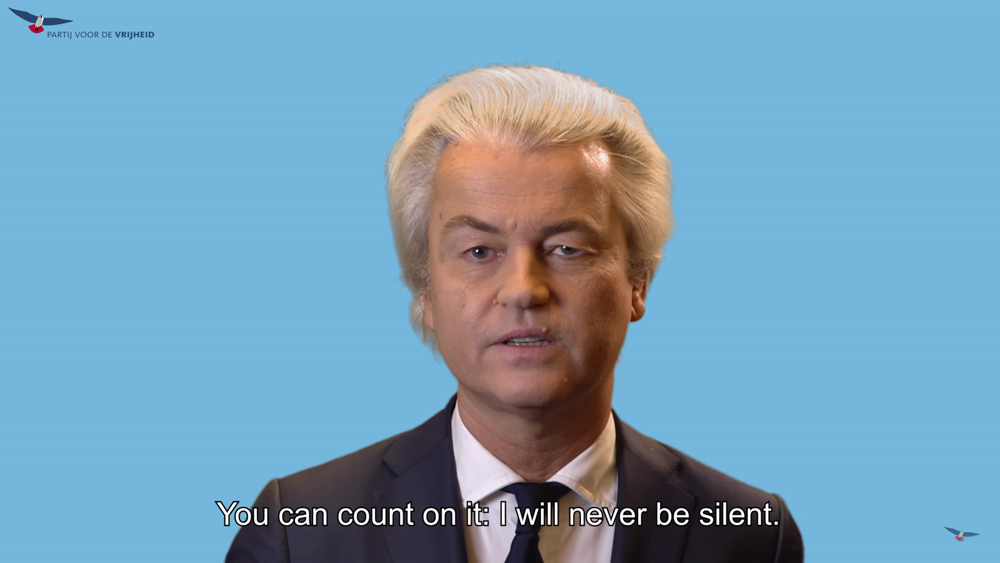
Today, I was convicted in a political trial, which, shortly before the elections, attempts to neutralize the leader of the largest and most popular opposition party. But they will not succeed. Not even with this verdict. Because I speak on behalf of millions of Dutch. And the Netherlands are entitled to politicians who speak the truth, and honestly address the problems with Moroccans. Politicians who will not let themselves be silenced. Not even by the judges. And you can count on it: I will never be silent.

And this conviction only makes me stronger. This is a shameful sentence, which, of course, I will appeal. But I can tell you, I am now more vigorous than ever. And I know: together, we aim for victory.
Standing shoulder-to-shoulder, we are strong enough to change the Netherlands.
To allow our children to grow up in a country they can be proud of.
In a Netherlands where we are allowed to say again what we think.
Where everybody can safely walk the streets again.
Where we are in charge of our own country again.
And that is what we stand for. For freedom and for our beautiful Netherlands.
Geert Wilders is a member of the Dutch Parliament and leader of the Party for Freedom (PVV).

=======================

Final Statement of Geert Wilders at his Trial

Final Statement of Geert Wilders at his Trial

by

Mr. President, Members of the Court,
When I decided to address you here today, by making a final statement in this trial against freedom of speech, many people reacted by telling me it is useless. That you, the court, have already written the sentencing verdict a while ago. That everything indicates that you have already convicted me. And perhaps that is true. Nevertheless, here I am. Because I never give up. And I have a message for you and the Netherlands.
For centuries, the Netherlands are a symbol of freedom.
When one says Netherlands, one says freedom. And that is also true, perhaps especially, for those who have a different opinion than the establishment, the opposition. And our most important freedom is freedom of speech.
We, Dutch, say whatever is close to our hearts. And that is precisely what makes our country great. Freedom of speech is our pride.
And that, precisely that, is at stake here, today.
I refuse to believe that we are simply giving this freedom up. Because we are Dutch. That is why we never mince our words. And I, too, will never do that. And I am proud of that. No-one will be able to silence me.
Moreover, members of the court, for me personally, freedom of speech is the only freedom I still have. Every day, I am reminded of that. This morning, for example. I woke up in a safe-house. I got into an armored car and was driven in a convoy to this high security courtroom at Schiphol. The bodyguards, the blue flashing lights, the sirens. Every day again. It is hell. But I am also intensely grateful for it.
Because they protect me, they literally keep me alive, they guarantee the last bit of freedom left to me: my freedom of speech. The freedom to go somewhere and speak about my ideals, my ideas to make the Netherlands -- our country -- stronger and safer. After twelve years without freedom, after having lived for safety reasons, together with my wife, in barracks, prisons and safe-houses, I know what lack of freedom means.
I sincerely hope that this will never happen to you, members of the court. That, unlike me, you will never have to be protected because Islamic terror organizations, such as Al-Qaeda, the Taliban and ISIS, and who knows how many individual Muslims, want to murder you. That you will no longer be allowed to empty your own mailbox, need to carry a bulletproof vest at meetings, and that there are police officers guarding the door whenever you use the bathroom. I hope you will be spared this.
However, if you would have experienced it -- no matter how much you disagree with my views -- you might perhaps understand that I cannot remain silent. That I should not remain silent. That I must speak. Not just for myself, but for the Netherlands, our country. That I need to use the only freedom that I still have to protect our country. Against Islam and against terrorism. Against immigration from Islamic countries. Against the huge problem with Moroccans in the Netherlands. I cannot remain silent about it; I have to speak out. That is my duty, I have to address it, I must warn for it, I have to propose solutions for it.
I had to give up my freedom to do this and I will continue. Always. People who want to stop me will have to murder me first.
And so, I stand here before you. Alone. But I am not alone. My voice is the voice of many. In 2012, nearly 1 million Dutch have voted for me. And there will be many more on March 15th.
According to the latest poll, soon, we are going to have two million voters. Members of the court, you know these people. You meet them every day. As many as one in five Dutch citizens would vote the Party for Freedom, today. Perhaps your own driver, your gardener, your doctor or your domestic aid, the girlfriend of a registrar, your physiotherapist, the nurse at the nursing home of your parents, or the baker in your neighborhood. They are ordinary people, ordinary Dutch. The people I am so proud of.
They have elected me to speak on their behalf. I am their spokesman. I am their representative. I say what they think. I speak on their behalf. And I do so determinedly and passionately. Every day again, including here, today.
So, do not forget that, when you judge me, you are not just passing judgment on a single man, but on millions of men and women in the Netherlands. You are judging millions of people. People who agree with me. People who will not understand a conviction. People who want their country back, who are sick and tired of not being listened to, who cherish freedom of expression.
Members of the court, you are passing judgment on the future of the Netherlands. And I tell you: if you convict me, you will convict half of the Netherlands. And many Dutch will lose their last bit of trust in the rule of law.

Geert Wilders in court, November 23, 2016. (Image source: NPO Nieuws video screenshot)
Of course, I should not have been subjected to this absurd trial. Because this is a political trial. It is a political trial because political issues have to be debated in Parliament and not here. It is a political trial because other politicians -- from mostly government parties -- who spoke about Moroccans have not been prosecuted. It is a political trial because the court is being abused to settle a political score with an opposition leader whom one cannot defeat in Parliament.
This trial here, Mr. President, it stinks. It would be appropriate in Turkey or Iran, where they also drag the opposition to court. It is a charade, an embarrassment for the Netherlands, a mockery of our rule of law.
And it is also an unfair trial because, earlier, one of you -- Mrs. van Rens -- commented negatively on the policy of my party and the successful challenge in the previous Wilders trial. Now, she is going to judge me.
What have I actually done to deserve this travesty? I have spoken about fewer Moroccans at a market, and I have asked questions of PVV members during a campaign event. And I did so, members of the court, because we have a huge problem with Moroccans in this country. And almost no-one dares to speak about it or take tough measures. My party alone has been speaking about this problem for years.
Just look at these past weeks: Moroccan fortune-seekers stealing and robbing in Groningen, abusing our asylum system, and Moroccan youths terrorizing entire neighborhoods in Maassluis, Ede and Almere. I can give tens of thousands of other examples -- almost everyone in the Netherlands knows them or has personally experienced nuisance from criminal Moroccans. If you do not know them, you are living in an ivory tower.
I tell you: If we can no longer honestly address problems in the Netherlands, if we are no longer allowed to use the word "alien," if we, Dutch, are suddenly racists because we want Black Pete to remain black, if we only go unpunished if we want more Moroccans or else are dragged before a criminal court, if we sell out our hard-won freedom of expression, if we use the courts to silence an opposition politician, who threatens to become Prime Minister, then this beautiful country will be doomed. That is unacceptable, because we are Dutch and this is our country.
And again, what on earth have I done wrong? How can the fact be justified that I have to stand here as a suspect, as if I robbed a bank or committed murder?
I only spoke about Moroccans at a market and asked a question at an election-night meeting. And anyone who has the slightest understanding of politics, knows that the election-night meetings of every party consist of political speeches full of slogans, one-liners and making maximum use of the rules of rhetoric. That is our job. That is the way it works in politics.
Election nights are election nights, with rhetoric and political speeches; not university lectures, in which every paragraph is scrutinized for 15 minutes from six points of view. It is simply crazy that the Public Prosecutor now uses this against me, as if one would blame a football player for scoring a hattrick.
Indeed, I said at the market, in the beautiful Hague district of Loosduinen: "if possible fewer Moroccans." Mark that I did so a few minutes after a Moroccan lady came to me and told me she was going to vote PVV because she was sick and tired of the nuisance caused by Moroccan youths.
And on election night, I began by asking the PVV audience "Do you want more or less EU," and I also did not explain in detail why the answer might be less. Namely, because we need to regain our sovereignty and reassert control over our own money, our own laws and our own borders. I did not do that.
Then, I asked the public "Do you want more or less Labour Party." And, again, I did not explain in detail why the answer might be less. Namely, because they are the biggest cultural relativists, willfully blind and Islam-hugging cowards in Parliament. I did not say that.
And then I asked, "Do you want more or fewer Moroccans," and again, I did not explain in detail why the answer might be fewer. Namely, because people with Moroccan nationality are overrepresented in the Netherlands in crime, benefit dependency and terror. And that we want to achieve this by expelling criminals with Moroccan nationality after denaturalizing them of their Dutch nationality, by a stricter immigration policy and an active voluntary repatriation policy. Proposals that we have made in our election manifesto from the day I founded the Party for Freedom.
I explained this in several interviews on national television, both between the statement at the market and election night, as well as on election night a few moments after I had asked the said questions. It is extremely malicious and false of the Public Prosecutor to want to disregard that context.
Disgusting -- I have no other words for it -- are the actions of other politicians, including the man who for a few months may still call himself Prime Minister. Their, and especially his, actions after the said election night constituted real persecution, a witch hunt. The government created an atmosphere in which it had to come to trial.
Prime Minister Rutte even told small children during the youth news that I wanted to expel them, and then reassured them that this would not happen. As if I had said anything of that kind. It is almost impossible to behave viler and falser.
But, also, the then Minister of Security and Justice -- who, it should be noted, is the political boss of the Public Prosecutor -- called my words disgusting and even demanded that I take them back. A demand of the Minister of Justice -- you do not have to be named Einstein to predict what will happen next, what the Public Prosecutor will do, if you do not comply to the demand of the Minister of Justice.
The Interior Minister and the Deputy Prime Minister, too, both from the Labour Party, expressed themselves similarly. In short, the government left the Public Prosecutor no option than to prosecute me. Hence, in this trial, the Officers of Justice are not representatives of an independent Public Prosecutor, but accomplices of this government.
Mr. President, the elite also facilitated the complaints against me. With pre-printed declaration forms, which were brought to the mosque by the police. In which, it has to be noted, the police sometimes said that they, too, were of the opinion that my statements were inadmissible.
And a sample taken by us showed that some complaints were the result of pure deception, intimidation and influence. People thought they were going to vote; they not even know my name, did not realize what they were signing or declared that they did not feel to be discriminated against by me at all.
Someone said that, at the As Soenah mosque, after Friday prayers alone, 1,200 complaints were lodged because it was thought to be an election. There were parades, led by mayors and aldermen, like in Nijmegen, where CDA mayor Bruls was finally able to show off his deep-seated hatred of the PVV. The police had extra opening hours, offered coffee and tea, there were dancing and singing Moroccans accompanied by a real oompah band in front of a police station. They turned it into a big party.
But meanwhile, two representative polls, one commissioned by the PVV, the other commissioned by De Volkskrant, showed that, apart from the government and media elite, 43% of the Dutch people, around 7 million people, agree with me. Want fewer Moroccans. You will be very busy if the Public Prosecutor is going to prosecute all these 7 million people.
People will never understand that other politicians -- especially from government parties -- and civil servants who have spoken about Moroccans, Turks and even PVV members, are being left alone and not prosecuted by the Public Prosecutor.
Like Labour leader Samsom, who said that Moroccan youths have a monopoly on ethnic nuisance.
Or Labour chairman Spekman, who said Moroccans should be humiliated.
Or Labour alderman Oudkerk, who spoke about f*cking Moroccans.
Or Prime Minister Rutte, who said that Turks should get lost.
And what about police chief Joop van Riessen, who said about me on television -- I quote literally: "Basically one would feel inclined to say: let's kill him, just get rid of him now and he will never surface again"?
And in reference to PVV voters, van Riessen declared: "Those people must be deported, they no longer belong here." End of quote. The police chief said that killing Wilders was a normal reaction. That is hatred, Mr. President, pure hatred -- and not by us, but against us. And the Public Prosecutor did not prosecute Mr. Van Riessen.
But the Public Prosecutor does prosecute me. And demands a conviction based on nonsensical arguments about race and concepts that are not even in the law. It accuses and suspects me of insulting a group and inciting hatred and discrimination on grounds of race. How much crazier can it become? Race. What race?
I spoke and asked a question about Moroccans. Moroccans are not a race. Who makes this up? No-one at home understands that Moroccans have suddenly become a race. This is utter nonsense. Not a single nationality is a race. Belgians are no race, Americans are no race. Stop this nonsense, I say to the Public Prosecutor. I am not a racist and neither are my voters. How do you dare suggest that? Wrongly slandering millions of people as racists.
43% of the Dutch want fewer Moroccans, as I already said. They are no racists. Stop insulting these people. Every day, they experience the huge problem with Moroccans in our country. They have a right to a politician who is not afraid to mention the problem with Moroccans. But neither they nor I care whether someone is black, yellow, red, green or violet.
I tell you: If you convict someone for racism while he has nothing against races, then you undermine the rule of law, then it is bankrupt. No-one in this country will understand that.
And now the Public Prosecutor also uses the vague concept of "intolerance." Yet another stupidity. The subjective word intolerance, however, is not even mentioned in the law. And what for heaven's sake is intolerance? Are you going to decide that, members of the court?
It is not up to you to decide. Nor up to the Supreme Court or even the European Court. The law itself must determine what is punishable. We, representatives, are elected by the people to determine clearly and visibly in the law for everyone what is punishable and what is not.
That is not up to the court. You should not do that, and certainly not on the basis of such subjective concepts, which are understood differently by everyone and can easily be abused by the elite to ban unwelcome opinions of the opposition. Do not start this, I tell you.
Mr. President, Members of the Court,
Our ancestors fought for freedom and democracy. They suffered, many gave their lives. We owe our freedoms and the rule of law to these heroes. But the most important freedom, the cornerstone of our democracy, is freedom of speech. The freedom to think what you want and to say what you think.
If we lose that freedom, we lose everything. Then, the Netherlands cease to exist; then the efforts of all those who suffered and fought for us are useless. From the freedom fighters for our independence in the Golden Age to the resistance heroes in World War II. I ask you: Stand in their tradition. Stand for freedom of expression.
By asking for a conviction, the Public Prosecutor, as an accomplice of the established order, as a puppet of the government, asks to silence an opposition politician. And, hence, silence millions of Dutch. I tell you: The problems with Moroccans will not be solved this way, but will only increase.
For people will sooner be silent and say less because they are afraid of being called racist, because they are afraid of being sentenced. If I am convicted, then everyone who says anything about Moroccans will fear to be called a racist.
Mr. President, Members of the Court, I conclude.
A worldwide movement is emerging that puts an end to the politically correct doctrines of the elites and the media that are subordinate to them.
That has been proven by Brexit.
That has been proven by the US elections.
That is about to be proven in Austria and Italy.
That will be proven next year in France, Germany, and The Netherlands.
The course of things is about to take a different turn. Citizens no longer tolerate it.
And I tell you, the battle of the elite against the people will be won by the people. Here, too, you will not be able to stop this, but rather accelerate it. We will win, the Dutch people will win, and it will be remembered well who was on the right side of history.
Common sense will prevail over politically correct arrogance. Because everywhere in the West, we are witnessing the same phenomenon.
The voice of freedom cannot be imprisoned; it rings like a bell. Everywhere, ever more people are saying what they think. They do not want to lose their land, they do not want to lose their freedom.
They demand politicians who take them seriously, who listen to them, who speak on their behalf. It is a genuine democratic revolt. The wind of change and renewal blows everywhere. Including here, in the Netherlands.
As I said:
I am standing here on behalf of millions of Dutch citizens.
I do not speak just on behalf of myself.
My voice is the voice of many.
And, so, I ask you, not only on behalf of myself, but in the name of all those Dutch citizens:
Acquit me! Acquit us!
Geert Wilders is a member of the Dutch Parliament and leader of the Party for Freedom (PVV).

=======================

Giulio Meotti : Critics of Islam on Trial in Europe: Wilders Convicted


  • On December 9, for the first time in Dutch history, a court criminalized freedom of expression: The truly heroic Dutch Member of Parliament, Geert Wilders, was found guilty of the "crimes" of "inciting discrimination and insulting a minority group."
  • The death sentence against Salman Rushdie in 1989 by Iran's supreme leader looked unreal. The West did not take it seriously. Since then, however, this fatwa has been assimilated to such an extent that today's threats to free speech come from ourselves. It is now the West that put on trial writers and journalists.
  • The Red Brigades, the Communist terror group which devastated Italy in the 1970s, coined a slogan: "Strike one to educate one hundred." If you target one, you get collective intimidation. This is exactly the effect of these political trials about Islam.
  • "Hate speech" has become a political weapon to dispatch whoever may not agree with you. It is not the right of a democracy to quibble about the content of articles or cartoons. In the West, we paid a high price for the freedom to write them and and read them it. It is not up to those who govern to grant the right of thought and speech.
  • In Europe now, the same iron curtain as in the Soviet era is descending.
After the Second World War and the horrors of Nazism and Stalinism, a central tenet of Western democracies has been that you can put people on trial, but not ideas and opinions. Europe is now allowing dangerous "human rights" groups and Islamists to use tribunals to restrict the borders of our freedom of expression, exactly as in Soviet show trials. "Militant anti-racism will be for the 21st century what communism was for the 20th century," the prominent French philosopher, Alain Finkielkraut has predicted.

A year ago, Christoph Biró, a respected columnist and editor of the largest Austrian newspaper, Kronen Zeitung, wrote an article blaming "young men, testosterone-fuelled Syrians, who carry out extremely aggressive sexual attacks" (even before mass the sexual assaults of New Year's Eve in Cologne, Hamburg and other cities). The article sparked much controversy, and it received a large number of complaints and protests. Biró needed four weeks off work because of these attacks and later (under pressure) admitted that he had "lost a sense of proportion". Prosecutors in Graz recently charged Biró with "hate speech" after a complaint by a so-called human rights organization, SOS Mitmensch. The case will be decided in court.

Journalists, novelists and intellectuals throughout Europe are now told to raise their right hand before a judge and swear to tell the truth and nothing but the truth -- as if that were not what they were doing all along and for what they are now being prosecuted.
It is an alarming but very common sight today, where "hate speech" has become a political weapon to dispatch whoever may not agree with you.

It is not the right of a democracy to quibble about the content of articles or cartoons. In the West, we paid a high price for the freedom to read and write them. It is not up to those who govern to grant the right of thought and speech, that belongs to the free initiative in the democracies. The right to express our own opinion was paid for dearly, but if it is not exercised, it can quickly disappear.

A grotesque new legal front was just opened in Paris. The French philosopher Pascal Bruckner began his trial, where he opened his defense with a quotation from Jean-Paul Sartre: "The guns are loaded with words". Bruckner, one of the most famous essayists of France, is on trial for having spoken out against the "collaborators of Charlie Hebdo's assassins".
"I will say the names: The organizations 'The Indivisibles' of Rokhaya Diallo and 'The Indigenous of the Republic', the rapper Nekfeu who wanted 'a bonfire for those dogs' (Charlie Hebdo), all those who have justified with ideology the death of the twelve journalists".
Countless witnesses testified in defense of Bruckner: the editor of Charlie Hebdo, "Riss"; the political scientist Laurent Bouvet; the former president of "Neither Whores nor Submissives," Sihem Habchi; and the philosopher, Luc Ferry. Bruckner used the term "collaborator" for "those newspapers which justified the liquidation of the Résistance and the Jews" during the Second World War. Sihem Habchi spoke of the danger of a "green fascism", Islamism.
Bruckner's verdict will be announced on January 17. "Bruckner brought his voice before the 17th Chamber [court], too often a grave-digger of freedom of expression," commented the important and courageous Riposte Laïque.

These political trials about Islam started in 2002, when a court in Paris considered a complaint against Michel Houellebecq, who, in the novel Platforme called Islam "the stupidest religion." The writer Fernando Arrabal, arrested for blasphemy in 1967 in Franco's Spain, was called by Houellebecq to testify in in court. "What a joy to be in a trial for crimes of opinion," Arrabal said in Paris. "Zaragoza, Valladolid, Santander," the playwright named a number of Spanish cities. "This is the list of the prisons where I have been for the same crime as Houellebecq."

The late Italian writer, Oriana Fallaci, was also put on trial for her book, La Rage et l'Orgueil ("The Rage and the Pride"). The French newspaper Libération called her "the woman who defames Islam." Later the satirical weekly, Charlie Hebdo, and its editor, Philippe Val, targeted by Islamist organizations, were also forced to appear in court.

The death sentence against Salman Rushdie in 1989 by Iran's supreme leader Ayatollah Khomeini looked unreal. The West did not take it seriously. Since then, however, this fatwa has been assimilated to such an extent that today's threats to free speech come from ourselves. It is now the West that puts on trial writers and journalists.

It has become almost impossible to list all the journalists and writers who have had to defend themselves in court because of their ideas on Islam. To quote the French-Algerian writer, Boualem Sansal, the author of the novel "2084," from an interview with Libération: "We are aware of the danger, but we do not know how to act for fear of being accused of being anti-immigrant, anti-Islam, anti-Africa... Democracy, like the mouse, will be swallowed by the serpent". And it will be turned into "a society that whispers".

Journalists are now prosecuted even if they question Islam during a radio debate. That is why today most of writers and journalists are only whispering about the consequences of mass migration in Europe, Islam's role in the terrorists' war on democracies and the sultans' offensives on freedom of expression.
The Red Brigades, the Communist terror group which devastated Italy in the 1970s, coined a slogan: "Strike one to educate one hundred." If you target one, you get collective intimidation. This is exactly the effect of these political trials about Islam. The debate is rapidly closing.
In the Netherlands yesterday, the trial for the "crimes" of "inciting discrimination and insulting a minority group" against Geert Wilders was concluded. The brave Dutch politician had asked supporters if they wanted "fewer Moroccans" in the country. Convicting Wilders yesterday, a court criminalized freedom of expression for the first time in Dutch history. (Wilders was acquitted five years ago in a similar trial).

Left: Writer Salman Rushdie. Right: Dutch MP Geert Wilders.

In France Ivan Rioufol, one of the most respected columnists of the newspaper, Le Figaro, had to defend himself in court against the "Collective Against Islamophobia." The writer Renaud Camus, who has expounded on the "great replacement" theory, which holds that France is being colonized by Muslim immigrants with the help of mainstream politicians, was charged with "hate speech." Marine Le Pen also had to appear in court. In Germany, there was the case of Jan Böhmermann, a comedian who satirized Turkish President Recep Tayyip Erdogan on television. German judges then put on trial Lutz Bachmann, the founder of "Pegida," the anti-Islamization movement. In Canada essayist and journalist Mark Steyn was charged with "flagrant Islamophobia" by a "Human Rights Tribunal" (and later cleared). Lars Hedegaard, the president of the Danish Free Press Society, was also charged with "hate speech" (and later aquitted) for comments critical of Islam.
It is fundamental that these writers and journalists are acquitted. But the goal of these trials is not to find the truth; it is to intimidate the public and to restrict freedom of expression on Islam. These are purges to "re-educate" them. Sadly, as we see from the Wilders trial, they have often been succeeding.

After the Russian invasion of Czechoslovakia in 1968, Milan Kundera's novels disappeared from bookstores and libraries. The intelligentsia lay in sterility and isolation. Cinemas and theaters offered only the Soviet performances. Radio, newspapers and televisions streamed only propaganda. The Russians rewarded the bureaucrats who pressured writers and journalists, and punished the rebels. Those who spoke out were often obliged to work as unskilled laborers. Prague, restless and fascinating, became silent and whispering.
In Europe now, the same iron curtain is descending.
Giulio Meotti, Cultural Editor for Il Foglio, is an Italian journalist and author.
==================

Douglas Murray : Geert Wilders - The Guilty Verdict Dutch Politicians Wanted So Much


  • Remarks, incomparably more damning than "fewer Moroccans", [were] made by members of the Netherlands' Labour Party, who of course were never prosecuted.
  • The irony cannot have been lost on the wider world that on the same day that news of Wilders's conviction came out the other news from Holland was the arrest of a 30 year-old terror suspect in Rotterdam suspected of being about to carry out 'an act of terrorism'.
  • Internationally it will continuously be used against Wilders that he has been convicted of 'inciting discrimination' even though the charge is about a proto-crime – a crime that has not even occurred: like charging the makers of a car chase movie for 'inciting speeding'. As with many 'hate-crime' trials across the free world, from Denmark to Canada, the aim of the proceedings is to blacken the name of the party on trial so that they are afterwards formally tagged as a lesser, or non-person. If this sounds Stalinist it is because it is.
  • In the long-term, though, there is something even more insidious about this trial. For as we have noted here before, if you prosecute somebody for saying that they want fewer Moroccans in the Netherlands then the only legal views able to be expressed about the matter are that the number of Moroccans in the country must remain at precisely present numbers or that you would only like more Moroccans in the country. In a democratic society this sort of matter ought to be debatable.
  • If there is one great mental note of which 2016 ought to have reminded the world, it is how deeply unwise it is to try to police opinion. For when you do so you not only make your society less free, but you disable yourself from being able to learn what your fellow citizens are actually – perhaps ever more secretly – feeling. Then one day you will hear them.
The trial of Geert Wilders has resulted in a guilty verdict. The court – which was located in a maximum security courthouse in the Netherlands near Schipol airport – found the leader of the PVV (Freedom Party) guilty of 'insulting a group' and of 'inciting discrimination'. The trial began with a number of complaints, but the proceedings gradually honed down onto one single comment made by Wilders at a party rally in March 2014. This was the occasion when Wilders asked the crowd whether they wanted 'fewer or more Moroccans in your city and in the Netherlands'. The crowd of supporters shouted 'Fewer'.
On Friday morning the court decided not to impose a jail sentence or a fine, as prosecutors had requested. The intention of the court is clearly that the 'guilty' sentence should be enough.


For Wilders himself this will have been another unpleasant ordeal. But he may have become used to them by now. Five years ago Wilders was put on trial for insulting a religion. The first trial fell apart after one of the judges was found to have attempted to influence the evidence of one of Wilders's defence witnesses. Once the trial restarted, it resulted in an acquittal. So the Dutch Justice system turn out to have been "second-time lucky" in getting the conviction they appear to have so badly wanted.
This is apparent from remarks, incomparably more damning than "fewer Moroccans", made by members of the Netherlands' Labour Party, who of course were never prosecuted:
  • "We also have s*** Moroccans over here." Rob Oudkerk, Dutch Labour Party (PvDA) politician.
  • "We must humiliate Moroccans." Hans Spekman, PvDA politician.
  • "Moroccans have the ethnic monopoly on trouble-making." Diederik Samsom, PvDA politician.
Wilders's legal trials are perhaps the least of it. For more than a decade Wilders has had to live under permanent security protection because of the threat to his life from Muslim extremists in the Netherlands. One might agree or disagree with a person who believes there should be fewer Moroccans in the Netherlands, but it requires an extraordinary degree of callousness to prosecute someone whose life is in danger from parts of such a community for voicing a desire not to see that community grow. The irony cannot have been lost on the wider world that on the same day that news of Wilders's conviction came out the other news from Holland was the arrest of a 30 year-old terror suspect in Rotterdam suspected of being about to carry out 'an act of terrorism'.

There are two aspects to this verdict which matter. The first is what it will do for Wilders himself. Domestically, within the Netherlands, it is hard to say. On the one hand it is possible that his supporters and others will be galvanised by the intrusion of the judiciary into politics and by the nakedly partisan and political nature of this trial. Many observers predict a boost in the polls for Wilders, who may benefit from this further proof of what he has often said – that it is Wilders against the Dutch establishment.

But internationally and among a good many Dutch nationals the conviction will carry a stigma. Internationally it will continuously be used against Wilders that he has been convicted of 'inciting discrimination' even though the charge is about a proto-crime – a crime that has not even occurred: like charging the makers of a car chase movie for 'inciting speeding'. As with many 'hate-crime' trials across the free world, from Denmark to Canada, the aim of the proceedings is to blacken the name of the party on trial so that they are afterwards formally tagged as a lesser, or non-person. If this sounds Stalinist it is because it is.

In the long-term, though, there is something even more insidious about this trial. For as we have noted here before, if you prosecute somebody for saying that they want fewer Moroccans in the Netherlands then the only legal views able to be expressed about the matter are that the number of Moroccans in the country must remain at precisely present numbers or that you would only like more Moroccans in the country. In a democratic society this sort of matter ought to be debatable. But the judges in the Wilders case have tried to make it un-debatable. By prosecuting somebody for expressing one opinion they have sent out a message to all citizens. And that is where the stifling effect of the Wilders trial will be felt.

It will be felt by all those Dutch men and women who have concerns about the direction their country is going in, including concerns that the rate of immigration has been too high in recent years. Many of these people will already have felt a certain social pressure not to air their views and now there is the additional restraining factor that their views have been made illegal. At social gatherings across the land the people who believe that there should only ever be more Moroccans in the Netherlands will have an additional card to play against anyone who believes the opposite. For their conversational partner will not merely be risking a social embarrassment but will be standing on the verge of committing a crime.

Any half-way civilised society – as the Netherlands most certainly is – must see that trying to squash contrary views in such a manner is the behaviour of tyrants. This gang-up of the courts and the political elite in an effort to crush dissenting opinion is unbecoming for a great and distinguished nation such as The Netherlands. But they may yet have their comeuppance.

If there is one great mental note of which 2016 ought to have reminded the world, it is how deeply unwise it is to try to police opinion. For when you do so you not only make your society less free, but you disable yourself from being able to learn what your fellow citizens are actually – perhaps ever more secretly – feeling. Then one day you will hear them. And only then – when it is too late – will you remember why you should have listened.
Douglas Murray, British author, commentator and public affairs analyst, is based in London, England

=====================

George Igler : What Was Behind the Trial of Geert Wilders?


  • If Europeans are ever to stand a chance of unravelling the coils of laws constricting their throats, preventing their ability to speak out against the demographic redrawing of their countries or any other potential danger they may note, it may prove helpful understanding how this slow strangulation took shape.
  • Although the gross unfairness of Geert Wilders's prosecution is clear when compared with other Dutch politicians who have articulated far worse, there is also compelling evidence that much that is preached from the Koran in mosques daily would clearly fall under such a definition of hate speech -- also remaining curiously outside the attention of public prosecutors.
  • Are not elected Member of Parliament even more responsible to for the safety of the public than are other citizens? If elected officials are criminalized for speaking out, at what point do such restrictions start posing a national security problem?
  • How are ordinary, decent, native Europeans ever likely socially and politically to articulate how they never consented to being part of a "grand experiment," without incurring the stain of bigotry accompanying this reasonable assertion, from friends and co-workers alike?
  • Would it not be a remarkable irony if, instead of burying Wilders, as the conviction seemed intended to do, it propelled him instead to victory?
Much has been made of the 2016 populist revolt in the West, beginning with Britain's June 23 decision to leave the European Union, and culminating with the victory of president-elect Donald Trump on November 8. The narrative of change is understandably seductive, but has recently been dealt successive blows by the domestic circumstances that so characterize European politics.
Despite traditions of liberty being placed at the heart of the successful Trump campaign, the promise of a new economic approach also enabled him to cross the line on election day.
The Brexit vote similarly took place under a referendum that allowed Britain's voting populace to defy the stated preference of the majority of their elected parliamentarians.
The most disturbing recent development on the European continent, however, was Friday's conviction of Geert Wilders on two charges, "inciting discrimination and insulting a minority group," for asking supporters whether they wanted "fewer Moroccans" in the Netherlands, at a small public rally in a bar in The Hague, on March 19, 2014.


Geert Wilders during his March 2014 speech, where he asked "Do you want more or fewer Moroccans?" (Image source: nos.nl video screenshot)

This "hate speech" case against Wilders similarly pits popular alarm over the consequences of mass migration plus a principled politician who for years -- in the face of threats against his life, has agitated for genuine change -- against an untrustworthy, politicized legal system which appears at odds with both Wilders and popular alarm. Several Dutch Labour Party politicians, who said far more damaging things about Moroccans than Wilders did, yet were never prosecuted:
  • "We also have sh*t Moroccans over here." -- Rob Oudkerk, a Dutch Labour Party (PvDA) politician.
  • "We must humiliate Moroccans." -- Hans Spekman, PvDA politician.
  • "Moroccans have the ethnic monopoly on trouble-making." -- Diederik Samsom, PvDA politician.
Although Wilders's trial clearly appears an orchestrated miscarriage of justice, it is arguably not helpful to view the basis for his prosecution through an absolutist defense of freedom of speech, intuitively understandable to Americans. No constitutional equivalent of the First Amendment, which prohibits Congress from passing laws abridging the freedom of speech, exists in Europe.
This right, however, even in the U.S. is somewhat qualified, as laid out in Brandenberg vs. Ohio, but none of those exceptions would apply to Wilders (imminent danger and individual personalization). Under the strictures of the European Convention of Human Rights (ECHR), freedom of expression is a "qualified" right in much broader terms -- from which "left-wing" members of the Dutch Labour Party issuing the far more objectionable statements quoted above are apparently excluded: "the state may lawfully interfere with the right to freedom of expression in certain defined and limited circumstances."[1]
The arguments qualifying the conviction of Wilders, in the courtroom of the military base at Schiphol Airport, according to the presiding jurist Hendrik Steenhuis, were that the PVV leader's comments were "unworthy" of an elected member of parliament -- as Judge Steenhuis denied any assertion that the trial was politically motivated. Yet, are not elected Members of Parliament even more responsible to for the safety of the public than are other citizens? If elected officials are criminalized for speaking out, at what point do such restrictions start posing a national security problem?
Submitting to the questionable tenets of the ECHR, however, is a condition of EU membership. Dutch prosecutors expressed themselves "very satisfied" with the verdict, a spokeswoman adding, "the standard is set."
If Europeans are ever to stand a chance of unravelling the coils of laws constricting their throats, preventing their ability to speak out against the demographic redrawing of their countries or any other potential danger they may note, it may prove helpful understanding how this slow strangulation took shape.
The most compelling defense of hate speech laws was articulated by Prof. Jeremy Waldron, in 2012, who took issue with those believing that, "the bigoted invective that defiles our public environment, should be of no concern of the law."[2]
In a passage dedicated to expressions of opposition to Muslim immigration, in The Harm in Hate Speech, the NYU School of Law professor questioned those who maintain that:
There is nothing to be regulated here, nothing for the law to concern itself with, nothing that a good society should use its legislative apparatus to suppress or disown. The people who are targeted should just learn to live with it.
He counters:

...there is a sort of public good of inclusiveness that our society sponsors and that it is committed to. We are diverse ... And we are embarked on a grand experiment of living and working together despite these sorts of differences. ... And each person, each member of each group, should be able to go about his or her business, with the assurance that there will be no need to face hostility, violence, discrimination, or exclusion by others.

This sense of security in the space we all inhabit is a public good ... Hate speech undermines this public good, or it makes the task of sustaining it much more difficult than it would otherwise be.
Although the gross unfairness of Geert Wilders's prosecution is clear when compared with other Dutch politicians who have articulated far worse, there is also compelling evidence that much that is preached from the Koran in mosques daily would clearly fall under such a definition of "hate speech" -- also remaining curiously outside the attention of public prosecutors.
Given that "hate speech" damages the maintenance of dignity between groups and public safety, can a compelling case therefore not be made that "hate speech" laws mandated by the European Union are doing considerably more harm than good?
Is it not high time that lawmakers grasp how mass Muslim immigration, and the importation of the sectarianism unfortunately inherent in Islamic doctrine, undermine even more significantly these noble principles of "public good"?
How exactly are the terrorism, rape and crime waves that have accompanied such migration into Europe, likely to be addressed by the democratic process -- within the confines of such originally benign legislation -- when across the continent fundamental notions of security are already being so comprehensively undermined?
How are ordinary, decent, native Europeans ever likely socially and politically to articulate how they never consented to being part of a "grand experiment," without incurring the stain of bigotry accompanying this reasonable assertion, from friends and co-workers alike?
Are loyal citizens being cowed into silence, as in the world's most totalitarian nations, by prosecutions that can justifiably be seen as "making an example" of those who fail to toe whatever is the current political line?
More sinisterly, with three months until the polls open in the Netherlands, the verdict against Wilders may have had little to do with either incitement or "hate speech," and everything to do with a desire to curtail precisely the sort of public rallies which were hallmarks of both victories led by Nigel Farage in Great Britain and Donald Trump in the United States.
It is precisely these kind of public gatherings that do so much to convince those with entirely legitimate grievances that they are not alone.
Would it not be a remarkable irony if, rather than burying Wilders as the trial seemed intended to do, it instead propels him to victory?
George Igler, between 2010 and 2016, aided those facing death across Europe for criticizing Islam.
==============