.

.
Library of Professor Richard A. Macksey in Baltimore

POSTS BY SUBJECT

Labels

Showing posts with label Egypt. Show all posts

Wednesday, July 18, 2018

Salim Mansur : The Abuse of Egypt's Coptic Christians


  • The violence, and incitement to violence, directed by Egyptian Muslims against the Copts -- especially those organized sectarian campaigns by the Muslim Brotherhood and related groups -- are crimes against humanity and should be treated as such by the international community.
  • We know that a few drops of lemon will curdle an entire bowl of milk. Egypt's Muslims, as many Muslims elsewhere, have poured the entire Nile River -- made toxic by their bigotry and violence -- into their faith-tradition. We, Muslims, have degraded our culture by authoritarianism and the obstinate tendency to blame others for our own failings. We have thus perverted the very Islam that we believe is the final revelation.
  • Muslims in Egypt and elsewhere know from experience the extent to which Western powers have betrayed in practice what they pronounce in theory when it comes to support for people subjected to authoritarian regimes.
  • What is long overdue from the West is a robust policy to defend and secure human rights for everyone, especially minorities, in Muslim-majority countries... [as in] the Helsinki Agreement of 1975.
We have seen and recoiled from the horrific footage of Coptic Christians beheaded by ISIS in 2015 in Libya and the repeated bombings over the past two decades of Coptic churches in Egypt. We read about the Maspero massacre in 2011, when Egyptian military tanks, deployed to protect peaceful Christian demonstrators, instead rolled over them, crushing many to death. And we continue to receive reports of Coptic girls abducted, compelled to convert to Islam and forced into marriages with Muslims.
Each time there is news of another act of hate-filled violence against the Copts, or other religious minorities, we shudder. When there are attacks against Yazidis in the Fertile Crescent, the Baha'is in Iran and Christians and Ahmadis in Pakistan, we ask how Muslims can affirm these crimes against humanity perpetrated under the banner of Islam.
Apart from condemning the visible/demonstrable bigotry and violence -- and from appealing to Western governments for assistance -- Muslims opposed to Islamist extremism are at a loss about what needs to be done to hold the governments of Egypt and other Muslim-majority states accountable for their failure to protect their religious minorities from the sectarian violence that is regularly directed at them.
Here, regarding the Copts in Egypt, are a few preliminary observations that might serve as a proposal for how Muslims and non-Muslims, working together, might find a way out of this terrible situation and ensure their mutual survival and peaceful co-existence:
  • Egyptian Muslims are primarily, and fundamentally, responsible for the worsening situation of the Coptic Christians in Egypt. As Egypt's overwhelming majority population, Muslims have the responsibility to secure the rights of the Copts as a religious minority.
  • The violence, and incitement to violence, directed by Egyptian Muslims against the Copts -- especially those organized sectarian campaigns by the Muslim Brotherhood and related groups -- are crimes against humanity and should be treated as such by the international community
  • As part of their religious obligation, Egyptian Muslims bear an even heavier responsibility to secure the well-being and protect the rights and dignity of Coptic Christians. In persecuting the Copts, Egypt's Muslims are shredding the directives of the Quran on respecting and protecting Jews and Christians as the "People of the Book." According to the Quran, each one of us will be held accountable for our deeds on the Day of Reckoning. It is not for God to forgive the wrong an individual does to another unless the wrongdoer has sought and received forgiveness from the victim. In accordance with their own beliefs, then, Egypt's Muslims are undeniably guilty for the wrongs they have done to the Copts and will most certainly be held accountable on the Day of Reckoning.
  • The tragedy of the Copts is hugely amplified when we take into account their unique status in the history of Islam: due to the very special and intimate relationship that the leader of the Coptic Church was instrumental in arranging between his people and the Prophet Muhammad. According to the official history of the Coptic Church:
    "For the four centuries that followed the Arab's conquest of Egypt, the Coptic Church generally flourished and Egypt remained basically Christian. This is due to a large extent to the fortunate position that the Copts enjoyed, for Mohammed -- the Prophet of Islam -- who had an Egyptian wife named 'Coptic Maria' (mother of Ibrahim his son), preached especial kindness towards Copts: 'When you conquer Egypt, be kind to the Copts for they are your protégés and kith and kin."'
  • We know that a few drops of lemon will curdle an entire bowl of milk. Egypt's Muslims, as many Muslims elsewhere, have poured the entire Nile River -- made toxic by their bigotry and violence -- into their faith-tradition. We, Muslims, have degraded our culture by authoritarianism and the obstinate tendency to blame others for our own failings. We have thus perverted the very Islam that we believe is the final revelation.
  • Egyptian history has been shaped greatly by the cycle of invasions, conquests, exploitation by non-Egyptians, sectarian disputes and religious conflicts, long before the coming of the Arabs in the seventh century of the Common Era, and long after the Arabs had lost their supremacy in the region to non-Arabs and non-Muslims. The negative effects of such a long and enduring history also find expression in the violence that makes the Copts victims of Muslim bigotry and violence in recent history.
  • Muslims in general, including those of Egypt, are a "third world" people. As a result, they are both victims and victimizers in the complicated history of the modern world. As a "third world" people, they are confronted with the immense challenge of modernization, made even more difficult with the deep involvement of, and intervention by, outside powers in their situation. For the past century, Egypt has borne the full imprint of this complicated history, particularly since the failed 1882 proto-nationalist uprising in the Nile valley, led by Ahmed Arabi. That failure led directly to the occupation of Egypt by Britain, and in the subsequent struggle of the Egyptian people to achieve both independence and development. It was a failure that greatly confounded the inherent patience and nobility of the Egyptian people, for whom wars and their devastating consequences became a heavy burden.
  • It may not be difficult to be magnanimous in victory, as the Prophet Muhammad demonstrated, following his conquest of Mecca in 630; but it is certainly easy to become embittered, resentful and vengeful in defeat, as has been the history of Arabs and Muslims over the past century. This situation is when enlightened leadership becomes essential, but such leadership has been sorely missing in Egypt and in the wider Muslim world.
So what is to be done given the situation of Coptic Christians in Egypt, and religious minorities across the Muslim ummah (community)?
Whatever specific policy initiative is taken to deal with their plight, there is one indispensable requirement going forward. In the words of the German Catholic theologian, Hans Küng: "No survival without a world ethic. No world peace without peace between religions. No peace between the religions without dialogue between the religions."
Muslims in the public arena have one simple yet formidable task on hand: to speak the truth about the way in which Muslims across the world have been perverting God's Word into a political ideology and their religion into an unending inquisition.
During a December 2014 address to religious scholars and clerics at Cairo's Al-Azhar University -- the most renowned Sunni Muslim institution of learning in the Islamic world -- Egyptian President Abdel Fattah al-Sisi declared unambiguously:
"Honorable Imam [the Grand Sheikh of Al-Azhar], you bear responsibility before Allah. The world in its entirety awaits your words, because the Islamic nation is being torn apart, destroyed, and is heading to perdition. We ourselves are bringing it to perdition... We must take a long, hard look at the current situation we are in. It is inconceivable that the ideology we sanctify, should make our entire nation a source of concern, danger, killing, and destruction all over the world. It is inconceivable that this ideology... I am referring not to 'religion,' but to 'ideology' -- the body of ideas and texts that we have sanctified in the course of centuries, to the point that challenging them has become very difficult."
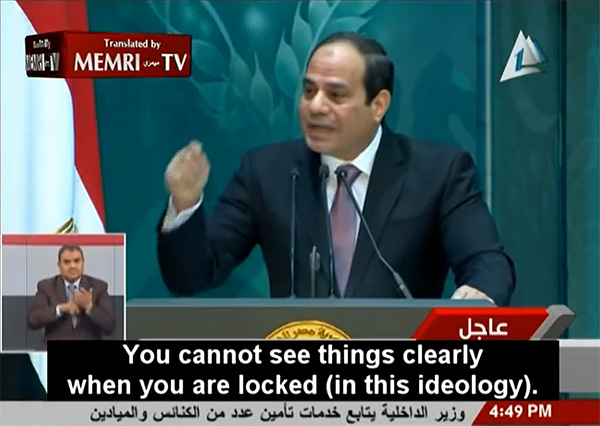
Egypt's President, Abdel Fattah el-Sisi, delivered a historic speech to top Islamic scholars and clergy at Al-Azhar University in Cairo, December 28, 2014. (Image source: MEMRI)
For the political leader of present-day Egypt to understand that Muslim religious scholars and clerics "bear responsibility" for perverting Islam by turning it into a fierce political ideology is extraordinary. The question, however, is whether those scholars and clerics grasped what he was saying. More importantly, do they have the integrity to rise to al-Sisi's challenge? And what about the West's responsibility in this matter?
Western powers, if they are to maintain credibility regarding leadership based on human rights, cannot turn a blind eye to what is going on in the Muslim world. Muslims in Egypt and elsewhere know from experience the extent to which Western powers have betrayed in practice what they pronounce in theory when it comes to support for people subjected to authoritarian regimes.
Egypt's Muslims have a long record of struggling to modernize their society. The lack of success of religious reformers, such as Muhammad Abduh (1849-1905) and Ali Abd al-Raziq (1888-1966), and secular intellectuals, such as Taha Hussein (1889-1973), Nasr Hamid Abu Zayd (1943-2010) and Hasan Hanafi (b.1935), in bringing Egypt out of its "third world" cultural backwardness was compounded by the complicated history of the country and people caught in the grips of colonial interests, anti-colonial struggles, inter-Arab rivalries, wars against Israel, and the Cold War contest in the Middle East.
What is long overdue from the West is a robust policy to defend and secure human rights for everyone, especially minorities, in Muslim-majority countries. Ironically, it already has on hand well-tested policies of both defending and successfully advancing respect for human rights within totalitarian states in the form of the Helsinki Agreement of 1975, which in retrospect contributed to the undoing of communism in the Soviet Union and its satellites in Eastern Europe.
A policy modelled on the Helsinki Agreement and tailored to the specific situation within the Muslim world, as in Egypt, by the Western powers led by the United States should be presented as the sine qua non to the member states of the Organization of Islamic Cooperation (OIC) if they wish to maintain a relationship of mutual respect and assistance with, for instance, the G7 nations. As signatories of the UN-adopted Universal Declaration of Human Rights of 1948, the OIC member states, including Egypt, must be told in no uncertain terms that their complicity in or failure to prevent human-rights abuses will have serious consequences.
The Western powers should also make it known categorically that the 1990 Cairo Declaration of Human Rights in Islam, which was adopted by the OIC, is unacceptable, because Article 24 of the document states: "All the rights and liberties stated in this Declaration are in accordance with the precepts of the Islamic Law." In other words, the Cairo Declaration makes Shariah law the basis for rights and freedoms within Muslim-majority countries. This should be totally unacceptable to Western powers, particularly the United States, as the principal founding member of the United Nations -- just as it is unacceptable to Muslims who understand the incompatibility of Shariah with the requirements of the modern world.
Shariah is an obsolete product of the minds of men belonging to the early Middle Ages. The Copts, as other religious minorities among the member states of the OIC, and many Muslims, are victimized daily on the basis of Shariah in Egypt. There can be no reprieve for them as long as the government continues to impose Shariah-directed rules and regulations in the country as a whole, and as long as Egyptian society complies.
An incessant demand must be made of the United States to lead the G7 to adopt a Helsinki-type of agreement in their dealings with the member states of the OIC. Such an accord eventually would have a similar effect on the Muslim world -- in terms of human rights, protection of religious minorities, equal status for women and freedom of speech as essential for advancing democracy -- as the Helsinki Agreement had in liberating the people under communism in the former Soviet Union and in Eastern Europe.
The treatment of the Copts in Egypt is a moral outrage for any Muslim aware of the religious tradition bequeathed to him by his prophet. This tradition includes Muhammad's affection for the Copts through his marriage to Maria, a daughter of the Copts, who bore him the son, Ibrahim (died in infancy), he so earnestly desired. As a result of this providentially blessed relationship, the Copts as a people became Muhammad's extended family, his kith and kin. When Egyptian Muslims seek God's mercy, they need reminding that it begins with atoning for wrongdoing against the Copts, and seeking forgiveness from them. The leadership of Al-Azhar University in Cairo could make a beginning by following President al-Sisi's example when he said recently, in welcoming the Copts with open arms as members of Egypt's family:
"We too love you. You are our family, you are from us, we are one and no one will divide us."
Salim Mansur is a Distinguished Senior Fellow at Gatestone Institute. He teaches in the department of political science at Western University in London, Ontario, and is the author of "The Qur'an Problem and Islamism"; "Islam's Predicament: Perspectives of a Dissident Muslim"; and "Delectable Lie: A Liberal Repudiation of Multiculturalism."
This article is based on remarks the author delivered at the 9th annual convention of Coptic Solidarity, held in Washington, D.C. on June 21-22.

Sunday, June 4, 2017

Shireen Qudosi : Egypt's Battle Against Islamic Extremism

  • When it comes to regional interests in the Middle East, the priority is the most dominant and violent force.
  • Egypt stands out as a primary target, given the cocktail of challenges that position it as a center of radical Islam. Egypt faces political, violent, and theological militancy within its borders.
  • For a nation to do what it must to survive, it needs the steadfast support of world powers. Step one is annihilating all sources of violent Islam.
For a Western audience, Egyptian President Abdel Fattah al-Sisi is a complex figure, who was shunned by the Obama administration. There appear truly pressing, immediate priorities in Egypt, such as developing the economy and combating the avalanche of extremist attempts to overthrow him. Among Middle East and North African territories, Egypt stands out as a primary target, given the cocktail of challenges that position it as a center of radical Islam.

President Sisi faces violent extremist hotbeds in the Sinai Peninsula, and the still-destabilizing influence of the Muslim Brotherhood (a political arm of violent radicals). Most notably, Sisi brought a reality check to the Arab Spring when he led the military overthrow of the Muslim Brotherhood government in 2013, ushering a spiritual and cultural Islamic reformation with widespread popular support from Egyptians on a grass-roots level.

Sisi faces more than just militant and political extremists within Egypt's borders; he is also walking a theological tightrope. Egypt is home to the regressive theocratic influence of the most revered Islamic institution in the Sunni world, Cairo's Al-Azhar University, which openly views freedom as a "ticking time-bomb."

Being held hostage intellectually by the grip of Al-Azhar University ensures that there is a constant supply when it comes to producing the next generation of militant and political Islamists.

Egypt also faces extremist infiltration from neighboring Libya, a nation caught in a power vacuum after the murder of its leader, Col. Muammar Gaddafi. This vacuum has been readily filled by Islamic militants, including ISIS.

Upon returning home in April from his first visit to the U.S. since 2013, Sisi faced a series of domestic terror attacks that once again put Egypt in a global spotlight. On Palm Sunday, in April, two suicide bombings in Coptic Christian churches killed more than 45 people and injured another 120. For Egypt, one of the last regional strongholds that still has a vibrant non-Muslim minority population, violent eruptions on major Christian holidays have become routine.

In England, just days after the May 22 Manchester suicide bombing, attention was once again on Egypt where 29 Coptic Christians were gunned down on a bus traveling to a monastery near the city of Minya. The attack was launched by masked terrorists who arrived in three pick-up trucks and opened fire on the passengers, many of whom were children. Egyptian intelligence believes the Minya attack was led by ISIS jihadists based in Libya. In February, the aspiring terrorist caliphate also launched a campaign against Egypt's Christian population. The Egyptian military responded swiftly with air strikes against terrorist camps, along with a televised warning against sponsored terrorism.

President Sisi's response to the brutal slaughter of peaceful Christian worshippers is being called rare but should not be surprising, considering the aggressive measures that need to be taken to hold extremism at bay, and to eradicate the threat that local groups pose to the Egyptian people. Coming out of the Riyadh Summit, where President Trump and a host of Muslim nations, including Egypt, agreed to drive out extremism, Sisi's reaction was necessary.


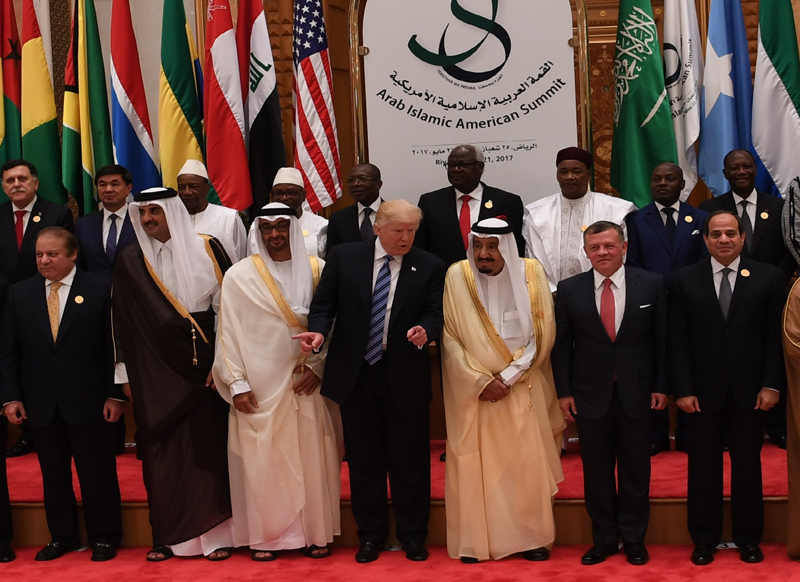
Egyptian President Abdel Fattah al-Sisi (front row, far-right) attended the May 21 Arab Islamic American Summit in Riyadh, Saudi Arabia, along with U.S. President Donald Trump (front-center). The problems of Islamic extremism and terrorism were much-discussed at the summit. (Photo by Thaer Ghanaim/PPO via Getty Images)

In a war that is equally ideological and kinetic, Muslim nations and others trying to survive the plague of Islamic terrorism will need to be as ruthless as their extremist counterparts. That is something that the warring political factions in the U.S. quickly need to understand. When it comes to regional interests in the Middle East, the priority is combating the most dominant and violent force. If that force wins, human rights are completely off the table. Beyond Egypt, President Trump has received considerable backlash in the U.S. for siding with what are seen as repressive regimes, whether it was hosting Turkey's President Recep Tayyip Erdoğan in the White House or engaging with dictators and monarchs during the Riyadh Summit.

In order to bring security to the region, alliances need to look at the real instigators and agents of chaos. There is a metastasizing threat that requires a new coalition of the willing. For a nation to do what it must to survive, it needs the steadfast support of world powers. Step one is annihilating all sources of violent Islam.
Shireen Qudosi is the Director of Muslim Matters, with America Matters.

Tuesday, May 30, 2017

Raymond Ibrahim : "Drip-Drip" Genocide: Muslim Persecution of Christians, February, 2017

  • "They are burning us alive! They seek to exterminate Christians altogether! Where's the military?" -- Christian man fleeing Al-Arish, Egypt; video.
  • "Historical churches in Iran being destroyed while UNESCO overlooks," is the title of one report.
  • On the same day as Pakistan's government charged an elderly Christian man with blasphemy -- which carries a death penalty -- it acquitted 106 Muslims of burning down an entire Christian village.
The Islamic State is at it again. More stories of atrocities against Christians continued to surface. In one, a Christian man, Meghrik, said the bus in which he was riding in Syria was stopped at what turned out to be an ISIS checkpoint. Three men dressed in black entered and began checking all the passengers' identification papers. "Are you a Christian?" they asked him. "No," he said. He explained that he was raised by Christian parents and his family name was Christian, but that he was not. "You're lying," the fighter said. "Your name says you're a Christian. Come with me." He was taken to an ISIS judge who "concluded that he was a Christian" and said "You're sentenced to death." Thereafter Meghrik was severely whipped and tortured. At one point, he was thrown in a hole in the ground and surrounded by an execution squad prepared to fire. After 10 days of this treatment and for unknown reasons -- Meghrik cites a miracle and is now a devout Christian -- he was released.

While much of the world acknowledges that the Islamic State is engaged in acts of genocide against religious minorities such as Christians and Yazidis, in other Muslim states, such as Pakistan, Christians and other non-Muslim minorities are experiencing a "drip-drip genocide", said the noted author, journalist and Pakistani politician Farahnaz Ispahani:
"Right before the partition of India and Pakistan, we had a very healthy balance of religions other than Islam. Hindus, Sikhs, Christians, Zoroastrians. Pakistan goes from 23 per cent [non-Muslim at the time of partition in 1947], which is almost a quarter of its population, to three per cent today. I call it a 'drip drip genocide', because it's the most dangerous kind of wiping out of religious communities.... It doesn't happen in one day. It doesn't happen over a few months. Little by little by little, laws and institutions and bureaucracies and penal codes, textbooks that malign other communities, until you come to the point of having this sort of jihadi culture that is running rampant."
Other accounts of Muslim persecution of Christians to surface in February 2017 include, but are not limited to, the following:

The Slaughter of Christians in Egypt

As in January, when five different Christians were killed in four separate hate crimes around the country, another murderous wave took non-Muslim minorities by storm, this time in al-Arish, Sinai. The murders may have resulted from a video released in February by the "Islamic State in Egypt." In the video, masked militants promise more attacks on the "worshipers of the cross" — a reference to the Coptic Christians of Egypt, of whom they also refer to as their "favorite prey" and "infidels who are empowering the West against Muslim nations." One of the militants, carrying an AK-47 assault rifle, added, "God gave orders to kill every infidel." Below is a list of Christians murdered in al-Arish:
  • January 30: A 35-year-old Christian was in his small shop working with his wife and young son when three masked men walked in, opened fire and killed him. The masked men then sat around his shop table, eating chips and drinking soda, while the bodies lay in a pool of blood before the terrified wife and child.
  • February 13: A 57-year-old Christian laborer was shot and killed as he tried to fight off masked men trying to kidnap his young son on a crowded street in broad daylight. The men, after murdering the father, seized his young son and took him to an unknown location (where, if precedent is accurate, he is likely being tortured or possibly killed, if a hefty ransom is not paid).
  • February 16: A 45-year-old Christian schoolteacher was moonlighting at his shoe store with his wife, when masked men walked in the crowded shop and shot him dead.
  • February 17: A 40-year-old medical doctor was killed by masked men who, after forcing him to stop his car, opened fire and killed him. He leaves a widow and two children.
  • February 22: Islamic State affiliates killed a 65-year-old Christian man by shooting him in the head. They then abducted and tortured his 45-year-old son before burning him alive and dumping his charred remains near a schoolyard.
  • February 23: A Christian plumber was shot dead in front of his wife and children at their home.
After the slayings, at least 300 Christians living in al-Arish fled their homes, with nothing but their clothes on their backs and their children in their hands. In a video of these Copts, one man can be heard saying "They are burning us alive! They seek to exterminate Christians altogether! Where's the military?" Another woman yells at the camera:
"Tell the whole world, look — we've left our homes, and why? Because they kill our children, they kill our women, they kill our innocent people! Why? Our children are terrified to go to schools. Why? Why all this injustice?! Why doesn't the president move and do something for us? We can't even answer our doors without being terrified!"
"We loved our country but our country doesn't love us," said the brother of one of the slain.

Muslim Abduction, Rape, Murder and Mutilation of Christian Women
Pakistan
Hours after being dropped off at the Convent of Jesus and Mary school in Punjab by her brother, Tania Mariyam, a 12-year-old Christian girl, was found dead in a canal. Despite all the evidence to the contrary — including her clothes being ripped off and signs of drugging — police investigations concluded that she had committed suicide. After three weeks of pressure from Mariyam's family and human rights groups, who insisted that the girl had been raped and murdered — as so many Christian girls (and boys) in Pakistan have been before her — police finally conceded that she had not killed herself. Even so, "the severe delays," says the British Pakistani Christian Association, "mean that much of the evidence has been lost."
"There was a disgusting police cover up," the murdered girl's father said, "and I fear that they have colluded with the murderer and know more than they are letting on. They do not care about Christians."
-----------

West Africa: According to a report, "Muslims radicals punished the [14-year-old] daughter of a Christian missionary for her faith by subjecting her to brutal female genital mutilation. Currently, the young woman remains in a coma, struggling for her life." Lydia's father, Yoonus, formerly a Muslim scholar, had converted to Christianity. When the local Muslim community heard of this — and that he "was now leading Muslims to Christ" — they "urged him to return to Islam and promised to give him gifts if he rejected Christianity. However, Yoonus and his family refused to renounce their faith, resulting in increased persecution," including the attack on his daughter.

Egypt: Two new cases surfaced of young Christian girls being abducted with the indifference or complicity of the authorities. After Rania Eed Fawzy, 17, failed to return home, her parents and lawyer said it was "an incident of kidnapping and forced conversion to Islam." They "filed a complaint with the local police that a Muslim male named Rabee Radi Naghi had taken their daughter against her will." When the family lawyer contacted the Egyptian Attorney General, Nabil Ahmed Sadek, requesting "to remove Rania from hiding and deliver her to one of the Christian Orthodox homeless youth shelters"—as "[n]ormally in such cases the local authorities know where the kidnap victim is kept" — the Attorney General refused and said, "[T]he girl embraced Islam, what do you want?"
As the report explains, even if she did freely convert, "a child in Egypt is considered a minor until age 21. Until [one comes] of age, conversion from one religion to another is illegal."
"In such kidnapping cases, however, the authorities always settle the issue by accepting the minor Christian girl's 'conversion' to Islam ... never the other way around. In conversion from Islam to Christianity complaints, police go above and beyond their role to retrieve the girl and warn her of death from apostasy. Such cases suit the purposes of ideological jihad. By removing a non-Muslim young woman of child-bearing age from the Christian community, adding her to the Muslim girl population to bear Muslim children serves to increase the Muslim population while decreasing Christian numbers."
Separately, after an apparent ruse caused the older brother of Hanan Adly, an 18-year-old Christian girl, to step out of the house one night, she disappeared from the family farm. The family and their lawyer made a formal complaint to the police, accusing a neighbor, Mohamed Ahmed Nubi Soliman, 27, of kidnapping her. Prosecutors summoned the man and "he admitted a connection with the incident. However, he was released due to lack of physical evidence," says the report.
"A national security investigation was ordered, but ... there has been no progress with the case, despite protests outside the police station by friends and family of Hanan."

Mali: A Christian nun was kidnapped in the Muslim-majority African nation with "no claims or demands for ransom", said a local Christian leader. Sister Cecilia Narváez Argoti, of Colombian background, belonged to the Congregation of the Franciscan Sisters of Mary Immaculate.
"The kidnappers arrived on 7 February from a secluded location a bit far from the village where Sister Cecilia and her sisters were. They broke into the missionary center and plundered money and computer equipment. They then escaped with the ambulance of the medical center with the nun."

Muslim Attacks on Christian Churches

Central African Republic: Supporters of a Muslim rebel group destroyed two churches and killed a pastor in what are described as "revenge attacks." After the national security forces, backed by UN peacekeepers, launched a military operation to interrogate Youssouf Malinga, a local Muslim militia leader known as the "Big Man," he and his men opened fire on the security forces and killed two passersby. Security forces responded with fire and killed Malinga and one of his men; three soldiers were also injured in the shootout. Malinga's supporters responded by surrounding an apostolic church and stabbing its pastor to death. "More than two dozen people were wounded. At least two churches were destroyed, along with a school," in the "revenge attacks," the report adds. "Central African Republic was plunged into civil war in 2013 following the overthrow of former president Francois Bozize, a Christian, by Muslim rebels from the Seleka militia."
Congo: Churches are "being desecrated and Christian nuns terrorised by 'violent thugs' amid a wave of increased hostility on Christians," according to reports. Elsewhere the "thugs" are described as "Islamist extremists." In February alone, "the extremists" burned a major seminary and
"sow[ed] terror among the Carmelite Sisters in nearby Kananga.... The extremists also attacked the St. Dominic church in the town of Limete. They 'overturned the tabernacle, ransacked the altar, smashed some of the benches and attempted to set fire to the church,' the archbishop said."
Iran: "Historical churches in Iran being destroyed while UNESCO overlooks," is the title of one report. After explaining that "Destroying church buildings has a long record in the history of the Islamic regime of Iran," it gives several examples in recent times. Sometimes churches are attacked by "extremist Muslims" who destroy crosses, statues, and icons with sledgehammers and axes; other times the government is responsible.
In one case, "judicial authorities in Kerman issued a ruling for a historical church building in their city to be brought down, even though a few years earlier this church had been registered as a national heritage site"; in another instance, a "historical evangelical church building in Mashhad that had been registered as a national heritage site in 2005, was destroyed." There "are around five hundred registered church buildings in Iran, with many of them abandoned or on the verge of destruction."

Sudan: The government ordered the "demolition of at least 25 church buildings" in the Khartoum area, relates one report. The government claimed the churches were built on land zoned for other uses, although mosques located in the same area were spared from the demolition order. Christian leaders said this is "not an isolated act" but rather part of a wider "crack-down" on Christianity that "should be taken with wider perspective." The Sudan Council of Churches denounced the order and called on the government to reconsider the decision or provide alternative sites for the churches. But Mohamad el Sheikh Mohamad, general manager of Khartoum State's land department in the Ministry of Physical Planning, said the order should be implemented immediately. "Sudan since 2012 has bulldozed church buildings and harassed and expelled foreign Christians," the report concludes.

Nigeria: The Christian Association of Nigeria is calling on the nation's government to help rebuild destroyed churches in the Muslim majority regions of the nation's northeastern states. This comes after a report revealed that "at least 900 Christian places of worship have been destroyed by Boko Haram since the [militant Islamic] group began its violent activities." U.S. lawmakers said that Nigeria is the worst nation in which to be Christian. Christopher Smith, Chairman of US House of Representatives' Sub-committee on Africa, said that both his staff and he have "investigated the crises facing Christians in Nigeria today" and
"made several visits to Nigeria, speaking with Christians and Muslim religious leaders across the country and visiting fire-bombed churches, such as in Jos.... Unfortunately, Nigeria has been cited as the most dangerous place for Christians in the world and impunity for those responsible for the killing of Christians seem to be widespread."
What makes the African nation so hostile to Christians is Boko Haram, a militant Muslim group, which has "forced Christians to convert and forced Muslims to adhere to its extreme interpretation of Islam."

Pakistan: Catholic churches and schools in the Lahore area closed down after a Taliban splinter group, which had killed seventy Christians on Easter Day, 2016, carried out a suicide bombing at a rally and killed at least 14 people. The group had vowed a year ago that it planned on launching "more devastating attacks that will target Christians and other religious minorities as well as government installations."


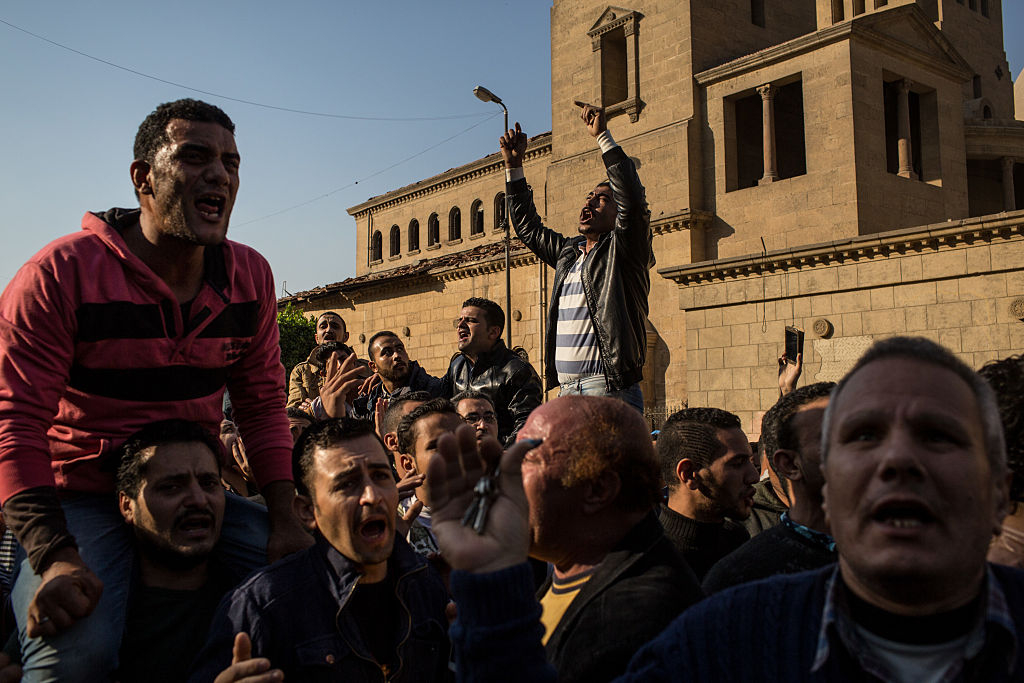
Coptic Christians protest outside the church of St Peter and St Paul in Cairo, Egypt, after a bomb attack on the complex, on December 11, 2016. (Photo by Chris McGrath/Getty Images)


Pakistani Justice

On January 28, a court acquitted 106 Muslims of burning down an entire Christian village in 2013 — including 150 homes and three churches. The attack came after one of its inhabitants, Sawan Masih, was accused of blasphemy. More than 80 prosecution witnesses, 63 of them with statements recorded about the attack, said they did not recognize any of the 106 accused. So they were all released.
Also on January 28, the government arrested an elderly Christian man on the charge of blasphemy — which carries a maximum death penalty. A mosque leader accused Mukhtar Masih, 70, of writing two letters containing derogatory remarks about the Koran and Muhammad. The report cites a source who said that "the charges against Masih were fabricated by local Muslims seeking to seize his property." Nonetheless, police raided the elderly man's home the same day and took his entire family into custody. His family was released but he was booked on charges of blasphemy, and beaten in an attempt to force him to admit to it.
Separately, the Pakistani government denied that "Christian minorities are being targeted by the country's controversial blasphemy laws," says another report — despite the well-known fact that religious minorities, chief among them Christians, are the demographic group most prone to being accused and convicted of blasphemy, to say nothing of being beaten, lynched, and burned alive in mob attacks. After alleging that, of 129 cases of blasphemy, 99 were leveled against fellow Muslims, Interior Minister Nisar Ali Khan said "religious minorities are not being embroiled in blasphemy cases more than Muslims." However, "[s]everal different persecution watchdog groups have pointed out that Christians are often heavily targeted by blasphemy laws." Pakistani human rights activist Wilson Chowdhry said officials are "twisting statistics":
"Sadly, Mr Khan's comments... [and] contrived results have failed to recognize that Christians in recent years have become the number one target of blasphemy allegations. It is our belief that a large proportion of the 26 percent of blasphemy convictions listed against minorities will have sentenced Christians, yet we contribute only 1.6 percent of the entire national population."

Muslim Hate for and Discrimination against Christians

Egypt: Fadi, a 15-year-old Christian boy, was sentenced to 15 years in prison after being found guilty of what human rights activists say is a false accusation. Last summer, a Muslim neighbor accused him of sexually assaulting an 8-year-old Muslim boy. Investigations and forensic examinations were performed but revealed no evidence of sexual activity. The family was still ordered to leave the village and the charges remained. According to Fadi's mother, Hana, he was targeted only because their Muslim neighbors, whose grandfather is an influential imam at the local mosque, "don't like Christians." She adds: the "judge convicted my son to 15 years because he is a Christian. If he was a Muslim boy, the judge would acquit him when he saw the forensic report, because the forensic report absolved my son," but "because my son is Christian," the judge "believed the speech of [the Muslim boy's] father instead of the forensic report."

Turkey: The Islamic terrorist who opened fire on an Istanbul nightclub during New Year's Eve celebrations confessed that "I wanted to stage the attack on Christians in order to exact revenge on them for their acts committed all over the world. My aim was to kill Christians." But for a variety of reasons that made it difficult for him to launch a spectacular attack on Christians, Abdulkadir Masharipov, of Uzbeki origin, ended up killing 39 people and wounded 65 others at a nightclub. He laments that he did not die then and there as a "martyr": "When I was out of bullets, I threw two stun grenades. I put the third one near my face to commit suicide, but I didn't die. I survived, but I entered Reina [nightclub] to die." Apparently to hurry him on his way to what he sought on the day of attack, Islamic paradise, Abdulkadir said that "it would be good if he were given capital punishment."

Iraq: Kurdish Peshmerga forces continue to be hostile to a Christian militia group also fighting the Islamic State. After William J. Murray, chairman of the Washington, D.C.-based Religious Freedom Coalition, visited the Christian town of Qaraqosh on the Nineveh Plain, he wrote that it
"has enemies other than the ruthless Islamic State, or ISIS, which left it in ruins. Currently the Kurdish militia, the Peshmerga, is blocking aid to the NPU [Nineveh Protection Unit] that guards the town, because the NPU is the Assyrian Christian militia. It is the only armed Christian group in Iraq.... While for appearance and funding from Washington, the Kurds support Christian interests for now, the historical relationship between the two groups includes participation in slaughtering Christians by the tens of thousands. There is no room for a Christian enclave, particularly one that is armed, in the future of an independent state of Kurdistan..."
Kurds are Sunni Muslims.

France: A new study revealed that, in the Western European nation with the largest Muslim population, the overwhelming majority of "religious attacks" are against Christians. "Acts targeting Christian places accounted for 90% of all attacks on places of worship (Christians, Jews or Muslims)." Although the government responded to these statistics by saying that "all these acts have no religious motivation," and that out of 949 attacks on churches, "there was a possible 'satanic motivation' in 14 cases and an 'anarchist' motivation in 25," it did not reveal the source behind the other 910 attacks. Another report, however, from neighboring Germany gives a hint:
"Last year in Dülmen, following the arrival of well over a million [mostly Muslim] migrants in Germany, local media said 'not a day goes by' without attacks on Christian religious statues."
===========

About this Series

While not all, or even most, Muslims are involved, persecution of Christians by Muslims is growing. The report posits that such Muslim persecution is not random but rather systematic, and takes place irrespective of language, ethnicity, or location.
Raymond Ibrahim is the author of Crucified Again: Exposing Islam's New War on Christians (published by Regnery with Gatestone Institute, April 2013).
Follow Raymond Ibrahim on Twitter and Facebook
============= 

Sunday, May 14, 2017

Nonie Darwish's "Wholly Different" Half her life in Egypt, half her life in the U.S. -- an insider's insights on Islam and the West.

Nonie Darwish's "Wholly Different"

Half her life in Egypt, half her life in the U.S. -- an insider's insights on Islam and the West.


Nonie Darwish's 2017 Regnery Faith book, Wholly Different: Why I Chose Biblical Values over Islamic Values, is a wide-ranging, reader-friendly view into the thinking of an Egyptian, Muslim woman who immigrated to America at age 30 and began to compare and contrast the values she was steeped in to those found in Judeo-Christian-influenced, Western culture.

Darwish was born in 1949 in Cairo, Egypt. She grew up in Egypt and Gaza. Her father, Mustafa Hafez, created and oversaw an anti-Israel terror group. When Darwish was eight, her father was assassinated by Israel. Egyptian President Nasser praised Darwish's father as a shahid, or martyr. Darwish immigrated to the US in 1978, and she has lived here ever since. She converted to Christianity.
Wholly Different is part memoir, part sociological observation, and part prophetic clarion. Darwish's style is cozy and conversational. Her sentences are short and easy to read. Darwish paints a vast, impressionistic landscape comparing the Muslim world to the West. She makes a series of thought-provoking points in a rapid style. She quotes relevant passages from Islamic scripture and shows how that scripture plays out in modern societies. In contrast, she quotes important Biblical passages and demonstrates how those have influenced the West.

Darwish combines the maternal love one might find in a wise grandmother, the kind who bakes cookies and contains a storehouse of folkloric wisdom, with the stripped-to-the-bone truth-telling and no-time-to-waste urgency of an Old Testament prophet. With every sentence, Darwish conveys the deep care she feels for every reader with an insistence on being heard, and heard for every last syllable.
As is often the case, this book by a former Muslim is more fearlessly blunt than many a counter-jihad statement by someone who has never been a Muslim. "Islamic values versus Biblical values is a bloody collision waiting to happen. The West must be warned," she writes. Darwish has seen jihad up close and personal. She knows what is at stake, she has taken the measure of the wolf at the door, and her call bursts forth like a trumpet. Just one example of the kind of unique insights she can offer: in thirty years of living as a Muslim in the most populous Arab state, she never heard anyone question why Mohammed, at over fifty years old, took a six-year-old as his wife.

"A fish doesn't know it is in water," goes the old saying. Perhaps nothing dramatizes this point so vividly as Western women who marry Muslim men, travel with those men to their natal countries, and are shocked to discover that rights they took for granted as universal ceased to exist once they stepped across a border and put their Western homeland at their back. One can see one such woman, Stephanie, sobbing in a 2016 EXMNA video. "I was certain that I was going to find a way to bring my daughters back, so I bought them a bunch of clothes, but they haven't had a chance to wear them yet," Stephanie says, with unbearable poignancy. The camera shows Stephanie's slender fingers fondling princess dresses she had purchased for her daughters, dresses that her daughters will never wear.
Stephanie was born in Canada and married a Muslim man. She had two children by him. She convinced herself that she and her Libyan husband could create a Canadian version of Islam. She could prevent her husband from forcing hijab on her daughters, allow the girls to listen to music, and take gymnastics. "We can mix both and be happy," she thought. Islam, though, she said, demanded that her husband "protect" his children from Stephanie; indeed, to protect Stephanie from herself. Her husband, over the course of eighteen months, hatched a plot to convince Stephanie to put her daughters on a plane so that he could attend grad school in Europe. This was a lie. He had no plans for a European PhD. He lured Stephanie into Libya, at which point she had no rights whatsoever. Stephanie says that in Islamic terms, her husband was kind – because he had the right to kill her, and he did not. It's five years later, and Stephanie has not seen her children since. She may never see them again.

Why did Stephanie make decisions that doomed her to a life of heartache and regret? Especially given the bestselling 1987 book, Not Without My Daughter? And numerous websites dedicated to warning Western women about the potential pitfalls in cross-cultural marriages, websites like this one, this one, this one, this one, this one, and too many others to list? Maybe this is why. Maybe Stephanie had politically correct teachers who told her that the West is an oppressive, racist, sexist place. They told her, further, that Islam is a religion of peace. These fonts of politically correct ideology emphasized cultural relativism. All religions are the same, they told young Stephanie. All religions are about love.

Wholly Different is a three-alarm wake-up call from Nonie Darwish. Darwish informs her reader that it's not just when it comes to terrorism that Western and Muslim worldviews conflict. Rather, in a thousand little ways, daily life is different. Darwish lists fifty-three features that, for her, differentiate the Western worldview from the Muslim one. Darwish, as a trained journalist and speaker of Arabic, cites canonical Islamic sources to support her points. "Islam and democracy are contradictory and absolutely incompatible," she writes. These are not her words. She is quoting an imam.

Darwish says that every cultural feature is grounded in the foundational texts that inform each culture. The West is inspired by the Judeo-Christian Bible. God is a father who affirms his creation and wants to love us. God is rational. God wants so badly to save us that he sacrificed his only son to die for us. In contrast, the Muslim world is founded on and inspired by the Koran and the life and sayings of Mohammed. Allah is not loving and he is not a father. Allah announces that he does not need humans; if he wanted to, he could wipe humanity out and choose to create some other lifeform. Allah is not only not rational, he is the "greatest deceiver" who can grant or withhold an afterlife paradise as he sees fit. Allah demands that humans not love him, but submit to him, as slaves submit to their masters, and to sacrifice their lives for him.

Darwish is a Christian, but an observant Atheist might have written a similar book. Atheist Richard Dawkins said "I am not aware of any Christian suicide bombers … I have mixed feelings about the decline of Christianity, in so far as Christianity might be a bulwark against something worse." Atheist Bill Maher said, "The values of Western civilization are not just different, they're better. I know a whole generation has been raised on the notion of multiculturalism … Rule of law is better than autocracy and theocracy. Equality of the sexes, better," and "Islam is not like other religions. It is a unique threat. Christians do not believe that if you leave the religion you should be killed for it … If they were beheading people in Vatican City … don't you think there would be a bigger outcry? This is the soft bigotry of low expectations that we have with Muslim people." Atheist Sam Harris has been criticized for saying things like, "The truth is that Islam is quite a bit scarier and more culpable for needless human misery than Christianity has been for a very, very long time. We have to point this out. To be evenhanded … is to misconstrue the problem."

Western rights did not emerge ex nihilo. They are founded on Judeo-Christian religion and Ancient Greek civilization. Thus the Supreme Court building, for example, is modeled on the Parthenon, and while the building's frieze depicts lawgivers from various cultures, the figure at its center and apex is Moses, the Jewish lawgiver. He holds two tablets, representing the Ten Commandments. The rights we in the West take for granted are not universal, but rather are specific to the West, and based on our unique history. When we give up our foundations, we give up our rights.

Darwish, no wilting violet, brings the hammer down with her first sentence: don't you dare, she warns, replace the word "Judeo-Christian" with the politically correct neologism "Abrahamic," meant to elevate Islam to Judeo-Christian status as a co-foundation for Western civilization. She links the term "Abrahamic" to a Muslim Brotherhood document instructing followers to "present Islam as a civilizational alternative" and "destroy the Western Civilization from within." The West's capitulation to this agenda, she says, "is undermining the Biblical values of the West." As proof, she cites the Army's disciplining of a soldier who attempted to rescue a boy sex slave from an Afghan police commander, who kept the boy chained to his bed. She says that when she worked in Egypt, there were no prayer rooms or foot faucets at her workplace. Now, Muslims demand these perquisites in Western workplaces. This is part of civilizational jihad, she says.

Darwish describes Islam as a religion driven by a sense of competition with Jews and Christians. Sixty-four percent of the Koran, she maintains, is devoted to denigrating commentary about kafirs, or non-Muslims. "Do unto others as you would have them do unto you" is totally alien to Islam, she says. "Islam has nothing to do with Abraham and Biblical values. In fact, it awards the highest esteem to Muslims who kill the children of Abraham, the Jews."

Darwish charts her intellectual and spiritual journey from simple observations of quotidian reality and larger trends. "Why is it that people in the West stand in line to wait for their turn while in the Muslim world people step on each other to get to be first? Why is it that in the West government leaders leave their office at the end of their term peacefully while in the Muslim world their term ends with either natural death or assassination?" Even in asking these questions, she writes, she was violating cultural expectations. "Asking questions and doubting is taboo in Islam."
Another factor, she says, impeded her maturation in Egypt. "I came from a culture where openly talking about one's true feelings, inadequacies, and vulnerabilities was taboo." That kind of repression prevents personal growth.

Darwish's focus on her natal society's suppression of her self-awareness and admission of vulnerability segues into the portion of the book that excited me the most. Darwish argues that Allah encourages Muslims to hide sin, seeing public admission of sin to be a sign of weakness, while the West encourages individuals to acknowledge and come to terms with their own faults. When Muslims sin, Allah covers those sins to allow the Muslim to avoid public censure. Muslims are forbidden to expose each other's weaknesses to non-Muslims. "Keeping up a good front" becomes a religious obligation. Darwish writes, "Islamic logic does not see confession of sin by Jews and Christians as a virtue or as the starting point to redemption and an attempt to be better people. In Islam self-criticism, admitting sin, praying for forgiveness, and openly exposing one's vulnerabilities and imperfections in a search for the truth is worthy of punishment." Darwish quotes Mohammed, "All of my community shall be pardoned, save those who commit sins openly." If followers of a sheikh witness the sheikh committing a sin, the follower should say, "it is my eyes that committed the sin" for having witnessed a power figure do wrong. The Islamic view of public exposure of sin feeds a culture based on pride and shame. The Koran is replete with references to "shame," "disgrace," "humiliation," and "losers." There is no comparable mention of "losers" in the Bible. In the Koran, in addition to being labeled "losers," Christians and Jews are also called "pigs," "apes," and "unclean."

This emphasis on hiding sin fuels honor killing, and Turkey's refusal to acknowledge the Armenian Genocide, Darwish argues. As a contemporary, concrete example of this advice to conceal sins, Darwish cites Islamweb's 2012 Fatwa number 184937. A woman wrote to report that her husband sexually assaulted their fourteen-year-old daughter. She asked what she should do. The religious expert responded that the daughter should cover herself with hijab and the wife ought to "conceal his sin" and continue to live as his wife.

Islam on Demand, a YouTube channel, features a 2011 lecture by respected sheikh Hamza Yusuf. Yusuf reflects Darwish's words. Islam demands that an individual suppress urges, he says. In the West, Yusuf says, the attitude is "don't harm anyone." In the Islamic worldview, he says, there is a harm when forbidden behavior "emerges into the public space." "What people do behind their closed doors is their own business." Yusuf cites the example of alcohol. If people make and consume wine at home, "that's between them and God. The minute they step into the public space, then that is where sharia says no."

I wrote about this aspect of the difference between Islamic worldviews and the West in 2001:
"Ritualized, religiously mandated confession generated, in the West, a culture-wide valorization of self-examination, subjectivity, individuality, and change … Confession caused believers to examine themselves, admit their errors, work for self-improvement and to develop a linear / teleological mindset – to believe that the future could be better than the past … This absence of ritualized, valorized, narration of sin and redemption to one's fellows does not provide the Muslim with the same cognitive, social or cultural exercise." I hope that others pick up on this theme.

Darwish cites many of the Koran verses and Hadith that call for jihad. One hadith promises that killing a Jew or a Christian offers a Muslim a chance to be redeemed from ever having to go to Hell. Darwish comments on the public relations attempt to redefine "jihad" as peaceful self-improvement. In Islamic texts, she says, jihad plainly means "war with non-Muslims to establish the religion."
Wholly Different will be a rewarding read for those interested in a big-picture comparison of the Muslim world and the West, from an educated observer who has lived decades in both worlds and can support her points with key texts and contemporary examples.

http://www.frontpagemag.com/fpm/266664/nonie-darwishs-wholly-different-danusha-v-goska
================

Friday, April 28, 2017

Lawrence A. Franklin : The Pope's Pilgrimage to Al-Azhar


  • During a meeting between the former Papal Nuncio to Cairo, Archbishop Jean-Paul Gobel, and Grand Imam Sheikh Ahmed el-Tayeb, the Grand Imam warned Gobel that "speaking about Islam in a negative manner was a 'red line' that must not be crossed." If there are any condemnations of violence against the Coptic Christians, they are likely to be articulated only by the Grand Imam and the Egyptian President.
  • If the Pope's humble bearing is excessive, however, it might be interpreted even by peaceable Muslims as a submission. If Francis is asked by the Grand Imam to pray at al-Azhar's mosque, that is a piety that el-Tayeb would not likely reciprocate in a Coptic Church in Egypt.
  • Facilitating the establishment of an Islamic-Christian relationship that excludes Judaism can only serve the Islamist goal of isolating Jews and Israel. Although relations between the Vatican and al-Azhar will improve in the near future, the honeymoon will not. The Grand Imam will doubtless protect his own theological power base and keep his distance from both the Vatican and the Egyptian regime.
The twin Palm Sunday bombings at Coptic Christian Churches by Islamic terrorists in Egypt, which killed 44 worshipers, draws attention to what is probably the principal reason for the upcoming visit of Pope Francis to Cairo on April 28-29. The Pontiff will likely seek the assistance of Egypt's Muslim hierarchy to help protect Egypt's Coptic Christians, the indigenous inhabitants of the country who now number about 9 million and constitute at least 10% of the population.
During his stay, Francis will meet with the Grand Imam of Cairo's al-Azhar Mosque, Sheikh Ahmed el-Tayeb. Al-Azhar's theological complex, which houses Islam's oldest university, is considered the most influential center of Sunni Islam.
The Pope possibly hopes that the meeting with el-Tayeb will fully repair relations between the Vatican and al-Azhar. These were restored as a result of a letter sent by Pope Francis to the Grand Imam last year. The Papal letter was followed up by a visit to the Holy See by el-Tayeb in May 2016. Relations between the Holy See and al-Azhar had been severed in 2011 by el-Tayeb after he took offense at comments made by the previous Pope, Benedict XVI, on the persecution of Christians in Muslim countries.
Grand Imam el-Tayeb now appears more disposed towards normalizing relations with the Vatican, especially since his amicable visit to the Holy See in May 2016. Al-Azhar's Grand Imam is likely to be more agreeable toward Francis than he was toward Benedict. This show of flexibility might possibly also be an effort by el-Tayeb to get in line with President Abdel Fatah al-Sisi's own call for reform within Islam. However, Al-Azhar, determined to maintain its authority over theological matters, has initiated no substantive, doctrinal reforms in response to President Sisi's declaration. In fact, Al-Azhar has pushed back against attempts by some Muslim reformists who have suggested a more liberal policy concerning women's rights, including the ability to divorce.
El-Tayeb, even if he accepted responsibility for protecting the Copts, may prove unable to prevent Islamic terrorist groups from targeting Egypt's minority Christian population. The alleged cooperation between the Islamic State and the Muslim Brotherhood makes it especially difficult for Cairo to prevent terrorist acts. Islamic terrorist cells in Alexandria and the Sinai Peninsula, where many of the attacks on Copts have occurred, act independently of Egypt's political and religious leaders. The targeting of Christians by these groups may also be part of a larger objective to destabilize the regime of al-Sisi, who has promised security to Egyptians, particularly Coptic Christians. Radical Islamists such as the Muslim Brotherhood and ISIS view the Copts as their enemies; many members of this Christian sect support the Sisi government.
It was, in any event, al-Sisi who invited Pope Francis to visit Egypt during the Egyptian president's visit to the Vatican in November 2014. Anti-regime elements might well attempt to stage a spectacular terrorist incident during the Pontiff's visit, particularly targeting Francis himself.
The Pope's upcoming visit is being organized by French Cardinal Jean-Louis Tauron, who chairs the Pontifical Council of Inter-Religious Dialogue. Cardinal Tauron is, no doubt, cognizant of the "red line" laid down by the Grand Imam if the Vatican wishes to have amicable relations with the Muslim leadership. During a meeting between the former Papal Nuncio to Cairo, Archbishop Jean-Paul Gobel, and el-Tayeb, the Grand Imam warned him that "speaking about Islam in a negative manner was a 'red line' that must not be crossed." However, given the Pope's past reluctance to condemn radical Islamic concepts, it is unlikely that, during his visit to Egypt, he will depart from this cautious public posture. Comments, if any, by Pope Francis on Muslim violence against Christians will, no doubt, be diplomatic and muted. If there are any condemnations of violence against the Coptic Christians, they are likely to be articulated only by the Grand Imam and the Egyptian President.
Nevertheless, Pope Francis will, it appears, publicly demonstrate his solidarity with fellow Christians by championing the Coptic Pope Tawadros II during memorial services for the recently martyred Copts. Francis, who is known to be fond of Tawadros, might express his deep personal concern for the welfare of the Coptic Pope -- who was celebrating Mass inside St. Mark's Cathedral when the bomber detonated his explosives just outside.
Francis is apparently most anxious to bring Copts and Catholics closer together, in the hope that the Egyptian Church will ultimately formally reunite with the Holy See. The Coptic Church first split from Rome in 451 A.D. However, the Vatican maintains deep respect for the Egyptian Church, which was established by one of the four authors of the Gospels, St. Mark, in Alexandria as early as 42 A.D.[1]


Catholic Pope Francis greets Egyptian Coptic Pope Tawadros II at the Vatican, on May 10, 2013. (Image source: News.va Official Vatican Network)

If the Pope's humble bearing is excessive, however, it might be interpreted even by peaceable Muslims as submission. If Francis is asked by the Grand Imam to pray at al-Azhar's mosque, that is a piety that el-Tayeb would not likely reciprocate in a Coptic Church in Egypt.
The public stance of the Vatican concerning Islam has been routinely cautious. The most recent example of the Pontiff's less-than-direct criticism of Islamist violence is his April 22 statement at a prayer service paying tribute to 21st Century Christian Martyrs in Rome:
Francis said the legacy of modern-day martyrs "teaches us that with the strength of love, meekness, one can combat arrogance, violence, war, and with patience, achieve peace."
A professor of Islamic Studies at the Pontifical Institute in Rome, Father Samir Khalil Samir, also an Egyptian, characterizes the Pope's diplomatic approach to Muslims, "who are the second-most important group in the world, to have a dialogue and understanding." Khalil adds:
"I think it's important to say things with charity, with friendship, but to say things as they are: that it cannot continue like this; we have to rethink Islam. This is my vision. They cannot take the texts of the seventh century literally as they are in the Quran. He [the Pope] does not dare to say something like that because he doesn't know the Quran well enough, and so on. So I understand his position, but it would be better to have a clearer and more frank discussion — with openness, but also with some realism."
This clearly modulated posture was apparent during a session of the Geneva Center of Human Rights Advancement and Dialogue. The theme of the Geneva sessions was "Islam and Christianity: The Great Convergence." The March 15 Conference, attended by Muslim and Christian delegates, studiously avoided key issues of doctrinal divergence, and stressed instead alleged areas of common interest. The key sponsors of the conference were Algeria, Pakistan, and Lebanon, all of which are Muslim majority countries. The only non-Muslim state sponsor of the Conference was Malta. One of the oft-repeated themes of the sessions in Geneva was the 'feel-good' concept of the 'common Abrahamic root' of Islam, Christianity and Judaism -- although no representatives of the Jewish faith were invited to the conference. Statements by representatives of Christian churches seemed overly optimistic about the prospects of developing positive relationships with Islamic societies.
The failure to invite Jewish or Israeli representation by conference organizers was presumably not an oversight. This omission would be consistent with the UN Arab bloc's objective of isolating Israel in an apparent effort to destroy and replace it. That campaign includes efforts by Arab states to marshal support at the United Nations for suffocating Israel through diplomatic subversion as well as through economic strangulation. Facilitating the establishment of an Islamic-Christian relationship that excludes Judaism can only serve the Islamist goal of isolating Jews and Israel.
After the visit of Pope Francis to Egypt, mass murders of Egyptian Copts are likely to continue. Although relations between the Vatican and al-Azhar will improve in the near future, the honeymoon will not. The Grand Imam will doubtless protect his own theological power base and keep his distance from both the Vatican and the Egyptian regime.
Dr. Lawrence A. Franklin was the Iran Desk Officer for Secretary of Defense Rumsfeld. He also served on active duty with the U.S. Army and as a Colonel in the Air Force Reserve, where he was a Military Attaché at the U.S. Embassy in Israel.

Friday, April 14, 2017

Building a Church is a 'Sin' Against God, Says Egyptian Muslim Council

AINA News
Building a Church is a 'Sin' Against God, Says Egyptian Muslim Council
Cairo (AINA) -- A controversial Fatwa (Islamic edict) prohibiting the construction of new churches in Egypt has provoked considerable discussion and spiraled into a crisis, involving the Fatwa Council, Al-Azhar Grand Sheikh, Christian and Muslim religious personalities, and the media. It was also reported on 8/26/2009 that the jurists who issued the Fatwa are under investigation on orders of the Grand Mufti and the Justice Minister.

The Fatwa (Arabic) in question was issued by the Al-Azhar affiliated "Dar el-Eftta" -- Fatwa Council for Islamic interpretations of laws in Islam. It stated "the will of a Muslim towards building a Church is a sin against God, just as if he left his inheritance towards building a nightclub, a gambling casino, or building a barn for rearing pigs, cats or dogs."

It was issued in response to an inquiry sent to the Fatwa Council by Dr. Naguib Gabraeel, President of the Egyptian Union Human Rights Organization (EUHRO), asking its opinion as to what he read in an article written by a prominent writer about what was stated in a textbook taught to third year students, Muslims and Christians, at the Faculty of Law, Cairo University, on Inheritance and execution of wills.

Gabraeel's inquiry pertained specifically to a quotation from the textbook "it is forbidden for a person to donate money for what would lead to sin, such as donating in his will money towards build a church, a nightclub, a gambling casino, towards promoting the alcohol industry or for building a barn for rearing pigs, cats or dogs."

He went on to inquire "So what is the Shari'a position to what was mentioned especially concerning the will of a Muslim to donate for the building of a church or a monk's cell? If the answer is prohibition, aren't these houses where the name of God is mentioned? Is not Christianity a recognized religion according to the Egyptian constitution? There are also a lot of wealthy Copts and Coptic businessmen who donate towards the building of mosques."

The Fatwa Council replied affirming the correctness of what came in the textbook and issued a Fatwa on September 10, 2008 (document number 1809), which is also published on its official website.

To highlight the reason for this "sin" the Fatwa went on to state: "Salvation in the Christian religion is the belief in Jesus as Lord, where Muslims fundamentally disagree on it. Muslims believe that Issa [Jesus in Arabic] peace be upon him, is a slave of Allah and His Messenger, and that Allah is one. He begets not and He is not begotten and there is none like unto Him. So if it is seen that one sect has deviated from this absolute Monotheism, then according to that person's own religion he is forbidden to donate for the erection of buildings where Allah is not worshiped alone."

According to Mohammed el-Maghrabbi, deputy chief of the Faculty of Law, and author of the controversial textbook, what he wrote is a principle agreed upon by all Islamic jurists. He added that a will, if devoted by a Christian for building a Church, is forbidden and sinful and is considered in Islam as separation from God. So it is also illegal if a non-Muslim wills his inheritance towards building a Church or a Synagogue.

This Fatwa has shocked many as it classified churches with nightclub, gambling casinos, and places for rearing pigs and dogs, which are considered 'unclean' animals according to Islam and Muslims.

Christians were angered and considered it a clear and explicit insult to all Christians. The renowned theologian Reverend Abdelmassih Bassit, Professor at the Coptic Orthodox Clerical Institute, called it "a shocking Fatwa."

Gabraeel called on the government and Al-Azhar to state their position clearly on the building of churches, as well as prayer meetings held in premises even if they were 'unlicensed' as churches.

On August 19, 2009, a delegation from EUHRO, headed by Dr. Gabraeel, paid a visit to Al-Azhar Grand Sheikh Mohamed Sayed Tantawi, who said that the Fatwa was wrong and untrue and that Muslims can make voluntary contributions to build churches, as a church is a house for "worshiping and tolerance" and that "Shari'a does not prevent Muslims from donating to the building of a church, as it is his free money. He also affirmed that Al-Azhar does not object to the "unified law for building places of worship."

Tantawi added that building churches should be left to the Christians and Muslims are not allowed according to Shari'a to interfere in other faiths, "because religion, faith and what a person believes in is a relationship between him and his God." He also called on the Grand Mufti Ali Gomaa to hold the five jurists who issued the Fatwa accountable.

Reactions to Tantawi's statements resulted in a crisis in the Islamic circles. Most Muslim leaders criticized him publicly and supported the Fatwa "as being issued by people qualified in Islamic Shari'a law" or "a Muslim should not donate to the building of a church when Christians do not believe in the religion of Mohammed, or him being a prophet."

Grand Mufti Ali Gomaa gave the excuse that he never ratified the Fatwa. Nevertheless, his answer was not convincing as it was an official Fatwa issued by the authority headed by him, stamped and signed by five of the Council's jurists. He failed to give an opinion about it.

Less than 24 hours after the EUHRO visit, Grand Sheikh Tantawi backtracked on his statements saying it was a misunderstanding on the part of the EUHRO delegation and the newspapers. He commented that what he meant was for non-Muslims to donate in their wills for church building and reaffirmed that it is forbidden for a person to donate money for the construction of "sinful" places, such as bars and nightclubs.

The reason for his change of heart, according to the Egyptian independent newspaper Al-Destour, was that 'high sources' contacted the Al-Azhar Grand Sheikh and the Grand Mufti to resolve the crisis raised over the Fatwa "in order to avoid any sectarian strife or an inconsistency between Al-Azhar and the Fatwa Council."

On his part EUHRO chief Dr. Gabraeel answered the Grand Sheikh saying that it is his right to change his mind but he cannot deny what he said during the visit, and that his statements were caught on the video recording of their meeting. He added that when Grand Sheikh Tantawi was asked by the delegation if a Muslim can donate from his own funds towards building a church, he answered that he is free to do so, and when asked if this was his personal opinion or the Shari'a stand on this issue, Tantawi answered that it was according to Shari'a Law. The video was sent to the media and was uploaded on all Coptic advocacy websites.

Many Christians believe that this Fatwa has exposed the true stance of the religious authorities and the government towards churches, and the reason why it refrains from passing the long awaited bill on the "unified law for building places of worship," which would put an end to all problems related to building and restoring places of worship. It is also believed that since Islam views church building as a sin, passing this bill would therefore be in conflict with Shari'a Law -- which is the main source of legislation as stipulated in the Constitution -- and this would be something that the government would avoid at all costs.

By Mary Abdelmassih