.

.
Library of Professor Richard A. Macksey in Baltimore

POSTS BY SUBJECT

Labels

Tuesday, April 20, 2010

Desertification: A review of the concept

Desertification:

A review of the concept


Michael H. Glantz
Environmental and Social Impacts Group
National Center for Atmospheric Research*
Boulder, CO 80307, USA

Nicolai Orlovsky
Desert Research Institute
Turkmen Academy of Sciences
Ashkhabad, Turkmen SSR, USSR

The following article will appear in the 
Encyclopedia of Climatology, J.E. Oliver 
and R. Fairbridge, eds., Hutchinson 
Ross Publishing Company, 1984

*The National Center for Atmospheric 
Research is operated by the University 
Corporation for Atmospheric Research 
and is sponsored by the National Science 
Foundation.


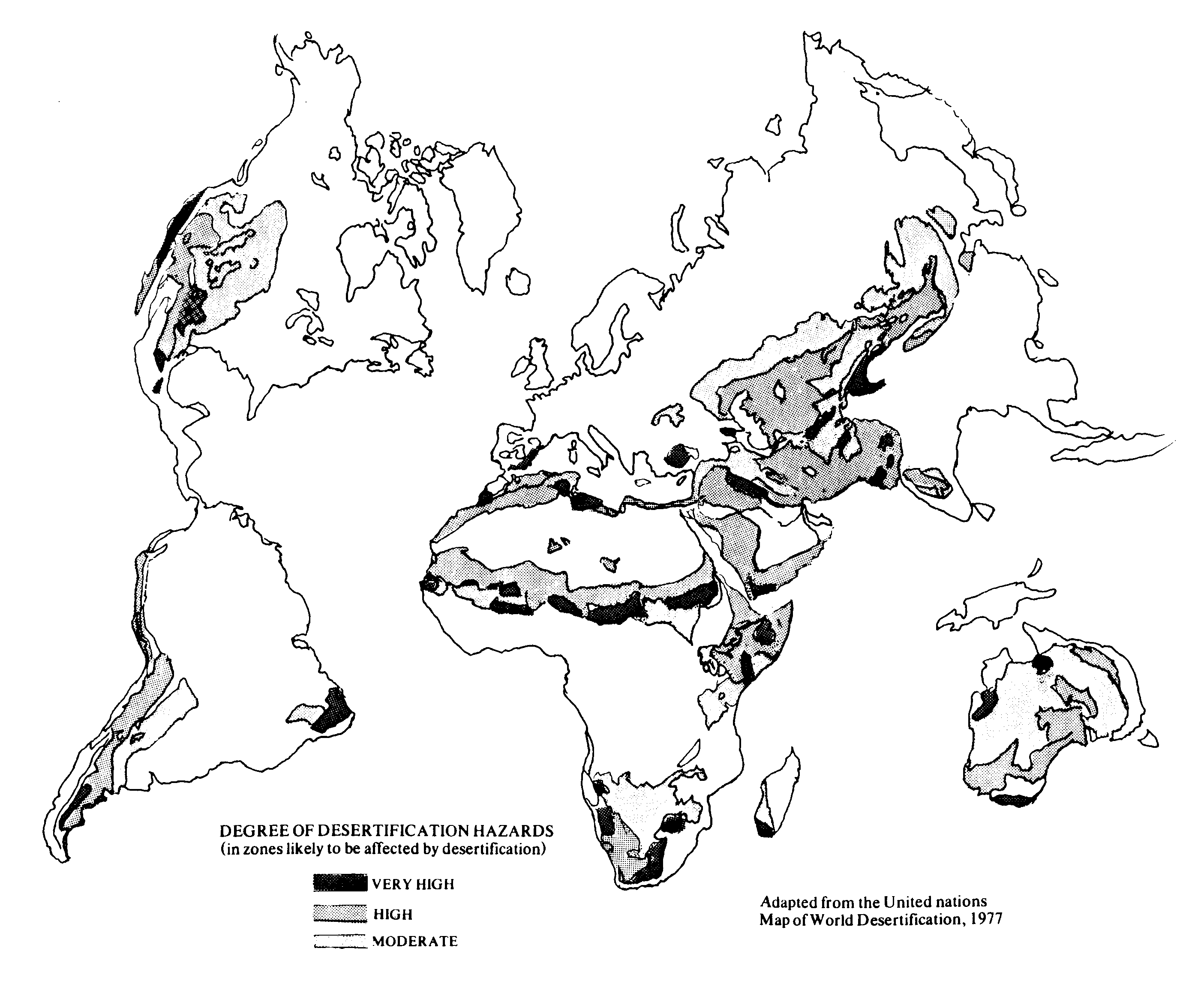
The phenomenon known as desertification has received widespread attention recently, as witness the creation of the United Nations Conference on Desertification in Nairobi in 1977, mainly as a result of the impact of extended drought in the West African Sahel in the early 1970s. That drought caused loss of human lives and livestock and widespread environmental deterioration. Although a number of recent articles, papers and reports from many countries begin with comments on the role of the Sahelian drought in the growing interest in the desertification issue (e.g. Glantz, 1977; UN Secretariat, 1977; Quintanilla, 1981; Zonn, 1981), that drought was neither the first manifestation of the desertification phenomenon nor the only reason for scientific interest in it. In fact, A. Aubreville, a French scientist, popularized the term desertification in his report as long ago as 1949 (Aubreville, 1949), and others (e.g. Le Houerou, 1962) have discussed the phenomenon since the late 1950s.
The 1977 Nairobi Conference did serve to draw attention to the phenomenon (UN Secretariat, 1977). It described desertification as:
"...the diminution or destruction of the biological potential of the land, (which) can lead ultimately to desert-like conditions. It is an aspect of the widespread deterioration of ecosystems, and has diminished or destroyed the biological potential, i.e. plant and animal production, for multiple use purposes at a time when increased productivity is needed to support growing populations in quest of development. Important factors in contemporary society--the struggle for development and the effort to increase food production, and to adapt and apply modern technologies, set against a background of population growth and demographic changes--interlock in a network of cause and effect. Progress in development, planned populations growth and improvements in all types of biological production and relevant technologies must therefore be integrated. The deterioration of productive ecosystems is an obvious and serious threat to human progress. In general, the quest for ever greater productivity has intensified exploitation and has carried disturbance by man into less productive and more fragile lands. Overexploitation gives rise to degradation of vegetation, soil and water, the three elements which serve as the natural foundation for human existence. In exceptionally fragile ecosystems, such as those on the desert margins, the loss of biological productivity through the degradation of plant, animal, soil and water resources can easily become irreversible, and permanently reduce their capacity to support human life. Desertification is a self-accelerating process, feeding on itself, and as it advances, rehabilitation costs rise exponentially. Action to combat desertification is required urgently before the costs of rehabilitation rise beyond practical possibility or before the opportunity to act is lost forever (UN Conference to Combat Desertification, 1978)"
The conference also served to bring together representatives of many countries whose landscapes had been directly or indirectly affected by desertification. The usefulness of the conference varied from country to country. For some countries, such as the People's Republic of China, it served to direct the attention of national policy-makers to arid lands research and to elevate such research to the status of a national priority. The Soviet Union's State Committee for Science and Technology (GKNT) established, with UNEP, international training courses on various aspects of desertification and on ways to identify and combat it (Zonn, 1981). In the United States and other countries the attention of national policy-makers was directed toward this form of environmental degradation and a Plan of Action was drawn up to assess desertification in a national context (Sabadell et al., 1982).
Desertification is acknowledged to be a complex phenomenon requiring the expertise of researchers in such disciplines as climatology, soil science, meteorology, hydrology, range science, agronomy, veterinary medicine, as well as geography, political science, economics and anthropology. It has been defined in many different ways by researchers in these and other disciplines, as well as from many national and bureaucratic (institutional) perspectives, each emphasizing different aspects of the phenomenon.
Desertification is of particular interest to climatologists in their attempts to understand climate variation and change on both short and long time scales (e.g. Hare, 1976). With increasing pressure on governmental decision-makers to allow populations to move into the climatically marginal areas, the implications of natural variations in climate have become even more important in decisions relating to the use by society of its land in these desertification-prone regions. One can easily assert that there will always be climatic deserts. However, man-induced extensions of these deserts or the creation of desert-like conditions in areas where they had not existed can and must be avoided. The climatological communities at both the national and international levels (through, for example, the World Meteorological Organization's Climate Programme and UNEP's World Climate Impacts Programme) have, in general, made the identification of the climatological and meteorological aspects of desertification one of their most important priorities.
A review of the desertification literature shows a great diversity (and confusion) among definitions (e.g. Carder, 1981). This mix of definitions (meanings attributed to the concept) leads to miscommunication among researchers, among policy-makers, and most important, between researchers and policy-makers (see IGU, 1975, passim). An analysis of the definitions of desertification could prove useful in developing an improved understanding of the phenomenon, of how it is viewed from different disciplines and countries (and bureaucratic units), and of whether progress in combating it has in fact been as slow as many observers suggest (e.g. UN General Assembly, 1981).
In the following sections we use these definitions as the basis for discussion, as they are often what is seen and used by decision-makers. In the last section it is argued that the concept of desertification also applies to higher-rainfall regions than those cited by contemporary researchers.
Desertification: What is it?
Some researchers consider desertification to be a process of change, while others view it as the end result of a process of change. This distinction underlies one of the main disagreements about what constitutes desertification. Desertification-as-process has generally been viewed as a series of incremental (sometimes step-wise) changes in biological productivity in arid, semi-arid, and subhumid ecosystems. It can encompass such changes as a decline in yield of the same crop or, more drastically, the replacement of one vegetative species by another maybe equally productive or equally useful, or even a decrease in the density of the existing vegetative cover. Desertification-as-event is the creation of desert-like conditions (where perhaps none had existed in the recent past) as the end result of a process of change. To many, it is difficult to accept incremental changes as a manifestation of desertification.
In fact, these two views represent different aspects of a broader concept of desertification. Thus, seemingly different statements such as "the creation of desert-like conditions in areas once green", "encroachment of desert-like conditions", "the intensification of desert-like conditions", as well as less drastic projections like "changes in soils and in climate" or "the land becoming less fit for range and crops", can be encompassed by the concept of desertification.
Form of change
Within the dozens of existing definitions of desertification, many words are used to describe the phenomenon, some of which complement each other while others appear to be contradictory. A point on which they all agree however, is that desertification is viewed as an adverse environmental process. The negative descriptors used in these definitions of desertification include: deterioration of ecosystems (e.g. Reining, 1981), degradation of various forms of vegetation (e.g. Le Houerou, 1975), destruction of biological potential (e.g. UNCOD, 1978), diminution of biological potential (ibid.), decay of a productive ecosystem (e.g. Hare, 1977), reduction of productivity (e.g. Kassas, 1977), decrease of biological productivity (e.g. Kovda, 1980), alteration in the biomass (e.g. UN Secretariat, 1977), intensification of desert conditions (e.g. Meckelein, 1980; WHO, 1980), and impoverishment of ecosystems (e.g. Dregne, 1976).
Each of these terms suggests change from a favoured or preferred state (with respect to quality, societal value, or ecological stability) to a less favoured one and each has been used to describe the condition of vegetation, or moisture availability, or soils, or atmospheric phenomena, depending on the particular definition. Other descriptors used in these definitions connote a movement or a transfer of the characteristics of a desert landscape into an area where such characteristics had not existed; extension, encroachment, acceleration, spread, and transformation. If one combined each of these negative and transfer descriptors with all the other factors cited in the existing definitions, desertification would encompass most kinds of environmental changes related to biological productivity (see Rozanov, 1981).
What is changed
Different definitions focus on changes in soil (e.g. salinization), or vegetation (e.g. reduced density of biomass), or water (e.g. waterlogging), or air (e.g. increased albedo). Most of them, regardless of primary emphasis, also describe changes in biological productivity, with comments related to the type, density, and value of vegetation.
Type-of-vegetation comments centre on changes from desired (or accepted) species to less desired (or less accepted) ones. Such comments cover a reduction in the proportion of preferred species having an economic or societal value, the lowering of yields of an existing preferred species, or a major ecological change such as species replacement.
Changes in the density of the vegetative cover constitute an important factor acknowledged by many authors in their definitions of desertification. As density decreases, for example, the risks of wind erosion, water erosion and the adverse effect of increased solar radiation on bare soils are increased dramatically. Surface albedo (reflectivity), also enhanced by a reduction in the vegetative cover, is a major contributor to desertification processes.
With respect to the value of vegetation, a few researchers have explicitly referred to "lower useful productivity" (Johnson, 1977), "reduced productivity of desirable plants" (Dregne, 1976), "sustained decline in the yield of useful crops" (UN Secretariat, 1977), and "loss of primary species" (Rapp et al., 1976). However, the concern with the value of vegetation in desertification processes is not shared by all. Some researchers have dismissed the value concern, by suggesting that any type of vegetation that holds the soil in place is of value in the fight against desertification, whether or not it has an economic value.
As a final comment on what desertification is, it is important to note that disciplinary and institutional biases may appear in any given definition of the phenomenon. For example, a meteorological bias might require for the use of the term "desertification" that a change take place in the meteorological parameters of a given region, so that they become similar to those for a desert region (e.g. high evaporation rates, aridity, increased rainfall intensity, and so on). As another example, Meckelein (1976; cited in Kharin and Petrov, 1977) alluded to the disciplinary bases for desertification when he wrote that desertification could be characterized by the following components: climate: increasing aridity (diminishing water supply); hydrological processes: runoff becoming more irregular; morphodynamic processes: intensification of distinct geomorphological processes (accelerated soil erosion by wind and water); soil dynamics: desiccation of soils and accumulation of salt; vegetation dynamics: decline of vegetation.
Location of change
There is no agreement on where desertification can take place. Many researchers identify arid, semi-arid, and sometimes subhumid regions as the areas in which desertification can occur or where the risks of desertification are highest. Others imply that the areas prone to desertification might not be restricted to arid, semi-arid, or subhumid regions, by using such descriptive words as extension, encroachment, and spread of desert characteristics into non-desert regions. Still others (e.g. Mabbutt and Wilson, 1980, p.11) refer to the intensification of desert-like areas. Many oppose this view, however, contending that desert-like conditions cannot be created in a desert. They assert that desertification can only occur along the desert fringes. According to Le Houerou, "desertification" can occur only in the 50-300 mm isohyet zone.
Reversibility
Few definitions explicitly refer to whether desertification is permanent. Le Houerou (1975), for example, explained briefly the conditions under which desertification might be reversible. Others have implied reversibility with reference to the higher costs of rehabilitation of desertified areas as opposed to prevention. For example, Adams suggested that the "reversibility of desertification was a function of technology and the cost of rejuvenating an area... Irreversibility should refer to a situation in which the costs of reclamation were greater than the return from a known form of land use" (IGU, 1975, p.133). Still others implied irreversibility by referring to the end result of desertification as the creation of desert-like conditions.
Two additional important considerations relating to the permanence of desertification are (a) when desertification (as a process or event) might be reversed (i...e the "time" factor), and (b) under what conditions (i.e. the "how" factor).
With respect to the time factor, desertification may be considered by some observers to be irreversible during a season or a few seasons but may be reversible on the scale of decades, or if not decades, perhaps centuries. Peel "saw great danger in the concept of irreversibility because it has no time limitations whatever" (IGU, 1975, p.138). One author has drawn a distinction between temporary and permanent desertification (WMO Secretariat, 1982). Is it possible to distinguish between temporary desertification and, for example, seasonal environmental changes? Some have addressed this question by defining desertification as a sustained (as opposed to temporary) decline in biological productivity (e.g. Sabadell et al., 1982; UN Secretariat, 1977). Le Houerou, commenting on "what is temporary?", noted that while temporary fluctuations may be interspersed with more favourable conditions, such a condition of successive crises does involve a progressively deteriorating situation, possibly past a threshhold of irreversibility" (IGU, 1975, p.27).
With respect to how desertification might be reversed, the reversal might occur naturally, once the contributing causes have been removed. Otherwise, human intervention might be required (e.g. Kassas, 1977) if there is a desire on the part of decision-makers to reverse it in less time than might be required to do so naturally. Chinese scientists, for example, have recently suggested a programme for reversing desertification in the People's Republic of China (Zhenda and Shu, 1981).
Desertification: Why does it occur?
Some researchers consider climate to be the major contributor to desertification processes, with human factors playing a relatively minor supporting role. Other researchers reverse the significance of these two factors. For example, Le Houerou (1959) concluded that "on its edges the Sahara is mainly made by man, climate being only a supporting factor" (quoted in Rapp, 1974, p.32). A third group blames climate and man more or less equally. For example, Grove (1973) has noted that "desertification or desert encroachment can result from a change in climate or from human action and it is often difficult to distinguish between the two." Each of these views can be shown to be valid, at least at the local level, and on a case-by-case basis. This suggests that there is a region-specific bias to perceptions about desertification, one that spills over to the definitions. Debates about causes of desertification occupy a large part of the desertificaton literature and need only be summarized here.[1]
Climate
References to climate in these definitions relate either to climate variability, climate change, or drought. Climate variability a (term that is usually itself undefined in these definitions) seems to refer to the natural fluctuations that appear in the statistics representing the state of the atmosphere for a designated period of time, usually of the order of months to decades. Fluctuations may occur in any or all of the atmospheric variables (such as precipitation, temperature, wind speed and direction, evaporation, etc.). A result of those fluctuations may be the alteration of an ecosystem, and this could eventually affect societal activities that have been developed to exploit the productivity of that ecosystem.
It is important to note that during the annual dry season the characteristics of the atmosphere in an arid or semiarid area are like that of a desert-like region (low precipitation, high evaporation, high solar radiation, etc.) and if improper use of the land occurs during this period, degradation results (Aubreville, 1949). Thus, short-term fluctuations in climatic factors as well as seasonal dry periods, when combined with improper land-use practices, can give the appearance of the impact of a climate change when none may have occurred at all.
Climate change refers to the view that the statistics that represent the average state of the weather for a relatively longer period of time are changing, and that desertification is primarily a result of such natural shifts in climate regimes. It has been suggested, for example, that there has been a trend towards increasing aridity in the West African Sahel, a natural desiccation of the region that man can do nothing to stop. Usually cited as evidence for longer term climate changes in that area in the past are fossil dune fields near the West African coast far from the active dunes close to the desert. The debate over long-term climate change in the West African Sahel continues.
Drought episodes have also been cited as a major cause of desertification, since during such extended dry spells desertification becomes relatively more severe, widespread, and visible, and its rate of occurrence increases sharply. As the probability of droughts increases as one moves from the humid to the more arid regions, so, too, does the proneness to desertification. Land forms, soils, and vegetation are often transformed during such extended drought periods.
Human activities
Cultivation, herding and woodgathering practices, as well as the use of technology, have all been cited in the definitions as major causes of, and contributors to, the desertification process in arid, semi-arid and subhumid areas. Cultivation practices that can lead to desertification include land-clearing practices, cultivation of marginal climatic regions, cultivation of poor soils, and inappropriate cultivation tactics such as reduced fallow time, improper tillage, drainage, and water use. For example, areas that might support agriculture on a shortterm basis may be unable to do so on a long-term sustained basis. Even areas that are considered suitable for cultivation may become degraded if they are managed in a way that is inappropriate to the ecological and climatic setting.
Rangeland use that can lead to desertification includes excessively large herds for existing range conditions (leading to overgrazing and trampling) and herd concentration around human settlements and watering points. Government policies towards their pastoral populations can also indirectly lead to desertification by, for example, not pursuing policies that encourage herders to cull their herds, by putting a floor on grain prices and a ceiling on prices that pastoralists might receive for their livestock, and so forth.
Gathering fuelwood by itself or in combination with overgrazing or inappropriate cultivation practices creates conditions that expose the land to existing "otherwise benign" meteorological factors (such as wind, evaporation, precipitation runoff, solar radiation on bare soil, etc.), thereby contributing to desertification.
The use of technology in arid, semi-arid and subhumid environments is the result of the policy-makers' desire for economic development. Thus, deep wells, irrigation and cash-crop schemes, even the reduction of livestock diseases such as sleeping sickness (trypanosomiasis), each in its own way, can increase the risk of desertification processes in an area. It has been shown that desertification can result from road building, industrial construction, geological surveys, ore mining, settlement construction, irrigation facilities, and motor transport (Rozanov, 1977).
In sum, most researchers accept the fact that both factors are involved in the desertification process, with a few observers noting that the two factors are so entwined that to separate them into primary and secondary contributors would be a fruitless endeavour.
Return to Aubreville
Aubreville discussed desertification at great length in his 1949 report entitled Climats, Forêts et Désertification. His work, when compared to the scores of contemporary definitions, raises the issue about wheredesertification can take place. Most of these contemporary definitions relate desertification to what, broadly speaking, might be viewed as the desert fringes. For example, a UNEP report identified types of deserts as rainless, runoff, rainfall and man-made, with man-made deserts defined as "parts of the semi-arid steppe country (rainfall 200-350 mm/yr) that have been transformed into deserts due to overexploitation (desertification) (1975, p. 1) . Aubreville, however, explicitly referred to the tropical forest of Africa delimited by the 700 to 1,500 mm precipitation isohyets, noting that: "These are real deserts that are being born today, under our eyes, in the regions where the annual rainfall is from 700 mm to 1,500 mm (Ce sont de vrais déserts que naissent aujourd'hui, sous nos yeux, dans des pays où il tombe cependant annuellement de 700 à plus de 1,500 mm de pluies) (p. 332). Thus the view of desertification given by Aubreville, who has been considered by many the father of the concept, would have no place in desertification studies today because it fails to meet the criteria identified in most contemporary definitions.
Aubreville viewed desertification primarily as a process but also referred to it as an event (the end state of a process of degradation). He described how forested regions were transformed into savanna and savanna into desert-like regions. One of Aubreville's central concerns was the rate of destruction, resulting from human activities, of Africa's tropical forests. He noted that cultivation, deforestation, and erosion were so entwined as to lead to the destruction of the vegetative cover and soils in the forested regions of tropical Africa where "the desert always threatens, more or less obviously, but is always present in the embryonic state during the dry and hot season" (le désert menace toujours, plus ou moins évidemment, mais il est toujours present, à l'état embryonnaire, dans la saison sèche et chaude). Savanna would result. Continued disregard for the fragility of the savanna would result in the creation of desert-like conditions.
Aubreville's research findings are directly relevant to contemporary efforts to identify, understand, and combat desertification processes. The reincorporation of his research into the desertification discussions is not a call to discard other definitions. It is a call to broaden our thinking about what constitutes desertification as a process and where that process might occur. If desertification can be identified by some of its component subprocesses, such as soil erosion, deforestation, overgrazing, or cultivation in marginal areas (determined, for example, by soil characteristics or by the amount of rainfall), then there is a great deal of research activity under way that relates directly as well as indirectly to desertification, without explicitly having desertification in its title (e.g. Riquer, 1982).
Finally, a broader conception of desertification would shed a different light on progress in the understanding and combating of the phenomenon. There is much research under way on soil erosion, range management, deforestation, increasing biological productivity in arid lands, and so forth. These research activities contribute to the fight against desertification processes, regardless of whether or not the term appears in the title of the programme or project. Viewed in this broader context, it can be shown that there are many activities that contribute to an increase in our knowledge and understanding of the phenomenon known as desertification. Only in this broader conceptualization can we develop a more accurate assessment of how nations are faring in their war against desertification.
This paper is based on a review of more than one hundred definitions of desertification taken from the literature. References cited in this paper include only a part of these definitions.

1 In a recent book on drylands, the authors noted in a section on desert expansion and its causes that "There are two schools of thought about the mysteries of the expanding deserts: either the changes are due entirely to climate variation, or man is the cause, independently of the climate or in association with its variations." These authors noted that in the absence of accurate paleoclimatological data. "it must be assumed that man is the most common cause, sometimes in combination with climatic variations but generally on his own" (Adam et al., Drylands. 1979, pp.3-4).
http://www.ciesin.org/docs/002-479/002-479.html

Monday, April 19, 2010

''Heaven and Earth: Global Warming''

Heaven and Earth (book)
From Wikipedia, the free encyclopedia

Heaven and Earth: Global Warming — The Missing Science  
Heaven_and_earth_plimer.jpg
Book cover (2009)
Author
Country
Australia
Language
English
Subject(s)
Publication date
May 2009
OCLC Number
Heaven and Earth: Global Warming — The Missing Science is a popular science book published in 2009 and written by Australian geologist, professor of mining geology at Adelaide University,[1] and mining company director Ian Plimer. It argues against the scientific consensus on climate change, rejecting the view that global warming is "very likely due to the observed increase in anthropogenic (man-made) greenhouse gas concentrations"[2] and asserting that the debate is being driven by what the author regards as irrational and unscientific elements.
The book received what The Age newspaper has described as "glowing endorsements" from the conservative press.[3] The Australian, one such conservative source, stated that it gave "all the scientific ammunition climate change skeptics could want."[4] Other reviewers, including scientists, criticised the book as unscientific, inaccurate, based on obsolete research, and internally inconsistent. Ideas in it have been described as "so wrong as to be laughable".[5]
Heaven and Earth was a bestseller among Australian independent bookstores when published in May 2009, and is in its seventh printing, according to the publisher.[6] The book has also been published in the United States and the United Kingdom.[7]
Contents [hide]
Background
Heaven and Earth is a sequel to a previous popular science work by Plimer called A Short History of Planet Earth. Published in 2001, A Short History was based on a decade's worth of radio broadcasts by Plimer aimed mainly at rural Australians. It became a bestseller and won a Eureka Prize in 2002.[8] However, Plimer was unable to find any major publisher willing to publish his follow-up book. He attributed this to there being "a lot of fear out there. No one wants to go against the popular paradigm."[9] Plimer turned to Connor Court Publishing, a husband-and-wife[10] operation based in Ballan, Victoria. The company has a history of publishing books on "culture, justice and religion", including many books on Christianity and Catholicism in particular. It has also published fellow Australian climate change skeptic Garth Paltridge's book, The Climate Caper, which likewise criticises the climate change consensus and the "politicisation of science".[11] Crikey magazine commented that the publication of Heaven and Earth was a coup for conservatives, and said of the publisher: "The conservatives have a new friend in publishing".[12]
According to Plimer, he wrote Heaven and Earth after being "incensed by increasing public acceptance of the idea that humans have caused global warming" and set out to "knock out every single argument we hear about climate change." Although he does not dispute that climate change is happening, he argues that "It's got nothing to do with the atmosphere, it's about what happens in the galaxy" and that climate is driven by the sun, the Earth's orbit and plate tectonics rather than the levels of atmospheric greenhouse gases such as carbon dioxide.[13] Plimer says his book is for the "average punter in the street" who can "smell something is wrong in the climate debate but can't put a finger on what." [14]
Critics have regularly questioned Plimer about his commercial interests in the mining industry,[15] but he defends the independence of his views, saying that these commercial interests do not colour his arguments, which are based on pure science. Critics note that Plimer has opposed a carbon trading scheme in Australia, saying that "it would probably destroy [the mining industry] totally".[16]
Synopsis
In the book, Plimer likens the concept of human-induced climate change to creationism and asserts that it is a "fundamentalist religion adopted by urban atheists looking to fill a yawning spiritual gap plaguing the West". Environmental groups are claimed to have filled this gap by having a romantic view of a less developed past. The book is critical of the IPCC, which he claims has allowed "little or no geological, archeological or historical input" in its analyses.[14] If it had, the book asserts, the IPCC would know cold times lead to dwindling populations, social disruption, extinction, disease and catastrophic droughts, while warm times lead to life blossoming and economic booms – suggesting that global warming, whether or not caused by humans, should be welcomed.[14]
The book is critical of political efforts to address climate change and argues that extreme environmental changes are inevitable and unavoidable.[13] Meteorologists have a huge amount to gain from climate change research,[17] the book claims, and they have narrowed the climate change debate to the atmosphere, whereas the truth is more complex. Money would be better directed to dealing with problems as they occur rather than making expensive and futile attempts to prevent climate change.
The book differs markedly from the scientific consensus in contending that the Great Barrier Reef will benefit from rising seas,[18] that there is no correlation between carbon dioxide levels and temperature, and that 96% of the greenhouse effect is due to water vapour.
In the book, Plimer asserts that the current theory of human-induced global warming is not in accord with history, archaeology, geology or astronomy and must be rejected, that promotion of this theory as science is fraudulent, and that the current alarm over climate change is the result of bad science.[19][20] He argues that climate models focus too strongly on the effects of carbon dioxide, rather than factoring in other issues such as solar variation,[21] the effect of clouds,[22] and unreliable temperature measurements.[22]
Reception and criticism
Heaven and Earth received substantial coverage in the Australian and international media. It produced a highly polarised response from reviewers, with members of the conservative press[14] praising the book and many scientists criticising it. A Wall Street Journal columnist called the book "a damning critique" of the theory of man-made global warming,[23] while left-wing journalist[24] and environmental activist George Monbiot listed some of the book's errors with the comment: "Seldom has a book been more cleanly murdered by scientists than Ian Plimer's Heaven and Earth, which purports to show that manmade climate change is nonsense. Since its publication in Australia it has been ridiculed for a hilarious series of schoolboy errors, and its fudging and manipulation of the data."[25]
Reactions from scientists
The book has been, in Canadian broadcaster John Moore's words, "widely criticised by fellow scientists as just another collection of denier hits."[26] The Adelaide Advertiser stated that among other scientists, "Plimer is all but out in the cold".[15]
Barry Brook of Adelaide University's Research Institute for Climate Change and Sustainability, who is at the same university as Plimer and has often debated climate change issues with him,[27] described the book as a case study "in how not to be objective" and accused Plimer of using "selective evidence". Brook commented that Plimer's "stated view of climate science is that a vast number of extremely well respected scientists and a whole range of specialist disciplines have fallen prey to delusional self-interest and become nothing more than unthinking ideologues. Plausible to conspiracy theorists, perhaps, but hardly a sane world view, and insulting to all those genuinely committed to real science."[28] He charged that Plimer's assertions about man’s role in climate change were "naive, reflected a poor understanding of climate science, and relied on recycled and distorted arguments that had been repeatedly refuted."[29] Brook also suggested that many of the scientific authors cited by Plimer actually support the consensus view and that their work is misrepresented in Plimer's book.[29] Susannah Eliott, the chief executive of the Australian Science Media Centre, encouraged colleagues to read the book and comment on it, but took the view that "there isn't anything new in there, they are all old arguments".[30]
Many reviewers highlighted factual and sourcing problems in Heaven and Earth. Colin Woodroffe, a coastal geomorphologist at the University of Wollongong, and a lead chapter author for the IPCC AR4, wrote that the book has many errors and will be "remembered for the confrontation it provokes rather than the science it stimulates." Woodroffe noted Plimer's "unbalanced approach to the topic," and concluded that the book was not written as a contribution to any scientific debate, and was evidently not aimed at a scientific audience.[31] Charlie Veron, former chief scientist at the Australian Institute of Marine Science, said every original statement Plimer makes in the book on coral and coral reefs is incorrect, and that Plimer "serve[s] up diagrams from no acknowledged source, diagrams known to be obsolete and diagrams that combine bits of science with bits of fiction."[14]
David Karoly, an atmospheric dynamicist at Melbourne University and a lead author for the IPCC,[32] accused Plimer of misusing data in the book and commented that "it doesn't support the answers with sources."[14] Karoly reviewed the book and concluded: "Given the errors, the non-science, and the nonsense in this book, it should be classified as science fiction in any library that wastes its funds buying it. The book can then be placed on the shelves alongside Michael Crichton's State of Fear, another science fiction book about climate change with many footnotes. The only difference is that there are fewer scientific errors in State of Fear."[33]
Ian G. Enting, a mathematical physicist at MASCOS, University of Melbourne and author of Twisted, The Distorted Mathematics of Greenhouse Denial, similarly criticised what he described as numerous misrepresentations of the sources cited in the book and charged that Plimer "fails to establish his claim that the human influence on climate can be ignored, relative to natural variation."[34] Enting compiled a list of over 100 errors in the book.[35]
Michael Ashley, an astronomer at the University of New South Wales, criticised the book at length in a review for The Australian in which he characterised the book as "largely a collection of contrarian ideas and conspiracy theories that are rife in the blogosphere. The writing is rambling and repetitive; the arguments flawed and illogical." He accused Plimer of having "done an enormous disservice to science, and the dedicated scientists who are trying to understand climate and the influence of humans, by publishing this book. It is not "merely" atmospheric scientists that would have to be wrong for Plimer to be right. It would require a rewriting of biology, geology, physics, oceanography, astronomy and statistics. Plimer's book deserves to languish on the shelves along with similar pseudo-science such as the writings of Immanuel Velikovsky and Erich von Daniken."[5]
Malcolm Walter, the Director of the Australian Centre for Astrobiology, University of New South Wales, commented on Plimer's "fallacious reasoning," noting the "blatant and fundamental contradictions" and inconsistencies in the book. Walter told ABC Radio National that Plimer's interpretation of the literature is confused and that Plimer "bit off more than he can chew." According to Walter, "reviewing this book has been an unpleasant experience for me. I have been a friendly colleague of Plimer's for 25 years or more. ... But..., in my opinion, he has done a disservice to science and to the community at large."[36] On the same network, geophysicist Kurt Lambeck, currently president of the Australian Academy of Science, said that the book was "sloppy" and that it "is not a work of science; it is an opinion of an author who happens to be a scientist."[37]
Chris Turney of the University of Exeter's Department of Geography, a past winner of the inaugural Sir Nicholas Shackleton Medal for his research into prehistoric climate change, castigated the book as "a cacophony of climate skeptic arguments that have been discredited by decades of research." He described the number of errors in the book as "disturbingly high": "statements that are at best ambiguous and in many cases plain wrong are repeated, figures purporting to demonstrate climate change is all natural are erroneous, time and spatial scales are mixed up . . . the list goes on." Turney comments that Plimer "badly mistreats" the history of the development of climate science, "regurgitating" the fringe idea of global cooling to portray "recent concerns over warming [as] just another case of alarmism." He concludes that "Plimer's thesis of inaction is a course we follow at our peril."[38]
On the other hand, retired meteorologist William Kininmonth, a long-standing critic of climate change theory,[39] supported the book in a commentary published in The Australian in which he wrote that "Plimer's authoritative book provides the excuse and impetus to re-examine the scientific fundamentals [of climate change]."[40]
The scientists' criticisms were rejected by Plimer, who embarked on a lecture tour following the book's publication in a bid to lobby the Australian government to change its policies on climate change to reflect what he called "valid science".[7] He said that he had predicted that "The science would not be discussed, there would be academic nit-picking and there would be vitriolic ad hominem attacks by pompous academics out of contact with the community" and asserted that "comments by critics suggest that few have actually read the book and every time there was a savage public personal attack, book sales rose."[22]
Media reactions
Plimer's book has received "glowing endorsements in the conservative press" according to Adam Morton of The Age.[14] Christopher Pearson, a columnist with the conservative broadsheet[41] The Australian, served as master of ceremonies at the book's launch and hailed it as a "campaign document" for climate change skeptics that "contains all the scientific ammunition they could want, packed into 493 eloquent pages."[30] Sydney Morning Herald conservative commentator[42] Miranda Devine called the book "a comprehensive scientific refutation of the beliefs underpinning the idea of human-caused climate change" and wrote that "Plimer's book, accessible as it is to the layperson, will help redress the power imbalance between those who claim to own the knowledge and the rest of us."[43] Paul Sheehan, a conservative commentator[44] from The Sydney Morning Herald, asserted that "Ian Plimer is not some isolated gadfly. He is a prize-winning scientist and professor." Sheehan continued, calling the book "an evidence-based attack on conformity and orthodoxy, including my own, and a reminder to respect informed dissent and beware of ideology subverting evidence."[21]
The Wall Street Journal's Kimberly Strassel called it "a damning critique" of the theory of man-made global warming and credited Plimer with sparking an "era of renewed enlightenment".[23] The British Daily Mail's right-wing[45][46][47] columnist Andrew Alexander called it "the best book on science and scientists I have ever read" and declared that "piece by piece, he takes apart the work of the fanatics."[48] The Spectator, a conservative British magazine,[49] made the book the cover story of its July 11, 2009 issue.[25] Its writer, James Delingpole, asserted that "reading Plimer's Heaven and Earth is at once an enlightening and terrifying experience" that "will do for the cause of climate change realism what Al Gore's An Inconvenient Truth did for climate change alarmism".[9]
In Canada, Rex Murphy of The Globe and Mail recommended Heaven and Earth as "a wonderfully comprehensive and fearless book."[50] London-based banker [51] Lakshman Menon wrote in the Leisure section of the Business Standard of India that "if [the book] kickstarts an honest debate about climate change, Heaven And Earth will have performed an important service."[52]
Leigh Dayton, science writer for The Australian, expressed dismay at Plimer for having "boarded the denialist ark" and described his arguments, such as his claims that scientists had been playing along with the view of human-induced climate change "in order to keep the research dollars flowing", as "a load of old codswallop". Dayton criticised Plimer's "shaky assumptions" and "misinformation", describing his assertion that the IPCC's scientists "whip up scary agenda-driven scenarios" as "fanciful".[53]
In The Times, science journalist and author Bob Ward called the book an angry, bitter and error-strewn polemic.[54] He said that Plimer "uses geology as an excuse to conclude the opposite of mainstream climate science", and that it is "hard to work out how and why he managed to produce such a controversial and flawed account."
The Australian's coverage of Heaven and Earth attracted criticism from Robert Manne, a lecturer on politics at LaTrobe University in Melbourne, who criticised the "gushing praise" given the book. Manne deplored the willingness of The Australian to "give books such as [Plimer's] the kind of enthusiastic welcome hundreds of others published in this country every year cannot dream of receiving", calling this "a grave intellectual, political and moral mistake".[55] Similarly, George Monbiot criticised the The Spectator for featuring Heaven and Earth as a cover story, calling it "one of the gravest misjudgments in journalism this year" since "a quick check would have shown that [the book is] utter nonsense".[25]
Lawrence Solomon of Canada's Financial Post commented that "Thanks to Plimer, the press and politicians, Australia is likely to become the developed world’s third Denier Nation" behind the Czech Republic and the United States.[56]
Other reactions
Václav Klaus, President of the Czech Republic, recommended Heaven and Earth in a blurb on the dust jacket: "This is a very powerful, clear, understandable and extremely useful book." [57][58] His endorsement was in response to Plimer's request for the backing of "the big guns", which Plimer asserts is indicative of "a great body of extremely clever and well-known people out there that do not agree with the Chicken Little arguments that are being put up."[30]
George Pell, the Catholic Archbishop of Sydney, wrote in The Sunday Telegraph newspaper that Heaven and Earth was "likely to make a huge difference to public opinion" and defended Plimer from charges of being a climate change "denier" because "history shows the planet is dynamic and the climate is always changing." The Archbishop concluded that Plimer's evidence "shows the wheels are falling from the climate catastrophe bandwagon."[59]
Former Australian Federal Representative and pro-mining[60] maverick Graeme Campbell has sought to use the book to get "the other side of the debate" on climate change into schools. In June 2009, Campbell gave copies of Heaven and Earth to every school in his home town of Kalgoorlie, Western Australia.[61] Senator Steve Fielding of the conservative Family First Party has also stated that his views on climate change have been influenced by Plimer and his book.[62]
Lyn Allison, leader of the Australian Democrats from 2004 to 2008, called Plimer the "pet denialist" of Rupert Murdoch's newspapers, and accused Plimer of "happily cashing in on his speaking tours and his book".[63]
See also
References
  1. ^ "The University of Adelaide Staff Directory". University of Adelaide. 28 March 2010. Retrieved 31 March 2010.
  2. ^ "IPCC AR4 Summary for Policymakers". Intergovernmental Panel on Climate Change.
  3. ^ Morton, Adam (2 May 2009). "The sceptic's shadow of doubt". The Age. Retrieved 30 March 2010.
  4. ^ "Sceptic spells doom for alarmists". www.theaustralian.com.au. Retrieved 2010-03-28.
  5. ^ a b Ashley, Michael (2009). "No science in Plimer's primer". The Australian. Retrieved 2009-07-11.
  6. ^ "Heaven and Earth Global Warming... Ian Plimer - $39.95 : Connor Court Publishing, Australian Publisher". www.connorcourt.com. Retrieved 2009-09-04.
  7. ^ a b Skinner, Anne (July 13, 2009). "Climate Clout – Plimer book out in UK". Kalgoorlie Miner.
  8. ^ "Eureka: A Short History of Planet Earth". Retrieved July 20, 2009.
  9. ^ a b Delingpole, James (11 July 2009), Meet the man who has exposed the great climate change con trick, The Spectater, retrieved 30 March 2010
  10. ^ Andrew Bolt (May 2009). "The story you want to read, but very nearly couldn't". News Corp.. Retrieved 2009-07-26.
  11. ^ "Ballan publisher in heaven after coup". The Courier. June 28, 2009. Retrieved July 20, 2009.
  12. ^ Andrew Dodd. "Plimer’s Heaven and Earth: a conservative coup?". crikey.com.au. Retrieved 2009-08-09.
  13. ^ a b Jenkin, Cara (April 13, 2009). "Humans are `not hurting' the climate". The Advertiser.
  14. ^ a b c d e f g "The sceptic's shadow of doubt". theage.com.au. Retrieved 2009-05-22.
  15. ^ a b "AdelaideNow... Why I'd put global warming on ice". www.news.com.au. Retrieved 2009-08-30.
  16. ^ "Lateline Business - 11/11/2008: Ian Plimer joins Lateline Business". www.abc.net.au. Retrieved 2009-08-30.
  17. ^ "Lateline - 27/04/2009: Ian Plimer discusses his book denying global warming". www.abc.net.au. Retrieved 2009-08-30.
  18. ^ "Unleashed: Legislative time bomb". www.abc.net.au. Retrieved 2009-08-30.
  19. ^ Akerman, Piers (2007-04-12). "ABC scaremongering on the environment | Opinion". News.com.au. Retrieved 2009-04-14.
  20. ^ "Cool heads missing in the pressure cooker – Environment". smh.com.au. Retrieved 2009-04-14.
  21. ^ a b Sheehan, Paul (April 13, 2009). "Beware the climate of conformity". Sydney Morning Herald.
  22. ^ a b c Ian Plimer (May 2009). "Vitriolic climate in academic hothouse". The Australian. Retrieved 2009-07-24.
  23. ^ a b Strassel, Kimberly (June 26, 2009). "The Climate Change Climate Change". The Wall Street Journal.
  24. ^ "Does the US wear the white hat? Two British views". The Christian Science Monitor. 11 September 2002. Retrieved 30 March 2010.
  25. ^ a b c Monbiot, George (9 July 2009), Spectator recycles climate rubbish published by sceptic, London: The Guardian, retrieved 30 March 2010
  26. ^ John Moore (May 2009). "One world government and global warming/climate change/whatever". National Post. Retrieved 2009-07-24. "book that has been widely criticised by fellow scientists as just another collection of denier hits"
  27. ^ "Ian Plimer: A question of faith - Local News - News - General - The Independent Weekly". independentweekly.com.au. Retrieved 2009-08-17.
  28. ^ Edwards, Verity (April 23, 2009). "Climate sceptics ready to storm heaven with earth's geological history". The Australian.
  29. ^ a b Barry Brook. "Ian Plimer – Heaven and Earth". BraveNewClimate.com. Retrieved 2009-07-05.
  30. ^ a b c Peddie, Clare (April 24, 2009). "Heated argument". The Advertiser.
  31. ^ "RAPID ROUNDUP: New book by Ian Plimer doubts human-induced climate change – experts respond". Australian Science Media Centre. April 21, 2009. Retrieved July 20, 2009.
  32. ^ Grubel, James (8 September 2008). "Scientists say Australian carbon targets too weak". Reuters. Retrieved 30 March 2010.
  33. ^ "Heaven + Earth – review by David Karoly". Australian Broadcasting Corporation. 2009. Retrieved 2009-07-11.
  34. ^ Enting, Ian G. (June 10, 2009). "Ian Plimer’s ‘Heaven + Earth’ — Checking the Claims" (PDF). ARC Centre of Excellence for Mathematics and Statistics of Complex Systems (MASCOS). Retrieved July 20, 2009.
  35. ^ Ian Plimer’s ‘Heaven + Earth’—Checking the Claims, University of Melbourne, retrieved 30 March 2010
  36. ^ "Heaven + Earth – review by Malcolm Walter". The Science Show – ABC Radio National. June 6, 2009. Retrieved June 6, 2009.
  37. ^ "Comments on Heaven and Earth: Global Warming: The Missing Science". The Science Show – ABC Radio National. June 7, 2009. Retrieved July 20, 2009.
  38. ^ Turney, Chris (June 27, 2009). "Grievous heavenly harm". The Age.
  39. ^ Fyfe, Melissa (November 27, 2004). "The global warming sceptics". The Age. Retrieved July 21, 2009.
  40. ^ Kinimonth, William (April 29, 2009). "Cold, hard facts dispel theories on warming". The Australian.
  41. ^ "The heir apparent". The Guardian (London). 1999-02-15. Retrieved 2009-08-28. "...the conservative broadsheet, the Australian, ..."
  42. ^ "Myth of the young fogeys - Opinion - theage.com.au". theage.com.au. Retrieved 2009-08-29. "Sydney Morning Herald conservative commentator Miranda Devine"
  43. ^ Devine, Miranda (April 18, 2009). "Planet doomsayers need a cold shower". Sydney Morning Herald.
  44. ^ "Australian Options". www.australian-options.org.au. Retrieved 2009-08-29.
  45. ^ "Inside my local nuclear bunker the old fears suddenly seem comical". www.spectator.co.uk. Retrieved 2010-04-02.
  46. ^ "Asia Times - Asia's most trusted news source". www.atimes.com. Retrieved 2010-04-01. "...conservative British writer Andrew Alexander..."
  47. ^ Applebaum, Anne (2001-09-16). "Anti-Americanism creates some strange bedfellows - Telegraph". London: telegraph.co.uk. Retrieved 2010-04-01. "...including Right-wing British isolationists, such as Mr Alexander..."
  48. ^ Andrew Alexander (July 9, 2009). "Hysteria is the real threat, not global warming". The Daily Mail. Retrieved 2009-07-16.
  49. ^ Oliver Luft (April 2009). "Spectator Business cuts schedule from monthly to quarterly". London: The Guardian. Retrieved 2009-08-10. "[The Spectator is a] rightwing political magazine"
  50. ^ Murphy, Rex (27 July 2009), So where's that global cooling alert?, The Globe And Mail, retrieved 30 March 2010
  51. ^ "COVERT Fortnightly Magazine". www.covertmagazine.com. Retrieved 2009-08-28. "Lakshman Menon is a London-based banker"
  52. ^ Menon, Lakshman (6 August 2009), Realism over alarmism, retrieved 30 March 2010
  53. ^ Leigh Dayton (May 2009). "Denialist ark a wobbly craft". The Australian. Retrieved 2009-08-09.
  54. ^ "Heaven and Earth by Ian Plimer - Times Online". London: timesonline.co.uk. 2009-08-22. Retrieved 2009-08-30.
  55. ^ Manne, Robert (April 25, 2009). "Cheerleading for zealotry not in the public interest". The Australian.
  56. ^ "Lawrence Solomon: Australia becoming a Denier Nation - FP Comment". network.nationalpost.com. Retrieved 2009-09-07.
  57. ^ Clare Reddie (April 2009). "Professor Ian Plimer's climate change book sparks debate". News Corp (Adelaide Now). Retrieved 2009-07-15.
  58. ^ , Connor Court Publishing, http://www.connorcourt.com/catalog1/index.php?main_page=product_info&products_id=103, retrieved 30 March 2010
  59. ^ Pell, George (May 24, 2009). "History teaches science". Sunday Telegraph (Australia).
  60. ^ Mineral Policy Institute (1997). "Miners Donations" (pdf). Mining Monitor June: 12–12. "Titan Resources donated $5,000 to the re-election campaign of pro-mining maverick Graeme Campbell from Kalgoorlie.".
  61. ^ "Sceptics, believers clash over climate change". Kalgoorlie Miner. June 13, 2009.
  62. ^ Smith, Deborah (9 June 2009), Tempers flare as scientists defend solar debate, The Sydney Morning Herald, retrieved 30 March 2010
  63. ^ "Plimerphiles: the dangerous delusions of Murdoch hacks’ pet denialist". www.onlineopinion.com.au. Retrieved 2009-09-11.
External links