Islam’s Sacred Religious Symbols…
by Lennard James
21 May, 2009
What do symbols represent in religion? For many, it is sacred; for
some, it is their identity, or represents their culture, or defines
their God(s), or signifies their place in religious worships and
rituals, or resembles their god(s) or a relic of historical
values….. Whatever these religious symbols are, they have mystified
mankind since he began to understand and make them by his bare hands
with little or no tools. The finished product appeased him; he gave
it significance to the creatures flying in the sky above him, or
something which he marveled. He fashioned and considered these
symbols to represent his god(s), which seemed to be greater than his
thinking could decipher… The heavenly objects in the night sky gave
him an understanding that some powerful beings are living in these
objects, which dazzled him. It also played a major part of his
surroundings and foods… We can still find and see such symbols
painted on the cave walls by people who dwelled in them. We also
have discovered objects of religious symbols fashioned as their
god(s). These symbols represent as divinity in major religions of
our present days! Most worshippers cling to these symbols at the
time/in hour of death and consider it holy. Symbols became relics
and relics became god(s)…!
Religious symbolism is the use of symbols, including archetypes, acts, artworks, events, or natural phenomena by religion. Religions view religious texts, rituals of worship, and works of art as symbols of compelling ideas or ideals. Symbols help create a resonant mythos expressing the moral values of the society or the teachings of the religion to foster solidarity among adherents, and also to bring adherents closer to their objects of worship.
The present-day man has still not given up on these symbolic artifacts, and adores them and wears them in times of religious rituals and offerings. It is also interesting how a symbol is associated with one view/party/religion even though the origin of that symbol may be totally different than the accepted meanings for which it is portrayed or assumed.
This article is on Religious Symbols or Symbolism in Islam and what do these Islamic Relics have to do within the confines Islamic history, practices, beliefs, spirituality, architectural artifacts, buildings, decorations and allah’s sacred names…
There are no official Islamic symbols, but several symbols or images have a special place in Islam. Below are some of the most revered and famous iconic symbols of Islam:
Star and Crescent Symbolism
The star and crescent is the best-known symbol used in representing Islam. It features prominently on the flags of many Islamic countries, notably Turkey and Pakistan. Surprisingly, this symbol is not of Islamic origin. Rather, it was a polytheistic icon adopted during the spread of Islam and its use today is sometimes controversial in the Muslim world. The crescent and star are often said to be Islamic symbols, but historians say that they were the insignia of the Ottoman Empire and not of Islam as a whole... It is also important to keep in mind that Islam has very few traditional symbols and the crescent moon and star are not the ones that are recognized as traditional symbols by Muslims. The symbol is due to its cultural diffusions and also with the spread of Islam to the Ottoman Turks, who ruled a large area of Europe, Asia and Africa. The Turks put the crescent moon and star symbol on their flag and it has since become associated with Islam…
Green as Islamic Color Symbolism
In early accounts of Muslim warfare, there are references to flags or battle standards of various colors: black, white, red, and greenish-black. Later Islamic dynasties adopted flags of different colors:
The color "green" has a special place in Islam, and is often used to represent it among other world religions. One can often find it in mosques and other important places, as well as on the flags of Muslim countries, notably Saudi Arabia. Some say green was Muhammad’s favorite color, and that he wore a green cloak and turban, while others believe it symbolizes vegetation and life. Some say that after Muhammad, only the caliphs were allowed to wear green turbans. In the Qur'an (Surah 18:31), it is said that the inhabitants of paradise will wear green garments of fine silk. While the reference to the Qur'an is verifiable, it is not clear if other explanations are reliable or mere folklore.
Regardless of its origins, the color green has been firmly cemented in Islamic culture for centuries; for example, it is absent in many medieval European coats of arms, as during the Crusades, green was the color used by Islamic soldiers. Additionally, in the Topkapi Palace in Istanbul, there is a room with relics of Muhammad. One of them, kept locked in a chest, is said to have been Muhammad's banner, under which he went to battles. Some say that this banner is green with golden embroidery; others say that it is black...
Other Islamic Symbolisms
Certain words in Arabic script or characters can be regarded as visually representing Islam, such as "Allah" at the top of this page, or the Kalima Shahada. A Shiite symbol is the sword, which is identified with Iimam Ali, who, they believe, fought with this sword and gave his life for Islam. The gardens of the Mughal Empire in India were symbols of paradise (Jannah).
The current flag of Saudi Arabia, used by the government of Saudi Arabia since March 15, 1973, is green featuring in white an Arabic inscription and a sword underneath. The Arabic inscription is written in the Thuluth script, which is the Islamic declaration of faith, the Kalima-e-Shahada:
Uses: Because the kalama-e-shahada is considered holy, the flag is not normally used on T-shirts or other wearable items. Saudi Arabia protested against its inclusion on a planned football to be issued by FIFA, bearing all the flags of the participants in the 2002 Football World Cup. Saudi officials said that kicking the creed with the foot was completely unacceptable in Islam. Similarly, an attempt by the US military to win favour with children of the Prosth region of Afghanistan, by distributing footballs adorned with participating countries flags including that of Saudi Arabia, ended in demonstrations. The Saudi flag is never lowered to half-mast as a sign of mourning. The normal flag cannot be hoisted vertically according to Saudi legislations. Special vertical flags are manufactured where both the inscriptions (the creed) and the emblem (the sword) are rotated, although this is rare, as most Arab countries lack the traditions of hoisting flags vertically.
History: A green flag with the shahada has been connected with the Wahhabi reformist movement since the 18th century. This movement was associated with the Al-Saud family's rise to power, and when Abdulaziz ibn Abdulrahman as-Saud became King of the Nejd in 1902, he added a sword to this flag. The design of the flag was not standardized prior to March 15 1973, and variants with two swords and/or a white vertical stripe at the hoist were frequently used. By 1938, the flag had basically assumed its present form.
Past Flags: The precursor states to Saudi Arabia were Nejd and Hijaz. The state flag of Nejd followed today's Saudi flag pattern very closely. The state of Hijaz followed the patterns seen in countries like Western Sahara and Sudan. From 1744, a crescent was present. From 1902 until 1921, a different Arabic inscription was used.
Islamic Figurative Art and Depictions of Muhammad
 "Thou
shalt not make unto thee any graven image, or any
likeness of any thing that is in Heaven above, or that is in the
earth beneath, or that is in the water under the earth. You shall
not bow down to them or serve them; for I the LORD your God am a
jealous God." (Second Commandment, Exodus 20:4-5).
"Thou
shalt not make unto thee any graven image, or any
likeness of any thing that is in Heaven above, or that is in the
earth beneath, or that is in the water under the earth. You shall
not bow down to them or serve them; for I the LORD your God am a
jealous God." (Second Commandment, Exodus 20:4-5).
"Those who paint pictures would be punished on the Day of Resurrection and it would be said to them: Breathe soul into what you have created." (Hadith, Sahih Muslim vol.3, no. 5268)
The unique beauty of Islamic art derives in large part from its longstanding rejection of depictions of humans and animals in the Islamic religious art. Instead, portraits or stories from the Quran, the mosques and manuscripts are adorned with flourishes of Arabic calligraphy, delicate tile work, layers of gold with intricate floral decorations. But the attitude towards figurative art have varied somewhat throughout the course of Islamic history, and across different Islamic cultures. Animals and humans appear sporadically throughout the centuries, and there are many surviving examples of beautiful figurative art from the Islamic world, most of which come from the late medieval period in Iran. These even depict events in the life of Muhammad, the prophet’s scenic visions of Paradise and Hell, battles of Iranian kings, everyday life, and other human subjects. Today, as is it well-known, figurative art is widely rejected in Islam and depictions of Muhammad are especially considered very offensive. This article seeks to provide a factual background for this, and chronicling the history of figurative depictions in the Islamic art, pinning down exactly what is prohibited in the Quran and hadiths, and by exploring the reasoning given for the special sensitivity to the depictions of Muhammad.
Rules about Images in the Qur'an, Hadiths and Islamic Laws
Unlike the Hebrew Bible, and perhaps surprisingly, there is no commandment against making images of living beings in the Quran. But it does make it clear that nothing should be honored alongside God:
History of Images and Figurative Art in Islam
 In
the earliest days of Islam, specifically "Islamic art" had not yet
begun to develop, and art in general was not a prominent issue.
According to the Encyclopedia Britannica:
In
the earliest days of Islam, specifically "Islamic art" had not yet
begun to develop, and art in general was not a prominent issue.
According to the Encyclopedia Britannica:
"Earliest Islam as seen in the Quran or in the more verifiable accounts of the Prophet's life simply does not deal with the arts, either on the practical level of requiring or suggesting forms as expressions of the culture. or on the ideological level of defining a Muslim attitude toward images.... There is no prohibitions against any representations of living things, and not a single Quranic passage refers clearly to the mosque, which eventually becomes the most characteristic figure of the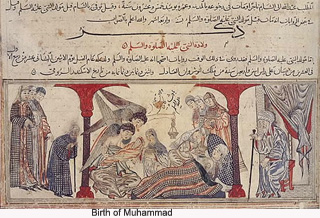 Muslim
religious building." But as the Islamic communities grew and
conquered a great deal of new territory, it came into contact with
the religious arts and architectures of other cultures, and thus the
Muslims began to develop its own figurative art in Islam..." By the
mid-8th century there was a clear Muslim doctrine against the
creation of images, as has been seen in the hadiths above.
Muslim
religious building." But as the Islamic communities grew and
conquered a great deal of new territory, it came into contact with
the religious arts and architectures of other cultures, and thus the
Muslims began to develop its own figurative art in Islam..." By the
mid-8th century there was a clear Muslim doctrine against the
creation of images, as has been seen in the hadiths above.
It is interesting though that, Islam came into contact with the Byzantine cultures at the height of the iconoclastic controversy! It is possible that those intensely negative associations of religious art had indeed influenced or strengthened Islamic views on these matters.
Regardless, "it is likely that, more or less intuitively, the Muslims felt a certain reluctance toward representations from the very beginning. For all monuments of religious art are devoid of any representations; even a number of attempts at representational of symbolism in the official art of coinage were soon abandoned."
In the 8th and 9th centuries, Islamic art experimented with a wide variety of materials, techniques and design; many of which were influenced by China and other parts of the world.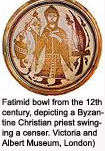 But
the decorative arts remained generally consistent in excluding
depictions of humans and animals. Some minor exceptions are birds
drawn from the folkloric past of the Near East and "occasionally
human figures drawn in strikingly abstract fashions".
But
the decorative arts remained generally consistent in excluding
depictions of humans and animals. Some minor exceptions are birds
drawn from the folkloric past of the Near East and "occasionally
human figures drawn in strikingly abstract fashions".
The art of the Fatimids (a Shiite dynasty that ruled from 909–1171) continued to focus mainly on calligraphy and decorative vines, but also frequently depicted animals and humans. The celebrated lustre-painted Fatimid ceramics from Egypt are especially distinguished by "the representation of the human figure. Some of these ceramics have been decorated with simplified copies of illustrations of the princely themes, but others have depictions of scenes of Egyptian daily life". The Fatimid’s also developed an art of manuscript illustration.
 The
Seljuk Turks sought to restore Islamic orthodoxy. They made many
contributions to Islamic art and architecture, including monumental
minarets, mausoleums of holy men (to which pilgrimages were made),
citadels and madressahs. Paintings and sculptures of animals and
people were among the decorations employed for the monumental new
architectures, but the Seljuks were especially interested in
geometry and mathematical proportion in art. The Mamluks ruled
Egypt, Palestine, and Syria from 1260 to 1517 and were very wealthy.
The
Seljuk Turks sought to restore Islamic orthodoxy. They made many
contributions to Islamic art and architecture, including monumental
minarets, mausoleums of holy men (to which pilgrimages were made),
citadels and madressahs. Paintings and sculptures of animals and
people were among the decorations employed for the monumental new
architectures, but the Seljuks were especially interested in
geometry and mathematical proportion in art. The Mamluks ruled
Egypt, Palestine, and Syria from 1260 to 1517 and were very wealthy.
 The
Mamluks are especially known for their splendid architecture, which
included the Dome of the Rock in Jerusalem. Mamluk art seems to have
been virtually devoid of human and animal depiction. Meanwhile, in
the Mongol period in Iran, Persian art became especially notable for
its figurative art in wall paintings and illuminated manuscripts.
These included many narrative scenes of the Prophet, Iranian kings
and other humans. Examples include the 56 miniature paintings of the
14th-century Shah-e-Namahs ("Book of Kings"); illustrations of the
Jami' at-tawarikh (“Universal History of Rashid ad-Din”); and
the Khwaju Kermani manuscript from 1396. The Iranian style of
painting was influenced by Seljuk art, but more so by Chinese
painting. The most celebrated Islamic painter was Behzad
(1455-1536), who led an academy of art in Iran.
The
Mamluks are especially known for their splendid architecture, which
included the Dome of the Rock in Jerusalem. Mamluk art seems to have
been virtually devoid of human and animal depiction. Meanwhile, in
the Mongol period in Iran, Persian art became especially notable for
its figurative art in wall paintings and illuminated manuscripts.
These included many narrative scenes of the Prophet, Iranian kings
and other humans. Examples include the 56 miniature paintings of the
14th-century Shah-e-Namahs ("Book of Kings"); illustrations of the
Jami' at-tawarikh (“Universal History of Rashid ad-Din”); and
the Khwaju Kermani manuscript from 1396. The Iranian style of
painting was influenced by Seljuk art, but more so by Chinese
painting. The most celebrated Islamic painter was Behzad
(1455-1536), who led an academy of art in Iran.
 The
Ottoman Turks (15th-19th centuries) are best known for their tiles
and pottery, but also developed their own form of miniature
figurative paintings. The Ottoman miniatures do have a character of
their own, either in the almost folk art effect of religious images
or in the precise depictions of such daily events as military
expeditions or great festivals. Among the finest examples of the
latter is the manuscript Surname-i-Vehbi (Topkapi Saray Museum,
Istanbul) painted by Levnî in the early 18th century.
The
Ottoman Turks (15th-19th centuries) are best known for their tiles
and pottery, but also developed their own form of miniature
figurative paintings. The Ottoman miniatures do have a character of
their own, either in the almost folk art effect of religious images
or in the precise depictions of such daily events as military
expeditions or great festivals. Among the finest examples of the
latter is the manuscript Surname-i-Vehbi (Topkapi Saray Museum,
Istanbul) painted by Levnî in the early 18th century.
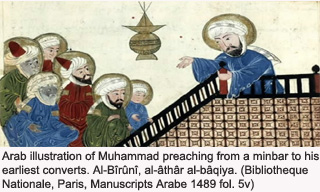
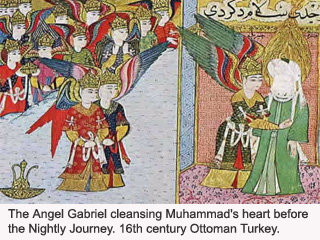
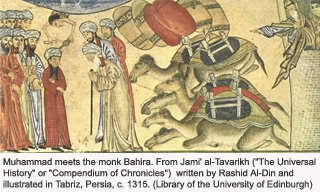
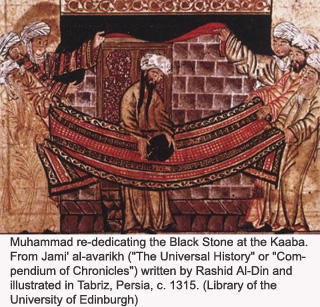
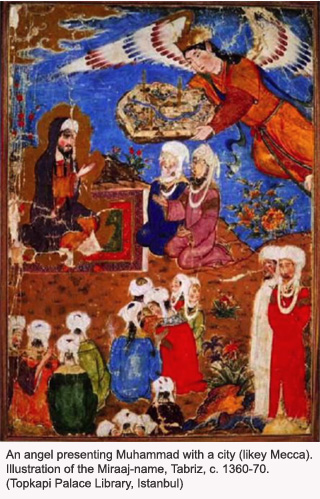
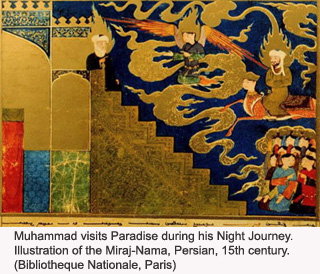
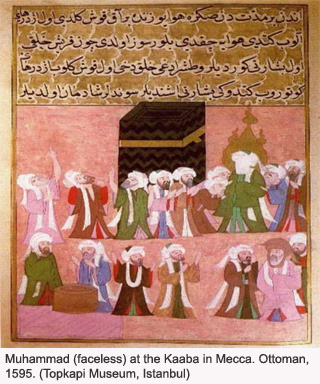
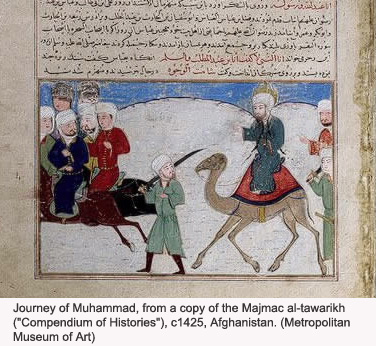
Included this essay are some of the pictorial depictions of Muhammad and his vision. We can see many of these illustrated pictorial manuscripts in museums around the world. Some depict the Prophet in full, while others leave him faceless or with his head engulfed in the sacred flames, representing his contact with Allah. The images are given in roughly chronological order.
From this brief history, it is clear that figurative art (depictions of humans and animals) has made regular appearances in the Islamic world. However, figurative art has largely been a private and secular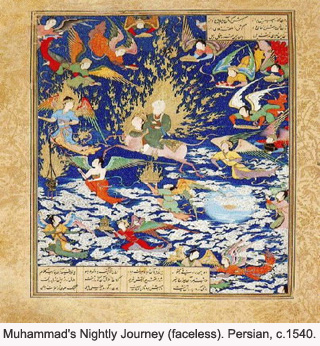 matter,
with most mosques kept free of such imagery. As explained on the
website of the Los Angeles County Museum of Art:
matter,
with most mosques kept free of such imagery. As explained on the
website of the Los Angeles County Museum of Art:
Contrary to a popular misconception, however, figural imagery is an important aspect of Islamic art. Such images occur primarily in secular and especially courtly arts and appear in a wide variety of media and in most periods and places in which Islam flourished. It is important to note, nevertheless, that representational imagery is almost invariably restricted to a private context. Figurative art is excluded from the decoration of religious monuments. This absence may be attributed to an Islamic antipathy toward anything that might be mistaken for idols or idolatry, which is explicitly forbidden by the Quran. Today, the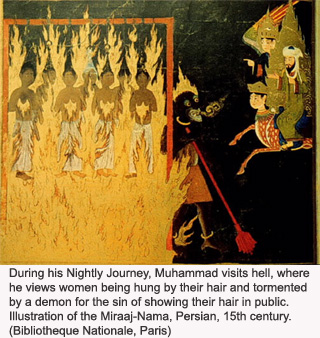 depiction of prophets and especially Muhammad is widely rejected.
The 1976 film The Message, directed by Moustapha Akkad and
starring Anthony Quinn, tells the story of Muhammad, but follows
Islamic law by not showing Muhammad or even portraying his voice (it
is filmed from his perspective). But aside from the taboo about
Muhammad, and despite the clear rules in hadiths, only the most
conservative Muslims (such as the Taliban) believe it is wrong to
create images in general, such as portraits or photographs. The
introduction of television into Saudi Arabia was widely protested at
first because of its images, but is now a common part of Saudi life.
depiction of prophets and especially Muhammad is widely rejected.
The 1976 film The Message, directed by Moustapha Akkad and
starring Anthony Quinn, tells the story of Muhammad, but follows
Islamic law by not showing Muhammad or even portraying his voice (it
is filmed from his perspective). But aside from the taboo about
Muhammad, and despite the clear rules in hadiths, only the most
conservative Muslims (such as the Taliban) believe it is wrong to
create images in general, such as portraits or photographs. The
introduction of television into Saudi Arabia was widely protested at
first because of its images, but is now a common part of Saudi life.
Depictions of Muhammad in Islam
 The
outrage and violence occasioned by the infamous "Danish cartoon
controversy" perhaps had more to do with disrespect for Islam than
depictions of the Prophet. But many of today's Muslims consider any
public depictions of Muhammad offensive and objectionable, no matter
how respectful, and frequently request their removal. The reasons
for this sensitivity to depictions of Muhammad are not immediately
clear, since Muhammad is as human as anyone else, Islamic sources do
not prohibit depictions of him any more than other images, and past
Islamic art has depicted Muhammad. Islamic scholars have explained
that the main reason for the ban on depicting Muhammad is the fear
that the images of Muhammad might be worshipped. Political scientist
As'ad AbuKhalil, visiting professor at the University of California
at Berkeley, explained:
The
outrage and violence occasioned by the infamous "Danish cartoon
controversy" perhaps had more to do with disrespect for Islam than
depictions of the Prophet. But many of today's Muslims consider any
public depictions of Muhammad offensive and objectionable, no matter
how respectful, and frequently request their removal. The reasons
for this sensitivity to depictions of Muhammad are not immediately
clear, since Muhammad is as human as anyone else, Islamic sources do
not prohibit depictions of him any more than other images, and past
Islamic art has depicted Muhammad. Islamic scholars have explained
that the main reason for the ban on depicting Muhammad is the fear
that the images of Muhammad might be worshipped. Political scientist
As'ad AbuKhalil, visiting professor at the University of California
at Berkeley, explained:
 "In
the Holy Quran of Islam, the one sin unforgivable is that of
polytheism. The prohibition is intended to protect the faithful from
that sin. The fear was that intense reverence for the prophet might
if unrestrained cross over into worship. In the 8th and the 9th
centuries a general consensus banning such depictions arose among
the clerics, but not all Muslims knew of it, paid attention, or
obeyed".
"In
the Holy Quran of Islam, the one sin unforgivable is that of
polytheism. The prohibition is intended to protect the faithful from
that sin. The fear was that intense reverence for the prophet might
if unrestrained cross over into worship. In the 8th and the 9th
centuries a general consensus banning such depictions arose among
the clerics, but not all Muslims knew of it, paid attention, or
obeyed".
According to Imam Talal Eid, director of the Islamic Institute of Boston:
"He [the Prophet] instructed his companions not to draw a picture of him, and this has been taken as a general prohibition. He also told them not to pray in places that have images. There also is a general prohibition against full statues. And -- though today, of course, we find photos in all passports -- many Muslims have felt some hesitance about permitting portraits of any kind".
Juan Cole, a professor of Middle Eastern history at the University of Michigan, told NPR:
"The fear was, both in Judaism and Islam that if you represented a holy figure like a prophet who had discussions with the divine, there would be a danger of people worshipping the image".
 Muslims
certainly do revere the Prophet extremely highly. As Professor of
Islamic Studies
John Esposito put it, "to criticize the prophet Muhammad is
as direct an attack as mocking or attacking the Koran, which is seen
as the word of God or the sacred Scripture. Muhammad is seen as the
living Koran. His life Muslims are to emulate".
Muslims
certainly do revere the Prophet extremely highly. As Professor of
Islamic Studies
John Esposito put it, "to criticize the prophet Muhammad is
as direct an attack as mocking or attacking the Koran, which is seen
as the word of God or the sacred Scripture. Muhammad is seen as the
living Koran. His life Muslims are to emulate".
Summary and Conclusions
The above evidence might be summarized in the following facts:
This section describes and explains the religious objects, ritual items and other physical things related to Islam.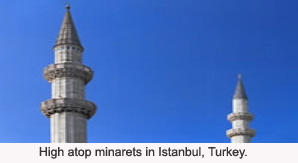
Minarets of Islam
A minaret (beacon) is an element of Islamic religious architecture. It is the tower traditionally used by a muezzin, the crier to call the faithful to prayer, five times a day. Minarets are always connected with a mosque, sometimes by an elevated passageway. At the time of the Prophet Muhammad, the call to prayer was made from the highest roof in the vicinity of the mosque. The earliest minarets as such were former Greek watchtowers or the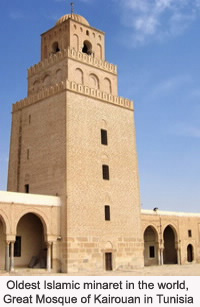 towers
of Christian churches... Today, calls to prayer are usually done in
the prayer hall through a loudspeaker, and minarets serve mainly
decorative purposes. The oldest minaret in the world is in Kairouan,
Tunisia. Built between 724 and 727, it has a massive square form.
The tallest minaret in the world is that of the new Hassan II Mosque
in Casablanca, Morocco, which stands 210 meters tall. Minarets were
built to be “landmarks of Islam” — to be visible from afar and to
stamp an area with Islamic character.
towers
of Christian churches... Today, calls to prayer are usually done in
the prayer hall through a loudspeaker, and minarets serve mainly
decorative purposes. The oldest minaret in the world is in Kairouan,
Tunisia. Built between 724 and 727, it has a massive square form.
The tallest minaret in the world is that of the new Hassan II Mosque
in Casablanca, Morocco, which stands 210 meters tall. Minarets were
built to be “landmarks of Islam” — to be visible from afar and to
stamp an area with Islamic character.
The number of minarets per mosque varies, from one to as many as six. They are constructed in a wide variety of forms ranging from thick, squat spiral ramps to soaring, delicate, pencil thin spires.
A minaret has one or more balconies, from which the muezzin announces the call to prayer, and a spiral staircase on the inside or outside. Often the minaret is square at the base, where it is attached to the mosque.
Above this square base it may rise in a series of circular, hexagonal, or octagonal stages, each marked by a projecting balcony.
At the top is a bulbous dome, an open pavilion, or a metal-covered cone. The upper parts of the minaret are usually richly decorated with carving. The steps may be internal or external.
Minbar
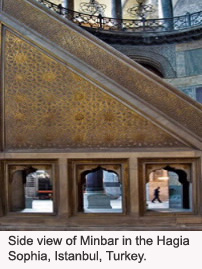 A
Minbar is the pulpit from which the Friday sermon (khutbah) is
delivered. In its simplest form, the Minbar is a platform with three
steps. It is located next to the Mihrab.
A
Minbar is the pulpit from which the Friday sermon (khutbah) is
delivered. In its simplest form, the Minbar is a platform with three
steps. It is located next to the Mihrab.
Muhammad originally delivered his sermons while leaning against a palm-trunk pillar in the mosque at Medina or ascending a stone platform. The Hadiths report that Muhammad later used a seat with two steps, fashioned from tamarisk wood by a Greek or Abyssinian carpenter, for receiving delegations in the mosque and also for preaching allahs’ Quran to his followers. Muhammad's successors, the caliphs, used the Prophet's Minbar as a symbol of their authority. During the first century of Islam, provincial governors came to use the Minbar primarily in their capacity as rulers, making speeches and hearing petitions from it. When the khutbah lost its informative and political character, and became purely religious sermons during the reign of the 'Abbasid caliphs dynasty, the Minbar also became a religious object in Islam. It became more permanent in nature, with the number of steps being increased, and it was commonly made of stone or brick. It was even covered with a cloth, the qatifah.
Religious symbolism is the use of symbols, including archetypes, acts, artworks, events, or natural phenomena by religion. Religions view religious texts, rituals of worship, and works of art as symbols of compelling ideas or ideals. Symbols help create a resonant mythos expressing the moral values of the society or the teachings of the religion to foster solidarity among adherents, and also to bring adherents closer to their objects of worship.
The present-day man has still not given up on these symbolic artifacts, and adores them and wears them in times of religious rituals and offerings. It is also interesting how a symbol is associated with one view/party/religion even though the origin of that symbol may be totally different than the accepted meanings for which it is portrayed or assumed.
This article is on Religious Symbols or Symbolism in Islam and what do these Islamic Relics have to do within the confines Islamic history, practices, beliefs, spirituality, architectural artifacts, buildings, decorations and allah’s sacred names…
There are no official Islamic symbols, but several symbols or images have a special place in Islam. Below are some of the most revered and famous iconic symbols of Islam:
| Kalima-e-Shahadah (Creed of Islam) |  |
| Allah (Name of God in Arabic) | 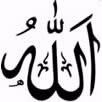 |
| Star and Crescent (Ottoman symbol on Islamic Flags) |  |
| Rub-el-Hizb (Islamic Architectural Designs) |  |
| Green (Color Symbolism in Islam) |  |
Star and Crescent Symbolism
The star and crescent is the best-known symbol used in representing Islam. It features prominently on the flags of many Islamic countries, notably Turkey and Pakistan. Surprisingly, this symbol is not of Islamic origin. Rather, it was a polytheistic icon adopted during the spread of Islam and its use today is sometimes controversial in the Muslim world. The crescent and star are often said to be Islamic symbols, but historians say that they were the insignia of the Ottoman Empire and not of Islam as a whole... It is also important to keep in mind that Islam has very few traditional symbols and the crescent moon and star are not the ones that are recognized as traditional symbols by Muslims. The symbol is due to its cultural diffusions and also with the spread of Islam to the Ottoman Turks, who ruled a large area of Europe, Asia and Africa. The Turks put the crescent moon and star symbol on their flag and it has since become associated with Islam…
Green as Islamic Color Symbolism
In early accounts of Muslim warfare, there are references to flags or battle standards of various colors: black, white, red, and greenish-black. Later Islamic dynasties adopted flags of different colors:
-
The Umayyad fought under white banners
-
The Abbasids chose black
-
The Fatimids used green
-
Various countries on the Persian Gulf have chosen red flags
The color "green" has a special place in Islam, and is often used to represent it among other world religions. One can often find it in mosques and other important places, as well as on the flags of Muslim countries, notably Saudi Arabia. Some say green was Muhammad’s favorite color, and that he wore a green cloak and turban, while others believe it symbolizes vegetation and life. Some say that after Muhammad, only the caliphs were allowed to wear green turbans. In the Qur'an (Surah 18:31), it is said that the inhabitants of paradise will wear green garments of fine silk. While the reference to the Qur'an is verifiable, it is not clear if other explanations are reliable or mere folklore.
Regardless of its origins, the color green has been firmly cemented in Islamic culture for centuries; for example, it is absent in many medieval European coats of arms, as during the Crusades, green was the color used by Islamic soldiers. Additionally, in the Topkapi Palace in Istanbul, there is a room with relics of Muhammad. One of them, kept locked in a chest, is said to have been Muhammad's banner, under which he went to battles. Some say that this banner is green with golden embroidery; others say that it is black...
Other Islamic Symbolisms
Certain words in Arabic script or characters can be regarded as visually representing Islam, such as "Allah" at the top of this page, or the Kalima Shahada. A Shiite symbol is the sword, which is identified with Iimam Ali, who, they believe, fought with this sword and gave his life for Islam. The gardens of the Mughal Empire in India were symbols of paradise (Jannah).
The current flag of Saudi Arabia, used by the government of Saudi Arabia since March 15, 1973, is green featuring in white an Arabic inscription and a sword underneath. The Arabic inscription is written in the Thuluth script, which is the Islamic declaration of faith, the Kalima-e-Shahada:
la ilaha ill allah muhammadun rasul allahThe sword symbolizes the importance of the inscription by underlining it. Green flags bearing this or other Arabic scripts are frequently seen in Islam and should not be confused with the Saudi national flag. Other flags normally do not bear the sword. The flag is manufactured with differing obverse and reverse sides, to ensure that the Kalima-e-Shahada reads correctly from right to left and from either sides. The sword points from hoist to fly on both the sides. This flag is sinister hoisted, meaning that the obverse side (front) has the hoist side (flagpole side) to the right. The green color used in the flag is 330C.
(There is no god but Allah, and Muhammad is his prophet)
Uses: Because the kalama-e-shahada is considered holy, the flag is not normally used on T-shirts or other wearable items. Saudi Arabia protested against its inclusion on a planned football to be issued by FIFA, bearing all the flags of the participants in the 2002 Football World Cup. Saudi officials said that kicking the creed with the foot was completely unacceptable in Islam. Similarly, an attempt by the US military to win favour with children of the Prosth region of Afghanistan, by distributing footballs adorned with participating countries flags including that of Saudi Arabia, ended in demonstrations. The Saudi flag is never lowered to half-mast as a sign of mourning. The normal flag cannot be hoisted vertically according to Saudi legislations. Special vertical flags are manufactured where both the inscriptions (the creed) and the emblem (the sword) are rotated, although this is rare, as most Arab countries lack the traditions of hoisting flags vertically.
History: A green flag with the shahada has been connected with the Wahhabi reformist movement since the 18th century. This movement was associated with the Al-Saud family's rise to power, and when Abdulaziz ibn Abdulrahman as-Saud became King of the Nejd in 1902, he added a sword to this flag. The design of the flag was not standardized prior to March 15 1973, and variants with two swords and/or a white vertical stripe at the hoist were frequently used. By 1938, the flag had basically assumed its present form.
Past Flags: The precursor states to Saudi Arabia were Nejd and Hijaz. The state flag of Nejd followed today's Saudi flag pattern very closely. The state of Hijaz followed the patterns seen in countries like Western Sahara and Sudan. From 1744, a crescent was present. From 1902 until 1921, a different Arabic inscription was used.
Islamic Figurative Art and Depictions of Muhammad
"Thou
shalt not make unto thee any graven image, or any
likeness of any thing that is in Heaven above, or that is in the
earth beneath, or that is in the water under the earth. You shall
not bow down to them or serve them; for I the LORD your God am a
jealous God." (Second Commandment, Exodus 20:4-5)."Those who paint pictures would be punished on the Day of Resurrection and it would be said to them: Breathe soul into what you have created." (Hadith, Sahih Muslim vol.3, no. 5268)
The unique beauty of Islamic art derives in large part from its longstanding rejection of depictions of humans and animals in the Islamic religious art. Instead, portraits or stories from the Quran, the mosques and manuscripts are adorned with flourishes of Arabic calligraphy, delicate tile work, layers of gold with intricate floral decorations. But the attitude towards figurative art have varied somewhat throughout the course of Islamic history, and across different Islamic cultures. Animals and humans appear sporadically throughout the centuries, and there are many surviving examples of beautiful figurative art from the Islamic world, most of which come from the late medieval period in Iran. These even depict events in the life of Muhammad, the prophet’s scenic visions of Paradise and Hell, battles of Iranian kings, everyday life, and other human subjects. Today, as is it well-known, figurative art is widely rejected in Islam and depictions of Muhammad are especially considered very offensive. This article seeks to provide a factual background for this, and chronicling the history of figurative depictions in the Islamic art, pinning down exactly what is prohibited in the Quran and hadiths, and by exploring the reasoning given for the special sensitivity to the depictions of Muhammad.
Rules about Images in the Qur'an, Hadiths and Islamic Laws
Unlike the Hebrew Bible, and perhaps surprisingly, there is no commandment against making images of living beings in the Quran. But it does make it clear that nothing should be honored alongside God:
"God does not forgive the joining of partners [shirk] with him: anything less than that he forgives to whoever he will, but anyone who joins partners with God is lying and committing a tremendous sin" (Surah 4:48).All Islamic injunctions against making religious images come from the hadiths (traditions recorded by various followers about what the Prophet said and did). Although not divine in revelation like the Quran, the hadiths is considered binding when multiple trustworthy sources agree on their authenticity. Following are some examples of hadiths on images:
"Ibn 'Umar reported Allah's Messenger (may peace be upon him) having said: Those who paint pictures would be punished on the Day of Resurrection and it would be said to them: Breathe soul into what you have created." (Sahih Muslim vol.3, no.5268)
"This hadiths has been reported on the authority of Abu Mu'awiya though another chain of transmitters (and the words are): Verily the most grievously tormented people amongst the denizens [inhabitants] of Hell on the Day of Resurrection would be the painters of pictures" (Sahih Muslim vol.3, no.5271)
"Narrated [Muhammad's wife] 'Aisha: Allah's Apostle said, 'The painter of these pictures will be punished on the Day of Resurrection, and it will be said to them, Make alive what you have created.'" (Bukhari vol.9, book 93 no.646)
"Narrated ‘Aisha: The Prophet entered upon me while there was a curtain having pictures (of animals) in the house. His face got red with anger, and then he got hold of the curtain and tore it into pieces. The Prophet said, ‘Such people as paint these pictures will receive the severest punishment on the Day of Resurrection.’" (Bukhari vol.8, book 73, no.130)
"Umar said, ‘We do not enter your churches because of the statues and pictures.’ Ibn ‘Abbas used to pray in the church provided there were no statues in it." (Bukhari vol.1, chapter 54)
"‘Aisha played with dolls while her husband Muhammad was with her. (Sahih Muslim vol.4, book 29 ch.1005, no.5981)
"Muhammad went to Fatimah’s house, but turned back when he saw a figured curtain." (Sunan Abu Dawud vol.3, book 21, no.3746)
History of Images and Figurative Art in Islam
In
the earliest days of Islam, specifically "Islamic art" had not yet
begun to develop, and art in general was not a prominent issue.
According to the Encyclopedia Britannica: "Earliest Islam as seen in the Quran or in the more verifiable accounts of the Prophet's life simply does not deal with the arts, either on the practical level of requiring or suggesting forms as expressions of the culture. or on the ideological level of defining a Muslim attitude toward images.... There is no prohibitions against any representations of living things, and not a single Quranic passage refers clearly to the mosque, which eventually becomes the most characteristic figure of the
Muslim
religious building." But as the Islamic communities grew and
conquered a great deal of new territory, it came into contact with
the religious arts and architectures of other cultures, and thus the
Muslims began to develop its own figurative art in Islam..." By the
mid-8th century there was a clear Muslim doctrine against the
creation of images, as has been seen in the hadiths above. It is interesting though that, Islam came into contact with the Byzantine cultures at the height of the iconoclastic controversy! It is possible that those intensely negative associations of religious art had indeed influenced or strengthened Islamic views on these matters.
Regardless, "it is likely that, more or less intuitively, the Muslims felt a certain reluctance toward representations from the very beginning. For all monuments of religious art are devoid of any representations; even a number of attempts at representational of symbolism in the official art of coinage were soon abandoned."
In the 8th and 9th centuries, Islamic art experimented with a wide variety of materials, techniques and design; many of which were influenced by China and other parts of the world.
But
the decorative arts remained generally consistent in excluding
depictions of humans and animals. Some minor exceptions are birds
drawn from the folkloric past of the Near East and "occasionally
human figures drawn in strikingly abstract fashions". The art of the Fatimids (a Shiite dynasty that ruled from 909–1171) continued to focus mainly on calligraphy and decorative vines, but also frequently depicted animals and humans. The celebrated lustre-painted Fatimid ceramics from Egypt are especially distinguished by "the representation of the human figure. Some of these ceramics have been decorated with simplified copies of illustrations of the princely themes, but others have depictions of scenes of Egyptian daily life". The Fatimid’s also developed an art of manuscript illustration.
The
Seljuk Turks sought to restore Islamic orthodoxy. They made many
contributions to Islamic art and architecture, including monumental
minarets, mausoleums of holy men (to which pilgrimages were made),
citadels and madressahs. Paintings and sculptures of animals and
people were among the decorations employed for the monumental new
architectures, but the Seljuks were especially interested in
geometry and mathematical proportion in art. The Mamluks ruled
Egypt, Palestine, and Syria from 1260 to 1517 and were very wealthy.
The
Mamluks are especially known for their splendid architecture, which
included the Dome of the Rock in Jerusalem. Mamluk art seems to have
been virtually devoid of human and animal depiction. Meanwhile, in
the Mongol period in Iran, Persian art became especially notable for
its figurative art in wall paintings and illuminated manuscripts.
These included many narrative scenes of the Prophet, Iranian kings
and other humans. Examples include the 56 miniature paintings of the
14th-century Shah-e-Namahs ("Book of Kings"); illustrations of the
Jami' at-tawarikh (“Universal History of Rashid ad-Din”); and
the Khwaju Kermani manuscript from 1396. The Iranian style of
painting was influenced by Seljuk art, but more so by Chinese
painting. The most celebrated Islamic painter was Behzad
(1455-1536), who led an academy of art in Iran.The
Ottoman Turks (15th-19th centuries) are best known for their tiles
and pottery, but also developed their own form of miniature
figurative paintings. The Ottoman miniatures do have a character of
their own, either in the almost folk art effect of religious images
or in the precise depictions of such daily events as military
expeditions or great festivals. Among the finest examples of the
latter is the manuscript Surname-i-Vehbi (Topkapi Saray Museum,
Istanbul) painted by Levnî in the early 18th century. Included this essay are some of the pictorial depictions of Muhammad and his vision. We can see many of these illustrated pictorial manuscripts in museums around the world. Some depict the Prophet in full, while others leave him faceless or with his head engulfed in the sacred flames, representing his contact with Allah. The images are given in roughly chronological order.
From this brief history, it is clear that figurative art (depictions of humans and animals) has made regular appearances in the Islamic world. However, figurative art has largely been a private and secular
matter,
with most mosques kept free of such imagery. As explained on the
website of the Los Angeles County Museum of Art: Contrary to a popular misconception, however, figural imagery is an important aspect of Islamic art. Such images occur primarily in secular and especially courtly arts and appear in a wide variety of media and in most periods and places in which Islam flourished. It is important to note, nevertheless, that representational imagery is almost invariably restricted to a private context. Figurative art is excluded from the decoration of religious monuments. This absence may be attributed to an Islamic antipathy toward anything that might be mistaken for idols or idolatry, which is explicitly forbidden by the Quran. Today, the
depiction of prophets and especially Muhammad is widely rejected.
The 1976 film The Message, directed by Moustapha Akkad and
starring Anthony Quinn, tells the story of Muhammad, but follows
Islamic law by not showing Muhammad or even portraying his voice (it
is filmed from his perspective). But aside from the taboo about
Muhammad, and despite the clear rules in hadiths, only the most
conservative Muslims (such as the Taliban) believe it is wrong to
create images in general, such as portraits or photographs. The
introduction of television into Saudi Arabia was widely protested at
first because of its images, but is now a common part of Saudi life.
Depictions of Muhammad in Islam
The
outrage and violence occasioned by the infamous "Danish cartoon
controversy" perhaps had more to do with disrespect for Islam than
depictions of the Prophet. But many of today's Muslims consider any
public depictions of Muhammad offensive and objectionable, no matter
how respectful, and frequently request their removal. The reasons
for this sensitivity to depictions of Muhammad are not immediately
clear, since Muhammad is as human as anyone else, Islamic sources do
not prohibit depictions of him any more than other images, and past
Islamic art has depicted Muhammad. Islamic scholars have explained
that the main reason for the ban on depicting Muhammad is the fear
that the images of Muhammad might be worshipped. Political scientist
As'ad AbuKhalil, visiting professor at the University of California
at Berkeley, explained:"In
the Holy Quran of Islam, the one sin unforgivable is that of
polytheism. The prohibition is intended to protect the faithful from
that sin. The fear was that intense reverence for the prophet might
if unrestrained cross over into worship. In the 8th and the 9th
centuries a general consensus banning such depictions arose among
the clerics, but not all Muslims knew of it, paid attention, or
obeyed". According to Imam Talal Eid, director of the Islamic Institute of Boston:
"He [the Prophet] instructed his companions not to draw a picture of him, and this has been taken as a general prohibition. He also told them not to pray in places that have images. There also is a general prohibition against full statues. And -- though today, of course, we find photos in all passports -- many Muslims have felt some hesitance about permitting portraits of any kind".
Juan Cole, a professor of Middle Eastern history at the University of Michigan, told NPR:
"The fear was, both in Judaism and Islam that if you represented a holy figure like a prophet who had discussions with the divine, there would be a danger of people worshipping the image".
Muslims
certainly do revere the Prophet extremely highly. As Professor of
Islamic Studies
John Esposito put it, "to criticize the prophet Muhammad is
as direct an attack as mocking or attacking the Koran, which is seen
as the word of God or the sacred Scripture. Muhammad is seen as the
living Koran. His life Muslims are to emulate".Summary and Conclusions
The above evidence might be summarized in the following facts:
-
Judaism, Christianity and Islam all consider idolatry a heinous sin.
-
The Qur'an does not prohibit making images, only worshipping them.
-
Hadiths clearly and consistently prohibits all images of any living being, with special mention of punishment for painters.
-
One exception to this rule is dolls for children, probably because children are not considered in danger of worshipping them as idols.
-
Neither the Qur'an nor Hadiths mention depictions of Muhammad.
-
The Hadiths prohibiting images are directed at Muslims only (e.g. Muslims are instructed not to enter buildings where there are images, not to demand their removal).
-
Muslim outrage against depictions of the Prophet does not usually extend to outrage against all images.
-
The Hadiths prohibiting images do not call for Muslims to take action against those who make images, but instead say that God will punish them severely at the Day of Judgment.
-
Muslims have applied the prohibitions against images in various ways throughout history, and there is still some variation today.
-
Figurative art of Muhammad and other humans has been a significant part of late medieval Islamic art. But it was generally limited to secular contexts and elite classes, who could afford fine art.
-
Shiites tends to be more open to religious images than Sunnis.
-
The main reason given for not depicting Muhammad is to avoid the temptation to worship the image.
-
Neither the Qur'an nor Hadiths say that viewing an image accidentally is a sin, but in the Hadiths the Prophet teaches Muslims to avoid them.
This section describes and explains the religious objects, ritual items and other physical things related to Islam.
Minarets of Islam
A minaret (beacon) is an element of Islamic religious architecture. It is the tower traditionally used by a muezzin, the crier to call the faithful to prayer, five times a day. Minarets are always connected with a mosque, sometimes by an elevated passageway. At the time of the Prophet Muhammad, the call to prayer was made from the highest roof in the vicinity of the mosque. The earliest minarets as such were former Greek watchtowers or the
towers
of Christian churches... Today, calls to prayer are usually done in
the prayer hall through a loudspeaker, and minarets serve mainly
decorative purposes. The oldest minaret in the world is in Kairouan,
Tunisia. Built between 724 and 727, it has a massive square form.
The tallest minaret in the world is that of the new Hassan II Mosque
in Casablanca, Morocco, which stands 210 meters tall. Minarets were
built to be “landmarks of Islam” — to be visible from afar and to
stamp an area with Islamic character.The number of minarets per mosque varies, from one to as many as six. They are constructed in a wide variety of forms ranging from thick, squat spiral ramps to soaring, delicate, pencil thin spires.
A minaret has one or more balconies, from which the muezzin announces the call to prayer, and a spiral staircase on the inside or outside. Often the minaret is square at the base, where it is attached to the mosque.
Above this square base it may rise in a series of circular, hexagonal, or octagonal stages, each marked by a projecting balcony.
At the top is a bulbous dome, an open pavilion, or a metal-covered cone. The upper parts of the minaret are usually richly decorated with carving. The steps may be internal or external.
Sources:
1. "minaret." Encyclopedia Britannica (2007). Encyclopedia Britannica Online.
2. "minaret." John L. Esposito, The Oxford Dictionary of Islam (2003).
More Information
Minbar
A
Minbar is the pulpit from which the Friday sermon (khutbah) is
delivered. In its simplest form, the Minbar is a platform with three
steps. It is located next to the Mihrab.Muhammad originally delivered his sermons while leaning against a palm-trunk pillar in the mosque at Medina or ascending a stone platform. The Hadiths report that Muhammad later used a seat with two steps, fashioned from tamarisk wood by a Greek or Abyssinian carpenter, for receiving delegations in the mosque and also for preaching allahs’ Quran to his followers. Muhammad's successors, the caliphs, used the Prophet's Minbar as a symbol of their authority. During the first century of Islam, provincial governors came to use the Minbar primarily in their capacity as rulers, making speeches and hearing petitions from it. When the khutbah lost its informative and political character, and became purely religious sermons during the reign of the 'Abbasid caliphs dynasty, the Minbar also became a religious object in Islam. It became more permanent in nature, with the number of steps being increased, and it was commonly made of stone or brick. It was even covered with a cloth, the qatifah.
Sources:
- "minbar." Encyclopedia Britannica (2007). Encyclopedia Britannica Online.
- "minbar." John L. Esposito, The Oxford Dictionary of Islam (2003).