.

.
Library of Professor Richard A. Macksey in Baltimore

POSTS BY SUBJECT

Labels

Wednesday, March 8, 2017

Tarek Fatah : From Bangladesh to Darfur: How Internalised Racism Has Permitted Lighter Skinned Muslims to Slaughter Their Darker Skinned Co-religionists

From Bangladesh to Darfur: How Internalised Racism Has Permitted Lighter Skinned Muslims to Slaughter Their Darker Skinned Co-religionists

Speech by Tarek Fatah
The Durban Review Conference (Durban II)
Geneva, Switzerland
http://www.facebook.com/note.php?note_id=164051190246

Dear NGO colleagues and delegates,

I speak to you deeply disappointed that my colleague Milly Nsekalije, a survivor of the Rwandan massacre could not share her story with all of you because in the eyes of some since she is not 100% Tutsi, she cannot have been a victim of the Genocide.

What does it say about the state of racism in our world when the victims of a genocide practise exclusion on the basis of the so-called purity of blood lines and ethnicities.

Worse than her exclusion from today’s event is the fact that it has happened at a conference meant to combat racism, when it fact, in my opinion, whether it was yesterday’s speech by Mahmood Ahmadenijad or this afternoon’s barring off Ms. Nsekalije, we have turned the concept of racism upside down.

Having said that, please allow me to dwell on how racism plays out its dirty game, not just as a Black-White divide, but also as a cancer that affects relations between people of colour, often sharing the same religion, but different shades of brown or black skin.

When the issue of racism comes up, the internalised racism that devours the people of the developing world in Asia and Africa, from within, rarely comes up for discussion.

This afternoon I would like to shed some light on two genocides—one in 1970-71 and the other that continues as I speak. In both instances the root of the problem lay in how one group of Muslims felt they were racially superior to their victims, who also happened to be Muslims. In both cases the doctrine of racial superiority and the practise of institutional racism went unchallenged even after the horrible consequences of such racism was evident and for all to see.

Bangladesh

The first genocide took place in then East Pakistan, now Bangladesh and second is taking place in Darfur. Let me dwell on the Bangladesh genocide first.

In 1970 in Pakistan, my country of birth was divided between two wings; an eastern part that is today known as Bangladesh and the western rump that survived a subsequent war with India as the state we know as Pakistan.

East Pakistan was inhabited by the darker skinned Bengali people who happened to be the majority community of the country, but found themselves ruled by a lighter skinned minority from what was known as West Pakistan—separated by a 1,000 miles.

In the first 25 years of the country, the racist depiction of the darker skinned Bengalis as an inferior and incapable people became the unquestioned dogma among the ruling minority. In addition to the racist depiction of the darker-skinned Bengalis, their culture was portrayed as unislamic and being influenced by Hinduism. Their music, cuisine and attire were mocked while their language was banned and led to widespread protests and deaths in 1952.

In 1970, after suffering under the minority rule of West Pakistan for 25 years, the people of East Pakistan voted to elect a party based in their region and gained a clear majority in the country’s national parliament.

However, the racist view that Bengali people were incapable of ruling the country or that they were traitors to the fair-skinned minority of West Pakistan, led to a military intervention and widespread massacres in which one million people were killed in a ten-month period.

The killing of the Bengali people by the West Pakistan army stopped only when India intervened and defeated the Pakistan Armed forces, but not before hundreds of Bengali intellectuals, professors, poets, authors, musicians and painters, were rounded up and massacred in the final act of mass murder that started with the tolerance of racism as an act of faith.

One million Muslims were murdered by fellow Muslims in an orgy of hate that defied the teachings of Islam and the very Prophet Muhammad who was being invoked by the Pakistan Army. At the root of this sad blot on Islamic history and all of humanity lay the view that people of darker skin are inferior to those for geographic reasons have for no fault of theirs, a lighter skin colour.

One would have hoped that the lessons of 1970-71 would have been learnt in the Muslim World, but the sad fact is that the ubiquitous racism that resides inside the Islamic world has faced no opposition. On the contrary there is near universal denial about this cancer, not just among the governments that rule with oppressive instruments of power, but also many NGOs and civil society groups in the Muslim world.

Darfur

The latest manifestation of racism leading to a genocide is in Sudan where the Arab Janjaweed militia and the Arab government in Khartoum has resulted in the killing of 500,000 Darfuri Muslims whose only fault is that they are Black and thus considered as inferior to the ruling classes of that country.

The mistreatment of Black Muslims by those who feel they are superior because of their lighter skin colour has been historical. Only in the Middle East can one get away by addressing a Black man as “Ya Abdi”, which translates to the horrible words, “Oh you slave”.

The acceptance of racism among the dominant community in the Arab world has today resulted in not just the genocide of Darfuris, but also the celebration by the Arab League of the man charged by the International Criminal Court, President Bashir of Sudan.

It is time that the medieval doctrine of the inferiority of non-Arab Muslims to Arab Muslims is laid to rest. It is necessary that Arab countries and leaders of Arab NGOs denounce this doctrine that has led to the discrimination of darker skinned Muslims by Arab governments in counties as far apart as Dubai to Darfur.

Behind the genocide of Bengal and Darfur, separated by 30 years, is the unchallenged doctrine of racial superiority of one ethnic group over another that has gone unnoticed and unpunished by any institution anywhere in the world.

This doctrine of racism has brought untold misery on the victims of this cancer, but this becomes worse when such racism is given a religious validation. In this day and age, we have fatwas from contemporary Islamic scholars who maintain that a non-Arab Muslim like me would be committing an act of sin if I considered myself equal to an Arab.

Fatwas from the 14th century have been dusted off the shelves, re-furbished and published on on-line Islamist forums to justify the superiority of one group over the other. This has provided the moral justification to the mass murder being committed on the Black Muslims of Darfur, which unfortunately, has gone unmentioned even at this conference.

Conclusion
Let me conclude by suggesting that if racism is a mountain that we all need to conquer, then we have not yet come to a place where we can see this mountain in the horizon, let alone be at base camp.

Ladies and gentlemen, sisters and brothers, if we cannot allow a woman to speak here because she is of mixed blood or the fact that untouchability in India is not on the agenda in Geneva, or that nations of the OIC seek the right to restrict free speech, or a demagogue from Iran with blood on his hands has the audacity to lecture us on human rights, then all I can say is that in the words of Robert Frost, we have miles to go before we sleep…
---
Tarek Fatah is the author of highly acclaimed recent book, Chasing Mirage: The Tragic Illusion of an Islamic State.

Puneet Madan : The Genesis and Working of Radical Islam

The Genesis and Working of Radical Islam

Puneet Madan on the inaugural Human Rights Coalition Against Radical Islam Rally in New York on May 3, 2009:

We are a multi-lingual, multi-cultural, multi-religious, multi-ethnic group that have gathered in Times Square, New York, today (May 3, 2009) under the Human Rights Coalition Against Radical Islam (HRCARI) banner to reaffirm the most basic of principles that our ancestors stood for when, over six decades ago, they established the United Nations, the cornerstone of a hoped-for global democracy. In doing so, they hoped to ensure that never again would humankind face the persecution it suffered during the tragedies of the mid-20th century. The establishment of the United Nations was to be the beginning of a new era in which people of different religion, cultures, castes, and color would together create a new global society, a humanistic society, finally overcoming the fascism and imperialism of the times past.

HRCARI reaffirms the most basic principles human rights: freedom of speech, freedom of religion, the right to vote, and the assurance that all human beings are equal, regardless of his social, cultural, gender, racial, sexuality or religious status.

For many in our world, democracy is considered the essence of human freedom. However, for others, the term “democracy” has come to imply only the right to vote. This is exemplified in the many Islamic countries that hold elections, even while exhibiting nary a trace of freedom. The most famous recent example of elections without the "essence of democracy" include the 2006 election of Hamas in the Palestinian Territories. The reality is that freedom, as a concept, has been defined straight out of existence. While most people in the world define freedom and human rights according to the universalistic notions set forth in the UN’s Universal Declaration of Human Rights (UNUDHR), and other documents such as the United States’ Declaration of Independence, radical Muslims have defined “freedom” to mean the freedom they enjoy to exploit human suffering and dignity, a "freedom", they believe, is granted them by their age-old religious scripture. They are, in short, demanding that the democratic, freedom-loving world be tolerant to their intolerance.
In the 1930s, when Jews were forced to wear arm bands in Nazi Germany, the world ignored their plight. One of the excuses for ignoring Jewish suffering during the Holocaust was a perceived need to be "sensitive" to the plight of Nazi Germany. It is still an open question why and how the world ignored and appeased the Nazi threat for as long as it did, until action was finally taken. But it is clear that by ignoring the Nazi threat, the world permitted a massive human tragedy, the Holocaust, to happen. The United Nations was founded in the wake of that tragedy in order to prevent another Holocaust.

Ironically the same story repeated itself in 1999, when the Taliban forced Afghan Hindus and Sikhs to wear orange armbands. They also were responsible for the genocide of the Hazara Muslims in Northern Afghanistan. Let loose, the Taliban grew into a global threat by 2001, and we are still living under the shadow of that threat. Today, the media and politicians are attempting to claim there is a “moderate Taliban.” The term “moderate Taliban” is an oxymoron in itself. Once again we are making deals and compromising the very definition of the “universal human dignity” in order to be “sensitive” towards the demands of perpetrators of genocide.
Presently, whenever a terrorist kills innocent people in horrific events such attacks on September 11, 2001 (New York), March 27, 2002 (Passover bombing in Netanya, Israel), March 11, 2003 (Madrid bombing), July 7, 2005 (London bombing), and November 26-28 2008 (Mumbai attacks), the majority of “mainstream politicians” run out to make apologies on behalf of the terrorists. There is also denial of the problem of radical Islam by the “mainstream media,” which does not refer to radical Muslims by their true identity: radical Muslims or Islamic terrorists. Instead, they have been referred to as “South Asians”, “militants" etc. When this is combined with a politically correct mentality, which requires universal tolerancethat is, tolerance even of intolerant radical Islama deadly “cocktail” is created. The last time such a confluence of events occurred was during the lead-up to the rise of Nazis in Germany, culminating in the World War II. It is important to note that we must discuss the background of radical Islam, because its history, thus far, has been ignored. The root of radical Islam must be understood in order to prevent further genocide.
We, the Indians, would like to inform Americans and the world of the full scope of the problem of radical Islam that we endured. During and before the 1920s, there was a mass-murdering rampage undertaken by India's radical Muslims, under the guise of evicting the British from India. In truth, these murders occurred as part of the khilafat movement, in order to found a radical Islamic state, a pan-Islamic caliphate, in the “British Jewel” of India. Today’s radical Muslims are, kind of, a continuation of same radical Islamic movement, having the same goal as those of the 1920s: founding of an Islamic caliphate of the global scale. However, since the history of radical Islam is unknown, or forgotten, it is mistakenly believed that radical Islam is a new phenomenon, a direct result of “Western imperialism” or other external factors.

In the year 1926, there was a summit in Mecca that gave birth to two Radical Islamic movementsthe Muslim Brotherhood and Tablighi Jamaatto combat the “non-Islamic” world on the western and eastern boundaries of the Arabian peninsula.[1] The Grand Mufti of Jerusalem, Haj Amin al Husseini was a key participant in this summit. He was in fact a key architect of the Jewish Holocaust and of the radical Islamic terrorism in Palestine. In addition, the radical Deobandi Muslim cleric, Maulana Ilyas, traveled back to India and created the Tablighi Jamaat. As such, in the “Western front”, Hassan-al-Banna and his associate Amin al Husseini received funds from Deobandi radicals, as well as from the Nawab (governor) of Hyderabad, India. This ultimately led to the creation of the Muslim Brotherhood, which later adopted the Mawdudi vision of the 'Ummah', or the society that decide how to impose religious apartheid on global level.

The Mecca Summit of 1926 quickly resulted in a series of murders of many opponents of the Aryan Race theory in India. As an example, the murder of high profile spiritual Hindu guru Swami Shraddhanand is still well-known. Although the political body maintained that the serial killings of 1926 were done by scattered religious fanatics and lacked any broader political connections, the actions of these murderers points to a different reality. The period between 1926 and 1932 was perhaps the earliest and most dynamic phase during which radical Muslims realigned themselves into a threat of global proportions. An example of early hate education and the tie-in to genocide can be traced back to 1926, when a radical Muslim, known as Inayat Allah Khan al-Mashriqi, translated Hitler's “Mein Kampf” into Urdu. This hate-text was then widely sold in mosques, and the sale of Mein Kampf in the Urdu-speaking world rivaled that in pre-Nazi Germany of 1926.
In the year 1929, there was a massacre of Jewish men, women, and children in the city of Hebron, in the British Mandate of Palestine. This massacre caused the British establishment, out of fear, to evict the victims of the massacre, the Jews, from the historic city of Hebron. What is not well-known is that the Hebron massacre itself was financed through an early version of “Sharia finance”: money was sent in from around the world, especially from India, in order to finance the massacre. Responding to the Hebron massacre, in addition to transferring all Jews out of Hebron, the British also tightened the control of the transfer of money between radical Muslim groups. The money transfer system was completely blocked by 1933, creating what today is known as the financial crisis of the Jerusalem-based Supreme Muslim Council (19321935). In 1933, the radical Islamic lobby came up with the idea of creating a pseudo-religious money transfer system to fund their violent and extremist activities in name of Islam: this banking system is today recognized as the “Sharia banking.”
After the British choked out the money-flow to radical Islamic groups, 1936 marked a new beginning for the radical Islamic movements, as the funds to support their hate-campaign now came from Nazi Germany. Amazingly, the two groups formed after the 1926 Mecca Summit, the Muslim Brotherhood and Tablighi Jamaat, now came together under one umbrella to work with the Nazis. During World War II, ‘Berlin Radio’ broadcasted Amin al-Husseini's sermons, in which he asked Muslims in India and beyond to attack anyone helping the British war effort against the Nazis. Indeed, there were, thereafter, nationwide attacks against the Hindus, who had sided with the British to fight the Nazis. In response, the British decided to lock up India's entire Muslim and leftist lobby.
After World War II, the British freed all the radical Muslims, who had contributed to genocide alongside the Nazis. Despite the fact that Amin al Husseini was an architect of the Final Solution, he was never prosecuted, and in fact died in 1974 at a ripe old age, never having to answer for his crimes.
If this was not egregious enough, the British political lobby pushed for the partition of India, without recognizing the human tragedy this would cause. Even until today, there are political lobbies, including British backed Indian leftists, that refuse to acknowledge the Indian partition genocide, denying due respect to its victims. Such Denialism has become the prime source of a never-ending cycle of barbarity. We see denial of genocide even today regarding the 1915 genocide in Armenia, the ongoing genocide in Sudan, and the incitement to genocide, on a daily basis, against the Jews in the state-sponsored media of Islamic countries such as Iran, Saudi Arabia, and Pakistan. This global Denialism will not let our civilization properly mourn the victims of radical Islam or prevent its recurrence.
Ironically, what the "mainstream media" highlights concerning Islamic violence is just the backlash by the victims of radical Islam, not the actions of the instigators, the radical Muslims. The portrayal of the backlash by the victims as the source of the problem, the "mainstream media" is, in fact, fueling resentment amongst Muslims and helping their recruitment to radical Islamic groups for waging Jihadi warfare. The best example of this phenomenon is the Gujarat riots of 2002 (India). These riots were provoked by the Godhra train-burning incident, in which 58 Hindus were charred into coals. The media, callously disregarding the Ghodra train-burning, heaped tremendous attention upon the Hindu backlash, the so-called Gujarat riots, and its Muslim victims. The media also implicitly excused dozens of suicide bomb attacks by radical Muslims, which occurred soon afterward, by citing the legitimate Muslim resentment over the Gujarat riots. None of the "mainstream media" outlets ever stopped to query the psychological state of Hindus when the riots occurred. In fact, the Indian government had ignored for decades the plight of the Hindu victims of radical Islam, prior to the 2002 Gujarat riots. Then there was the Godhra train burning incident ahead of the riots, in which a mob of radical Muslims set fire on a train containing Hindu pilgrims, including women and infant children, burning them alive. This occurred at the same time as mosques were blaring on their loudspeakers messages to kill the "kuffar," i.e. the Hindus.
The vast majority of the "mainstream media" and politicians refused to acknowledge these facts. It is also true that Muslims suffered extensively during the 2002 Gujarat riots, which HRCARI will never excuse, or endorse. Nonetheless, the Godhra train-burning incident (the instigator of Gujarat riots 2002), the Mumbai train bombings and the London tube bombings are intimately connected: their motivation is radical Islam; the perpetrators are radical Muslims. Why the media, the politicians, refuse to make and highlight this obvious link between these horror acts of terrorism? The horrendous Godhra terror incident was the handiwork of the Tablighi Jamaat, the same group which worked as an intelligence agency for the Nazis, also worked as a proxy in recruiting the Jihadis for the London Tube bombings and the Glasgow airport attack. But hardly any media outlet will ever publish this fact. Instead, the "mainstream media" pretends that all cultures are equal, and we should "give respect" to the culture of radical Islam than confronting this hateful ideology.
When will we acknowledge that the paganic 'multicultural’ system is, politically, a failure? How long will we continue shying off from standing up for human dignity in the name of political correctness? When will we recognize that the society we created after World War II was secular, not multicultural? Modern democracies hold the sacredness of life as their core value, not any obsolete ancient scripture. In modern democracy, all human beings are equal.
Ironically, the Muslim world has rejected the secular notion of human rights after World War II; it never joined the universalistic effort to prevent future human tragedies. And let me be clear that I am counting in this, those Muslims around the world, who applaud the fanatics. At the same time, we are deeply thankful to the handful of Muslims, who have joined us today in this stand for human rights and dignity for all.
For whatever reason, be it oil-money spent to propagate extremist forms of Islam, or due to cultural reasons, the majority of Muslims have not spoken out against the radical Islamists' rampant violence and violation of human rights worldwide. This needs to change for success of our mission, and it is a hopeful sign that some Muslims have stood together with us today; they are starting to speak out against radical Islam. They need to take a clear stand against the radicals and intensify their unequivocal condemnation of violence and violation of human in Islamic countries. We are eager to join Muslims for calling in one voice for the equality of all before the law, and the enforcement of the Universal Declaration of Human Rights everywhere without exception.
We are here today to call for universal human rights and dignity. We hope that this global campaign will continue to be strengthened until uniform human rights and dignity is ensured to all regardless of faith, color, caste, or race.
Before closing, we want to pay our respect to all the innocent victims of all types of fascism. This is a moment we provide recognition of this, but we will continue our fight to prevent future occurrence of genocide, a mission in which the United Nations has failed miserably.

[1] Al-Karmil, May 30 1926, issue no. 1186.

Lennard James : Islam’s Sacred Religious Symbols…

Islam’s Sacred Religious Symbols…

What do symbols represent in religion? For many, it is sacred; for some, it is their identity, or represents their culture, or defines their God(s), or signifies their place in religious worships and rituals, or resembles their god(s) or a relic of historical values….. Whatever these religious symbols are, they have mystified mankind since he began to understand and make them by his bare hands with little or no tools. The finished product appeased him; he gave it significance to the creatures flying in the sky above him, or something which he marveled. He fashioned and considered these symbols to represent his god(s), which seemed to be greater than his thinking could decipher… The heavenly objects in the night sky gave him an understanding that some powerful beings are living in these objects, which dazzled him. It also played a major part of his surroundings and foods… We can still find and see such symbols painted on the cave walls by people who dwelled in them. We also have discovered objects of religious symbols fashioned as their god(s). These symbols represent as divinity in major religions of our present days! Most worshippers cling to these symbols at the time/in hour of death and consider it holy. Symbols became relics and relics became god(s)…!

Religious symbolism is the use of symbols, including archetypes, acts, artworks, events, or natural phenomena by religion. Religions view religious texts, rituals of worship, and works of art as symbols of compelling ideas or ideals. Symbols help create a resonant mythos expressing the moral values of the society or the teachings of the religion to foster solidarity among adherents, and also to bring adherents closer to their objects of worship.

The present-day man has still not given up on these symbolic artifacts, and adores them and wears them in times of religious rituals and offerings. It is also interesting how a symbol is associated with one view/party/religion even though the origin of that symbol may be totally different than the accepted meanings for which it is portrayed or assumed.

This article is on Religious Symbols or Symbolism in Islam and what do these Islamic Relics have to do within the confines Islamic history, practices, beliefs, spirituality, architectural artifacts, buildings, decorations and allah’s sacred names…

There are no official Islamic symbols, but several symbols or images have a special place in Islam. Below are some of the most revered and famous iconic symbols of Islam:

Kalima-e-Shahadah (Creed of Islam)
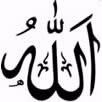
Allah (Name of God in Arabic)
Star and Crescent (Ottoman symbol on Islamic Flags)
Rub-el-Hizb (Islamic Architectural Designs)
Green  (Color Symbolism in Islam)


Star and Crescent Symbolism
The star and crescent is the best-known symbol used in representing Islam. It features prominently on the flags of many Islamic countries, notably Turkey and Pakistan. Surprisingly, this symbol is not of Islamic origin. Rather, it was a polytheistic icon adopted during the spread of Islam and its use today is sometimes controversial in the Muslim world. The crescent and star are often said to be Islamic symbols, but historians say that they were the insignia of the Ottoman Empire and not of Islam as a whole... It is also important to keep in mind that Islam has very few traditional symbols and the crescent moon and star are not the ones that are recognized as traditional symbols by Muslims. The symbol is due to its cultural diffusions and also with the spread of Islam to the Ottoman Turks, who ruled a large area of Europe, Asia and Africa. The Turks put the crescent moon and star symbol on their flag and it has since become associated with Islam…

Green as Islamic Color Symbolism
In early accounts of Muslim warfare, there are references to flags or battle standards of various colors: black, white, red, and greenish-black. Later Islamic dynasties adopted flags of different colors:
  1. The Umayyad fought under white banners
  2. The Abbasids chose black
  3. The Fatimids used green
  4. Various countries on the Persian Gulf have chosen red flags
These four colors (white, black, green and red) dominate the flags of the Arab World.
The color "green" has a special place in Islam, and is often used to represent it among other world religions. One can often find it in mosques and other important places, as well as on the flags of Muslim countries, notably Saudi Arabia. Some say green was Muhammad’s favorite color, and that he wore a green cloak and turban, while others believe it symbolizes vegetation and life. Some say that after Muhammad, only the caliphs were allowed to wear green turbans. In the Qur'an (Surah 18:31), it is said that the inhabitants of paradise will wear green garments of fine silk. While the reference to the Qur'an is verifiable, it is not clear if other explanations are reliable or mere folklore.

Regardless of its origins, the color green has been firmly cemented in Islamic culture for centuries; for example, it is absent in many medieval European coats of arms, as during the Crusades, green was the color used by Islamic soldiers. Additionally, in the Topkapi Palace in Istanbul, there is a room with relics of Muhammad. One of them, kept locked in a chest, is said to have been Muhammad's banner, under which he went to battles. Some say that this banner is green with golden embroidery; others say that it is black...

Other Islamic Symbolisms
Certain words in Arabic script or characters can be regarded as visually representing Islam, such as "Allah" at the top of this page, or the Kalima Shahada. A Shiite symbol is the sword, which is identified with Iimam Ali, who, they believe, fought with this sword and gave his life for Islam. The gardens of the Mughal Empire in India were symbols of paradise (Jannah).
The current flag of Saudi Arabia, used by the government of Saudi Arabia since March 15, 1973, is green featuring in white an Arabic inscription and a sword underneath. The Arabic inscription is written in the Thuluth script, which is the Islamic declaration of faith, the Kalima-e-Shahada:
la ilaha ill allah muhammadun rasul allah
(There is no god but Allah, and Muhammad is his prophet)
The sword symbolizes the importance of the inscription by underlining it. Green flags bearing this or other Arabic scripts are frequently seen in Islam and should not be confused with the Saudi national flag. Other flags normally do not bear the sword. The flag is manufactured with differing obverse and reverse sides, to ensure that the Kalima-e-Shahada reads correctly from right to left and from either sides. The sword points from hoist to fly on both the sides. This flag is sinister hoisted, meaning that the obverse side (front) has the hoist side (flagpole side) to the right. The green color used in the flag is 330C.
Uses: Because the kalama-e-shahada is considered holy, the flag is not normally used on T-shirts or other wearable items. Saudi Arabia protested against its inclusion on a planned football to be issued by FIFA, bearing all the flags of the participants in the 2002 Football World Cup. Saudi officials said that kicking the creed with the foot was completely unacceptable in Islam. Similarly, an attempt by the US military to win favour with children of the Prosth region of Afghanistan, by distributing footballs adorned with participating countries flags including that of Saudi Arabia, ended in demonstrations. The Saudi flag is never lowered to half-mast as a sign of mourning. The normal flag cannot be hoisted vertically according to Saudi legislations. Special vertical flags are manufactured where both the inscriptions (the creed) and the emblem (the sword) are rotated, although this is rare, as most Arab countries lack the traditions of hoisting flags vertically.
History: A green flag with the shahada has been connected with the Wahhabi reformist movement since the 18th century. This movement was associated with the Al-Saud family's rise to power, and when Abdulaziz ibn Abdulrahman as-Saud became King of the Nejd in 1902, he added a sword to this flag. The design of the flag was not standardized prior to March 15 1973, and variants with two swords and/or a white vertical stripe at the hoist were frequently used. By 1938, the flag had basically assumed its present form.

Past Flags: The precursor states to Saudi Arabia were Nejd and Hijaz. The state flag of Nejd followed today's Saudi flag pattern very closely. The state of Hijaz followed the patterns seen in countries like Western Sahara and Sudan. From 1744, a crescent was present. From 1902 until 1921, a different Arabic inscription was used.

Islamic Figurative Art and Depictions of Muhammad
"Thou shalt not make unto thee any graven image, or any likeness of any thing that is in Heaven above, or that is in the earth beneath, or that is in the water under the earth. You shall not bow down to them or serve them; for I the LORD your God am a jealous God." (Second Commandment, Exodus 20:4-5).

"Those who paint pictures would be punished on the Day of Resurrection and it would be said to them: Breathe soul into what you have created." (Hadith, Sahih Muslim vol.3, no. 5268)

The unique beauty of Islamic art derives in large part from its longstanding rejection of depictions of humans and animals in the Islamic religious art. Instead, portraits or stories from the Quran, the mosques and manuscripts are adorned with flourishes of Arabic calligraphy, delicate tile work, layers of gold with intricate floral decorations. But the attitude towards figurative art have varied somewhat throughout the course of Islamic history, and across different Islamic cultures. Animals and humans appear sporadically throughout the centuries, and there are many surviving examples of beautiful figurative art from the Islamic world, most of which come from the late medieval period in Iran. These even depict events in the life of Muhammad, the prophet’s scenic visions of Paradise and Hell, battles of Iranian kings, everyday life, and other human subjects. Today, as is it well-known, figurative art is widely rejected in Islam and depictions of Muhammad are especially considered very offensive. This article seeks to provide a factual background for this, and chronicling the history of figurative depictions in the Islamic art, pinning down exactly what is prohibited in the Quran and hadiths, and by exploring the reasoning given for the special sensitivity to the depictions of Muhammad.

Rules about Images in the Qur'an, Hadiths and Islamic Laws
Unlike the Hebrew Bible, and perhaps surprisingly, there is no commandment against making images of living beings in the Quran. But it does make it clear that nothing should be honored alongside God:

"God does not forgive the joining of partners [shirk] with him: anything less than that he forgives to whoever he will, but anyone who joins partners with God is lying and committing a tremendous sin" (Surah 4:48).

All Islamic injunctions against making religious images come from the hadiths (traditions recorded by various followers about what the Prophet said and did). Although not divine in revelation like the Quran, the hadiths is considered binding when multiple trustworthy sources agree on their authenticity. Following are some examples of hadiths on images:

"Ibn 'Umar reported Allah's Messenger (may peace be upon him) having said: Those who paint pictures would be punished on the Day of Resurrection and it would be said to them: Breathe soul into what you have created." (Sahih Muslim vol.3, no.5268)

"This hadiths has been reported on the authority of Abu Mu'awiya though another chain of transmitters (and the words are): Verily the most grievously tormented people amongst the denizens [inhabitants] of Hell on the Day of Resurrection would be the painters of pictures" (Sahih Muslim vol.3, no.5271)

"Narrated [Muhammad's wife] 'Aisha: Allah's Apostle said, 'The painter of these pictures will be punished on the Day of Resurrection, and it will be said to them, Make alive what you have created.'" (Bukhari vol.9, book 93 no.646)

"Narrated ‘Aisha: The Prophet entered upon me while there was a curtain having pictures (of animals) in the house. His face got red with anger, and then he got hold of the curtain and tore it into pieces. The Prophet said, ‘Such people as paint these pictures will receive the severest punishment on the Day of Resurrection.’" (Bukhari vol.8, book 73, no.130)

"Umar said, ‘We do not enter your churches because of the statues and pictures.’ Ibn ‘Abbas used to pray in the church provided there were no statues in it." (Bukhari vol.1, chapter 54)

"‘Aisha played with dolls while her husband Muhammad was with her. (Sahih Muslim vol.4, book 29 ch.1005, no.5981)

"Muhammad went to Fatimah’s house, but turned back when he saw a figured curtain." (Sunan Abu Dawud vol.3, book 21, no.3746)

History of Images and Figurative Art in Islam
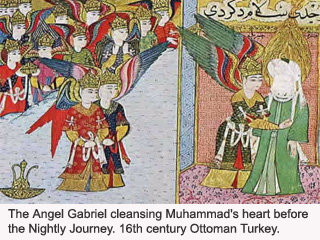
In the earliest days of Islam, specifically "Islamic art" had not yet begun to develop, and art in general was not a prominent issue. According to the Encyclopedia Britannica:
"Earliest Islam as seen in the Quran or in the more verifiable accounts of the Prophet's life simply does not deal with the arts, either on the practical level of requiring or suggesting forms as expressions of the culture. or on the ideological level of defining a Muslim attitude toward images.... There is no prohibitions against any representations of living things, and not a single Quranic passage refers clearly to the mosque, which eventually becomes the most characteristic figure of the Muslim religious building." But as the Islamic communities grew and conquered a great deal of new territory, it came into contact with the religious arts and architectures of other cultures, and thus the Muslims began to develop its own figurative art in Islam..." By the mid-8th century there was a clear Muslim doctrine against the creation of images, as has been seen in the hadiths above.
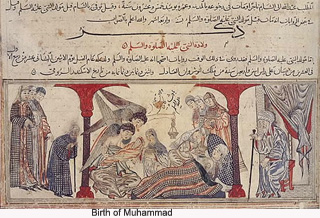
It is interesting though that, Islam came into contact with the Byzantine cultures at the height of the iconoclastic controversy! It is possible that those intensely negative associations of religious art had indeed influenced or strengthened Islamic views on these matters.

Regardless, "it is likely that, more or less intuitively, the Muslims felt a certain reluctance toward representations from the very beginning. For all monuments of religious art are devoid of any representations; even a number of attempts at representational of symbolism in the official art of coinage were soon abandoned."

In the 8th and 9th centuries, Islamic art experimented with a wide variety of materials, techniques and design; many of which were influenced by China and other parts of the world. But the decorative arts remained generally consistent in excluding depictions of humans and animals. Some minor exceptions are birds drawn from the folkloric past of the Near East and "occasionally human figures drawn in strikingly abstract fashions".
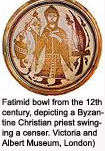
The art of the Fatimids (a Shiite dynasty that ruled from 909–1171) continued to focus mainly on calligraphy and decorative vines, but also frequently depicted animals and humans. The celebrated lustre-painted Fatimid ceramics from Egypt are especially distinguished by "the representation of the human figure. Some of these ceramics have been decorated with simplified copies of illustrations of the princely themes, but others have depictions of scenes of Egyptian daily life". The Fatimid’s also developed an art of manuscript illustration.
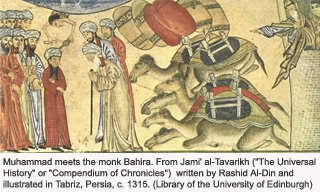
The Seljuk Turks sought to restore Islamic orthodoxy. They made many contributions to Islamic art and architecture, including monumental minarets, mausoleums of holy men (to which pilgrimages were made), citadels and madressahs. Paintings and sculptures of animals and people were among the decorations employed for the monumental new architectures, but the Seljuks were especially interested in geometry and mathematical proportion in art. The Mamluks ruled Egypt, Palestine, and Syria from 1260 to 1517 and were very wealthy. The Mamluks are especially known for their splendid architecture, which included the Dome of the Rock in Jerusalem. Mamluk art seems to have been virtually devoid of human and animal depiction. Meanwhile, in the Mongol period in Iran, Persian art became especially notable for its figurative art in wall paintings and illuminated manuscripts. These included many narrative scenes of the Prophet, Iranian kings and other humans. Examples include the 56 miniature paintings of the 14th-century Shah-e-Namahs ("Book of Kings"); illustrations of the Jami' at-tawarikh (“Universal History of Rashid ad-Din”); and the Khwaju Kermani manuscript from 1396. The Iranian style of painting was influenced by Seljuk art, but more so by Chinese painting. The most celebrated Islamic painter was Behzad (1455-1536), who led an academy of art in Iran.
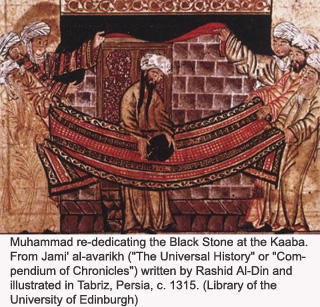
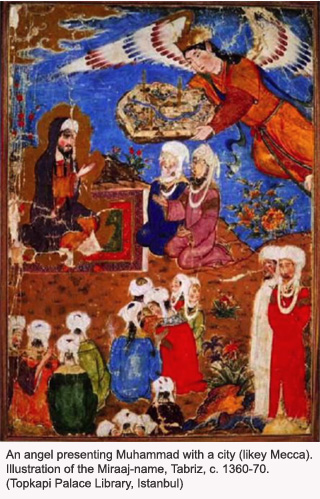
The Ottoman Turks (15th-19th centuries) are best known for their tiles and pottery, but also developed their own form of miniature figurative paintings. The Ottoman miniatures do have a character of their own, either in the almost folk art effect of religious images or in the precise depictions of such daily events as military expeditions or great festivals. Among the finest examples of the latter is the manuscript Surname-i-Vehbi (Topkapi Saray Museum, Istanbul) painted by Levnî in the early 18th century.
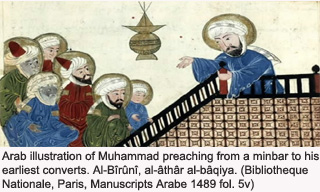
Included this essay are some of the pictorial depictions of Muhammad and his vision. We can see many of these illustrated pictorial manuscripts in museums around the world. Some depict the Prophet in full, while others leave him faceless or with his head engulfed in the sacred flames, representing his contact with Allah. The images are given in roughly chronological order.

From this brief history, it is clear that figurative art (depictions of humans and animals) has made regular appearances in the Islamic world. However, figurative art has largely been a private and secular matter, with most mosques kept free of such imagery. As explained on the website of the Los Angeles County Museum of Art:
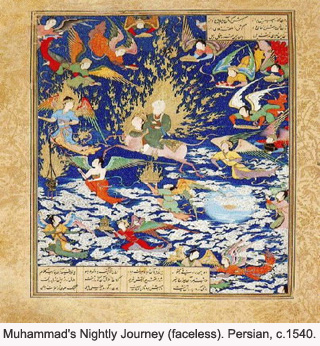
Contrary to a popular misconception, however, figural imagery is an important aspect of Islamic art. Such images occur primarily in secular and especially courtly arts and appear in a wide variety of media and in most periods and places in which Islam flourished. It is important to note, nevertheless, that representational imagery is almost invariably restricted to a private context. Figurative art is excluded from the decoration of religious monuments. This absence may be attributed to an Islamic antipathy toward anything that might be mistaken for idols or idolatry, which is explicitly forbidden by the Quran. Today, the depiction of prophets and especially Muhammad is widely rejected. The 1976 film The Message, directed by Moustapha Akkad and starring Anthony Quinn, tells the story of Muhammad, but follows Islamic law by not showing Muhammad or even portraying his voice (it is filmed from his perspective). But aside from the taboo about Muhammad, and despite the clear rules in hadiths, only the most conservative Muslims (such as the Taliban) believe it is wrong to create images in general, such as portraits or photographs. The introduction of television into Saudi Arabia was widely protested at first because of its images, but is now a common part of Saudi life.
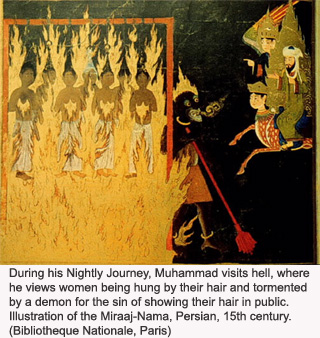
Depictions of Muhammad in Islam
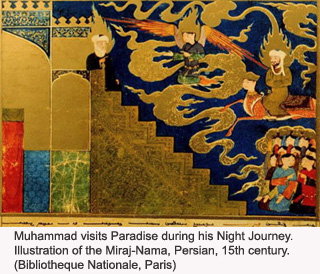
The outrage and violence occasioned by the infamous "Danish cartoon controversy" perhaps had more to do with disrespect for Islam than depictions of the Prophet. But many of today's Muslims consider any public depictions of Muhammad offensive and objectionable, no matter how respectful, and frequently request their removal. The reasons for this sensitivity to depictions of Muhammad are not immediately clear, since Muhammad is as human as anyone else, Islamic sources do not prohibit depictions of him any more than other images, and past Islamic art has depicted Muhammad. Islamic scholars have explained that the main reason for the ban on depicting Muhammad is the fear that the images of Muhammad might be worshipped. Political scientist As'ad AbuKhalil, visiting professor at the University of California at Berkeley, explained:
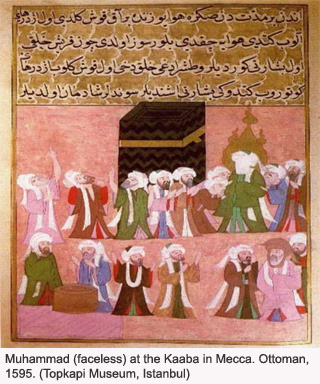
"In the Holy Quran of Islam, the one sin unforgivable is that of polytheism. The prohibition is intended to protect the faithful from that sin. The fear was that intense reverence for the prophet might if unrestrained cross over into worship. In the 8th and the 9th centuries a general consensus banning such depictions arose among the clerics, but not all Muslims knew of it, paid attention, or obeyed".

According to Imam Talal Eid, director of the Islamic Institute of Boston:

"He [the Prophet] instructed his companions not to draw a picture of him, and this has been taken as a general prohibition. He also told them not to pray in places that have images. There also is a general prohibition against full statues. And -- though today, of course, we find photos in all passports -- many Muslims have felt some hesitance about permitting portraits of any kind".

Juan Cole, a professor of Middle Eastern history at the University of Michigan, told NPR:

"The fear was, both in Judaism and Islam that if you represented a holy figure like a prophet who had discussions with the divine, there would be a danger of people worshipping the image".
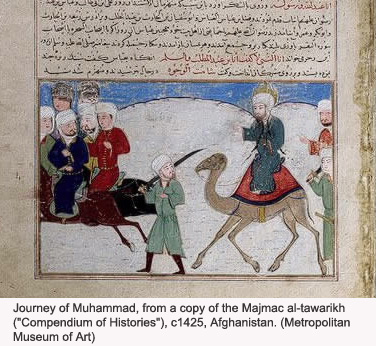
Muslims certainly do revere the Prophet extremely highly. As Professor of Islamic Studies John Esposito put it, "to criticize the prophet Muhammad is as direct an attack as mocking or attacking the Koran, which is seen as the word of God or the sacred Scripture. Muhammad is seen as the living Koran. His life Muslims are to emulate".


Summary and Conclusions
The above evidence might be summarized in the following facts:
  1. Judaism, Christianity and Islam all consider idolatry a heinous sin.
  2. The Qur'an does not prohibit making images, only worshipping them.
  3. Hadiths clearly and consistently prohibits all images of any living being, with special mention of punishment for painters.
  4. One exception to this rule is dolls for children, probably because children are not considered in danger of worshipping them as idols.
  5. Neither the Qur'an nor Hadiths mention depictions of Muhammad.
  6. The Hadiths prohibiting images are directed at Muslims only (e.g. Muslims are instructed not to enter buildings where there are images, not to demand their removal).
  7. Muslim outrage against depictions of the Prophet does not usually extend to outrage against all images.
  8. The Hadiths prohibiting images do not call for Muslims to take action against those who make images, but instead say that God will punish them severely at the Day of Judgment.
  9. Muslims have applied the prohibitions against images in various ways throughout history, and there is still some variation today.
  10. Figurative art of Muhammad and other humans has been a significant part of late medieval Islamic art. But it was generally limited to secular contexts and elite classes, who could afford fine art.
  11. Shiites tends to be more open to religious images than Sunnis.
  12. The main reason given for not depicting Muhammad is to avoid the temptation to worship the image.
  13. Neither the Qur'an nor Hadiths say that viewing an image accidentally is a sin, but in the Hadiths the Prophet teaches Muslims to avoid them.
Islamic Religious Objects
This section describes and explains the religious objects, ritual items and other physical things related to Islam.
Minarets of Islam
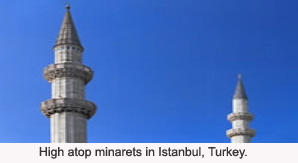
A minaret (beacon) is an element of Islamic religious architecture. It is the tower traditionally used by a muezzin, the crier to call the faithful to prayer, five times a day. Minarets are always connected with a mosque, sometimes by an elevated passageway. At the time of the Prophet Muhammad, the call to prayer was made from the highest roof in the vicinity of the mosque. The earliest minarets as such were former Greek watchtowers or the towers of Christian churches... Today, calls to prayer are usually done in the prayer hall through a loudspeaker, and minarets serve mainly decorative purposes. The oldest minaret in the world is in Kairouan, Tunisia. Built between 724 and 727, it has a massive square form. The tallest minaret in the world is that of the new Hassan II Mosque in Casablanca, Morocco, which stands 210 meters tall. Minarets were built to be “landmarks of Islam” — to be visible from afar and to stamp an area with Islamic character.
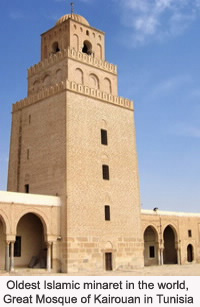
The number of minarets per mosque varies, from one to as many as six. They are constructed in a wide variety of forms ranging from thick, squat spiral ramps to soaring, delicate, pencil thin spires.
A minaret has one or more balconies, from which the muezzin announces the call to prayer, and a spiral staircase on the inside or outside. Often the minaret is square at the base, where it is attached to the mosque.
Above this square base it may rise in a series of circular, hexagonal, or octagonal stages, each marked by a projecting balcony.
At the top is a bulbous dome, an open pavilion, or a metal-covered cone. The upper parts of the minaret are usually richly decorated with carving. The steps may be internal or external.
Sources:
1. "minaret." Encyclopedia Britannica (2007). Encyclopedia Britannica Online.
2. "minaret." John L. Esposito, The Oxford Dictionary of Islam (2003).
More Information

Minbar
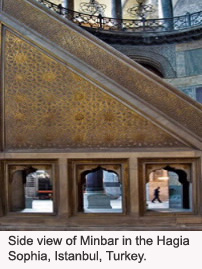
A Minbar is the pulpit from which the Friday sermon (khutbah) is delivered. In its simplest form, the Minbar is a platform with three steps. It is located next to the Mihrab.
Muhammad originally delivered his sermons while leaning against a palm-trunk pillar in the mosque at Medina or ascending a stone platform. The Hadiths report that Muhammad later used a seat with two steps, fashioned from tamarisk wood by a Greek or Abyssinian carpenter, for receiving delegations in the mosque and also for preaching allahs’ Quran to his followers. Muhammad's successors, the caliphs, used the Prophet's Minbar as a symbol of their authority. During the first century of Islam, provincial governors came to use the Minbar primarily in their capacity as rulers, making speeches and hearing petitions from it. When the khutbah lost its informative and political character, and became purely religious sermons during the reign of the 'Abbasid caliphs dynasty, the Minbar also became a religious object in Islam. It became more permanent in nature, with the number of steps being increased, and it was commonly made of stone or brick. It was even covered with a cloth, the qatifah.
Sources:
  1. "minbar." Encyclopedia Britannica (2007). Encyclopedia Britannica Online.
  2. "minbar." John L. Esposito, The Oxford Dictionary of Islam (2003).

Lennard James : Muslims ‘Expect No Criticism’

Muslims ‘Expect No Criticism’

“PROXIMITY”, as Shakespeare might have said although he didn't, breeds hostility... That explains why Muslims have been so hostile to other religions? The other side of the coin is, always, that hostility creates an urge for proximity!
Muslims are such a demanding race that, whenever there is criticism of their brutal history around the world over, they come out in their thousands, chanting “Allahu Akbar” and engaging in acts of mindless vandalism and terror. They even openly speak out about spilling blood of innocents, play havoc, and destruction…
Why the Muslims do all this?

….(‘cause we pamper ’em!!!)
Why do they have a free hand into every whim of theirs..? (Are we cowards? Are we afraid of them? Are we just gonna sit there with gloomy faces and don’t do anything about???)
…(‘cause we support ‘em!!!)


Here are just some statistics on recent Muslim achievements and they "expect not criticism":
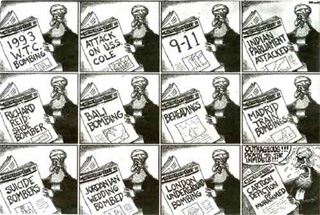
  1. Muslims murdered some 3,000 innocent peoples in New York on September 11, 2001, and..... Expect no criticism!
  2. Muslims murder 202 tourists in Bali, and........... Expect no criticism!
  3. Muslims murder 333 school children and their teachers in Beslan, and.........Expect no criticism!
  4. Muslims murder 292 innocents, mainly Kenyans and Tanzanians at two US Embassies, .......And expect no criticism!
  5. Muslims murder 241 US and 58 French peacekeepers in Beirut, and..... Expect no criticism!
  6. Muslims fire 4,000 Katyusha/Stinger rockets into Northern Israel killing over 50 innocent civilians, and............ Expect no criticism!
  7. Muslims murder 52 commuters in London and 191 in Madrid, and..... Expect no criticism!
  8. Muslims murder some 200 people in Mumbai, and......... Expect no criticism!
  9. Muslims behead Western hostages in Iraq, Buddhist monks in Thailand and Christian schoolgirls in Indonesia, and............. Expect no Criticism!
  10. Muslim genocide in Sudan has claimed over 3 million lives since mid-1980; they massacred nearly 500,000 in Darfur since 2004, and........... Expect no criticism!
  11. Muslims regard Jews as 'sons of pigs and monkeys', and vow to nuke Israel out of existence, and.......... Expect no criticism!
  12. Muslims force women to wear hideous conical sacks, stone  to death for getting raped and for leaving their homes unescorted, engage in honor-killing of sisters and daughters for unapproved dating/marriages, and...... Expect no criticism!
  13. Muslims danced in the streets and handed out sweets to their kids to celebrate the 9/11 atrocity, and......... Expect no Criticism!
  14. Since 9/11, Muslims have killed over 26,000 and wounded over 150,000 in terrorist attacks worldwide, and............ Still Expect no Criticism!
  15. Since 9/11 Muslims have committed terrorist attacks in Afghanistan, Algeria, Bangladesh, Belgium, Chad, Chechnya, Dagestan, Denmark, East Timor, Egypt, England, Eritrea, Ethiopia, France, Germany, India, Indonesia, Ingushetia, Iran, Iraq, Israel, Jordan, Jordan-Iraq, Kabardino-Balkans, Kenya, Kosovo, Kuwait, Kyrgyzstan, Lebanon, Mauritania, Morocco, Netherlands, Nigeria, Pakistan, Gaza-Palestinian Authority, Philippines, Qatar, Russia, Saudi Arabia, Scotland, Somalia, Spain, Sri Lanka , Sudan , Syria , Tajikistan, Thailand , Tunisia , Turkey , United Arab Emirates, United Arab Republic , United States , Uzbekistan and Yemen, and............ STILL Expect No Criticism!
  16. Muslims have carried out over 13,000 fatal terrorist atrocities and damages to public and private buildings/vehicles since 9/11, and countless millions since the Islamic conquest began from 623 AD; and still they Expect No Criticism!
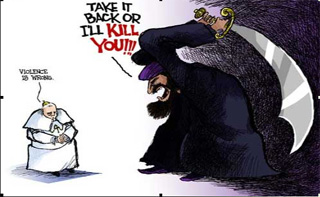
  17. But if the Pope dares to tell the truth about Islam's history, or a Danish Newspaper publish cartoons of Mohammed, they let the outpourings of Islamic rage, and.......... Expect no criticism!
  18. And, by some twisted reach of logics, these arrogant vandals demand apology from the Pope, and.......... Expect no criticism!

Is this fair?

Muslims expect us to just shut up and watch, while they do what their Holy Book, the Quran, teaches and preaches… “You do as you please”, and…… still Expect No Criticism!
Here is a countdown of "top- ten facts" about Islam in our world:
10. In Afghanistan ‘You’ grow and refine heroin for a living, and, yet, you have a moral objection to beer.
09. You own a $3,000 machine gun and a $5,000 rocket launcher, but you cannot afford to wear shoes.
08. You have more wives than teeth, and, yet, you want to rape more infidels.
07. You think vests come in two styles: bullet-proof and suicide jackets, and, yet, you want us to believe it is haram to kill.
06. You cannot think of anyone you HAVEN'T declared Jihad against, yet the Quran preaches harmony.
05. You consider television dangerous, and, yet, you routinely carry ammunition in your robe.
04. You've never been asked, "Does this burka/hijab make my butt look fat?", and, yet, you make it mandatory for your women folk to wear when leaving home.
03. You are amazed to discover that cell-phones have uses other than setting off roadside bombs, and, yet, the kuffar technology is ably used for that horrendous purpose.
02. You've never uttered the phrase, "I love what you've done with your cave", but yet you destroy infidel homes and their places of worships.
And, the NUMBER ONE SIGN you might be a member of the Taliban...
01. You wipe your rear with mud-stones, and, yet, you consider all infidels are unclean.

Ibn Warraq : On The World Trade Center Atrocity

Statement By Ibn Warraq On The World Trade Center Atrocity

Given the stupefying enormity of the acts of barbarism of 11 September, moral outrage is appropriate and justified, as are demands for punishment. But a civilized society cannot permit blind attacks on all those perceived as “Muslims” or Arabs. Not all Muslims or all Arabs are terrorists. Nor are they implicated in the horrendous events of Tuesday. Police protection for individual Muslims, mosques and other institutions must be increased.

However, to pretend that Islam has nothing to do with Terrorist Tuesday is to wilfully ignore the obvious and to forever misinterpret events. Without Islam the long-term strategy and individual acts of violence by Usama bin Laden and his followers make little sense. The West needs to understand them in order to be able to deal with them and avoid past mistakes. We are confronted with Islamic terrorists and must take seriously the Islamic component. Westerners in general, and Americans in particular, do not understand the passionate, religious, and anti-western convictions of Islamic terrorists. These God-intoxicated fanatics blindly throw away their lives in return for the Paradise of Seventy Two Virgins offered Muslim martyrs killed in the Holy War against all infidels.

Jihad is “a religious war with those who are unbelievers in the mission of the Prophet Muhammad [the Prophet]. It is an incumbent religious duty, established in the Qur’an and in the Traditions as a divine institution, and enjoined specially for the purpose of advancing Islam and repelling evil from Muslims”[1].

The world is divided into two spheres, Dar al-Islam and Dar al-Harb. The latter, the Land of Warfare, is a country belonging to infidels which has not been subdued by Islam. The Dar al-Harb becomes the Dar-al Islam, the Land of Islam, upon the promulgation of the edicts of Islam. Thus the totalitarian nature of Islam is nowhere more apparent than in the concept of Jihad, the Holy War, whose ultimate aim is to conquer the entire world and submit it to the one true faith, to the law of Allah. To Islam alone has been granted the truth: there is no possibility of salvation outside it. Muslims must fight and kill in the name of Allah.

We read (IX. 5-6):“Kill those who join other gods with God wherever you may find them”;

IV.76: “Those who believe fight in the cause of God”;

VIII.39-42: “Say to the Infidels: if they desist from their unbelief, what is now past shall be forgiven; but if they return to it, they have already before them the doom of the ancients! Fight then against them till strife be at an end, and the religion be all of it God’s.”

Those who die fighting for the only true religion, Islam, will be amply rewarded in the life to come:

IV.74: “Let those who fight in the cause of God who barter the life of this world for that which is to come; for whoever fights on God’s path, whether he is killed or triumphs, We will give him a handsome reward.”

What should we make with these further unfortunate verses from the Qur’an:

*Torment to Non-believers->IV.56
*Only Islam Acceptable-> III.85
* No friends from outsiders->III.118
*No friends with Jews, christians->V. 51
* No friends with non believers->IV.144, III.28
* No friends with parents/siblings if not believers->IX.23
* Fight non-believers->IX.123 * Kill non-believers->IV.89
*Anti Jewish verses->V.82
* God a "plotter"->VIII.30
*Killing Idolators->IX.5
* Idolators are unclean just because they are idolator->IX.28
* Forcing non-believers to pay tax->IX.29
* The Torment of Hell->XLIV.43-58
* All except Muslims/Jews/Christians/Sabeans will go to hell->II.62, V.69
* Cast terror in the hearts, smite the neck and cut fingertips of unbelievers->VIII.12
* Smite the neck of unbelievers->XLVII.4
* Severe Punishment for atheists->X.4 ; V.10 ; V.86
* Severe Punishment for non-believers->XXII.19-22 ; LXXII.23, XCVIII.6
*Punishing non-believers of Hereafter->XVII.10
* Punishing for rejecting faith->III.91
* Non believers go to hell->IV.140 ; VII.36 * Partial Believers go to hell too->IV.150-1
* Sadistic punishments->LVI.42-43
* Punishment for apostates->XVI.106 ; III.86-88 ; III.90 ; IV.137.
* Threat of punishement for not going to war->IX.38-39, XLVIII.16
*God making someone more sinful so he can be punished more->III178
*Intentionally preventing unbelievers from knowing the truth->VI.25 ; VI.110
* Intentionally preventing unbelievers from Understanding Quran->XVII.45-46
* It is God who causes people to err and He punishes them for that->XVII.97
* God could guide, if he chose to, but did not->VI.35
* Intentionally misguiding those whom he pleases to->XIV.4
* Willfully misguiding some->XVI.93
* God causes human to err->IV.143 ; VII.178
* God deceiving humans->IV.142

It is surely time for us who live in the West and enjoy freedom of expression to examine unflinchingly and unapologetically the tenets of these fanatics, including the Qur’an which divinely sanctions violence. We should unapologetically examine the life of the Prophet, who was not above political assassinations, and who was responsible for the massacre of the Jews.

“Ah, but you are confusing Islam with Islamic fundamentalism. The Real Islam has nothing to do with violence,” apologists of Islam argue.

There may be moderate Muslims, but Islam itself is not moderate. There is no difference between Islam and Islamic fundamentalism: at most there is a difference of degree but not of kind. All the tenets of Islamic fundamentalism are derived from the Qur’an, the Sunna, and the Hadith – Islamic fundamentalism is a totalitarian construct derived by Muslim jurists from the fundamental and defining texts of Islam. The fundamentalists, with greater logic and coherence than so-called moderate or liberal Muslims, have made Islam the basis of a radical utopian ideology that aims to replace capitalism and democracy as the reigning world system. Islamism accounts for the anti-American hatred to be found in places far from the Arab-Israeli conflict, like Nigeria and Afghanistan, demonstrating that the Middle East conflict cannot legitimately be used to explain this phenomenon called Islamism. A Palestinian involved in the WTC bombings would be seen as a martyr to the Palestinian cause, but even more as a martyr to Islam.

“Ah, but Islamic fundamentalism is like any other kind of fundamentalism, one must not demonise it. It is the result of political, social grievances. It must be explained in terms of economics and not religion,” continue the apologists of Islam.

There are enormous differences between Islamic fundamentalism and any other kind of modern fundamentalism. It is true that Hindu, Jewish, and Christian fundamentalists have been responsible for acts of violence, but these have been confined to particular countries and regions. Islamic fundamentalism has global aspirations: the submission of the entire world to the all-embracing Shari’a, Islamic Law, a fascist system of dictates designed to control every single act of all individuals. Nor do Hindus or Jews seek to convert the world to their religion. Christians do indulge in proselytism but no longer use acts of violence or international terrorism to achieve their aims.

Only Islam treats non-believers as inferior beings who are expendable in the drive to world hegemony. Islam justifies any means to achieve the end of establishing an Islamic world.

Islamic fundamentalists recruit among Muslim populations, they appeal to Islamic religious symbols, and they motivate their recruits with Islamic doctrine derived from the Qur’an. Economic poverty alone cannot explain the phenomenon of Islamism. Poverty in Brazil or Mexico has not resulted in Christian fundamentalist acts of international terror. Islamists are against what they see as western materialism itself. Their choice is clear: Islam or jahiliyya. The latter term is redefined to mean modern-style jahiliyya of modern, democratic, industrialised societies of Europe and America, where man is under the dominion of man rather than Allah. They totally reject the values of the West, which they feel are poisoning Islamic culture. So, it is not just a question of economics, but of an entirely different worldview, which they wish to impose on the whole world. Sayyid Qutb, the very influential Egyptian Muslim thinker, said that “dominion should be reverted to Allah alone, namely to Islam, that holistic system He conferred upon men. An all-out offensive, a jihad, should be waged against modernity so that this moral rearmament could take place. The ultimate objective is to re-establish the Kingdom of Allah upon earth...”[2]

It is surely time for moderate Muslims to stand up and be counted. I should like to see them do three things:

1. All moderate Muslims should unequivocally denounce this barbarism, should condemn it for what it is: the butchery of innocent people,

2. All moderate Muslim citizens of the United States should proclaim their Americanness, their patriotism, and their solidarity with the families of the victims. They should show their pride in their country by giving blood and other aid to victims and their families.

3. All moderate Muslims should take this opportunity to examine the tenets of their faith; should look at the Qur’an, recognize its role in the instigation of religious violence, and see it for what it is, a problematical human document reflecting 7th or perhaps 8th Century values which the West has largely outgrown.

While it should not be too difficult for moderate Muslims to accept the need to denounce the violence of Terrorist Tuesday, I am not at all optimistic about their courage or willingness to proclaim their love for their chosen country, the USA, or examine the Qur’an critically.

Too many Muslims are taught from an early age that their first allegiance is to Islam. They are exhorted in sermons in mosques, and in books by such Muslim intellectuals as Dr Siddiqui of the Muslim Institute in London, that if the laws of the land conflict with any of the tenets of Islam, then they must break the laws of the infidels, and only follow the Law of God, the Shari’a, Islamic Law.

It is a remarkable fact that at the time of the Gulf War, a high proportion of Muslims living in the West supported Saddam Hussein. In the aftermath of the WTC terror, it is now clear from reports in the media that many Muslims, even those living in the West, see these acts of barbarism as acts of heroism; they give their unequivocal support to their hero, Usama bin Laden.

Few Muslims have shown themselves capable of scrutinising their sacred text rationally. Indeed any criticism of their religious tenets is taken as an insult to their faith, for which so many Muslims seem ready to kill (as in the Rushdie affair or the Taslima Nasreen affair). Muslims seem to be unaware that the research of western scholars concerning the existence of figures such as Abraham, Isaac and Joseph or the authorship of the Pentateuch applies directly to their belief system. Furthermore, it is surely totally irrational to continue to believe that the Qur’an is the word of God when the slightest amount of rational thought will reveal that the Qur’an contains words and passages addressed to God (e.g. VI.104; VI.114; XVII.1; XXVII.91; LXXXI.15-29; lxxxiv.16-19; etc.); or that it is full of historical errors and inconsistencies.

Respect for other cultures, for other values than our own, is a hallmark of a civilised society. But Multiculturalism is based on some fundamental misconceptions. First, there is the erroneous and sentimental belief that all cultures, deep down, have the same values; or, at least, if different, are equally worthy of respect. But the truth is that not all cultures have the same values, and not all values are worthy of respect. There is nothing sacrosanct about customs or cultural traditions: they can change under criticism. After all, the secularist values of the West are not much more than two hundred years old.

If these other values are destructive of our own cherished values, are we not justified in fighting them both by intellectual means, that is by reason and argument, and criticism, and by legal means, by making sure the laws and constitution of the country are respected by all? It becomes a duty to defend those values that we would live by. But here western intellectuals have sadly failed in defending western values, such as rationalism, social pluralism, human rights, the rule of law, representative government, individualism (in the sense that every individual counts, and no individual should be sacrificed for some utopian future collective end), freedom of expression, freedom of and from religion, the rights of minorities, and so on..

Instead, the so-called experts on Islam in western universities, in the media, in the churches and even in government bureaus have become apologists for Islam. They bear some responsibility for creating an atmosphere little short of intellectual terrorism where any criticism of Islam is denounced as fascism, racism, or “orientalism.” They bear some responsibility for lulling the public into thinking that “The Islamic Threat ” is a myth. It is our duty to fight this intellectual terrorism. It is our duty to defend the values of liberal democracy.

One hopes that the U.S. government will not now act in such a way that more innocent lives are lost, albeit on the other side of the globe. One hopes that even now there is a legal way out in international courts of law. The situation is far more delicate and complex than a simple battle between good and evil, the solution is not to beat hell out of all Arabs and Muslims but neither is it to pretend that Islam had nothing to do with it, for that would be to bury one’s head in the Sands of Araby.


[1] T.Hughes, Dictionary of Islam, entry “Jihad”

[2] E.Sivan, Radical Islam, New haven, 1985, p.25.

Ibn Warraq is the author of Why I Am Not a Muslim and the editor of The Origins of the Koran, The Quest for the Historical Muhammad, and What the Koran Really Says
======