.

.
Library of Professor Richard A. Macksey in Baltimore

POSTS BY SUBJECT

Labels

Saturday, April 8, 2017

Yves Mamou : France: Decomposing in Front of Our Eyes


  • Four officers were injured (two badly burned) when around 15 "youths" (Muslim gang-members) swarmed their cars and hurled rocks and firebombs at them. Police were aggrieved when the minister of interior called the attackers "little wild ones." Police and opposition politicians replied that the attackers were not "little wild ones but criminals who attacked police to kill."
  • Two students at a vocational training school in Calais attacked a teacher, and one fractured the teacher's jaw and several teeth -- because the teacher had asked one of the students to get back to work.
  • "This is a warning. These young people did not attack the school by chance; they wanted to attack the institution, to attack the State." — Yacine, 21, a student at the University of Paris II.
  • The riot, which lasted for four nights, broke out after the arrest of a driver who did not stop when asked to by a policeman.
  • This revolt of one pillar of French society, the police, was the biggest that ever happened in modern France. Yet, virtually no one in France's mainstream media covered the event.
  • "Everything that represents state institutions (...) is now subjected to violence based on essentially sectarian and sometimes ethnic excesses, fueled by an incredible hatred of our country. We must be blind or unconscious not to feel concern for national cohesion". — Thibaud de Montbrial, lawyer and expert on terrorism.
France will elect a new president in May 2017. Politicians are already campaigning and debating about deficits, welfare recipients, GDP growth, and so on, but they look like puppets disconnected from the real country.

What is reality in France today?
Violence. It is spreading. Not just terrorist attacks; pure gang violence. 
It instills a growing feeling of insecurity in hospitals, at schools, in the streets -- even in the police. 
The media does not dare to say that this violence is coming mainly from Muslim gangs -- "youths," as they call the in the French media, to avoid naming who they are. 
A climate of civil war, however, is spreading visibly in the police, schools, hospitals and politics.

The Police

The most jolting evidence of this malaise was to see more than 500 French police officers demonstrating with police cars and motorcycles on the night of October 17, without the backing of labor unions, without authorization, on the Champs Elysées in Paris. According to the daily, Le Figaro, "the Interior Ministry was in panic," frightened by a possible coup: "Police blocked access to the Avenue Marigny, which runs beside the Presidential Palace and overlooks the Place Beauvau."
On October 18, when Jean-Marc Falcone, director-general of National Police, met the leaders of the protest, he was surrounded by hundreds of police officers urging him to resign.
The main cause of their anger seems primarily the violence often directed against police, and terrorist attacks. On the terrorist level, two policemen were stabbed to death in Magnanville in June 2016 by a Muslim extremist, Larossi Aballa. This spring, more than 300 police officers and gendarmes were injured by demonstrators. In May, police unions demonstrated in the streets of Paris to protest "anti-police hatred."
This autumn, the last straw was an attack on a police patrol in the Paris suburb of Viry-Châtillon. Four officers were injured when a group of around 15 "youths" (Muslim gang-members) swarmed their cars in the town and hurled rocks and firebombs at them. Two policemen were badly burned; one had to be placed in an induced coma. The same scenario took place a few days later: a police patrol was ambushed in another no-go zone in the "sensitive" area of Val-Fourré.

Four police officers were recently injured (two badly burned) when a group of around 15 "youths" (Muslim gang-members) swarmed their cars and hurled rocks and firebombs at them, in the Paris suburb of Viry-Châtillon. (Image source: Line Press video screenshot)

Police were also aggrieved by Bernard Cazeneuve, the minister of interior, who called the attackers "sauvageons" ("little wild ones"). Police and opposition politicians replied that the attackers were not "little wild ones but criminals who attacked police to kill."

"Police are seen as an occupying force," declared Patrice Ribeiro of the Synergie Officiers police commanders' union. "It is not surprising that violence is spiking."

On October 18, Le Figaro launched an online poll online with one question: "Do you approve the protest by policemen?" Ninety percent of the 50,000 respondents answered "yes."

Since then, police demonstrations have spread to other cities. More than a month after the start of the discontent, police officers were still protesting in every big city. On November 24, two hundred police officers demonstrated in Paris between Place de la Concorde and the Arc de Triomphe, to express their "anger." Police in civilian clothes, some wearing orange armbands, some hidden under a scarf or hood, supported by citizens, gathered in the evening at the Place de la Concorde, before walking the length of the Champs Elysée up to the Arc de Triomphe, where they formed a human chain around the monument and sang La Marseillaise (France's national anthem).
This revolt of one pillar of French society, the police, was the biggest that ever happened in modern France. Yet, virtually no one in France's mainstream media covered the event.

Schools

Tremblay-en-France (Seine-Saint-Denis close to Paris): The headmaster of the Hélène-Boucher training school was attacked on October 17 by several individuals outside the school. Some "youths" were attacking the building with firebombs, and when the headmaster tried to calm the situation, one of the "youths" answered with blows. Fifty unidentified people were involved in the incident. This was the third episode of violence to occur in the vicinity. Four days earlier, two vehicles were torched.

One month later, the daily Le Monde held a meeting with several students, The goal of this meeting was to try to understand the cause of the violence in in Tremblay. Yacine, 21, a student at the University of Paris II, said: "This is a warning. These young people did not attack the school by chance; they wanted to attack the institution, to attack the State."

Argenteuil (Val d'Oise, suburb of Paris): A teacher at the Paul Langevin primary school, was beaten up in the street, on October 17, while leading children back to school from tennis courts a kilometer from the school. After hearing the teacher raise his voice at a child, two young men stopped their car, told the teacher he was a "racist" and beat him in front of the children. According to Le Parisien, one of the attackers justified his actions by accusing the professor of "racism". "You are not the master," said the man. "The only Master is Allah".

Colomiers (Toulouse, south of France). A physical-education teacher was assaulted by a student on October 17, when the teacher tried to stop the student from leaving the school through a prohibited exit.

Calais (Pas-de-Calais): Two students at a vocational training school in Calais attacked a teacher, and one fractured the teacher's jaw and several teeth on October 14, according the local paper, Nord-Littoral. The students attacked the electrical engineering teacher because he had asked one of the students to get back to work.

Saint-Denis (Seine Saint-Denis, suburb of Paris): On October 13, a school headmaster and his deputy were beaten by a vocational student who had been reprimanded for arriving late.

Strasbourg: A mathematics teacher was brutally attacked on October 17 at the Orbelin school. The headmaster of the institution told France Bleu that a "youth," who is not a student at the school, had beaten the teacher. This was not the first time that the "youth" had entered the building. Earlier, when the teacher asked him to leave his class, the "youth" delivered several blows to the teacher's face before fleeing.

All these attackers were not terrorists, but like Islamic terrorists, they apparently wanted to destroy "attack the institution, to attack the State."

Hospitals

On October 16, fifteen individuals accompanying a patient sowed terror in the emergency department of Gustave Dron Hospital in Tourcoing, according to La Voix du Nord. A doctor was severely beaten; another pulled by the hair. Doctors and nurses told the newspaper they were still in shock. Said a nurse:
"Ten people forced their way into the heart of the ER. The doctors asked them to leave... When everything stopped, I realized that the ER was ravaged, patients terrorized, relatives of patients crying."
The attackers were from the district of La Bourgogne, an area essentially populated with North African immigrants. Three people were arrested.
In the same area of La Bourgogne, there was a riot on October 4. Fourteen cars were burned and 12 people arrested. The riot, which lasted for four nights, broke out after the arrest of a driver who did not stop when asked to by a policeman.

Politics

On October 14, Nadine Morano, deputy of the opposition party Les Républicains, tried physically to prevent an Algerian businessman, Rachid Nekkaz, from entering the Center of Public Finance of Toul, in the east of France. Nekkaz is known for paying fines of Muslim women arrested because they were wearing a burqa in public, banned by law since October 2010. Police came to protect the right of Mr. Nekkaz to pay the fine. An amendment to the finance law is currently under discussion to block and punish practices, like those of Nekkaz, that circumvent the law.
President François Hollande is currently under fire after the publication of a book, A President Should Not Say That... In it, he is reported to have said, "France has a problem with Islam," and "there are too many migrants in France" -- remarks Hollande claims he never made. Another quote in the book that Hollande denies saying:
"We cannot continue to have migrants who arrive without control, in the context of the attacks... The secession of territories (no go zones)? How can we avoid a partition? Because it is still what is going to happen."
President Hollande spends his time apologizing for things he never said, but should have said because they are true.

French People

French Chinese: The French Chinese live in the same suburbs as Muslims and are attacked and harassed, to the general indifference of police.
As crime against community members has spiraled, about 50,000 ethnic Chinese staged a protest march in Paris on September 4, after the fatal mugging of a Chinese tailor.
The protesters, all of them wearing white T-shirts reading "Security for All" and waving French flags, rallied at the Place de la République. They had organized the demonstration by themselves and were not supported by the traditional "human rights" groups, which prefer to help Muslim migrants.

Public Opinion: In January 2016, Cevipof, a think tank of the Paris Institute of Political Studies (Sciences Po), released its seventh Barometer of Political Trust, a poll published annually to measure the values of democracy in the country, and based on interviews with 2074 people:
  • What is your current state of mind? Listlessness 31%, Gloom 29%, Mistrust 28%, Fear: 10%
  • Do you trust government? Not much 58%, not at all 32%
  • Do you trust lawmakers? Not much 39%, not at all 16%%
  • Do you trust the president? Not much 32%; not at all 38%
  • Do politicians care about what the people think? Not much 42%, not at all 46%
  • How democracy is working in France? Not well 43%, not well at all 24%
  • Do you trust political parties? Not much 47%, not at all 40%
  • Do you trust the media? Not much 48% not at all 27 %
  • What do you feel about politics? Distrust 39%; disgust 33%, boredom 8%
  • What do you feel about politicians? Disappointment 54%; disgust 20%
  • Corruption of politicians? Yes 76%
  • Too many migrants? Yes, plus tend to agree: 65%
  • Islam is a threat? Yes, plus tend to agree: 58%
  • Proud to be French? Yes 79%
What this poll shows is the gap between people and politicians has never been so vast.

Thibaud de Montbrial, lawyer and expert on terrorism, declared on October 19 to Le Figaro:
The term "dislocation" of French society seems appropriate. Violence against police, hospitals, attacks that multiply against schools and teachers... are attacks against pillars of the ruling domain. In other words, everything that represents state institutions (...) is now subjected to violence based on essentially sectarian and sometimes ethnic excesses, fueled by an incredible hatred of our country. We must be blind or unconscious not to feel concern for national cohesion."
Yves Mamou, based in France, worked for two decades as a journalist for Le Monde.
===============

Najat AlSaied : Middle East: A Shift from Revolution to Evolution


  • The lesson the Trump administration might learn from the disastrous mistakes of its predecessor is that the main sources of terrorism in the region are political Islam and all its related religious groups. All these radical groups, including ISIS, Al-Qaeda, Jabhat Al-Nusra and Hamas have been spawned by a political Islam driven by the ideology of the Muslim Brotherhood.
  • The fight, therefore, should not be against Islam, but against political Islam. Islam needs to be practiced the way other religions are, as a private personal faith that should be kept separate from public life and politics, and whose expression should be confined to worship only.
  • Mosques, whether in the Arab and Muslim world or in the West, should be places of worship only and must not transformed to centers for polarizing society or for recruitment by political religious groups.
After each Islamist terrorist attack in the West, the public is divided into two camps: one angry and one indifferent. The problem with defeating Islamist terrorism seems to be that either it is attacked by conservatives who call Islam an evil cult or it is forgiven entirely by liberal apologists. What, then, is the answer?

One of the main failures in Western analyses of the origins of terrorism in the Middle East and North Africa is that the West attributes them to a lack of democracy and a lack of respect for human rights. This is, indeed, part of the cause, but the root of the problem is a lack of development and modernity. U.S. President Donald Trump did not exaggerate when he said that the Obama administration's foreign policy was disastrous. It was catastrophic mainly for two reasons. One was the knee-jerk support for the "Arab Spring" and for extremist Islamic political groups such as the Muslim Brotherhood. The second was the alliances the Obama administration built with unreliable countries such as Qatar, which supports radical political groups such as the Muslim Brotherhood. In addition, Obama made the mistake of continuing to try to appease Iran's theocratic regime.

The Arab Spring's uncalculated, hasty attempt to establish so-called democracy only generated more turmoil and chaos in the region. 

Certain radical political groups simply exploited the elections to serve their own political and sectarian agendas; that swoop for power only resulted in more authoritarian and dictatorial regimes, as have played out, for instance, in Egypt, where we have witnessed the murder of civilians and police officers by the Muslim Brotherhood. In other countries, the situation is even worse; attempts to install democracy have totally destroyed the state and facilitated the spread of terrorist militias, as in Libya.

It is ironic that Western countries and their advocates stress the need to apply democratic practices in Arab countries, but evidently do not recall that development and secularism preceded democracy in Western Europe. The United Kingdom, which has the oldest democratic system, did not become fully democratic until 1930. France became fully democratic only in 1945, 150 years after the French Revolution.


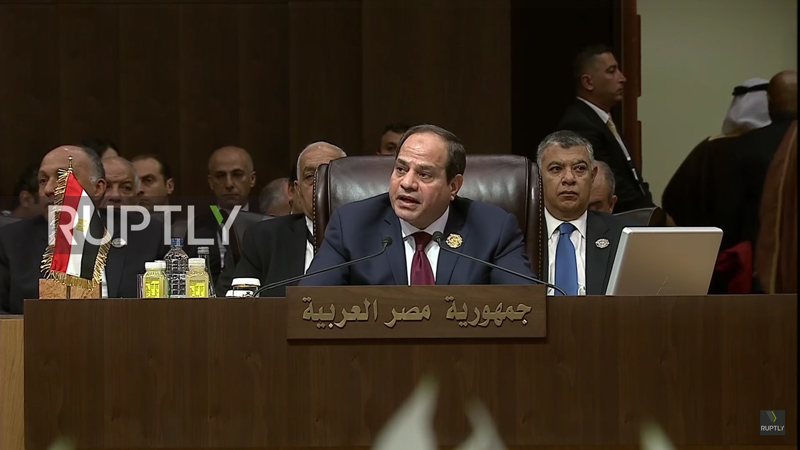
The Emir of Qatar, Sheikh Tamim bin Hamad Al-Thani, at the Arab Summit in Jordan on March 28, 2017 delivered a speech in which he indicated his continuous support for the Muslim Brotherhood:
"If we are serious about focusing our efforts on armed terrorist organizations, is it fair to consider any political party we disagree with as terrorist? Is our goal to increase the number of terrorists?"
Many Arab leaders were infuriated by his speech; at the forefront was President Abdel Fattah el-Sisi of Egypt, who left the Arab Summit Hall during the speech to meet King Salman of Saudi Arabia.
Most Arab leaders and analysts, in fact, are enraged by Qatar's continuous support for Islamist political groups such as the Muslim Brotherhood, because these groups are a threat to their national security.


President Abdel Fattah el-Sisi of Egypt speaks at the Arab Summit, on March 29. The previous day, Sisi walked out of a speech by the Emir of Qatar, Sheikh Tamim bin Hamad Al-Thani. Sisi was infuriated by Al-Thani's declaration of support for the Muslim Brotherhood. (Image source: Ruptly video screenshot)

Another consequence of Obama's foreign policy -- in particular attempts to get close to Iran's hostile regime -- has been a fraying of relationships with old Arab allies of the United States. Some of Obama's advisors thought that replacing Saudi Arabia with Iran was somehow "better" for the United States, if Iran "is beginning to evolve into a very civilized and historically important country" -- an analysis that can be described as completely short-sighted.

The Saudi regime, with all its flaws, is a monarchy run by princes; the Iranian regime is a theocracy run by clerics. The Saudi regime is not a theocratic regime but a hybrid structure, which is neither wholly secular nor wholly religious. As such, the religious class functions under the authority of the ruling class. Princes are driven by self-interest; clerics are driven by ideology. In terms of extremism, the Iranian regime is pushing for hegemony, whilst Saudi Arabia has been taking only a defensive, rather than an expansionist, position.

The motivation of Saudi Arabia in exporting mosques world-wide and installing radical Saudi imams is defensive, not expansionist as in Iran. Saudi Arabia's impetus is to confront Iran's hegemony and the spread of its hostile ideology.
It is this strategy, which Saudi Arabia has practiced since 1979 to balance Iran's power and to combat its rebellious ideology, that must change.

That Iran's Khomeini regime sought to embarrass Saudi Arabia -- a country that is home to Islam's two holiest mosques, in Mecca and Medina -- by portraying it as not sufficiently Islamic, meant that the foundational Islamic Wahhabism of the Saudi Kingdom was aggressively reinforced.
This emphasis resulted in even more constraints being put in place in Iran: especially on entertainment. Since the Khomeini revolution in 1979, all plays, fashion shows, international events, and cinemas have been banned.
As for women, the Commission for the Promotion of Virtue and Prevention of Vice has increasingly harassed them.
As for minorities, especially Shia challenging the Iranian Shia regime and its support for Shia militias -- particularly the dominant Revolutionary Guards -- books were published attacking the Shia:
More books appeared, attacking the Shias and especially Khomeini's views. These books – like the arguments of Khomeini's followers – rejected modern thinking as an "intellectual invasion." Saudi Arabia, considered the guardian of Sunni Islam, spent billions of dollars on challenging the Khomeini-backed Shiites.
This religious one-upmanship -- a competition over which body can be the "most religious" -- must stop.
Saudi Arabia would do well to understand that in order to confront the hegemony of the Iranian theocratic regime, the answer is not to radicalize Saudi society but to return to the way it was before 1979.

The best way to defeat the rebel hostile regime in Iran might be through creating an inclusive and tolerant society in Saudi Arabia. Saudi Arabia needs to change its approach towards Iran because the current strategy has not worked. The current strategy has done nothing except to strengthen the Iranian regime's dominance; distort, globally, the image of Saudi Arabia and accelerate terrorism.

The lesson the Trump administration might learn from the disastrous mistakes of its predecessor is that the main source of terrorism in the region are political Islam and all its related religious groups. All these radical groups including ISIS, Al-Qaeda, Jabhat Al-Nusra and Hamas have been spawned by a political Islam driven by the ideology of the Muslim Brotherhood. Extremist jihadists such as Osama bin Laden, Abdullah Azzam and Ayman al-Zawahiri were all taught by the Muslim Brotherhood.

Political Islam practiced by the Iranian theocratic regime has been comfortably generating Shia radical militias, including the terrorist group, Hezbollah. The fight, therefore, should not be against Islam, but against political Islam.

 Islam needs to be practiced the way other religions are, as a private personal faith that should be kept separate from public life and politics, and whose expression should be confined to worship only. Mosques, whether in the Arab and Muslim world or in the West, should be places of worship only and must not transformed to centers for polarizing society or for recruitment by political religious groups. Unfortunately, Western countries have turned a blind eye to the political activities inside these mosques.

The danger of these religious political groups is that they do not believe in democracy or human rights; they just use elections to grasp power in order to impose a system of "Islamic Caliphate" as their only form of government. Most of these groups use religion as an ideology to oppose governments other than their own, and when they are criticized or attacked, they play the role of the oppressed.
The Trump administration needs to take advantage of the fact that the majority of people in the Middle East and North Africa have lost faith in religious political groups, especially since the failure of the Muslim Brotherhood in Egypt and Tunisia.
Before the Arab Spring, support for these groups was huge; now it stands at less than 10% of the population. This study was conducted in the Arab world, not including Turkey. The Muslims who support Turkish President Recep Tayyip Erdogan are the Muslim Brotherhood.

Most recent polls indicate that the majority of people in Arab and Muslim countries prefer religion to be kept separate from politics.

The country that is working the most systematically to fight these religious political groups in the region is the United Arab Emirates (UAE). There are several institutes and think tanks researching how to combat these groups. Dr. Jamal Sanad Al-Suwaidi, Director General of the Emirates Center for Strategic Studies and Research (ECSSR), has given a robust analysis of these groups and how to combat them in his book, The Mirage. In it, he cites a study on public opinion on political religious groups: A survey of the UAE population, on how these groups are able to influence the public by taking advantage of certain flaws in the system: 53.9% because of corruption; 47.9% because of poverty and 29.1% because of an absence of civil society groups that confront these opportunists.

The Middle East-North Africa region will undoubtedly have to go through several stages before it can successfully establish democracy. An evolutionary developmental approach will definitely be better than the failed revolutionary democratic one pursued by the Obama administration.

Secularization is also crucial in the fight against terrorism. Trying to build a democracy before going through the stages of secularism and political reformation -- which includes rectifying existing flaws, such as corruption; modernization which means the liberation of the region from extremist totalitarian religious dogma and all other forms of backwardness in order to kick-start a renaissance; and scientific development -- will not only be inadequate but will actually generate more terrorism by helping radicals to keep gaining power. It would be like a farmer who wants to plant roses in arid desert soil full of thorns.
Najat AlSaied is a Saudi American academic and the author of "Screens of Influence: Arab Satellite Television & Social Development". She is an Assistant Professor at Zayed University in the College of Communication and Media Sciences in Dubai-UAE. She can be reached at: najwasaied@hotmail.com
===================

Majid Rafizadeh : Sentenced to Death for "Insulting Islam"


  • Can you imagine making a joke and facing death as a result?
  • "During his interrogation, Sina was told that if he signed a confession and repented, he would be pardoned and let go," said the source in an interview with CHRI on March 21, 2017. "Unfortunately, he made a childish decision and accepted the charges. Then they sentenced him to death." "Later he admitted that he signed the confession hoping to get freed," said the source. "Apparently the authorities also got him to confess in front of a camera as well." -- Center for Human Rights in Iran (CHRI).
  • When the Islamists gain power, they immediately create their own "judiciary system" in order to "legitimize" their implementation of sharia law. In fact, the judiciary system is used less as a tool for bringing people to justice, and more as a tool to suppress freedom of speech and of the press.
To radical Islamist groups, Islam is not a religion which all are free to pursue; it is a weapon. It is the most powerful tool that can be wielded with manipulative skill to control entire populations. 

Beneath their fierce rule, every aspect of daily life is dictated. What is worn, what is eaten, what you say and what you write are all scrutinized; violations of these stringent laws are met with extreme punishments. Can you imagine making a joke and facing death as a result? Can you imagine the constant fear of doing the wrong thing, saying the wrong thing, when you have seen people beaten, stoned, or killed in the street for nothing more than a mild transgression?

Freedom of speech and press are the Islamists' top enemies. They are targeted on a regular basis, making it difficult or impossible for the truth to be revealed to the world. While others may take their privacy for granted, the people living under this kind of tyranny must think about everything they say and do. Sometimes even the bravest of souls turn away in the face of such intimidation. Can it really be as restrictive as described? Yes, and far worse than you can imagine.

Sina Dehghan, 21, for example, was arrested by Iran's Islamic Revolutionary Guard Corps (IRGC) when he was 19 for "insulting Islam". Charges were brought against him for insulting the Prophet Muhammad on the messaging app LINE.
According to the Center for Human Rights in Iran (CHRI):
"During his interrogation, Sina was told that if he signed a confession and repented, he would be pardoned and let go," said the source in an interview with CHRI on March 21, 2017. "Unfortunately, he made a childish decision and accepted the charges. Then they sentenced him to death." "Later he admitted that he signed the confession hoping to get freed," said the source. "Apparently the authorities also got him to confess in front of a camera as well."
Such a sentence may seem like madness, but in fact there is a cold and calculated pattern to these actions. 
When extremist Muslims gain power, they immediately create their own "judiciary system" in order to "legitimize" their implementation of sharia law. This judiciary system is, in fact, used less as a tool for bringing people to justice, and more as a tool to suppress freedom of speech and freedom of the press. Once this silence is ensured, they are able to oppress the entire society, restrain any budding opposition, imprison and torture innocent people and sentence thousands to death.


Sina Dehghan, 21, has been sentenced to death in Iran for "insulting Islam". There are many people like him in Iran who are currently imprisoned, tortured on a daily basis, or awaiting their execution for "insulting Islam", "insulting the prophet", "insulting the Supreme Leader" -- the examples are endless. (Image source: Center for Human Rights in Iran)

By imprisoning, torturing and hanging idealistic and rebellious young people, the ruling politicians and the Islamist judiciary system are using them as an example to send a message to millions of people that they will not tolerate anyone who opposes their religious or political view.

Radical Islamist groups have been using the same tactic in other nations to impose fear and shock in the public. They aim at silencing people and making them subservient. Once they have control, they will stop at nothing to keep it.

For the Islamists, once you submit to their religion, your freedom of speech and of the press belong to Allah. Your only job is to exercise silence and obedience, and follow your religious leader, imam, sheikh, or velayat-e faqih ("guardianship of the Islamic jurist").

As the Center for Human Rights in Iran pointed out:
"Security and judicial authorities promised Sina's family that if they didn't make any noise about his case, he would have a better chance of being freed, and that talking about it to the media would work against him," added the source. "Unfortunately, the family believed those words and stopped sharing information about his case and discouraged others from sharing it as well." "Sina is not feeling well," continued the source. "He's depressed and cries constantly. He's being held in a ward with drug convicts and murderers who broke his jaw a while ago."
For the ruling Islamists, it does not matter if you have been a loyalist all your life. If you speak up or oppose them just once, you will be eliminated. 

As CHRI quoted one source: "He was a 19-year-old boy at the time (of his arrest) and had never done anything wrong in his life."

One of Dehghan's co-defendants, Mohammad Nouri, was also sentenced to death for posting anti-Islamic comments on social media. Another co-defendant, Sahar Eliasi, was sentenced to seven years, and later the sentence was reduced to three years.

What does the term "anti-Islamic" mean exactly in an Islamist judiciary system? If it carries a death sentence, you might assume that the parameters of the law would be well outlined. However, that is not the case. For the ruling Islamists, the term "anti-Islamic" is completely ambiguous and subjective, and can relate to anything that opposes their view or their power. What might seem like an innocent remark, could change a life forever.

If they are such violent and oppressive people, you might wonder how they are ever able to gain power. They do this through manipulation, charm and countless false promises.

Some radical Islamists, before they gain power, promise people equality, justice, peace, and a far better life. They appeal to the young, to the traditional, and to the hopeful. But once they seize power, they close an iron grip around any and all freedoms, available to their people -- in particular freedom of speech.

Once radical Islam has gained power, established its own judiciary system, or infiltrated the legal system with its sharia law, no one is capable of criticizing the government or the political establishment. In a social order ruled by radical Islam, the government is Islam; the government is the representative of Allah and the Prophet Muhammad. Ruling politicians who decide the laws are "divine" figures supposedly appointed by God. They are not to be questioned.

There are many people like Sina Dehghan who are currently imprisoned, tortured on a daily basis, or awaiting their execution for "insulting Islam", "insulting the prophet", "insulting the Supreme Leader" -- the examples are endless. The issue is that we do not hear about these cases.

Some media outlets refuse to report on them in order to appease the Islamic Republic of Iran -- just further proof of how coercive their power can be. The only way to reduce it -- and the oppression and slaughter of so many people -- is to bring attention to the human rights abuses conducted under the Islamic banner of religious "legitimacy " and "authenticity".

This type of tyranny is a danger, not just for those enduring it, but for the world.
Dr. Majid Rafizadeh, political scientist and Harvard University scholar is president of the International American Council on the Middle East. He can be reached at Dr.rafizadeh@post.harvard.edu.
  • Follow Majid Rafizadeh on Twitter
=======================

Judith Bergman : Europe's Out-of-Control Censorship


  • If Facebook insists on the rules of censorship, it should at the very least administer those rules in a fair way. Facebook, however, does not even pretend that it administers its censorship in any way that approximates fairness.
  • Posts critical of Chancellor Merkel's migrant policies, for example, can be categorized as "Islamophobia", and are often found to violate "Community Standards", while incitement to actual violence and the murder of Jews and Israelis by Palestinian Arabs is generally considered as conforming to Facebook's "Community Standards".
  • Notwithstanding the lawsuits, Facebook's bias is so strong that it recently restored Palestinian Arab terrorist group Fatah's Facebook page, which incites hatred and violence against Jews -- despite having shut it down only three days earlier. In 2016 alone, this page had a minimum of 130 posts glorifying terror and murder of Jews.
Germany has formally announced its draconian push towards censorship of social media. On March 14, Germany's Justice Minister Heiko Maas announced the plan to formalize into law the "code of conduct", which Germany pressed upon Facebook, Twitter and YouTube in late 2015, and which included a pledge to delete "hate speech" from their websites within 24 hours.

"This [draft law] sets out binding standards for the way operators of social networks deal with complaints and obliges them to delete criminal content," Justice Minister Heiko Maas said in a statement announcing the planned legislation.

"Criminal" content? Statements that are deemed illegal under German law are now being conflated with statements that are merely deemed, subjectively and on the basis of entirely random complaints from social media users -- who are free to abuse the code of conduct to their heart's content -- to be "hate speech". "Hate speech" has included critiques of Chancellor Angela Merkel's migration policies. To be in disagreement with the government's policies is now potentially "criminal". Social media companies, such as Facebook, are supposed to be the German government's informers and enforcers -- qualified by whom and in what way? -- working at the speed of light to comply with the 24-hour rule. Rule of law, clearly, as in North Korea, Iran, Russia or any banana-republic, has no place in this system.


Maas is not pleased with the efforts of the social media companies. They do not, supposedly, delete enough reported content, nor do they delete it fast enough, according to a survey by the Justice Ministry's youth protection agency. It found that YouTube was able to remove around 90% of "illegal" postings within a week, while Facebook deleted or blocked 39% of content and Twitter only 1%. The German minister, it seems, wants more efficiency.

"We need to increase the pressure on social networks... There is just as little room for criminal propaganda and slander [on social media] as on the streets," said Maas. "For this we need legal regulations." He has now presented these legal regulations in the form of a draft bill, which provides for complaints, reporting and fines.
There also appears to be no differentiation made between primary-source hate speech, as in many religious tenets, and secondary-source hate speech, reporting on the former.

According to the draft, social media platforms with more than two million users would be obliged to delete or block any criminal offenses, such as libel, slander, defamation or incitement, within 24 hours of receipt of a user complaint. The networks receive seven days for more complicated cases. Germany could fine a social media company up to 50 million euros for failing to comply with the law; it could fine a company's chief representative in Germany up to 5 million euros.
It does not stop there. Germany does not want these measures to be limited to its own jurisdiction. It wants to share them with the rest of Europe: "In the end, we also need European solutions for European-wide companies," said Maas. The European Union already has a similar code of conduct in place, so that should not be very hard to accomplish.

Facebook, for its part, has announced that by the end of 2017, the number of employees in complaints-management in Berlin will be increased to more than 700. A spokeswoman said that Facebook had clear rules against hate speech and works "hard" on removing "criminal content".

If Facebook insists on operating under rules of censorship, it should at the very least aim to administer those rules in a fair manner. Facebook, however, does not even pretend that it administers its censorship in any way that approximates fairness. Instead, Facebook's practice of its so-called "Community Standards" -- the standards to which Facebook refers when deleting or allowing content on its platform in response to user complaints -- shows evidence of entrenched bias. Posts critical of Merkel's migrant policies, for example, can get categorized as "Islamophobia", and are often found to violate "Community Standards", while incitement to actual violence and the murder of Jews and Israelis by Palestinian Arabs is generally considered as conforming to Facebook's "Community Standards".
Facebook's bias, in fact, became so pronounced that in October 2015, Shurat Hadin Israel Law Center filed an unprecedented lawsuit against Facebook on behalf of some 20,000 Israelis, to stop allowing Palestinian Arab terrorists to use the social network to incite violent attacks against Jews. The complaint sought an injunction against Facebook that required it to monitor incitement and to respond immediately to complaints about content that incites people to violence. Shurat Hadin wrote at the time:
"...Facebook is much more than a neutral internet platform or a mere 'publisher' of speech because its algorithms connect the terrorists to the inciters. Facebook actively assists the inciters to find people who are interested in acting on their hateful messages by offering friend, group and event suggestions ... Additionally, Facebook often refuses to take down the inciting pages, claiming that they do not violate its 'community standards'. Calling on people to commit crimes is not constitutionally protected speech and endangers the lives of Jews and Israelis".
In 2016, Shurat Hadin filed a separate $1 billion lawsuit on behalf of five victims of Hamas terrorism and their families. They are seeking damages against Facebook under the U.S. Antiterrorism Act, for Facebook's having provided material support and resources to Hamas in the form of Facebook services, which Hamas then used to carry out their terrorist activities. The US has officially designated Hamas a "Foreign Terrorist Organization" which means that it is a criminal offense to provide material support to such an organization.

Notwithstanding the lawsuits, Facebook's bias is so strong that it recently restored Palestinian Arab terrorist group Fatah's Facebook page, which incites hatred and violence against Jews -- despite having shut it down only three days earlier. In 2016 alone, this page had a minimum of 130 posts glorifying terror and the murder of Jews.

It is only a small step from imposing censorship on social media companies to asking the same of email providers, or ordering postal authorities to screen letters, magazines and brochures in the event that citizens spread supposed "xenophobia" and "fake news". There is ample precedent for such a course of action on the continent:
During the Cold War, people living behind the Iron Curtain had their private letters opened by the communist authorities; those passages deemed to be out of line with the communist orthodoxy, were simply blacked out.
Who would have thought that more than a quarter of a century after the fall of the Berlin Wall (1989), Western Europe would be reinventing itself in the image of the Soviet Union?
Judith Bergman is a writer, columnist, lawyer and political analyst.
=======================

Thursday, April 6, 2017

Reaction of Geert Wilders to His Conviction


Dear friends, I still cannot believe it, but I have just been convicted. Because I asked a question about Moroccans. While the day before yesterday, scores of Moroccan asylum-seekers terrorized buses in Emmen and did not even had to pay a fine, a politician who asks a question about fewer Moroccans is sentenced.
The Netherlands have become a sick country. And I have a message for the judges who convicted me: You have restricted the freedom of speech of millions of Dutch and hence convicted everyone. No one trusts you anymore. But fortunately, truth and liberty are stronger than you. And so am I.


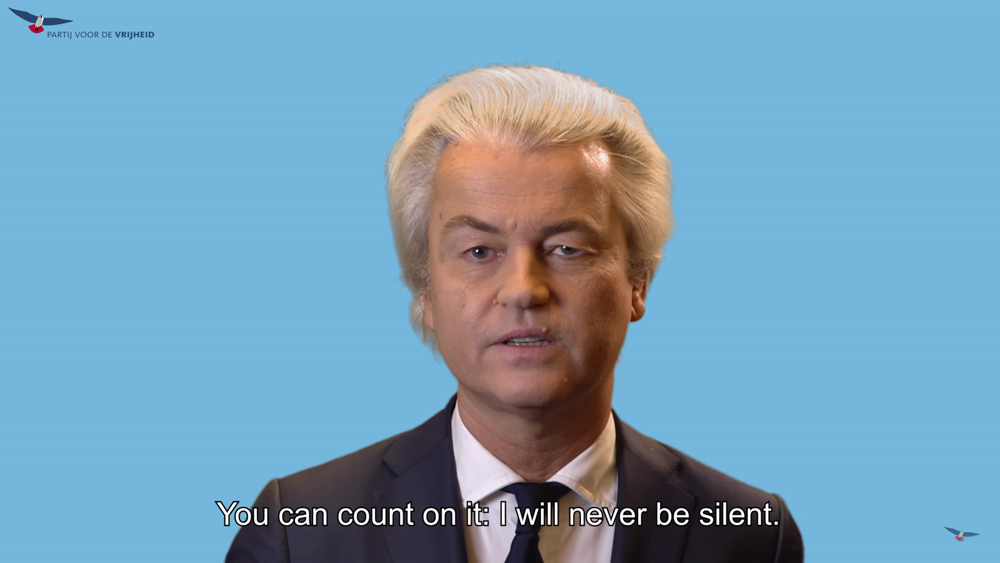
I will never be silent. You will not be able to stop me. And you are wrong, too. Moroccans are not a race, and people who criticize Moroccans are not racists. I am not a racist and neither are my voters. This sentence proves that you judges are completely out of touch.

And I have also a message for Prime Minister Rutte and the rest of the multicultural elite: You will not succeed in silencing me and defeating the PVV. Support for the Party for Freedom is stronger than ever, and keeps growing every day. The Dutch want their country back and cherish their freedom. It will not be possible to put the genie of positive change back in the bottle.

And to people at home I say: Freedom of speech is our pride. And this will remain so. For centuries, we Dutch have been speaking the unvarnished truth. Free speech is our most important possession. We will never let them take away our freedom of speech. Because the flame of freedom burns within us and cannot be extinguished.
Millions of Dutch are sick and tired of political correctness. Sick and tired of the elite which only cares about itself and ignores the ordinary Dutchman. And sells out our country. People no longer feel represented by all these disconnected politicians, judges and journalists, who have been harming our people for so long, and make our country weaker instead of stronger.

But I will keep fighting for you, and I tell all of you: thank you so much. Thank you so much for all your support. It is really overwhelming; I am immensely grateful to you. Thanks to your massive and heartfelt support, I know that I am not alone. That you back me, and are with me, and unwaveringly stand for freedom of expression.
Today, I was convicted in a political trial, which, shortly before the elections, attempts to neutralize the leader of the largest and most popular opposition party. But they will not succeed. Not even with this verdict. Because I speak on behalf of millions of Dutch. And the Netherlands are entitled to politicians who speak the truth, and honestly address the problems with Moroccans. Politicians who will not let themselves be silenced. Not even by the judges. And you can count on it: I will never be silent.

And this conviction only makes me stronger. This is a shameful sentence, which, of course, I will appeal. But I can tell you, I am now more vigorous than ever. And I know: together, we aim for victory.
Standing shoulder-to-shoulder, we are strong enough to change the Netherlands.
To allow our children to grow up in a country they can be proud of.
In a Netherlands where we are allowed to say again what we think.
Where everybody can safely walk the streets again.
Where we are in charge of our own country again.
And that is what we stand for. For freedom and for our beautiful Netherlands.
Geert Wilders is a member of the Dutch Parliament and leader of the Party for Freedom (PVV).

=======================

Final Statement of Geert Wilders at his Trial

Final Statement of Geert Wilders at his Trial

by

Mr. President, Members of the Court,
When I decided to address you here today, by making a final statement in this trial against freedom of speech, many people reacted by telling me it is useless. That you, the court, have already written the sentencing verdict a while ago. That everything indicates that you have already convicted me. And perhaps that is true. Nevertheless, here I am. Because I never give up. And I have a message for you and the Netherlands.
For centuries, the Netherlands are a symbol of freedom.
When one says Netherlands, one says freedom. And that is also true, perhaps especially, for those who have a different opinion than the establishment, the opposition. And our most important freedom is freedom of speech.
We, Dutch, say whatever is close to our hearts. And that is precisely what makes our country great. Freedom of speech is our pride.
And that, precisely that, is at stake here, today.
I refuse to believe that we are simply giving this freedom up. Because we are Dutch. That is why we never mince our words. And I, too, will never do that. And I am proud of that. No-one will be able to silence me.
Moreover, members of the court, for me personally, freedom of speech is the only freedom I still have. Every day, I am reminded of that. This morning, for example. I woke up in a safe-house. I got into an armored car and was driven in a convoy to this high security courtroom at Schiphol. The bodyguards, the blue flashing lights, the sirens. Every day again. It is hell. But I am also intensely grateful for it.
Because they protect me, they literally keep me alive, they guarantee the last bit of freedom left to me: my freedom of speech. The freedom to go somewhere and speak about my ideals, my ideas to make the Netherlands -- our country -- stronger and safer. After twelve years without freedom, after having lived for safety reasons, together with my wife, in barracks, prisons and safe-houses, I know what lack of freedom means.
I sincerely hope that this will never happen to you, members of the court. That, unlike me, you will never have to be protected because Islamic terror organizations, such as Al-Qaeda, the Taliban and ISIS, and who knows how many individual Muslims, want to murder you. That you will no longer be allowed to empty your own mailbox, need to carry a bulletproof vest at meetings, and that there are police officers guarding the door whenever you use the bathroom. I hope you will be spared this.
However, if you would have experienced it -- no matter how much you disagree with my views -- you might perhaps understand that I cannot remain silent. That I should not remain silent. That I must speak. Not just for myself, but for the Netherlands, our country. That I need to use the only freedom that I still have to protect our country. Against Islam and against terrorism. Against immigration from Islamic countries. Against the huge problem with Moroccans in the Netherlands. I cannot remain silent about it; I have to speak out. That is my duty, I have to address it, I must warn for it, I have to propose solutions for it.
I had to give up my freedom to do this and I will continue. Always. People who want to stop me will have to murder me first.
And so, I stand here before you. Alone. But I am not alone. My voice is the voice of many. In 2012, nearly 1 million Dutch have voted for me. And there will be many more on March 15th.
According to the latest poll, soon, we are going to have two million voters. Members of the court, you know these people. You meet them every day. As many as one in five Dutch citizens would vote the Party for Freedom, today. Perhaps your own driver, your gardener, your doctor or your domestic aid, the girlfriend of a registrar, your physiotherapist, the nurse at the nursing home of your parents, or the baker in your neighborhood. They are ordinary people, ordinary Dutch. The people I am so proud of.
They have elected me to speak on their behalf. I am their spokesman. I am their representative. I say what they think. I speak on their behalf. And I do so determinedly and passionately. Every day again, including here, today.
So, do not forget that, when you judge me, you are not just passing judgment on a single man, but on millions of men and women in the Netherlands. You are judging millions of people. People who agree with me. People who will not understand a conviction. People who want their country back, who are sick and tired of not being listened to, who cherish freedom of expression.
Members of the court, you are passing judgment on the future of the Netherlands. And I tell you: if you convict me, you will convict half of the Netherlands. And many Dutch will lose their last bit of trust in the rule of law.

Geert Wilders in court, November 23, 2016. (Image source: NPO Nieuws video screenshot)
Of course, I should not have been subjected to this absurd trial. Because this is a political trial. It is a political trial because political issues have to be debated in Parliament and not here. It is a political trial because other politicians -- from mostly government parties -- who spoke about Moroccans have not been prosecuted. It is a political trial because the court is being abused to settle a political score with an opposition leader whom one cannot defeat in Parliament.
This trial here, Mr. President, it stinks. It would be appropriate in Turkey or Iran, where they also drag the opposition to court. It is a charade, an embarrassment for the Netherlands, a mockery of our rule of law.
And it is also an unfair trial because, earlier, one of you -- Mrs. van Rens -- commented negatively on the policy of my party and the successful challenge in the previous Wilders trial. Now, she is going to judge me.
What have I actually done to deserve this travesty? I have spoken about fewer Moroccans at a market, and I have asked questions of PVV members during a campaign event. And I did so, members of the court, because we have a huge problem with Moroccans in this country. And almost no-one dares to speak about it or take tough measures. My party alone has been speaking about this problem for years.
Just look at these past weeks: Moroccan fortune-seekers stealing and robbing in Groningen, abusing our asylum system, and Moroccan youths terrorizing entire neighborhoods in Maassluis, Ede and Almere. I can give tens of thousands of other examples -- almost everyone in the Netherlands knows them or has personally experienced nuisance from criminal Moroccans. If you do not know them, you are living in an ivory tower.
I tell you: If we can no longer honestly address problems in the Netherlands, if we are no longer allowed to use the word "alien," if we, Dutch, are suddenly racists because we want Black Pete to remain black, if we only go unpunished if we want more Moroccans or else are dragged before a criminal court, if we sell out our hard-won freedom of expression, if we use the courts to silence an opposition politician, who threatens to become Prime Minister, then this beautiful country will be doomed. That is unacceptable, because we are Dutch and this is our country.
And again, what on earth have I done wrong? How can the fact be justified that I have to stand here as a suspect, as if I robbed a bank or committed murder?
I only spoke about Moroccans at a market and asked a question at an election-night meeting. And anyone who has the slightest understanding of politics, knows that the election-night meetings of every party consist of political speeches full of slogans, one-liners and making maximum use of the rules of rhetoric. That is our job. That is the way it works in politics.
Election nights are election nights, with rhetoric and political speeches; not university lectures, in which every paragraph is scrutinized for 15 minutes from six points of view. It is simply crazy that the Public Prosecutor now uses this against me, as if one would blame a football player for scoring a hattrick.
Indeed, I said at the market, in the beautiful Hague district of Loosduinen: "if possible fewer Moroccans." Mark that I did so a few minutes after a Moroccan lady came to me and told me she was going to vote PVV because she was sick and tired of the nuisance caused by Moroccan youths.
And on election night, I began by asking the PVV audience "Do you want more or less EU," and I also did not explain in detail why the answer might be less. Namely, because we need to regain our sovereignty and reassert control over our own money, our own laws and our own borders. I did not do that.
Then, I asked the public "Do you want more or less Labour Party." And, again, I did not explain in detail why the answer might be less. Namely, because they are the biggest cultural relativists, willfully blind and Islam-hugging cowards in Parliament. I did not say that.
And then I asked, "Do you want more or fewer Moroccans," and again, I did not explain in detail why the answer might be fewer. Namely, because people with Moroccan nationality are overrepresented in the Netherlands in crime, benefit dependency and terror. And that we want to achieve this by expelling criminals with Moroccan nationality after denaturalizing them of their Dutch nationality, by a stricter immigration policy and an active voluntary repatriation policy. Proposals that we have made in our election manifesto from the day I founded the Party for Freedom.
I explained this in several interviews on national television, both between the statement at the market and election night, as well as on election night a few moments after I had asked the said questions. It is extremely malicious and false of the Public Prosecutor to want to disregard that context.
Disgusting -- I have no other words for it -- are the actions of other politicians, including the man who for a few months may still call himself Prime Minister. Their, and especially his, actions after the said election night constituted real persecution, a witch hunt. The government created an atmosphere in which it had to come to trial.
Prime Minister Rutte even told small children during the youth news that I wanted to expel them, and then reassured them that this would not happen. As if I had said anything of that kind. It is almost impossible to behave viler and falser.
But, also, the then Minister of Security and Justice -- who, it should be noted, is the political boss of the Public Prosecutor -- called my words disgusting and even demanded that I take them back. A demand of the Minister of Justice -- you do not have to be named Einstein to predict what will happen next, what the Public Prosecutor will do, if you do not comply to the demand of the Minister of Justice.
The Interior Minister and the Deputy Prime Minister, too, both from the Labour Party, expressed themselves similarly. In short, the government left the Public Prosecutor no option than to prosecute me. Hence, in this trial, the Officers of Justice are not representatives of an independent Public Prosecutor, but accomplices of this government.
Mr. President, the elite also facilitated the complaints against me. With pre-printed declaration forms, which were brought to the mosque by the police. In which, it has to be noted, the police sometimes said that they, too, were of the opinion that my statements were inadmissible.
And a sample taken by us showed that some complaints were the result of pure deception, intimidation and influence. People thought they were going to vote; they not even know my name, did not realize what they were signing or declared that they did not feel to be discriminated against by me at all.
Someone said that, at the As Soenah mosque, after Friday prayers alone, 1,200 complaints were lodged because it was thought to be an election. There were parades, led by mayors and aldermen, like in Nijmegen, where CDA mayor Bruls was finally able to show off his deep-seated hatred of the PVV. The police had extra opening hours, offered coffee and tea, there were dancing and singing Moroccans accompanied by a real oompah band in front of a police station. They turned it into a big party.
But meanwhile, two representative polls, one commissioned by the PVV, the other commissioned by De Volkskrant, showed that, apart from the government and media elite, 43% of the Dutch people, around 7 million people, agree with me. Want fewer Moroccans. You will be very busy if the Public Prosecutor is going to prosecute all these 7 million people.
People will never understand that other politicians -- especially from government parties -- and civil servants who have spoken about Moroccans, Turks and even PVV members, are being left alone and not prosecuted by the Public Prosecutor.
Like Labour leader Samsom, who said that Moroccan youths have a monopoly on ethnic nuisance.
Or Labour chairman Spekman, who said Moroccans should be humiliated.
Or Labour alderman Oudkerk, who spoke about f*cking Moroccans.
Or Prime Minister Rutte, who said that Turks should get lost.
And what about police chief Joop van Riessen, who said about me on television -- I quote literally: "Basically one would feel inclined to say: let's kill him, just get rid of him now and he will never surface again"?
And in reference to PVV voters, van Riessen declared: "Those people must be deported, they no longer belong here." End of quote. The police chief said that killing Wilders was a normal reaction. That is hatred, Mr. President, pure hatred -- and not by us, but against us. And the Public Prosecutor did not prosecute Mr. Van Riessen.
But the Public Prosecutor does prosecute me. And demands a conviction based on nonsensical arguments about race and concepts that are not even in the law. It accuses and suspects me of insulting a group and inciting hatred and discrimination on grounds of race. How much crazier can it become? Race. What race?
I spoke and asked a question about Moroccans. Moroccans are not a race. Who makes this up? No-one at home understands that Moroccans have suddenly become a race. This is utter nonsense. Not a single nationality is a race. Belgians are no race, Americans are no race. Stop this nonsense, I say to the Public Prosecutor. I am not a racist and neither are my voters. How do you dare suggest that? Wrongly slandering millions of people as racists.
43% of the Dutch want fewer Moroccans, as I already said. They are no racists. Stop insulting these people. Every day, they experience the huge problem with Moroccans in our country. They have a right to a politician who is not afraid to mention the problem with Moroccans. But neither they nor I care whether someone is black, yellow, red, green or violet.
I tell you: If you convict someone for racism while he has nothing against races, then you undermine the rule of law, then it is bankrupt. No-one in this country will understand that.
And now the Public Prosecutor also uses the vague concept of "intolerance." Yet another stupidity. The subjective word intolerance, however, is not even mentioned in the law. And what for heaven's sake is intolerance? Are you going to decide that, members of the court?
It is not up to you to decide. Nor up to the Supreme Court or even the European Court. The law itself must determine what is punishable. We, representatives, are elected by the people to determine clearly and visibly in the law for everyone what is punishable and what is not.
That is not up to the court. You should not do that, and certainly not on the basis of such subjective concepts, which are understood differently by everyone and can easily be abused by the elite to ban unwelcome opinions of the opposition. Do not start this, I tell you.
Mr. President, Members of the Court,
Our ancestors fought for freedom and democracy. They suffered, many gave their lives. We owe our freedoms and the rule of law to these heroes. But the most important freedom, the cornerstone of our democracy, is freedom of speech. The freedom to think what you want and to say what you think.
If we lose that freedom, we lose everything. Then, the Netherlands cease to exist; then the efforts of all those who suffered and fought for us are useless. From the freedom fighters for our independence in the Golden Age to the resistance heroes in World War II. I ask you: Stand in their tradition. Stand for freedom of expression.
By asking for a conviction, the Public Prosecutor, as an accomplice of the established order, as a puppet of the government, asks to silence an opposition politician. And, hence, silence millions of Dutch. I tell you: The problems with Moroccans will not be solved this way, but will only increase.
For people will sooner be silent and say less because they are afraid of being called racist, because they are afraid of being sentenced. If I am convicted, then everyone who says anything about Moroccans will fear to be called a racist.
Mr. President, Members of the Court, I conclude.
A worldwide movement is emerging that puts an end to the politically correct doctrines of the elites and the media that are subordinate to them.
That has been proven by Brexit.
That has been proven by the US elections.
That is about to be proven in Austria and Italy.
That will be proven next year in France, Germany, and The Netherlands.
The course of things is about to take a different turn. Citizens no longer tolerate it.
And I tell you, the battle of the elite against the people will be won by the people. Here, too, you will not be able to stop this, but rather accelerate it. We will win, the Dutch people will win, and it will be remembered well who was on the right side of history.
Common sense will prevail over politically correct arrogance. Because everywhere in the West, we are witnessing the same phenomenon.
The voice of freedom cannot be imprisoned; it rings like a bell. Everywhere, ever more people are saying what they think. They do not want to lose their land, they do not want to lose their freedom.
They demand politicians who take them seriously, who listen to them, who speak on their behalf. It is a genuine democratic revolt. The wind of change and renewal blows everywhere. Including here, in the Netherlands.
As I said:
I am standing here on behalf of millions of Dutch citizens.
I do not speak just on behalf of myself.
My voice is the voice of many.
And, so, I ask you, not only on behalf of myself, but in the name of all those Dutch citizens:
Acquit me! Acquit us!
Geert Wilders is a member of the Dutch Parliament and leader of the Party for Freedom (PVV).

=======================

Giulio Meotti : Critics of Islam on Trial in Europe: Wilders Convicted


  • On December 9, for the first time in Dutch history, a court criminalized freedom of expression: The truly heroic Dutch Member of Parliament, Geert Wilders, was found guilty of the "crimes" of "inciting discrimination and insulting a minority group."
  • The death sentence against Salman Rushdie in 1989 by Iran's supreme leader looked unreal. The West did not take it seriously. Since then, however, this fatwa has been assimilated to such an extent that today's threats to free speech come from ourselves. It is now the West that put on trial writers and journalists.
  • The Red Brigades, the Communist terror group which devastated Italy in the 1970s, coined a slogan: "Strike one to educate one hundred." If you target one, you get collective intimidation. This is exactly the effect of these political trials about Islam.
  • "Hate speech" has become a political weapon to dispatch whoever may not agree with you. It is not the right of a democracy to quibble about the content of articles or cartoons. In the West, we paid a high price for the freedom to write them and and read them it. It is not up to those who govern to grant the right of thought and speech.
  • In Europe now, the same iron curtain as in the Soviet era is descending.
After the Second World War and the horrors of Nazism and Stalinism, a central tenet of Western democracies has been that you can put people on trial, but not ideas and opinions. Europe is now allowing dangerous "human rights" groups and Islamists to use tribunals to restrict the borders of our freedom of expression, exactly as in Soviet show trials. "Militant anti-racism will be for the 21st century what communism was for the 20th century," the prominent French philosopher, Alain Finkielkraut has predicted.

A year ago, Christoph Biró, a respected columnist and editor of the largest Austrian newspaper, Kronen Zeitung, wrote an article blaming "young men, testosterone-fuelled Syrians, who carry out extremely aggressive sexual attacks" (even before mass the sexual assaults of New Year's Eve in Cologne, Hamburg and other cities). The article sparked much controversy, and it received a large number of complaints and protests. Biró needed four weeks off work because of these attacks and later (under pressure) admitted that he had "lost a sense of proportion". Prosecutors in Graz recently charged Biró with "hate speech" after a complaint by a so-called human rights organization, SOS Mitmensch. The case will be decided in court.

Journalists, novelists and intellectuals throughout Europe are now told to raise their right hand before a judge and swear to tell the truth and nothing but the truth -- as if that were not what they were doing all along and for what they are now being prosecuted.
It is an alarming but very common sight today, where "hate speech" has become a political weapon to dispatch whoever may not agree with you.

It is not the right of a democracy to quibble about the content of articles or cartoons. In the West, we paid a high price for the freedom to read and write them. It is not up to those who govern to grant the right of thought and speech, that belongs to the free initiative in the democracies. The right to express our own opinion was paid for dearly, but if it is not exercised, it can quickly disappear.

A grotesque new legal front was just opened in Paris. The French philosopher Pascal Bruckner began his trial, where he opened his defense with a quotation from Jean-Paul Sartre: "The guns are loaded with words". Bruckner, one of the most famous essayists of France, is on trial for having spoken out against the "collaborators of Charlie Hebdo's assassins".
"I will say the names: The organizations 'The Indivisibles' of Rokhaya Diallo and 'The Indigenous of the Republic', the rapper Nekfeu who wanted 'a bonfire for those dogs' (Charlie Hebdo), all those who have justified with ideology the death of the twelve journalists".
Countless witnesses testified in defense of Bruckner: the editor of Charlie Hebdo, "Riss"; the political scientist Laurent Bouvet; the former president of "Neither Whores nor Submissives," Sihem Habchi; and the philosopher, Luc Ferry. Bruckner used the term "collaborator" for "those newspapers which justified the liquidation of the Résistance and the Jews" during the Second World War. Sihem Habchi spoke of the danger of a "green fascism", Islamism.
Bruckner's verdict will be announced on January 17. "Bruckner brought his voice before the 17th Chamber [court], too often a grave-digger of freedom of expression," commented the important and courageous Riposte Laïque.

These political trials about Islam started in 2002, when a court in Paris considered a complaint against Michel Houellebecq, who, in the novel Platforme called Islam "the stupidest religion." The writer Fernando Arrabal, arrested for blasphemy in 1967 in Franco's Spain, was called by Houellebecq to testify in in court. "What a joy to be in a trial for crimes of opinion," Arrabal said in Paris. "Zaragoza, Valladolid, Santander," the playwright named a number of Spanish cities. "This is the list of the prisons where I have been for the same crime as Houellebecq."

The late Italian writer, Oriana Fallaci, was also put on trial for her book, La Rage et l'Orgueil ("The Rage and the Pride"). The French newspaper Libération called her "the woman who defames Islam." Later the satirical weekly, Charlie Hebdo, and its editor, Philippe Val, targeted by Islamist organizations, were also forced to appear in court.

The death sentence against Salman Rushdie in 1989 by Iran's supreme leader Ayatollah Khomeini looked unreal. The West did not take it seriously. Since then, however, this fatwa has been assimilated to such an extent that today's threats to free speech come from ourselves. It is now the West that puts on trial writers and journalists.

It has become almost impossible to list all the journalists and writers who have had to defend themselves in court because of their ideas on Islam. To quote the French-Algerian writer, Boualem Sansal, the author of the novel "2084," from an interview with Libération: "We are aware of the danger, but we do not know how to act for fear of being accused of being anti-immigrant, anti-Islam, anti-Africa... Democracy, like the mouse, will be swallowed by the serpent". And it will be turned into "a society that whispers".

Journalists are now prosecuted even if they question Islam during a radio debate. That is why today most of writers and journalists are only whispering about the consequences of mass migration in Europe, Islam's role in the terrorists' war on democracies and the sultans' offensives on freedom of expression.
The Red Brigades, the Communist terror group which devastated Italy in the 1970s, coined a slogan: "Strike one to educate one hundred." If you target one, you get collective intimidation. This is exactly the effect of these political trials about Islam. The debate is rapidly closing.
In the Netherlands yesterday, the trial for the "crimes" of "inciting discrimination and insulting a minority group" against Geert Wilders was concluded. The brave Dutch politician had asked supporters if they wanted "fewer Moroccans" in the country. Convicting Wilders yesterday, a court criminalized freedom of expression for the first time in Dutch history. (Wilders was acquitted five years ago in a similar trial).

Left: Writer Salman Rushdie. Right: Dutch MP Geert Wilders.

In France Ivan Rioufol, one of the most respected columnists of the newspaper, Le Figaro, had to defend himself in court against the "Collective Against Islamophobia." The writer Renaud Camus, who has expounded on the "great replacement" theory, which holds that France is being colonized by Muslim immigrants with the help of mainstream politicians, was charged with "hate speech." Marine Le Pen also had to appear in court. In Germany, there was the case of Jan Böhmermann, a comedian who satirized Turkish President Recep Tayyip Erdogan on television. German judges then put on trial Lutz Bachmann, the founder of "Pegida," the anti-Islamization movement. In Canada essayist and journalist Mark Steyn was charged with "flagrant Islamophobia" by a "Human Rights Tribunal" (and later cleared). Lars Hedegaard, the president of the Danish Free Press Society, was also charged with "hate speech" (and later aquitted) for comments critical of Islam.
It is fundamental that these writers and journalists are acquitted. But the goal of these trials is not to find the truth; it is to intimidate the public and to restrict freedom of expression on Islam. These are purges to "re-educate" them. Sadly, as we see from the Wilders trial, they have often been succeeding.

After the Russian invasion of Czechoslovakia in 1968, Milan Kundera's novels disappeared from bookstores and libraries. The intelligentsia lay in sterility and isolation. Cinemas and theaters offered only the Soviet performances. Radio, newspapers and televisions streamed only propaganda. The Russians rewarded the bureaucrats who pressured writers and journalists, and punished the rebels. Those who spoke out were often obliged to work as unskilled laborers. Prague, restless and fascinating, became silent and whispering.
In Europe now, the same iron curtain is descending.
Giulio Meotti, Cultural Editor for Il Foglio, is an Italian journalist and author.
==================