.

.
Library of Professor Richard A. Macksey in Baltimore

POSTS BY SUBJECT

Labels

Sunday, September 18, 2022

Europe's Energy Crisis


Europe's Energy Crisis

by

  • In response to Russia severely restricting or cutting off gas supplies, EU governments will take dramatic actions over the coming months. Germany recently announced it would keep two of the nuclear plants it was shuttering as backups, just in case. EU leaders will then go back to the voters and describe the amazing job they did while failing to mention they were the ones who made the decisions that put their countries in this crisis in the first place.

  • The entire current crisis was avoidable if the EU had developed a rational plan instead of one based on a daydream, no matter how enticing.

  • The U.S. needs urgently to examine what is happening in Europe and develop a rational energy transition plan. Any long-term solution must include strategies for reliable power production, affordable sustainable energy and a massively strengthened electrical grid.

  • Europe's plan was built on the hope that consumers would accept higher prices, that Russia and Putin would be reliable, and that battery storage technology would be robust enough to cover the times when "the wind doesn't blow and the sun doesn't shine."

  • This strategy, sadly always doomed to failure, provides a cautionary tale for "solutions" based solely on hope.

  • The U.S. should not repeat the same mistakes as the EU by continuing down a path that cuts domestic fossil fuel production, bans gasoline-powered vehicles, and ignores that the power generation capacity and energy infrastructure are not in place to achieve an unrealistic and unfortunately unsustainable green agenda.
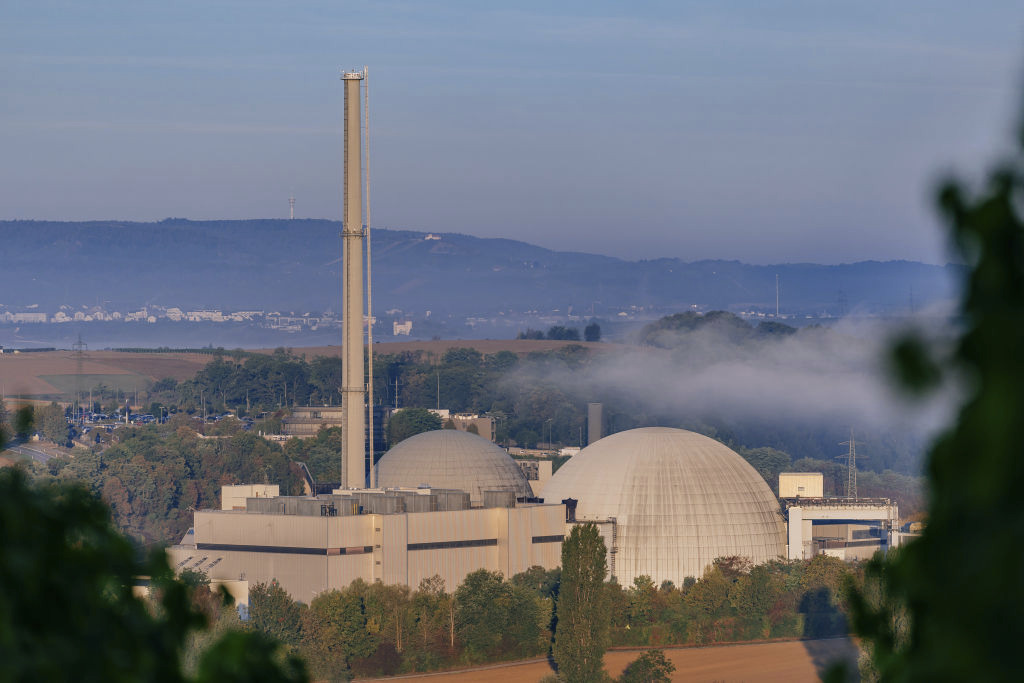
In response to Russia severely restricting or cutting off gas supplies, EU governments will take dramatic actions over the coming months. Germany recently announced it would keep two of the nuclear plants it was shuttering as backups, just in case. Pictured: The Neckarwestheim nuclear power plant, one of two that the German government plans to allow to continue running as a backup. (Photo by Thomas Niedermueller/Getty Images)

Europe is facing a growing energy crisis. Individuals and industries are being battered by rising energy costs. On August 31, Russia shut down the Nord Stream 1 gas pipeline to Germany for initially what was supposed to be 72 hours, but followed by an announcement of "technical difficulties" that would prevent a resumption. Russian energy giant Gazprom also announced that natural gas supplies to French energy company Engie SA would be immediately reduced. These actions have created significant uncertainty and the threat of much higher energy prices in Europe as the cold winter season approaches.

In the Netherlands last month, I had the opportunity to discuss the skyrocketing energy costs. Monthly utility bills of 400 to 600 euros are not unusual. One company said it was spending four times the amount for natural gas than a year ago. The company indicated because of these higher costs, it would be cutting its production by 50% this winter. Most European Union countries are experiencing an eight-fold increase in energy prices.

Both Germany and the Netherlands have been seeing extreme energy price spikes. Germany's prices surged to 1,050 euros per megawatt hour (MWh) before falling to 610 euros in August. Last year, the approximate cost was only 85 euros per MWh.

This dramatic inflation in energy costs is resulting in predictable actions with unpredictable outcomes. The Dutch have reported demand destruction. This means that when the price for a product increases, the demand for it decreases. What we are seeing in Europe is significant decrease in demand for energy because of the huge price increases. An example is the business that will cut production by 50% because energy costs have significantly increased the costs of their end product, resulting in a 50% cut in demand for their product.

The Dutch used 25% less natural gas in the first six months of 2022 than they did in the comparable period in 2021 — primarily due to customers' responses to the higher prices and mercifully somewhat milder than expected temperatures.

The EU has already asked member states to cut energy use by 15% this winter. When it comes to Russian gas supplies, European Commission President Ursula von der Leyen warned Europe to prepare for the "worst situation." Meanwhile, the Norwegian energy company Equinor estimates that European power companies will need to find 1.5 trillion euros to cover the costs of margin calls related to soaring energy prices. Europe and the West look as if they will be in for a rough, expensive winter.

Predictably, EU government leaders believe that the EU and its member states "must act." Several countries have already unilaterally implemented measures -- from imposing price caps to direct government handouts to deal with the immediate costs of the crisis. At the EU level, there now appears to be a consensus that the entire energy market structure must be redesigned, and quickly. They seem to be hoping that this might be completed by early 2023, but none of these actions is laying the foundation for a long-term, workable energy solution.

The reality, however, is that this situation did not develop overnight and will not be fixed overnight. Despite European politicians blaming all this on Russian President Vladimir Putin and Russia's invasion of Ukraine, the root causes go deeper. The EU made a commitment to sustainability and so-called green energy years ago. Germany, Austria, Italy and the Netherlands are now reportedly going back to coal-fired plants to save on natural gas usage. Experts in Germany say the coalition government is "trying to buy time with coal so that it can come up with a more sustainable long-term solution."

In January, Germany closed half of its six remaining nuclear power plants despite rising energy costs. Germany's lofty sustainable climate goals did not include plans on how to replace the energy that was being provided by its safe, clean and reliable nuclear power plants.

Instead, to achieve its climate utopia, Germany decided that it would become more dependent on Russian gas, that consumers willingly would pay higher prices, and that it could turn to power from far less reliable wind and solar energy. This fantasy became the model across the EU, and the EU has no one else to blame for the results.

The frustrating outcome is that businesses, families and individuals will be forced to shoulder the burden caused by unwise policy decisions by their leaders. As one Dutch farmer said, their governments are run by a bunch of bureaucrats who sit in chairs and have no real-world experience. It might be worth adding they also have no accountability.

In response to Russia severely restricting or cutting off gas supplies, EU governments will take dramatic actions over the coming months. Germany recently announced it would keep two of the nuclear plants it was shuttering as backups, just in case. EU leaders will then go back to the voters and describe the amazing job they did while failing to mention they were the ones who made the decisions that put their countries in this crisis in the first place.

The entire current crisis was avoidable if the EU had developed a rational plan instead of one based on a daydream, no matter how enticing.

The U.S. needs urgently to examine what is happening in Europe and develop a rational energy transition plan. Any long-term solution must include strategies for reliable power production, sustainable energy and a massively strengthened electrical grid.

Europe's plan was built on the hope that consumers would accept higher prices, that Russia and Putin would be reliable, and that battery storage technology would be robust enough to cover the times when "the wind doesn't blow and the sun doesn't shine."

This strategy, sadly always doomed to failure, provides a cautionary tale for "solutions" based solely on hope.

The U.S. should not repeat the same mistakes as the EU by continuing down a path that cuts domestic fossil fuel production, bans gasoline-powered vehicles, and ignores that the power generation capacity and energy infrastructure are not in place to achieve an unrealistic and unfortunately unsustainable green agenda.

Peter Hoekstra was US Ambassador to the Netherlands during the Trump administration. He served 18 years in the U.S. House of Representatives representing the second district of Michigan and served as Chairman and Ranking member of the House Intelligence Committee. He is currently Chairman of the Center for Security Policy Board of Advisors, and a Distinguished Senior Fellow at Gatestone Institute.


China's Commentary on Mistakes of Gorbachev to Make Sure the Chinese Communist Party Endures


China's Commentary on Mistakes of Gorbachev to Make Sure the Chinese Communist Party Endures

by

 https://www.gatestoneinstitute.org/18899/communist-china-gorbachev

  • Social commentary by Chinese Communist Party organs continue to urge members to be vigilant against the West's strategy of "peaceful evolution," meaning the eventual adoption by the Party of reforms that might sap it of its revolutionary aggressive stance against liberal democracies.

  • Under Xi's tutelage, the CCP strengthened its role in the life of the ordinary Chinese citizen. President Xi galvanized CCP bureaucrats to accelerate a mass migration of China's rural peasantry to urbanized environments. Consequently, tens of millions of Chinese were forced to learn new skills in manufacturing jobs. This transformation helped lift many out of abject poverty, thereby expanding China's middle class as well as the domestic market for Chinese goods. The urbanization process also helped the CCP to better control China's huge population by concentrating people in cities.

  • The USSR had failed to improve the quality of life of the Soviet citizenry. CCP leaders possibly reasoned that, because of this failure, Soviet citizens began to challenge Communist rule.... As openness became the norm, people in the USSR quickly saw that citizens in Western countries had freer and more comfortable lives.

  • Instead of imitating Gorbachev's "Glasnost" (political openness) China constructed the "Great Firewall" which filters all traffic on the Chinese Internet. Chinese authorities also ban the citizenry access to Facebook and Wikipedia.

  • China conducts its diplomatic relations even with foreign countries strictly on a transactional business basis. The CCP did not seek to export its revolution violently, as did Iran. Beijing also refused to allow its few allies, such as Pakistan, to drain its national resources. That was another self-inflicted burden that Moscow shouldered: its burden of bankrupt colonies in Eastern Europe.

  • China, instead, is offering its own model of governance -- a one-party system, tight control, a controlled economy, social stability rather than individual freedoms, internet control, and "to protect the dominant role of the CPC" -- to the world as a viable alternative to the American system.... China remains resolute in its campaigns against any movement that might possess the energy to compete with the CCP, whether the Falun Gong movement or Christianity.

  • China's leaders apparently still worry, otherwise they would not be investing such enormous resources in domestic espionage and repressing their own people.

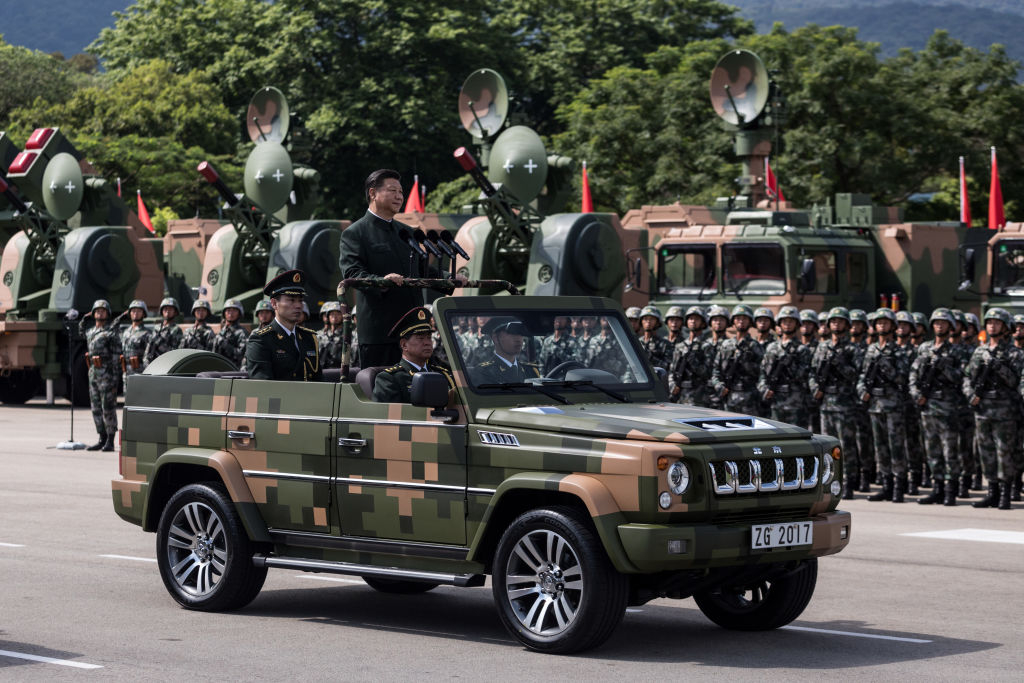
China remains resolute in its campaigns against any movement that might possess the energy to compete with the Chinese Communist Party. China's leaders invest enormous resources in domestic espionage and repressing their own people. Pictured: China's President Xi Jinping (standing in vehicle) inspects People's Liberation Army soldiers at a military base in Hong Kong on June 30, 2017. (Photo by Dale de la Rey/AFP via Getty Images)

Chinese Communist Party (CCP) commentators reacting to the death of Mikhail Gorbachev blamed the former Soviet leader for the demise of the Soviet Union. Hu Xijin, former editor of the CCP's Global Times, wrote that Gorbachev garnered praise in the West "by selling out the interests of his homeland." Xiang Ligang, a hardline journalist on international relations, claimed that Gorbachev was responsible for the war in Ukraine and unspecified disasters to follow. State controlled academia echoed similar themes. Beijing-based Renmin University Political Science Professor Shi Yinhong said: "The Chinese Communist Party is very critical of [Gorbachev], believing that he betrayed the Soviet Union."

Although more than 30 years have passed since the collapse of the Soviet Union, the CCP remains deeply troubled by the sudden disappearance of the Communist Party of the Soviet Union (CPSU). Just this past July, the CCP re-issued a six part documentary detailing ideological "lessons learned" from the failure of the CPSU. The film, entitled "Silent Contest," is mandatory viewing for CCP members. Political training courses on "The Rise and Fall of the Soviet Union" are part of the curriculum in all Party schools. During President Xi Jinping's tenure as CCP leader, countless articles and Party-sponsored study groups on CPSU failures continue.

Xi, almost immediately upon his installment as CCP General Secretary in 2012, warned that "Our Party must never find itself afflicted with the poisonous mix of ideological heresy, military disloyalty, and corruption." Xi has repeatedly lectured CCP members that the Party "will never permit subversive heresies on fundamental issues." Social commentary by CCP organs continue to urge members to be vigilant against the West's strategy of "peaceful evolution," meaning the eventual adoption by the Party of reforms that might sap it of its revolutionary aggressive stance against liberal democracies. Xi seems to have expressed his personal regret at the expungement of the CPSU when he remarked, "In the end, nobody was a real man, nobody came out to resist."

CCP leaders painfully remember that Gorbachev's visit to China in 1989 coincided with about a million Chinese demonstrators protesting in the streets of China's capital, Beijing. These protests were embarrassing to the regime, as protestors forced Gorbachev's motorcade to use the back entrance of the Great Hall of the People and made Chinese leader Deng Xiaoping alter his plans for celebrating the restoration of friendly party relations between the CCP and the CPSU. Two weeks later, on June 4, 1989, CCP leaders ordered a bloody crackdown by dispatching the Peoples' Liberation Army to fire on student demonstrators in Tiananmen Square. The CCP clearly believes it made the correct decision to save both the Party and the Chinese state, an opinion echoed by China's Defense Minister Wei Fenghe during a 2019 visit to Singapore on the 30th anniversary of the crackdown.

China, in its opening to the global market in the 1980s under Deng, unlike Gorbachev's "Perestroika" (economic restructuring), continued to protect state-owned enterprises with financial support. China established an economic model that Beijing calls "Socialism with Chinese Characteristics."

Beijing demanded a high price from Western companies investing in the Chinese domestic market. Foreign firms were forced to surrender trade and technological secrets, and no Western company was permitted to own a majority of stock in a Chinese company.

Under Xi's tutelage, the CCP strengthened its role in the life of the ordinary Chinese citizen. Xi galvanized CCP bureaucrats to accelerate a mass migration of China's rural peasantry to urbanized environments. Consequently, tens of millions of Chinese were forced to learn new skills in manufacturing jobs. This transformation helped lift many out of abject poverty, thereby expanding China's middle class as well as the domestic market for Chinese goods. The urbanization process also helped the CCP to better control China's huge population by concentrating people in cities.

Xi's governing strategy gamble is that by raising the individual's standard of living and quality of life, the Chinese people will continue to permit the Party to maintain its monopoly on political affairs. The USSR had failed to improve the quality of life of the Soviet citizenry. CCP leaders possibly reasoned that, because of this failure, Soviet citizens began to challenge Communist rule. The Chinese regime blamed Gorbachev's policy of "Glasnost" (political openness) for making matters in the Soviet Union even more unstable for the government. As openness became the norm, people in the USSR quickly realized that citizens in Western countries had freer and more comfortable lives.

China's Communist regime implemented several specific measures to guarantee that the People's Republic and the CCP did not suffer a similar fate as did the Soviet Union and the CPSU. Instead of imitating Gorbachev's "Glasnost," China constructed the "Great Firewall," which filters all traffic on the Chinese internet. Chinese authorities also ban the citizenry access to Facebook and Wikipedia.

For decades, China's "Consensus policy" decision makers avoided expensive foreign adventures like Moscow's 1979-1989 occupation of Afghanistan. The Chinese also steered clear of entanglements in proxy conflicts, as opposed to the Soviet Union in Africa, Asia, and Latin America during the Cold War.

China conducts its diplomatic relations even with foreign countries strictly on a transactional business basis. The CCP did not seek to export its revolution violently, as did Iran. Beijing also refused to allow its few allies, such as Pakistan, to drain its national resources. That was another self-inflicted burden that Moscow shouldered: its burden of bankrupt colonies in Eastern Europe.

China, instead, is offering its own model of governance -- a one-party system, tight control, a controlled economy, social stability rather than individual freedoms, internet control, and "to protect the dominant role of the CPC" -- to the world as a viable alternative to the American system. The Chinese Communist Party continues to study intensely the reasons for the Soviet Union's passage to oblivion, and seems to be implementing what it evidently believes to be a foolproof surveillance system that will prevent a similar collapse. China remains resolute in its campaigns against any movement that might possess the energy to compete with the CCP, whether the Falun Gong movement or Christianity.

China's leaders apparently still worry, otherwise they would not be investing such enormous resources in domestic espionage and repressing their own people.

Dr. Lawrence A. Franklin was the Iran Desk Officer for Secretary of Defense Rumsfeld. He also served on active duty with the U.S. Army and as a Colonel in the Air Force Reserve.


Sunday, July 10, 2022

Giulio Meotti, Brussels: Capital of Europe or Eurabia?


  • "Molenbeek would love to be forgotten, because it is the very example of the failure of the multicultural society, which remains an untouchable dogma in Belgium". -- Alain Destexhe, former Belgian senator and general secretary of Doctors Without Borders, Le Figaro, May 3, 2022

  • "[I]n the Brussels region as a whole only a quarter of Belgians are of Belgian origin.... Molenbeek is in fact only the tip of the iceberg of the progressive Islamization in all the major Belgian cities. Islam is increasingly visible in the public space of Molenbeek, and in the month of Ramadan almost all the shops and restaurants in the city are closed during the day. In many neighborhoods, women are no longer able to dress however they want or go out at night, and homosexuals have no right of citizenship. There are, however, hardly any voices to worry about this development, as if French-speaking Belgium, anesthetized in unison by the multicultural media, had resigned itself". – Alain Destexhe, former Belgian senator and general secretary of Doctors Without Borders, Le Figaro, May 3, 2022

  • "Today the Muslim Brotherhood... continues its lobbying and blame games with its imaginary Trojan horse: Islamophobia". -- Assita Kanko, Belgian MEP, who fled Burkina Faso to look for freedom in Europe; cofoe.euractive.com, December 20, 2021

  • "The aim is clear: normalise radical Islamic codes and ways of life in order gradually to transform our Western societies instead of adapting to our European way of life. As a black woman and a secular Muslim, I know what it is to live under Islamic pressure and I know what it takes to emancipate oneself in order to finally live in dignity.... Europe must urgently pull itself together and reaffirm its commitment to its own values...." -- Assita Kanko, Belgian MEP, who fled Burkina Faso to look for freedom in Europe; cofoe.euractive.com, December 20, 2021

  • "Where will we be in 50 years? All of Europe - inshallah - will be Muslim. So, have children!" – Brahim Laytouss, president of the Islamic Cultural Center of Belgium, dhnet.be, March 5, 2019

  • The greatest form of cultural racism in Europe today is that of EU elites who censor or support this spectacular change of civilization.

  • "Of all the European capitals, Brussels is the one through which the Islamist project intends to spread to Europe. Their lobbies are powerful there, so it is much easier for Islamists to break into the system and gradually transform it". -- Djemila Benhabi, Camadian journalist, lecho.com

  • "[I]n exchange [for oil], the Saudi king asked the Belgian king Baudouin to grant Arabia a monopoly on representing Islam and appointing imams in Belgium". The Belgian government officially recognized the Islamic religion. It was the first European country to do so. There followed the inclusion of the Islamic religion in the school curriculum. -- Alain Chouet, former "number two" of the DGSE, the French counterintelligence service, from his new book: "Sept pas vers l'enfer" ["Seven Steps to Hell"]

  • "Eurabia" was born in those years, the years of an energy crisis, European weakness and the great rise of Islam. Sound familiar?

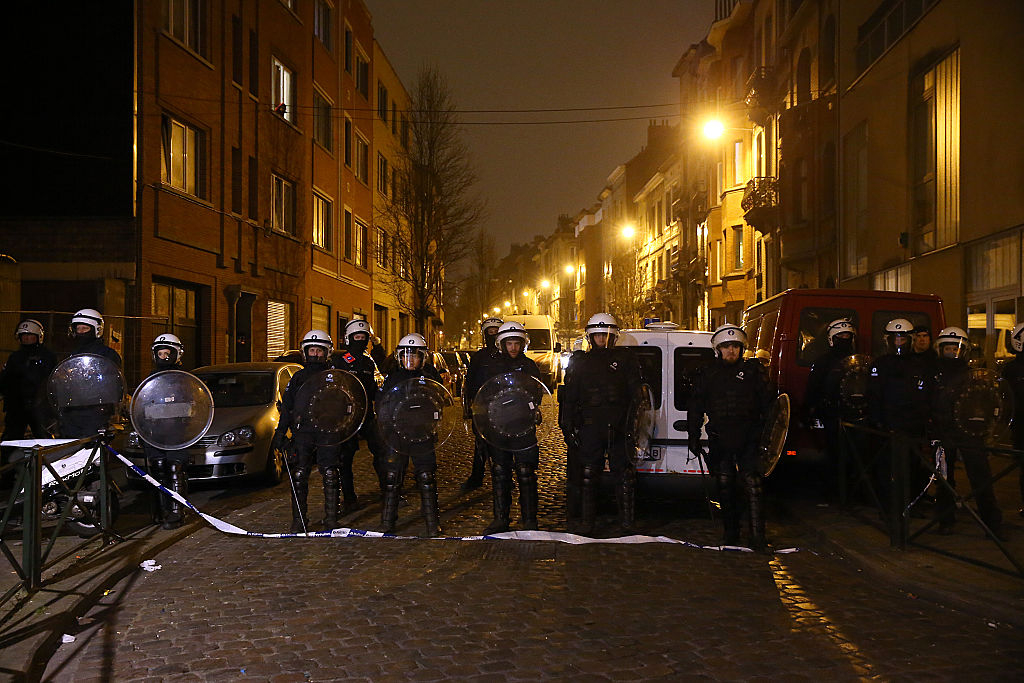
Riot police guard a road in the Molenbeek district of Brussels, after raids in which several people, including Salah Abdeslam, one of the perpetrators of the November 2015 Paris attacks, were arrested on March 18, 2016. (Photo by Carl Court/Getty Images)

While Lieven Verstraete, an acclaimed Belgian journalist who hosts the program, "De Zevende Dag" ("The Seventh Day"), was recently interviewing two members of the Green Party, he raised the issue of immigration and called Brussels "the perfect example of a city whose neighborhoods are conquered one by one by newcomers".

Newcomers? Conquered?

"How?" replied Nadia Naji, a politician of Molenbeek's Green party.

"Well," Verstraete, visibly uncomfortable, tried to explain, "more and more people with immigrant origins come to live there and claim their place. Do you feel Belgian in Molenbeek?"

A few hours after the broadcast, he apologized.

"In twenty years", the French newspaper Le Figaro predicted about Brussels, "the European capital will be Muslim".

"Almost a third of the population of Brussels already is Muslim", stated Olivier Servais, a sociologist at the University of Louvain. "Practitioners of Islam, due to their high birth rate, should be the majority 'in fifteen-twenty years'. Since 2001, Mohamed has been the most popular name among babies in Brussels".

Verstraete had told the truth -- but, as is said, in the time of universal deception, telling the truth is a revolutionary act.

"Molenbeek would love to be forgotten, because it is the very example of the failure of the multicultural society, which remains an untouchable dogma in Belgium", wrote Alain Destexhe, an honorary Senator in Belgium and former Secretary General of Doctors Without Borders. He was talking about the case of Conner Rousseau, president of Vooruit, the Flemish socialist party, who recently told Humo magazine, "When I drive around Molenbeek, I do not feel [as if I am] in Belgium".

"I no longer dare to walk hand in hand with a man in Molenbeek", Gilles Verstraeten, a gay parliamentarian, confessed.

"[I]n the Brussels region as a whole", Destexhe noted, "only a quarter of Belgians are of Belgian origin, 39 per cent of Belgians are of foreign origin and 35 per cent are foreigners."

"Molenbeek is in fact only the tip of the iceberg of the progressive Islamization in all the major Belgian cities. Islam is increasingly visible in the public space of Molenbeek, and in the month of Ramadan almost all the shops and restaurants in the city are closed during the day. In many neighborhoods, women are no longer able to dress however they want or go out at night, and homosexuals have no right of citizenship. There are, however, hardly any voices to worry about this development, as if French-speaking Belgium, anesthetized in unison by the multicultural media, had resigned itself".

It is true not just Brussels. Antwerp, the country's second-largest city, is now 25% Muslim. Another parliamentarian, Herman de Croo , revealed that 78% of Antwerp's children aged 1-6 are foreigners.

The former Brussels Secretary of State Bianca Debaets recently said, "there are too many areas where it is difficult for women and homosexuals to walk".

The Chief Rabbi of Brussels, Albert Guigui, was attacked by a group of Arabs. They insulted him, spat on him and kicked him. Since then, Guigui has not worn his skullcap in public.

No Jew lives in the Gare du Nord district anymore. "There are hardly any Jews left in this neighborhood," remarked Michel Laub, founder of the Museum of Deportation in Malines. "Yet this part of Schaerbeek near the Gare du Nord was once an important Jewish quarter."

For women, too, Brussels has become dangerous. "The Belgian political-media elites have surrendered in the face of the spread of Islamic fundamentalism", Fadila Maaroufi, a Belgian-Moroccan social worker and founder of the Observatory of Fundamentalisms in Brussels, told the French magazine Marianne.

"I grew up in a Moroccan family in a neighborhood near Molenbeek. In the 1980s, it was still quite cosmopolitan. Then, little by little, we saw the native Belgians leaving. I witnessed the rise of Islam, my sisters veiled while my parents wore flared pants. I myself have come under pressure, including from my family. It had become inconceivable that I did not veil myself .... When I tried to alert public authorities and associations, I found myself facing a wall. There have been attacks in Paris and attacks in Brussels, yet I had the feeling that we still did not grasp the extent of the problem".

In such an environment, freedom of expression also finds itself in dramatic retreat.

Belgian student associations protested the arrival in the capital of the publisher of satirical weekly newspaper Charlie Hebdo, "Riss", who survived a 2015 massacre in the paper's office.*

The Filigranes bookshop in Brussels, the largest in the country, canceled a meeting with the journalist Éric Zemmour for "security reasons".

Demonstrations against the author had been planned and a group, "Collective Against Islamophobia", had filed a complaint. The Hergé Museum took back deserted its tribute to Charlie Hebdo by censoring itself. An exhibition that had been planned was canceled "for security reasons".

"Today the Muslim Brotherhood, spearhead of political Islam and of the insidious soft Islamisation of Western societies, continues its lobbying and blame games with its imaginary Trojan horse: Islamophobia", wrote a Belgian MEP, Assita Kanko, who fled Burkina Faso to look for freedom in Europe. "The aim is clear: normalise radical Islamic codes and ways of life in order gradually to transform our Western societies instead of adapting to our European way of life. As a black woman and a secular Muslim, I know what it is to live under Islamic pressure and I know what it takes to emancipate oneself in order to finally live in dignity. The fight to preserve European civilisation is a fight to preserve humanism .... Two stones support the European temple: the Judeo-Christian heritage with the idea of human dignity and the Enlightenment, with the intellectual effervescence that accompanied it. It is from this subtle alchemy that European culture was born. European Judeo-Christian civilisation has created for itself over the centuries the conditions for its intellectual emancipation, and it can be proud of this .... Europe must urgently pull itself together and reaffirm its commitment to its own values...."

Destexhe, in his book "Immigration et Intégration: avant qu'il ne soit trop tard" ["Immigration and Integration: before it will be too late"] , recalled that from 2000 to 2010, Belgium welcomed more than a million migrants into a population of eleven million. It was a demographic tsunami that would forever change the face of Belgian society.

"Belgium was the first to recognize and subsidize Islam; it also elected the first veiled parliamentarian". Canadian journalist Djemal Benhabi told L'Echo, "Of all the European capitals, Brussels is the one through which the Islamist project intends to spread to Europe. Their lobbies are powerful there, so it is much easier for Islamists to break into the system and gradually transform it".

Journalist Marie-Cécile Royen also described the same collaboration in an article, "How the Muslim Brotherhood took Belgium hostage".

We recently saw what the "left's" alliance with Islam means in Brussels. Socialists and Greens just voted in the Brussels Parliament not to ban the ritual slaughter of animals. Le Monde called it the "community phenomenon": Brussels elects representatives who benefit from the support of one community or another in this highly multicultural region and are sometimes forced to abandon some of their convictions, or a facet of their identity, in order not to alienate voters.

Djemila Benhabib, in Le Point, noted that "in Brussels half of the Socialist electorate is Muslim." "[I]n Brussels now", she reported, "politics is in the hands of conservative Muslims".

As they say: It's the demography, stupid.

According to French demographer Michéle Tribalat, in the Brussels region (1.2 million inhabitants), 57% of those under 18 are of non-European origin; in the city of Brussels 68.4% of those under 18 are of non-European origin and in Antwerp (529,000 inhabitants), 51.3% of those under 18 are of non-European origin.

De-Christianization accompanies Islamization. 36 out of 110 churches in Brussels are destined to change their use in the face of the dramatic decline of the faithful. According to a Rtbf dossier, this is the plan of the archbishop of Brussels: "Homes, museums, hotels, climbing walls... What to do with our deconsecrated churches?"

Jean-Pierre Martin and Christophe Lamfalussy in their book "Molenbeek-sur-djihadr" disclosed that "in Molenbeek, in an area of ​​just six square kilometers, there are 25 mosques". What is that, if not Islamization?

Professor Felice Dassetto , in his book, "L'iris et le croissant", wrote that with more than 200 associations that explicitly refer to Islam, it, after football, is the most mobilizing organized reality in Brussels -- more than more than political parties, more than trade unions, more than the Catholic Church. "41 percent of public school students," noted Le Figaro, "take the Muslim religion course".

Welcome to the "European capital ... of the Muslim Brotherhood" -- and the Muslim Brotherhood know it. "Where will we be in 50 years?" the president of the Islamic Cultural Center of Belgium felt free to declare. "All of Europe - inshallah - will be Muslim. So, have children!".

The greatest form of cultural racism in Europe today is that of EU elites who censor or support this spectacular change of civilization.

Meanwhile, Islam has become a "taboo" in the European capital, Florence Bergeaud-Blackler, CNRS researcher and anthropologist, told L'Express. Certain districts of Brussels have become "a kind of sanctuary of Islam in Europe".

The answer is in Professor Felice Dassetto's book: in the mid-1970s there were only 6 mosques and Koranic schools in Brussels, in the early 1980s there were 38, now they are 80. And so, headlines Le Vif, "mosque projects are flourishing in Brussels".

How did we get here?

In the midst of the 1973 oil crisis, Belgium turned to look for supplies to Saudi Arabia. Muslims in Belgium were of the first generation: they worked in the mines and wanted spaces to pray. The Belgian king Baudouin, in exchange for oil contracts, offered the Saudis the Pavillon du Cinquantenaire in Brussels, along with a 99-year lease. The building stands two hundred meters from the Schuman Palace and the headquarters of the European Union. Saudi Arabia soon transformed it into the Grand Mosque of Brussels, which has since been the de facto Islamic authority of Belgium.

As Alain Chouet, the former "number two" of the DGSE, the French counterintelligence service, recounted in his newly published book "Sept pas vers l'enfer" ["Seven Steps toward Hell"], "in exchange, the Saudi king asked the Belgian king Baudouin to grant Arabia a monopoly on representing Islam and appointing imams in Belgium". The Belgian government officially recognized the Islamic religion. It was the first European country to do so. There followed the inclusion of the Islamic religion in the school curriculum.

"Eurabia" was born in those years, the years of an energy crisis, European weakness and the great rise of Islam. Sound familiar?

=========

*

Bruxelles : des étudiants boycottent la venue de Charlie Hebdo, journal “réactionnaire”

Deux associations d’étudiants se sont opposées à la venue du rédacteur en chef et de la DRH de l’hebdomadaire satirique qu’ils jugent “islamophobe” et “réactionnaire”. 

SIPA_AP21731131_000001
Image d'illustration © Lionel Cironneau/AP/SIPA

Ils ne sont plus « Charlie ». Ce jeudi 13 février au soir, l’Université Libre de Bruxelles organise un débat sur la liberté d’expression intitulé « Charlie Hebdo : cinq ans après, la liberté d’expression c’est fini ? ». Pour l’occasion le rédacteur en chef de l’hebdomadaire Gérard Biard et sa DRH Marika Bret sont invités, rapporte notamment le quotidien belge Sudinfo. Des intervenants que n’ont pas cautionné deux associations étudiantes de l’université. 

« Charlie Hebdo a rejoint les rangs des réactionnaires »

Ainsi, l’Union syndicale étudiante et le Cercle Féministe se sont opposés à la venue des deux représentants du journal satirique. Dans un communiqué commun, les deux associations dénoncent une invitation « qui permettra une fois de plus à la parole réactionnaire de se faire entendre sur notre campus », estimant que « Charlie Hebdo a rejoint depuis longtemps les rangs des réactionnaires de tout poil dans leur dénonciation des nouveaux censeurs ». Si cet adjectif ne colle pourtant pas vraiment à l’idéologie de Charlie Hebdo, c’est un édito de Riss que visent particulièrement les étudiants. Il y écrivait : « Hier, on disait merde à Dieu, à l’armée, à l’Eglise, à l’Etat. Aujourd’hui, il faut apprendre à dire merde aux associations tyranniques, aux minorités nombrilistes, aux blogueurs et blogueuses qui nous tapent sur les doigts comme des petits maîtres d’école ». Les récentes déclarations de Gérard Biart sont également ciblées, précise le quotidien Le Soir. Le rédacteur en chef a en effet dénoncé la « censure moderne » des « groupuscules refusant le débat » et exigeant « que l’on abandonne tout universalisme ».

Saturday, June 18, 2022

Judith Bergman : China's New Way of War


  • "Chinese thinkers have clearly stated that the core operational concept of intelligentized warfare is to directly control the enemy's will. The idea is to use AI to directly control the will of the highest decision-makers, including the president, members of Congress, and combatant commanders, as well as citizens." — Colonel Koichiro Takagi, senior fellow of Training Evaluation Research and Development Command, Japan Ground Self-Defense Force, War on the Rocks, April 13, 2022.

  • "War has started to shift from the pursuit of destroying bodies to paralyzing and controlling the opponent. The focus is to attack the enemy's will to resist, not physical destruction" and to cause "the brain to become the main target of offense and defense of new concept weapons... To win without fighting is no longer far-fetched." — Bill Gertz, describing a report written in 2019 by China's People's Liberation Army, in the Washington Times, December 29, 2021.

  • "The PLA plans to employ all available tools to the overarching objective of reducing an enemy's will to resist." — Ben Noon, research assistant at the American Enterprise Institute and Dr. Chris Bassler, senior fellow at the Center for Strategic and Budgetary Assessments, Defense One, September 17, 2021.

  • "Influencing human cognition requires a large amount of detailed personal information to identify influential individuals or to conduct influential operations according to the characteristics of subgroups of people. China has already collected a massive amount of personal information on government officials and ordinary U.S. citizens.... China has even succeeded in identifying CIA agents operating in foreign countries using such data. These activities are particularly aggressive and coercive in Taiwan and Hong Kong, which the Chinese government considers its territory. Attempts to use digital means to influence elections have also been seen in Taiwan's recent presidential election." — Colonel Koichiro Takagi, War on the Rocks, April 13, 2022.

  • While cognitive warfare may sound like science fiction to most people, experts have cautioned that the US needs to take the threat seriously.

  • "They should also designate the cognitive arena as a new operational arena, along with land, air, sea, space, and cyberspace, to raise awareness and invest resources. Furthermore, it is necessary to consider how to win the 'battle of narratives' to counter the manipulation of public opinion in wartime." — Colonel Koichiro Takagi, War on the Rocks, April 13, 2022.

Since 2019, China has been pursuing a new concept of war, known as "intelligentized warfare." The idea is to operationalize artificial intelligence and the use of unmanned platforms in a way that subdues the enemy, ultimately without having to resort to conventional "hot" warfare. (Image source: iStock)

Since 2019, China has been pursuing a new concept of war, known as "intelligentized warfare." The idea is to operationalize artificial intelligence (AI) and the use of unmanned platforms (such as drones) in a way that subdues the enemy, ultimately without having to resort to conventional "hot" warfare. According to the 2019 Annual Report to Congress, "Military and Security Developments Involving the People's Republic of China," written by the Office of the Secretary of Defense:

"The PLA is ... exploring next-generation operational concepts for intelligentized warfare, such as attrition warfare by intelligent swarms[1], cross-domain mobile warfare[2], AI-based space confrontation[3] and cognitive control operations[4]. The PLA considers unmanned systems to be critical intelligentized technologies, and is pursuing greater autonomy for unmanned aerial, surface, and underwater vehicles to enable manned and unmanned hybrid formations[5], swarm attacks[6], optimized logistic support[7] and disaggregated ISR [Intelligence, Surveillance and Reconnaissance] among other capabilities." [Emphasis added.]

What sets China apart in its pursuit of "intelligentized warfare" is not its focus on AI and drone swarming – the US Army, Air Force, and the Navy are all pursuing drone swarm projects and the U.S. Marine Corps is working on so-called kamikaze drone swarms - but the cognitive aspects of intelligentized warfare. According to Colonel Koichiro Takagi is a senior fellow of Training Evaluation Research and Development Command, Japan Ground Self-Defense Force:

Chinese thinkers have clearly stated that the core operational concept of intelligentized warfare is to directly control the enemy's will. The idea is to use AI to directly control the will of the highest decision-makers, including the president, members of Congress, and combatant commanders, as well as citizens. 'Intelligence dominance' or 'control of the brain' will become new areas of the struggle for control in intelligentized warfare, putting AI to a very different use than most American and allied discussions have envisioned.

According to Takagi, Chinese military theorists believe that war as we know it is about to change.

"Chinese theorists, however, are looking further ahead. They believe that the development of information technology has reached its limits, and that future wars will occur in the cognitive domain. The Ardennes Forest of future wars that the Chinese People's Liberation Army intends to exploit is a pathway of direct attack against human cognition, using AI and unmanned weapons. The French builders of the Maginot Line could not imagine the assault of German armored forces from the Ardennes Forest. Likewise, to those of us who have been accustomed to almost three decades of information-age warfare since the Gulf War, intelligentized or cognitive warfare seems a strange and unrealistic way of thinking."

Ben Noon, a research assistant at the American Enterprise Institute, and Dr. Chris Bassler, senior fellow at the Center for Strategic and Budgetary Assessments, wrote in September 2021:

"PLA theorists argue that intelligentization will center upon a 'cognitive space' that privileges complex thinking and effective decision-making. On battlefields where advanced AI technology enables better decisions, they write, the side that can better integrate human creativity and robotic calculating capacity will hold the crucial edge...

"Above all, intelligentization will aim to achieve advantages in psychological warfare. Theorists describe a 'cognitive confrontation,' in which PLA leaders will psychologically dominate opposing commanders through better and faster decisions. The PLA plans to employ all available tools to the overarching objective of reducing an enemy's will to resist."

In December 2021, the US Commerce Department imposed sanctions on 12 Chinese research institutes and 22 Chinese technology firms, chief among them China's Academy of Military Medical Sciences and its 11 research institutes. The reason for this was that they "use biotechnology processes to support Chinese military end uses and end users, to include purported brain-control weaponry," the Commerce Department said.

According to three reports written in 2019 by the People's Liberation Army and obtained by the Washington Times, China has been doing brain-control or brain warfare research for several years as part of its work on developing intelligentized warfare.

"War has started to shift from the pursuit of destroying bodies to paralyzing and controlling the opponent", one of the Chinese reports, which was published in the official military newspaper PLA Daily said, according to the Washington Times.

"The focus is to attack the enemy's will to resist, not physical destruction" and to cause "the brain to become the main target of offense and defense of new concept weapons... To win without fighting is no longer far-fetched."

The PLA reports revealed that China is also working on integrating humans and machines to create enhanced human physiological and cognitive capacities.

"Future human-machine merging will revolve around the contest for the brain," one of the PLA reports said.

"The two combatant sides will use various kinds of brain control technologies and effective designs to focus on taking over the enemy's way of thinking and his awareness, and even directly intervene in the thinking of the enemy leaders and staff, and with that produce war to control awareness and thinking."

According to the Washington Times:

"Among its various research focuses are 'brain control technologies, such as measuring neuronal activity in the brain and translating neuro-signals into computer signals, establishing uni-directional or bi-directional signal transmission between the brain and external equipment' and 'neuro-defense technology such as 'leveraging electromagnetic, biophysical, and material technologies to enhance human brain's defense towards brain-control attacks'".

Takagi has pointed out that cognitive warfare requires vast amounts of information, but that China already has access to such amounts.

"Influencing human cognition requires a large amount of detailed personal information to identify influential individuals or to conduct influential operations according to the characteristics of subgroups of people. China has already collected a massive amount of personal information on government officials and ordinary U.S. citizens, ensuring a foundation for influencing people's cognition. This includes the confidential data of 21.5 million people from the U.S. Office of Personnel Management, the personal information of 383 million people from a major hotel, and sensitive data on more than 100,000 U.S. Navy personnel. The Chinese government has then allowed Chinese IT giants to process this large amount of data, making it useful for intelligence activities. In this way, China has accumulated an enormous amount of data over the years, which could be weaponized in the future. China has even succeeded in identifying CIA agents operating in foreign countries using such data. These activities are particularly aggressive and coercive in Taiwan and Hong Kong, which the Chinese government considers its territory. Attempts to use digital means to influence elections have also been seen in Taiwan's recent presidential election."

While cognitive warfare may sound like science fiction to most people, experts have cautioned that the US needs to take the threat seriously.

"The United States and its allies should analyze intelligentized warfare more to avoid surprise attacks in future wars," Takagi warned.

"They should also designate the cognitive arena as a new operational arena, along with land, air, sea, space, and cyberspace, to raise awareness and invest resources. Furthermore, it is necessary to consider how to win the 'battle of narratives' to counter the manipulation of public opinion in wartime."

Takagi is not the only one to take China's research in cognitive warfare seriously. According to Noon and Bassler:

"The United States military should work to better understand Chinese conceptions of intelligentization and the PLA's efforts to integrate it into its model of future warfare. Taking advantage of some of the possible weaknesses of the PLA's approach should be a top priority and would also help the United States military to shore up some of the weaknesses in its own vision and efforts."

Among other things, Bassler and Noon suggest that the US military should not repeat past mistakes, when the US sat on its hands while China accumulated threatening capabilities, often by stealing massive amounts of whatever it could, for instance here, here , here, here and here.

"The United States military should be more public in its discussions about the PLA's intelligentization efforts," Bassler and Noon wrote.

"With other notable PLA efforts, the United States military has been content with sitting on classified awareness while losing valuable time for mobilizing a response. Several years were lost during the South China Sea island building campaign. Most recently, U.S. Strategic Command's vague and scant public details about the rapid growth of the Chinese nuclear program did little, only for open-source investigators to finally sufficiently expose the efforts several years later. In the case of intelligentization, the U.S. military should not repeat this mistake yet again. Instead, it should more clearly highlight the nature of the PLA's efforts as they continue to develop."

Judith Bergman, a columnist, lawyer and political analyst, is a Distinguished Senior Fellow at Gatestone Institute.

[1] Such as "collective behaviors that result from the local interactions of the individuals with each other and with their environment. Examples of systems studied by swarm intelligence are colonies of ants and termites, schools of fish, flocks of birds, herds..."

[2] Such as "the ability of electronic warfare (EW) devices and systems to contribute to, enhance, and work seamlessly across all six domains in which military organizations operate – air, land, space, sea (maritime), human (cyber), and the electromagnetic spectrum (EMS)".

[3] Such as target selection, satellite communication, collision avoidance.

[4] Such as "neurons [nerve cells] communicat[ing] with your brain by altering... the connections that lead from your body to your brain."]

[5] Combining AI capabilities with human ones, such as inserting a chip to learn a language.

[6] Such as using swarms of drones to overwhelm security systems.

[7] Such as planning and developing the best support for the system throughout its life-cycle.


Thursday, June 16, 2022

Václav Klaus: Mass Migration Always Has Unpleasant Consequences – Do We Know That?


Mass Migration Always Has Unpleasant Consequences – Do We Know That?