.

.
Library of Professor Richard A. Macksey in Baltimore

POSTS BY SUBJECT

Labels

Sunday, May 20, 2012

Great Pyramid - PYRAMIDS AND GEOPOLYMERS - 2.A Close Look at the Problem


PYRAMIDS AND GEOPOLYMERS

BOOK: THE PYRAMIDS AN ENIGMA SOLVED
Prof. Joseph Davidovits
Chapter 2
A Close Look at the Problem


Generally, people believe that the pyramids were built by primitive methods of quarrying, carving, and hoisting huge limestone blocks because they have been conditioned thus. They have accepted their conditioning because it is handed down through the authority of scholarship. What they generally are not taught is that the evidence against the accepted theory is flagrant.
About forty theories attempt to explain how the Great Pyramid may have been constructed by carving and hoisting stone, all proposed by intelligent people with academic backgrounds. Yet something is wrong with a reasoning that spawns such technological profusion. Nothing is wrong with the logic itself, it is the premise of the logic that is erroneous. Traditional theory has simply not resolved the problems of pyramid construction.
Common sense rejects as illogical any conclusion accompanied by blatant flaws. And the more closely we examine the issue, the more blatant those flaws become. In my own process of discovering the true method of pyramid construction, my first step was to examine closely the accepted theory. I found myself embarked on a fascinating analytical journey, one that began with a close look at the unresolved problems of pyramid construction.
As mentioned previously, the labor involved in cutting the amount of stone in the Great Pyramid equals that required to cut all of the stone used in the monuments produced during the New Kingdom, Late period, and Ptolemaic period combined, a span of about 1,500 years (1550-30 BC). A calculation of the amount of stone used during this 1,500 - year period was made by de Roziere, a geologist with the Napoleonic expedition.
Napoleon’s army was stranded in Egypt for fourteen months during the French Revolution.An army of 50,000 men was accompanied by 150 scholars, among them Geoffroy Saint Hilaire, a naturalist; de Dolomien, the mineralogist who lent his name to dolomite; Dominique Vivant Denon, an artist and engraver; Claude Bertholet, a chemist; Dominique Larrey, a surgeon; Guillaume Villoteau, a musician; Marie Jules de Savigny, a botanist; Nicholas Conté, the inventor of the lead pencil; Colonel Coutelle, a geometrician; and de Roziere, a geologist. The academics among the group produced the most impressive study ever of Egyptian monuments.
Between 1809 and 1813, François Jomard, general com- missioner for the scientific expedition, produced his great work, Description de l’Egypte, based on the research of the Cairo Institute, which was founded by Napoleon. In this work de Roziere reported his volumetric approximations of stone used in Egyptian edifices [10].
“ Using approximations, I have estimated that the surviving sandstone edifices might represent a total surface area of about one and a half million square meters [125.5 acres], which are covered with bas-reliefs, including columns, pylons, and enclosure walls. This does not include the monuments which were demolished, of which vestiges can still be seen, and those which must have been destroyed completely, which would perhaps form a very considerable amount. And this estimate does not include Nubia, where the sandstone monuments are hardly less numerous and widespread than those of the Thebaid. By similar means, I have estimated the total volume of surviving sandstone monuments to be more than one million cubic meters [35,314,475 cubic feet]. The total would not be doubled by adding those which have disappeared because part of this material was used in succeeding edifices. If we take into account the material used in foundations, floors, roads, quays, and hydraulic constructions, we can estimate at a glance that there must have been at least three or four million cubic meters [141,257,950 cubic feet] of carved sandstone from quarries simply for those constructions in the Thebaid that can be estimated. However large this quantity, it still does not equal half of the material that exists merely in the pyramids of Giza or those at Saqqara. ”
The following calculation demonstrates the inefficiency of the accepted method of pyramid construction. My calculation is based on the amount and hardness of the stone used and the time required for construction. To balance the equation we will assume that bronze tools were used to prepare the blocks for the Great Pyramid even though they were unavailable. For a given amount of labor, using the same bronze tools as were used to build and decorate the sandstone edifices of the New Kingdom and later periods mentioned, all that could be carved would be the amount of a medium- soft limestone, such as that used in the Great Pyramid. Only a quarter of this amount could have been carved of Carrara marble, and scarcely a sixteenth of this amount of basalt. In other words, the labor required to cut, haul, and hoist the 4 million cubic meters (140 million cubic feet) of limestone for the two Great Pyramids alone, during forty years of work, equals the labor used to carve and erect the 4 million cubic meters (141,257,950 cubic feet) of sandstone used for all the monuments built during the 1,500 years of the New Kingdom, Late period, and Ptolemaic period combined (Fig.3).
Figure 3: Construction of the Great Pyramids required the same efforts as the construction of all monuments in the 1,500 successive years.
I use a twenty-year construction period for each pyra- mid in this calculation for two reasons. First, each pyramid was built during the reign of the pharaoh for whom it was constructed. The reign of Pharaoh Khufu (Kheops or Cheops) was from 2551 to 2494 BC, or twenty-one years. Second, when the Greek historian Herodotus (c. 484 - 425 BC) visited Egypt, he was told that the Great Pyramid was constructed in twenty years.
During the combined New Kingdom, Late period, and Ptolemaic period 4 million cubic yards of sandstone monu- ments were prepared in 1,500 years. During the Old King- dom, about 4 million cubic yards of stone for the two Great Pyramids were prepared in forty years. As mentioned, this production period is no aberration because the two pyra- mids of Sneferu (2575 -2551 BC), which have a total volume of 3 million cubic yards, were produced during this king’s reign of twenty-four years.
Because the Old Kingdom limestone in the Giza quarries is as soft as the sandstone used during the New Kingdom and later periods mentioned, the Old Kingdom could have produced 4 million cubic meters of sandstone in forty years. Therefore, to show how much more productive the Old Kingdom was compared with the New Kingdom and later times, we divide 1,500 years by 40 years, yielding 37.5 years. Assuming that during the New Kingdom and later as few as 20,000 workers were continuously involved in such labor, then 750,000 workers (37.5 x 20,000) would have been required to work on the great Pyramids to achieve the same productivity.
It is ridiculous to suppose that the 750,000 men required could effectively labor together in the work area at Giza; and Egyptians of the Old Kingdom, without bronze tools, accomplished in twenty years what took Egyptians of the New Kingdom, Late, and Ptolemaic periods together 1,500 years. This calculation makes it obvious that the standard construction theory is unacceptable.
Egyptologists are able to make only a poor attempt to settle this issue. Egyptologist Dieter Arnold, in an attempt to reconcile the vast number of blocks that would have to have been set per day, proposed to expand the life span of the pharaohs far beyond that provided for by Egyptology. D. Arnold calculated that from Sneferu to Khafra (Khefren or Chephren), a period he calculated to be eighty years, 12 mil- lion blocks were used in pyramids, yielding a minimum of 413 blocks set per day [11]. He recognized that the number of blocks would not begin on the first day of the pharaoh’s reign. A site had to be chosen, plans drawn, and the leveling work completed. Depending on when work began on the pyramid itself, the number of blocks would exceed 413 and possibly become two to three times as high, leading to, as Arnold said, “ astronomical numbers ”.Arnold therefore proposed,“ There can only be one solution... namely to increase the lifetime of the pharaoh... ” He proposed life spans which are two or three times as long as those established by Egyptologists from existing records.
It is abundantly clear, however, that even going against the grain of established Egyptology and vastly lengthening life spans, no appreciable dent is made in the enormous problem. Arnold admitted, “ But we cannot deduce from the records how the Egyptian workers managed to accomplish this task. But the fact that they were able to solve the hard problems they were facing is beautifully exemplified by the pyramids of Khufu (Kheops or Cheops) and Khafra (Khefren or Chephren) ”. In this last statement, one begins to see the futility of the typical response to this puzzle. Instead of considering that a different method must have been used, experts throw up their hands and admire the monument in question.
The same type of response has been provided for the problems of quarrying hard varieties of granite and other hard rocks with primitive methods. We have already seen a passage from Description de l’Egypte mentioning that the means for quarrying the hard quartzite used for the Memnon Colossi had not been determined. A substantial number of finely jointed blocks of hard granite appear in the Egyptian pyramids. In The Pyramids of Egypt, I. E. S. Edwards, retired Keeper of Egyptian Antiquities for the British Museum, writes [12]:
“ The methods employed in the Pyramid Age for quarrying granite and other hard stones are still a subject of controversy. One authority even expressed the opinion that hard stone quarrying was not attempted until the Middle Kingdom; before that time, the amount needed could have been obtained from large boulders lying loose on the surface of the ground. It seems difficult, however, to believe that a people who possessed the degree of skill necessary for shaping the colossal monoliths built into the granite valley building of Khafra (Khefren or Chephren) were not also able to hew blocks of this stone out of the quarry ”
In other words, because beautifully formed granite blocks appear in the pyramid complexes, the Egyptians must have quarried such stone even though expert opinion denies the possibility. Here, results are used as proof of method. This is a useless process when it ignores well-founded arguments to the contrary. Worse, the it-must-have-been-so approach does not settle the issue because the method by which hard granite blocks were shaped for construction remains unsettled.
Although it is taken for granted that the pyramids were erected by workers using simple stone or copper hand tools and primitive quarrying techniques, an examination of these methods will help to show how really limited they are. French archaeologist and architect Jean Pierre Adams remarked on the amount of surface area of stone that would have to have been cut for pyramid construction [13]:
“ It is easily imagined from this, that to obtain one cubic meter [35 cubic feet] of building stone it was easier to make it in one single piece than from a number of smaller blocks which would considerably multiply the number and extent of surfaces to be worked. But before the carving, there was the extraction. Nowadays, it is difficult to imagine workers attacking a rocky cliff with stone axes. It is, however, in this way that numerous megaliths were detached and squared. ”
Assuming that the builders aimed for maximum efficiency when carving stone, the first pyramids should have been made of enormous blocks with a relatively low surface- to-volume ratio. As tools improved, the dimensions of the blocks forming the monuments should have diminished, yielding a higher surface-to-volume ratio. The opposite happened. The pyramid of Zoser (c. 2670 BC), the first ever erected, was made entirely of small stones, 25 centimeters (9.8 inches) high, weighing only several dozens of kilograms (50 -100 pounds) apiece. Blocks in the Great Pyramid, the seventh or eighth in chronology, are larger, weighing at least two tons apiece. Beams forming the vaults of the inner chambers of the last pyramids of the Fifth and Sixth Dynasties weigh from thirty to forty tons apiece. Monolithic burial chambers produced during the Twelfth Dynasty weigh seventy-two metric tonnes and more. We see that the size of stones gradually increased. Accordingly, the conventional theory does not accommodate the evolution of pyramid construction.
Dressing or knapping blocks with stone or copper tools would pose serious problems, and more acute problems would be encountered if another, still cruder, method advocated by Egyptologists was used to produce pyramid blocks. Adams remarked:
“ When dressing the surfaces was necessary, two techniques could have been used. The first, already described, consisted of dressing with the aid of hard stones or metal tools, the art of knapping being quite well known at the time. The second method described in Egyptian documents, among other sources, consisted of heating the surface of the stone very strongly with fire, then spraying on water to make it split. ”
Heating stone and applying water is applicable for reducing large pieces of sandstone, granite, or basalt into small aggregates. But granite blocks, for instance, in the base of Khafra’s (Khefren or Chephren) pyramid have only one flat side, perhaps the result of splitting by the water and heat method. The other surfaces of the stone are irregular, demonstrating that this technique is not applicable for making perfect blocks (Fig.4).
Figure 4: Irregular granite blocks on the west side of the Second Pyramid suggest builders of the Fourth Dynasty were unable to quarry regular granite blocks, if these were part of the original masonry.
In addition, blocks of the dimensions used for the pyra- mid of Zoser (25 x 15 x 10 centimeters, or 9.8 x 5.9 x 3.39 inches) cannot be dressed by heating and applying water without reducing them to debris. Moreover, heating with fire transforms limestone into lime, because the transformation to lime occurs at 704°C (1,300°F). This completely disqualifies the use of the heating operation for producing pyramid blocks.
How efficient are flint and copper tools for shaping pyramid blocks? Tools made of hard stone are useful for working softer varieties of stone but are not applicable for producing 2.5 million blocks for the Great Pyramid in twenty years. Copper is a soft metal. Because it is unsuitable for cutting hard stone, a popular theory proposes that the ancient Egyptians mastered a process for giving copper a high temper. This surmise has never been proved, and there is no evidence to support it. No such highly tempered copper has ever been found. It is difficult to believe, when considering the billions of dollars of research money spent on metallurgy in modern times, that the technique would not have been rediscovered.
Although the Great Pyramids were erected during historic times, technically they belong to the Chalcolithic (copper-producing) period, which marked the end of the Neolithic Age. The only metals known in Egypt were gold, copper, silver, and lead, which are all quite malleable. Native copper was available in the eastern desert, and copper was smelted from ores since prehistoric times. A copper arsenate alloy, considered as bronze, was used in Egypt during early times. This, however, was not a hard product.
The type of bronze required for cutting rock of medium hardness is an alloy of copper and tin, such as that introduced at either the end of the Middle Kingdom or in the early New Kingdom, about 1900 BC. In other words, hard bronze was introduced 800 years after the Great Pyramid was built. Some scholars estimate the appearance of iron at about 1400 BC, and others place it as late as 850 BC.
I am not suggesting that stone and copper tools were not used in pyramid construction where applicable. These primitive tools were used for leveling and tunneling work and for sculpting the in situ body of the Great Sphinx.Whereas fossil shells in the upper Giza bedrock make it difficult to cut into blocks, the bedrock itself is loosely bound and easily disaggregated (see more details in Appendix II: The Circuit at Giza).
However, shaping the Sphinx cannot be compared with building the Great Pyramid. We must appreciate the vast difference between using stone and copper implements for hollowing out tunnels and sculpting in situ monuments, and for using these same tools to produce 2.5 million blocks for the Great Pyramid in twenty years. Stone and copper tools are not applicable for producing the approximately 115,000 casing blocks that were fitted together with tolerances averaging 0.02 inch and as small as 0.002 inch in the Great Pyramid. The scale and precision of the Great Pyramid is simply too grand for primitive tools to have been applicable.
The problems of logistics are far more mysterious and complex than has been realized. The logistical studies established so far have never even considered certain germane issues. The geochemical study mentioned earlier, for instance, by D. D. Klemm, a German geochemist from the University of Munich, presents an unusual new dimension to the puzzle [14].
Klemm presented data at the Second International Congress of Egyptologists, held in Grenoble, France, in 1979. As mentioned, he attempted to determine which quarries provided blocks for the Great Pyramid. His team sampled twenty different building blocks from the Great Pyramid. The team also sampled twenty geological sites along the Nile, excluding those of Tura and Mokattam on the east bank, which are in a restricted area. The team then compared trace elements in the pyramid samples with those of the quarry samples.
Based on his analyses, Klemm reported that the twenty pyramid blocks he sampled came from the different geological sites he visited. In other words, he concluded that blocks for the Great Pyramid were hauled from sites hundreds of miles away from the pyramid itself. This presents a dramatic conflict. Legend has it that the blocks came from Tura and Mokattam (not tested by Klemm). Geologists who have performed petrographic analyses affirm that the blocks for the Great pyramid were quarried at Giza. Now a geochemist has determined that the blocks came from sites hundreds of miles away. The paramount problems Klemm’s study poses threaten all logistical studies made so far on the Great Pyramid. In 1988, at the Fifth International Conference of Egyptologists, Cairo, Egypt, Klemm presented new data obtained with different and less sophisticated tools. He was able to show that the stones match those of the Giza quarries (see for more details in Appendix II: The Circuit at Giza).
As mentioned, the same sort of scientific dilemma is associated with the Memnon Colossi in the Theban necropolis. These remarkable monuments were built during the New Kingdom a period during which the quality of architecture declined in comparison with that of the Old Kingdom. The colossi are two gigantic seated statues of the great Eighteenth Dynasty Pharaoh Amenhotep III. They adorned the entrance of his funerary temple, which is now demolished but which must also have been spectacular.
The colossi were originally monolithic and are made of exceptionally hard quartzite, a type of stone that is almost impossible to carve. The statues weigh 750 tons a piece and rest on 556-ton pedestals. Including their pedestals, they each originally stood sixty-three feet high or the height of a seven- story building. The width at the shoulders is twenty feet. The length of the middle finger of the hand is 1.35 meters (4.5 feet).
A legend is associated with the statues. The northernmost of the colossi was damaged during an earthquake around 27 BC. After the earthquake, reports say that every morning when sunlight struck the statue, musical tones, like those of a harp, were emitted. The statue was repaired about 250 years after the earthquake by a Roman emperor, Septimus Severius, during the Roman occupation of Egypt. His men repaired the statue by adding blocks, so it is no longer made of a solid piece of stone. From the day of the repair forward, the statue remained silent.
Even more interesting are the features that have mystified those who discovered the colossi and modern scientists alike. The passage from Description de l’Egypte describes the fact that none of the quartzite deposits, where the stone had to have originated, exhibit tool marks, and that it was the opinion of members of the Napoleonic expedition, that because the quartzite is so hard, an unknown process must have been used on this unworkable type of stone. Members of the expedition were amazed by the fact that the flint and agate aggregates constituting the stone were never disturbed by the engraving process.
In 1913, French scholar M. G. Dofressy and German scholar G. Steindorff proposed that the 750-ton statues were transported along the flow of the Nile from around Edfu or Aswan to Thebes [16]. In 1965, L. Habachi, Chief Inspector of Antiquities of Egypt, concurred [17]. In 1973, a team from the University of California, Berkeley, proposed a more incredible feat. Based on the team’s studies, it was proposed that the statues were quarried at Gebel el-Ahmar, not far from Cairo. In other words, they say that the 750 ton colossi were floated 440 miles along the Nile against its flow! [18]
To determine the source of the quartzite, the French and German teams made petrographic analyses. They analyzed flint, agate, and the other components off the stone. The Berkeley team studied the geochemical aspects of the quartzite, performing analyses on infinitesimal quantities of trace elements with neutronic activation, a method allowing the quantity and type of minerals occurring to be measured.
After comparing the quarry samples with samples of the colossi, the team concluded that indeed the stone originates from Gebel el-Ahmar. However, the French and German scientists interpreting these scientists’ data arrived at their original conclusion, that the stone came from Syena (Aswan). Even expert scientists with the most sophisticated modern equipment and methods cannot agree on the origin of the stone for the Colossi of Memnon.
The list of anomalies about the Great Pyramid lengthens when we consider the dimensions of the blocks. There is a misconception about the blocks of the Great Pyramid which archaeologists perpetuate. They advocate that the heights of the blocks at the base are always greater than those near the summit. If accurate, this would make logistical problems far less complex.
It is true that the height of the blocks at the base is 1.41 meters (1.54 yards) and that the heights of blocks progressively diminish to 0.59 meter (1.93 feet) in the first seventeen steps.With the exception of the huge cornerstones, the weight of blocks in the first seventeen steps diminishes from approximately six to two tons. Beyond the seventeenth step, however, blocks weigh from fifteen to thirty tons apiece, showing that block size does not consistently diminish as the pyramid ascends.
What most people fail to recognize is that at the nineteenth step the height of the blocks increases suddenly to 0.90 meter (2.95 feet). This is not obvious when you are standing at the bottom of the pyramid looking up because the heights of blocks forming the tiers appear to diminish. From a distance it is difficult to make an accurate assessment. The only way to determine the exact heights of the steps is by measuring them. Because it is difficult and potentially dangerous to climb to the top of the pyramid, it is likely that most specialists have mounted only the first few steps.
MM. le Pere and Colonel Coutelle of the Napoleonic expedition very carefully measured the heights of the steps of the Great Pyramid one at a time and recorded the exact measurements in feet and inches in Description de l’Egypte. I transposed their measurements onto Graph I in Fig.5 and have made the following observations:
1. Stones more than 1 meter (1.09 yards) high are equally distributed throughout the pyramid.
2. Except for the cornerstones, the largest stones of all are located about thirty stories high in the pyramid, at about the level of the King’s Chamber.
3. Small stones are distributed between several successive series of larger stones throughout the pyramid, with many situated near the base.
Figure 5: Height variation for Khufu (Kheops or Cheops) Pyramid layers.
Why is the misconception perpetuated? Egyptologists rely on the following general remarks by Jomard from Description de l’Egypte, which they consider, without further verification, to be precise [12]:
“ Finally, in 1801 MM. le Pere and Coutelle measured all of the steps of the pyramid with the utmost care, using a specially designed instrument. The number of steps counted was 203 and the height of the pyramid itself was 139.117 meters (152.14 yards]. . . It is perhaps worth taking note of the agreement which exists between our measurements and those of le Pere and Coutelle, not only regarding the height, but for the number off steps. Among the various travelers, some have counted 208, others 220, etc....The perfect agreement on this point, together with that of our measurements of the base and height, is important proof (if proof were necessary) of the scrupulous care with which the engineers and artists of the expedition made their observations. Before deducing measurements other than the base and height, I should point out the differences in the heights of the steps from bottom to top. As is natural, the heights continuously decrease from 1.411 meters [1.54 yards] down to 0.559 meter [1.83 feet], with the smallest stones of all 0.514 meter [1.68 feet] high.The average height is 0.685 meter [2.24 feet]. ”
Jomard’s remark that, “ As is natural, the heights continuously decrease ” was meant as a general statement which was not intended to account for all blocks in the pyramid. It certainly does not apply to hundreds of blocks weighing from fifteen to thirty tons situated near the King’s Chamber. Blocks of this size, represented in Graph I and shown in Figure 6, are so large that they occupy the space of two tiers. Nevertheless, Jomard’s general statement is always cited, whereas the precise, detailed reports of le Pere and Coutelle are rarely, if ever, taken into consideration. Because of the difficulty of raising such large stones to great heights, their detailed report poses a serious threat to the accepted theory.
In November 1984, I made an on-line search in the French archaeological data bank, Francis-H, using the key words PYRAMID and QUARRY. I discovered that in 1975, at the same time I was transposing le Pere and Coutelle’s measurements for Graph I, Georges Goyon, a French Egyptologist published a report after climbing the northeast corner of the Great Pyramid and carefully measuring the steps [20]. Comparing his results with the measurements of 1801 reveals that the Great Pyramid has lost steps 202 and 203. The peaks and plateaus charted by Goyon compare exactly with all other data established in 1801. Step heights suddenly increase and diminish in nineteen sharp fluctuations. Goyon could not account for the dramatic fluctuations except to propose that they must conform to the heights of the geological strata of the Giza plateau. His assumption is incorrect. The blocks of both the Great Pyramid and the Second Pyramid of Giza are smaller than the heights of the strata at Giza.
Almost none of the pyramid blocks matches the Giza bedrock. The strata appearing in the body of the Great Sphinx are 1 meter (1.09 yards) high. Those in the quarry near Khafra’s pyramid are more than 4.5 meters (4.90 yards) high. Realizing this, we might begin to feel sympathetic toward some of the wildly conjectural pyramid construction theories presented in recent years.
Having been impressed by the heights of the double blocks measured by le Pere and Coutelle, as can be deduced from Graph I, I decided to make a preliminary study of the lengths (or widths). The lengths have never been measured, and I therefore photographed the area below the top thirty levels of the south and west faces of the Second Pyramid of Giza. The blocks in the Great Pyramid itself are too eroded to afford accurate overall measurements. The area I photographed is unweathered and in very good condition because the casing blocks previously covering it were removed only within the last 150 years (see in the Giza Circuit, Appendix II). The area encompasses twenty-two steps, or - 1,000 surface blocks per face. The steps photographed represent about ten percent of the area of the pyramid.
Figure 6: Large blocks at Step 35 (A). Isolated large block spans Steps 20 and 21 (B).

I had slides produced and projected them onto a screen, and then I measured the length of each of the 2,000 blocks. I transposed the measurements onto graphs to analyze structural features of the pyramid. Slides made with conventional photographic equipment do not allow the actual dimensions of blocks to be measured in feet and inches. Having used standard equipment, I made relative measurements. I considered that strata and defects make it impossible to cut stone to perfectly uniform dimensions with primitive tools. Therefore, if a low occurrence of uniform block lengths appeared, it would support the traditional carving hypothesis. A high occurrence of uniform lengths corroborate a method affording more precision.
I found that blocks do conform to the same lengths, and not to a moderate degree. Surprising as it may seem, almost all 2,000 blocks conform to ten perfectly uniform lengths. These lengths are distributed in diverse patterns throughout the twenty-two steps. Any possibility that the blocks were cut to the random sizes that would be dictated by cracks and other features of bedrock is eliminated.Anyone attempting to explain the preparation and use of blocks of such highly uniform dimensions based on the carving hypothesis would encounter serious difficulty. This degree of uniformity makes the possibility of carving with primitive tools out of the question.
It might appear that the Egyptians had a taste for performing bizarre and impossible tasks. Another example is the placement of monolithic sarcophagi in confined or otherwise difficult spaces. We can, for instance, appreciate the emotion of Cotaz, a member of the Napoleonic expedition, as he discovered the numerous tombs in the Valley of the Kings. Cotaz entered the valley on the one road that passed through a narrow access gorge situated between two steep mountains. Cotaz reached the area consecrated to the Ramses pharaohs. He reported [21]:
“ The gate through which one enters the valley is the only opening in its entire contour. As this opening is man-made, the valley must previously have been shaped in the form of an isolated basin which could only be reached by climbing the steep mountains. It was perhaps this remoteness which gave them the idea of placing the royal sepulchers there to make them safe from robbery, which the ancient Egyptians so much feared.... High mountains crowned with rock are hemmed in on all sides from the horizon, allowing only part of the sky to be seen. Towards midday when the bottom of the valley has been in the sun for a few hours, the heat becomes concentrated and excessive. Any tempering wind can find absolutely no way into this enclosure. It is like an oven. Two men from the escort of General Desaix died from suffocation. I do not think that it would be possible to remain there for twenty-four hours without the shade provided by the catacombs which offer protection from this overwhelming heat. ”
Most of the sarcophagi Cotaz discovered in the various tombs had already been destroyed. He described one, belonging to Ramses III, which was still intact and is now in the Louvre:
“ Imagine a large oblong chamber made of pink syenite granite, ornamented inside and out with hieroglyphs and paintings. Its dimensions are such that a man standing inside can hardly be seen by anyone outside. A blow with a hammer makes it ring like a bell.... The sarcophagus must previously have been closed by a cover which has since disappeared.... The cover would have formed a considerable mass which was very difficult to move.... A comparison between the dimensions of the sarcophagus to those of the entrance to the valley yields a big surprise and a new example of the Egyptian’s taste for difficult tasks.The entrance of the Valley of the Kings is not wide enough to allow the sarcophagus through, so that the huge mass must have been hoisted with a crane or pulley up the hills which surround the valley and then brought down along their sides. ”
The sarcophagus in the King’s Chamber of the Great Pyramid is another example of unusual placement. It does not fit through the doorway or adjoining hallway. Egyptologists surmise that it must have been placed before the pyramid was completed.Although this goes against what is known about Egyptian funerary customs, the carving and hoisting theory offers no other alternative. Cotaz suggested the use of pulleys for raising sarcophagi, although Egyptologists have discovered since that pulleys were not known to the Egyptians until the Roman occupation. The matter in which sarcophagi were placed will be tentatively discussed as we progress.
----------------------------------------

Great Pyramid - PYRAMIDS AND GEOPOLYMERS - 1.Mysteries of the Ancient World


PYRAMIDS AND GEOPOLYMERS


BOOK: THE PYRAMIDS AN ENIGMA SOLVED
Prof. Joseph Davidovits
Chapter 1
Mysteries of the Ancient World


Egypt's legendary reputation as master of the masonry arts spans almost the entire history of civilization. At a time before hieroglyphs or numbers were written or copper was smelted, prehistoric settlers in the Nile valley either inherited or began a remarkable legacy that has survived for at least 6,000 years. During this era, hard stone vessels made of slate, metamorphic schist, diorite, and basalt first appeared. All but indestructible, these items are among the most unusual and enigmatic of the ancient world. In a later era, 30,000 such vessels were placed in an underground chamber of the first pyramid, the Third Dynasty Step Pyramid at Saqqara (Fig. 1).
“ On examining them attentively, I only became more perplexed,” wrote the renowned German scholar, Kurt Lange, after encountering these stone vessels [1].
“ How were they made, the dishes, plates, bowls, and other objects in diorite, which are among the most beautiful of all the fine stone objects? I have no idea... But how could such a hard stone be worked? The Egyptian of that time had at his disposal only stone, copper, and abrasive sand... It is even more difficult to imagine the fabrication of hard stone vases with long narrow necks and rounded bellies. ”
The vessels do indeed present a problem that Lange’s “ imagination could not handle ”.
Figure1: Stone Vases, 3000 BC
Metamorphic schist is harder than iron. The diorite used, a granitic rock, is among the hardest known. Modern sculptors do not attempt to carve these varieties of stone.Yet these vessels were made before the introduction into Egypt of metals strong enough to cut hard stone. Numerous vessels have long, narrow necks and wide, rounded bellies. Their interiors and exteriors correspond perfectly. The tool has not been imagined that could have been inserted into their long necks to shape the perfect, rounded bellies. Smooth and glossy, these vessels bear no trace of tool marks. How were they made?
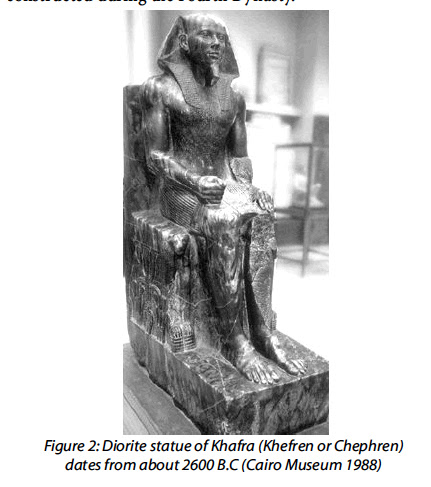
An extraordinarily hard diorite statue of Pharaoh Khafra (Khefren or Chephren in Greek), builder of the Second Pyramid at Giza, was created during the Fourth Dynasty (Fig. 2). Acknowledged to be one of the greatest masterpieces of sculpture ever produced, it was found upside down in a pit in the Valley temple south of the Sphinx, which is associated with Khafra’s (Khefren or Chephren) pyramid at Giza. Archaeologists confirm that during the Fourth Dynasty, the Egyptians did not possess metals hard enough to sculpt this diorite statue, and the Great Pyramids of Giza were also constructed during the Fourth Dynasty.
Figure 2: Diorite statue of Khafra (Khefren or Chephren) dates from about 2600 B.C (Cairo Museum 1988)
Similarly, small scarab amulets made of diorite date from early times and bear no tool marks. In other parts of the ancient world, tiny stone beads with ultrafine holes for threading defy explanation. Only the most current technology is capable of piercing holes of a comparably minute size in stone.
In Khafra’s Valley temple at Giza, the blocks weigh up to 500 tons apiece. As will be explained, these blocks were not carved in situ from the bedrock as is generally assumed. Who were the men of Egypt who, without powerful machinery, placed 500 hundred-ton blocks in temples? How did they manage to place hundreds of fifteen- and twenty-ton blocks in tiers thirty stories above the ground in pyramids? Before pondering the technology of these ancient master builders, briefly consider some facts about the pyramids for which Egyptologists have no adequate explanation.
The Great Pyramid was built for a pharaoh named Khnumu Khufu (Kheops or Cheops in Greek) during his twenty-year reign. During those twenty years approximately 2.5 million limestone blocks, weighing from two to seventy tons apiece, were incorporated into his sacred monument. Large fossil shells make this stone material difficult to cut precisely. Enormous plugs of granite harder than limestone once blocked the ascending passageway. The walls of the so- called King’s Chamber are granite, and the latter room contains a granite sarcophagus, which is curious in that it is too large to fit through the adjoining door and hallway.
Egyptologists claim that this unparalleled structure was built using primitive stone and copper tools. Flint tools, though they can be made with sharp cutting edges, are unsuitable for perfectly shaping millions of large blocks. Copper, which the Egyptians smelted and also mined in native form, is a soft metal. Copper saws are suitable for cutting wood, but not the type of hard granite found in the Great Pyramid, and copper implements are quite unsuitable for cutting 2.5 million nummulitic limestone blocks in twenty years. Bronze working was not introduced in Egypt until about 800 years after the Great Pyramid was built, during or slightly before the Egyptian period known as the Middle Kingdom. Iron came later to Egypt and was rare even during the New Kingdom.
If the blocks of the Great Pyramid, of a material of medium hardness, had been shaped using bronze tools, the labor involved would equal that required for shaping all the stone monuments built during the New Kingdom, Late period, and Ptolemaic era, periods which together span 1,500 years. How did Old Kingdom pyramid builders accomplish in twenty years what required successors 1,500 years of labor?
The Great Pyramid is not an aberration. Khnumu- Khufu’s (Kheops or Cheops) son, Pharaoh Khafra (Khefren or Chephren), built the Second Pyramid at Giza, which is almost as large as that of his father, during a twenty-six year reign. Khnumu-Khufu’s father, Pharaoh Sneferu, was the most prolific builder in Egypt’s long history. He built two colossal pyramids, applied casing stone to another, and erected stone monuments throughout Egypt. It is estimated that Sneferu’s workmen used 9 million tons of stone during the pharaoh’s twenty-four year reign. All of this was expertly accomplished before the invention of the wheel as a means of transportation.
To raise a two-ton portcullis positioned in a narrow passageway in Khafra’s (Khefren or Chephren) pyramid requires the force of at least forty men. The fact that the passageway allows room for no more than eight men to work at once has caused some archaeologists to admit that extraordinary means, about which they have no information, were employed for pyramid construction.
The casing blocks of the pyramids are made of fine- grained limestone that appears to be polished. The Great Pyramid originally possessed about 115,000 casing blocks,
some weighing about ten tons apiece, and covering twenty- two acres of surface area. A razor blade cannot be inserted between any two remaining casing blocks. The noted Egyptologist, Sir Flinders Petrie, determined that some casing blocks in the Great Pyramid fit as closely as 0.002 inch. Those covering the pyramid of Khafra (Khefren or Chephren) also fit perfectly with an additional touch of expertise - they fit together with tongue-and-groove joints. How were these blocks prepared so perfectly? How did workers install them without chipping the corners even slightly?
Twenty-two steps near the top of Khafra’s pyramid are unweathered and in good condition, since the casing blocks which covered them were removed as recently as 150 years ago. In a preliminary study in 1984, I measured the lengths of the thousands of blocks in these steps, which make up about ten percent of the area of the pyramid. The blocks all conform to ten uniform lengths. How could a civilization without the benefit of hard metals prepare many thousands of blocks with such precision? Limestone frequently splits during cutting, even with the most efficient modern tools. Faults and strata in bedrock assure that for every block cut to standard, at least one will crack or be improperly sized during quarrying, and this rate of breakage is far more optimistic than realistic. Given the many millions of blocks in the numerous pyramids, there should be millions of cracked blocks lying nearby or at least somewhere in Egypt, but they are nowhere to be found.
We know that millions of broken limestone blocks were not cut down and used for building monuments when bronze and iron were introduced. By that time only soft varieties of sandstone and granites were being used in monuments. Ancient historians who documented their visits to Giza have not mentioned heaps of broken blocks. So this is the technological paradox of Egypt: before Egypt possessed strong metals for stone cutting, hard varieties of stone were employed in monuments. As bronze and iron came into use, only the softest varieties of stone were used, with very few exceptions.
Rather than providing a logical solution to the riddle of pyramid construction, investigators so far have succeeded only in challenging the flaws in numerous proposed theories. There are far more complex and perplexing aspects of the pyramid puzzle. Before describing them, let us consider the knowledge of the solar priests responsible for pyramid construction.
The ancient Egyptian town of Anu, called On by the Hebrews and Heliopolis by the Greeks, was a great religious center for thousands of years. The city, located about twenty- five miles from Giza, was erected on holy ground, symbolizing rebirth and creation. Starting at the time of the great Imhotep, the Heliopolitan priest credited with inspiring and engineering the first pyramid, the priests of Heliopolis engaged in raising spectacular pyramids and temples for the Sun. These priests excelled in arts and sciences. They were considered to be the traditional wise men of Egypt throughout that nation’s extremely long history. Religious philosophy, mysticism, mathematics, geometry, horology and astronomy were among the sciences piously fostered by the priests.
Their preoccupation with the heavens is reflected in the orientation of pyramids and temples and stemmed from great reverence for the Sun and other stars. The priests descended from an extremely long and learned line. During prehistoric times, their ancestors invented the first 365-day calendar.
Archaeologists assume that modern science is in every way superior to the science of antiquity. However, with technological and scientific possibilities being as limitless as the human imagination, it is unsubstantial bias to suppose that modern technology is all encompassing and always su- perior. The pyramids and other monuments provide a glimpse into a tremendous knowledge gap between ancient and modern science.
There are also astounding examples of long-term food preservation. Until recent years, few archaeologists acknowledged that ancient people successfully stored grain for long periods. In the 1800s European travelers discovered ancient grain silos in Spain. It has since been learned that grain was once universally stored in sealed subterranean silos. Ancient silos have been found in Hungary, Ukraine, Turkestan, India, and several regions of Africa. In Central and North America subterranean silos were built by numerous Indian tribes. In France and in England, subterranean silos were found in abundance. Agronomists were initially surprised to find that sealed silos can successfully store grain.
In the Nile valley, the inundating river made subterranean silos impractical and above-ground silos were constructed. They have been depicted in bas-reliefs and look like upside-down earthenware jars. In the pyramids, too, grain has been found free of mold and in good condition after thousands of years. Though germination was unsuccessful, the condition of the grain was so good that researchers attempted germination.
In contrast, using state-of-the-art technology, the U. S. Department of Agriculture can store grain for no more than four years before insect infestation and mold render it unfit for human consumption. Modern storage methods, based on ventilation, sharply contrast with the sealed systems used in antiquity, demonstrating the vast difference between ancient and modern technology.
Historically, the pyramids were called the storehouses of the Hebrew patriarch Joseph, son of Jacob. The biblical book of Genesis recounts that grain was stored in Egypt by Joseph from seven to perhaps as much as twenty years. The Genesis story has been discounted in modern times because historians are generally unaware that ancient peoples were capable of such technology. The account cannot be doubted in the light of the information already presented.
In the 1930s,Antoine Bovis,a Frenchman,observed that animals that wandered into the Great Pyramid and perished before finding their way out did not decompose. He began to investigate, and thus was born the theory of pyramid power. Its advocates attribute the Great Pyramid’s ability to preserve organic matter to the alignment and shape of the pyramid itself. However, this theory does not explain why preservation can also occur in other tombs. Some theorists suggest that the pyramids and their surroundings are protected by a mysterious force, but no such force has prevented the pyramids from being raided during antiquity or excavated in modern times.
When tourists enter the Grand Gallery and the so- called King’s Chamber of the Great Pyramid for the first time, most are surprised to encounter high humidity. In 1974, a joint research project carried out by Stanford Research Institute (SRI International), of Stanford (California) University, and Ain Shams University, in Cairo, indicated that while the bedrock of Giza is dry, the pyramid blocks are full of moisture [2]. The scientists attempted to locate hidden chambers in the Great Pyramids of Giza with electromagnetic sounding equipment but were prevented by the high moisture content of the blocks. The waves emitted by the equipment would not transmit through the pyramid stone. The waves were instead absorbed, ending any chance of a successful mission. The Great Pyramids attract moisture in the midst of an arid desert necropolis. Why? How can the atmosphere in their chambers be conducive to preserving organic matter?
In an attempt to discover ancient secrets of preservation, the Egyptian Antiquities Organization (AEO), in Cairo, has assembled an impressive team of scientists from the National Geographic Society and the National Oceanic and Atmospheric Administration. The scientists are studying the air sealed inside the rectangular pit in front of the Great Pyramid-air which is 4,500 years old. Samples of air are being encapsulated using space technology developed by NASA for testing the atmosphere of other planets. Scientists hope to learn from ambient temperatures, pressure, and the air itself, how preservation was accomplished.
Because artifacts begin to deteriorate once they are excavated and exposed to the air, one of the most treasured items of antiquity was placed in jeopardy. In the 1950s, an excavation of one of the pits near the Great Pyramid yielded a sacred funerary boat of Khnumu-Khufu. To the delight of archaeologists, the acclaimed artifact was preserved in perfect condition. The boat, measuring more than 120 feet, had a displacement capacity of over forty tons.
The hull, composed of hundreds of pieces of wood shaped to fit together like a jigsaw puzzle, is cleverly sewn together with a single piece of rope. The boat does not require caulking or tar to be completely water-tight. The design principle is that when wet, wood swells whereas rope shrinks, producing an automatic seal impervious to water.
A specially designed museum was erected under the auspices of the Egyptian Antiquities Organization to house and display Khufu’s boat. After the museum opened, serious problems were encountered. The atmospheric control system could not accommodate the vast number of tourists passing in and out of the building. The boat, which the ancient Egyptians had confidently called “ Boat of Millions of Years ”, rapidly began to disintegrate. The museum closed its doors to the public for some time. Subsequently, costly, energy- consuming devices were successfully substituted for the original cost-free, self-powered means that had so subtly and perfectly preserved the entombed boat for 4,500 years.
Khufu’s boat is as seaworthy as any craft of Christopher Columbus’s day. The famous mission of Thor Heyerdahl in 1970, from Morocco to Barbados in a papyrus reed boat, makes it clear that ancient Egyptian ships were capable of intercontinental travel. Their seaworthy craft is impressive, but crossing an ocean is a demanding venture. With their knowledge of the stars, it is likely that the Egyptians were excellent navigators, but how would they obtain fresh water at sea? In modern times desalination is achieved through several methods, including distillation, electrodialysis, freezing, ion exchange, and reverse osmosis, all requiring either high-energy input or advanced apparatus or materials. There is evidence that the Egyptians not only possessed technology for perpetually obtaining moisture in the desert, but were able also to extract fresh water from the ocean.
The ancient method was described by the Roman naturalist,Pliny(AD23-79).InhisLatinworkNaturalHistory, Pliny described curious ceramic vessels, which, during voyages, were tightly corked and immersed into the sea in nets-where they automatically filled with pure, fresh water [3]. When Pliny’s text was translated from Latin to French in 1833 by the French Academy of Sciences (to compare ancient science with science of their day), the scholars could not believe the account. During their era, distillation was the only way of obtaining fresh water from salt water.
The Romans occupied Egypt from 30 BC to AD 395 and absorbed some of the technology developed in the country during more ancient times. It seems unlikely that the Egyptians would have built ships capable of crossing an ocean unless they also possessed technology that assured their survival.
Whether ancient Egyptian travelers, or those who may have inherited their technology, influenced other megalithic- building civilizations around the globe is a matter of debate. Enigmatic stone edifices, most often difficult to transport and place and bearing no tool marks, are found in numerous regions. Foundation blocks at Tiahuanaco, Bolivia, weigh 100 tons apiece. The Cuzco walls in Peru are made of enormous stones-spectacular because of their unusual jigsaw joints. The Easter Island statues were studied by a UNESCO-sponsored team, which reported that the oldest statues do not match mineralogically the stone of the quarries [4]. Standing stones of prehistoric Brittany tower over sixty-five feet high and one weighs more than 340 tons. Also curious are the Pyramids of the Sun in Mexico, numerous stone sundials in North America, and the stone calendar or observatory of Stonehenge, England.
Of all the mysteries of the ancient world, the Great Pyramids with their adjoining complexes provide the most obvious evidence of sophisticated technology very different from our own. Unlike the other megalith-building civilizations who left no written history holding relevant clues about the technology used, the ancient Egyptians left a wealth of information. Egyptian written history spans a 3,000-year period, and though much has been destroyed, surviving records are a treasure-trove of information on surgery, medicine, mathematics, the arts, topography, religion, and much more. Egyptologists have long claimed that no surviving records describe how the pyramids were built. They are incorrect in this assumption, as will be shown in a later chapter.
Considering the number of workers necessarily involved in pyramid design and construction, the actual building method employed was known or witnessed by enormous numbers of people. Their methods, therefore, could not have been secret and must have been documented. Most hieroglyphic and cuneiform texts were deciphered in the 1800s and have not been updated to reflect current archaeological finds or scientific developments. They cannot, therefore, be completely accurate; so accurate conclusions about ancient technology cannot necessarily be drawn from them.
To discover more about the level of ancient technology, pyramidologists focus their attention on the dimensions, design, orientation, and mathematical aspects of the Great Pyramid. These mirror the level of some of the science of the Pyramid Age, but pyramidologists have overlooked the most enigmatic aspect of the pyramids, the blocks themselves.
Much of the scientific research on the stone of the Great Pyramid raises more questions than answers. For instance, in 1974, geologists at Stanford University analyzed building- block samples from the Khafra (Khefren or Chephren) Pyramid [5]. They were unable to classify paleontologically the samples containing no shells. This raises the question: Where does the pyramid stone come from? A team of geochemists from the University of Munich, Germany, sampled quarries along the Nile and removed specimens from twenty different blocks of the main body of the Great Pyramid.
To determine the origin of the pyramid blocks, they compared trace elements of the pyramid samples with those of the quarry samples. Their interpretation of the test results is startling. The scientists concluded that the pyramid blocks came from all of the twenty quarries sampled [6]. In other words, to build the Great Pyramid, these geochemists say that the Egyptians hauled stone for hundreds of miles, from all over Egypt-an amazing feat for which archaeologists have no logical explanation.
Geologists do not concur with their findings. They can demonstrate that the source of stone is near the pyramid itself. Geologists and geochemists cannot agree on the origin of the pyramid blocks, and geologists cannot agree among themselves on the source of stone used for the wondrous statues built for the Eighteenth Dynasty pharaoh,Amenhotep III, in the Valley of the Kings. The awe-inspiring statues, the Colossi of Memnon, were originally monolithic and weigh 750 tons apiece. They rest on monolithic 550-ton pedestals. The structures are each seven stories high. They are made of hard, dense quartzite, which is almost impossible to carve. At the beginning of the nineteenth century, members of the Napoleonic Egyptian expedition remarked about these statues and Egypt’s quartzite quarries in Description de l’Egypte [7]:
“ None of the quartzite hills or quarries show tool marks, as are so common in the sandstone and granite quarries. We have to conclude that a material so hard and unworkable by sharp tools must have been exploited by a process other than that generally used for sandstone, or even granite.... We do not know anything about the process used by the Egyptians to square this stone, to trim the surfaces, or to impart the beautiful polish that we see today on some parts of the statues. Even if we have not determined the means used, we are forced to admire the results.... When the tool of the engraver in the middle of a hieroglyphic character hit a flint or agate in the stone, the sketch was never hindered, but instead it continued in all its purity neither the agate fragment nor the stone itself was even slightly broken by engraving ”.
This last observation has profound implications.What masonry process could possibly allow hieroglyphs to be inscribed in this manner? The beloved king Amenhotep III called the production of his statues “a miracle.” Hieroglyphic documents written after his time refer to this type of stone as biat inr meaning “stone resulting from a wonder.” What technological wonder did Amenhotep behold?
French and German scholars, who will be discussed later, claim that the Colossi of Memnon were carved from a quarry fifty miles away and hauled along the Nile by boat. English and American geologists advocate a feat bordering on the unbelievable. They claim that the statues were quarried and hauled 440 miles up river-against the flow of the Nile. As more sophisticated methods, such as atomic absorption, X- ray fluorescence and neutronic activation are used to study Egypt’s most enigmatic monuments, more confusion arises.
The Great Sphinx in front of Khafra’s pyramid has become more controversial than ever in light of recent geological studies. Based on the severe manner in which blocks covering the lower layers of the body and paws are eroded, the age of the Sphinx has, once again, come into serious question.
Today, the Sphinx is attributed to Khafra (Khefren or Chephren). Earlier Egyptologists believed it was erected a great deal earlier than his reign, perhaps at the end of the Archaic period. The Sphinx looks much older than the pyramids. No inscriptions connect the sacred monument to Khafra, but in the Valley Temple, a dozen statues of Khafra, one in the form of a Sphinx, were uncovered in the 1950s. Some Egyptologists claim a resemblance between these statues and the face of the Sphinx.
A document which indicates greater antiquity, however, was found on the Giza plateau by French Egyptologists during the nineteenth century The text, called the “Inventory Stele,” bears inscriptions relating events occurring during the reign of Khafra’s father, Khufu. The text says that Khufu instructed that a temple be erected alongside the Sphinx, meaning that the Sphinx already existed before Khafra’s time. The accuracy of the stele has been questioned because it dates from the Twenty-first Dynasty (1070-945 BC), long after the Pyramid Age, but because the Egyptians took great pride in precise record keeping and the careful copying of documents, no authoritative reason exists to discount the text as inaccurate.
Fragments of early papyruses and tablets, as well as the later writings of the third century BC Greco-Egyptian historian Manetho, claim that Egypt was ruled for thousands of years before the First Dynasty-some texts claim as much as 36,000 years earlier. This chronology is dismissed by Egyptologists as legend. However, ancient Egyptian history is viewed by scholars mostly from a New Kingdom perspective because numerous documents have survived from Thebes. The capital of Memphis, founded during prehistoric times, was a vitally important religious, commercial, cultural, and administrative center with a life span of thousands of years, but unfortunately, it has not been effectively excavated.
The recent geological studies of the Sphinx have kindled more than mere debate over the attribution and age. The established history of the evolution of civilization is being challenged.
A study of the severe body erosion of the sphinx and the hollow in which it is situated indicates that the damaging agent was water. A slow erosion occurs in limestone when water is absorbed and reacts with salts in the stone. The controversy arises over the source of the vast amount of water responsible.
Two theories are popular. One is that groundwater slowly rose into the body of the Sphinx. This theory raises irreconcilable problems: A survey carried out by the American Research Center in Egypt (ARCE) determined that three distinctly separate repair operations were completed on the Sphinx between the New Kingdom and Ptolemaic rule, that is, during a period of roughly 700 to 1,000 years [8]. The study also indicates that the Sphinx was already in its current state of erosion when these early repairs were made. No appreciable erosion has occurred since the original damage, nor is there further damage on the bedrock of the surrounding hollow; an area that never underwent repair.
Knowing this, one must consider that the inundating Nile slowly built up levels of silt over the millennia, and this was accompanied by a gradual rise in the water table. During Khafra’s time the water table was about thirty feet lower than it is today. For the rising groundwater theory to hold, an un- believable geological scenario would have to have taken place. It would mean that from thirty feet lower than today’s water table, water rose to about two feet into the body of the Sphinx and the surrounding hollow where it caused erosion for roughly 600 years, and then stopped its damaging effects.
Historians find the second theory that is offered more unthinkable. It suggests that the source of water stemmed from the wet phases of the last ice age - c. 15,000 to 10,000 BC- when Egypt underwent periods of severe flooding. This hypothesis advocates that the Sphinx necessarily existed before the floods. If it could be proven, well-established theories about prehistory would be radically shaken. The world’s most mysterious sculpture would date to a time when historians place humanity in a neolithic setting, living in open camps and depending largely on hunting and foraging.
The age of the pyramids themselves has been challenged by a recent project carried out, in cooperation with the American Research Center in Egypt (ARCE), with radiocarbon (carbon-14) dating [9]. Although limestone contains no carbon for dating purposes, mortar found in various parts of the pyramids’ core masonry contains minute fragments of organic material, usually calcined charcoal or reeds. Some fragments are too minute to be dated by standard methods, and therefore carbon-14 dating was also carried out with the aid of an atomic accelerator in Zurich, Switzerland. Seventy-one samples were collected from thirteen pyramids or their surrounding funerary monuments. From the core masonry of the Great Pyramid itself, fifteen samples were taken at various levels from bottom to top.
The test results announced by the research team are startling. The team claimed that their tests indicate that the Great Pyramid is up to 450 years older than Egyptology had established from the archaeological record. Most remarkably,
Mysteries of the Ancient World the team also reported that the mortar at the top of the Great Pyramid was older than that on the bottom and that the Great Pyramid dated older than the Step Pyramid of Zoser, which Egyptologists have established as the first ever built.
All Egyptologists are in firm agreement that the Great Pyramid was built about 100 years after Zoser’s pyramid. Those questioned about the recent carbon-dating project deny the possibility of the accuracy of the tests. The researchers, however, are confident that their sampling was careful and their methods effective. A German laboratory previously sampled tombs at Saqqara and their tests also provided dates of about 400 to 450 years earlier than established dates.
The baffling features of the Valley Temple near the Sphinx deeply impressed members of the Napoleonic expedition at the beginning of the nineteenth century. François Jomard, a member of the expedition, at first thought that the enormous temple blocks were protrusions of bedrock that had been rough cut and squared. As mentioned, the blocks are assumed today to have been carved in situ. But Jomard noticed cement between the blocks of the temple and realized he was observing deliberately placed blocks weighing as much as 500 tons. Reflecting amazement and admiration, he remarked in Description de l’Egypte,“I wonder who these Egyptian men that playfully moved colossal masses around were, for each stone is itself a monolith in the sense that each is enormous.”
Engineers have not reconciled the logistical problems that would be encountered by raising stones of this magnitude. To shift them about manually and set them so perfectly in place with cement in their joints in the small work area would have been impossible. A remark that Petrie made when describing stones in the inner gallery of Khufu’s pyramid makes this point clear: “To place such stones in exact contact required careful work, but to do so with cement in the joints seems almost impossible.” Petrie was referring to stones that weighed sixteen tons-a mere fraction of the weight of these temple blocks.
The floor of the Valley Temple is made of white alabaster slabs. Interior walls are lined with precisely joined granite facing blocks. The curious tailoring of the corners in the interior is unlike anything found in modern architecture. Blocks curve around the walls and join in a diverse interlocking jigsaw pattern. These hard and beautifully crafted stones exemplify an extraordinary masonry method.
Petrie introduced the puzzles of pyramid construction with the publication of Pyramids and Temples of Giza in 1883. The topic simmered in the public mind until the writings of amateur archaeologist Erich von Daniken caused the controversy to explode in the 1970s. In his book Chariots of the Gods? von Daniken sought the solution to the numerous engineering enigmas of the past. He wrote, “The Great Pyramid is (and remains?) visible testimony of a technique that has never been understood. Today, in the twentieth century, no architect could build a copy of the Pyramid of Khufu (Kheops or Cheops) even if the technical resources were at his disposal. How is anyone going to explain these and other puzzles to us?”
Our book reveals what I believe to be the true method of pyramid construction, and, as I will explain, most of the mysteries of the ancient world are finally solved by one major scientific breakthrough. The discovery is so dramatic and far reaching that many important aspects of ancient history will be reconsidered. First, a deeper look at the unresolved problems of pyramid construction is required.
-----------------------------

Saturday, May 19, 2012

Taj Mahal - A Hindu Temple-Palace -13 -Plea on Taj history dismissed

Taj Mahal - A Hindu Temple-Palace -13


Friday, July 14, 2000, Chandigarh, India


Plea on Taj history dismissedNEW DELHI: A self-proclaimed historian’s petition seeking to rewrite the history of Mughal monument Taj Mahal, which figures among the seven wonders of the world, has been dismissed by the Supreme Court as "misconceived". Somebody has a bee in his bonnet, hence this petition," was the remark of a Division Bench comprising Mr Justice SP Bharucha and Mr Justice Ruma Pal when the public interest litigation (PIL) came up for hearing on Monday. The self-proclaimed historian, PN Oak, claimed "the monument of world heritage, Tejomahalaya, commonly known as Taj Mahal, was constructed in 1155 A.D. by one Raja Parmar Dev’s Chief Minister, Salakshan." Oak claimed that the court chronicle of Shahjahan said "the mansion known as Raja Mansingh’s Manzil, at present owned by his grandson Jaisingh, was selected for the burial of Mumtaz and she was buried in it" and added he moved the court "to reestablish the truth and cultural heritage of our country". — PTI
http://www.tribuneindia.com/2000/20000714/nation.htm

ISLAM in INDIA: Hindu Genocide

ISLAM in INDIA: Hindu Genocide

Hindu Kush means Hindu Slaughter

By Shrinandan Vyas


All the Encyclopedias and National Geographic agree that Hindu Kush region is a place of Hindu genocide (similar to Dakau and Auschwitz). All the references are given. Please feel free to verify them.


ABSTRACT
All Standard reference books agree that the name 'Hindu Kush' of the mountain range in Eastern Afganistan means 'Hindu Slaughter' or 'Hindu Killer'. History also reveals that until 1000 A.D. the area of Hindu Kush was a full part of Hindu cradle. More likely, the mountain range was deliberately named as 'Hindu Slaughter' by the Moslem conquerors, as a lesson to the future generations of Indians. However Indians in general, and Hindus in particular are completely oblivious to this tragic genocide. This article also looks into the reasons behind this ignorance.
21 References - (Mainly Encyclopedia Britannica & other reference books, National Geographic Magazines and standard history books).


INTRODUCTION
The Hindu Kush is a mountain system nearly 1000 miles long and 200 miles wide, running northeast to southwest, and dividing the Amu Darya River Valley and Indus River Valley. It stretches from the Pamir Plateau near Gilgit, to Iran. The Hindu Kush ranges mainly run thru Afganistan and Pakistan. It has over two dozen summits of more than 23,000 ft in height. Below the snowy peaks the mountains of Hindu Kush appear bare, stony and poor in vegetation. Historically, the passes across the Hindu Kush have been of great military significance, providing access to the northern plains of India. The Khyber Pass constitutes an important strategic gateway and offers a comparatively easy route to the plains of Punjab. Most foreign invaders, starting from Alexander the Great in 327 BC, to Timur Lane in 1398 AD, and from Mahmud of Ghazni, in 1001 AD, to Nader Shah in 1739 AD attacked Hindustan via the Khyber Pass and other passes in the Hindu Kush (1,2,3). The Greek chroniclers of Alexander the Great called Hindu Kush as Parapamisos or Paropanisos (4). The Hindu name of the Hindu Kush mountains was 'Paariyaatra Parvat'(5).


EARLY HISTORY OF HINDU KUSH REGION (UP TO 1000 AD)
History of Hindu Kush and Punjab shows that two major kingdoms of Gandhaar & Vaahic Pradesh (Balkh of Bactria) had their borders extending far beyond the Hindu Kush. Legend has it that the kingdom of Gandhaar was established by Taksha, grandson of Bharat of Ayodhya (6). Gandhaar's borders extended from Takshashila to Tashkent (corruption of 'Taksha Khand') in the present day Uzbekistan. In the later period, Mahabharat relates Gaandhaari as a princess of Gandhaar and her brother, Shakuni as a prince and later as Gandhaar's ruler.
In the well documented history, Emperor Chandragupt Maurya took charge of Vaahic Pradesh around 325 BC and then took over Magadh. Emperor Ashok's stone tablets with inscriptions in Greek and Aramaic are still found at Qandahar (corruption of Gandhaar?) and Laghman in eastern Afganistan(3). One such stone tablet, is shown in the PBS TV series 'Legacy with Mark Woods' in episode 3 titled 'India: The Spiritual Empire'. After the fall of Mauryan empire, Gandhaar was ruled by Greeks. However some of these Greek rulers had converted to Buddhism, such as Menander, known to Indian historians as Milinda, while some other Greeks became followers of Vishnav sects (Hinduism)(7). Recent excavations in Bactria have revealed a golden hoard which has among other things a figurine of a Greek goddess with a Hindu mark on its forehead (Bindi) showing the confluence of Hindu-Greek art (8). Later Shaka and KushaaN ruled Gandhaar and Vaahic Pradesh. KushaaN emperor Kanishka's empire stretched from Mathura to the Aral Sea (beyond the present day Uzbekistan, Tajikistan, and Krygzystan)(9).
Kanishaka was a Buddhist and under KushaaN influence Buddhism flourished in Gandhaar. Two giant sandstone Buddhas carved into the cliffs of Bamian (west of Kabul) date from the Kushan period. The larger Buddha (although defaced in later centuries by Moslem invaders) is about 175 ft tall (10,11). The Kushan empire declined by 450 AD. The Chinese traveller Hsuan-Tsang (Xuan-zang) travelled thru the region in 7 th century AD and visited many Buddhist religious centers (3) including Hadda, Ghazni, Qonduz, Bamian (3,10,11), Shotorak and Bagram. From the 5 th thru 9 th cenury AD Persian Sasanians and Hepthalites ruled Gandhaar. During their rule Gandhaar region was again influenced by Hinduism. The Hindu kings (Shahiya) were concentrated in the Kabul and Ghazni areas. The last Hindu Shahiya king of Kabul, Bhimapal was killed in 1026 AD. The heroic efforts of the Hindu Shahiya Kings to defend the northwestern gates of India against the invaders are described by even al-Biruni, the court historian of Mahmud of Ghazni (12). Some excavated sites of the period include a major Hindu Shahiya temple north of Kabul and a chapel that contains both Buddhist and Hindu images, indicating that there was a mingling of two religions (3).
Islamic invasions on Afganistan started in 642 AD, but over the next several centuries their effect was marginal and lasted only a short time after each raid. Cities surrendered only to rise in revolt and the hastily converted returned to their old religion (Hinduism or Buddhism) once the Moslem armies had passed (3).
THUS TILL THE YEAR 1000 AD AFGANISTAN WAS A FULL PART OF HINDU CRADLE.


HINDU KUSH AND THE HINDU GENOCIDE
Now Afganistan is a Moslem country. Logically, this means either one or more of the following must have happened:
a) original residents of Hindu Kush converted to Islam, or
b) they were slaughtered and the conquerors took over, or
c) they were driven out.
Encyclopedia Britannica (3) already informs us above about the resistance to conversion and frequent revolt against to the Moslem conqueror's rule from 8 th thru 11 th Century AD. The name 'Hindu Kush' itself tells us about the fate of the original residents of Gandhaar and Vaahic Pradesh during the later period of Moslem conquests, because HINDU KUSH in Persian MEANS HINDU SLAUGHTER (13) (as per Koenraad Elst in his book 'Ayodhya and After'). Let us look into what other standard references say about Hindu Kush.
Persian-English dictionary (14) indicates that the word 'Kush' is derived from the verb Kushtar - to slaughter or carnage. Kush is probably also related to the verb Koshtan meaning to kill. In Urdu, the word Khud-kushi means act of killing oneself (khud - self, Kushi- act of killing). Encyclopedia Americana comments on the Hindu Kush as follows: The name Hindu Kush means literally 'Kills the Hindu', a reminder of the days when (Hindu) SLAVES from Indian subcontinent died in harsh Afgan mountains while being transported to Moslem courts of Central Asia (15). The National Geographic Article 'West of Khyber Pass' informs that 'Generations of raiders brought captive Hindus past these peaks of perpetual snow. Such bitter journeys gave the range its name Hindu Kush - "Killer of Hindus"'(10). The World Book Encyclopedia informs that the name Kush, .. means Death ..(16). While Encyclopedia Britannica says 'The name Hindu Kush first appears in 1333 AD in the writings of Ibn Battutah, the medieval Berber traveller, who said the name meant 'Hindu Killer', a meaning still given by Afgan mountain dwellers who are traditional enemies of Indian plainsmen (i.e. Hindus)(2). However, later the Encyclopedia Britannica gives a negationist twist by adding that 'more likely the name is a corruption of Hindu-Koh meaning Hindu mountains'. This is unlikely, since the term Koh is used in its proper, uncorrupted form for the western portion of Hindu Kush, viz. Koh-i-Baba, for the region Swat Kohistan, and in the names of the three peaks of this range, viz. Koh-i-Langer, Koh-i-Bandakor, and Koh-i-Mondi. Thus to say that corruption of term Koh to Kush occurred only in case of Hindu Kush is merely an effort to fit in a deviant observation to a theory already proposed. In science, a theory is rejected if it does not agree with the observations, and not the other way around. Hence the latter negationist statement in the Encyclopedia Britannica must be rejected.
IT IS SIGNIFICANT THAT ONE OF THE FEW PLACE NAMES ON EARTH THAT REMINDS US NOT OF THE VICTORY OF THE WINNERS BUT RATHER THE SLAUGHTER OF THE LOSERS, CONCERNS A GENOCIDE OF HINDUS BY THE MOSLEMS (13).
Unlike the Jewish holocaust, the exact toll of the Hindu genocide suggested by the name Hindu Kush is not available. However the number is easily likely to be in millions. Few known historical figures can be used to justify this estimate. Encyclopedia Britannica informs that in December 1398 AD, Timur Lane ordered the execution of at least 50,000 captives before the battle for Delhi, .. and after the battle those inhabitants (of Delhi) not killed were removed (as slaves) (17), while other reference says that the number of captives butchered by Timur Lane's army was about 100,000 (18). Later on Encyclopedia Britannica mentions that the (secular?) Mughal emperor Akbar 'ordered the massacre of about 30,000 (captured) Rajput Hindus on February 24, 1568 AD, after the battle for Chitod' (19). Another reference indicates that this massacre of 30,000 Hindu peasants at Chitod is recorded by Abul Fazl, Akbar's court historian himself (20). These two 'one day' massacres are sufficient to provide a reference point for estimating the scale of Hindu genocide. The Afgan historian Khondamir records that during one of the many repeated invasions on the city of Herat in western Afganistan, 1,500,000 residents perished (11).
Since some of the Moslem conquerors took Indian plainsmen as slaves, a question comes : whatever happened to this slave population? The startling answer comes from New York Times (May-June 1993 issues). The Gypsies are wandering peoples in Europe. They have been persecuted in almost every country. Nazis killed 300,000 gypsies in the gas chambers. These Gypsies have been wandering around Central Asia and Europe since around the 12 th Century AD. Until now their country of origin could not be identified. Also their Language has had very little in common with the other European languages. Recent studies however show that their language is similar to Punjabi and to a lesser degree to Sanskrit. Thus the Gypsies most likely originated from the greater Punjab. The time frame of Gypsy wanderings also coincides early Islamic conquests hence most likely their ancestors were driven out of their homes in Punjab and taken as slaves over the Hindu Kush.
The theory of Gypsie origins in India was first proposed over two centuries ago. It is only recently theta linguistic and other proofs have been verified. Even the Gypsie leadership now accepts India as the country of their origin.
Thus it is evident that the mountain range was named as Hindu Kush as a reminder to the future Hindu generations of the slaughter and slavery of Hindus during the Moslem conquests.


DELIBERATE IGNORANCE ABOUT HINDU KUSH
If the name Hindu Kush relates such a horrible genocide of Hindus, why are Hindus ignorant about it? and why the Government of India does not teach them about Hindu Kush? The history and geography curriculums in Indian Schools barely even mention Hindu Kush. The horrors of the Jewish holocaust are taught not only in schools in Israel and USA, but also in Germany. Because both Germany and Israel consider the Jewish holocaust a 'dark chapter' in the history. The Indian Government instead of giving details of this 'dark chapter' in Indian history is busy in whitewash of Moslem atrocities and the Hindu holocaust. In 1982, the National Council of Educational Research and Training issued a directive for the rewriting of school texts. Among other things it stipulated that: 'Characterization of the medieval period as a time of conflict between Hindus and Moslems is forbidden'. Thus denial of history or Negationism has become India's official 'educational' policy (21).
Often the official governmental historians brush aside questions such as those that Hindu Kush raises. They argue that the British version is the product of their 'divide and rule' policy' hence their version is not necessarily true. However it must be remembered that the earliest reference of the name Hindu Kush and its literal meaning 'Hindu Killer' comes from Ibn Battutah in 1333 AD, and at that time British were nowhere on the Indian scene. Secondly, if the name indeed was a misnomer then the Afgans should have protested against such a barbaric name and the last 660 plus years should have been adequate for a change of name to a more 'civil' name. There has been no effort for such a change of name by the Afgans. On the contrary, when the Islamic fundamentalist regime of the Mujahadeens came to power in 1992, tens of thousands of Hindus and Sikhs from Kabul, became refugees, and had to pay steep ransom to enter into Pakistan without a visa.
In the last 46 years the Indian Government also has not even once demanded that the Afgan Government change such an insulting and barbaric name. But in July 1993, the Government of India asked the visiting Jerusalem Symphony Orchestra to change its name because the word Jerusalem in its name is offensive to Moslem Fundamentalists.


CONCLUSION
It is evident that Hindus from ancient India's (Hindustan's) border states such as Gandhaar and Vaahic Pradesh were massacred or taken as slaves by the Moslem invaders who named the region as Hindu Kush (or Hindu Slaughter,or Hindu Killer) to teach a lesson to the future Hindu generations of India. Unfortunately Hindus are not aware of this tragic history. The Indian government does not want the true history of Hindu Moslem conflicts during the medieval ages to be taught in schools. This policy of negationism is the cause behind the ignorance of Hindus about the Hindu Kush and the Hindu genocide.


COMMENTS & FUTURE WORK
Although in this article Hindu Kush has been referred to as Hindu slaughter, it is quite possible that it was really a Hindu and Buddhist slaughter. Since prior to Moslem invasions influence of Buddhism in Gandhaar and Vaahic Pradesh was considerable. Also as the huge 175 ft stone Buddhas of Bamian show, Buddhists were idol worshipers par excellence. Hence for Moslem invaders the Buddhists idol worshipers were equally deserving of punishment. It is also likely that Buddhism was considered an integral part of the Hindu pantheon and hence was not identified separately.
This article barely scratches the surface of the Hindu genocide, the true depth of which is as yet unknown. Readers are encouraged to find out the truth for themselves . Only when many readers search for the truth, the real magnitude of the Hindu genocide will be discovered.


REFERENCES

  1. Encyclopedia Britannica, 15 th Ed, Vol.5, p.935, 1987

  2. Encyclopedia Britannica, 15 th Ed, Vol.14, pp.238-240, 1987

  3. Encyclopedia Britannica, 15 th Ed, Vol.13, pp.35-36, 1987

  4. The Invasion of India by Alexander the Great (as described by Arrian, Q.Curtius, Diodoros, Plutarch & Justin), By J.W.McCrindle, Methuen & Co., London, p.38, 1969

  5. Six Glorious Epochs of Indian History, by Veer Savarkar, Savarkar Prakashan, Bombay, 2nd Ed, p.206, 1985

  6. Chanakya - a TV series by Doordarshan, India

  7. Encyclopedia Britannica, 15 th Ed, Vol.21, pp.36-41, 1987

  8. V.Sarianidi, National Geographic Magazine, Vol.177, No.3, p.57, March 1990

  9. Hammond Historical Atlas of the World, pp. H4 & H10, 1993

  10. W.O.Douglas, National Geographic Magazine, vol.114, No.1, pp.13-23, July 1958

  11. T.J.Abercrombie, National Geographic Magazine, Vol.134, No.3, pp.318-325, Sept.1968

  12. An Advanced History of India, by R.C.Majumdar, H.C.Raychaudhuri, K.Datta, 2nd Ed., MacMillan and Co, London, pp.182-83, 1965

  13. Ayodhya and After, By Koenraad Elst, Voice of India Publication, p.278, 1991

  14. A Practical Dictionary of the Persian Language, by J.A.Boyle, Luzac & Co., p.129, 1949

  15. Encyclopedia Americana, Vol.14, p.206, 1993

  16. The World Book Encyclopedia, Vol.19, p.237, 1990

  17. Encyclopedia Britannica, 15 th Ed, Vol.21, pp. 54-55, 1987

  18. An Advanced History of India, by R.C.Majumdar, H.C.Raychaudhuri, K.Datta, 2nd Ed., MacMillan and Co, London, pp.336-37, 1965

  19. Encyclopedia Britannica, 15 th Ed, Vol.21, p.65, 1987

  20. The Cambridge History of India, Vol.IV - The Mughul Period, by W.Haig & R.Burn, S.Chand & Co., New Delhi, pp. 98-99, 1963

  21. Negationism in India, by Koenraad Elst, Voice of India Publ, 2nd Ed, pp.57-58, 1993


Hindu Genocide in East Pakistan

By Shrinandan Vyas


This article deals with slaughter of about 2.5 million Hindus in East Pakistan in 1971.
This article refers to information provided by Dept. of Planning of Government of Bangla Desh, Encyclopedia Britannica, Senator Edward Kennedy's report to the U.S.Senate Judiciary Committee, Newsweek, New York Times,etc. This information and elementary math are used to show that indeed millions of Hindus were killed in East Pakistan in 1971.

ABSTRACT
It is well known that the 1971 army repression in Bangla Desh (former East Pakistan) resulted in an influx of 10 million refugees into India. Most world renowned relief and news agencies put the number of dead at 3 million. However the fact that is glossed over in these statistics is that THE ENTIRE HINDU POPULATION OF EAST PAKISTAN WAS THE PRIMARY TARGET OF PAKISTANI ARMY DURING THE 9 MONTHS OF REPRESSION IN 1971. Using the population statistics from Bangla Desh Government and US Government publications this article PROVES that 80 percent of the refugees from Bangla Desh were Hindus and that 80 percent of the 3 million killed were Hindus. THUS IT WAS A HINDU REFUGEE PROBLEM and IT WAS A HINDU GENOCIDE THAT TOOK PLACE IN EAST PAKISTAN IN 1971.
10 References - Encyclopedia Britannica, Bangla Desh Government - Ministry of Planning (for statistics), Newsweek, New York Times, Senator Edward Kennedy's report to the U.S. Senate Judiciary Committee.

INTRODUCTION
In the December 1970 general election in Pakistan, Awami League won 167 of 169 seats and over 80 % of popular votes in East Pakistan. Numerically Awami League had an absolute majority of seats in the Pakistan National Assembly (167 of the total 313 seats)(1). Historically, East Pakistan was allocated only 36 % of the total resources and East Pakistanis occupied only 20 % of the positions in the federal government in the United Pakistan (2). The Pakistani government's apathy towards East Pakistan after a terrible cyclone in November 1970 in which over 250,000 people died, had alienated East Pakistani people. The solid outcome of the 1970 elections for Awami League created an alternative power center for an already alienated people. The differences between the East and West Pakistani politicians snowballed into a major international crisis. On March 25, 1971 Pakistani army on President Yahya Khan's orders initiated a campaign of terror which was to last till its final surrender to the Indian army on December 17, 1971. This terror campaign by Pak army resulted in 10 million Bangla Deshi refugees crossing over to India (per Senator Edward Kennedy's report to the U.S. Senate Judiciary Committee (3)) and 3 million killed (4,5) based on reports from most relief agencies and official Bangla Desh government estimate. However the religious mix of both the refugees and the dead is nowhere emphasized anywhere. This significant information has particularly been absent in the reports from Indian News Media. This selective news dissemination has kept a more sinister truth of Hindu genocide in East Pakistan hidden from the world in general and Indians in particular.

HINDUS IN EAST PAKISTAN WERE SPECIAL TARGET OF PAK ARMY
In the summary of his report dated November 1, 1971 Senator Edward Kennedy writes (6):
    'Field reports to the U.S. Government, countless eye-witness journalistic accounts, reports of International agencies such as World Bank and additional information available to the subcommittee document the reign of terror which grips East Bengal (East Pakistan). HARDEST HIT HAVE BEEN MEMBERS OF THE HINDU COMMUNITY WHO HAVE BEEN ROBBED OF THEIR LANDS AND SHOPS, SYSTEMATICALLY SLAUGHTERED, AND IN SOME PLACES, PAINTED WITH YELLOW PATCHES MARKED "H". All of this has been officially sanctioned, ordered and implemented under martial law from Islamabad. ..' (emphasis added by author of this article).
Sydney Schanberg, pulitzer prize winning journalist (of 'Killing Fields') was New York Times correspondent in Dhaka in 1971 at the time of army repression and during the 1971 Bangla Desh war. In his syndicated column 'The Pakistani Slaughter That Nixon Ignored' Mr.Schanberg writes:
    "I covered the war and witnessed first the population's joyous welcome of the Indian soldiers as liberators .. Later I toured the country by road to see the Pakistani legacy firsthand. In town after town there was an execution area where people had been killed by bayonet, bullet and bludgeon. In some towns, executions were held on a daily basis."
    This was a month after the war's end (i.e. January 1972), ... human bones were still scattered along many roadsides. Blood stained clothing and tufts of human hair clung to the brush at these killing grounds. Children too young to understand were playing grotesque games with skulls. OTHER REMINDERS WERE THE YELLOW "H"s THE PAKISTANIS HAD PAINTED ON THE HOMES OF HINDUS, PARTICULAR TARGETS OF THE MUSLIM ARMY." (7) (emphasis added by the author of this article).
Thus two independent observations one dated prior to November 1, 1971 and other in January 1972 confirm that Hindu houses in East Pakistan were marked with yellow "H"s and that Hindus were particular targets of the Pakistani army. The situation thus bears an uncanny resemblance to the predicament of Jews targeted by Nazis from 1939 to 1944, with similar out come.

MOST OF THE REFUGEES FROM BANGLA DESH WERE HINDUS
Senator Edward Kennedy in his report gives following details about the the refugees from Bangla Desh in 1971. As of October 25, 1971, 9.54 million refugees from East Pakistan had crossed over to India. The average influx as of October 1971 was 10,645 refugees a day (3). Hence the total refugee population at the start of Bangla Desh war on December 3, 1971 was about 10 million (5).
Sen. Kennedy further mentions that Government of India had set up separate refugee camps for Hindus and Muslims where possible, i.e. refugee camps of Hindus were located in Hindu majority areas and similarly Muslim camps were located in Muslim majority areas. THE COMMUNAL REPRESENTATION OF REFUGEES WAS 80 PERCENT HINDU, 15 PERCENT MUSLIM AND 5 PERCENT CHRISTIAN AND OTHER (8).
This means that 8 MILLION OF THE 10 MILLION REFUGEES WERE HINDUS (8). Other fact that corroborates this is that when Sen. Kennedy had asked several Chief Relief officers in charge of refugee camps what was needed most urgently, their reply was "crematoriums".

THE MISSING 2 .5 MILLION HINDUS
Several agencies indicate that the brutal Pakistani army repression killed 3 million Bengalis. This estimate is even given by the Government of Bangla Desh (5). However no religious mix of the dead is easily available.
Let us therefore look at the population demographics for Bangla Desh which is given in Table I.
TABLE I
Source : Based on Information from Bangladesh Ministry of planning, Bureau of Statistics (9)

YEAR

Total Population in Millions

Hindu Population as % of Total

Hindu Population in Millions

1941

42.00

28.0

11.76

1961

50.84

18.5

9.41

1974

71.48

13.5*

9.655

1981

87.13

12.2

10.633
* Encyclopedia Britannica (10) gives 13.5% figure for 1974, where as Government of Bangla Desh gives 13.5% for 1971 and total population of 71.48 million for 1974 (9).
Since Hindus and Muslims in Bangladesh have similar socio- economic and educational backgrounds, the birth and death rates for these two groups must be very similar. This means that the Hindu population must grow at the same pace as the total population growth rate. Hence any unusual drop must be accounted for by influx of Hindu refugees and mortality rate from non natural causes. The expected Hindu population, the emigration to India from E. Pakistan and actual populations are listed in Table II.
Table II

YEAR

Hindu Population of East Pak/BD Actual (9)
(millions)

Expected Hindu Population in Absence of Strife
(millions)

Refugees from E. Pakistan to India(8)
(millions)

Hindus Missing
(millions)

1941

11.766

-

-

-

1961

9.41

14.24

4.12(1947-58)

0.711

1974

9.65

13.23

1.11(1964-70)

2.477
Thus if 1947 partition had not resulted, the Hindu population of East Pakistan area should by 1961 have increased proportionally from 11.76 millions in 1941, to 14.24 millions (11.76 * 50.84 / 42 = 14.24). The official Indian Government records indicate that between 1947 and 1958, 4.12 million (Hindu) refugees crossed into India from East Bengal(3). This means the Hindu population in East Pakistan in 1961 should have been 10.12 million (14.24 - 4.12) compared to the actual 9.41 million. The missing 0.7 million Hindu population can be accounted by several hundred thousands killed in the riots in 1947 on the Bengal border, plus the refugee influx from 1958 to 1961. 1961.
Let us now look at Hindu population in East pakistan from 1961 to 1974. With proportional increase the Hindu population of 9.41 million in 1961 should have increased to 13.23 million ( 9.41 * 71.48 / 50.84 = 13.23 ) by 1974. However the actual Hindu population as per Bangla Desh Census data for 1974 was 9.65 million. Of the 3.58 million shortfall only 1.11 million can be accounted for since Government of India's record indicate that 1.11 million (Hindu) refugees crossed into India between 1964 and 1970 (3) i.e.PRIOR to the 1971 crisis.
    THUS 2.47 MILLION (13.23 - 9.65 - 1.11 = 2.47) HINDUS FROM EAST PAKISTAN ARE UNACCOUNTED FOR FROM THE 1971 PAK ARMY REPRESSION.

OTHER PROOF FOR 2.4 MILLION HINDUS KILLED IN EAST PAKISTAN
    Since the 80 percent of the refugees in 1971 were Hindus,a similar proportion of the dead are likely to be Hindus also. The official Bangla Desh government estimate puts the number of Bengalis killed at 3 million. 80 percent of 3 million put THE NUMBER OF HINDUS KILLED AT 2.4 MILLION which is close to the number of Hindus missing calculated comes above.

SUMMARY & CONCLUSIONS
  1. Independent accounts indicate that Hindus from East Pakistan were special target during the 1971 army repression. HINDU HOUSES WERE PAINTED WITH YELLOW "H"s, THEY WERE ROBBED OF THEIR LANDS AND SHOPS, AND THEY WERE SYSTEMATICALLY SLAUGHTERED.
  2. 80 percent of the refugees to India in 1971 were Hindus, THUS IT WAS A HINDU REFUGEE PROBLEM.
  3. NEARLY 2.5 MILLION HINDUS WERE KILLED DURING THE 9 MONTHS OF PAKISTANI ARMY REPRESSION OF EAST PAKISTAN IN 1971. THUS IT WAS A HINDU SLAUGHTER IN 1971.
  4. ALL THE ABOVE BEAR AN UNCANNY RESEMBLANCE TO THE PERSECUTION & HOLOCAUST OF JEWS BY THE NAZIS.
  5. INDIAN GOVERNMENT CONTROLLED 'SECULAR' MEDIA DELIBERATELY HID THE SINISTER TRUTH OF HINDU GENOCIDE IN EAST PAKISTAN.
  6. In any internal political problem of an Islamic country, Hindus (or minorities of other religions) become the scapegoats and will be liquidated at the first chance the Islamic Government gets.
  7. WE HAVE LEARNT NOTHING FROM THE HISTORY AND WITH THE 'PSECULAR' MEDIA WE WILL LEARN NOTHING.

COMMENTS & FUTURE WORK
This is just the tip of the iceberg. The ethnic cleansing of Hindus in Bangla Desh did not end in 1971. Since 1974 to 1981 the Hindu population as a percent of total Bangla Deshi population decreased from 13.5 % to 12.2 %. This slide has continued over the last decade. Same is true about Hindus in Pakistan and in Kashmir valley.
There is a genuine need for systematic record keeping and documentation of the history of Hindu genocides & Hindu ethnic cleansing, so that we don't repeat it again (and again and again..) There is also a need to build a memorial of this Hindu holocaust similar to the Jewish Holocaust memorial in Washington DC.
This topic is extensively dealt in a book 'Genocide in East Pakistan/ Bangla Desh' by S.K.Bhattacharya. However the present author has verified the findings of S.K. Bhattacharya based on completely independent sources. For detailed descriptions and news reports of 1971, reader should refer to the original book.

REFERENCES
  1. Bangladesh: The Birth Of A Nation, A hand book of Background information and Documentary Sources Compiled by Univ. of Chicago Group of Scholars, by M.Nicholas, P.Oldensburg, Ed.W.Morehouse, M.Seshachalam & Co., India, 1972, p.7

  2. Same as reference 1, p.73

  3. Crisis in South Asia - A report by Senator Edward Kennedy to the Subcommittee investigating the Problem of Refugees and Their Settlement, Submitted to U.S. Senate Judiciary Committee, November 1, 1971, U.S. Govt. Press, pp.6-7.

  4. Newsweek, August 1, 1994, p.37

  5. Same as reference 1, pp.44-45

  6. Same as reference 3, p.66

  7. The Pakistani Slaughter That Nixon Ignored , Syndicated Column by Sydney Schanberg, New York Times, May 3, 1994.

  8. Same as reference 3, p. 19

  9. Bangladesh A Country Study, Ed. J.Heitzman & R.L.Worden, 2nd Ed, Federal Research Division, Library of Congress, Publisher U.S. Army, 1989, pp.250,255

  10. Encyclopedia Britannica, 15 th Ed, Micropedia, Vol.1, p.789 Desh.

http://www.hindunet.org/hindu_history/modern/hindu_bangla.html