.

.
Library of Professor Richard A. Macksey in Baltimore

POSTS BY SUBJECT

Labels

Sunday, August 20, 2017

Ruthie Blum : The Real Lessons from Charlottesville

  • Although Hamas, the terrorist organization that rules the Gaza Strip, is shunned by U.S. negotiators, Fatah, the party headed by Palestinian Authority (PA) President Mahmoud Abbas, is considered a potential partner for peace with Israel.
  • Official Fatah social media pages, however, openly laud and encourage "lone wolves" to arm themselves with knives and vehicles with which to slaughter Israelis whenever and wherever possible.
  • Abbas and his henchmen in the PA do not allow freedom of expression. They do not "weep" over the "thuggish" and "deliberately murderous" conduct of their populace. Instead, they champion it and fund it. A Palestinian who uses his car as a deadly weapon is viewed by his peers and rulers as a hero. Physical violence is officially sanctioned and rewarded. An American who commits violence is demonized by everyone other than a handful of hard-core bigots.
A day before the car-ramming attack in Charlottesville, Virginia -- which left 32-year-old Heather Heyer dead and 19 others wounded -- the White House announced that it would be dispatching President Donald Trump's son-in-law and special adviser, Jared Kushner, Special Adviser on International Affairs Jason Greenblatt, and Deputy National Security Adviser for Strategy Dina Powell to the Middle East for the second time since June.

The stated purpose of their trip, the scheduled date of which has yet to be disclosed, is to revive the peace process between Israel and the Palestinian Authority (PA). Justifiably, the Trump administration's declaration that it would resume efforts to broker negotiations between Jerusalem and Ramallah was drowned out by the events in Charlottesville.

The act of domestic terrorism, committed by 20-year-old James Alex Fields Jr. of Ohio, mimicked a choice method employed by Palestinian organizations Hamas and Fatah in Israel, and ISIS in Europe. The car-ramming so horrified the American public that it instantly became the key issue of the day, with candlelight vigils and memorials held across the country -- indicating mass consensus that such abhorrent behavior is anathema to American values and will not be tolerated.
James Alex Fields rams his car into a crowd of "antifa" marchers in Charlottesville, Virginia, on August 12. (Image source: Al Jazeera video screenshot)


The otherwise universal condemnation of the Charlottesville clashes between the "Alt-Right" and extreme "Antifa" (short for anti-Fascist) movements -- sparked by the city's decision to remove a statue of Civil War Confederate General Robert. E. Lee from Emancipation Park -- has, however, been clouded in two points of controversy.

One involves the fact that, while dubbed "Unite the Right," the protest was actually a gathering of neo-Nazis, Ku Klux Klan members and other racists, xenophobes and anti-Semites -- most, it turned out, imported from out-of-state.

Although the sight of their angry faces and banners was reminiscent of the Old South, it was being attributed to the current climate, ostensibly created by the Republican Party, conservatives in general, and Trump in particular.
The other controversy surrounds the wording of Trump's denunciation of the "many sides" of the violence.

Conservatives promptly dissociated themselves from the Charlottesville bullies, but simultaneously took Trump to task for not exhibiting the same moral outrage towards the white supremacists that he expresses against "radical Islamic terrorism."

On the Left, columnists went even further, blaming not only Trump but the United States itself for the climate that led to the events in Virginia.
In Politico, for example, Joshua Zeitz argued that "What Happened in Charlottesville Is All Too American."

To put things in perspective, however, conservative (and Jewish) political commentator Ben Shapiro -- whose own criticism of Trump has turned him into a target of anti-Semitic vilification on the web -- explained that the "Alt-Right" is neither "conservative" nor particularly widespread in America, in spite of its trying to create the impression that it is growing exponentially.
"They fill up comments sections at sites like Breitbart, and they email spam, and they prank call people, and they live on 4chan boards, but the vast majority of alt-right anti-Semitic tweets came from just 1,600 accounts," Shapiro wrote, citing Anti-Defamation League (ADL) statistics.
In a separate report, the ADL listed examples of events held by white supremacists to mobilize and spread a culture of hatred, yet referred to them as a "fringe movement."

This is not simply due to their relatively infinitesimal numbers in the United States, but to American culture as a whole, which is overwhelmingly liberal.
Well before college, children in the U.S. are treated to heavy doses of progressive ideas in their schools and on television. It is not racism and xenophobia with which they have been bombarded, particularly in the last decade, but rather with "identity politics." American kids are taught to respect people of different ethnic backgrounds, religious affinities, gender identities and sexual preferences -- as long as those meet "victimhood" criteria.

They are told that "white privilege" is an evil to be eradicated. In this context, "white" is a misnomer, of course, because Jews and Asians who excel in school are included in the derogatory category. Still, the principle is understood, and it both emanates from and is disseminated by left-wing groups.

It therefore beggars belief that the most vocal supporters of the Palestinian Authority -- an entity whose leadership purposely fosters a culture of hatred, racism, gender-abuse and anti-Semitism – hail from those same groups.
On August 13, a day after the Charlottesville travesty, convicted Palestinian terrorist Rasmea Odeh was honored in Chicago. Odeh, who in 1969 placed a bomb in a Jerusalem supermarket, killing two innocent people and wounding nine, and days later carried out an attack on the British Consulate, was released from Israeli prison as part of a prisoner swap in 1980. In March 2017, she was convicted in the United States of immigration fraud, for lying about her past to U.S. authorities. A plea deal, however, is enabling her to travel to Jordan, without serving any time behind bars.
Odeh emerged as a hero of many Americans. She led the anti-Trump Women's March on Washington and served as a key figure in the March 8, 2017 "Global Women's Strike."

She is also celebrated in the Palestinian Authority, an entity whose leadership fosters a culture of hate against Jews, Christians and the West in general. As has been extensively documented by Palestinian Media Watch, PA schools and summer camps educate children to believe not only that that murdering on behalf of the "liberation of Palestine" -- and in the name of Allah -- is honorable, but worthy of glorification. PA imams preach jihad. PA sports arenas and tournaments are named after "martyred" terrorists, all of whose families receive a monthly salary of more than $3,000 per month for life, courtesy of the American taxpayer -- a beneficence that led this month to the Taylor Force Act, approved by the Senate Foreign Relations Committee, to stop incentivizing PA murder by stopping the payments for it.

Although Hamas, the terrorist organization that rules the Gaza Strip, is shunned by U.S. negotiators, Fatah, the party headed by PA President Mahmoud Abbas, is considered a potential partner for peace with Israel.

Official Fatah social media pages, however, openly laud and encourage "lone wolves" to arm themselves with knives and vehicles with which to slaughter Israelis whenever and wherever possible.

Trump has expressed "confidence" that a deal can be reached, and is sending his team to the region again for yet another try at bringing both sides of the conflict to the table.

Kushner, however, told a group of congressional interns that "there may be no solution" to the conflict. Short of wiping Israel off the map, which the PA does in every cartographic depiction of the "state of Palestine," there certainly will be no solution in the foreseeable future.

Nevertheless, many Americans continue to repeat what Abbas regularly feeds the international community: that the "Israeli occupation" is at the root of Palestinian terrorism. For internal consumption, however, Abbas has made it clear, in word and deed, that Israel's very establishment in 1948 is what all Arabs should consider the real "catastrophe." This is why he laughably announced that he would sue the UK for the Balfour Declaration, a letter sent 100 years ago to the head of the Jewish community in Britain expressing support for a Jewish homeland in Palestine.
The majority of the Arab citizens of the Jewish state, who make up one-fifth of its population, not only know that Abbas totally distorts history to keep a stranglehold on his people and maintain status at the United Nations, but enjoy full rights as equal members of Israeli society. They have political parties and seats in the Knesset, hold seats on the Supreme Court, and are among the country's prominent academics, doctors, lawyers and other professionals. Israel is a liberal democracy, after all.

In America, two liberal organizations, the American Civil Liberties Union (ACLU) and the Rutherford Institute, defended the "constitutional and civil right" of the neo-Nazis and white supremacists to hold their rally in Charlottesville. When the free speech turned into illegal riots, however, the ACLU of Virginia stated:
"What happened... had nothing to do with free speech. It devolved into conduct against individuals motivated by hate that was initially thuggish, and ultimately, deliberately murderous. There will be a time to investigate, assign responsibility, and seek accountability, and we will be a voice in that process. For now, we decry white nationalism, reject hatred, and weep."
Abbas and his henchmen in the PA, in contrast, do not allow freedom of expression. They do not "weep" over the "thuggish" and "deliberately murderous" conduct of their populace; instead, they champion and fund it. A Palestinian who uses his car as a deadly weapon is viewed by his peers and rulers as a hero. Physical violence is officially sanctioned and rewarded. An American who commits violence is demonized by everyone other than a handful of hard-core bigots.
Still, many in the U.S. consider America to be a racist country and the Palestinians worthy of stalwart support. This is the true meaning of what George Orwell called "doublethink" -- the "power of holding two contradictory beliefs in one's mind simultaneously, and accepting both of them."

On the eve of team Trump's imminent visit to Israel and the Palestinian Authority, let us hope that Washington is not becoming similarly afflicted.

Ruthie Blum is the author of "To Hell in a Handbasket: Carter, Obama, and the 'Arab Spring.'"

Bruce Bawer : The Anti-Semitic Jewish Media

  • Almost everyone in a position to do something is a coward. Politicians continue to recite the mantra that "Muslims are today's Jews," even though in Europe today Muslims are far more often the tormentors than the tormented, and Jews lead the list of victims of public abuse.
  • Needless to say, the immigrants Trump wants to keep out of the U.S. are precisely the type who, in Europe, are currently Jew-bashing people like Stephen Miller -- and Rob Eshman. But Eshman doesn't want to think about this ticklish fact, which challenges his own simplistic, self-righteous pontifications.
  • Linda Sarsour is the very personification of stealth Islamization and an obvious anti-Semite. But as Davidson himself noted, she's acquired plenty of Jewish allies and defenders, "including Jeremy Ben-Ami, Mark Hetfield, Rabbi Jill Jacobs and Brad Lander."
For years now, Jews across western Europe have been the targets of harassment by Muslims. Police officers stand guard outside of synagogues. Recently, when I stayed in the Jewish Quarter in Rome, I couldn't help notice the presence of multiple police kiosks, each manned by an armed cop. Many Jews in European cities have long since ceased wearing yarmulkes or Stars of David. Jewish kids are instructed by their parents to avoid identifying themselves as Jews at school lest they be beaten up by their little Muslim friends.

Meanwhile, almost everyone in a position to do something is a coward. Politicians continue to recite the mantra that "Muslims are today's Jews," even though in Europe today Muslims are far more often the tormentors than the tormented, and Jews lead the list of victims of public abuse. Police prefer not to prosecute Muslim perpetrators for fear of being called "Islamophobes." Teachers don't want to deal with Muslim bullies in their classes for the same reason.

Yet you would hardly know this to read much of America's Jewish media. On August 2, the Jewish Journal ran a piece slamming Trump adviser Stephen Miller for dismissing (quite properly) the suggestion by CNN's Jim Acosta that the new immigration bill favoring English-speakers violated the "spirit" of Emma Lazarus's Statue of Liberty poem, "The New Colossus," and emphasizing, as if it had anything to do with the issue, that Miller himself is the great-grandson of Jewish immigrants.
This was not the first time the Jewish Journal had gone after Miller for being a Jew who supports immigration reform. In March, another piece in that publication, headlined (I kid you not) "From Hebrew School to Halls of Power," noted that Miller was "a principal author of Trump's draconian immigration measures, including the executive order the president signed in late January targeting immigrants from Muslim-majority countries," even though "[t]hese politics are generally reviled in the liberal circles of his Jewish upbringing."

The big hit-job, however, came a year ago, when the editor-in-chief of the Jewish Journal, Rob Eshman, sneered at Miller for the way in which he "froth[ed] the mob" at Trump rallies over immigration. Eshman professed shock at the news that Miller is Jewish. How, he asked, could "this young anti-immigrant leader" be "the descendent of immigrants"? Eshman looked into Miller's family tree, and discovered that his maternal great-grandfather, seeking to escape persecution by Cossacks, fled Antopol (in present-day Belarus) and settled in Pennsylvania, where he founded a thriving business. And yet, thundered Eshman, Miller dares to serve as "Trump's anti-immigrant avatar." Imagine: "The great-grandson of a desperate refugee can grow up to shill for the demagogue bent on keeping desperate refugees like his great-grandfather out."


Stephen Miller, Senior Advisor to the President for Policy, talks to reporters about President Donald Trump's support for creating a "merit-based immigration system", August 2, 2017. (Photo by Chip Somodevilla/Getty Images)

Needless to say, the immigrants Trump wants to keep out of the U.S. are precisely the type who, in Europe, are currently Jew-bashing people like Stephen Miller -- and Rob Eshman. But Eshman doesn't want to think about this ticklish fact, which challenges his own simplistic, self-righteous pontifications. No, better to demonize Miller as "an American Jew [who has] turn[ed] on immigrants," who has "tak[en] the side of people who... would have met your own great-grandparents at the docks with stones and spitballs," and who is "stoking anti-immigrant fear and hate, by calling for a ban on an entire religion."

As it happens, Trump has never sought to enact a ban on an entire religion, although the present situation in Europe certainly makes a good argument for such a ban (with ample room for sensible exceptions, of course).

On August 3, over at the Forward, formerly the Jewish Daily Forward, one Steven Davidson actually served up one of the most idiotic articles of the year, entitled "19 People Jews Should Worry About More Than Linda Sarsour." Sarsour, of course, is the devout, hijab-wearing, sharia-loving, Israel-boycotting Muslim who, since her high-profile appearance at the Women's March on the day after Trump's inauguration, has become a hero of feminism and of the left generally. Linda Sarsour is the very personification of stealth Islamization and an obvious anti-Semite. But as Davidson himself noted, she's acquired plenty of Jewish allies and defenders, "including Jeremy Ben-Ami, Mark Hetfield, Rabbi Jill Jacobs and Brad Lander."

As for Davidson, while finding some of her language "coarse and insensitive," he insists that criticism of her has "no basis in reality." In his piece, he encouraged readers to move from Sarsour and focus their concerns instead on 19 other people, including Louis Farrakhan, David Duke, the Ayatollah Khamenei, and the leaders of Hamas and Hezbollah. Well, I don't know about you, but I'm capable of hating all these other people while still having enough hate left for Linda Sarsour. (I'm also capable of noticing that nobody in the American mainstream is celebrating most of these other creeps, while Sarsour, under a Hillary Clinton administration, would probably have been in line for a Presidential Medal of Freedom.)

Also on the list, however, are White House counter-terrorism adviser Sebastian Gorka, whom Davidson smears as "a member of a far-right group founded by Nazis"; Trump strategist Steve Bannon, formerly of Breitbart, which "spew[s] xenophobic hate"; Milo Yiannopoulos, who although half-Jewish "disseminat[es] Jewish conspiratorial tropes"; and President Trump himself, whose crimes against the Jewish people, according to Davidson, include "[r]efus[al] to mention Jews on Holocaust Remembrance Day." Never mind that he has a Jewish daughter and grandchildren; we are supposed to believe that it is Trump, not Sarsour, who threatens Jews. Perhaps Davidson should have a little chat with some of the growing number of European Jews who are heading straight to Trump's America to escape Sarsour's coreligionists who, in countries run by politicians of whom Davidson doubtless approves, are being allowed to turn Europe once again into a place from which Jews feel compelled to flee.
Bruce Bawer is the author of the new novel The Alhambra (Swamp Fox Editions). His book While Europe Slept (2006) was a New York Times bestseller and National Book Critics Circle Award finalist.

Soeren Kern : Europe: Migrant Crisis Reaches Spain

  • "The biggest migration movements are still ahead: Africa's population will double in the next decades. A country like Egypt will grow to 100 million people, Nigeria to 400 million. In our digital age with the internet and mobile phones, everyone knows about our prosperity and lifestyle." — German Development Minister Gerd Müller.
  • "Young people all have cellphones and they can see what's happening in other parts of the world, and that acts as a magnet." — Michael Møller, Director of the United Nations office in Geneva.
  • "If we do not manage to solve the central problems in African countries, ten, 20 or even 30 million immigrants will arrive in the European Union within the next ten years." — Antonio Tajani, President of the European Parliament.
Spain is on track to overtake Greece as the second-biggest gateway for migrants entering Europe by sea. The sudden surge in migration to Spain comes amid a crackdown on human smuggling along the Libya-Italy sea route, currently the main migrant point of entry to Europe.

The westward shift in migration routes from Greece and Italy implies that Spain, situated only ten miles from Africa by sea, may soon find itself at the center of Europe's migration crisis.

More than 8,300 illegal migrants have reached Spanish shores during the first seven months of 2017 — three times as many as in all of 2016, according to the International Organization for Migration (IOM).

Thousands more migrants have entered Spain by land, primarily at the Spanish enclaves of Ceuta and Melilla on the north coast of Morocco, the European Union's only land borders with Africa. Once there, migrants are housed in temporary shelters and then moved to the Spanish mainland, from where many continue on to other parts of Europe.

In all, some 12,000 migrants have arrived in Spain so far this year, compared to 13,246 for all of 2016. By comparison, 14,156 migrants have arrived in Greece so far in 2017.

Italy remains the main migrant gateway to Europe, with around 97,000 arrivals so far this year, compared to 181,436 for all of 2016. Italy has been the main point of entry to Europe since the EU-Turkey migrant deal, signed in March 2016, shut off the route from Turkey to Greece, at one time the preferred point of entry to Europe for migrants from Asia and the Middle East. Almost 600,000 migrants have arrived in Italy during the past four years.

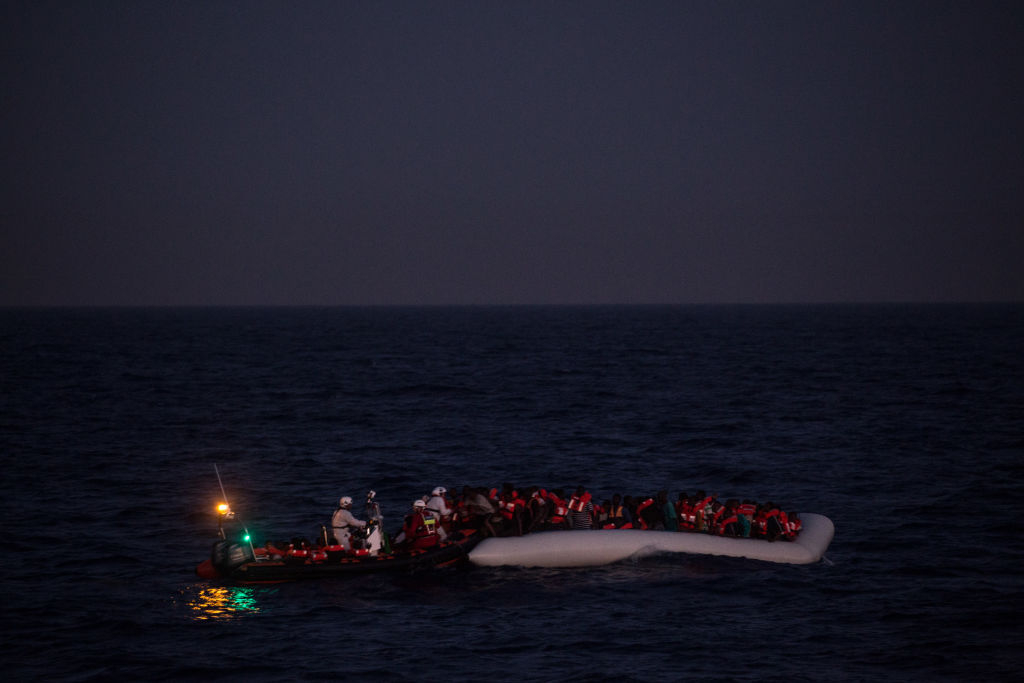
Migrants wait to be rescued by crewmembers from the Migrant Offshore Aid Station (MOAS) Phoenix vessel on June 10, 2017 off Lampedusa, Italy. (Photo by Chris McGrath/Getty Images)

In May, Italy signed a deal with Libya, Chad and Niger to stem the flow of migrants across the Mediterranean through improved border controls. In July, Italy also reached a deal with France and Germany to tighten the regulation of charities operating boats in the Mediterranean and to increase funds to the Libyan coast guard.

Since then, the Libyan coast guard has prevented thousands of migrants from leaving the Libyan coast for Italy. The crackdown, however, has sent would-be migrants scrambling for an alternative route to cross the Mediterranean. This appears to explain the increase in migrants arriving in Spain.

On August 14, Frontex, the European Union's border agency, reported that the number of African migrants arriving in Italy from Libya had dropped by more than half in July compared to the month before. During this period, the number of migrants arriving in Spain rose sharply.

Frontex said that 10,160 migrants had arrived in Italy by sea in July — 57% fewer than in June and the lowest level of arrivals for a July since 2014. According to Frontex, 2,300 migrants made it to Spain in July, more than four times as many as the year before. Most of the migrants arriving in Italy and Spain are believed to be economic migrants seeking a better life in Europe, not refugees fleeing war zones.
"The vast majority of migrants crossing to Italy from Libya come from Senegal, Gambia, Guinea and other west African countries," said Joel Millman, an IOM spokesman, in an interview with the Financial Times. "Given the crackdown on migration from Libya, it seems natural that many would forsake the dangerous dessert [sic] crossing to Libya and choose to cross from Morocco."

Julio Andrade, a city councilor in Málaga, a port city in southern Spain, called it "the balloon effect." In an interview with the Irish Times, he said: "If you squeeze one area, the air goes elsewhere. If there is a lot of police pressure and arrests of mafias around the Mediterranean routes via Greece and Italy, for example, then the mafias will look for other routes."

Spanish authorities have reported that there is a surge in African migrants attempting to cross the land border at Ceuta by scaling fences that are up to six meters (20 feet) tall and topped by razor wire. Spanish Interior Minister Juan Ignacio Zoido said there were 2,266 attempts to jump the perimeter at Ceuta during the first seven months of 2017, compared to a total of 3,472 attempts in all of 2016.

On August 7, more than 300 mostly sub-Saharan Africans ambushed Spanish and Moroccan security forces and stormed the border crossing at El Tarajal; 186 migrants made it onto Spanish territory. On August 8, more than a thousand migrants armed with spears and rocks attempted to breach the same crossing. On August 9, Spanish authorities closed the border for a week. On August 10, around 700 migrants stormed the border; 200 migrants were arrested.

Meanwhile, on August 9, a video showed a rubber boat carrying dozens of migrants arrive at a beach full of sunbathers in Cádiz. José Maraver, the head of a rescue center in nearby Tarifa, told the Telegraph that a second boat had landed on another beach in the area and that this scene was now a regular occurrence. "Every day there are boats, every day there is migration," he said. "The situation is getting very complicated."

Migrants are also using other means to reach Spain. On August 6, for example, four Moroccans reached the coast of Málaga on jet skis. During July and August, police intercepted at least two dozen migrants using jet skis to cross over to Spain. On August 10, police using motion detectors and thermal imaging sensors found 56 migrants, including 14 children, hiding inside trucks en route from Ceuta to the mainland ferry port in Algeciras.

In an August 9 editorial, Spain's El País newspaper said that it was "obvious that migratory pressure has moved to the western Mediterranean and there is no indication that this situation will change in the near future." It added:
"The migratory pressure Spain has experienced during the past several weeks is an increase of such dimensions that it exceeds all measures of surveillance and control. The massive entry of sub-Saharan people across the border of Ceuta, whether by jumping the fence or crossing the El Tarajal border, reveals the enormous difficulties in stopping the entry of those fleeing war, famine or economic hardship....
"The management of migratory flows requires a strong European policy and sufficient economic resources. Spain cannot stand alone as the guardian of southern Europe."
German Development Minister Gerd Müller recently warned that Europe must prepare for the arrival of millions more migrants from Africa:
"The biggest migration movements are still ahead: Africa's population will double in the next decades. A country like Egypt will grow to 100 million people, Nigeria to 400 million. In our digital age with the internet and mobile phones, everyone knows about our prosperity and lifestyle."
The director of the United Nations Office in Geneva, Michael Møller, has echoed those concerns:
"What we have been seeing is one of the biggest human migrations in history. And it's just going to accelerate. Young people all have cellphones and they can see what's happening in other parts of the world, and that acts as a magnet."
The President of the European Parliament, Antonio Tajani, said that in order to staunch the flow of migrants from Africa, the European Union would need to invest billions and develop a long-term strategy to stabilize the continent: "If we do not manage to solve the central problems in African countries, ten, 20 or even 30 million immigrants will arrive in the European Union within the next ten years."
Soeren Kern is a Senior Fellow at the New York-based Gatestone Institute.

Giulio Meotti : Muslims Tell Europe: "One Day All This Will Be Ours"

  • The Archbishop of Strasbourg Luc Ravel, nominated by Pope Francis in February, just declared that "Muslim believers know very well that their fertility is such today, that they call it... the Great Replacement. They tell you in a very calm, very positive way: One day all this, all this will be ours...".
  • Hungarian Prime Minister Viktor Orbán just warned against a "Muslimized Europe". According to him, "the question of the upcoming decades is whether Europe will continue to belong to Europeans".
  • "In the coming 30 years, the number of Africans will grow by more than one billion people. That is twice the population of the entire European Union... The demographic pressure will be enormous. Last year, more than 180,000 people crossed in shabby boats from Libya. And this is just the beginning. According to EU Commissioner Avramopoulos, at this very moment, 3 million migrants are waiting to enter Europe". — Geert Wilders, MP, The Netherlands, and leader of the Party for Freedom and Democracy (PVV).
This week, yet another Islamic terrorist attack targeted the Spanish city of Barcelona. As it was for many years under Muslim rule, it is, therefore, like Israel, land which many Islamists believe they are entitled to repossess.

At the same time, far from Spain, elementary schools have been closing, shuttered by the state after the number of children dropped to less than 10% of the population. The government is converting these structures into hospices, providing care for the elderly in a country where 40% of the people are 65 or older. That is not a science-fiction novel. That is Japan, the world's oldest and most sterile nation, where there is a popular expression: "ghost civilization".

According to Japan's National Institute of Population and Social Security Research, by 2040 most of the country's smaller cities will see a dramatic drop of one-third to one-half of their population. Due to a dramatic demographic decrease, many Japanese councils can no longer operate and have been closed. Restaurants have decreased from 850,000 in 1990 to 350,000 today, pointing to a "drying up of vitality". Predictions also suggest that in 15 years, Japan will have 20 million empty houses. Is that also the future of Europe?

Among the experts in demography, there is a tendency to call Europe "the new Japan". Japan, however, is dealing with this demographic catastrophe with its own resources, and banning Muslim immigration to the country.

"Europe is committing demographic suicide, systematically depopulating itself in what British historian Niall Ferguson has called "the greatest sustained reduction in European population since the Black Death in the fourteenth century'", as George Weigel recently noted.

Europe's Muslims appear to be dreaming of filling this vacuum. The Archbishop of Strasbourg, Luc Ravel, nominated by Pope Francis in February, recently declared that "Muslim believers know very well that their fertility is such today, that they call it ... the Great Replacement. They tell you in a very calm, very positive way: 'One day all this, all this will be ours' ...".

A new report by the Italian think tank Centro Machiavelli just revealed that if current trends continue, by 2065 first- and second-generation immigrants will exceed 22 million persons, or more than 40% of Italy's total population. In Germany, as well, 36% of children under the age of five are being born to immigrant parents. In 13 of the 28 EU member countries, more people died than were born last year; without migration, the populations of Germany and Italy are expected to decline by 18% and 16%, respectively.

The impact of demographic free-fall is most visible in what was once called the "new Europe", the countries of the former Soviet bloc such as Poland, Hungary and Slovakia, to distinguish these from the so called "old Europe", France and Germany. Those Eastern countries are now the ones most exposed to the "depopulation bomb", the devastating collapse in birth rate that the current-events analyst and author Mark Steyn has called "the biggest issue of our time".

The New York Times asked why, "despite shrinking population, Eastern Europe resists accepting migrants". The shrinking demography is precisely the reason they fear being replaced by migrants. In addition, much of Eastern Europe has already experienced being occupied by Muslims for hundreds of years under the Ottoman Empire, and are all too well aware what would be in store for them were they to come there again. Aging countries fear the antipathetic values sure to appear if there were a replacement by the current young foreign population.

"There are two distinct views in Europe today to consider [regarding the decline and aging of the population]", Hungary's Prime Minister Viktor Orbán recently said. "One of these is held by those who want to address Europe's demographic problems through immigration. And there is another view, held by Central Europe – and, within it, Hungary. Our view is that we must solve our demographic problems by relying on our own resources and mobilising our own reserves, and – let us acknowledge it – by renewing ourselves spiritually". Orbán just warned against a "Muslimized Europe". According to him, "the question of the upcoming decades is whether Europe will continue to belong to Europeans".

Hungary's Prime Minister Viktor Orbán recently said: "Our view is that we must solve our demographic problems by relying on our own resources and mobilising our own reserves, and... by renewing ourselves spiritually". (Image source: David Plas/Wikimedia Commons)


Africa is also pressing Europe with a demographic time bomb. According to Dutch parliamentarian Geert Wilders:
"In the coming 30 years, the number of Africans will grow by more than one billion people. That is twice the population of the entire European Union... The demographic pressure will be enormous. One-third of the Africans want to move abroad, and many want to come to Europe. Last year, over 180,000 people crossed in shabby boats from Libya. And this is just the beginning. According to EU Commissioner Avramopoulos, at his very moment, 3 million migrants are waiting to enter Europe".
Eastern Europe is thinning out. Demography has even become a problem for Europe's security. There are fewer people to serve in Europe's military and social welfare posts. The President of Bulgaria, Georgi Parvanov, has, in fact, called on the country's leaders to attend a meeting of the national Consultative Committee entirely devoted to the problem of national security. Once Eastern European countries feared Soviet tanks; now, they fear empty cradles.

The United Nations estimated that there were about 292 million people in Eastern Europe last year, 18 million fewer than in the early 1990s. The number is equivalent to the disappearance of the entire population of the Netherlands.
The Financial Times had called this situation in Eastern Europe "the largest loss of population in modern history". Its population is shrinking as has no other before. Not even the Second World War, with its massacres, deportations and population movements, had come to that abyss.

Orbán's way -- dealing with a demographic decline using the country's own resources -- is the only way for Europe to avoid Archbishop's Ravel's prediction of a "great replacement". Mass immigration will most likely fill those empty cradles -- but Europe will then become also just a becomes a "ghost civilization"; it is just a different kind of suicide.
Giulio Meotti, Cultural Editor for Il Foglio, is an Italian journalist and author.

APPENDIX

Romania will lose 22% of its population by 2050, followed by Moldova (20%), Latvia (19%), Lithuania (17%), Croatia (16%) and Hungary (16%). Romania, Bulgaria and Ukraine are the countries where the population decline will be most severe. Poland's population is estimated to decrease by 2050 to 32 million from the current 38 million. Nearly 200 schools have closed, but there are enough children to fill the remaining ones.

In Central Europe, the proportion of "over 65s" increased by more than one-third between 1990 and 2010. The Hungarian population is at its lowest point in half a century. The number of people fell from 10,709,000 in 1980 to the current 9,986,000 million. In 2050, there will be fewer than 8 million people in Hungary; and one in three will be over the age of 65. Hungary today has a fertility rate of 1.5 children per woman. If you exclude the Roma population, this figure drops to 0.8, the lowest in the world -- the reason Prime Minister Orbán announced new measures to solve the demographic crisis.

Bulgaria will have the fastest population decline in the world between 2015 and 2050. Bulgaria is part of a group that is expected to decrease by more than 15% between 2015 to 2050, along with Bosnia-Herzegovina, Croatia, Hungary, Japan, Latvia, Lithuania, Moldova, Romania, Serbia and Ukraine. Bulgaria's population of about 7.15 million people is estimated to fall to 5.15 million in 30 years -- a decline of 27.9%.

Official figures show that 178,000 babies were born in Romania. By comparison, in 1990, the first post-Communist year, there were 315,000 births. Croatia last year had 32,000 births, a decline of 20% from 2015. The depopulation of Croatia could come to more than 50,000 people each year.

When the Czech Republic was part of the Communist bloc (as part of Czechoslovakia), its total fertility rate was conveniently close to the replacement rate (2.1). Today it is the fifth most barren country in the world. Slovenia has the highest GDP per capita in Eastern Europe, but an extremely low fertility rate.

Majid Rafizadeh : When Feminists Join Islamist Terrorists

  • The fact is that these supposed feminists not only turn a blind eye to those atrocities, but their presence at these events actively endorses and legitimizes the rule of these dictators.
  • When the subject turns to the specific cases of millions of oppressed women around the world -- such as Asia Bibi, a Christian mother on death row in Pakistan for seven years for taking a drink of water; or the 19-year-old who, this year, was raped by her cousin at gunpoint and then sentenced to death by stoning for "adultery"; or women who were forced to marry their rapists; or child marriages at 12,000 a day; or women who are beaten by their husbands or who have acid thrown in their faces; or women used as suicide bombers.
  • When Mogherini smiles in her hijab in Iran, she is delivering a strong blow to women rights movements that attempt to remove the compulsion of the obligatory hijab and grant women equal autonomy, education and freedom. She is empowering suppression.
The social democrats and so-called feminists have been raising their voices for all to hear. They boast about advocating gender equality, individual rights, and advancing women's rights. They argue that these values are universal; that every person, especially every woman, everywhere in the world, is entitled to these "inalienable" rights. Speeches are given, fundraisers are held, and an army of champions charges toward the cause.

Everyone is equal, and everyone deserves these rights. The chants, the inspirational lectures, the determination that echoes through television interviews, and is spread across the pages of magazines, all fill their followers with enthusiasm. But what is the reality?

Alongside other social democrats, Federica Mogherini, the current High Representative of the European Union for Foreign Affairs and Security Policy, recently visited the Islamist state of Iran to attend the official endorsement and inauguration of the regime's president, Hassan Rouhani. Instead of enforcing the standards she professes -- such as the strong support for women -- she folded in with those around her. Others who accepted Iran's invitation were North Koreans, members of Hezbollah, and leaders of Hamas. All three of these groups are known for cruelty, especially against women, and crimes against humanity.

The presence of such people makes the issue of despotism more complicated than it needs to be. By attending these kinds of events, social democrats such as her repeatedly endorse and give legitimacy to repressive states that implement Islamic law, Sharia. As Mogherini rubs elbows with men who have ordered the deaths of thousands of women (and men), she toes the line of their expectations. Instead of evolving their mindset, she allowed all of the women she claims to represent, to remain oppressed, as they have been for so very long.

Mogherini took the problem even a step even farther. Instead of attempting to appear as if she were working toward progressive thinking among these violent Islamist leaders, she acted as if they were friends. She appeared proud to snap selfies with the representatives of this repressive regime. The story came under the international spotlight. Some of the deputies used their selfies with Mogherini to project their legitimacy to the international community while others created self-promotional posters of themselves with Mogherini wearing the mandatory hijab. Mogherini, a social democrat Italian politician who speaks of women's rights and was once a member of the Italian Communist Party, delightedly agreed to follow the Islamist rule of wearing a mandatory hijab. This act of compliance sends a brutal and unshakeable message. Women in these Islamist societies are controlled by laws which proclaim they must be hidden, or treated as their husband's property. The hijab has become a symbol of this. Conversely, when Iranian leaders visit Mogherini's country, they do not follow Italy's rules. Instead, Italy follows the regime's Islamist rules by offering appeasements such as covering up nude statues and not serving wine.

Mogherini -- who years ago also agreed to be in controversial picture taken with the late Palestinian Authority Chairman Yasser Arafat -- also played a crucial role in sealing the nuclear agreement for the Iranian regime and lifting the sanctions for those dictators. Instead of seeing these oppressors punished, she enabled them to have fewer limitations, as they still hold their own people beneath their thumbs and continue to be the cause of their suffering.

Mogherini then tweeted about her blog post, which states "It was an opportunity to talk again to Rouhani, to Foreign Minister Javad Zarif and to the Supreme Leader's foreign policy advisor, Ali Akbar Velayati".
Is this really an opportunity to be proud of and boast about? And what did she talk to them about?

While Mogherini is joyfully attending events with these Islamist leaders and rejoicing in having taking pictures beside them, does she ever think about the millions of women who are brutally oppressed under these Islamist regimes? Does she consider those women balled up and crying on the floor after being beaten by their husbands? Does she ever think about hundreds of people -- men and women -- being executed, often after sham trials, every year, and based on the Islamist laws in this country?


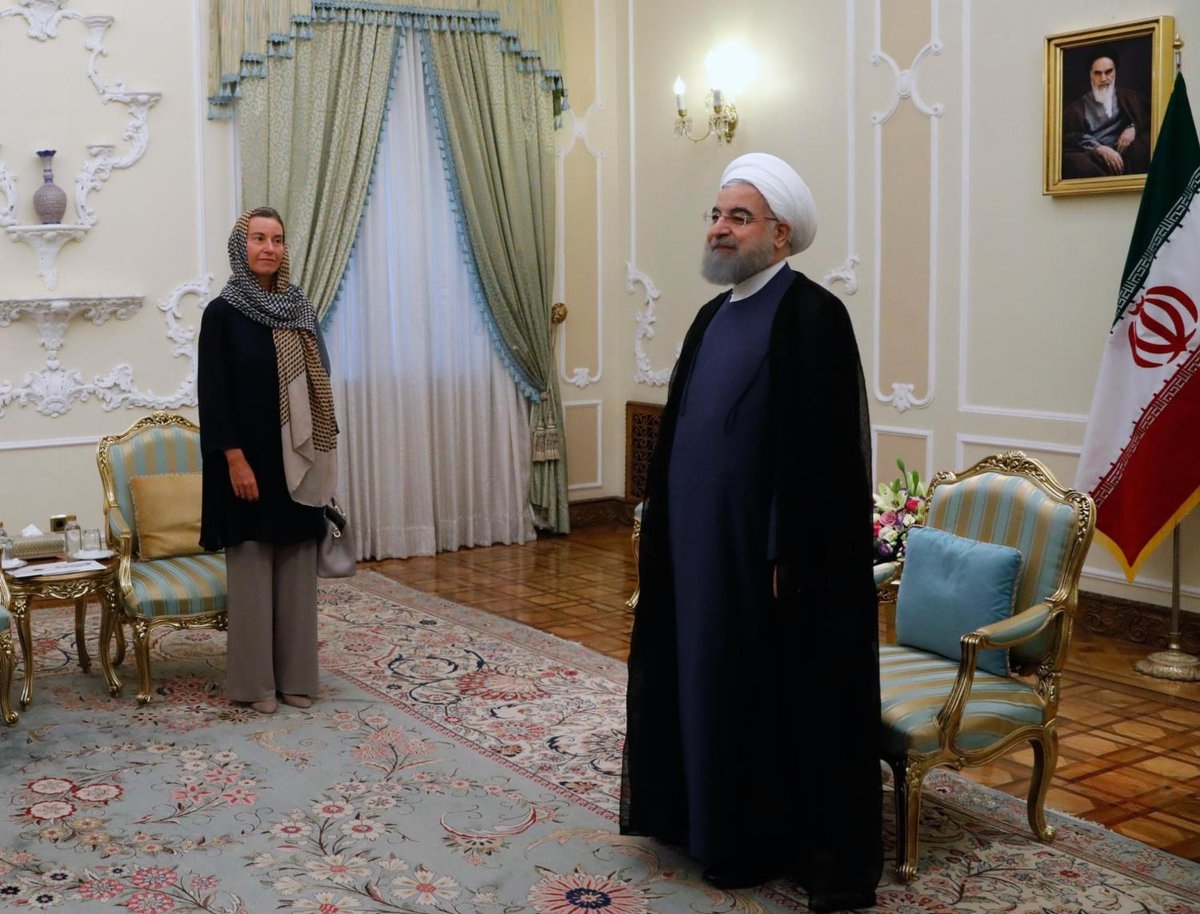
During her visit to Iran this month, Federica Mogherini (left), the current High Representative of the European Union for Foreign Affairs and Security Policy, rubbed elbows with men who have ordered the deaths of thousands of women (and men). Does she ever think about hundreds of people being executed, often after sham trials, every year, and based on the Islamist laws in this country? (Image source: European Commission)

While she shakes the hands of these men, does think of the nine-year-old girls who are "legally" being forced into marriage with the government's approval?
Where are all the women's rights, liberal moral values that she and her party stand for? They were not at the celebration, and they were certainly not represented by those selfies.

Women are dehumanized, subjugated and treated as inferior on a daily basis in Islamist state of Iran as well as other Muslim states. Many people in there are struggling every day despite all the dangers they face to obtain the few rights they can. In general, a woman's testimony in court is worth half of a man's testimony. Women need approval from their male guardian to leave the country, and in Saudi Arabia, to leave their home. Women cannot obtain a passport without a guardian's consent. In Iran, a man can marry any woman he desires. Men are allowed to have four wives and an unlimited number of temporary marriages (mut'a), but women can only marry a Muslim man. Honor killings continue while the regime turns a blind eye to them.

Based on the law of tamkin (obedience), women must provide full accessibility and unhampered sexual availability to her husband. Article 1105 of Iran's Islamist Civil Code states, "In relations between husband and wife, the position of the head of the family exclusively belongs to the husband." Article 1117 of the Iran's Islamist Civil Code states that states :
"The husband can prevent his wife from an occupation or technical profession which is incompatible with the family's interests or the dignity of him or his wife."
Men can initiate a unilateral divorce. Women receive only half of what men get in inheritance. A wife gets to receive only one-sixth of an inheritance if she has a son when her husband dies. If she has only a daughter, the inheritance would not automatically go to them. The deceased husband's family -- brothers, sibling and parents -- would have a call on it as well. Women cannot become judges... and the list goes on.

Of course, people such as Mogherini are fully cognizant of these atrocities and the discrimination which are repeatedly reported by human rights organizations. These are even possibly the same abuses that people such as Mogherini then use to rally funds at their parties and splash in disturbing images across the media. Not one of these European leaders can plead ignorance of the acts that those men commit.
Yet, there we see people like Mogherini shaking the hands that rob women of their freedom and their voices.

The fact is that these supposed feminists not only turn a blind eye to those atrocities, but their presence at these events actively endorses and legitimizes the rule of these dictators.

People like Mogherini may be calling for admission to exclusive clubs and higher salaries for women because that equality is fair. But why, if they claim that they are champions and front-runners of women all around the world, do they contribute to, and facilitate the rule of ruthless dictators against their own people?

When the subject turns to the specific cases of millions of oppressed women around the world -- such as Asia Bibi, a Christian mother on death row in Pakistan for seven years for taking a drink of water; or the 19-year-old who, this year, was raped by her cousin at gunpoint and then sentenced to death by stoning for "adultery"; or who were forced to marry their rapists; or child marriages at 12,000 a day; or women who are beaten by their husbands or who have acid thrown in their faces; or women used as suicide bombers -- they become totally silent. They disregard these women's rights.

By demonstrating their support for these regimes and the men that enforce them, people such as Mogherini significantly weaken and undermine the indigenous movements that attempt to advance precisely the human rights that people such as Mogherini claim to advocate.

When Mogherini smiles in her hijab in Iran, she is delivering a strong blow to women rights movements that attempt to remove the compulsion of the obligatory hijab and grant women equal autonomy, education and freedom. She is empowering suppression.

A true advocate of individual rights and democracy might instead have set a brave example. Women such as Mogherini are feeding into the system, not destroying it. Those who continue to give legitimacy to oppressors and Islamists need to be held accountable.

Finally, my message to people such as Mogherini and others like her is simple: Do you have any conscience or sense of decency? Or is it simply all about power, money, narcissism, and manipulations at the cost of the oppressed, including women? Can you hear that little girl's cry, or are your ears as deaf to it as the men who cause it?

Dr. Majid Rafizadeh is president of the International American Council on the Middle East. He is a Harvard-educated and Iranian-American political scientist, businessman, and author of "Peaceful Reformation in Iran's Islam". He can be reached at Dr.Rafizadeh@Post.Harvard.Edu.
  • Follow Majid Rafizadeh on Twitter

Friday, August 11, 2017

John Derbyshire: Race Realism Has a Past. Does Race Denialism Have a Future?


John Derbyshire At AMREN 2017: Race Realism Has a Past. Does Race Denialism Have a Future?

John Derbyshire
August 8, 2017, 

 http://www.vdare.com/articles/john-derbyshire-at-amren-2017-race-realism-has-a-past-does-race-denialism-have-a-future?content=is%20race%20denialism.


John Derbyshire writes: I gave a half-hour PowerPoint presentation under this title to the AmRen Conference on July 29th 2017.  Video of the event will be posted at the AmRen website some time soon.
As a pre-Information Age relic, my default format is the essay.  For events like this, I first write out an essay, then boil it down to PowerPoint slides.
PowerPoint is performance art (“Power corrupts: PowerPoint corrupts absolutely”—Roger Kimball), so the presentation had additions and subtractions from what’s written below.  Subtractions especially: “Better too much than too little” is my rule.


Introduction

With all the chatter about the Alt Right that came up in last year’s election season, Jared Taylor has been doing some interviews recently.  The interviewer—this one, for example—generally opens by asking: “What is your organization, this American Renaissance, all about?  What do you stand for?”
Jared commonly gives a two-part answer.
  • First, he says, we are a white advocacy group, speaking up on behalf of the collective interests of white Americans and pushing back against the anti-white rhetoric that pervades our culture.
  • Second, we are race-realist, seeking to promote honest, open discussion about race differences and their implications for social policies, especially immigration, education, and law enforcement.
You have heard, or will be hearing, white advocacy from Jared himself and from other speakers at this conference.  In this talk I am going to turn my plow into the other field.  I am going to talk about race realism, and about the opposite thing: race denialism.
Let me define these two positions:  race realism and race denialism.
Race realism is the point of view that:
  • Like any other widely-distributed species, Homo sapiens is divided into local varieties—races—that differ in their biology.
  • Where races show different statistical profiles on heritable traits—physiognomy, metabolism, disease susceptibility, and the BIP traits (Behavior, Intelligence, Personality)—it is reasonable to infer that biological differences are causal factors.
  • Biological race differences work together with adscititious factors (history, geography, epidemiology) to shape social outcomes.
The opposite of race realism is race denialism.
Race denialism is the point of view that:
  • Observed group differences between local varieties of Homo sap. are superficial and inconsequential, like the hair color of individuals.
  • The different statistical profiles of races on BIP traits and social outcomes are entirely caused by historical and social factors. Biology plays no part.
My approach here will be chronological.  I’m going to take a look at the present of both race realism and race denialism; then at the past; then I’ll offer some speculations about the future.

The Present Situation, West and East

The intellectual climate in the West today is one of guerilla race realism.
  • The commanding heights of Western societies—media, schools, politics—are held by race denialists.
  • Race denialism is a social dogma. All respectable people are required to affirm it.
Meanwhile, in the maquis:
  • The biological and human sciences (especially genetics, psychometry, paleoanthropology) uncover ever more race-realist facts—“hatefacts.”
  • Ever more educated, thoughtful citizens observe persistent patterns in group social outcomes that contradict official dogma. (The thoughtcrime of Noticing.) They conclude that the race-denialist Emperor has no clothes.


The guardians of race denialism are obliged to conduct counter-guerilla operations. 
Here is a representative one from—yes!—The Guardian, May 1, 2015.  The occasion here was the publication of Nicholas Wade’s race-realist 2014 book A Troublesome Inheritance.

Guardian reviewer Adam Rutherford [Email him] cracked the race-denialist whip.
We now know that the way we talk about race has no scientific validity. There is no genetic basis that corresponds with any particular group of people, no essentialist DNA for black people or white people or anyone … There are genetic characteristics that associate with certain populations, but none of these is exclusive, nor correspond uniquely with any one group that might fit a racial epithet.
Race doesn’t exist, racism does. But we can now confine it to opinions and not pretend that there might be any scientific validity in bigotry.
Indeed.  Some sub-Saharan Africans, of entirely local ancestry, have white skin.  They are albinos.
So white skin is certainly not exclusive to non-Africans.
So … there is no such thing as race?

Rutherford here is retailing an argument put forward by Marxist ideologue Richard Lewontin in 1972, an argument since debunked so often and comprehensively it commonly appears in reference sources as “Lewontin’s Fallacy.” [PDF] Wade deals with it in his book (Chapter 5).

So much for the Western world of today.  What about the East?
The advanced nations of East and South Asia are broadly race-realist.  Race denialism is not a social dogma in China, India, Japan, or Korea.
These nations are, however, monoracial (or in India’s case long, long accustomed to the racial mix they have), and apparently wish to remain so.
Race realism and race denialism are therefore not salient topics in the current intellectual climate of Eastern Civ.

The Salience of Race

When discussing the past of race realism and race denialism, as always with historical topics, some effort of imagination is necessary.
From the beginnings of science in the 17th century to the rise of the U.S.A. in the late 19th, the center of Western intellectual activity was in Europe.  For Europeans of this period, race in the modern understanding was not salient.  It occupied very little space in their minds.
“Race” to them generally meant “nationality.”  A character in Benjamin Disraeli’s 1847 novel Tancred says: “All is race, there is no other truth.”  He was referring to the Anglo-Saxon-Celts of the British Isles, in the context of the rise and fall of nations within Europe.
Similarly with Winston Churchill’s 1964 (!) book The Island Race, also about the British.  The race referred to in the title of Madison Grant’s 1916 bestseller The Passing of the Great Race was the Nordics, a subset of white Europeans.
As a dabbler in the history of mathematics, my favorite in this line comes from a speech with the title “Mathematics Knows No Races” (Die Mathematik kennt keine Rassen) prepared by David Hilbert for the International Congress of Mathematicians in Bologna, 1928.
Mathematics Knows No Races. If we look — even superficially — at the history of our science, we see all nations and peoples, the big as well as the small, taking successful and equal part in it. Let us think of Descartes, Fermat, Pascal,Huygens, Newton, Leibniz, Bernoulli, Euler, d’Alembert, Lagrange, Monge, Laplace, Legendre, Fourier, Gauss, Poisson,Möbius, Chasles, Lamé, Steiner, Abel, Jacobi, Dirichlet, Hamilton, Riemann, Clebsch, Cantor, Poincaré, Darboux,Klein — these names are thrown wildly among the nations, as a dice-cup couldn’t do more thoroughly and less biased [gründlicher und unparteiischer].
My photomontage makes my point: “race” in this usage is distinctly monochromatic.


For one more example of the weak salience of race in Europe until recent decades I bring forward my grandfather’s 1922 Atlas-Guide to the British Commonwealth of Nations and Foreign Countries.  From which:
1922 populations
  • British Isles: 47.31 million.
  • British West Africa: 22.48 million.
  • Ratio: 2.10.
Compare:
2015 populations
  • UK + Irish Republic: 68.97 million.
  • Nigeria + Ghana + Sierra Leone + Gambia: 215.74 million.
  • Ratio: 0.32.
“Numbers are of the essence”—Enoch Powell.

Race Realism Has a Past

Before the 17th-century scientific revolution, ideas about race were inchoate and unsystematic—“Folk anthropology.”
To the degree they included notions we would now consider biological, those notions came from:
From these, by the time methodical science arrived on the scene, civilized peoples had a fair, but unorganized, stock of knowledge about inheritance and genetic similarity.


With the Enlightenment, systematic biological classification was attempted, most persuasively by Linnaeus.  Philosophers also took an interest—Kant, for example.
Race in the modern sense was salient in the 18th-century Americas and the Caribbean, which had long made use of black African and (to a much smaller degree) local indigenous peoples as slave labor.  It was salient, too for the small minority of Europeans who had first-hand experience of Europe’s overseas empires.
This did not lead to much scientific theorizing, but it did cause a lot of noticing.  Thomas Jefferson can be taken as representative.
The “long” 19th century (i.e. to 1914) saw the end of race slavery in the civilized world, and the rise and acceptance of evolutionary biology.  There was much theorizing about race, most of it not very scientific.  Charles Darwin was of course an outstanding exception—a great scientist.


The 20th century saw the rise of population genetics (Wright, Fisher, Haldane), the neo-Darwinian synthesis (Dobzhansky, Mayr) in evolutionary biology, the molecular structure of DNA (Watson & Crick), and rigorous psychometry (Burt, Eysenck, Jensen).
All these developments had implications for the understanding of race as a feature of the human world.

Race Denialism Has a Past, Too.

Race denialism has a past at least as long and respectable as race realism’s.
Pre-modern civilizations often had race-denialist themes.  Most interpretations of Christianity have been race-denialist.  Missionary endeavors by white Christians among other races were usually inspired by race-denialist ideas about the Brotherhood of Man.  There were similar strains in the other big old religions.
(This didn’t stop the pre-moderns practicing race slavery.  At least one medieval Pope accepted a gift of African slaves as tribute to the Holy See.  Devoutly Muslim Saudi Arabia did not abolish slavery until 1962.)
The European Enlightenment brought a new style of moral universalism that was implicitly race-denialist.
You see this in, for example, Dr. Johnson’s preface to Fr. Lobo’s Voyage to Abyssinia (1735):
The reader will … discover, what will always be discovered by a diligent and impartial inquirer, that, wherever human nature is to be found, there is a mixture of vice and virtue, a contest of passion and reason.
Johnson famously remarked at the time of the American Revolution: “How is it that we hear the loudest yelps for liberty among the drivers of negroes?”  He employed a black manservant, Francis Barber, whom he treated kindly and to whom he left a bequest in his will.  Barber’s descendants still farm in Staffordshire.
The most important legacy of Enlightenment universalism today is found in college departments of Economics (in some ways the quintessential Enlightenment discipline), where human beings and human populations are treated as perfectly interchangeable units without biological essence.
There has, though, been some low-level guerilla activity in those departments in recent years.  Presumably Behavioral Economics will at some point have to seek terms from Behavioral Genetics; but that point is a couple of decades away, at least.
As the Enlightenment made room for the Romantic era, a strain of “romantic primitivism” came up, with the Noble Savage as a stock figure.  Jean-Jacque Rousseau is generally blamed here; but in fact some related notions can be traced all the way back to the pastoralism of ancient poets (Hesiod, Vergil), and are present in other civilizations (e.g. in Taoism).
Enlightenment universalism did not always get on well with romantic primitivism, its illegitimate offspring.  When James Boswell ventured an admiring remark about Polynesians, Johnson slapped him down with: “Don’t cant in defence of savages.”
Romantic primitivism evolved naturally into phenomena of our own time:  white ethnomasochism and reverence for the “magic Negro.”

Race Denialism’s Past (Cont.): 
After the Enlightenment 
 
During the “long” 19th century, elite Protestant universalism in the U.S.A. was implicitly race-denialist.  Most Abolitionists were race-denialists.
Harriet Beecher Stowe, for example, closed out her book Uncle Tom’s Cabin with a plea to fellow Christians to educate and improve freed slaves so that when shipped to Liberia (as most white Americans, including most Abolitionists, wanted), they could build a successful modern country over there.


The subsequent history of Liberia suggests that either the author’s plea was not heard—remarkable, for such a colossally-bestselling book—or that the race-denialist premises underlying it are false, or both.
A more consequential development in race denialism was the anthropology of Adolf Bastian and his acolytes.
In 1859, the year Darwin published On the Origin of Species, Bastian coined the phrase “the psychic unity of mankind” (die psychische Einheit des Menschen).
Bastian’s most important follower, in the next generation, was Franz Boas.  Boas brought Bastian’s universalism to the U.S.A., where it took over the social and human sciences in the decades after WW1.

“Culture” became the standard rationale for group differences—a sort of all-explanatory phlogiston or luminiferous aether.

This modern race denialism got a mighty boost from WW2—what Peter Brimelow calls “Hitler’s Revenge.”

Yet at the same time, biology was staging something of a recovery in the human sciences, at least at the guerilla level.  Carl Degler tells the story in his 1991 book In Search of Human Nature.  Degler tracks the beginnings of the revival to post-WW2 psychologists, dissatisfied with the cold mechanics of Behaviorism.
A key event was the publication in 1975 of E.O. Wilson’s Sociobiology, which, as its title plainly tells, sought to apply biological principles to human society.
Forty-two years on from that, you can still get yourself into major trouble by mentioning sociobiology in an academic journal of the Humanities, as Professor Wolters discovered recently.

So the revival of biology in the social and human sciences remains at the guerilla level.  Carl Degler, writing in 1991, did not foresee this.  Indeed, the 1990s proved to be a time of remarkable openness in those sciences.  I had a go at quantifying this once.  Peter Brimelow calls that period an “interglacial.”
The ice-sheets have since returned.

Race Realism’s Future

What then is the future of race realism?
At the level of research into the rigorous sciences, race realism is established fact.
The human genome and its many varieties are now the subject of massive, lavishly-funded research.  A person’s self-identified race can be read off from the genome with 99 percent accuracy.
China is a big player here, but genomic research is happening all over: in Ireland, for example.
Deeper understanding of the genetic architecture of BIP traits, and of race differences in that architecture, will inevitably emerge as a by-product of this research.
Mapping that genetic architecture is, however, harder than we thought 20 years ago.  Thousands of genes are involved, each with a tiny effect (and possible side-effects).
That is no excuse for race denialism: “You don’t need to know the name and job description of every worker in the factory to know that the factory produces widgets.”
It does, though, mean that race denialism has plenty of life in it yet.

Race Denialism’s Future

It may well be that while race denialism disappears from the rigorous sciences, it maintains its grip on the social sciences, and on the liberal-arts elites who control the cultural heights of Western nations.
Understandings from the rigorous sciences can take an awfully long time to be accepted outside the labs.
As I have written myself:
More important, especially in this supremely un-PC area, is the power with which the human mind resists science. When the boffins deliver some irresistible amenity—a drug, a plane, a light switch—there is grudging acceptance that the underlying principles must have some epistemic content. In other cases, nobody much is convinced. Forty-six percent of Americans deny the truth of evolution.
The collective death-wish that seized the European-derived civilizations sometime in the second half of the 20th century has hardened from mere wish to near-fanatical determination. The dogma of utopian egalitarianism, that has been used to justify the opening of white nations (with a very few exceptions) to mass immigration from regions with very different civilizational attainment, or none, waxes stronger by the hour.
And if you doubt that race denialism can persist in the teeth of obvious fact and proven science, consider sex denialism.


Here was Nicholas Matte, Lecturer in History at the University of Toronto; speaking on The Agenda (a Canadian TV program), October 2016:
Basically, it’s not correct that there is such a thing as biological sex.  And I’m a historian of medicine; I can unpack that for you accurately at length if you want, but in the interests of time I won’t.  So that’s a very popular misconception.
Once again: That is a licensed, credentialed academic in the Humanities speaking.
If we can deny the reality of sex, what aspect of human biology can we not deny?
The White Queen, speaking to Alice in Through the Looking-Glass:
Why, sometimes I’ve believed as many as six impossible things before breakfast.
That’s what human beings are like—other than the few freaks and misfits who take the empirical sciences seriously.  As a very wise man once wrote:
The ordinary modes of human thinking are magical, religious, social, and personal. We want our wishes to come true; we want the universe to care about us; we want the approval of those around us; we want to get even with that s.o.b who insulted us at the last tribal council. For most people, wanting to know the cold truth about the world is way, way down the list.  (We Are Doomed, Chapter 7.)
Let’s not get our hopes up.  Race denialism will be around for a while yet.

-----------------

John Derbyshire [email him] writes an incredible amount on all sorts of subjects for all kinds of outlets. (This no longer includes National Review, whose editors had some kind of tantrum and fired him. ) He is the author of We Are Doomed: Reclaiming Conservative Pessimism and several other books.  He has had two books published by  VDARE.com com:FROM THE DISSIDENT RIGHT (also available in Kindle) and  FROM THE DISSIDENT RIGHT II: ESSAYS 2013.
For years he’s been podcasting at Radio Derb, now available at VDARE.com for no charge.His writings are archived at JohnDerbyshire.com.