 What
would Russian President Vladimir Putin do if China invaded Russia to
regain control of territory that was once Chinese? If we accept that
what once belonged to one state can never belong to another, Crimea must
be handed over to Turkey as successor to the Ottoman caliphate, or,
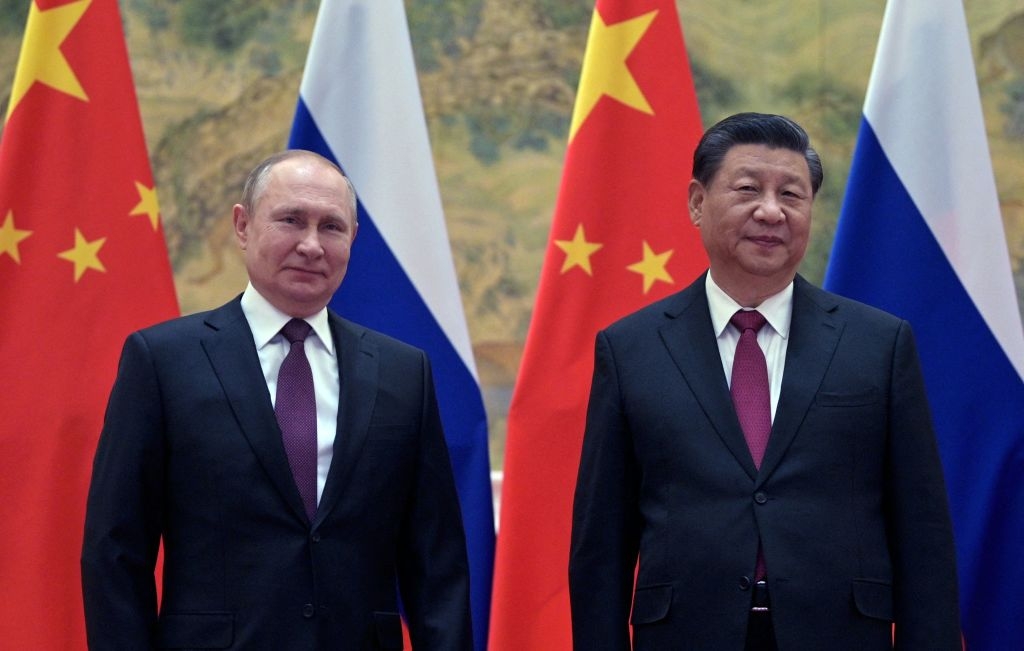
even better, the Tatar khans who ruled it before the Ottomans. Pictured:
Putin (L) and Chinese President Xi Jinping meet in Beijing on February
4, 2022. (Photo by Alexei Druzhinin/Sputnik/AFP via Getty Images) |
Who do you think is to blame for the war in Ukraine?
For the Blame-America-International the answer is simple: the culprit is the United States.
At one end of the Blame-America International (BAI), we find usual
suspects such as the Khomeinist mullahs, the Sudanese and Burmese
jackboots, the Maoists of Eritrea, the Assad clan in Damascus and the
bad boys of Belarus. These one could dismiss if only because their
mercenary status is clear.
It is at the other end of the spectrum that one finds a potentially
more dangerous narrative at a time that what is euphemistically referred
to as the world order is facing its biggest challenge since World War
II. For here we find individuals and groups that try to use, or rather
abuse, such labels as "public intellectuals" and/ or "elder statesmen"
to legitimize Vladimir Putin's invasion.
That narrative is peddled by people like former UK Foreign Secretary
David Lord Owen, professors John Mearsheimer and Stephen Walt, French
presidential candidates Marine Le Pen, Éric Zemmour and Jean-Luc
Mélenchon, British columnist Peter Hitchens, and a string of lesser
known figures in Europe and the United States.
They all build their narrative around three charges.
The first is that Putin and his Russia must be seen as victims of the
United States' insatiable quest for global hegemony by constantly
trying to downgrade Russia's status.
The second is that, by trying to include Ukraine in its ranks, the
North Atlantic Treaty Organization (NATO) posed a direct threat to
Russia's national security, a threat that no Russian leader could
ignore.
The third is that Ukrainian leaders, prompted by Washington, refused
to recognize Russia's right to "reintegrate" the Crimean Peninsula, a
part of Russian homeland that Nikita Khrushchev, a Ukrainian chauvinist
disguised as a Bolshevik, snatched away from Mother Russia.
As for the first charge, the opposite may be nearer to the truth.
Four successive US administrations starting with George WH Bush's
went out of their way not only to soften the shock caused by the
collapse of the Soviet Empire but also to recognize Russia as its
legitimate successor with "superpower" status.
Although post-Soviet Russia was diminished in terms of demographic,
economic, diplomatic and military power, all treaties and procedural
agreements concluded with the USSR remained in force. The US worked
closely with Moscow to smooth the difficult transition that Europe faced
as the Warsaw Pact was dissolved and the European Union enlarged.
Anxious to keep Russia "on board," the US campaigned for Russia's
membership of the G7 (which became G8) and the World Trade Organization
(WTO), helped open global capital markets to Russia, and encouraged
American businesses to heavily invest in developing the post-Soviet
economy.
It is no exaggeration to suggest that the American stamp of approval
played a key role in encouraging other foreign investment, especially
European, followed by the biggest transfer of technology witnessed in
Russian history.
The second charge related to NATO's alleged rush to included Ukraine,
or what Mearsheimer calls "reckless expansion", provoked Putin is
equally absurd.
To start with, NATO never invites any state to join. It is up to
other states to apply for membership and, to this day, Ukraine has not
done so and, if it did, it is clear that its application would be
unacceptable under NATO's rules, which exclude any country with
unresolved irredentist and/or other territorial disputes with any other
nation.
For almost two decades, Russia made no objection to NATO enlargement
that included former members of the Warsaw Pact. Under Putin, Russia
even concluded a deal for cooperation with NATO on issues of mutual
security, with the Helsinki Accords as historic reference. In 2002,
Putin met NATO Secretary-General George (Lord) Robinson and quipped that
"maybe it is time NATO invited Russia to become a member."
Robinson wasn't sure whether that was a serious approach or Russian
black humor but reminded Putin that NATO never issues invitation but
would consider applications.
In NATO's 2008 Bucharest summit, both Georgia and Ukraine expressed
the desire to apply for membership but were quietly told not to submit
formal applications. The undeclared reason was the persistence of
irredentist problems both had with Russia. Putin interpreted that as a
rebuff to Kiev and Tbilisi by NATO and invaded Georgia, snatching South
Ossetia and Abkhazia.
The "provocation" charge is equally nonsensical.
However, even if there was provocation shouldn't one apportion blame
between the provoker and the provoked? Isn't the rapist who claims he
was provoked because his victim wore provocative dress at least as much
to blame as the victim?
Without saying so, the pro-Putin chorus is advocating a new concept,
that of limited sovereignty for countries that were once part of the
Tsarist and/or Soviet empires. That concept would apply not only to
Ukraine and Georgia but also to the Baltic republics and the Eastern
European members of the defunct Warsaw Pact. In his latest rhetoric,
Putin has extended that concept to Central Asian republics, Serbia,
Macedonia, Kosovo and Albania in the Balkans.
More importantly, perhaps, should the "threat to national security" be regarded as an excuse exclusive to Vladimir Putin?
The Montevideo Convention of 1933-34, in its Article 8, stipulated
that "no state has the right to intervene in the internal and external
affairs of another." Later, it became a fundamental principle of the
United Nations and the world order that has shaped the global system for
seven decades.
Mercifully, not even Éric Zemmour repeats Putin's absurd claim that
Ukraine is governed by neo-Nazis, implying that the current war is a
sequel to World War II.
However, the claim that Ukraine's refusal to accept the loss of
Crimea, and presumably also of Donbas, left Putin with no choice but to
invade is equally questionable. What would Putin do if China invaded
Russia to regain control of territory that was once Chinese?
If we accept that what once belonged to one state can never belong to
another, Crimea must be handed over to Turkey as successor to the
Ottoman caliphate, or, even better, the Tatar khans who ruled it before
the Ottomans. As for Donbas and chunks of southern Russia returning to
"original owners", this means the revival of the Cossack state that once
controlled both.
It is a pity, not to say a shame, that hatred for America has led so
many otherwise sane people to endorse Putin's authorship of a great
tragedy.
Amir Taheri was the executive editor-in-chief of the daily Kayhan in
Iran from 1972 to 1979. He has worked at or written for innumerable
publications, published eleven books, and has been a columnist for Asharq Al-Awsat since 1987.
This article was originally published by Asharq al-Awsat and is reprinted by kind permission of the author.