.

.
Library of Professor Richard A. Macksey in Baltimore

POSTS BY SUBJECT

Labels

Monday, May 21, 2012

Great Pyramid - PYRAMIDS AND GEOPOLYMERS - 9.The Birth of Masonry, 10.The Invention of Stone Buildings

PYRAMIDS AND GEOPOLYMERS


BOOK: THE PYRAMIDS AN ENIGMA SOLVED
Prof. Joseph Davidovits
Chapter 9
The Birth of Masonry


The role of the historian is to explain why events occur as they do. Many important facets of history have eluded historians as a result of lost knowledge about the alchemical stonemaking technology. Now that the old science is recovered, one is called to re-examine several is- sues. New light is shed on the developments that led to the construction of the first pyramid. One can recognize reasons for the rise and decline of pyramid building. These have been improperly understood as have critical periods of instability and decline in the Egyptian civilization. Then there is the question of how such an important technology could have been lost. If the old science really did exist, there must be some historical traces. An exploration of these issues sheds new light on many aspects of history. The historical remnants provide additional, powerful proof and significantly deepen our understanding.
The oldest known remains of high-quality cement are found in the ruins of Jericho in the Jordan valley. They date from 9,000 years ago. We know that white lime vessels, based on the synthesis of zeolites, were produced in Tel-Ramad, Syria, 8,000 years ago. Mortar from this era has also survived from Catal Hujuk, Turkey. The existence of these ancient products suggests that the earliest stonemaking technology migrated into Egypt.
Settlers attracted by the fertile valley arrived with various animals, plants, traditions, skills, materials, and processes. Hard stone vessels first appeared in pre-dynastic Egypt at about 3800 BC. Later, approximately 30,000 hard stone vessels were placed in the first pyramid, the Third Dynasty Step Pyramid at Saqqara. Many of the vessels were handed down from ancestry.
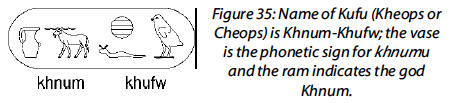
Stone vessels were sacred funerary objects, probably offering vessels. Stone vessels symbolized the god Khnum, the Divine Potter, also depicted with the head of a flat-horn ram. When hieroglyphic writing was invented, Khnum was represented by the stone vase symbol (sign W9 in Gardiner’s list). Although unrecognized by Egyptologists, because they have been unaware of its existence, alchemical stonemaking was attributed to Khnum (Fig. 35). Egyptology classifies Khnum as a significant early god. But the profound influence of Khnum’s religious tradition is vastly underrated.
Figure 35: Name of Kufu (Kheops or Cheops) is Khnum-Khufw; the vase is the phonetic sign for khnumu and the ram indicates the god Khnum.
Khnum is one of the most ancient prehistoric Egyptian gods. Since remote times he possessed many attributes. Like all other Egyptian gods, he was identified with the Sun god, but notably he was regarded as one of the creators of the universe. As the Divine Potter, he was the ultimate technocrat. Khnum was depicted as the Nile god of the annual floods whose outstretched hands caused the waters to increase. The Nile floods were believed to originate from a sacred cavern beneath the island of Abu (first town), now known as Elephantine, the major center of Khnum worship (Fig. 36). Over the eons the annual inundation gradually converted a narrow strip of about 600 miles of coast into rich land, unparalleled for farming.
Figure 36: Detail of bas-relief from temple Khnum at Elephantine (Description de l'Egypte). God Khnum (right) welcomes Pharaoh (center).
Khnum’s influence grew steadily in early epochs, but diminished after the Twelfth Dynasty and made a resurgence in the Eighteenth Dynasty. Khnum was usually depicted in human form with the head of a flat-horned ram. He was also depicted with four ram heads on a human body, which according to Egyptologist Karl H. Brugsh represented fire, air, earth, and water. The flat-horned ram was not native to Egypt, suggesting that the technology for making hard stone vessels was brought to Egypt by migratory shepherds whose national symbol was the flat-horned ram.
During antiquity it was customary to depict profes- sion or tribal identity symbolically. In the ancient custom, men of truly great accomplishment were deified, and great principles of nature and science were attributed reverence and honor through divine personification. Other symbols of the shepherd were not personified but became part of the ceremonial vestments of the god king. Throughout pharaonic times the king’s royal garb always included the crook and incense-gum collecting flail of the shepherd. The symbols were clearly associated with divine political influence.
Figure 37: Khnum fashions a pharaoh and the ka (spiritual body) on his potter's wheel.
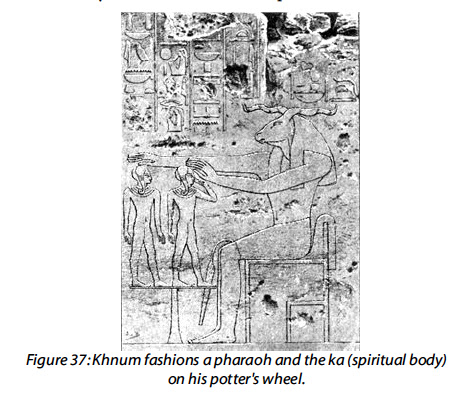
The most ancient mythology of the Old Kingdom recounts that the Divine Potter created other gods, divine kings, and mortals on his potter’s plate. Khnum used different materials depending on whether the being created was di- vine or mortal. Divine beings were depicted with materials indicative of the eternal realm. Gods were often depicted in gold with hair of lapis lazuli. The funerary statue of the pharaoh, representing his ka (eternal body), was made of stone. The divine spirit was incarnated in the eternal material of stone (Fig.37).
The mortal man was made of the reddish-brown mud of the Nile River, and man was always depicted in reddish brown on bas-reliefs. The perishable mortal body was destroyed by aging and death. Only with an offering of Khnum’s sacred alchemical product, the natron salt, could immortality be imparted at death. If a man was sinful, he knew that his body would be thrown into the river. The sinful would not attain immortality through the seventy-day mummification ritual using natron.
Natron never lost its sacred value. In the Talmud, na- tron symbolized the Torah (the Law). In Leviticus 2:13 of the Bible, natron was the salt of the covenant between God and the people:
“ And every oblation of thy meat offering shalt thou season with salt; neither shalt thou suffer the salt of the covenant of thy God to be lacking from thy meat offering: with all thine offerings thou shalt offer salt. ”
The salt mentioned in this verse is not sodium chloride or potassium nitrate, but natron. Proof of this can be derived from information provided in Proverbs 25:20:
“ As he that taketh away a garment in cold weather, and as vinegar upon nitre [salt], so is he that singeth songs to an heavy heart. ”
An adverse effect is implied in the verse. If one places vinegar on natron (sodium carbonate), the natron disintegrates, leaving a sodium acetate solution. If vinegar is put onto potassium nitrate or sodium chloride there is no disintegration.
The Genesis authors in the Bible described Creation within the framework of their knowledge, revered information handed down from remote ancestry. Assyriology has been studied widely in relation to the Old Testament, whereas the Egyptian influence has been mostly disregarded.
The remotely ancient tradition of Khnum is historically outstanding, for it has prevailed in some form throughout the written history of mankind. Thousands of years after the pyramids were built, Khnum was worshipped by the Gnostics, a semi-Christian sect. What is not widely recognized is that the Bible still preserves the age-old religious tradition characteristic of Khnum.A passage from an Egyptian creation legend by Khnum follows:
“ The mud of the Nile, heated to excess by the Sun, fermented and generated, without seeds, the races of men and animals. ”
Passages of the Bible leave no doubt about the belief in the concept of the Divine Potter. Genesis 2:7 mentions the material used to make man, the same type of substance used by Khnum:
“ And the Lord God formed man of the dust of the ground, and breathed into his nostrils the breath of life: and man became a living soul. ”
The Hebrew verb used in the verse to signify deity is ysr, the root of yoser; which means potter. Further, the tradi- tion can be shown by Job 33:6, where Elihu reminds his elders that he is entitled to speak in their presence:
“ I am your equal as far as God is concerned; I, too, have been 150 pinched off from clay ”
The tradition of the Divine Potter can be further observed in Isaiah 29:16:
“ What perversity is this! Is the potter no better than the clay? Can something that was made say of its maker, “ He did not make me ”? Or a pot say of the potter,“ He is a fool ”? ”
and Isaiah 64:7:
“ And yet, Yahweh, you are our Father: we the clay, you the potter, we are all the work of your hand. ”
The hard stone vessels of Khnum exhibit characteristic features of man-made reconstituted stone. To explain the vessels, Egyptologists assert that a vesselmaker spent perhaps as much as his entire life making only one vessel. But the design features of some of the vessels indicate that time was not the critical factor. Very hard stone materials, basalt, metamorphic schist, and diorite were being used to make the vessels at about the prehistoric epoch when copper was first smelted. The smooth surfaces, absence of tool marks, the vases with long, narrow necks and wide, rounded bellies and interiors and exteriors that perfectly correspond -features unexplainable by any known tooling method- are characteristic of a molded or modeled material. The methods afforded by geopolymerization, a slurry, or rock aggregates, poured into a mold or a pliable mixture fashioned on a potter’s wheel, are truly the only viable means by which to explain the features of these otherwise enigmatic vases. The following are remarks made by Kurt Lange after he studied fragments of stone vessels that he found in the sand and talus near the Step Pyramid at Saqqara (Fig. 38) [44a]:
“ This noble and translucid material is of exceptional hardness.... They are made of a perfectly homogeneous material, dense, polished, and glossy.... At once robust and fra- gile, of unequaled finesse and elegance of shape, they are of supreme perfection. The internal face is covered with a microscopic network of tiny grooves so regular that only an ultramodern potter’s wheel of precision could have produced them. To see the grooves one needs a magnifying glass and good lighting.... Obviously, the equipment used must have been some kind of potter’s wheel. But how could such a hard material be worked?... the plates on which earthenware pots were made with such regularity of form had only just been invented, and it is hard to believe that it was this tool, doubtless still extremely primitive, which was used in the fabrication of the hardest and most perfect bowls ever made. ”
Figure 38: Stone vessels found in the Step Pyramid of Zoser at Saqqara by J.P. Lauer and Drioton
Egyptologists assume that the hard stone vessels were drilled with a type of tool often displayed in different tomb representations. This tool is a straight shaft with an inclined and tapered top handle. Two stones or bags of sand were fastened just under the handle (Fig. 39 a, b). Yet no drills of this type have ever been found. Rather, archaeological remains feature bow-drilling tools, a technology always depicted for drilling all kind of materials. According to Denys Stock [44b] the rate of drilling granite with the tool recommended by Egyptology is in the order of 60-75 times slower than drilling limestone by a copper tubular drill driven by a bow. I am therefore inclined to consider that the tool displayed in the tomb representations has a different purpose. For example, a bas-relief from the Sixth Dynasty tomb of Merah, at Saqqara, is interpreted by Egyptologists to depict workmen drilling out stone vessels (Fig. 39a). In 1982, I presented a different interpretation at the 22nd Symposium of Archaeometry, held at the University of Bradford, in Bradford, United Kingdom [45]. The vessels shown were made of Egyptian alabaster, a calcium carbonate stone.Alabaster vases made as shown were not carved or agglomerated. It is obvious the vase makers are not drilling. Rather they are squeezing a liquid, stored in a sewn animal skin or a bladder, through a tube. I suggested that they were drilling with the means of bio-tooling, that is, using an acidic liquid such as vinegar, citric or oxalic acid, or a combination of acidic liquids extracted from plants, to act upon the alabaster (calcium carbonate). It is well known that acidic plant saps dissolve calcium carbonate very easily. I have measured the efficiency of using acidic liquids of the type just mentioned on Egyptian alabaster in my laboratory. The conclusion of our scientific paper reads as follow:
“ An experiment of interest was to compare the bio-tooling technique with the shaping of a hole (in local limestone) using steel tool and the quartz sand technique recommended by archaeologists.The test was run for 15 minutes and the drilled volume was measured for each technique: for steel tool 12 ml, quartz sand 8.5 ml, bio-tooling 9.5 ml. (bio-tooling mix contains vinegar,citrus sap and oxalic sap).The hole resulting from sand abrasion has rough walls, whereas bio-tooling gives a smooth finish. ”
The bio-tooling technology with acidic saps is not feasible when dealing with hard stones. It only works for calcium carbonate based stone, not for granite, basalt, hard schist and the like.

One can envision the production of the earliest stone vessels. The sacred alchemical products were first gathered. Natron saturated numerous lakes and was also found in large deposits in numerous desert regions.A natron lake was easily identified from other salt lakes because natron absorbs coloring from organic matter, leaving the water surface covered with a brown film. The peculiar taste of the water is also characteristic. Small white, unsoiled masses of pure natron were carefully removed from the tips of encrusted reed stalks growing above the water’s surface. It is characteristic for the salt to crystallize more than an inch above the tips.
Another product was lime, CaO, acquired by calcining limestone or dolomite. Two of the earliest products of humankind are lime and bread. Yet, the lime supply for stonemaking in Egypt may have been a by-product of breadmaking. The collected wood and plant ashes may contain between 50 and 75 per cent by weight of lime CaO. The Nile valley was blessed with produce of all kinds, and some plants and trees would produce more or less lime CaO in their ashes. For bread, the main crops were winter and summer wheat and six-row barley. After agriculture was introduced in the Faiyum region during neolithic times, the lifestyle of the inhabitants of the Nile Valley gradually transformed from hunter-gatherer to farmer. Bread consumption increased over the epochs with expanded irri- gation. Late records indicate that the Greeks dubbed the Egyptians artophagoi, the bread-eaters.
With the pharaohs involved in increasing agricultural yield, one can appreciate the precarious position of the high priests responsible for oracles and interpreting the pharaohs’ dreams. The size of the pharaohs’ monuments may well have depended on the predictability of the Nile. Enormous quantities of lime-ash from breadmaking in hearths, would automatically have been available and collected for stone- making during plenteous years. Soda (natron) ritually added to bread dough to make unleavened bread during remote antiquity, would have placed all of the required elements (lime, natron, and water) in close proximity for the invention of one of the primary ingredients of stone making, caustic soda.
The Nile yielded sacred water for the process. Egyptian cosmogony asserted that the Nile water was the original abode of the gods from which sprang the forces of light and darkness. The Egyptian name for the Nile was Hapu, and the Nile god Hapu was identified with the cosmogonic gods. Hapu took the form of Khnum during the inundation, when an annual solemn, festival was celebrated to rejoice the rise of the waters.
Many types of rock aggregates, considered by the Egyptians to be withered or injured rocks, were available. Examples are flint, slate, steatite, diorite, alabaster, quartzite, limestone, dolomite, granite, basalt, and sandstone. Precious gems, such as diamond, ruby, and sapphire, were unknown. Semiprecious varieties acquired by mining or trade included lapis lazuli, amethyst, carnelian, red jasper, peridot, amazonite, garnet, quartz, serpentine, breccia, agate, calcite, chalcedony, and feldspar.
Table II. The Mafkat Minerals

In addition, the blue minerals required for geopolymerization, generically known as mafkat during the more ancient periods, are included in Table II. The first mining operations in the Sinai Peninsula were primitive. Mineral deposits were attacked with pointed flint implements. Sandstone masses were removed and crushed with harder stones to free mafkat nodules. Even though turquoise and chrysocolla look similar, the Egyptians made a distinction between the two. The following are the remarks of a miner from the time of Pharaoh Ammenemes III [46]:
“ I found that it was difficult to determine the right color when the desert is hot in the summer The hills burn... and the colors fluctuate... during the severe summer season the color is not right. ”
Chrysocolla dehydrates in the hot desert sun, becoming whitish on the surface. Heating a sample with a flame would also have enabled a distinction because chrysocolla causes a flame to turn green. Nile silt was probably an ingredient of the earliest vessels. Silt was the traditional material for Khnum’s mortal processes, and perhaps a union between the divine and mortal was symbolized through stonemaking.
Another substance was not vital to the chemistry but may have been added because it symbolized the highest spiritual essence. The product was gold, the metal of the Sun. During my analyses, I found flecks of gold dust in Lauer’s sample from the Great Pyramid. It is possible that the gold did not occur naturally and was instead ritually added. Di- vine eternal qualities were attributed to gold. In addition to its beauty and association with the Sun god, gold does not rust or tarnish and can be worked indefinitely without becoming brittle or damaged. Even though gold was probably always an item of exchange, anciently its value was purely sacred.A monetary value gradually manifested.Some experts believe that the Egyptians never minted state gold coins until the Greek occupation or after 332 BC.
The practices of the first vesselmakers are lost in prehistory. A standard system of weights and measures was not adopted by 3800 BC. We can, therefore, only conjecture about a recipe for making a stone vessel of that period:


THE ETERNAL VESSEL of Khnum

  • 1 heqat natron + 2 heqat wood ash
  • 2 hin Nile water
  • 2 heqat powder of mafkat + 3 heqat Nile silt + 5 heqat
  • eternal rock particles
  • Ceremonial quantity of gold dust

Combine the sacred natron with ash powder collected from the hearth and blend them in a ceramic bowl with blessed water to form the caustic substance. Obtain mafkat which turns white on the surface during summer and which produces a green color of fire when you burn it. Powder the mafkat by crushing it with hard rocks and add it to the caustic substance. When the mafkat has been consumed, add fine silt such as Khnum uses to make perishable creatures.Recite prayers every day until the liquid has the consistency of honey, then add the injured, eternal aggregates (the limbs of Neter [God]), and the golden particles (the spirit of Neter), to incarnate His Di- vine Presence.
Protect your hands with oil and knead the material. Then fashion the vessel on your turning plates. Tear strips of linen and coat them with bitumen. Wind the strips around the outside of the vessel. Line the inside and carefully pack it. Allow the vessel to remain overnight. It will gain strength.When the vessel is strong, unwind the linen. Cover the vessel loosely with a linen cloth so that it can breathe. Remove the cloth when the vessel attains eternal life. Rejoice that Khnum’s living vessel may endure forever!
Although the ritual is speculative, the chemistry is based on reactions that work very well in our laboratory. An analysis of stone pottery may prove that the early binders were far more sophisticated. A process involving turquoise and allowing objects to harden in air-tight molds was introduced at about 3000 BC and is described in Appendix 1. Methods used to make vases with narrow necks and rounded bellies were innovated for making glass vases in the Eighteenth Dynasty at about 1350 BC.
From primitive beginnings, Khnum’s alchemical stonemaking technology advanced beyond pottery to produce the world’s most impressive architecture. The earliest burial places were pits, where funerary gifts were placed for use in the afterlife. Buried bodies were naturally preserved in the warm, dry sand of the desert necropolises. Mastabas represent the next phase of tomb construction. These are rectangular mud-brick structures, named mastabas from the Arabic word for bench used to describe their shape.
Stone material began to appear in the mastabas erected at Abydos and Saqqara during the Archaic period. These tombs have been badly plundered and only enough material remains to establish a tenuous history of this period. The remains suggest a constant evolution of mastaba design and an increased magnificence of furnishings. The early royal mastabas of the First Dynasty consisted of a large covered underground chamber surrounded at ground level by a wall. As the dynasty progressed, the tombs acquired additional storerooms and an access stairway. Large wooden beams and linings were incorporated into the tombs of the pharaohs. Sealed in the tombs were funerary offerings of food, precious articles of copper and gold, and various commemorative items. The tombs also included a vast array of alchemically made vessels in various beautiful shapes and hard stone materials.
An artifact from a First Dynasty cenotaph indicates that the precious mafkat deposits were jealously guarded. An ivory label of Den, the fifth king of the First Dynasty, depicts him symbolically smiting a bedouin in the Sinai.
A dramatic architectural advance appeared by the end of the Second Dynasty. Adjacent to the mastabas the king built a large enclosure. The well preserved Palace of Eternity erected by Khasekhemwy, the last king of the Second Dynasty in Abydos, consists of imposing crude brick walls, 10-12 meters high and more than 700 meters periphery (Fig. 40).
Figure 40: Khasekhemwy's enclosure made of crude bricks, Abydos.
Until recently, local tradition assimilated this construction to the grain storehouses of the biblical patriarch Joseph, or to military fortifications. In fact, Khasekhemwy’s Palace of Eternity was a replica of the enclosure wall of his secular palace. The enormous walls are crenellated, composed of alternating projections and recesses.A great number of their crude silt bricks are in excellent conditions, with little or no sign of erosion, after 5000 years. The crude bricks were overlaid with a decorative coating of white gesso, or white plaster. Khasekhemwy is the first of the great builders in Egyptian history.
The next major technological innovation, based on Khasekhemwy’s superstructure, would revolutionize mortuary construction and have dramatic impact on the course of history,
--------------------


Chapter 10
The Invention of Stone Buildings


Khasekhemwy left no male heir to the throne, and the Third Dynasty pharaoh first to rule was Zanakht. He was followed by Neterikhet (Zoser). Pharaoh Zoser’s architect, Imhotep, was responsible for the construction of the first pyramid. Before discussing this accomplishment, we will review what little relevant information has survived about this intriguing historical personality. Imhotep left an unforgettable legacy. Historically, the lives of few men are celebrated for 3,000 years, but Imhotep was renowned from the height of his achievements, at about 2700 BC, into the Greco-Roman period. Imhotep was so highly honored as a physician and sage that he came to be counted among the gods. He was deified in Egypt 2,000 years after his death, when he was appropriated by the Greeks, who called him Imuthes and identified him with the god Asclepius, son of Apollo, their great sage and legendary discoverer of medicine.
Figure 41: Statue of Imhotep.
Imhotep wrote the earliest “ wisdom literature ”, venerated maxim, which regrettably has not survived, and Egypt considered him as the greatest of scribes. This presiding genius of King Zoser’s reign was the first great national hero of Egypt. During King Zoser’s reign, Imhotep was the second most eminent man in Egypt, and this is registered in stone (Fig. 41). On the base of a statue of King Zoser, excavated at the Step Pyramid, the name and titles of Imhotep are listed in an equal place of honor as those of the king. Imhotep had many titles, Chancellor of the King of Lower Egypt, the First after the King of Upper Egypt, Administrator of the Great Palace, Physician, Hereditary Noble, High Priest of Anu (On or Heliopolis), Chief Architect for Pharaoh Zoser, and, interestingly, Sculptor, and Maker of Stone Vessels.
The titles confirm the records of the Greco-Egyptian historian Manetho on Imhotep, written in Greek 2,400 years later, during the early Ptolemaic era, in the third century BC [47]. Manetho was one of the last high priests of Heliopolis. Part of his text (reported by Sextus Julius Africanus) was translated in AD 340 by the ecclesiastic historian Eusebius to read, “ the inventor of the art of building with hewn stone ” . In fact, Eusebius’s translation is incorrect. The Greek words Manetho used, xeston lithon, do not mean hewn stone: they mean polished stone or scraped stone. The words describe stone with a smooth surface, a feature characteristic of fine, agglomerated stone [see the discussion in note 48]. These words were also used in the Greek texts of Herodotus (see the discussion in Chapter 12). It is impossible for translators accurately to translate texts while lacking vital technical knowledge. Similar errors of translation have been made throughout history, and more examples will be provided. For Manetho, Imhotep was “ the inventor of the art of building with agglomerated stone ”. This refers to the construction of the first pyramid (Fig. 42).
Figure 42: Step pyramid of Zoser was the world's first building made entirely of stone.
Imhotep was regarded as the son of a woman named Khradu’ankh and the god Ptah of Memphis. The title Hereditary Noble indicates aristocratic parentage. His career would have begun when he was a boy trained by a master scribe. With his parents among the elite, lessons would have begun around the age of twelve. Because priests were among the literate of Egypt, he may have received scribal training by entering the priesthood. His title, High Priest of Heliopolis, was traditionally attained on two conditions. A man either succeeded his father in the priesthood, or he was personally appointed to office by the king because of some great deed. The position of high priest was attained after extensive trai- ning in the arts and sciences-reading, writing, engineering, arithmetic, geometry, the measurement of space, the calculation of time by rising and setting stars, and astronomy. The Heliopolitan priests became guardians of the sacred knowledge, and their reputation for being the wise men of the country sustained even into the Late Period.
Their religious ideologies and sciences were heavily applied to the construction of tombs and other sacred archi- tecture. A magnificent solar temple oriented by the heavenly bodies was erected during the reign of Zoser to mark the most sacred place in Heliopolis. The city was the holy sanctuary of Egypt, the ground itself religiously symbolic. The site for Heliopolis had been chosen at a location in the apex of the Delta where the inundating Nile waters first began to recede. There the earth, fertilized by the arrival of silt and nurtured by the Sun, received the first renewed life of the agricultural year. This ground represented rebirth and Creation.
Located about twenty miles north of Memphis, the town is estimated to have measured 1,200 x 800 meters (3/4 mile x 1/4 mile). It became the capital of the thirteenth Lower Egyptian nome or district. No precise archaeological history of the city has been established. So it is unknown when ground was first broken for construction. The city is considered to have been founded during prehistory, and it had a very impressive life span. It flourished in the Pyramid Age and still remained an important center when Herodotus visited Egypt in the fifth century BC. Today, all of the temples and buildings of Heliopolis have vanished and the abandoned site has been incorporated into a suburb of eastern Cairo. Only a single standing obelisk, erected for a jubilee of Pharaoh Sesostris 1 (1971-1926 BC), remains amid empty fields.
When King Zoser was enthroned, he no doubt expected to be buried in a mud-brick mastaba with a superb Palace of Eternity similar to that of his predecessor Khasekhemwy. The site for his tomb was selected at Saqqara, south of Memphis. Design plans and calculations for orienting the monuments were being made. At this point, the subsequent history of the construction of all pyramids must be revised on the basis of my discoveries.
Khasekhemwy’s Palace of Eternity provides a key ar- chitectural design, which has been ignored by the archaeological community. Because the massive walls were made of crude bricks, formed in molds, it has always been stated that the brick sizes would be uniform from one layer to the other. The picture of Khasekhemwy’s enclosure wall and the sketch focusing on the bricks heights, reveal that this statement is entirely wrong (Fig. 43a,b).
Figure 43a: Enclosure of Khasekhemwy Palace of Eternity is made of crude bricks of different sizes. Figure 43b: Five sizes for crude bricks in Khasekhemwy's enclosure.
Khasekhemwy’s enclosure displays five different brick sizes. By measuring the height of 11 successive layers, I found that layer no.7 contains large crude bricks of size (I), layers no. 1, 4, 5, 11, medium high bricks of size (II), layers no. 3, 6, 10 medium bricks of size (III), layers no. 8, 9, medium bricks of size (IV) and layer no.2, the smallest size (V). In other words, the architect deliberately prepared 5 different molds for the manufacture of the crude clay bricks. In the previous Chapter 8 on the Proofs at Giza, I mentioned how the staggering block heights produce tremendous stability. This key architectural knowledge was continuously used in the construction of every major building erected since that time. It explains the height variations measured for Khufu Pyramid layers, displayed in Fig. 5.
Minerals were being excavated to produce stone and blue ceramics for lining interior walls and floors. King Zoser’s workmen inscribed a stele in the sandstone cliffs of the mi- nes of Wadi Maghara in the Sinai to commemorate the cons- truction of the monument. Some time before actual cons- truction got under way, Imhotep made an important discovery. Certain titles of this Chief Architect, Sculptor, and Maker of Stone Vessels profile prerequisite skills for building a monument with alchemically made stone. He would have applied himself to producing a mastaba which would last forever. Like the pride in a great nation, the pride intrinsic to a monument would be its longevity.
Khnum’s clergy apparently amalgamated its alchemical science with that of the Heliopolitan priests when stone was first made for use in architecture. Imhotep perhaps specialized in materials processing or alchemy. His aim may have been to strengthen the sun-dried Nile silt bricks used for mastabas and enclosures. Any attempts made by Imhotep or others to fire bricks made of silt from the Nil River would have been futile. The Nile silt contains the refractory element aluminum oxide, not the silico-aluminates, the components required for producing good, fired bricks at temperatures that they were capable of achieving. They would not even come close to the required temperatures of 1,300 to 1,500°C (2.400 to 2,700°F). Ordinary clay had been fired for pottery since pre-dynastic times by using fluxes to lower firing temperature, but this fired material was impractical for construction purposes.
Let us suppose that Imhotep discovered the properties of the yellow limestones located at Saqqara: a lime-sandstone and a clay-limestone (marl). These materials contain a mini- mum of 10%, sometimes up to 60% of aluminous clay, which is released in water, yielding a muddy limestone [49] (see Appendix I, The Fifth Alchemical Invention). Water eases disaggregation, making the limestones ideal for stone making, and the aluminous clay itself produces a dramatic result in combination with caustic soda and lime. Using aluminous clay instead of the required amount of mafkat, the material of the process most difficult to obtain was indeed eliminated for building the pyramid. Mafkat was required only for stones of high quality, such as stone vases. By eliminating the mafkat, Imhotep’s simple innovation enabled the enormous leap from small-scale funerary applications to the massive scale of the pyramids.
Small mud-brick molds with different sizes were filled, as they had been for Khasekhemwy to produce the pharaoh’s Palace of Eternity. But for the first time, the mud-brick molds were being filled with muddy limestone concrete and, as for the making of pisé, the material was rammed with a pestle. When, two decades ago, I started this study, I introduced the notion of “ cast-stone ”. Several magazine writers exaggerated this description and their headlines went far beyond by emphasizing on “ ... pouring a Pyramid ” (see in note [40]). Casting a fluid or pouring blocks or bricks require sophisticated molds like those implemented for the making of stone vases (poured) or statues. I am presently introducing a slightly different and more feasible technology. It is connected to the packed-earth (rammed earth) or pisé tech- nique. This more practical method is developed in several following chapters.
The new stone bricks, produced in five or six different sizes, were dried in the shade to avoid premature cracking, demolded, and transported to the construction site. The alchemically made stone bricks were used to produce a huge Enclosure and a square mastaba with its sides oriented to cardinal points. The Enclosure comprises limestone bricks of six different heights (Fig. 44). The burial chamber was un- derground. The mastaba was covered with small casing bricks of smooth limestone, and the sacred monument was considered to be complete.
Figure 44: Six heights of limestone bricks measured in Zoser's pyramid Enclosure at Saqqarah; increase of height in per cent compared to brick nr. VI.
Some time passed, and the stone bricks showed no sign of cracking. The pharaoh no doubt soon desired to make additional use of the new building material. Imhotep drew up plans to enlarge the mastaba. First, ten feet of agglomerated limestone were applied on each of its sides. Then, a more elaborate plan was devised. A twenty-five foot extension on its eastern face transformed the square mastaba into a rectangular shape, and the project was again brought to a close (Fig. 45).
Figure 45: Successive stages of construction of Zoser's pyramid are the Mastaba (M) and elaboration on the design (P1 and P2, after J.P. Lauer).
A later inspection would show that the stone under the weight of the mass showed no sign of cracking. King Zoser and Imhotep conferred again, and a plan was devised to heighten the structure to two tiers. Additional subterranean chambers, a shaft, and corridors were also dug.
As the size of the structure increased, the size of the bricks increased, maintaining, however, the five-six size distribution of the height within the construction (Fig.46). We are witnesses to dramatic design alterations inevitable with all revolutionary technological breakthroughs.
Figure 46: To construct Third Dynasty pyramids, worker (a) rammed limestone bricks in different wooden molds, (b) transported the bricks to the construction site, and (c) built the pyramids in inclined layers made of different brick sizes.

Figure 47: Limestone bricks of Zoser's pyramid are rounded like molded bricks.
The more extraordinary their architectural wonder became, the more they built upon it. The amount of agglomerated stone that could be made would have appeared endless. A transformation into a four-tiered structure was followed by another construction phase in which the final form of a six-tiered pyramid, sixty meters (196 feet) high emerged. Its design included internal walls and inclined stone layers to provide great stability.With great skill and ingenuity, Imhotep incorporated all of the engineering and artistic methods the nation had derived from countless decades of building with wood, bundles of reeds and stalks, and sun- dried silt brick.
The final outcome was an extraordinary funerary complex. The Heliopolitan religious doctrine profoundly influenced its architectural form and the symbolism of its motifs. The design theme incorporated mythology which preserved and amalgamated Egypt’s most ancient and cherished cosmological beliefs. Heliopolitan theology taught that in the beginning, a primordial megalith, known as the Ben Ben (benben), arose out of the waters of Chaos. The benben represented the hill or mound upon which Creation began. The benben has been interpreted to symbolize dense, primeval physical substance or matter.
The Creator appeared on the benben in human form, as Atum, the personification of the Sun, or in the form of Bennu, the phoenix of light. Out of elemental chaos the Crea- tor separated the darkness from the waters. The Creator formed a trinity after having created himself and Shu, the god of air, and Tefnut, the goddess of moisture. Tefnut and Shu procreated Geb, the earth, and Nut, the heavens. Four other deities were created, and all of the gods together made up the Heliopolitan Enneade. In later times, the Greek philo- sopher Empedocles (c. 495 - 435 BC) recognized in the pri- mordial Egyptian gods personifications of air, water, earth, and fire. Empedocles, and alchemists of later eras, held that these were the indestructible elements that composed all matter.
James Henry Breasted (1886 - 1935), founder of the Oriental Institute at the University of Chicago, first recognized that the pyramids themselves are representations of the benben. After the first Heliopolitan temple was built, Egypt had adopted the ideology that the benben, or stone symbolic of the Sun god, was located beneath the temple.
The theogonic theme appears in subterranean chambers of King Zoser’s pyramid.Special chambers are lined with blue ceramic tiles in patterns depicting the primeval reed marsh from which vegetable life first emerged. Blue was the color symbolic of the Creator, and the blue glaze on the tiles imitated chrysocolla, the mafkat mineral indicative of Creation. With the exception of this monumental first pyramid, the artistic theme depicting the events of Creation was preserved only in the holy of holies of the great Sun tem- ples.
In a specially designed room a life-size stone statue of Zoser seated upon his throne represented his eternally reigning spirit or ka. When this statue was found by archaeologists, it was intact except for damage to the eyes and surrounding facial area. The eyes were probably made of semiprecious gems, which would most likely have been pillaged when the tomb was plundered. Certain stone statues of the Old Kingdom now in the Louvre and the Cairo Mu- seum are greatly admired for their inlaid eyes, a technique offering extraordinary realism and easily afforded by using alchemically made stone. Other rooms held the 30,000 stone vessels of Khnum, agglomerated using aggregates of schist, breccia, granite, diorite, and various other stones .
Surrounding the pyramid, a wall with clean architec- tural lines, originally more than thirty feet high, encloses more than a square-mile area.A characteristic of the smooth stone, encasing the wall and now mostly removed, is that it appears to be polished. The wall protects an elegant entrance colon- nade, great courts, large buildings, a mortuary temple, and ceremonial altars and shrines. The enclosed area is virtually an entire town. The design character of the enclosure wall resembles contemporary architecture, and did, in fact, in- fluence a style of twentieth century architecture. European architects visiting Saqqara earlier in the century found the enclosure wall a refreshing, appealing diversion from ornate Victorian architecture. They left with the inspiration for a style of architecture that we now consider modern and take for granted.
It was the pride of Egypt. Zoser’s funerary complex, with its towering pyramid and exquisite artistry, was unprecedented in the history of the world. Throughout Egyptian history the time of Imhotep was looked on as an age of great wisdom. Like the First Time event of Creation, as it was called, and the founding or amalgamation of the Egyptian nation by the first pharaoh, King Menes, the construction of the Step Pyramid was viewed as another first time event of great importance.
-----------------------------------

Great Pyramid - PYRAMIDS AND GEOPOLYMERS - 8.The Proof at Giza

PYRAMIDS AND GEOPOLYMERS


BOOK: THE PYRAMIDS AN ENIGMA SOLVED
Prof. Joseph Davidovits

Chapter 8
The Proof at Giza


To further demonstrate that the pyramid stone results from a man-made reagglomeration of nummulitic limestone, I conducted several studies at Giza between 1984 and 1992. A complete survey of the geological strata of the Giza plateau has never been conducted because the site is completely filled with tombs and sand. I surveyed all of the exposed strata in the bedrock, and I made a comparative study between the exposed strata and thousands of blocks in the pyramids and those in the temples at Giza. (See also Appendix II, The Giza Plateau Circuit).
The variation in quality of blocks composing the Giza pyramids is striking. Certain blocks are unweathered whereas the majority has become extremely eroded by wind, rain, and the sunlight; the latter is most severe from the south and west. The effects of erosion are most obvious on a very rough layer that forms the top portion of all of the pyramid blocks. This top area, generally from twenty to 30 centimeters (7.87-8.81 inches) thick, is weaker, lighter in density, and more affected by erosion than the rest of the stone. Two explanations to this unusual feature would be as follows:
First, let us assume that limestone aggregates (with fossil shells) were poured directly into a mold that was partially filled with water and binder. As the mixture combined with the water, the heaviest materials settled to the bottom. Air bubbles and excess watery binder rose to the top, producing a lighter, weaker matrix. The top layer also exhibits the smallest number of fossil shells, which were not as crowded within the dense slurry and were therefore depositionally oriented horizontally. No mixing was required to produce the concrete, and precise measurements afforded perfectly level tiers.
Figure 21: Blocks on the west face of Khafra's (Khefren or Chephren) Pyramid exhibit sponge-like upper portions. (1984) {BELOW}
In the second explanation, the limestone aggregates were rammed (instead of poured) as in the making of pisé (packed earth). The bottom of the semi-dry mixture became compacted with the pestle and was more dense than the top.
Due to the technology employed, the top layer tended to exhibit light horizontal layering (see Stage 1 in Appendix II). Sometimes, the top layer is so rough and riddled with holes that the blocks look like sponges (Fig.21). My first impression was that they resemble geopolymeric foam, a product that I have developed. Gaber accompanied me in my survey, and his professors from the geology department of Ain Shams University commented that the numerous holes in the top portion result from fossil shells having been stripped away by erosion. I explained that although erosion caused the deterioration, it did so because the top layer is
more susceptible than is the denser bottom layer. Furthermore, I observed that blocks on the west side of Khafra’s pyramid have been protected from weathering during centuries. Until about 100 years ago, the first several tiers on the west side were buried in sand (see drawings from Description de l’Egypte and Lepsius). Because erosion occurred after the sand was cleared, the blocks on the west side are relatively unweathered. However, even these unweathered blocks exhibit the light, weak top layer, which, therefore, cannot be attributed to weathering (see Stage 5 in Appendix II).
All blocks composing the pyramids at Giza, those of Khufu, Khafra, Menkure (Mycerinus in Greek), and the mile- long causeway from Menkure’s pyramid to the Nile bear the weak top layer (Figures 21 to 30). In contrast, a comparison of the cast blocks and the bedrock demonstrates obvious differences.
To form a level base on the incline of the Giza plateau, five steps on the west side of the pyramid of Khafra were shaped in situ from natural bedrock (see in Appendix II, Stage 5). There are no individual blocks in these bedrock steps, and therefore, shaping them did not involve the arduous labor required to cut perfectly fitting blocks. The transition between the natural bedrock steps and the man-made reconstituted limestone blocks appears near the middle of the north and south sides of the base of the pyramid (Fig. 24). Above are about 2 million individual blocks. At the base, blocks were cast directly on bedrock, which is quite homogeneous in density when cut within a given geological stratum or series thereof. The jumbled shells in the pyramid blocks reported by Jomard and de Roziere are apparent. On the opposite, the nummulites in the bedrock steps are oriented horizontally, characteristic of natural sedimentary layering.
Figure 22: Block fallen from southwest corner of Khafra's pyramid has three lift lines (B- bottom; T-top); behind arrows show weak top layer (1984). {BELOW}
Figure 23: Arrow points out thick mortar used to seal bottom of mold for blocks on south face of Khafra's pyramid (1984). {BELOW}
Figure 24: The author examines transition between bedrock base and pyramid blocks. (A) Fossil shells correspond to the natural sedimentary layering in the bedrock portion of the base. (B) Pyramid blocks cast on bedrock have well-fitted joints. In lighter top portion jumbled and broken fossil shells are visible. (C) Separation between bedrock and pyramid blocks (1984). {BELOW}
If the pyramid blocks were natural limestone, the unnatural density pattern could be explained only if two ad- jacent strata of different qualities had been included in the cut, the lower of a better quality than the upper. That the pyramid blocks were cast explains why the rough top layer is always about the same size regardless of the height of a block. It would be ridiculous to suppose that quarries exhibiting this unusual feature could have been identified and used to the degree that is exhibited in the pyramids.
With few exceptions, the pyramid blocks contain no type of strata. If the blocks were quarried, it would have required that they be extracted to avoid cutting along the division between strata because the blocks are smaller than the strata in the bedrock. Incongruence with regard to strata is contrary to what is advocated by Egyptologists. They assume that the blocks were easy to cut because advantage was taken of natural divisions in the bedrock. Occasionally, a stratum (lift line) can be observed in very large pyramid blocks. When one does appear, however, it is not as high as the divisions of strata found on the Giza plateau. The divisions of strata in the bedrock near the pyramid of Khafra and in the Khent-Kawes quarry, are about 4.5 meters (5 yards) apart, three to four times greater than the heights of the pyramid blocks (Fig.25).
Figure 25: Exposed bedrock at Giza allows comparison between heights of pyramid blocks (A and B) and the divisions of geological strata (arrows) (1984). {BELOW}
In the pyramids of Khufu, Khafra, and Menkure, a thick, pink gypsum mortar was used to fill cracks and level imperfect blocks and also to cement a minority of rough trapezoidal-shaped core blocks to neighboring blocks. The mortar was applied to a thickness of up to 20 millimeters (0.78 inch) beneath the base of the trapezoidal blocks. These blocks are positioned with their widest area upward. The mortar was applied to be thickest at the bottom, with that thickness gradually decreasing as it neared the top of the blocks. Practically no mortar is visible at their top edges, because this area is very small. The presence of this thick mortar indicates that these particular blocks were moved into place, as opposed to having been cast in situ.
Figure 26: Second Pyramid of Giza exhibits three different types of joints. A and B are carved restoration. C is an original agglomerated stone joint. D is a joint in which thick mortar was applied during construction (1984) {BELOW}
That these trapezoidal blocks are bound by mortar does not invalidate the agglomerated stone theory because the blocks represent only a small minority. Instead, the blocks provide insight into the plan by which the pyramids were constructed. The blocks were probably cast near by and placed during the final construction phase to plug passageways that had remained open to provide ventilation and allow ingress and egress of materials.
I closely examined blocks in the mortuary temple, valley temple, the temple of the Sphinx in Khafra’s complex, and the mortuary temple in Menkure’s complex. Walls protected from weathering are smooth and light gray. Large surface areas of blocks composing walls that have been attacked by weather exhibit the same density variations as appear in the pyramid blocks. Blocks in the temples in Khafra’s complex are enormous. They stand approximately 2 to 3 meters (6 to 10 feet) high and, as mentioned, weigh up to 500 tons apiece. The weathered faces of the largest of these blocks exhibit two or three wavy, irregular strata. These are smaller than the divisions of strata in the Giza plateau. The geologists I encountered from Ain Shams University opined that the strata proves that the stones are natural. They were unaware that most types of concrete can also exhibit strata, known as lift lines.
Like those exhibited in the largest pyramid blocks, these lift lines can be explained by the method used to produce the blocks (Figures 27, 28). If the large temple blocks were natural, they would have to have been quarried from close by, because their great size would make them almost impossible to move by primitive means. To cast blocks of such enormous size might require three days. After the workers quit for the day, the unfinished block hardened. As it set, a surface (lift line) formed. The process was repeated daily until the block was complete. The lift lines are visible now that weathering has destroyed the outer block. In addition, the strata in the bedrock are horizontal, whereas the wavy lift lines are characteristic of material dumped into a mold. The planed surfaces and sharp, geometrical angles of the blocks of these temple walls compare exactly with those of modern walls made of concrete blocks. It is strikingly obvious that the northern face of the valley temple in Khafra’s complex is a wall of gigantic geopolymeric concrete blocks, formed of parallelepipeds with perfect right angles.
Figure 27: Enormous blocks in the mortuary temple of Khafra exhibit lightweight, weathered top portions characteristic of concrete (1984). {BELOW}
The block quality is excellent. The core blocks of the pyramids, though of better quality than the bedrock body of the Sphinx, do not compare with the fine quality of the tem- ple blocks. The difference can be explained only by the quality of the stonemaking formula itself.
Figure 28: Blocks at Khafra's mortuary temple have wavy lift lines characteristic of construction interruptions during casting (1984). {BELOW}
Aside from evidence from the chemical analysis of pyramid stone, geologists supporting the agglomerated theory find the most compelling evidence for cast-in-place pyramid stones to be gross features such as the chunks of stone incorporated into the pyramid blocks (Figure 29), the wavy lift lines (Figures 27, 28), the density differences between the pyramid and quarry stone, and the jumbled nature of the fossil shells in the pyramid stone. The apparent absence of sedimentary stratification in the pyramid stones is also powerful geological evidence. Additionally, the quarry rocks contain cracks, ranging from microscopic to several inches in width. These cracks are filled with secondary calcite. Similar cracks were not observed in the pyramid blocks and are thought not to be present.
Figure 29: Chunk of stone incorporated into block is visible in Khafra's pyramid (1984).{BELOW}
The pyramid of Menkure has an exceptional history. Most of its casing blocks, now disappeared, were limestone. Those appearing on the lower quarter of the pyramid are made of carved granite (see Stage 10 in Appendix II). Some of the blocks are irregularly shaped, typical of carved blocks. Menkure’s pyramid probably fell victim to the New Kingdom pharaoh, Ramses II, who routinely used pyramid casing blocks to build or restore temples consecrated to his god, Amun.
The pyramid of Menkure was stripped starting at the bottom, but only one-third was denuded. A subsequent ruler restored the pyramid with carved syenite granite from Aswan, a material which was commonly carved during the New Kingdom. As opposed to supporting the traditional theory of construction, the carved blocks contribute to my theory. Their appearance clearly demonstrates the difference between carved and cast blocks because carved blocks always exhibit tool marks whereas cast blocks do not.
Edwards states in his book The Pyramids of Egypt [123]: “ ... Menkure (Mykerinos) must have intended to follow the example of Khafra (Khefren or Chephren) by constructing his Mortuary Temple of limestone faced with ashlars of granite.... Reiner’s excavations, however have shown that this plan was never realized.... Only the foundations of the Valley Building were made of stone; the superstructure was composed almost entirely of crude brick.... In the Mortuary Temple the foundations and the inner core of some of its walls were composed of limestone blocks... but crude brick was again the material used for completing the greater part of the building... ”
The blocks were overlaid with a plaster imitating granite or with a white plaster, inside and outside. The unweathered side (north) of the Menkure (Mykerinos) Mortuary Temple blocks shows visible toolmarks (Fig. 30a, 30b). These toolmarks are also observed on the blocks of other temples and have been taken as proof against the agglomerated stone theory. They are not! As mentioned above, the blocks were not bare, but recovered with a decorative coating. It is traditional in all civilizations to proceed in the same way when applying a decorative coating or plaster, or stucco, upon a smooth stone or brick surface. The stone sur- face must be roughened in order to achieve good mechanical adhesion between the plaster and the stone surface. In the author’s mind, these toolmarks were specially worked on the agglomerated stone because Menkure’s (Mykerinos) architect did not have the time or the budget to face the ashlars with massive granite stones. Remains of colored plaster (coating) are often visible on pyramid blocks, essentially those located on the east sides.
Figure 30a: Stage 11, Mortuary Temple, Menkure (Mykerinos) Pyramid, east, on the right hand when facing the valley. Blocks with tool-marks for plaster adherence and worked edge (1988). {BELOW}
Figure 30b: visible tool-marks (1988). {BELOW}
Ancient repairs with lime gypsum mortar caused no damage to the Sphinx body and a protective coating formed, which is in my opinion a result of geopolymerization. However, salts leaching from the modern mortar used in repairs have caused the stone to decay. This shows that ancient Egyptian gypsum mortar does not have the same chemical makeup as modern gypsum mortar. The modern material consists exclusively of hydrated calcium sulfate, whereas the ancient mortar is based on a silico-aluminate, a result of geopolymerization. I have observed well-preserved, hard lime-gypsum mortar on some ancient Egyptian monuments and lime-gypsum that is completely disaggregated on others. The disaggregated mortar is modern, and because the modern mortar has deteriorated, it is assumed that lime-gypsum mortar does not endure.
At Saqqara and Giza I found geological layers of well crystallized gypsum sandwiched between layers of limestone and aluminous clay. When a combination of these three materials is calcined and combined with natron, a geopolymeric lime-gypsum cement results, which sets rapidly and resists erosion. Such cement was used for patching and sealing in most of the pyramids. This is the thick mortar used to set the trapezoidal blocks, previously described, and it is in good condition after thousands of years. However, because it sets rapidly, it does not allow sufficient time for casting and, therefore, is unsuitable for producing limestone concrete. This explains why gypsum is not a component of the reconstituted limestone described previously.
Much of the restoration by Lauer on the pyramid of Zoser was made with Portland cement concrete. Those repairs of fifty years ago have cracked and, consequently, had to be replaced with carved limestone (Fig.31-32). The geopolymeric material would be ideal for a lasting restoration of monuments.
Figure 31: Restoration detail of Zoser's pyramid shows (A) original casing stones over 4,500 years old, and (B) cracked blocks made of portland cement-based concrete less than 50 years old (1984) {BELOW}
Figure 32: Restoration of Zoser's pyramid shows (A) original casing blocks, (B) Portland cement-based concrete blocks, (C) block carved from soft white limestone of Tura during recent restorations. (1984).{BELOW}
During the studies at Giza, I photographed the south and west faces of the pyramid of Khafra below the top thirty levels. The uniformity of lengths of the blocks of Khafra’s pyramid show that the use of agglomerated stone is the only viable system of pyramid construction. The heights of the pyramid blocks are more variable than the lengths. This would not call for more molds; the desired height could be achieved by marking the molds at a certain level and by filling them to that point. This system accounts for the dramatic fluctuations relative to the Great Pyramid that Goyon could not correctly explain.
Staggering the block heights also produces tremendous stability. This type of structural design was used in cathedrals built in northern France and Germany during the Gothic period between the twelfth and fifteenth centuries. They are capable of withstanding an impressive amount of shock. In my home town of Saint Quentin the thirteenth century basilica made this way remains standing although the city was destroyed by bombs in the battle of the Somme during World War I (1914 - 1918). Likewise, the old city hall, similarly constructed, is still standing. In Cologne, West Germany, one such cathedral stood alone above the ruins of the city in World War II. The Great Pyramid was unscathed by the earthquake of 1301 that devastated Cairo.
Figure 33: Basilica in Saint-Quentin, France, survived the old city after World War I.{BELOW}
One of the main purposes of my study at Giza was to determine whether the lengths of individual blocks might recur and, if so, to what degree. A high degree of uniform lengths corroborates the principle of blocks cast in molds. Almost all 2,000 blocks I photographed in Khafra’s pyramid conform to ten uniform lengths. The various lengths are set in different patterns throughout the twenty-two steps. That only ten dimensions exist indicates that all twenty-two steps were produced with molds of only five sizes because some blocks were cast with their lengths perpendicular to the plane of the pyramid face.
That the longest blocks are always the same length is extremely strong evidence in favor of the use of cast stone. It shows that each block was produced according to the exact, immediate specifications of the architect during construc- tion. Long blocks always appear directly above or beneath blocks that are short in length, making the construction plan apparent.
Any dimension required could be determined quickly by the architect because it would be relative to the length of the block in the tier directly below. It is simple to determine the length needed when blocks are all produced from molds of the same few sizes. Anyone, however, attempting to explain the preparation and use of blocks of such highly uniform dimensions based on the carving hypothesis would be unable to do so. Blocks could never have been cut, stored, and selected on the scale required.
The south and west faces of Khafra’s pyramid are a mirror image of each other, indicating that the entire intricate design is three dimensional. Successive tiers are made of the same pattern, whereas others are made of different, interrelated patterns. Certain tiers have patterns that are almost the same as those of neighboring tiers. The patterns of other tiers are opposite to those surrounding them. All blocks were cast according to an uncanny master plan of patterns that eliminated the formation of vertical joints, which would cause weak points. The pyramid resembles an intricate three-dimensional puzzle that was effectively formulated to create an incredibly strong, stable superstructure. In Appendix II, the Circuit at Giza provides additional information.


Objections to my theory
Immediately upon arriving at the site in January 1990, the American geologists Folk and Campbell observed features that they interpreted to indicate that the blocks are natural. In an article published in Journal of Geological Education , they state:
“ Within the first minute at Kheops (Khufu) pyramid, we knew that the pyramids were built of real limestone blocks, not of concrete [agglomerated stone]... ”. [128]
For a reason which is not explained in their papers, Folk and Campbell went directly to the North East corner of the Khufu (Kheops or Cheops) pyramid, and found there, natural limestone, an outcrop of the Mokattam Formation.
A major part of their preliminary geological study was carried out precisely on this location (see in Fig. 34a and the sketch in Fig. 34b). They deliberately ignored the elementary fact that the pyramid was built on a leveled plateau, which left some natural bedrock as part of the monument.
In 1983, Lehner had mentioned that this natural bedrock shows to a height of 4 meters above the base, at the North-East corner [129]. Nevertheless, Folk and Campbell based all their demonstration against the agglomerated limestone theory, on superficial investigation. They identified real stones where previous studies showed them to be located, thus proving on one hand their expertise in geology and on the other hand their scientific misconduct. They used this North-East. corner natural stone to demonstrate that
“ ... they are tectonic fractures in many pyramid blocks, filled with calcite [the vertical tectonic fracture T in the photo].... These fractures generally are only about 1 mm wide, and run in a more or less straight path all across a single block....These are obvious tectonic fractures formed when the block was flexed millions of years ago, and demonstrate that the pyramid core stones were quarried blocks, not poured geopolymer... ”.
Figure 34a: Block discussed by Folk and Campbell in Ref. 92, 101, with vertical tectonic fracture T, burrow B and marly bed M. Notice the tree and the building on the right, and compare with the sketch.{BELOW}
Figure 34b: Sketch published by the author in Concrete International [133] in relation with Folk/Campbell geological study.{BELOW}
They also used these natural blocks to demonstrate that specific weaker parts of pyramid blocks were caused by the presence of burrows (label B in the picture), stating that there are:
“ ... numerous burrows and tubes formed by animals when the sediment had a muddy consistency on the Eocene sea floor. Similar burrows are readily seen in nearby outcropping limestones. Burrowing and churning of the soft sediment by sea-floor organisms produces inhomogeneities in sediment composition, texture, and porosity, which control to a great extent the processes of hardening into rock as the pore spaces are filled with a secondary geologic cement, in this case cal- cite. When the rock is weathered, the inhomogeneities are strikingly brought out as generally irregular, elongated, discolored features on the rock surface. Consequently, the inhomogeneities in the rock result in its differential weathering... ”
Other natural limestone blocks located on the lower two courses of the same East side were also given as proof for the explanation of density changes and lift lines presence in pyramid blocks. Taking the marly layer labeled M as example, they stated that all layers were merely geological stratification produced in the ancient Eocene seas.
In response to another of their papers also published in 1991 but in a different technical journal, Concrete International [132], I published in 1992 in the same journal, the sketch focusing on the N-E corner of Khufu (Kheops or Cheops) pyramid (Fig. 34b) and the obvious occurrence of natural stones [133].
I cannot refrain from citing again some excerpts from their published sloppy study:
“ ... we feel it is the duty of professional geologist to expose this egregiously absurd archeological theory before it becomes part of entrenched pseudoscience....We believe that had Davidovits had any understanding of basic geologic principles and understood the implications of simple geological evidence at Giza, he would have realized that this geopolymer theory had no basis in fact....We have also shown how geologic commonsense can destroy archaeological quackery, but not, unfortunately, before it has enjoyed widespread publicity among the gullible and sensation- minded.... The geopolymer theory is defunct; we still remain in awe of the enigma of Egyptian skill and engineering... ” [131].
Folk and Campbell never publicly admitted their error. Some of their 1990-1991 published papers are still used today (year 2000) by those who wants to discredit my theory. They do not know that Folk confessed his mistake in private. In March 1992, I received a letter from him dated of February 18th, 1992, that reads:
“ ... I was impressed by your reasonable and interesting letter in Concrete International, Feb. 1992... Your argument that the lower two courses of Khufu (Kheops), on the east face, are in place bedrock is intriguing and I must admit was a new thought to me. This morning, thanks to your citation, I went over and read Lehner (1983) on Khufu (Kheops) and he does indeed show the NE corner of Khufu to be bedrock in his sketch. Our photo was of that corner. So I concede that, on the North-East corner, you are correct as the bedrock idea had not entered my head at the time we were there... ”
The geologist and limestone specialist Robert L. Folk admitted that he did not have any basic geological knowledge of the Giza plateau when he made his survey and triumphally claimed: “ ... Within the first minute at Khufu (Kheops or Cheops) pyramid, we knew that the pyramids were built of real limestone blocks, not of concrete [agglomerated stone]... ”.


---------------------------


Great Pyramid - PYRAMIDS AND GEOPOLYMERS - 7.The Hard Scientific Proof


PYRAMIDS AND GEOPOLYMERS

BOOK: THE PYRAMIDS AN ENIGMA SOLVED
Prof. Joseph Davidovits
Chapter 7
The Hard Scientific Proof


Though I am the first to apply this technology to the pyramid construction theory, another French chemist, Henry le Chatelier (1850 - 1936), was the first to discover that the ancient Egyptians produced man-made stone. Le Chatelier was also a metallurgist and ceramist. He worked with newly developed micrographic techniques, glass slides, thin section analysis, and photography in combination with the microscope. He was the first to examine enameled funerary statuettes from Egypt’s Thinite epoch (c. 3000 BC) with these techniques and to see them as they had never been seen before [37].
As Le Chatelier studied enameled funerary statuettes, he found that his observation methods led him to notice that the enamel was not a coating applied to the surface of the statuettes. Instead, the enamel was the result of minerals which migrated from within the stone itself. He cut thin sections with a diamond-tipped saw and observed a gradually increasing concentration of minerals that had migrated to or near the surface of the stone to form enamel. The process is like that which occurs with Egyptian faience, a self-glazing ceramic. Le Chatelier was astonished to realize that the statuettes were man-made stone.
He and his colleagues tried in vain to duplicate the process. The method that produced the statuettes is one of my chemical discoveries discussed in Appendix 1. Le Chatelier’s research took place in the early 1900s and his revelation should have raised debate about other stone artifacts, especially the pyramids with their numerous enigmatic features.
Academics, however, are not necessarily innovators. And scholars involved with the soft sciences, such as history, may not necessarily be scientifically minded. In fact, during my presentation at the Second International Congress of Egyptologists, I used le Chatelier’s work to make the Egyptologists who were present aware that science had already shown that the Egyptians produced man-made stone. Acknowledging that, they were still unwilling to concede that the pyramid stone might be man-made.
It was not until some years after I devised my theory that I analyzed actual ancient geopolymer. In 1981, Liliane Courtois of the Center for Archaeological Research, in Paris, and I carried out an X-ray chemical analysis on fragments of lime vessels fromTel-Ramad, Syria, dating from 6000BC.The vessels were made of a white stony lime material. In other words, they are classified as being made primarily of lime. We made a presentation at the Twenty-First International Symposium on Archaeometry, held at the Brookhaven National Laboratory in New York [38]. We reported that the samples contain up to forty-one percent of analcime (analcite), a zeolite that is easy to produce. This high amount of zeolitic material is not found in the raw material from which the vases were made and could only be the result of geopolymerization.The fact is that synthetic zeolites had been produced 8,000 years ago in the Middle East. In modern times they were first produced by an English scientist named Barrer in the 1950s.
Knowing that it would be impossible to prove my theory without samples of pyramid stone, in 1982 I made an appointment to visit Jean-Philippe Lauer at his home in Paris. Lauer, now over ninety years old, is eminent among European Egyptologists. He spent sixty years of his career restoring the pyramid of Zoser. He has his own conservative views on pyramid construction based on more than fifty years of study, and his attitude about my research is reserved. In a letter I received before I visited him, he said, “ I defy you to prove that the pyramid stone is synthetic. ”
That, of course, was my intent. During our visit, he gave me samples from the pyramids of Khufu (Kheops or Cheops) and Teti. The sample from Teti came from an outer casing block and the one from the Great Pyramid came from the ascending passageway (Fig.16). I had X-ray chemical analysis performed on the samples by two different laboratories to be sure that there would be no analytical discrepancies. I presented a paper on the test results at the International Congress of Egyptologists held that same year in Toronto [39]. The title of my conference was “ No more than 1,400 Workers to Build the Pyramid of Cheops (Khufu) with Man-Made Stone ”. At the congress, Lauer and I each made separate presentations about our theories of pyramid construction. Despite knowing that I was making a presentation using his samples, Lauer did not attend my presentation because he did not take my theory seriously. The Toronto Star newspaper covered the congress and published Lauer’s following response to my research (September 7, 1982): “ There are man ridiculous surveys, not stupid, but impossible. Not many are serious. ”
Figure 16: The Great Pyramid Lauer sample with coating.
X-ray chemical analysis detects bulk chemical composition. These tests undoubtedly show that Lauer’s samples are man-made. The samples contain mineral elements highly uncommon in natural limestone, and these foreign minerals can take part in the production of a geopolymeric binder.
The sample from the Teti pyramid is lighter in density than the sample from Khufu’s (Kheops or Cheops) pyramid (the Great Pyramid). The Teti sample is weak and extremely weathered, and it lacks one of the minerals found in the sample from the Great Pyramid. The samples contain some phosphate minerals, one of which was identified as brushite, which is thought to represent an organic material occurring in bird droppings, bone, and teeth, but it would be rare to find brushite in natural limestone.
The presence of such organic materials in the pyramid stone affords new possibilities for a better understanding of ancient culture. If bird droppings were a source of the brushite, this might explain a function of the large place known as Ostrich Farm, which was not far from Giza. It is well known that in ancient Egypt, bird droppings, urine, and animal dung were added to straw and mud to increase the cohesiveness of mud brick.
If bone were a source of brushite, this could shed new light on the mysterious sacrificial rites of antiquity. The sacred animals would have been slaughtered and burned on the sacrificial altars, their bones calcined to ashes. The ashes would have been powdered and used as an ingredient of the religious monument. The vestiges of this alchemical knowledge may have influenced customs and inspired mythology and legends of later times.
The pyramid samples also contain a mineral known as opal CT, a siliceous material. I had a debate about this with Michael S. Tite, Head of the Museum Laboratory at the British Museum. Tite was the coordinator of the Archaeometry ’84 Symposium, held at the Smithsonian Institution in Washington, DC, in 1984. As coordinator, he had the advantage of prior review of my presentation. He took advantage of this and submitted a piece of a casing block exhibited at the British Museum to chemical analysis at the museum laboratory.
After my presentation titled“ Pyramids of Egypt Made of Man-Made Stone, Myth of Fact? ” [40], he arose and told the symposium,“ All of the features that they [his analytical team] saw can be explained on the basis of natural origin, and there is really no need to introduce this hypothesis of reconstituted stone. ” Like anyone unfamiliar with geopolymerization, Tite saw nothing unusual in the mineral composition.
Thanks to help from colleagues, especially Hisham Gaber, a geology graduate of Ain Shams University in Cairo, I obtained samples from the quarries of Tura and Mokkatam in the Arabian mountains, where it is believed that the casing blocks originated. Gaber collected more than thirty samples from various sites.We performed X-ray chemical analysis and X-ray diffraction on quarry stones and on pyramid stones. X-ray diffraction and microscopical analyses of the quarry samples indicates that they are pure calcite, sometimes containing a trace of dolomite. None of the quarry samples contains any of the unusual minerals found in the pyramid samples. If the casing stones were natural limestone, quarries different from those traditionally associated with the pyramid sites must be found, but where? This demonstrates that a complicated man-made geopolymeric system was produced in Egypt 4,700 years ago.
Thin sections made on pyramid stones of Khufu (Kheops or Cheops) and Teti show that they are light in density unlike the quarry samples which are uniformly dense. A thin section from Teti casing (Fig.17a) shows a natural nummulite imbedded in calcite surrounded with gaps in a very loose matrix. This could be agglomerated limestone. The thin sections for Tura/Mokkatam geological samples are quite different (Fig.17b). Their matrix is dense with no gap and no trapped air bubble. A problem of analysis, assuming that the Khufu (Kheops or Cheops) and Teti stones are made by agglomerating limestone using lime as a binder, is that lime hardens over a period of time and becomes recarbonated into calcium carbonate. It is impossible to distinguish a natural calcite microcrystal and a microcrystal of calcite which is the result of the recarbonation of lime. This is an obstacle involved in the detection of geopolymeric setting and new techniques must be developed to resolve it.
I met with Tite in London shortly thereafter to have a closer look at his test results. His charts showed practically the same peaks as the charts produced by my analysis, indicating a comparable mineralogical makeup in our samples. I presented my official rebuttal to Tite at the Science in Egyptology Symposium, held in England at the Manchester Museum in June 1984 [41]. The title of my conference was “ X-Ray Analysis and X-Ray Diffraction of Casing Stones from the Pyramids of Egypt, and the Limestone of the Associated Quarries ”. While a geological explanation for the presence of opal CT is valid, the presence of opal CT (detected by X- ray diffraction or microscopy) could also imply the addition of silicate materials during stone manufacture. The presence of opal CT in the pyramid stone might result from an addition of plant-ashes from bread-hearths. The burning of cereal husks, straw, and certain types of reeds yields such siliceous materials.
Although the quarry samples do not match the pyra- mid stone, a sample of stone I made with a very large excess of geopolymeric cement and fine limestone produced simi- lar peaks on the X-ray charts. Researchers who previously performed chemical analysis on pyramid stone never suspected anything out of the ordinary even though their samples contain elements uncommon in natural limestone. A case in point is a project mentioned in Chapter 1, the joint research venture carried out by Ain Shams University and SRI International. G. E. Brown, a geologist at Stanford University, was unable to mineralogically classify casing- block samples devoid of classifiable fossils, which enable pet- rographic comparison. Consequently, he could draw only ten- tative conclusions about the origin of the casing blocks. I am providing another example at the end of this chapter. Because it is not easy to match blocks which appear incomparable mineralogically with the natural limestone of Egypt, one be- gins to see how the use of reconstituted stone settles the out- standing scientific dilemmas.
Figure 17a: Thin section of Teti casing stone with nummulite shell and calcite micrystals.
Figure 17b: Thin section of Turah limestone with quartz inclusion (arrow) in dense matrix.
Another issue settled is the controversy raised by Klemm’s geochemical study. Klemm created quite a debate with geologists at the 2nd Congress of Egyptologists,Grenoble 1979, when he compared trace elements from twenty core blocks of the Great Pyramid with those of his quarry samples and determined that the pyramid blocks had been quarried from sites all over Egypt. If Klemm’s data are correct, his conclusion that the stones were quarried from all over Egypt does not necessarily follow. Not only does it make for insur- mountable logistical problems, but the apparently conflict- ing geological and geochemical studies uphold my findings. Minerals were mined for the cement from various sites, and fossil shell limestones were gathered for the building blocks at Giza, at the very foot of the pyramids. The geological and geochemical reports contain no inaccurate data but were misinterpreted because the basic premise of pyramid construction on which most scientists rely is incorrect. Applying the standard theory ensures that the conflict will remain forever unresolved, even when the best modern equipment and well-trained scientists are used.
Figure 18: Drawing from Description de l'Egypte shows jumbled shells in pyramid core blocks.
Even if geopolymeric concrete is as strong and beau- tiful as natural stone, some telltale signs of its reconstituted nature must exist. The signs would depend on the variety of stone imitated. For instance, nummulitic limestone is com- prised of the skeletal remains of foraminifers that accumu- late over millions of years to form sedimentary layers of bed- rock. The fossil shells lie horizontally or flat in the bedrock.
Napoleonic geologists Jomard and de Roziere, however, described the rough building blocks of the Great Pyramid as being composed of shells that are in disarray (Fig.18) [42]:
“ The main variety of limestone in the Great Pyramid is almost solely formed of an accumulation of nummulites, which are disk-like fossil shells of various sizes that seem to be arranged in all orientations. ”
As in any concrete, the aggregates are for the most part jumbled, in this case devoid of sedimentary layering.
In addition to the jumbled shells and chemical makeup, the pyramid stone demonstrates other telltale physical features. Scattered through Lauer’s samples are numerous air bubbles. The bubbles are not round, but oval, like those that occur during the manipulation of clay. The broken surfaces have a clay-matrix look (Fig.19). This can often be observed with the naked eye on the broken surface of casing blocks.
Figure 19: Organic fibers, air bubbles, and an artificial red coating are visible on a sample stone from the ascending passageway of the Great Pyramid.
I noticed a small dark streak just beneath the surface of a broken part of the sample from the Great Pyramid. The streak is visible because it is close to the surface. I contracted three different laboratories to identify this particle. All three laboratories reported that the streak could be nothing other than a small bundle of two or three organic fibers, possibly hair. The fibers are unlikely to be algal filaments occurring naturally, since algae are mainly calcite-forming and not easily preserved. The presence of organic fibers could instead result from the accidental incorporation of fragments of hair rope or the deliberate incorporation of animal remains from ritual sacrifices. The fibers are flat, like human arm hair, but they may not necessarily be of human origin. The bundle is surrounded by clusters of air bubbles. Hair has never been discovered in 50-million-year-old rocks. The limestone would have formed under the ocean 50 million years ago during the Middle Eocene geological epoch.While fur-bearing mammals on the ocean floor among the foraminifers 50 million years ago creates an impossible scenario, hair from animals or the arms of workers probably commonly fell into the stone- making slurry during pyramid construction. Organic fibers were not found in the quarry samples.
The sample from the Great Pyramid provided by Lauer is topped with a white coating overlaid with a brownish-red surface coloration. Such coloration appears also on a few remaining outer casing blocks of this pyramid and varies from brownish red to greyish black. There has been long debate about whether the coloration is a type of paint or a patina, the latter resulting gradually from desert weather conditions.
Attempting to show that the casing block coloration of the Khufu (Kheops or Cheops) and Khafra (Khefren or Chephren) pyramids is a paint, Andre Pochan, in 1934, analyzed the coloration appearing on these pyramids [43]. His tests revealed the presence of minerals highly uncommon in limestone, leading him to conclude that the coloration could not be a patina because that would require a migration of minerals from within the stone itself. He therefore proposed that some type of hard, siliceous binder was applied and painted over with a pigment of red ochre.
A. Lucas accepted the validity of Pochan’s chemical analysis but disputed the presence of a deliberate coating. Lucas maintained that the coloration is a patina. Lauer and K. L. Gauri, of the Stone Conservation Laboratory of the University of Louisville, in Kentucky, also maintain that the coloration is a patina. Pochan and Lauer hotly debated the issue for twenty years. Lauer’s opinion carries great weight among peers, and he had the last word on the subject because he outlived Pochan. The chemistry of geopolymerization serves to settle this issue as well.
Because Pochan had already analyzed the red coloration, I analyzed only the underlying white coating appearing on the white coating from the Great Pyramid. I submitted Lauer’s sample to two different laboratories employing experts with diverse backgrounds in geology and mineralogy, Combining our expertise, I was amazed to find a tremendously complex geopolymeric chemical system in the white coating. Its principal ingredients are two calcium phosphates, brushite and crystalline hydroxyapatite, both found in bone, and a zeolite called ZK-20. The coating is pure geopolymeric cement. It is the key to the composition of the pyramid stone. This binder is infinitely more sophisticated than the simple gypsum and lime cement by which scholars have characterized Egyptian cement technology. Indeed, the binder is even more sophisticated than I had expected.
Even though Pochan did not understand the chemistry involved, he was nevertheless correct in his surmise that the red coloration is synthetic. As he knew, the minerals thought to have migrated are highly uncommon in natural limestone. In any case, the amount of minerals present in the stone is too small to form a patina. Additionally, the minerals in the red coloration, like those in the white coating, are insoluble and, therefore, could not have migrated, nor could minerals have migrated through the white coating to form a red coloration. Furthermore, the sample I analyzed exhibiting the red coloration came from the pyramid’s interior where it was unaffected by weathering. Finally, using a microscope, I observed two cracks in the red coating of this sample. One crack is deep and exposes white limestone, making it much more recent than the coating. The other crack is ancient, and it is filled with the red coloration. The color was obviously painted on because it filled the crack. The coating and coloration are truly remarkable alchemical products, showing no blistering or other appreciable deterioration after about 4,500 years.
In fall of 1992, a geologist, James Harrell, University of Toledo, approached my assistant Margie Morris. She agreed that Harrell be allowed to perform additional tests on the Lauer sample. He classified the limestone as natural limestone and the coating as man-made. Harrell never gave back the sample to Mss. Morris. He told her that in his effort to prove the natural limestone case, he destroyed the Lauer sample. He never stated that my claim on the presence of organic fibers was wrong. [43b].
Geologists who have analyzed the pyramid blocks have recognized no known adhesives holding the stone together. Not realizing that the unusual minerals in the stone comprise the binder, they have not recognized the stone as reconstituted limestone. Likewise, researchers recognize no known chemical composition to justify a man-made coating and coloration on the stone. A report that typifies the reaction of geologists to this material is amusing. A geologist was commissioned by the owners of a collection of limestone artifacts from ancient Egypt to prove them to be natural stone because museum authenticators interested in the collection detected that the stone was artificial. They opined that the pieces must, therefore, be fakes. Trying to prove the natural origin of the limestone, the geologist claimed that perhaps some extraterrestrial system, far in advance of our own, might possess the technology required for producing such stone, but lacking proof of that, we of the earth must consider the stone to be of natural origin. I shall come back to this extraordinary statement in a later chapter.
There is a historical account that supports the presence of paint on the Great Pyramid, and it also mentions remarkable pyramid cement. The following remarks were made by Abd el Latif (13 century AD):
“ These pyramids are built of large stones, ten to twenty cubits [16.6 -33 feet] in length by a thickness of two to three cubits [20 - 30 inches] and a similar width. What is worthy of the greatest admiration is the extreme precision with which the stones have been dressed and laid one over the other. Their foundations are so well leveled that one cannot plunge a needle or a hair between any two stones. They are cemented by mortar which forms a layer the thickness of a sheet of paper. I do not know what this mortar is made of; it is totally unknown to me. The stones are covered with writings in ancient characters whose meaning today I do not know and nowhere in all of Egypt have I met anyone who, even by hearsay, is able to interpret them.The inscriptions are so numerous that if one were to copy on paper merely those on the surface of the two pyramids, ten thousand pages would be filled. ”
Even though the paper-thin cement would afford no appreciable cohesive power for adhering one block to another, it is assumed that the builders, nevertheless, applied a thin coating of what is assumed to be ordinary lime-gypsum plaster. But Abd el-Latifs account shows that the Arabs, who were producing lime-gypsum plaster and lime mortar more than 3,000 years after the Great Pyramid was built, found the thin cement completely unfamiliar and quite impressive. Pa- per-thin mortar is a by-product of geopolymerization that forms when there is excess water in the slurry. The weight of aggregates squeezes watery cement to the surfaces, where it sets to form a skin.We may never learn much more about the colored hieroglyphs cited above. Abd el-Latif’s report was made shortly before the earthquake of AD 1301. Cairo was destroyed, and most of the outer casing blocks were stripped to rebuild the city.
That the pyramid stone is reconstituted limestone has eluded several individuals who might have recognized it. It never occurred to Jomard and de Roziere that the pyramid stone was a concrete when they observed the jumbled shells in 1801. Only poor-quality cement was produced after the fall of the Roman Empire in AD 476. Portland cement was invented only in 1824. It was not manufactured until the 1830s.
Pochan recognized the coloration on the pyramid blocks as synthetic because it contains minerals uncommon in limestone. It follows that had he analyzed the pyramid stone as well, he would also have recognized it as the result of man- made reagglomeration, especially if he had considered the work of le Chatelier. And in 1974, the revelation eluded researchers of SRI International. Their team attempted to locate hidden chambers in the Great Pyramids of Giza. The project failed, however, because the pyramid stone contains so much moisture that the electromagnetic waves would not transmit, and were instead absorbed by the stone. This was unexpected because the natural limestone bedrock at Giza is relatively dry.
Only concrete would be full of moisture. The moisture content encountered by SRI International alone would convince any professional of the concrete industry that the pyramid stone is some kind of concrete. Today’s newly built concrete structures are internally moist. The moisture in the pyramid stone is probably the result of the migration of ground water. It is common for concrete structures to absorb ground water in desert environments.Additionally,the Great Pyramids are so massive and were built so rapidly that blocks that were not exposed to air for any appreciable time never fully dried. That the pyramid stone must be a concrete never occurred to the researchers at SRI International.


Additional supporting analytical data
The basic geological knowledge set out that the stone material was extracted from quarries located at the edges of the wadi in the soft yellow marly bed. In 1993, the German geochemist Klemm published analytical data from his new study on the origin of the core stones for the three pyramids, Khufu (Kheops or Cheops), Khafra (Khefren or Chephren) and Menkure (Mykerinos) [124]. Klemm did not discuss the agglomerated stone theory in this study. His objectives were to locate the source of the limestone raw material. To do this he chemically analyzed pieces of fossil shells and compared the results obtained on pyramid blocks and quarry fragments. The bulk material in reagglomerated stone is made of these fossil shells or of disaggregated quarry limestone. Klemm’s results relate to the origin of the fossil shells, in other words to the provenience of the limestone raw material.
Figure 20: Origin of the core stones for Khufu, Khafra and Menkure pyramids. Adapted from Klemm [124]

The chart in Fig. 20 summarizes the results of Klemm’s study performed on 72 core block samples for Khufu (Kheops or Cheops), 77 for Khafra (Khefren or Chephren) and 22 for Menkure (Mykerinos). They are statistically representative of the material representing each pyramid.
1 - Up to 100 % (100% Menkure, 72% Khufu, 44% Khafra) are attributed to the quarries located at the north edge of the wadi in the soft marly bed, some in the vicinity of Khent Kawes monument, named in the chart Wadi N .
2 - Up to 26% (0% Menkure, 15% Khufu, 26% Khafra) are attributed to a quarry located at the south edge of the wadi at the place called Hitan el Gurab and named in the chart Wadi S.1 .
3 - For Khafra, 25% are attributed to a quarry not recognized by Klemm; yet, from the analytical data, it could be located in the vicinity of the latter, at the south edge of the wadi, named in the chart Wadi S.2.
4 - up to 10% (0% Menkure, 10% Khufu, 2.5% Khafra) are attributed to an unknown quarry, which is not located in the vicinity of the pyramids, named in the chart unknown.
5 - Only up to 3% (0% for Menkure, 2.5% for Khafra, 3% for Khufu) of the analyzed blocks are attributed to the hard Mokattam Formation in the direct vicinity of the pyramids, named in the chart Base . It is reasonable to admit that these stones were added probably later to the site and were carved, during subsequent repair and restoration works carried out either by Ramses II or his successors.
Klemm’s results confirm the basic geological statement, namely that the pyramid builders did not quarry the hard grey Mokattam limestone located nearby the basements of the pyramids, but preferred to excavate 97% to 100% of the raw material limestone in the soft marly outcrops located at the edges of the wadi (down the hill).
Some Egyptologists criticize my findings because I obtained only two small samples of pyramid stone for analysis. However, the samples analyzed by Klemm (which came from the rough core blocks), Brown, and Tite can serve further to confirm my test results. In 1984 I submitted a research proposal to the Egyptian Antiquities Organization in Cairo requesting permission to sample the core blocks of the Great Pyramid. The permission was denied. The following excerpts are from their letter to me, translated from French:
“ Cairo, December 16, 1984 Dear Sir: WeareansweringyourletterfromOctober13,1984,andIhave the duty of informing you that the Permanent Committee of the Egyptian Antiquities Organization, during their meeting on December 6, 1984, regrets not responding favorably to your proposal concerning the authorization for analyzing the stones of the pyramids, the Sphinx, and the quarries. The decision is because your hypothesis represents only a private point of view which has no analogy with archaeological or geological facts.
Sincerely yours, The President of the Egyptian Antiquities Organization. ”
Objection to my theory
A scientific paper was published by a team from the University of North Texas, USA in the December 1993 issue of the Journal of Archaeological Science. The paper titled “ The Pyramids - cement or stone? ” by K. Ingram, K. Daugherty and J. Marshall, outlines the results of a series of tests performed in 1989 on samples of limestone from the pyramids of Khafra (Khefren or Chephren) and Menkure (Mykerinos) at Giza. Their con- clusion reads: “ ... We found no evidence that support his [Davidovits] ideas ... ”. This conclusion is wrong because the paper contains at least three data which proves the contrary. What would have upset any fair geologist seems normal to these scientists. Trained experts will decide whether the three following uncommon scientific data must be qualified as ‘normal’ or ‘abnormal’ results:
1 - To determine the chemical content of the limestone, one proceeds generally with a calcination at 900°C of a powdered sample. The calcite (calcium carbonate) decomposes and gives off carbon dioxide. In general, the calcination material loss for Egyptian limestone (and other limestones) ranges between 40-41% of its mass. In Ingram/ Daugherty’s paper, the material lost 60% of its mass during decarboxylation. This is an unusual result for ordinary limestone. This excessive loss should have been tentatively assigned to bounded water and therefore suggesting geopolymeric reagglomeration.
2 - The chemical analysis determined with a sophisticated tool called Inductively Coupled Plasmagraphy (ICP) provides a high amount for aluminum, 3.9 % expressed in aluminum oxide Al2O3. The authors wrote: “ ... the sample appears to be normal limestone, not a geopolymeric cement blend... ” This is again very unusual. We know that the limestone of the hard gray Mokattam bed does not contain more than 0.5% aluminum oxide Al2O3. On the other hand this high aluminum amount is found in the soft yellow marly limestone of the Sphinx trench and the wadi quarries and that it is not appropriate for standard constructional purpose, yet a dedicated raw material for the reagglomeration process as depicted in the previous chapter.
3 - The third mistake relates to the Infra-Red Spectroscopy investigation. The infra-Red spectrum differentiates between calcium carbonate calcite and silico- aluminate (clay constituent of geopolymeric cement). A shoulder in the spectra around 1000 cm-1 characterizes silico- aluminate. Both Khafra (Khefren or Chephren) and Menkure (Mykerinos) stones spectra display this shoulder. Yet for Ingram/Daugherty“ ... this is a minor variation... ”.Why did they refrain from enlarging their spectra, as would have done any scientist in order to focus on this very peculiar band which pertains to routine geopolymeric characterization?
To sum up: this paper provides additional data supporting the agglomeration theory. It shows how untrained scientist, who are ignorant of the geopolymer chemistry potential, can improperly assign the analyzed samples to natural stones despite their uncommon features. K. Ingram, K. Daugherty and J. Marshall assumed that since the agglomeration stone theory is against orthodoxy, it must be incorrect; therefore, it is not worthy of serious study and hence their sloppy science and incorrect conclusion.
------------------