

What Happened to the ADL?

In the months leading up to the U.S. presidential election in
November 2016, a former director of the World Jewish Congress decried
the direction in which the new head of the Anti-Defamation League (ADL)
was taking the international human rights group.
In a series of columns, Isi Leibler -- a prominent Australian Israeli -- blasted ADL CEO Jonathan Greenblatt, a former adviser to President Barack Obama, for turning the 100-year-old organization, whose mission is to monitor and expose anti-Semitism and other forms of racism, into a platform that "represents an echo chamber of left-wing Democratic politics."
Leibler first took issue with Greenblatt's April 2016 address to the far-Left Jewish organization J Street, backed by anti-Israel billionaire George Soros.
Leibler wrote that Greenblatt "incorporated [in his speech] criticisms of Israel that were thoroughly inappropriate...[and] indirectly gave a seal of approval for the Obama administration to impose solutions on future borders that could dramatically compromise Israel's security."
Ironically, Greenblatt's rebuttal, in the form of a letter to the editor of The Jerusalem Post, illustrated Leibler's point. He not only defended J Street, referring to the people in the audience as "a group of deeply thoughtful college students whose commitment to Israel is genuine and whose passion on the issues is impressive;" he claimed that he had not been morally equating Israel and the Palestinians.
In a subsequent piece, Leibler called Greenblatt to task for having "lost the plot, behaving as though he remained employed by the Obama administration." Leibler cited the ADL's July 13, 2016 statement "welcoming the Republican Party platform on Israel," but expressing "disappoint[ment] that the platform draft departs from longstanding support of a two-state solution to the Israeli Palestinian conflict... the only viable way to secure Israel as both a Jewish and democratic state."
Leibler wrote:
Far more questionable, however, has been the ADL's support for the Black Lives Matter (BLM) movement -- a group established in 2013 to counter police brutality against African Americans, but that quickly mushroomed into a full-fledged "intersectional" anti-American, anti-white, anti-Israel, pro-radical Palestinian organization.
About this, too, Greenblatt made what critics claim is a convoluted statement -- saying that the ADL has no "official relationship with the body of activists who claim membership in this effort," and attributing its "anti-Israel — and at times anti-Semitic — positions" to a "small minority of leaders within the Black Lives Matter movement."
In November 2016, during his opening remarks at the ADL's "Never Is Now" conference in New York City, Greenblatt responded to a Fox News interview with a pro-Trump PAC spokesman citing World War II-era Japanese internment camps -- when discussing possible ways to keep tabs on terrorists in the U.S. -- by announcing:
Greenblatt's openness about his political views was to be expected. When it was announced in November 2014 that he would be replacing long-time ADL director Abraham L. Foxman after his retirement in July 2015, Jews on all sides of the political spectrum called the move a "dramatic shift." This was not merely due to the difference in age and stage between the two men -- Foxman was the child of Holocaust survivors and Greenblatt a second-generation, tech-savvy social activist -- but because Foxman, although himself a liberal, was a staunch defender of Israel against Palestinian anti-Semitism, while Greenblatt's support for the Jewish state has been more conditional on the policies of the Netanyahu government.
In the aftermath of the August 12, 2017 "Unite the Right" demonstrations in Charlottesville, Virginia -- during which a white supremacist murdered a young woman and wounded many other people in a car-ramming attack -- the ADL joined all other Jewish organizations in condemning the anti-Semitism on display. Although the event was held to protest the imminent removal of a statue of Civil War Confederate Gen. Robert E. Lee, it quickly escalated into an altercation between Ku Klux Klan members shouting anti-Semitic slogans and left-wing radicals from the Antifa ("anti-fascist") movement.
When Trump responded by condemning "all sides," rather than denouncing the far-right anti-Semites, the ADL was not alone in criticizing him for it. Greenblatt's attack, however, was not simply harsh; it was also a defense of Antifa.
"President Trump went beyond the pale today in equating racist white supremacists in Charlottesville with counter protesters who were there to stand up against hate," he said. Yet Antifa is a radical organization that employs violence as a tactic, and also contains a strong anti-Zionist component.
Trump's mentioning of "all sides," then, may have been an error of judgment, given the explosive political and cultural climate, but -- as has become evident with the emerging of more details about Charlottesville and subsequent demonstrations -- it was tragically true.
Furthermore, even after Trump issued a clear condemnation two days later of "criminals and thugs, including KKK, neo-Nazis, white supremacists, and other hate groups," Greenblatt was not satisfied.
"Let's be clear: I think we should expect a leader in the highest office in the land to step above the lowest possible bar," he said. "We need to move from words to real action." Then, as he had done during his Knesset address, he proceeded to imply that certain White House staff members were on the side of the white supremacists. "Individuals who are associated with, for example, the alt-right found their way into positions of authority in the West Wing."
Greenblatt's partisanship seems to have paid off, and not only figuratively. Immediately after the events in Charlottesville and the outcry over Trump's initial reaction to them, major companies began announcing massive donations to the ADL and another NGO, the left-wing, anti-Trump Southern Poverty Law Center (SPLC).
As of the time of this writing, JP Morgan, Apple, and the George and Amal Clooney Foundation for Justice had pledged $1 million to the ADL and the SPLC each or together -- and, rebuking Trump, 21st Century Fox said it, too, would be contributing $1 million to the ADL, while urging others to do the same. JP Morgan and Apple also initiated a two-for-one match for employee donations to those organizations.
Separately, the ADL reported a 1,000% increase in online donations since August 13, a day after the Charlottesville rally. It is interesting to note that just over two weeks later, Greenblatt announced the creation of a new position at the ADL and hired George Selim -- an Arab-American former official at the Department of Homeland Security who worked under Presidents George W. Bush, Obama and Trump -- to fill it. Selim, whose past meetings with Muslim Brotherhood-affiliated groups is "raising concerns" about this role, will lead the organization's education, law enforcement and community security programs, and oversee its Center on Extremism, according to Greenblatt.
It is certainly the right of individuals, foundations and private companies to contribute to causes they deem worthy. It is forbidden, however, for NGOs listed by Internal Revenue Service as 501(c)(3) organizations -- charities -- to engage in political activity on behalf of or against candidates for or in public office. According to the IRS Code, "Violating this prohibition may result in denial or revocation of tax-exempt status and the imposition of certain excise taxes."
The ADL and the SPLC currently enjoy tax-exempt status. Unlike the SPLC, however, which has irked even many liberals for its exaggeration of hate-crime statistics to keep itself relevant and handsomely funded -- and whose reputation was damaged over the recent discovery that it has been funneling millions of dollars to offshore accounts -- the ADL is a widely respected, influential group in the Jewish world and among international human rights circles.
If, as Leibler suggested, the ADL has "lost the plot" under Greenblatt, it deserves to lose its tax-exempt status. Although this is not likely to happen, the ADL board nevertheless must step in to curb Greenblatt's political activism and restore the organization's reputation as a serious anti-Semitism watchdog. In the meantime, potential donors to the ADL need to ask themselves to what use their money will be put.
In a series of columns, Isi Leibler -- a prominent Australian Israeli -- blasted ADL CEO Jonathan Greenblatt, a former adviser to President Barack Obama, for turning the 100-year-old organization, whose mission is to monitor and expose anti-Semitism and other forms of racism, into a platform that "represents an echo chamber of left-wing Democratic politics."
Leibler first took issue with Greenblatt's April 2016 address to the far-Left Jewish organization J Street, backed by anti-Israel billionaire George Soros.
Leibler wrote that Greenblatt "incorporated [in his speech] criticisms of Israel that were thoroughly inappropriate...[and] indirectly gave a seal of approval for the Obama administration to impose solutions on future borders that could dramatically compromise Israel's security."
Ironically, Greenblatt's rebuttal, in the form of a letter to the editor of The Jerusalem Post, illustrated Leibler's point. He not only defended J Street, referring to the people in the audience as "a group of deeply thoughtful college students whose commitment to Israel is genuine and whose passion on the issues is impressive;" he claimed that he had not been morally equating Israel and the Palestinians.
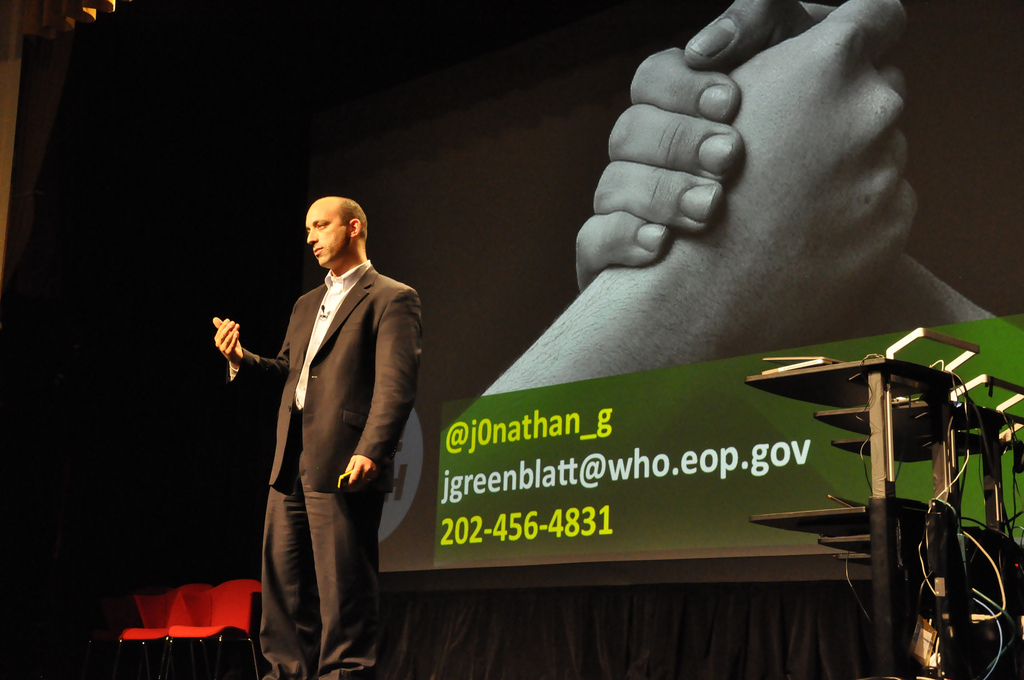
Columnist
Isi Leibler blasted Jonathan Greenblatt (pictured above), CEO of the
Anti-Defamation League and a former adviser to President Obama, for
turning the 100-year-old organization, whose mission is to monitor and
expose anti-Semitism and other forms of racism, into a platform that
"represents an echo chamber of left-wing Democratic politics." (Image
source: Erik Hersman/Flickr)
|
In a subsequent piece, Leibler called Greenblatt to task for having "lost the plot, behaving as though he remained employed by the Obama administration." Leibler cited the ADL's July 13, 2016 statement "welcoming the Republican Party platform on Israel," but expressing "disappoint[ment] that the platform draft departs from longstanding support of a two-state solution to the Israeli Palestinian conflict... the only viable way to secure Israel as both a Jewish and democratic state."
Leibler wrote:
"One can disagree about a two-state policy, but for an American Jewish organization which must remain bipartisan and should be concentrating on anti-Semitism to issue such a statement breaches all conventions. It is totally beyond the ADL's mandate to involve itself in such partisan political issues."Yet this is just what Greenblatt did. In a September 13, 2016 article in the journal Foreign Policy, he contested a video clip of Israeli Prime Minister Benjamin Netanyahu pointing to the Palestinian Authority's outright refusal to have even a single Jew reside within the boundaries of a future Palestinian state. In the piece, titled "Sorry, Bibi, the Palestinians are not 'ethnic cleansing' Jewish settlers," Greenblatt wrote that Netanyahu "chose to raise an inappropriate straw man regarding Palestinian policy toward Israeli settlements."
Far more questionable, however, has been the ADL's support for the Black Lives Matter (BLM) movement -- a group established in 2013 to counter police brutality against African Americans, but that quickly mushroomed into a full-fledged "intersectional" anti-American, anti-white, anti-Israel, pro-radical Palestinian organization.
About this, too, Greenblatt made what critics claim is a convoluted statement -- saying that the ADL has no "official relationship with the body of activists who claim membership in this effort," and attributing its "anti-Israel — and at times anti-Semitic — positions" to a "small minority of leaders within the Black Lives Matter movement."
In November 2016, during his opening remarks at the ADL's "Never Is Now" conference in New York City, Greenblatt responded to a Fox News interview with a pro-Trump PAC spokesman citing World War II-era Japanese internment camps -- when discussing possible ways to keep tabs on terrorists in the U.S. -- by announcing:
"I pledge to you that because I am committed to the fight against anti-Semitism that if one day Muslim Americans are forced to register their identities, that is the day that this proud Jew will register as Muslim."After U.S. President Donald Trump's inauguration in January 2017, the ADL "unambiguously condemned" his proposed executive order on immigration and refugees. Greenblatt stated:
"History will look back on this order as a sad moment in American History – the time when the president turned his back on people fleeing for their lives. This will effectively shut America's doors to the most vulnerable people in the world who seek refuge from unspeakable pain and suffering... [such as] the Sunni family whose son languishes in prison in Iran... [and] LGBT youth in Yemen terrorized because of their sexual orientation or gender identity...Yes, we need strict screening but our current system is sufficient in keeping America safe... More than most, our community knows what happens when the doors to freedom are shut. That is why ADL relentlessly will fight this policy in the weeks and months to come. Our history and heritage compel us to take a stand."In other words, Trump had barely entered the White House before Greenblatt "took a stand" against him -- one that had nothing to do with anti-Semitism, to boot. This was not surprising. A month earlier, in an address to the Knesset (Israel's parliament) in Jerusalem, he said he was worried about what the future would hold with Trump at the helm of his country:
"[P]erhaps more so than any moment in modern memory, we truly do not know what the president-elect will do when he becomes the 45th person to occupy the Oval Office. I would be remiss if I did not share with you the very deep sense of concern shared by many in the American Jewish community in this moment of uncertainty. And there is legitimate cause for concern."Greenblatt went on to lodge a not-so-veiled accusation against Trump for the resurgence of anti-Semitism in the United States, comparing it to 1930s Germany and going so far as to say that "one of the main cheerleaders of [the Alt-Right] movement will be sitting in the West Wing, literally down the hall from the Oval Office." Without naming names, Greenblatt was apparently referring to Steve Bannon.
Greenblatt's openness about his political views was to be expected. When it was announced in November 2014 that he would be replacing long-time ADL director Abraham L. Foxman after his retirement in July 2015, Jews on all sides of the political spectrum called the move a "dramatic shift." This was not merely due to the difference in age and stage between the two men -- Foxman was the child of Holocaust survivors and Greenblatt a second-generation, tech-savvy social activist -- but because Foxman, although himself a liberal, was a staunch defender of Israel against Palestinian anti-Semitism, while Greenblatt's support for the Jewish state has been more conditional on the policies of the Netanyahu government.
In the aftermath of the August 12, 2017 "Unite the Right" demonstrations in Charlottesville, Virginia -- during which a white supremacist murdered a young woman and wounded many other people in a car-ramming attack -- the ADL joined all other Jewish organizations in condemning the anti-Semitism on display. Although the event was held to protest the imminent removal of a statue of Civil War Confederate Gen. Robert E. Lee, it quickly escalated into an altercation between Ku Klux Klan members shouting anti-Semitic slogans and left-wing radicals from the Antifa ("anti-fascist") movement.
When Trump responded by condemning "all sides," rather than denouncing the far-right anti-Semites, the ADL was not alone in criticizing him for it. Greenblatt's attack, however, was not simply harsh; it was also a defense of Antifa.
"President Trump went beyond the pale today in equating racist white supremacists in Charlottesville with counter protesters who were there to stand up against hate," he said. Yet Antifa is a radical organization that employs violence as a tactic, and also contains a strong anti-Zionist component.
Trump's mentioning of "all sides," then, may have been an error of judgment, given the explosive political and cultural climate, but -- as has become evident with the emerging of more details about Charlottesville and subsequent demonstrations -- it was tragically true.
Furthermore, even after Trump issued a clear condemnation two days later of "criminals and thugs, including KKK, neo-Nazis, white supremacists, and other hate groups," Greenblatt was not satisfied.
"Let's be clear: I think we should expect a leader in the highest office in the land to step above the lowest possible bar," he said. "We need to move from words to real action." Then, as he had done during his Knesset address, he proceeded to imply that certain White House staff members were on the side of the white supremacists. "Individuals who are associated with, for example, the alt-right found their way into positions of authority in the West Wing."
Greenblatt's partisanship seems to have paid off, and not only figuratively. Immediately after the events in Charlottesville and the outcry over Trump's initial reaction to them, major companies began announcing massive donations to the ADL and another NGO, the left-wing, anti-Trump Southern Poverty Law Center (SPLC).
As of the time of this writing, JP Morgan, Apple, and the George and Amal Clooney Foundation for Justice had pledged $1 million to the ADL and the SPLC each or together -- and, rebuking Trump, 21st Century Fox said it, too, would be contributing $1 million to the ADL, while urging others to do the same. JP Morgan and Apple also initiated a two-for-one match for employee donations to those organizations.
Separately, the ADL reported a 1,000% increase in online donations since August 13, a day after the Charlottesville rally. It is interesting to note that just over two weeks later, Greenblatt announced the creation of a new position at the ADL and hired George Selim -- an Arab-American former official at the Department of Homeland Security who worked under Presidents George W. Bush, Obama and Trump -- to fill it. Selim, whose past meetings with Muslim Brotherhood-affiliated groups is "raising concerns" about this role, will lead the organization's education, law enforcement and community security programs, and oversee its Center on Extremism, according to Greenblatt.
It is certainly the right of individuals, foundations and private companies to contribute to causes they deem worthy. It is forbidden, however, for NGOs listed by Internal Revenue Service as 501(c)(3) organizations -- charities -- to engage in political activity on behalf of or against candidates for or in public office. According to the IRS Code, "Violating this prohibition may result in denial or revocation of tax-exempt status and the imposition of certain excise taxes."
The ADL and the SPLC currently enjoy tax-exempt status. Unlike the SPLC, however, which has irked even many liberals for its exaggeration of hate-crime statistics to keep itself relevant and handsomely funded -- and whose reputation was damaged over the recent discovery that it has been funneling millions of dollars to offshore accounts -- the ADL is a widely respected, influential group in the Jewish world and among international human rights circles.
If, as Leibler suggested, the ADL has "lost the plot" under Greenblatt, it deserves to lose its tax-exempt status. Although this is not likely to happen, the ADL board nevertheless must step in to curb Greenblatt's political activism and restore the organization's reputation as a serious anti-Semitism watchdog. In the meantime, potential donors to the ADL need to ask themselves to what use their money will be put.
Ruthie Blum is the author of "To Hell in a Handbasket: Carter, Obama, and the 'Arab Spring.'"

