When did humans first become human? The
answer is far from simple, because
the question assumes that sometime in
the past, humans achieved modernity and were locked within an
evolutionary loophole where natural selection no longer applies.
Despite the absurdity of this scenario, and
in stark contrast to empirical data, it is widely believed that humans have not changed physically or mentally for the past 50,000 years or so.
After the discipline of anthropology was hijacked by Cultural Marxism
and it became crimethink to observe average group differences, a
preoccupation with tracing everything back to Africa developed. Africa
does have an outstanding archaeological record revealing many firsts:
the
first bipedal hominids, the first
stone tools, and the
first anatomically modern humans
that looked roughly like we do today (a vertical forehead, round skull,
flat face, and prominent chin). But largely due to the anti-racist
politicization of anthropology, the currently accepted evolutionary
paradigm is that Africa was the source of an intellectual watershed
event sometime between 100,000 to 50,000 years ago, and that it was only
a matter of time before this new breed of clever Africans spread out
and replaced all the dim-witted archaic human populations in the rest of
the world, such as Neanderthals. (As used here, the term ‘racist’
refers to views that race and racial differences are a legitimate
variable in research on humans, with none of the usual negative
connotations found in the popular and scientific literature.) The
concept of behavioral modernity as it has been applied to the
Paleolithic seemingly arose out of the Cultural Marxist obsession with
proving that Africans are just as good as, and even better than the evil
racist nineteenth-century White scientists who dared to rank societies
and point out that advanced civilization never developed in certain
areas of the world, such as south of the Sahara.
The problem with this paradigm is that, using the same set of
criteria proposed by those scholars pushing for an African origin for
modern behavior, it seems to have originally appeared in Europe instead,
when modern humans first arrived there and replaced Neanderthals.
Furthermore, the so-called modern behavior in the African Stone Age is
not qualitatively different from that of Neanderthals, who were
supposedly replaced by cognitively-advanced modern humans.
Why all the confusion and intellectual gymnastics to argue for an
African origin for modern human behavior? The reason can be traced back
to the early twentieth century, when an anti-racist political agenda
was injected into anthropological scholarship, which eventually was
influenced and transformed by critical theory of the Frankfurt School,
with its overtones of anti-establishment and anti-Western sentiment
aimed at the Marxist goal of liberating oppressed groups. It has been
debated elsewhere whether such anti-racist sentiments were sincere, or
in contrast
were used as a means to advance ethnic Jewish group
interests while simultaneously de-ethnicizing non-Jewish elites [1].
Regardless, this Cultural Marxist ideology has served as a hindrance to
scientific inquiry and has resulted in unfortunate situations where data
are simply ignored when they do not follow the accepted paradigm, which
evokes the exclusionary tactics used by the Boasian intellectual movement against dissenters.
The Anti-Racist Crusade in Anthropology
At the turn of the twentieth century, a spark was lit in the academic
world of anthropology that would drastically change its course and
politicize the discipline to serve as a mouthpiece for the far left.
This spark, lit by Franz Boas, the “Father of American Anthropology,”
introduced the concept of cultural relativism and involved the heavy use
of an anti-racist political ideology. The Boasian tradition would
later dovetail with critical theory, created by Cultural Marxists of the
Frankfurt School, in that dominant (Western) societies and their
supporting ideologies were seen as the primary obstacle to human
liberation. Thus, critical theory is inherently anti-Western because
the dominant ideologies at that time were Western in origin.
This freedom fighter mentality against traditional Western ideals and
society has been a mainstay in anthropology since it was introduced at
the turn of the twentieth century, and has arguably metastasized into a
political-philosophical juggernaut that crushes all dissent and has
resulted in the railroading of the discipline into meaningless
postmodern, unscientific pursuits of self-interest, such as the field of
feminist archaeology (which is
so 1980s and has since been eclipsed by
black feminist archaeology).
Many of today’s anthropologists are infused with Cultural Marxist
cultural relativism and the desire to be a freedom fighter railing
against mainstream thought. The irony of course is that Cultural
Marxism
is the mainstream, completely dominating all aspects of Western academia and media.
Despite major scientific advances in various aspects of anthropology
such as radiometric dating and genomic studies,
Cultural Marxism remains
at the helm, firmly keeping the discipline on the straight and narrow
path of anti-racism and disingenuous cultural relativism that
overemphasizes the virtues of non-Western societies while simultaneously
de-emphasizing the positive aspects of Western civilization.
The Legacy of Franz Boas
The person most responsible for saturating anthropology with Cultural
Marxism was Franz Boas, a German-Jewish émigré who found his academic
home at Columbia University in 1896, where he stayed until his
retirement in 1936. Boas had a profound impact on the field of
anthropology, and was unashamedly political in his orientation, placing
great emphasis on fighting
scientific racism.
Boas’s anti-racist enthusiasm was shared by other Jewish intellectuals
of the Frankfurt School, which relocated from Germany to Columbia
University in New York City in 1934.
Shortly after establishing the department of anthropology at
Columbia, Boas turned his attention to “the race problem,” and part of
this effort involved nurturing Africa-centric studies in the social
sciences. Contrary to the common view at that time that sub-Saharan
Africa was a cultural backwater, Boas claimed that “the Negro race had
contributed its liberal share” of cultural inventions and civilized
accomplishments [2, p. 313].
Boas claimed that African cultural
inventions in agriculture and iron smelting were crucial to “the
advancement of the human race.” Subsequent research has shown that
neither agriculture nor iron smelting was an African invention, despite
decades of intensive investigation within Africa that was influenced by
this idea originated by Boaz. Boaz was also the first to advocate for
an African Institute and Museum, and the adoption of a Black studies
curriculum at universities [3].
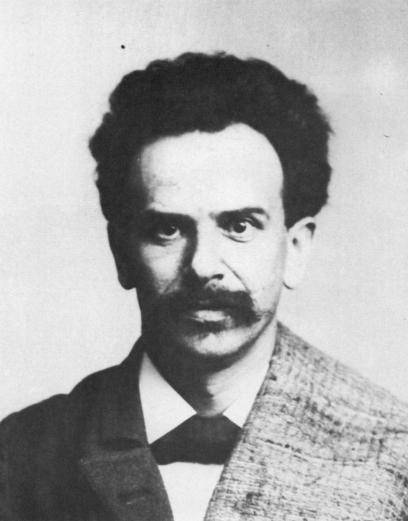
Franz Boas. Photo from National Anthropological Archives, Smithsonian Institution, Washington, D.C. 20560, U.S.A.
Anthropology becomes a Cog in the Wheel of the Radical Left
I went to the University of Chicago
for a while after the Second World War. I was a student in the
Department of Anthropology. At that time they were teaching that there
was absolutely no difference between anybody. They may be teaching that
still. (Kurt Vonnegut, Slaughterhouse Five, Ch. 1)
Kurt Vonnegut, Slaughterhouse-Five
They sure are. Little has changed since Vonnegut’s wry observation.
Beginning in the 1950’s, a new crop of scholars attempted to change
the course of anthropology to a more rigidly scientific discipline,
sometimes viewing Boas’s ideas as old-fashioned. A few scholars,
however, exacted more searing criticism of Boas, claiming that his
politicization of anthropology was primarily self-serving in that it
supported primarily ethnic Jewish group interests. Boas was accused of
nepotism by being principally receptive to Jewish students and
prejudiced against American gentile scholarship [4]. It was also
contended that Boas’s political leanings served two primary purposes: to
combat anti-Semitism and to ensure that Boas and other European Jews
achieved domination of anthropology in the United States [5, p. 139].
The same scholar concluded that Boas, in all of his talk of emancipating
blacks and other minorities from perceived oppression, was essentially
using Africans and other dark-skinned people as pawns in a game against
non-Jewish scholars to obtain Jewish hegemony in the discipline of
anthropology [5, p. 139].
But most criticisms of Boas were primarily methodological. The core
tenants of Cultural Marxism stuck like glue in the field of
anthropology: radical egalitarianism, cultural relativism, etc. Even
Boas’s most vocal opponents were dyed-in-the-wool socialists, one of
whom was
under investigation by the FBI
after his gushing praise of the Soviet Union during a 1929 speech at
the American Association for the Advancement of Science was published in
Pravda.
Boas and his academic brood remain profoundly
influential in anthropological research even today. The urge to debunk
evolutionist claims of outmoded (largely non-Jewish) scientists has
carried on through the twentieth century, perhaps culminating in Steven
Jay Gould’s
Mismeasure of Man (originally published in 1981), a
highly influential book that was assigned reading in nearly every
college course dealing with human evolution. Gould’s book is still read
as gospel in many college courses, despite the fact that scholars have
since debunked some of Gould’s own research.
Completing his graduate work at Columbia University in 1967, Gould
became a part of the Jewish intellectual movement at that institution
spearheaded by Boas. Among his litany of attacks against early
racialist scientists in
Mismeasure of Man, Gould claimed that
nineteenth century physical anthropologist Samuel George Morton had
manipulated the brain volumes of human skulls to favor a bias that
Europeans had larger brains and Africans smaller ones.
In a classic
case of the pot calling the kettle black, a group of scholars recently
re-measured the original sample of Morton’s skulls, revealing that
Morton’s
data were correct, and that Gould was the one who was guilty of
manipulating data and making bogus claims to push his political agenda [6]. In the chapter claiming to debunk Morton, Gould wrote with much condescension and moral triumphalism:
Liars, if discovered, are excommunicated; scientists declare that
their profession has properly policed itself, and they return to work,
mythology unimpaired, and objectively vindicated. The prevalence of
unconscious finagling, on the other hand, suggests a general conclusion
about the social context of science. For if scientists can be honestly
self-deluded to Morton’s extent, then prior prejudice may be found
anywhere, even in the basics of measuring bones and toting (sic)
sums. [7, pp. 87–88]
Now that Morton’s research has been exonerated, and after Gould’s own
blundering mismeasurements have been exposed, one wonders how Gould
would have judged himself: as a liar deserving of scientific
excommunication, or simply as a self-deluded ideologue to be pitied and
ignored?
The Evolution of Modern Humans
Has anthropology’s love affair with Africa produced anything other than an outlet for
fashion-challenged celebrities
to show that they care about ending poverty? In fact, African
prehistoric archaeology has been very productive. Archaeologists have
made several outstanding discoveries here during the latter half of the
twentieth century. But, poignantly, despite Boas’s goal of revealing
Africa’s cultural contributions to civilization and simultaneously
minimizing biological-evolutionary inquiry, the best discoveries in
sub-Saharan Africa are fossilized hominid remains that have revealed a
great deal about human evolution and nothing at all about early
civilization.
Current evidence suggests that anatomically modern humans evolved in Africa — that is, humans of our own species,
Homo sapiens sapiens.
The oldest candidates are a few fragmentary skulls and postcranial
bones found in East Africa and South Africa dating to between ca.
100,000 and 200,000 years ago.
It is important to note that these
earlier anatomically modern skulls are quite robust, and it is only
after ca. 35,000 years ago that skeletons show fully modern morphology
[8].
But this hasn’t stopped the idea, perpetuated by Cultural Marxist
creed, that once we evolved into modern humans, somehow our brains have
miraculously been unaffected by any subsequent evolution and that all
human achievements after were built with the same brain.
It should come as no surprise that finding the first modern humans in
Africa was very welcome news to the politically correct community,
which has relentlessly glommed onto the idea that “
we’re all out of Africa.” National Geographic even has a lesson plan on its website aimed at teaching high school students how we’re “
all Africans under the skin”. Never mind that forensic scientists regularly
identify the race of human skeletal remains, or that with a sample of your saliva, several
genetic testing companies can provide a highly-detailed breakdown of your racial composition.
Behavioral Modernity
One thing eluded the pro-Africa, anti-Western crusaders in the realm
of human evolution: pinning ‘behavioral modernity’ squarely inside
Africa.
The problem is that anatomically modernity (as it is currently
loosely defined) does not correlate with behavioral modernity. Those
anatomically modern humans that evolved in Africa, as far as we can
tell, acted the same as Neanderthals and other archaic modern human
groups for over 100,000 years. In other words, there is no appreciable
behavioral difference between early modern humans and archaic humans for
more than half of the time that we have existed as a species.
That didn’t stop scholars from trying really hard to locate the
origins of behavioral modernity in Africa. Decades of research in South
Africa resulted in the claim that a series of sites along the coast
were the fountainhead of modern human cognition. Realizing the power of
these statements, the media, politicians, and funding agencies have
accepted these claims uncritically.
What’s the big deal about these South African sites? Scholars in the
Africa-first camp claim that modern human culture arose here for three
reasons: (1) new, more advanced stone tool technology; (2) more advanced
subsistence strategies (exploiting more nutritious foods, etc.); and
(3) most importantly, symbolic artifacts (artistic depictions).
The evidence they are using for these claims comes primarily from two
sites in South Africa: Blombos Cave and Klasies River Mouth. By about
80,000 years ago, the occupants at these locations were manufacturing
perforated shells that were used as decorative beads, and they were
making engraved designs on small pieces of ochre, a mineral often used
as a red pigment. It is argued that the incised lines on two pieces of
ochre at Blombos Cave and on ostrich egg shells, including a hatched
band motif, are symbolic in nature and thus support the emergence of
modern human behavior here.
Why so much emphasis on these lumps of incised ochre? For one, it has been revealed that
Neanderthals
made shell beads in Europe. Also, the discovery of anatomically modern
humans in the Levant (in modern-day Israel) at 100,000 years ago,
together with
perforated shell beads
and lumps of scratched-up ochre threatened to usurp coveted prize of
earliest behavioral modernity. So the Africa-centric scholars claimed
that the scratches on the lump of ochre in the Near East at 100,000
years ago were not as purposeful and intricate as those in Africa at
80,000 years ago. Even more unsettling to the Africa-first model is the
fact that Neanderthals occupied the same region of the Levant
after
anatomically modern humans lived there, indicating that modern humans
here did not replace Neanderthals, as was the case later in Europe.
So
if the beaded, ochre-loving modern humans in Israel were so cognitively
advanced, why did they give up their prized real estate to the
supposedly cognitively inferior Neanderthals for over 50,000 years?
Furthermore, the Near Eastern modern humans had the exact same stone
tool technology as contemporaneous Neanderthals, and the same
subsistence strategies so far as we can tell. So the three indications
for behavioral modernity proposed by the Africa-first crowd (nice tools,
advanced hunting skills, and art) were not really telling us anything.
Were there really any qualitative differences between these groups of
early modern humans and Neanderthals?
The obvious answer is no, and that incised hatch designs and
perforated shells are not unambiguous evidence for fully modern
behavior.
One would expect the blossoming of other types of modern
behavior shortly afterwards if indeed this was the genesis of
modernity. But there were no new artistic or symbolic advancements in
sub-Saharan Africa for approximately 55,000 years after the beads and
ochre pieces. The first painted art in Africa is found at a cave in
Namibia and dates to approximately 25,000 years ago. These
early African paintings are predated by about 10,000 years by
cave paintings in Western Europe,
which were drawn with much more sophistication and aestheticism than
the African paintings (e.g., use of shading and highlighting to
emphasize three dimensionality and dynamism; detailing of eyes, hair,
musculature, etc.).
The Artistic Explosion in Paleolithic Europe
Investigations in Europe over the past decade have revealed rich
archaeological remains attributed to early modern humans as they
migrated into an area inhabited by Neanderthals about 40,000 years ago.
Artifacts found at sites in Germany include a spectacular array of
personal ornaments, artwork, and musical instruments unparalleled in
sophistication and aesthetic quality anywhere else in the world for tens
of thousands of years. These skillful artists manufactured
naturalistic and mythical images in three dimensions with exquisite
attention to detail and perspective, together with sophisticated
personal ornamentation and musical instruments: flutes carved from
animal bone capable of producing a remarkably wide range of tones and
harmonies. Not to mention the exquisite cave paintings appearing only
5,000 years later in France and Spain.
Without a doubt, these early Europeans were far ahead of their time
and attained an astonishing aptitude for creativity and invention. The
timeline figure below provides a direct comparison of Paleolithic art
across the world. It is immediately apparent that, if there ever was a
source of behavioral modernity during the Paleolithic, that it occurred
in Europe and nowhere else.
Paleolithic art in Europe is far advanced in several ways:
- Figurative art (representing actual things such as humans and animals, rather than abstract designs)
- Mastery of three-dimensional sculpting
- Paintings displaying a mastery of three dimensional perspective and dynamism (such as providing a sense of movement)
- Musical instruments
- Depictions of mythical imagery (imaginary beings such as the half-lion, half-man sculpture shown in timeline figure)
- Degree of aestheticism and the successful transfer of an appreciation of beauty to the artistic form
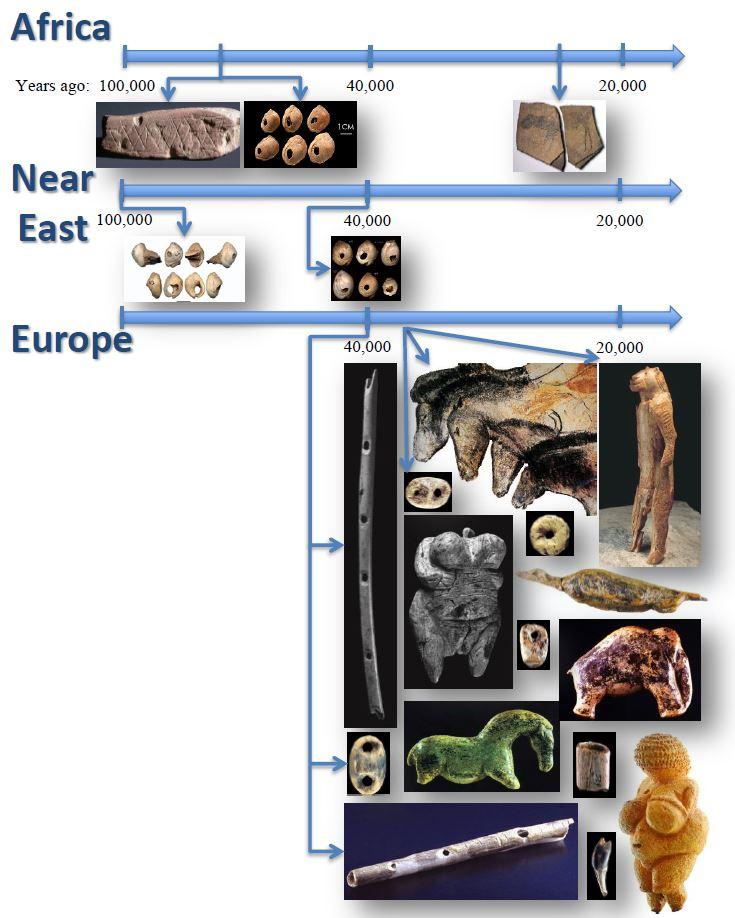
A comparison of artwork around the world during the Paleolithic.
The items shown in the timeline are only a small sample of the rich
artwork created in Europe during the Paleolithic. For example, the
prehistoric flutes
are not isolated occurrences. A total of eight flutes have been found
in Germany alone at sites dating back to 40,000 years ago. One nearly
complete specimen is made from the radius bone of a griffon vulture and
measures 21.8 centimeters in length (8.5 inches), has five finger holes
and a V-shaped notch at one end serving as the mouthpiece. Others are
made from the bones of swans and mammoth ivory. Although flutes were
used throughout the remainder of the Paleolithic in Europe, there is no
definitive evidence for musical instruments of any kind anywhere else in
the world for more than 30,000 years after their use in Europe.
In terms of artistic representation, nothing else compares to Europe
for tens of thousands of years, and some societies never accomplished
this level of sophistication in their material culture. But you
wouldn’t know this from listening to The Narrative, which relentlessly
claims that the seeds of advanced human cognition were first sown in
Black Africa. Never mind the obvious creative explosion during the
European Upper Paleolithic. And never mind that European
Neanderthals were producing the same types of objects heralded as ‘modern’ in South Africa.
The evidence for significant cultural advancements in Europe earlier
than anywhere else in the world is largely ignored by scholars and the
public alike, because it does not fit the politically-motivated idea
that humanity was an African invention and that the human brain was born
there, after which it has remained fixed and resistant to all effects
of evolution. If cultural modernity first arose in Europe,
after
anatomically modern humans spread out of Africa, then the possibility
arises that populations who remained in Africa may have been left behind
on the brain train. Obviously, this won’t do in a discipline steeped
in Boasian cultural relativism.
But if you were to objectively consider all sources of empirical
data, then such a possibility becomes a very plausible hypothesis. Not
only does the archaeology suggest that something special happened in the
brains of Europeans 40,000 years ago, but genetic studies also
corroborate this idea.
In 2006, scholars at the University of Chicago
published research
suggesting that mating between ancient humans and Neanderthals in
Europe may have introduced a gene variant into the human population that
enhanced human brain function. Analyzing the DNA sequence structure of
the gene microcephalin, which regulates brain size in humans, indicated
that all modern copies of the D alleles in this gene arose from a
single progenitor copy around 40,000 years ago [9]. This allele must
have provided a strong fitness advantage, because it then spread rapidly
and is now present in about 70 percent of the world’s population.
Further, the researchers found that the D alleles are much more
prevalent today in Eurasia and less common in sub-Saharan Africa, which
is consistent with the scenario that it originated in Neanderthals and
was passed on to modern humans in Europe.
To review: a genetic mutation for enhanced brain function evolves at
the same time when there is an explosion in creative artistic
representation in Europe (and advancements of similar magnitude in
hunting technologies). This gene is found more commonly in European and
Asian populations and less commonly in African populations. It doesn’t
take many D alleles to connect the dots. But in the spirit of Cultural
Marxist suppression of dissent, the University of Chicago study was
relegated to the shadowy sidelines of scientific literature, not because
its findings were refuted, but simply because it was called “manifestly
racist” [10]. Dropping their initial enthusiasm of the study’s
findings like a sack of potatoes, the University of Chicago abandoned
its patent application for DNA-based intelligence testing, and the lead
researcher moved onto other research because “
it’s getting too controversial”.
For all of the lip service paid to
Occam’s razor,
scholars today would rather construct elaborate and implausible
scenarios that either muddy the issue, or directly mislead the public.
If they value their job, they will avoid this controversial topic all
together.
Ignorance is Bliss
Africa-first scholars with a Cultural Marxist orientation have argued
themselves into a corner. By supporting a concept such as “behavioral
modernity,” they have implicitly approved the hierarchical ranking of
humans into groups who were mentally advanced and those who were not,
despite the tireless inculcation of the anthropological discipline with
Boasian cultural relativism for the past century.
This was no doubt a compromise to allow some ranking of prehistoric
groups, just so long as it was clear that all modern humans are exactly
the same, all derived from the same source population, and that all of
the dummies are extinct populations who became Darwinian zeros after
succumbing to African superiority.
Without some sort of ranking of our
deep past onto a scale from primitive to advanced, paleoanthropology is
rendered meaningless. To say that there is no difference between humans
today and the earliest hominids some four million years ago is to deny
human uniqueness. This is too much for even the most politically
correct crowds to accept, so a line had to be drawn between modern
humans and everything else.
Much to the chagrin of scholars seeking an African origin to fully
modern human behavior, there is simply too much evidence to the
contrary. It was fine to say that the seeds of human greatness arose in
Africa and that these chosen people then spread out and replaced all
other humans through their cultural and biological superiority. But by
constructing a testable hypothetical scenario, they left the door open
for the discovery of contradictory evidence. To the horror of
politically correct academics, by their own definition of modernity,
contradictory evidence indicates that Europeans were the first to reach
this mental milestone, and that by comparison populations in sub-Saharan
Africa and Australia did not catch up, even into modern times.
Over the past few years, the concept of behavioral modernity has
become rather unfashionable within the inner-circle of prehistorian
scholars. It is probably no coincidence that this concept lost steam
after the political implications of behavioral modernity arising in
Europe first were realized. Recently, an academic symposium
was
held to deconstruct the notion that behavioral modernity arose first in
one place, or that it can be recognized archaeologically at all
(“Alternative Pathways to Complexity: Evolutionary Trajectories in the
Middle Paleolithic and Middle Stone Age,”
Current Anthropology, 54,
No. S8, Dec. 2013). A new framework was developed which essentially
claims that after we evolved as a species, behavioral changes were
circumstantial, and that different groups were simply reacting to
diverse environmental, demographic, and cultural influences.
Frankly, the concept of behavioral modernity was always dubious, and
arguably only ever gained popularity as a political tool for the “we’re
all the same under the hood” crowd. It was claimed that behavioral
modernity was the tipping point when culture took over natural selection
and the human brain was locked into its current state. For example,
Neanderthals are thought to have used thrusting spears and necessarily
relied more heavily on their brute strength than the more gracile modern
humans who had developed a spear throwing technology that required less
strength and put them in less danger while hunting.
Advancements in human genomic studies have shown that such a concept
is manifestly untrue. To believe that the modern human brain has
somehow been magically spared from the effects of natural selection is
no less an act of faith than to believe that the world was created on
October 23, 4004 B.C.
Although we are all different culturally and genetically from the
first modern humans entering Europe some 40,000 years ago, it is clear
that something special did happen there at that time. This phenomenon
is worthy of attention, particularly when combined with advancements in
genetic research such as the University of Chicago study revealing
mutations that enhanced brain function around the same time as the
artistic explosion.
But the suppression of this study indicates that
political correctness trumps empiricism and scientific advancement. To
the Cultural Marxists, it’s time to put the nail in the coffin of yet
another idea that could potentially provide meaning to the
archaeological record with their usual techniques: “by emphasizing the
vast diversity and chaotic minutiae of human behavior” [1, p. 24], thus
obfuscating the data before it can be exploited within a theoretical
framework of any consequence.
Bibliography
| [1] |
K. Macdonald, The Culture of Critique: An Evolutionary
Analysis of Jewish Involvement in Twentieth-Century Intellectual and
Political Movements, Long Beach: California State University, 1998. |
| [2] |
G. W. J. Stocking, The Shaping of American Anthropology, 1883-1911: A Franz Boas Reader, New York, NY: Basic Books, 1974. |
| [3] |
H. S. Lewis, “The Passion of Franz Boas,” American Anthropologist, vol. 103, no. 2, pp. 447-467, 2001. |
| [4] |
L. A. White, “The Social Organization of Ethnological Theory,” Rice University Studies, vol. 52, no. 4, pp. 1-66, 1966. |
| [5] |
W. S. J. Willis, “Skeletons in the Anthropological Closet,” in Reinventing Anthropology, New York, NY: Random House, 1969, pp. 121-152. |
| [6] |
J. E. Lewis, D. DeGusta, M. R. Meyer, J. M. Monge, A.
E. Mann and R. L. Holloway, “The Mismeasure of Science: Stephen Jay
Gould versus Samuel George Morton on Skulls and Bias,” vol. 9, no. 6,
2011. |
| [7] |
S. J. Gould, The Mismeasure of Man, New York: W. W. Norton & Company, 1996. |
| [8] |
G. P. Rightmire, “Middle and Later Pleistocene Hominins in Africa and Southwest Asia,” Proceedings of the National Academy of Sciences of the United States of America, vol. 106, no. 38, pp. 16046-16050, 2009. |
| [9] |
P. D. Evans, N. Meke-Bobrov, E. J. Vallender, R. R.
Hudson and B. T. Lahn, “Evidence that the adaptive allele of the brain
size gene microcephalin introgressed into Homo sapiens from an archaic
Homo lineage,” PNAS, vol. 103, no. 48, pp. 18178-18183, 2006. |
| [10] |
J. Marks, “The Origins of Anthropological Genetics,” vol. 53, no. S5, pp. S161-S172, April 2012. |
http://www.theoccidentalobserver.net/2014/01/anthropologys-obsession-with-african-origins/
=================


