.

.
Library of Professor Richard A. Macksey in Baltimore

POSTS BY SUBJECT

Labels

Showing posts with label Global warming. Show all posts

Wednesday, June 7, 2017

JAMES DELINGPOLE: ‘Global Warming’ Is a Myth, Say 58 Scientific Papers in 2017

JAMES DELINGPOLE: ‘Global Warming’ Is a Myth, Say 58 Scientific Papers in 2017

by James Delingpole 

6 Jun 2017

“Global warming” is a myth — so say 80 graphs from 58 peer-reviewed scientific papers published in 2017.

In other words, the so-called “Consensus” on global warming is a massive lie. And Donald Trump was quite right to quit the Paris agreement which pretended that the massive lie was true.

By “global warming” these papers don’t, of course, mean the mild warming of around 0.8 degrees Celsius that the planet has experienced since the middle of the 19th century as the world crawled out of the Little Ice Age. Pretty much everyone, alarmists and skeptics alike, is agreed on that.

Rather, they mean “global warming” in the sense that is most commonly used today by grant-troughing scientists, and huxter politicians, and scaremongering green activists, and brainwashed mainstream media (MSM) environmental correspondents. “Global warming” as in the scary, historically unprecedented, primarily man-made phenomenon which we must address urgently before the icecaps melt and the Pacific islands disappear beneath the waves and all the baby polar bears drown.
What all these papers argue in their different ways is that the alarmist version of global warming — aka Catastrophic Anthropogenic Global Warming (CAGW) — is a fake artefact.


That is, all these different experts from around the world — China, Russia, Canada, the U.S., Italy, etc. — have been looking closely at different aspects of the global warming puzzle in various regions and on different timescales and come to the conclusion in irreproachable, peer-reviewed scientific ways that there is no evidence to support the global warming scare story.

Late 20th century and early 21st century global warming, they show, is neither dramatic, nor unusual, nor scary.

Here, as collated by Kenneth Richard at No Tricks Zone, are just some of the charts to prove it.

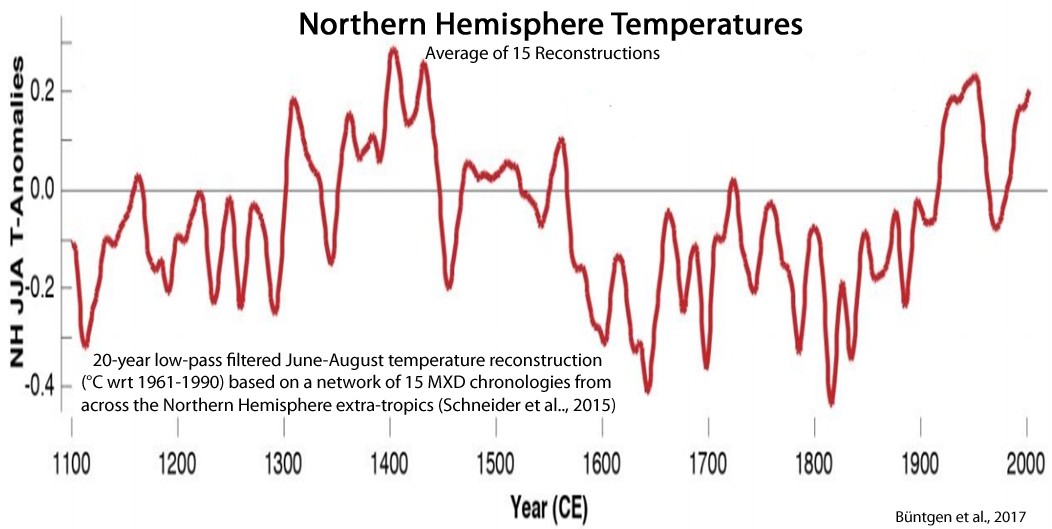
Büntgen et al, below, shows that temperatures in the northern hemisphere were warmer in the early 1400s than they are today


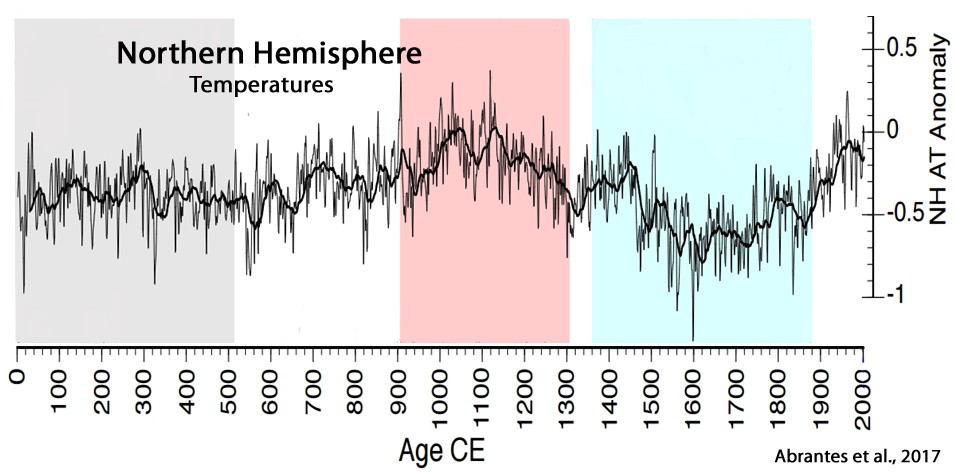
Abrantes et al (below) confirms the traditional view — which Michael Mann tried to dismiss with his discredited Hockey Stick chart — that the Medieval Warming Period was warmer than anything we have experienced in our own era.


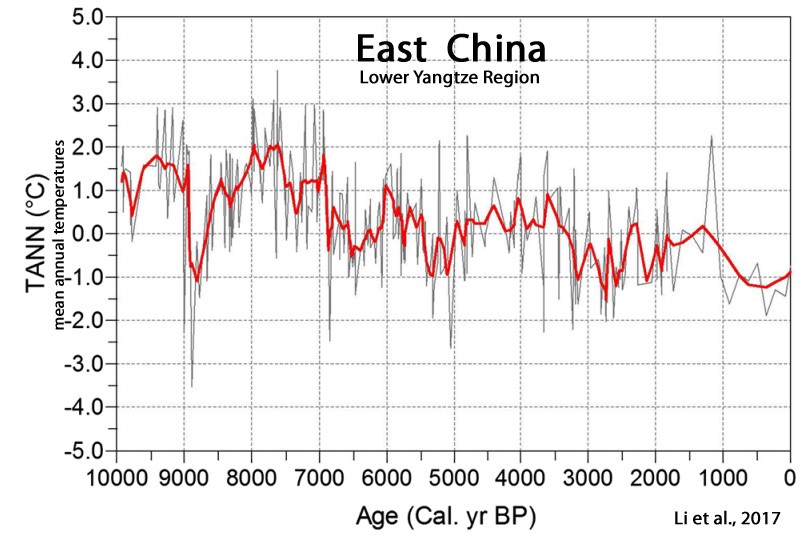
Here’s one from Li et al showing that China was much warmer 8,000 years ago


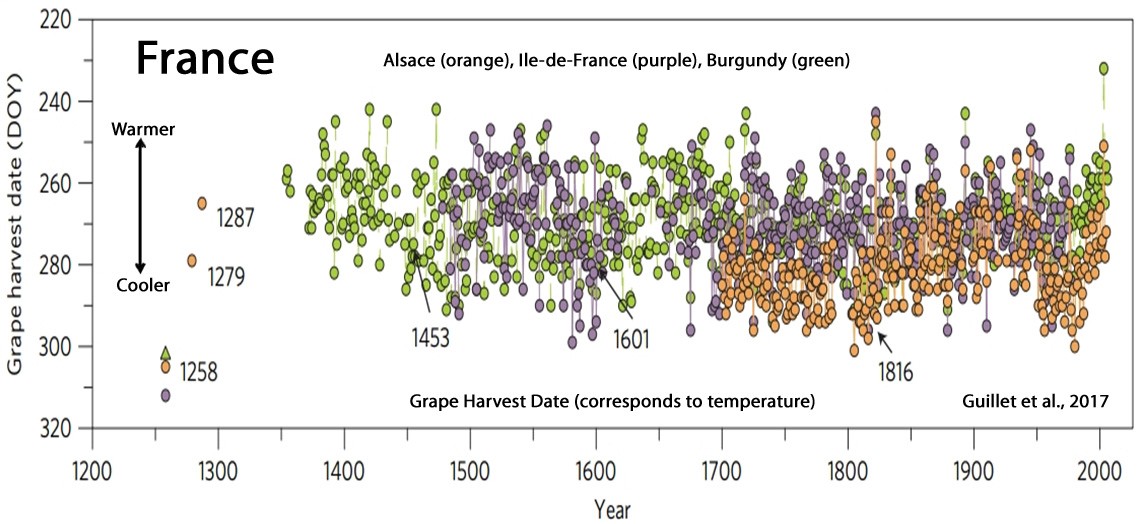
Here’s an unusual one from Guillet et al suggesting that there’s nothing new about wildly early or late grape harvests through the centuries:


And on and on it goes — there are 80 graphs in all, each showing in its different way why the scare about global warming has been horribly overdone because the evidence just doesn’t support its being unusual or a problem. Several of the papers note that the primary influence on warming appears to be solar activity. Few, if any, entertain the notion that carbon dioxide levels have much to do with it.

The intellectually corrupt and mendacious alarmist science establishment — I’m thinking, for example, of my personal bete noir, the left-wing political activist and Nobel-prizewinning geneticist Sir Paul Nurse, former president of the Royal Society — would have us believe that climate skepticism is a minority activity, the preserve of a few cranks, championed only by people who don’t do the science. But this is just ugly propaganda.

Here are dozens of reputable scientists from around the world with no axe to grind collaborating on studies which all corroborate, independently and rigorously, the increasingly respectable view that “man-made global warming” just isn’t a thing.
Not that it ever was a thing, really.
This debate — as I argue at some length in Watermelons — was always about left-wing ideology, quasi-religious hysteria, and “follow the money” corruption, never about “science.”
Still, it’s always a comfort to know that “the science” is on our side too.
They do so hate that fact, the Greenies.


http://www.breitbart.com/big-government/2017/06/06/delingpole-global-warming-is-myth-58-scientific-papers-2017/
==============

Saturday, June 3, 2017

Tyler Durden : Studying The Climate Doesn't Make You An Expert On Economics And Politics

Studying The Climate Doesn't Make You An Expert On Economics And Politics


Tyler Durden's picture

Authored by Ryan McMaken via The Mises Institute,


In response to the Trump administration's announcement that it was pulling out of the Paris Climate Accord, some of his critics declared that anyone who likes "science" would have supported the accord. 
Not surprisingly, Neil deGrasse Tyson rushed to declare that Trump supported the withdrawal because his administration "never learned what Science is or how and why it works."
40FB8A7E00000578-4561928-Astrophysicist_Neil_deGrasse_Tyson_suggested_that_Trump_didn_t_u-a-19_1496330408968_0.jpg


But what does "Science" (which Tyson capitalizes for some reason) have to do with it? 
We know that Tyson is of the opinion that there is global warming. We also know that many other physical scientists agree with him.
But, it does not follow logically that agreeing with Tyson on the matter of climate change must necessarily mean supporting the Paris Climate Agreement.
After all, the Paris Climate Agreement isn't a scientific study. It's a political document that lays out a specific public-policy agenda. 
Agreement or disagreement with the accord might hint at one's opinions about climate science. Or it might not. One can agree that climate change exists and that human beings have a large role in the phenomenon. Agreement on this matter, however, does not dictate that one must also agree with the political policies outlined in the Paris document.
The two are totally independent phenomena. 

Science and Politics Are Not the Same Thing 

An analogy might help illustrate further:
Scientific inquiry tells us that obesity is bad for one's health. Let's imagine then, that in response to rising obesity rates, a large number of politicians gather and sign an agreement — let's call it the London Obesity Avoidance Deal (LOAD). The supporting politicians claim that the deal will reduce obesity and that failure to abide by the agreement will spell a health crisis for humanity.
Does this mean, then, that any politician who doesn't sign onto the agreement is an "obesity denier"? Does a failure to approve of the agreement prove that the dissenters believe that obesity is not a real thing? 
Obviously not.
Those who refuse to sign the agreement may be of the opinion that the LOAD does little to actually reduce obesity. Or, the dissenters may feel that the deal fails to properly compare costs and benefits when imposing its directives. Opponents may feel that "the cure is worse than the disease."
In any case, dissent from the deal has nothing to do with denying the existence of obesity or the science behind the studies on the matter.

The Problem with Paris 

The same is true of the Paris deal. Those who disagree with it may very well be — and probably are — taking issue with the specific provisions of the deal which may actually prove to be more costly to people than the presumed global warming itself.
But, for physicists like Tyson — i.e., people who know nothing about economics or political institutions — public policy is like a magic trick. A group of politicians get together, declare that they're going to solve problem X, and then problem X is magically solved, so long as everyone supports the "solution."
But what if the policy prescriptions of the Paris politicians are wrong? Or, what if the cure is worse than the disease?
Presumably, the agreement is supposed to improve the lives of real-world human beings by improving their standards of living. 
If this is true, then, the Paris agreement must accomplish several things: 
1. It must rely on good science about the climate.

2. It must accurately predict the effects of climate change on standards of living.

3. It must endorse public policies that will do something to mitigate the negative effects of climate change on standards of living.

4. It must demonstrate that these public policies will in fact mitigate the effects of climate change.

5. The agreement must demonstrate that the costs of the proposed public policies themselves are lower than the costs of the climate change. 
If the Paris agreement fails to do any of these things, it should be rejected. If the net effect of the agreement is to make people poorer, then the agreement is of no value. 
Now, without making any judgment about climate science itself, we can see just from looking at the Paris agreement that it could easily be rejected on the basis of numbers two, three, four, and five in our list.
After all, the agreement is based on policy predictions that are wildly speculative.They attempt to make predictions about the global economy decades in the future (a notoriously unreliable endeavor) and they fail to honestly take into account the true costs of imposing far-higher energy costs on most of the world's poor and working classes — which is what the agreement would do.
In fact, the agreement doesn't even mention the cost to households that would face higher energy costs under the agreement. The only costs mentioned are the costs of adapting to climate change. In other words, the agreement assumes that there is no downside for households in the agreement's provisions. That's a huge red flag right there. 
Also ignored is the opportunity cost of adopting the agreement's provisions. In real life, adoption of the agreement's policy prescriptions will lessen growth by reducing access to basic energy resources. In addition to reducing household wealth, this will also reduce tax revenues. Money spent on higher energy costs is money that can't be spent elsewhere — on things like health care, and research into better agricultural practices. Yet, at the same time, the agreement calls for massive redistribution of wealth and large amounts of government spending on various programs such as "emergency preparedness" and more government "insurance" to pay for the effects of natural disasters.
Thus, the agreement calls for more spending, while reducing the ability of both the public and private sectors to engage in that spending. It's a self-defeating endeavor. 
Other opportunity costs include the impact on the production of fresh water. As I noted in a 2015 article:
A second major factor here in the necessity of energy is fresh water. The California drought has reminded us that fresh water is a scarce resource, even if the government likes to treat it as if it were not. But even as larger populations demand more water, fresh water can be produced through the use of energy via desalinization and pump-based aqueducts.

Today, most such schemes are still uneconomical because the problem of water scarcity can usually be solved through cheaper means such as importing food from wetter climates and through cheaper aqueduct systems that are primarily gravity-based.

In the future, however, as water does become more and more scarce as populations grow, the most practical answer will indeed become more energy-intensive solutions.

By centrally planning and artificially limiting energy usage, however, what the global warming lobby wants to do is raise the price of water processing, and by limiting the use of such methods, also inhibit technological progress by preventing practical experience in the use of water processing and fresh water production.
The Paris Climate Agreement supporters will no doubt retort that the provisions of the agreement will somehow amazingly prevent the need for more spending on clean water in the future by reducing global temperatures. Based on what evidence? Based on a computer model for what will happen decades from now?
With such flimsy evidence, it's easy to see that it might be wiser to stick with policies we have now that are likely to produce a bird in hand — rather than the two birds in the bush merely promised by the Paris agreement. 
We already know we can help the poor now with cheap energy, more productive capacity, and a robust economy. The Paris agreement only promises to help hypothetical people in the future based on a theoretical and untried public policy regime.
Many prudent people will elect to go with the former. 
Moreover, many of the global warming lobby's own people deny that the Paris agreement does much of anything to reduce temperatures anyway. Thus, prudence would dictate a renewed interest in investing in technologies and poverty-relief measures (such as those that encourage more trade and capital investment) that we know will help the poor right now. Adopting policies that cripple our ability to invest in these measures — as the Paris agreement does — only makes matters worse.
Nevertheless, in the imaginary world of physicists and climate scientists who can't comprehend the complicated realities of economics and public policy, simply wishing something to be so makes it so. If we just wish really hard that all our problems are solved, surely the good people in government will make it happen.

===============