.

.
Library of Professor Richard A. Macksey in Baltimore

POSTS BY SUBJECT

Labels

Showing posts with label Lord Kitchener. Show all posts

Wednesday, July 18, 2012

Was Winston Churchill A "Soviet" Agent?


Was Winston Churchill A "Soviet" Agent?

January 19, 2011
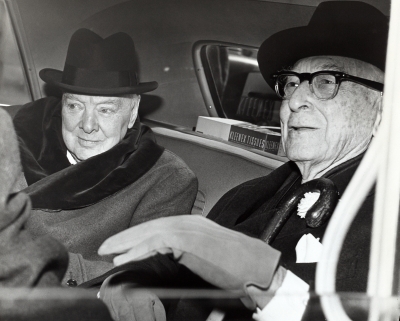
Winston_Churchill_and_Bernard_Baruch_talk_in_car_in_front_of_Baruch's_home,_14_April_1961.jpg(left, Churchill in 1961 with his old time boss, Illuminati banker Bernard Baruch)
The USSR was a proxy for the Rothschild banking syndicate. Victor Rothschild was a "Soviet" spy. He was also Churchill's handler. The Illuminati make war on humanity by instigating war and controlling both sides. War is a devilish dance of suffering which they choreograph.   

by T. Stokes
(Edited by Henry Makow)  


Winston Churchill's mother was a high-class whore, and his father was a wastrel who suffered from syphilis.  Churchill was a Jewish stooge for W W One. The sinking of the H.M.S Hampshire [June 5, 1916] was a British false flag operation, a Churchill/Jewish plot to kill Lord Kitchener, who was planning [to convince the Russians to make peace, which would have forestalled the Bolshevik revolution.]

Churchill's original Sandhurst military file, describes him as a drunken aggressive homosexual, and only his mother sleeping with Prince of Wales, stopped him from being prosecuted for sodomy.

Psychologists understand now that putting same-sex children together in boarding schools for years and hot-housing their development with no contact with the opposite sex, breeds homosexuality. The term "Fagging" meant the younger boys were bullied to do jobs for the older ones, and same sex relations grew from this at a colossal rate,as told in detail by Guy Burgess.

Arthur Ransome (1884-1967), an author best known for his "Swallows and Amazons" stories, was an expert on Russian affairs, having cultivated friendships with both Lenin and Trotsky. He was a high ranking MI-6 operative with the codename S76.

This man, according to Winston Churchill's nanny, Elizabeth Anne Everest,
knew first-hand from Russia that Churchill was working for Rothschild interests, not Britain's. Many British intellectuals have suspected this, and Walter Thompson, Churchill's bodyguard, said Churchill felt more at risk of assassination for betraying his own people in Britain, than from the enemies he made abroad,

Churchill received Jewish banker money paid into a secret account in the name of Colonel Arden. Maxim Litvinov was from a wealthy Jewish banking family, and, according to Constantin Volkov, also paid money to Churchill. It was Volkov's knowledge of this and his documents tabling it, which caused Kim Philby to silence him.

Churchill comes from a long line of traitors. He was a  descendant of the 7th Duke of Marlborough, the first duke came to fame during the reign of Queen Anne. John Churchill played the prime part in the overthrow of James II, when William of Orange arrived in Britain, John Churchill the first Duke of Marlborough was paid 6000 pounds per year by Solomon of Medina. The other Jewish merchants paid William of Orange 2 million gilders. William III then with John Churchill founded the Bank of England in 1694, for the Jews to run and they still own it and us now,  converting the English people to tax and national debt slaves. Each new born babe in Britain today January 2009 already owes the Jewish banksters, 15,347 pounds each and it's rising.

So when the Jews call us to war on our Saxon brothers in Germany, or peaceful Muslims in Iraq, we have to go.

A recent 20 pound note had a star of David depicted on it,  showing we are all Jewish property.

HMS HAMPSHIRE CONSPIRACY THEORIES


HMS HAMPSHIRE
CONSPIRACY THEORIES

Also see Hampshire's Gold and the conspiracy theory printed in The Sunday Times in August 1998.

Over eighty years have come and gone since Kitchener went down with the Hampshire; yet still rumours persist that a cover-up conceals some dark, terrible conspiracy to make a premature end of the great soldier. Why, it is asked, did the Hampshire leave port in such a hurry, when imminent severe gales had been forecast? Why had she, contrary to her original orders, set off round the West Orkney coast into the teeth of a Force 8 north west wind? And why, given the status of the Hampshire's VIP passenger (Kitchener), had nothing been done to save his life? Kitchener was last reported seen pacing the deck, seemingly resigned to his fate. Old Orcadians to this day tell stories of armed soldiers posted on the cliffs around Birsay, keeping curious folk away at bayonet point. Will we ever know the truth about the Hampshire's end? Probably not.

MISTAKE or CONSPIRACY

Here is another fact which I have learned since creating this website which points to maybe not a conspiracy but a mistake, something which was over looked at the time leading to disastrous consequences.

Fact: 29th May 1916 - The U75 German U-Boat laid mines West of Orkney.
Fact: (little known as it maybe) 2nd June 1916 - The British Naval Vessel 'Laurel Crown' a 'drifter' or trawler hit one of the mines laid by the U75 West of Orkney and sunk.
Fact: 5th June 1916 - HMS Hampshire hits another mine laid by the U75 West of Orkney and the rest is history.

Now here's the theory:

It appears that in the days between when the U75 laid the mines West of Orkney (29th May) and the Hampshire sinking (5th June) that, that particular area of sea wasn't sweep for mines due to the 'bad' weather conditions. Prior to the 2nd June 1916 German surface minelayers and mine laying U-Boats didn't even present a danger in this area as they were thought to have insufficient range to reach the Orkneys, the farthest they had been seen were the seas off the Firth of Forth.

After the Laurel Crown struck a mine on the 2nd June (3 days before the sinking of the Hampshire) the English Fleet Directors must have now known of U75’s mine barrier, yet the area wasn't sweep for mines and the Hampshire was still sent on this deadly route.

Now was this because the Battle of Jutland had just taken place and in the confusion after the Battle the report of the Laurel Crown sinking was delayed, paid no attention to or maybe the Fleet Directors were unaware of it. In this case it was a 'mistake' with deadly consequences which is now not the best kept secret, but it is also not very well known.

The only other alternative is that the Fleet Directors were fully aware of the sinking of the Laurel Crown and the U75 mine barrier along this route. If this was the case the demise of the Hampshire was deliberate and Kitchener, together with his staff of six officers and the crew of the Hampshire were sent to their doom intentionally.

Here are some 'theories' given by other people:

I recently bought a book at a fair by Ernst Carl, Germany's master spy in Britain during 1914-1918.the book was published in 1935 by Jarrod and is a personal biography of the author's war service mainly undercover in England.

A large part of the book is devoted to Ernst Carl's plan and execution to blow up HMS Hampshire which he devised with Sinn Fein agents working in the UK and Ireland.

The author describes how Sinn Fein agents took naval positions on many of the navy's ships during this period and of a great plot to destroy the British fleet in port by placing large bombs in the ammunition rooms of the whole fleet so that on the designated day the fleet would be sunk which would in effect end the war.

Sinn Fein hated Kitchener and knew that when the war was over he would turn returning troops to Ireland and they had been planning to assassinate him for some time.
It seems impossible to me that this book could be anything but fact as there is much detail from the sinking including how Ernst Carl and his compatriots watched the Hampshire leaving port from a pub on the Orkney Isles after a three hour delay during which they thought their plan had been found out.

The author also states categorically that there was a large amount of gold on the ship which Kitchener was taking to the hotbed of Russia to use as a bargaining tool.
Regards
Steve

With regards to the above conspiracy, I was emailed in February 2003 by a Television producer who was looking at making a documentary on the Sinking of the Hampshire. He said that he had been approached by a 'reputable' Journalist who had evidence from a recent dive of the Hampshire that the Plating at the bow of the ship was blown outwards and not inwards, indicating the explosion which sunk the Hampshire was internal not external.
Jane Storey

Roger Collins wrote to tell me about Frank Power a journalist who was involved in a hoax regarding the body of Kitchener.
Frank Power was a journalist who caused much trouble over the sinking of the Hampshire. In October 1925 he began a weekly series of articles in the "REFEREE", a popular Sunday paper of the time. Week after week he piled claim upon claim, causing a public outcry. Public meetings were held all over the country, and the government began discreet enquiries, interviewing many persons about their recollection of events. This information was pulled together and published in August 1926, and finally told the whole truth about the Hampshire.

Power then changed his line, and claimed that Kitchener's body had been located in Norway. He made a trip to Norway with a film crew and a few weeks later a coffin arrived at Waterloo station in London, where Power picked it up. At this stage the authorities intervened and the coffin was opened in the presence of the police and Sir Bernard Spilsbury (the leading forensic scientist of the time). Power did not attend the opening as he was seeing his wife off on holiday!!

The coffin was empty, and it was later proved that Power had engaged in an elaborate hoax. The "REFEREE" disowned Power and he was interviewed several times by the police, but in the end he was not prosecuted.

This was a sad episode, causing a lot of grief to relatives of the men on the Hampshire.

I would like to impart some information that has been passed on to me via a colleague at school.

The theory is: Kitchener allegedly shot himself in a government building and this fact was covered up by saying that he was lost on a mission to Russia on board HMS Hampshire.

The information to my colleague was passed to him by somebody, many years ago who said he was there when Kitchener committed suicide.

Bob Pearson

I have to say that I find it hard to believe that, during wartime, The government via the Admiralty would sacrifice an entire ship and her crew just to kill one man that was off to Russia anyway, where he could be assassinated at a fraction of the price and no comeback on HM Government!

Simon D Smith

I talked to one 'local' (who held a position of Authority) in the Orkney's when I visited. He told me how on the 5th June 1916 the life boats where not launched for a period of time and also the few who knew of the disaster, who wanted to help, were in some cases “forcibly prevented under dire threats”. One man was told by a soldier “that all civilians were to remain in their houses and not to venture near the shore or we should be fired on”.
He went on to say that some of the survivors who reached the shore were shot by our own soldiers.
Is this true or just hearsay? I know it sounds 'unbelievable', but without saying where he worked the source of this information does have a reasonable strong connection with the Hampshire.

Dave in Carlisle.

To add some depth to the above theory Mike Jefferies emailed saying that he too had heard local rumours that the local home guard had been told that a German warship had been sunk that night and that they were to shoot survivors and that some had been shot on the cliffs. If this was the case, an initial mistaken identity of the sunken ship, it may explain why there was such a delay in launching the life boats and why locals had witnessed soldiers shooting the survivors, they assumed the survivors that made it to the shore would be foe not friendly.

Hello ,

I just finish to read a book called "les dessous de l'espionnage anglais , des documents, des faits" written by Robert Boucard in 1925 .

(an "insider", he worked for the French intelligence during WWI and again for the British Intelligence after the war).

This author, and I are not what people can say "British lovers". In his theory he says KITCHENER was murdered (time bomb ?), by the British Intelligence .

When KITCHENER went to Russia, it was in order to speak with the Czar about some high ranking officers who were German agents (Soukhomlinof = war minister) . It was after the reading of Sidney Reilly's reports upon felons in czar's staff. His mission was to reorganize the Czar's staff .

But according to Boucard's theory there were people in the British government who were thinking of a Russian defeat and an agreement with Germany (the "great game" and geopolitical theory of MacKINDER ) were earning a lot of money making business with Germany through the neutrals (Punch's drawing: William II saying "God bless England " with in his back bags of cotton, sugar , tea, ..........)
So, KITCHENER, who was close to France " The defence of London begin on the shores of Calais"  was an obstacle for them .

I would like to have your opinion about this .

Regards .

D.BESSON

The loss of the HMS Hampshire: Act of war or murder?


The loss of the HMS Hampshire: Act of war or murder? 

By Sean Chase, Daily Observer


The sailors aboard the HMS Hampshire were climbing into their hammocks when the vibrations of an explosion suddenly knocked them off their feet.
In the mess hall, off-duty personnel were sitting down to supper when they heard this dreadful grating sound echoing through the bowels of the ship. The blast, under the port side just forward of the bridge, tore an enormous hole below the keel -a mortal injury for any vessel. The lights flickered off, plunging the mess hall into darkness. Petty Officer Wilfred Wesson felt a gust of air rushing along the deck, blowing men's caps off. Groping for the switch, he felt the floor list steadily towards the bow.
Captain Herbert Savill was on the bridge when he felt the violent shudder ripple through his ship as the clock struck 7:40 p.m. The damage was cataclysmic. The helm was disabled while the power failed, knocking out the lights and the wireless. The Hampshire was barely three hours into her voyage to Archangel, Russia. Her assignment: to escort Lord Kitchener, the Secretary of War, on a secret diplomatic mission to engage Czar Nicholas. That mission was now over. The 655 souls aboard the warship must now fight for their lives.
The Hampshire was sailing up the Orkney coast between Marwick Head and the Brough of Birsay when the explosion occurred. A lookout stationed with the Orkney Royal Artillery garrison on the cliffs near Birsay saw the blast. Despite the heavy rain, the gunner could clearly see the Hampshire was in trouble. She was only one-and-a-half miles offshore. He ran down the path to inform the duty corporal, James Drever, who raced to the village's post office. There he crafted two urgent messages that were wired by postmistress Jessie Comloquoy. One was sent to the western patrol command in Stromwell, some 20 miles away, and the artillery commander at Kirkwall. Drever glanced at his watch. Five minutes had now passed since they heard the explosion.
By now, the Hampshire was going down by the bow with a sharp list to starboard. Savill had ordered "abandon ship!" The hatches opened as men clambered onto the deck to take their positions at the boat stations. Considering the situation, everyone remained cool and calm, including their illustrious passenger.
Wearing his khaki field marshal's uniform, Lord Kitchener exited the gun room flat followed by his entourage. The biting frigid winds of the gale did not seem to bother the Earl of Khartoum, who left his stateroom in such a hurry he forgot his great coat and forge cap. Captain Savill called out orders for the war minister to proceed to the quarter-deck where the captain's boat was being manually lowered. Wesson saw Lord Kitchener and was struck by how unaffected he was by the events around him.
"He looked as though he might have appeared at that moment, not for self-preservation, but regretfully to inspect the irreparable damage to a proud vessel," recounted Wesson later. "He looked tired and worn."
The old soldier then mounted the ladder. That was the last anyone saw of Lord Kitchener. With the power loss, five of the largest lifeboats could not be electrically launched from their derricks. Chief shipwright William Phillips and two others threw a carpenter's bench overboard, hoping to use it as a life raft. The mountainous waves immediately smashed it to pieces. Desperate sailors began jumping into the roaring sea, including many badly scalded by the steam escaping the engine room. Those bleeding screamed in agony when the salt water washed their wounds.
The propellers rose out of the water, motionless as the Hampshire dipped her bow deep into the sea. Wesson joined a crowd of 50 men who had cut away a raft and managed to float it off the sinking ship. As the hull began rolling over, they paddled with every ounce they had for the derelict raft. Those strong enough made it on board.
The Hampshire suddenly exe- cuted a somersault lurch for- ward, throwing men clinging to her boat deck and the stern into the raging water. On shore, Drever watched in horror as the Hampshire disappeared beneath the waves. Ms. Comloquoy then tapped out a second message: "vessel down."
Only three circular Carley rafts were launched. Each accommodated 45 people -not enough room for the hundreds now thrashing about in the ice cold water. Aboard Phillips' raft, men wearing life jackets were asked to leave the craft to make room for those without. Given the plunging temperatures, they would be going to their deaths. Some 18 volunteers stood up and jumped over- board, sacrificing themselves so their shipmates stood a chance to reach shore.
"All around us were floating bodies," recounted stoker Walter Farnden. "Other men were cling- ing to lifebelts and pieces of wreckage and calling for help. It was impossible to rescue them."
Standing on the cliffs, a help- less Drever and others watched the boats wallow in the seas. He saw the hundreds of heads bob- bing in the surf and quietly prayed help would arrive soon. But none would be coming for the doomed survivors of the Hampshire. At 8:10 p.m., G.L. Thomson, honourary secretary of the Royal National Lifeboat Institution, rushed into navy headquarters at Stromness instructing duty personnel that his lifeboat was ready for launch. To his utter amazement, he was rebuked by a senior officer who told Thomson it was a naval matter and to stay out of it. Fur- thermore, if he launched his lifeboat, he would be charged with mutiny. No instructions went out to the life stations along the island's west coast.
By 9:45 p.m., more than two hours after the explosion, a tug and two trawlers pulled away from the docks at Stromness enroute to the scene. At 10 p.m., the destroyer escorts Unity and Victory were finally ordered to Birsay.
Since the Hampshire went down, men were dying by the minute. Water began filling the bottom of Wilfred Wesson's raft. Exposure was the killer for most. Their limbs became numb as they closed their eyes, embrac- ing eternity where they sat. Tom Jennings, a grizzled 45-year-old gunner, tried leading the boys in a few choruses of "Tipperary." Fighting off death to the last, Tom defiantly stood up, faced the howling wind and belted out "... farewell Leicester Square," before collapsing to the bottom of the raft.
By midnight, volunteers from Birsay set out along the sheep paths in search of survivors who may have reached shore. The vil- lagers were surprised to see Ter- ritorial soldiers already posted along the cliffs. At 1 a.m., a Carley raft struck the rocks of a creek north of Skaill Bay. Initially overloaded with 70 men, only six were still alive.
At the same time, Wesson's raft washed up on the jagged rocks of the craggy Orkney coast. There were only four left alive. The sailor began climbing the treacherous heights before him. His limbs numb from the cold, he clawed his way up. The exhausted sailor reached the top where his weary eyes spotted a light across the field. Reaching a house, he banged on the door until the owners found him hypothermic. Wrapping him in blankets and hot-water bottles, they put him to bed.
In those dark hours, ships began reaching the scene far too late. By dawn, the gale calmed. The dead strewed the shore, or were retrieved by the late res- cuers. Only 12 sailors managed to reach the shelter of Birsay res- idences. No officers survived. Nor did any member of the dele- gation. Lord Kitchener's body was never found. A week later, King George and Queen Mary led all mourners in a elaborate memorial service at St. Paul's Cathedral.
Since then, speculation has been rife with the belief there were some in the British estab- lishment, seeing the war minis- ter as an obstacle to victory, who conspired to assassinate Lord Kitchener. After the field mar- shal's demise, Lord Northcliffe remarked: "Now we can get on with winning the war."
Many point to the fact that Lloyd George was pulled from the mission, at the last minute, as proof. Kitchener had also con- fided to Lord Derby that he intended to seek a peace of con- ciliation when the war ended. Would this policy have been too much for those seeking utter German capitulation?
The Admiralty's inquiry
heard from survivors that they believed Hampshire struck a single mine.
Some also felt more than one explosion caused the ship to go down in just 10
minutes. Germany's master spy, Ernst Carl, once
claimed he smuggled two bombs aboard the Hampshire as she was docked.
In addi- tion, how did British intelligence fail to know that the route had been
mined for weeks? If they did, why was this infor- mation not passed
onto Admi- ral Jellicoe, who made the fateful decision to send the Hampshire on a west- ern course instead of their intended route through the east channel.
One matter that the Admiralty never fully explained was its slow response to the disaster. Many questions have been asked about why it took rescue ships two hours to leave port -a criti- cal time when hundreds could have been saved. It's estimated 200 sailors escaped the Hamp- shire alive before she went down. Another 130 made it onto the life rafts. Was it incompe- tence or did the navy deliber- ately delay sending aid?
Orkney residents contra- dicted the Admiralty's assertion that rescue vessels arrived at the scene at midnight. Many have testified that the army arrived at Birsay and posted guards along the coast to dis- suade volunteer rescue parties. One farmer said he was told by a soldier that all civilians were to remain in their houses and not to venture near the shore or they would be fired upon.
To this day, there is still a feel- ing on the islands that the gov- ernment covered up the whole affair. More horrifying is that if such a conspiracy existed, it meant 655 men were sent to their deaths to destroy one man.
Perhaps Kitchener's friend and biographer knew the truth. In 1920, Sir George Arthur cryp- tically wrote: "By an unhappy error of judgement an unswept channel was chosen for the pas- sage of the cruiser; and Kitch- ener -the secret of whose jour- ney had been betrayed -was to fall into the machinations of England's enemies, and to die swiftly at their hands."
Sean Chase is a Daily Observer multimedia journalis

Lord Kitchener: The Truth At Last


Lord Kitchener: The Truth At Last

By T. Stokes on August 11, 2006

The sudden death of Lord Kitchener on June 5th 1916, caused as big an international stir, as that of President Kennedy and Princess Diana, and just as every one remembers where they were when the news was announced of their deaths, and so it was with Kitchener.At the start of W.W.I Horatio Herbert Kitchener was recalled home from Cairo, to become secretary of state for war, Kitchener was seen as a hero, winner of battles in the Sudan, India and the Boer war.
Small boys would sing out in the street “Come home Kitchener of Khartoum”. He was said he was more popular than the king. In the lead up to W.W.I Britain’s huge battle fleet, which was coal fired, took ages to warm up and was heavy to get going, the German Inventor Rudolph Diesel invented an engine which bears his name, which was demonstrated to run on vegetable oil, so impressed were the British government that he was invited across to Britain to sell us his engines, for updating the fleet, this would give badly needed work and prosperity to Britain’s farmers, and land workers, producing vegetables for fuel.
Strangely, for a man who was about to become filthy rich, the history books say Rudolph Diesel jumped over board on the crossing and drowned. Co-incidentally of course, Rothschild whose banks became rich loaning for Britain’s wars, put his agent Winston Churchill, into the admiralty as first sea lord, to lobby for the new middle east oil based engines, which would run on oil he supplied, the purchase of the new engines would be also bought with Rothschild loans,
Rothschild’s bank would also take over vast chunks of Germany after the war and influence the treaty of Versailles, this would later create a major problem for all Jews in Germany. In researching the newspapers of the day, surprisingly even the disastrous Gallipoli campaign in which Churchill overrode opposition from Kitchener to push through this invasion, failed to dent Kitcheners popularity.
On June 5th 1916 in a force 8 gale, with Kitchener on board the armoured cruiser, H.M.S Hampshire suddenly and hurriedly left for Russia, with the 2 escort ships, Unity and Victor, and new instructions to travel round the Orkneys.
Some short time out, the escort ships were ordered by the Admiralty to return home from the West Orkneys, leaving the Hampshire to find its way through the minefield alone, in a gale that was now force 9, on its journey to the port of Archangel, in Russia.
The Admiralty was aware there was a minefield in this location because, the laurel Crown was sunk here on June 2nd, by mines laid on May 29th by U75 U-Boat. This was confirmed by intercepted radio traffic.
We are told from witness statements, that the Hampshire with 655 men on board hit one mine, but several explosions then sunk the ship. The lifeboats were said to have been unlaunchable, of the 12 survivors who made the coast, instructions were given to the home guard to shoot all those who made it ashore. The war office later claimed that it thought the ship was German and wanted no prisoners.
Now is this a case of mass incompetence on a colossal scale, or something else? Lord Kitchener was a cult figure, an icon of his day, in spite of being a great strategist and battle student, he refused his men’s advice to bring in high explosive shells, and mistakenly ordered shrapnel shells, which in the closeness of the trenches, killed as many of his own men as the enemy.
He also through war office recruitment saw to it that bully boy press gang tactics, insured that boys as young as 14 joined up when the legal age to fight in France was 19, he instigated plans where women would give white feathers of cowardice to lads outside schools.
In preparation for this article I discovered one boy soldier was aged 12. But if asked to produce a Birth certificate on joining, this horrific situation would not have arisen.
The war office also shot for cowardice underage soldiers who they knew were under age, I interviewed many men who were W.W.I veterans in the 1950s and 60s who said even in the heat of the trenches they knew this was murder.
Although no government figures are available for child soldiers, the Red Cross and other organisations say approx 80,000 casualties were under age. Kitchener was a predatory homosexual, whose appetite for these boys was unquenchable, and cruel in the extreme, and the sort of army stories circulating, were similar to those in the catholic church of today.
Churchill despised both Kitchener and his popularity, yet both were senior freemasons. The street boys rhyme;” boy soldiers for war if you fancy, all for Kitchener ‘cos he’s a nancy” would have appealed to Churchill’s humour.
Importantly Kitchener died a few days after the biggest naval battle ever, the battle of Jutland, and some days before the Bolshevik revolution.
Some 50 years ago, a senior intelligence man on his death bed told myself and another witness the following story, and this is almost word for word.

“Myself and my C.O. went on board the Hampshire, I was told to keep watch outside while he went into Kitcheners cabin, I put my ear to the door, and heard the C.O say, I am going to leave you my pistol with one bullet, I will wait outside and you will do the honourable thing”We heard a shot, the C.O went in and retrieved the pistol, and we hurriedly left the ship”
He also claimed the sinking of the Hampshire with the loss of 643 men was a British cover up operation, as Kitchener had been directly approached for peace discussions.
Recent divers to the ship have said it is possible that the several explosions were from inside the ship, as the fragments appear to be outwards not inwards,
But not all are in agreement.
If this sounds far fetched look up “Operation Northwood’s” where the Americans planned to blow up one of their own planes with U.S youngsters on board. Or the deaths of 29 intelligence experts on the Irish situation in a helicopter crash.
Rothschild who financed both world wars and the Napoleonic war, and probably other wars, was instrumental in the start of W. W. I. And in the break up of the Ottoman empire, Palestine was too close to the Suez canal, and Arabs were 88% of the Palestinian population, the remainder were a few Jews and Christians, yet this land was demanded by Rothschild as part payment.
Nathaniel Rothschild and Winston Churchill were inseparable, Churchill’s mother was Jewish and as the bloodline is carried down through the woman, so was Winston, which explains his fanatical pro-jewish stance.
Because in 1917 Britain’s war was not going well, and hope of victory was optimistic. The Jewish influence world wide was pushing for the “Balfour agreement” and Britain needed the wealthy American Jews to back its war effort, by bringing in America, so Zionist influence meant President Woodrow Wilson had to support Britain, and the influential Russian Jews who masterminded the Bolshevik revolution, use its influence to keep Russia in the war.
Alfred Lord Douglas who wrote for the weekly “ Plain English” and “morning post”, had sources in the Jewish underground, and one member Benjamin Friedman, claimed that Jewish financiers under Rothschild, manipulated Churchill to make false statements after Jutland whereby the stock exchange dropped. Then next day a further more optimistic statement meant a rise in stock prices, head of the Jewish financial syndicate Sir Ernest Cassel, paid Churchill a cheque for £40,000.
One of Churchill’s speech writers told of Churchill having an account in the name of colonel Arden for payments. This stock exchange tactic was employed previously by Rothschild after the Napoleonic war.
I asked Winston Churchill about this episode in his constituency office in Woodford many years ago, he replied; “see yourself out”
In the book written by the society palmist and mystic “Cheiro” entitled; “palmistry for all” the frontispiece shows the palm-print of Lord Kitchener taken on July 21st 1894
Cheiro himself says, there will be some mystery attached to his death, the palm-print confirms the suddenness of his death with the suggestion of murder, interestingly the hand tells of waters involvement.
Palmistry has fascinated me since childhood, and as a child I studied Kitcheners hand-print, some palmists claim the hand cannot foretell the future, because the hand changes, but some aspects do not change, and his hand clearly shows Cheiro’s analysis to be absolutely correct, and a crisis to occur at age 66 the age of his death.
Cheiro says of this number 66 when reduced in numerology to the primary 12 that; “This number speaks of suffering and anxiety and is an indicator of the suffering of the victim, and depicts someone sacrificed for the plans and intrigues of others”
This number also gives us the occult indicators behind the death. From Kitcheners birthdate 24 June 1850, we deduce in microcosm again from Cheiro, “these people are extremely magnetic, obstinate and unyielding, they attract others to them and are often loved and worshipped by those under them”
Herbert Kitcheners name in numerology reduces from an 88 to a 16, Cheiro says of this; “This number is represented by the tarot card of a tower struck by lightning, from which a man falls, it is a warning of some strange fatality”
Interestingly his name contains 16 letters. The H.M.S.Hampshires numbers are 56 which reduce to an 11. Lord Herbert Kitchener also reduces from a 56 to an 11, and amazingly, First Sea lord is also a 56 then 11, and Winston Churchill M. P. again shows this compound number 11, showing absolute karmic linkage to a single plan.
Incidentally the word “treachery” is also an 11 number. Cheiro says again; “ Ominous warnings of hidden dangers, trial and treachery of others” that about sums up the ship.
The country celebrates all this when on the 11 of the 11 of the 11th how strange! Nietzche has this statement in his book thus spoke Zarasthustra;
“The state lies in all the tongues of good and evil, and whatever it says is lies, and whatever it has, it has stolen, everything it is, is false, it bites with stolen teeth, and it bites often, it is false down to its bowels”
So here we have it, in a nutshell, government lies and deception, Kitchener murdered by agents of his own government. And the Hampshire sunk, with all hands as a cover up.

T Stokes lecturer in paranormal studies copyright 2005
palmist@fsmail.net