.

.
Library of Professor Richard A. Macksey in Baltimore

POSTS BY SUBJECT

Labels

Showing posts with label GERMANY viz. ISLAM. Show all posts

Saturday, June 4, 2022

Europe: Demography Governs Democracy


  • There is a replacement of civilization and the media is not even covering it.

  • "By 2050, 50 percent of the French population will be mixed." — Jean-Luc Mélenchon, Radio Classique, May 17, 2021.

  • "The mayor of Grenoble adopts the arguments and rhetorical formulas of the Muslim Brotherhood: talking about freedom to impose sexism". — Céline Pina, Le Figaro, May 4, 2022.

  • This wokeism talk pretends to be "inclusive" but carefully excludes entire groups on the clearly racist basis of skin color (whites) or ethnicity (Jews). Wokeism, filled with progressive, racist talk, pretends not to be racist but meanwhile is imbued with the syrupy racist ideology of "diversity" -- which advocates replacing a society by immigration. It also promotes political correctness, a deadly virus that paralyzes the vital reflexes of the West. Wokeism is the ideal ground for the debut of political Islam in Europe.

  • This ever-increasing percentage of Turkish, Bosnian, Kosovar, Iranian and Iraqi politicians in Germany will increasingly influence the choices of the first European power in matters of immigration and multiculturalism.

  • "What we see in big cities today will be normal for the whole country in the future. In a city like Frankfurt, we will have between 65 percent and 70 percent." — Herbert Brücker, head of migrant research at the Federal Institute for Employment Research, Die Welt, April 11, 2019.

  • "The massive vote for Mélenchon is proof that the strategy of community victimization that began in the 1990s produced what it was intended to produce in one or two generations. Mélenchon gathered a large part of the Muslim vote, which obviously does not make it a Muslim or Islamist party, but only a 'cuckoo' party. Like the cuckoo hatching its eggs in the nest of a bird of another species, a cuckoo party shelters and protects ideas that are not its own. The Muslim Brothers have a strategy that they expressed in their plans from the 1980s: to form an alliance with the most docile parties to propagate their ideas". — Florence Bergeaud-Blackler, anthropologist, Marianne.net. April 22, 2022.
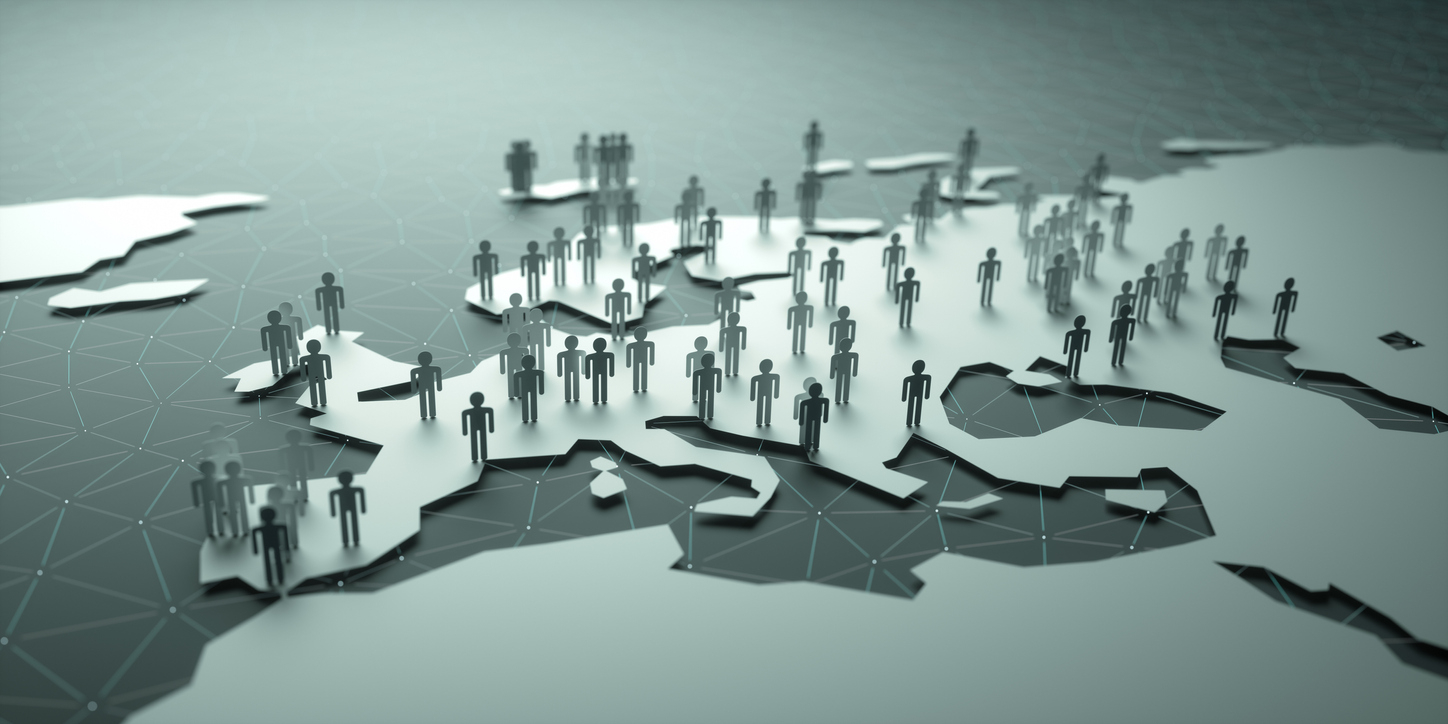
There is a replacement of civilization in Europe and the media is not even covering it. (Image source: iStock)

There is a replacement of civilization and the media is not even covering it.

Sept pas vers l'enfer ("Seven Steps to Hell"), the new book by Alain Chouet, the former number two of the DGSE, the powerful French counter-intelligence service, is an indictment of the European élites. Chouet recalls:

"I have been invited every year to give a lecture on the problems of the Arab world in Molenbeek, a suburb of Brussels. One day I was there... when Philippe Moureaux, the city's socialist mayor and big boss of the Belgian Socialist Party, took the front row flanked by two imposing bodyguards in djellabas, beards and white berets. To the audience, Moureaux said I was not qualified to discuss the Arab world, as I came from a country that had tortured Muslims in Algeria. His reasoning is significant in the way in which, since the late 1980s, the European left has allowed itself to be taken by the sirens of militant Salafism. The management of Molenbeek is exemplary in this sense: authorizations granted easily and without any control for the opening and functioning of mosques, Islamic private schools, cultural and sports clubs generously subsidized by Saudi Arabia".

25 out of 89 member of the Brussels Regional Parliament are not of European origin.

Chouet continues:

"I accuse political leaders of never wanting to understand the rise of radical Islam and of deliberately ignoring it because of the electorate and 'politically correctness'. I accuse them of allowing several municipalities to develop jihadist radicalism for years, to the point that a socialist official told me: 'We know Molenbeek's problem, but what do you want, it is an electorate that cannot be neglected'".

It now is France's turn. "Is the Muslim vote decisive?" the Algerian writer Kamel Daoud asked in the French weekly Le Point.

The re-election of Emmanuel Macron was predicted. The real shock from the last French presidential election was the resounding boom of the radical left. The candidate of the pro-immigration party, Jean-Luc Mélenchon, of "La France Insoumise" ("Rebellious France"), made dramatic progress compared to 2017. He received 22.2% of the vote, just one point behind Marine Le Pen. Notably, he received 69% of Muslim vote.

"Mélenchon," said the French philosopher Alain Finkielkraut in an interview with French television Europe 1 "is betting on the Great Replacement to acquire more power". Finkielkraut had also mentioned the "Great Replacement" in January, when he said that the replacement of the European people by Africans, Asians and Middle Easterners was "obvious."

"This is in fact a fragmentation and yes, this risk does exist and in any event, I think the demographic change of Europe is extremely spectacular. The historical people in certain municipalities and regions are becoming a minority."

France's suburbs and large cities with a high rate of immigration have been the heart of Mélenchon's political project, and where he received 60% of the votes in the elections.[1]

What do these numbers tell us? That many have gotten on the bandwagon of political Islam, and the feeling of communal solidarity has yielded the desired results. Mélenchon, who participated in "marches against Islamophobia" and compared Muslims in 2022 to Jews in 1942, predicted the "creolization" of France: "By 2050, 50 percent of the French population will be mixed".

"I am the only one who defended the Muslims", Mélenchon openly claims . He was heralded in working-class neighborhoods, in particular thanks to the Muslim vote, according to Le Figaro.

Although other candidates had also supported the claims of political Islam, "There is a category in which Jean-Luc Mélenchon is very strong, where he is the strongest", Brice Teinturier (Ipsos) warned. "[T]hese are French Muslims, where he is between 45% and 49%..."

In short, a new national dynamic can be seen: demography governs democracy. The common theme between supporters of these candidates and supporters of Islam appears to be an aversion to Western societies, which, using the progressive language and symbols of "woke", they apparently want to displace -- ostensibly to impose a more "inclusive" and "cosmopolitan" society that would be austere, forbidding and fundamentalist.

When the city of Grenoble, for instance, recently approved wearing burkinis in its public swimming pools, the mayor justified the change as a form of social inclusion. "The mayor of Grenoble", Céline Pina wrote in Le Figaro, "adopts the arguments and rhetorical formulas of the Muslim Brotherhood: talking about freedom to impose sexism."

This wokeism talk pretends to be "inclusive" but carefully excludes entire groups on the clearly racist basis of skin color (whites) or ethnicity (Jews). Wokeism, filled with progressive, racist talk, pretends not to be racist but meanwhile is imbued with the syrupy racist ideology of "diversity" -- which advocates replacing a society by immigration. It also promotes political correctness, a deadly virus that paralyzes the vital reflexes of the West. Wokeism is the ideal ground for the debut of political Islam in Europe.

France Strategy, an autonomous institution accountable to the Prime Minister, published a shocking study last October, which showed that there are 25 cities in France where the percentage of non-European young people is between 70% and 79%. More than 70% reside in four Seine-Saint-Denis cities.[2]

"There is an extraordinary correlation between Mélenchon's vote and the share of immigrants of non-European origin in the Paris region," wrote the analyst Sylvain Catherine.

In Montpellier, "there are more practicing Muslims than practicing Christians, and while the churches are not very crowded, the mosques are full", the Midi Libre newspaper reported. There, Mélenchon found an immense reserve of votes. In Créteil, for instance, a symbolic city of immigration in the Marne Valley, Mélenchon received 40%.

Erwan Seznec, the author of the book Nos élus et l'islam ("Our Elected and Islam"), detailed how so many of the French leadership have allowed Islamism to flourish in these cities. From Denain to Perpignan, sizeable numbers of elected officials have ambiguous relations with their Muslim voters. In exchange for votes, they watch out for their homes, jobs and prayer rooms. Islamist activists, in turn, fight to care for their supportive politicians. Bernard Rougier, author of the book Les territoires conquis de l'islamisme, ("The Territories Conquered by Islamism") cautioned two years ago that "In the next elections, in Mélenchon's party, there will be candidates of this Islamist fabric..."

Mélenchon received 61% percent in centers such as Trappes, a symbol of the Islamization of provincial cities:

"70 percent Muslim, 40-50 different nationalities that take on the appearance of some Lebanese localities, microworlds enclosed in the perimeter of another religious reality and civilization. The ethnic grid of the Balkans is also not far off."

In Roubaix, in a city already 40% Muslim, Mélenchon received 50% of the vote. In Mulhouse, the Alsatian city chosen by Macron to launch a project to contain political Islam, Mélenchon won 36% of the vote. In Nîmes, where Mélenchon effortlessly won, non-European immigration is expanding and, according to Le Monde, "the share of inhabitants born outside Europe rose from 7.3% to 16.3% of the population between 1990 and 2017".

In the second round of the elections, most Mélenchon voters opted for Macron. During Ramadan, the Great Mosque of Paris even organized for Macron's re-election an iftar-dinner. Christophe Castaner, Macron's former interior minister and president of his party, attended it. The votes for Macron rolled in. Trappes voted 74%, for Macron, 20 points above the national average; in Roubaix, 70%; in Grigny, 70%; in La Courneuve, 77%; in Bondy 74%; in Colombes, 80%; in Les Lilas, 83.5%; in Bobigny, 75.5%.... These are the symbolic cities of Saint-Denis.

In the northern districts of Marseille, which had largely voted for Mélenchon in the first round, Macron easily won. Those are the neighborhoods that are home to a large part of the Islamic community -- 30% of the total population of the city and a quarter of all the inhabitants of the city. "The northern districts of Marseille", wrote: Le Figaro, "a 'small city' where communitarianism is a daily reality..."

------------------

The same dynamic can also be seen in Germany. Research by MedienDienst Integration noted that 83 parliamentarians in the newly elected German Bundestag -- 11.3% of the total -- have foreign origins. The percentage of German parliamentarians of foreign origin has increased for the third consecutive time since the national elections of 2013 (by 5.9%) and 2017 (by 8%). 18 new Members of Parliament are of Turkish origin, and 24 have Balkan roots.... The number of Social Democratic MPs (the winners of last September's elections) who have an immigrant background went from 10% to 17% in one election.

This ever-increasing percentage of Turkish, Bosnian, Kosovar, Iranian and Iraqi politicians will increasingly influence the choices of the first European power in matters of immigration and multiculturalism. The left-wing party Die Linke has the highest percentage of parliamentarians with an immigrant background: 28.2%. And tomorrow? Herbert Brücker, the head of migrant research at the Federal Institute for Employment Research, told the German newspaper Die Welt:

"Currently a quarter of the people in Germany have an immigrant background. In 20 years, it will be at least 35 percent, but it could also exceed 40 percent... What we see in big cities today will be normal for the whole country in the future. In a city like Frankfurt, we will have between 65 percent and 70 percent".

"The result of the presidential election reveals that Mélenchon's strategy aimed at the Muslim community paid off," noted the anthropologist Florence Bergeaud-Blackler. But with what consequences in the future?

"The massive vote for Mélenchon is proof that the strategy of community victimization that began in the 1990s produced what it was intended to produce in one or two generations. Mélenchon gathered a large part of the Muslim vote, which obviously does not make it a Muslim or Islamist party, but only a 'cuckoo' party. Like the cuckoo hatching its eggs in the nest of a bird of another species, a cuckoo party shelters and protects ideas that are not its own. The Muslim Brotherhood have a strategy that they expressed in their plans from the 1980s: to form an alliance with the most docile parties to propagate their ideas".

What will happen in France in five years with demographics turning upside down? Will there be a scenario as in the novel Submission by Michel Houellebecq, with a "moderate" Muslim Brother elected as president? Or those with similar policies who take the lead thanks to their pact with the Muslim communities?

"Today," the philosopher Alain Finkielkraut reflected, "there are 145 mosques in Seine-Saint-Denis compared to 117 churches." The former are overcrowded, the latter are half-empty.

The future is here already.

Giulio Meotti, Cultural Editor for Il Foglio, is an Italian journalist and author.


[1] To be exact, Mélenchon received 61.13% percent in Saint-Denis, 17 points more than in 2017. In Montreuil, Mélenchon collected 55.35%. In Bobigny, 60% of the vote. Across the Seine-Saint-Denis, Mélenchon reached 49.09% -- a dramatic increase compared to 2017, when he gained only 34.02%. In Argenteuil, the third largest city in Île-de-France, he came first with 49.89%. Across Île-de-France, the largest French department which also includes Paris, Mélenchon largely defeated Macron.

In the Islamized Seine-Saint-Denis, Mélenchon won in 37 out of 40 cities. Mélenchon won in Marseille (31%), Le Havre (30%), Lille (40%), Lyon (31%), Montpellier (40%), Saint-Etienne (33%), Toulouse (36%), Strasbourg (35%), Rennes (36%) and Nantes (33% ). In Marseille and Lyon (second and third largest cities of France) Muslims already make up 30% percent of the population, and a quarter of the students of public schools in Strasbourg are Islamic. In Mulhouse the Muslim community is already 25% percent of the population. In Paris, Mélenchon came in second with 29%of the vote. In Aubervilliers there was a plebiscite. "Here the municipality is working with Muslims to build a large mosque", said the panel installed on a piece of land in Rue Saint-Denis in Aubervilliers. Islamic clientelism is in evidence in "9-3", the French department where 30% of the population is now Muslim.

[2] La Courneuve (64%), Villetaneuse (73%), Clichy -sous-Bois (72%), Aubervilliers (70%). In La Courneuve, Mélenchon had 64% of the votes, in Clichy-sous-Bois 60%, and so on.


Sunday, August 16, 2020

The bitter truth about multiculturalism

The bitter truth about multiculturalism

Heinz Buschkowsky, mayor of the Berlin problem-district Neukölln (41% immigrants), has written a book that will unleash a lot of discussion. Bild [a leading German tabloid] has published exclusive excerpts:

At this point my case is more about the daily powerlessness in a world where shoppers walk through the supermarket, collect products, pass the cashier without paying, and make clear to the cashier what will happen to her when she calls the police.

There, where five persons walk abreast over the sidewalk and all others should make way. There, where possibly everyone is gazing into nothingness before the traffic light to avoid trouble with the streetfighters in the car next to you and being asked: “Do you have a problem? We can resolve it here and now!”
There, where small children are asked for a ‘road tribute’ or a ‘consumption tax’ for the use of the playground. Where young women are being asked if they wish to have a ‘fertilisation process’. Where people throw their softdrink over the head of the bus driver when he asks for your bus ticket. This simply puts you in a bad mood, just by reading it.


As long as we pursue a policy of all-understanding and all-forgiving and make clear to the people that we are not thinking about changing these conditions, because this neglect of manners belong to ‘cultural identity’ and ‘openness to the world,’ we will only find lukewarm partners for a genuine successful  integration policy.


Usually it is the elderly who suffer under this territorial behavior, or the very young who find out who has the final say on the streets.

There is a demonstrative neglect of manners such as courtesy or consideration — the simplest rules for how to behave toward others in the public. That is the issue which makes people think: Where am I at the moment? Is this still my town, my homeland?

That’s why at some point many come to the conclusion: I don’t like these people. If they don’t want to live together with me, I also don’t want to live together with them.

These are not excessive incidents, but the goal of the “top dogs” is all about demonstarting that the Germans have nothing to say; they don’t care about the rules at all. They are not completely without success.

For example, in the Sonnenallee of Neukölln cars are often parked three abreast. The first car is on the sidewalk, the second in the normal parking spot, the third on the street, i.e., in the first driving lane.When the drivers are unlucky, a car stops in the second lane and the driver loudly starts talking with the people who are drinking thea or coffee in front of the cafe. Don’t make the mistake of honking or getting out of your car. You might end up in an uncomfortable situation.

Any problem that you might have can be ‘solved’ directly [i.e., by confrontation]; or when you think that you have something to say about manners as a German, they will show you that you can lick their boots. The police patrols  don’t have a different experience.

Police officers are careful not to come within arms’ length of a person. It could happen that suddenly a cap or other things will be taken. Loud  talking starts, which is unintelligible for anybody, but nobody knows whose car it is and the police should just proceed and don’t bother them.

All this is happening with an agressive posture and with an agressive tone. If the situation gets out of control, the police have to call for reinforcements and really must restore the situation, there may well be physical violence.

Afterwards it can happen that the police officers are questioned by their team leader—asked if they have ever heard about the ground rule of proportionate conduct. Asked if they were aware that resistance was to be expected. Asked whether they are aware of how such conduct will be judged by the judicial system.

These judicial procedures usually end up with the acquittal of the traffic ruffian, in which case the police officers should be happy that they have not been convicted. Many judges are not even inclined to let the police do their government-assigned work of regulating traffic; they are not inclined to support them by applying the law.

The aggression and other difficulties in enforcing the law that police officers have to endure while doing their duty do not trouble these “do-gooder judges” with no firsthand experience.

Gaertner, the police commissar who was active in Neukölln for decades recently told me that he could not recall ever reading a report of a handbag theft or a robbery by an immigrant youngster on a woman with a headscarf [i.e., a non-German].

The enemy are the hated Germans; they are the target of their agression, and they have nothing to counter the flashmobs: via cell-phones numerous people appear in mere minutes who directly start to behave threatingly. Germans are considered easy targets.

Germans are considered easy targets.


It can happen to anybody on a normal day. It can happen to you that you experience a suprise at a normal traffic accident, particularly when the person you collided with is easily recognisable as an immigrant.

In that case you and the other driver are quickly surrounded by numerous “witnesses,” who happen to have it seen very clearly. The man behind rearended your car, but they will  swear that you have callously driven your car backwards into his car.

When in doubt, the ground rule is to help the ethnic sisters and brothers. What is true or not has no value in the case of a “disbeliever” [i.e., those in outgroups have no moral standing—an case of moral particularism]. These are some of the small experiences that makes the people here so “happy.”

We Germans educate our children to be non-violent. We reject violence in encounters and teach that to our offspring. Others teach their children to be strong, brave and ready to fight. The ground rules basics are simply different from the beginning.


Heinz Buschkowsky’s book Neukölln ist überall [Neukölln is everywhere] appeared on Septemebr 21st at Ullstein Verlag.
Translated by Peter Stuyvesant

Wednesday, July 18, 2018

Vijeta Uniyal : Germany: Migrant Crisis Delusions


  • A report commissioned by the German government found that newly-arrived asylum seekers were behind more than 90% percent of the increase in violent crimes in the state of Lower Saxony.
  • As of December 2017, an estimated 600,000 able-bodied asylum seekers in Germany were on the welfare dole, according to Die Welt. "More than half of the able-bodied unemployment benefit receivers at present are of foreign descent," wrote Der Spiegel on April 10, 2018.
  • Meanwhile, poverty in Germany, especially among elderly pensioners, has reached a historic high.
While the number of Salafists in Germany reaches a record high and machete-wielding gangs riot on the country's streets, the establishment media not only covers up the fallout from Chancellor Angela Merkel's open door migration policy, but continues to paint a false picture of the country's current state.

"Cool Germany," a cover story on Britain's magazine, The Economist, claims that, "Germany is becoming more open and diverse" and "[m]any of the country's defining traits" including "its ethnic and cultural homogeneity, conformist and conservative society" are "suddenly in flux."
The Economist attributes this change to Chancellor Merkel's migrant policy. "The biggest change comes from Mrs. Merkel's "open door" policy towards refugees, which brought in 1.2 million new migrants in 2015-16. The magazine celebrates the sudden outburst of diversity as its transforms "once-homogeneous Germany" into a "melting-pot" and claims that the "patriarchal culture has become more gender-balanced."
The Economist also advocates the urgent necessity of the open-door policy for refugees, and alleges that the "flow of newcomers to Germany" will "cushion the demographic crunch."
Since the onset of the migrant crisis, which began in the autumn of 2015, much of the mainstream media has been peddling the idea of an influx of hundreds of thousands of migrants from Arab and Muslim countries as a silver bullet for Europe's economic woes. Young and sturdy immigrants were going to bolster Europe's shrinking labor force and usher in the next economic boom, a miracle comparable to Germany's post-war Wirtschaftswunder ("economic miracle").
"Refugees to pay our pension," an editorial headline the newspaper Frankfurter Rundschau in February 2016 promised. The migrant "influx ensures rejuvenation that is so urgently needed" and the refugees "will soon pay into our public welfare system," the newspaper pledged.
"The German business community views the recent influx of refugees as an opportunity to help companies grow and ensure long term prosperity," the Der Spiegel reported in its August 2015, issue, just ahead of Merkel's decision to open the country's borders to mass migration. "The business community urgently needs workers," it added.
"What the refugees bring to us is more valuable than gold," said Martin Schulz, Merkel's main political rival and the leader of Germany's Social Democrats (SPD).
"Many [migrants] are in integration courses or waiting to get in them. So I think we will need to show some patience," Merkel said in September 2016.

Unfortunately, these claims and assurances now seem like nothing more than liberal pipe-dreams to push through a pro-immigration policy in Germany.
Instead of lining up to join the German workforce, as the political elite and most of the media were asking us to believe, these young immigrant men, in the hundreds of thousands, took refuge in the Germany's generous welfare system.

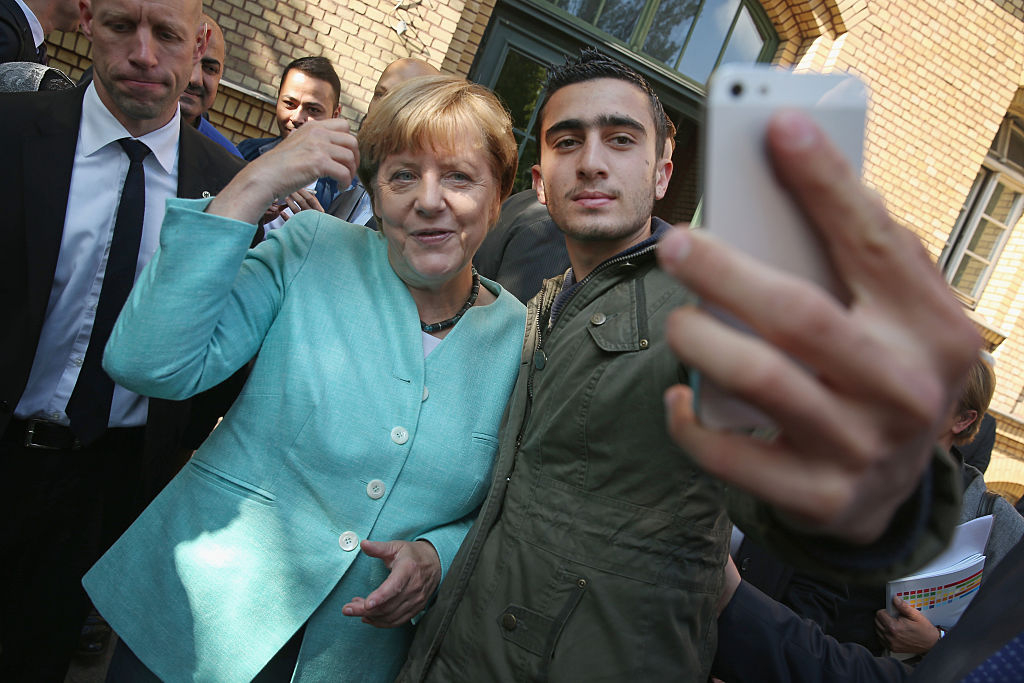
German Chancellor Angela Merkel poses for a selfie with Anas Modamani, a migrant from Syria, outside a shelter for migrants in Berlin, on September 10, 2015. (Photo by Sean Gallup/Getty Images)

"More than half of the able-bodied unemployment benefit receivers at present are of foreign descent," Der Spiegel reported on April 10, 2018. "According to latest numbers complied in September 2017, out of 4.3 million able-bodied welfare recipients, 55.2% were of an immigrant background. In 2013, that figure was 43%."

As of December 2017, an estimated 600,000 able-bodied asylum seekers in Germany were on the dole, the newspaper Die Welt revealed in December, 2017. 
For the first time in post-war German history, the number of foreigners living on unemployment benefits has crossed the 2-million-mark.

All this has happened, moreover, at time when poverty, especially among elderly pensioners, reached a historic high. Under Merkel's watch, nearly 20% of Germans are threatened by poverty, according to the German Federal Statistical Office. The current level of poverty is "higher than ever since the unification of the Federal Republic and the [Communist] German Democratic Republic," the German public broadcaster Deutsche Welle reported.

Contrary to what the establishment media would have people believe, there is no evidence that the hundreds of thousands of young migrant men pouring into Germany are going to relieve the country's aging work force or become productive citizens in other ways.

Not only are these newly arrived immigrants a strain on Germany's finances, but since their arrival, there has been a surge across the country in violent crime. A recent report commissioned by the German Ministry of Family Affairs found that the newly arrived asylum seekers were behind more than 90% percent of the increase in violent crimes in the northern state of Lower Saxony. Similar trends can be witnessed throughout the country.

According to the country's annual crime report of 2017, compiled by the Federal Crime Bureau (BKA), Germany saw a 50% year-on-year rise in migrant crimes. This tiny but growing minority, that presently makes up less than 2% of the German population, was charged for nearly 15% of all violent crimes, such as rapes and aggravated assaults, the BKA report revealed.

In March, Turkish and Arab gangs "armed with machetes, clubs and baseball bats" clashed on German streets in violent attempts to demarcate gang territories. The country is also in the grip of a stabbing epidemic, with the attackers often turning out to be "unaccompanied minors" holding refugee status.

While media outlets such as The Economist are busy touting Merkel's Germany as "model for the West" for its newly-acquired "diversity," the country is sinking ever deeper into a social, economic and demographic bog. 
With their collective heads buried in sand, many in the establishment and the media seem to want the rest of the Western world to follow Germany's example by opening their borders to unregulated mass immigration. 
Sadly, the current result of Germany's open-door policy indicates that all those rosy reports seem to have been nothing more than an elaborate campaign of deceit or misinformation.
Vijeta Uniyal, a journalist and news analyst, is based in Germany.

Soeren Kern : Germany's Migrant Rape Crisis: "Failure of the State"

  • "Susanna is dead. Maria from Freiburg; Mia from Kandel; Mireille from Flensburg; and now Susanna from Mainz...." — Alice Weidel, co-leader AfD party.
  • "Susanna's death is not a blind stroke of fate. Susanna's death is the result of many years of organized irresponsibility and the scandalous failure of our asylum and immigration policies. Susanna is victim of an out-of-control leftwing multicultural ideology that stops at nothing to impose its sense of moral superiority." — Alice Weidel, co-leader AfD party.
  • "On the day of Susanna's murder, you [Merkel] testified in parliament that you have handled the migrant crisis responsibly. Do you dare to repeat that claim to Susanna's parents?" — Alice Weidel, co-leader AfD party.
The rape and murder of a 14-year-old Jewish girl by a failed Iraqi asylum seeker has cast a renewed spotlight on Germany's migrant rape crisis, which has continued unabated for years amid official complicity and public apathy.

Thousands of women and children have been raped or sexually assaulted in Germany since Chancellor Angela Merkel welcomed into the country more than one million mostly male migrants from Africa, Asia and the Middle East.

The latest crime, entirely preventable, is uniquely reprehensible in that it highlights in one act the many insidious consequences of Germany's open-door migration policy — including the failure to vet those allowed into the country and the practice of releasing migrant criminals back onto German streets instead of incarcerating or deporting them.

The crime also exposes the gross negligence of Germany's political class, which appears to be more concerned with preserving multiculturalism and the rights of predatory migrants than protecting German women and children from them.
Police say that Ali Bashar, a 20-year-old Iraqi Kurd, raped Susanna Maria Feldman, strangled her and then dumped her body in a wooded area alongside railroad tracks on the outskirts of Wiesbaden. Bashar then fled to Iraq on false identity papers.

Feldman had been missing from her home in Mainz since May 22. Her mother filed a missing person report on May 23. Police, however, did not even begin to search for the girl until more than a week later, when an unnamed 13-year-old boy, a migrant living in the same refugee shelter as Bashar, contacted the police. Feldman's body was finally recovered on June 6.

14-year-old Susanna Maria Feldman (inset) was raped and murdered by Ali Bashar, a failed Iraqi asylum seeker in Germany. He dumped her body in a wooded area on the outskirts of Wiesbaden. (Image sources: Feldman - Facebook; Wiesbaden - Maxpixel)

Bashar arrived in Germany in October 2015, at the height of the migrant influx, along with his parents and five siblings; claiming to be refugees, they turned out to be economic migrants. Bashar's asylum request was rejected in December 2016. He should have been deported, but after he filed an appeal, German authorities allowed him to stay.

During his three years in Germany, Bashar chalked up an extensive criminal record, including physical assault of law enforcement officers, violent robbery at knifepoint and possession of illegal weapons.

Police said that Bashar was also a suspect in the March 2018 rape of an 11-year-old girl living in the same refugee shelter where he and his family were staying.

Bashar was able to flee Germany under a false identity because of bureaucratic incompetence: federal border police failed to check if the name on his plane ticket matched the name on his identity papers.

Bashar was arrested in northern Iraq on June 8 and was extradited to Germany a day later. He is currently being held at a correctional facility in Wiesbaden.
Susanna's murder was the fourth German teenager to be murdered by illegal migrants during the past 18 months.
  • October 16, 2016. Maria Ladenburger, a 19-year-old medical student from Freiburg, was raped and murdered after returning home from a party hosted by her school's medical faculty. Her attacker was Hussein Khavari, who entered Germany in November 2015 without identification papers. He claimed to have been born in Afghanistan in November 1999. Because of his alleged age (16), he was granted asylum as an underage unaccompanied migrant and placed with a foster family.
    After Khavari was arrested as a suspect in the Ladenburger case, the newsmagazine Stern reported that in February 2014, Khavari had been sentenced to ten years in prison for attempted murder for pushing a 20-year-old woman over a cliff on the Greek island of Corfu. The woman survived the attack and Khavari was released after serving 18 months in prison, based on an amnesty for juvenile offenders. He then migrated to Germany.
    During his trial in Greece, Khavari told the court that he had been born in Iran in January 1996 and had arrived in Europe in January 2013.
    During his trial in Germany, Khavari confessed to raping and killing Ladenburger. It emerged that Khavari was born in Iran on January 29, 1984 and that at the time he killed Ladenburger, he was actually 32. On March 22, 2018, Khavari was sentenced to life in prison for rape and murder, but according to German law, he may apply for parole after serving 15 years.

  • December 27, 2017. Mia Valentin, a 15-year-old girl from Kandel, a small town in the federal state of Rhineland-Palatinate, near the German border with France, was stabbed to death at a local drugstore. Her attacker was Abdul Mobin, a failed Afghan asylum seeker who claimed to be 15 years old.
    Valentin and her attacker had been in a relationship for several months, but after she ended it in early December 2017, Mobin began to threaten her. On December 15, the girl's parents filed a formal complaint to police. Police visited Mobin on December 17, and again on the morning of December 27. Later that day, Mobin followed Valentin into the drugstore and stabbed her with a kitchen knife he had purchased at the same store. The girl died a short time later.
    Mobin had arrived in Germany in April 2016 and initially resided at a refugee shelter in Frankfurt. He was later transferred to a refugee shelter in Germersheim, a small town in the federal state of Rhineland-Palatinate, and then to a youth facility in nearby Neustadt. His asylum claim was rejected in February 2017, but he was not deported. Mobin, who was known to police after he punched a student at Valentin's school, is being held in custody while German authorities try to determine his true age.

  • March 12, 2018. Mireille Bold, a 17-year-old girl from Flensburg, was stabbed to death by Ahmad Gulbhar, an 18-year-old asylum seeker from Afghanistan. He allegedly became enraged and killed her after she refused to wear a headscarf convert to Islam. Gulbhar had arrived in Germany in 2015 as an underage unaccompanied migrant. His asylum application was rejected but he was never deported.
    Bold, who lived in the same building as her attacker, had called police for help at least once before she was killed. A good friend of Bold's family told the newspaper Bild:
    "Ahmad was a jealous rooster who always wanted to control her. They have been in a relationship since January 2016, but there were constant rows. He insisted that she convert to Islam and always wear a headscarf.
    "She wasn't sure. Whenever she went scarfless there was trouble. Mireille told me that he fled alone from Afghanistan and had a great longing for his family. He was supposed to have a job in a civil engineering company. Once when she met with him he called her every two minutes on her phone demanding to know what was happening."
    The attacker is being held in pre-trial detention.
As with the deaths of the other teenagers, Susanna's murder prompted the usual barrage of political posturing and feigned outrages from German politicians and media.

The level of public outrage over Susanna's case, however, suggests that Germany may be reaching a tipping point: the German government is finally being held to account for its role in the migrant rape crisis.

"The government should beg for forgiveness from Susanna's parents," said the mass circulation Bild. "The only thing that is worse than the murder of a child is the murder of a child by a criminal who should not have been in our country."

The leader of the Free Democrats (FDP), Christian Lindner, said that the crime raises many questions: 
"Why are rejected asylum seekers not deported more consistently? Why could the perpetrator and his family flee under a false identity?"

"This is typical of our German security agencies," FDP politician Alexander Graf Lambsdorff said. "There are simply too many gaps in this system. This has been terribly upsetting for many years."

SPD manager Carsten Schneider said what had to be quickly clarified was "how the suspect was able to escape, and how he can be brought to court in Germany as quickly as possible."

"The Federal Interior Minister must ensure that the existing control mechanisms are also used during entry and exit," said Burkhard Lischka, an SPD spokesman. "With such questionable papers and in view of the destination, the Federal Police could have determined with a simple fingerprint comparison that a criminal is on the run."

"The cruel murder of Susanna fills me with great sadness and anger," said Eckhardt Rehberg of the CDU. "As a politician responsible for the budget, I say...the entire asylum process needs to be fundamentally reshaped. We will provide the money for that."

The Alternative for Germany (AfD), the anti-immigration party, called for the resignation of the entire federal government. In a video posted on Twitter, AfD co-leader Alice Weidel said:
"Susanna is dead. Maria from Freiburg; Mia from Kandel; Mireille from Flensburg; and now Susanna from Mainz....
"Susanna's death is not a blind stroke of fate. Susanna's death is the result of many years of organized irresponsibility and the scandalous failure of our asylum and immigration policies. Susanna is victim of an out-of-control leftwing multicultural ideology that stops at nothing to impose its sense of moral superiority. Susanna is also another victim of Chancellor Angela Merkel's hypocritical and selfish welcome policy.
"Legally, Ali Bashar should never have been allowed into Germany. His asylum request was rejected more than two years ago, and he should have been deported. Bashar was known to police for physical assault, attacking police officers, and possessing illegal weapons. In March 2018, he was suspected of raping an 11-year-old girl at a refugee shelter. According to the law, Bashar should have had to leave Germany a long time ago or be arrested.
"An absurd asylum law and a grotesque asylum policy...it is lenient toward asylum cheaters and criminals but ignores the genuine concerns of German citizens.
"Ali Bashar, his parents and five siblings lived here on the taxpayer's dime, they could not be deported, but after his Ali's crime, they somehow found the money to flee Germany on falsified documents. No problem in a Germany with open borders.
"On the day of Susanna's murder, you [Merkel] testified in parliament that you have handled the migrant crisis responsibly. Do you dare to repeat that claim to Susanna's parents? Well, no. Your hard-heartedness and self-righteousness means you feel you are above offering the victims of your policies a personal word. This is unacceptable to us citizens. Will you finally accept responsibility, Mrs. Merkel? You and your entire cabinet should resign to make possible another asylum policy so that the parents in this country no longer need to fear for the safety of their children."
The newsmagazine Stern concluded:
"The emotional reactions to Susanna's case illustrate how Germany has changed. Already in the summer of the refugee crisis, when hundreds of thousands of people came into the country, there were warnings that the mood in the population could tip....
"The case of Susanna awakens the image of a loss of control, an overstretched state that no longer has a grip on asylum policy — especially in a society that loves law and order. There are now repeated demands for stricter laws. The current scandal over maladministration at the Federal Office of Migration and Refugees [immigration officials accepted cash bribes in exchange for granting asylum to more than 1,200 migrants] seems to emphasize the impression of a failure of the state."
Soeren Kern is a Senior Fellow at the New York-based Gatestone Institute.


Stefan Frank : Germany: 'Decapitating' Freedom of the Press?


  • If it was indeed the authorities' plan to censor the news and keep the information of the beheading under wraps, then it backfired. Due to the reports about the raid, thousands of people have seen the video, and hundreds of thousands have heard about the botched censorship attempt.
  • Hamburg's government is still trying to conceal the beheading. Among other things, they [the AfD party] wanted to know whether the child had been beheaded. The administration -- in breach of its constitutional duty -- refused to answer. It also censored the questions by blacking out whole sentences.
  • Why the beheading should be kept a secret is anyone's guess. What has become clear is how easily authorities in Germany can censor the news and punish bloggers who spread undesired information. They have a vast toolbox of laws at their disposal. It does not seem to bother them that the law invoked in this case stipulates explicitly that it shall not be applied to the "reporting of contemporary events."
In an apparent attempt to sweep under the rug a recent double homicide in Hamburg, Germany, authorities there censored the story. They also raided the apartments of a witness who filmed a video describing the murder, and a blogger who posted the video on YouTube.
The murder, which made headlines worldwide, occurred on the morning of April 12. The assailant, Mourtala Madou, a 33-year-old illegal immigrant from Niger, stabbed his German ex-girlfriend, identified as Sandra P., and their one-year-old daughter, Miriam, at a Hamburg subway station. The child died at the scene; her mother died later, at the hospital. The woman's three-year-old son witnessed the murders.
According to the prosecutor's office, Madou -- who initially fled the scene, but then called the police and was arrested shortly thereafter -- acted "out of anger and revenge," because the day before the incident, the court had denied him joint custody of his daughter.
It later emerged that for months Madou had been threatening to harm Sandra P. and the baby. A senior public prosecutor told reporters that the police investigated the woman's charges, but had concluded that the "threats were not meant seriously" and did not pursue the case.
Furthermore, half a year earlier, in October 2017, a judge revoked a restraining order that Sandra P. had obtained against Madou two months earlier, on the grounds that he saw "no evidence" that Madou had threatened her. That was when Madou's threats increased and he explicitly announced: "I'm going to kill our daughter, and then I kill you!"
A detail of the murders that has never officially been revealed, is that Madou apparently attempted to decapitate the baby. This detail was mentioned by a commuter -- Ghanaese citizen Daniel J., a gospel singer at an evangelical church in Hamburg -- who happened to arrive at the subway station moments after the attack and filmed the scene on his phone. In the video, police officers can be seen questioning witnesses, and paramedics are surrounding what appears to be the baby girl. Daniel J. says, in English, "Oh my God. It's unbelievable. Oh Jesus, oh Jesus, oh Jesus. They cut off the head of the baby. Oh my God. Oh Jesus."

Police question witnesses to the double-murder in Jungfernstieg subway station in Hamburg, Germany. (Image source: Daniel J./Heinrich Kordewiner video screenshot)

Heinrich Kordewiner, a blogger from Hamburg who discovered the video on Daniel J.'s Facebook page, uploaded it to YouTube.

A few days later, a team of state prosecutors and officers of the cybercrime unit of the Hamburg police arrived at Kordewiner's apartment with a search warrant, and confiscated his computer, mobile phone and other electronics, allegedly to find "evidence" of the "crime". He was -- and still is -- accused of: uploading the video.
Kordewiner and his flatmate told Gatestone about the raid, which took place at 6.45 a.m. They recounted that when they first refused to open the door, police forced it open -- and even searched the flatmate's room, although it was apparently not covered by the search warrant.
"The police officer said that he could also search for SD (secure digital) cards," the flatmate told Gatestone. "While he fumbled through the books on my shelf, he suggested that he could turn my whole apartment upside down. He told me to relax."

According to the search warrant, Kordewiner is accused of having "invaded the private sphere" of the murder victim, in breach of §201a of Germany's Criminal Code. This so-called "paparazzi paragraph" -- the legislation of which was launched by Heiko Maas (currently Germany's Foreign Minister), who as Minister of Justice was responsible for Germany's internet censorship law -- is a barely known and rarely applied law, passed in 2015. Among other things, it makes it illegal to take pictures that "display someone in a helpless situation." 

Supposedly aimed at protecting victims of traffic accidents from being filmed by curious onlookers, the law was already highly controversial when it was debated in 2014, and journalist associations criticized it for jeopardizing freedom of the press.

When the German parliament debated the law, one of the 10 experts invited to give their opinions on the matter was Ulf Bornemann, head of the "Hate and Incitement" department of Hamburg's public prosecution office. A former MP and member of the East German civil rights movement, Vera Lengsfeld, wrote at the time that Bornemann was the only one to embrace the law without reservations: "Why," she reported he had said, "should the data of a supposed inciter be protected?"

In a written statement, Bornemann praised the censorship law for sending "a clear political message that the administration is willing to act against hate crime in social networks." Bornemann was also part of the team that raided Kordewiner's apartment.

The stated reason for the raid -- a breach of privacy rights -- is flimsy. Only the victim's feet can be seen in the video, and even those for only a brief moment. As the daily newspaper Hamburger Abendblatt pointed out, the footage "is blurred, taken from a distance and doesn't allow the identification of any person."

Meanwhile, the German publication Welt online posted a video that shows close-up footage of the victim -- something that did not spur state prosecutors into action. The main difference between the two videos seems to be the verbal comment on the beheading in Daniel J's video. The alleged breach of "privacy rights," then, would appear to be a pretext.

The "Beheading"

"We don't comment on this rumor," state prosecutor Nana Frombach said to Gatestone when asked about the beheading. All she was willing to acknowledge was that the child had suffered "severe neck injuries." When Gatestone said that §201a could not be applied to the video in question because it did not show anybody's face, she replied that this had "yet to be decided," and that the raid was based on an "initial suspicion." Gatestone then mentioned that Kordewiner, instead of uploading the video anonymously (which would have been easy for him to do), had uploaded it to his YouTube channel, along with his full name and address, rendering the raid's stated goal of "finding evidence" not merely disproportionate but entirely unnecessary. Frombach said that she was not allowed to "comment on details of an ongoing investigation," but that she could "guarantee" that the search warrant had been "approved by a judge."

How can any journalist, under such censorship, report the news? Would it be illegal to film the scene of a terrorist attack? Frombach said that she could "not tell" whether this would still be legal in today's Germany. "I can only judge specific cases, not ones that lie in the future," she said.
The libertarian website Achse des Guten (Axis of the Good) was the first media outlet to report the raid. Two days later, the daily Hamburger Abendblatt wrote:
"Hamburg's state prosecutor rabidly prosecutes a blogger who has published pictures of the tragedy at Jungfernstieg... The raid was based on paragraph 201a, a law that the council of the press and journalist associations view as being problematic with regard to free reporting."
The Abendblatt criticized the "nebulous phrasing" of the law and the "even more nebulous interpretation by the state prosecutor," stating, "The law stipulates that no pictures of helpless persons may be taken. However, the cell phone footage does not show such persons."

According to the Abendblatt, sources "from within the security apparatus" had been "surprised" by the raids of the homes of the blogger and Daniel J. The state prosecutor who ordered the raids had been "very hot on this case," these sources said, and was "shooting out of cannons into sparrows... it is surprising how quickly the search warrant was issued, given the high obstacles we face every day, even when dealing with serious crime."

In an accompanying comment, Abendblatt editor Matthias Iken called the raid "foolish," because "it supports the conspiracy theories of right-wingers." Where, he asked, "do the prohibitions start? And where do they stop?"
In the meantime, the incriminated video has been deleted from all German websites and made inaccessible for German visitors to YouTube (although Germans can still view it on websites that are out of reach of the German authorities).

Censorship Backfired

If it was indeed the authorities' plan to censor the news and keep the information of the beheading under wraps, then it backfired. Due to the reports about the raid, thousands of people have seen the video, and hundreds of thousands have heard about the botched censorship attempt. Even worse for the would-be censors, they unwittingly revealed the very detail that they wanted to keep from the public. This is because the search warrant -- a copy of which was handed to Kordewiner -- happens to provide a detailed account of the murders. It elaborates that Madou had "wanted to punish the mother of the child" and "enforce his claim to power and ownership." With an "intent to kill," Madou "suddenly" took a "knife from the backpack he was carrying, stabbed the child in the belly and then almost completely cut through the neck."

The office of the state prosecutor is under the authority of Hamburg's state government, a coalition of Social Democrats and the Green Party. The state's Minister of Justice, Till Steffen, is a member of the Green Party and has for years been accused of being behind many scandals in his ministry. Among these are that alleged murderers repeatedly have had to be released from pre-trial detention because their trials have taken too long. In 2016, Steffen prevented police from sharing pictures of the Berlin truck terrorist, Anis Amri when he was still at large, out of fear that sharing images of jihadist terror suspects could incite racial hatred.

Censorship in Parliament

Hamburg's government is still trying to conceal the beheading. This became clear when, in May, MPs of the anti-immigration party Alternative for Germany (AfD) made a parliamentary enquiry about the police raid and details of the murder case. Among other things, they wanted to know whether the child had been beheaded. The administration -- in breach of its constitutional duty -- refused to answer. It also censored the questions by blacking out whole sentences. The newspaper Die Welt noted: "That the text of an enquiry and the questions are blackened out without consultation" is something "that almost never happens."

When Gatestone contacted Alexander Wolf, one of the MPs who made the enquiry, to find out what exactly was censored, he sent the original enquiry (the first two pages from the left) as well as the senate's answer (pages 3, 4 and 5) in which parts of the questions were censored. Every hint of a beheading that might have taken place was blacked out, as was the link to the article that first broke the news about the beheading and the subsequent police raid. Wolf told Gatestone:
"In the session of the interior committee, the Senator of the Interior and the responsible state prosecutor both replied very evasively to the repeated questions of our speaker, Dirk Nockemann, and imputed a lack of respect [for the murder victim]. In my opinion, this was designed to cause indignation against the enquirer on the part of the other MPs. Apparently, the Senator wants to sweep the issue under the rug."
The speakers of the other opposition parties were also contacted by Gatestone: Dennis Gladiator of the Christian-Democrats (CDU) and Anna von Treuenfels-Frowein of the centrist Free Democrat Party (FDP). Treuenfeld-Frowein replied:
"Of course, the public has a right to information. But for us as a party committed to the rule of law, personal rights do not end with death. We therefore consider the decision to black out parts of the enquiry to be appropriate. Right now, there is no need to make details of the crime public."
Gladiator did not respond to Gatestone's repeated requests for comment.
Why the beheading should be kept a secret is anyone's guess. What has become clear is how easily authorities in Germany can censor the news and punish bloggers who spread undesired information. They have a vast toolbox of laws at their disposal. It does not seem to bother them that the law invoked in this case stipulates explicitly that it shall not be applied to the "reporting of contemporary events." The state prosecutor, however, argues that this murder case – which was reported, among others, in France, India, Pakistan, South Africa and the United States – does not constitute such a "contemporary event."

"For Hamburg's ministry of justice," the Abendblatt wrote, "the double murder is a crime of passion that must not be of any interest to the public."
Stefan Frank is a journalist and author based in Germany.