.

.
Library of Professor Richard A. Macksey in Baltimore

POSTS BY SUBJECT

Labels

Showing posts with label WEST/ISLAM Relations. Show all posts

Sunday, August 20, 2017

Majid Rafizadeh : When Feminists Join Islamist Terrorists

  • The fact is that these supposed feminists not only turn a blind eye to those atrocities, but their presence at these events actively endorses and legitimizes the rule of these dictators.
  • When the subject turns to the specific cases of millions of oppressed women around the world -- such as Asia Bibi, a Christian mother on death row in Pakistan for seven years for taking a drink of water; or the 19-year-old who, this year, was raped by her cousin at gunpoint and then sentenced to death by stoning for "adultery"; or women who were forced to marry their rapists; or child marriages at 12,000 a day; or women who are beaten by their husbands or who have acid thrown in their faces; or women used as suicide bombers.
  • When Mogherini smiles in her hijab in Iran, she is delivering a strong blow to women rights movements that attempt to remove the compulsion of the obligatory hijab and grant women equal autonomy, education and freedom. She is empowering suppression.
The social democrats and so-called feminists have been raising their voices for all to hear. They boast about advocating gender equality, individual rights, and advancing women's rights. They argue that these values are universal; that every person, especially every woman, everywhere in the world, is entitled to these "inalienable" rights. Speeches are given, fundraisers are held, and an army of champions charges toward the cause.

Everyone is equal, and everyone deserves these rights. The chants, the inspirational lectures, the determination that echoes through television interviews, and is spread across the pages of magazines, all fill their followers with enthusiasm. But what is the reality?

Alongside other social democrats, Federica Mogherini, the current High Representative of the European Union for Foreign Affairs and Security Policy, recently visited the Islamist state of Iran to attend the official endorsement and inauguration of the regime's president, Hassan Rouhani. Instead of enforcing the standards she professes -- such as the strong support for women -- she folded in with those around her. Others who accepted Iran's invitation were North Koreans, members of Hezbollah, and leaders of Hamas. All three of these groups are known for cruelty, especially against women, and crimes against humanity.

The presence of such people makes the issue of despotism more complicated than it needs to be. By attending these kinds of events, social democrats such as her repeatedly endorse and give legitimacy to repressive states that implement Islamic law, Sharia. As Mogherini rubs elbows with men who have ordered the deaths of thousands of women (and men), she toes the line of their expectations. Instead of evolving their mindset, she allowed all of the women she claims to represent, to remain oppressed, as they have been for so very long.

Mogherini took the problem even a step even farther. Instead of attempting to appear as if she were working toward progressive thinking among these violent Islamist leaders, she acted as if they were friends. She appeared proud to snap selfies with the representatives of this repressive regime. The story came under the international spotlight. Some of the deputies used their selfies with Mogherini to project their legitimacy to the international community while others created self-promotional posters of themselves with Mogherini wearing the mandatory hijab. Mogherini, a social democrat Italian politician who speaks of women's rights and was once a member of the Italian Communist Party, delightedly agreed to follow the Islamist rule of wearing a mandatory hijab. This act of compliance sends a brutal and unshakeable message. Women in these Islamist societies are controlled by laws which proclaim they must be hidden, or treated as their husband's property. The hijab has become a symbol of this. Conversely, when Iranian leaders visit Mogherini's country, they do not follow Italy's rules. Instead, Italy follows the regime's Islamist rules by offering appeasements such as covering up nude statues and not serving wine.

Mogherini -- who years ago also agreed to be in controversial picture taken with the late Palestinian Authority Chairman Yasser Arafat -- also played a crucial role in sealing the nuclear agreement for the Iranian regime and lifting the sanctions for those dictators. Instead of seeing these oppressors punished, she enabled them to have fewer limitations, as they still hold their own people beneath their thumbs and continue to be the cause of their suffering.

Mogherini then tweeted about her blog post, which states "It was an opportunity to talk again to Rouhani, to Foreign Minister Javad Zarif and to the Supreme Leader's foreign policy advisor, Ali Akbar Velayati".
Is this really an opportunity to be proud of and boast about? And what did she talk to them about?

While Mogherini is joyfully attending events with these Islamist leaders and rejoicing in having taking pictures beside them, does she ever think about the millions of women who are brutally oppressed under these Islamist regimes? Does she consider those women balled up and crying on the floor after being beaten by their husbands? Does she ever think about hundreds of people -- men and women -- being executed, often after sham trials, every year, and based on the Islamist laws in this country?
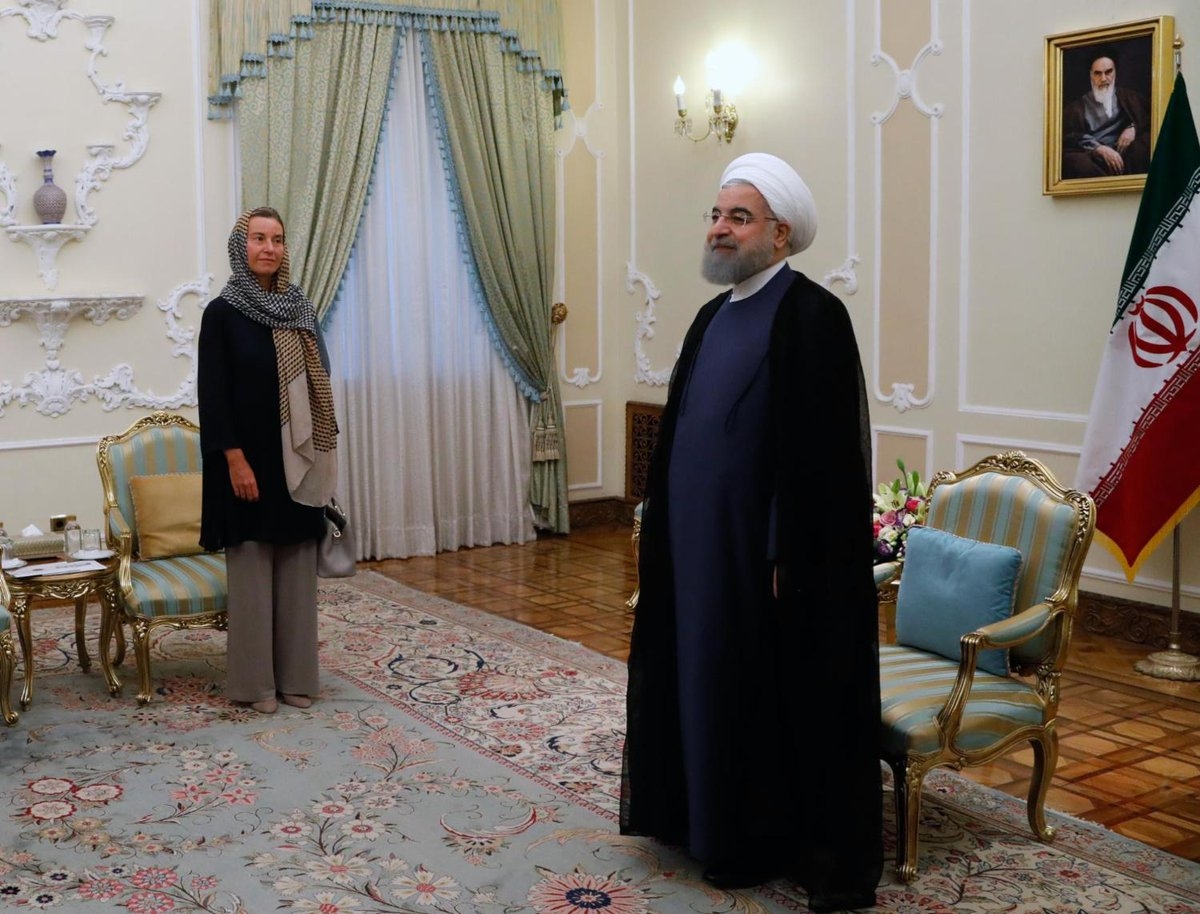


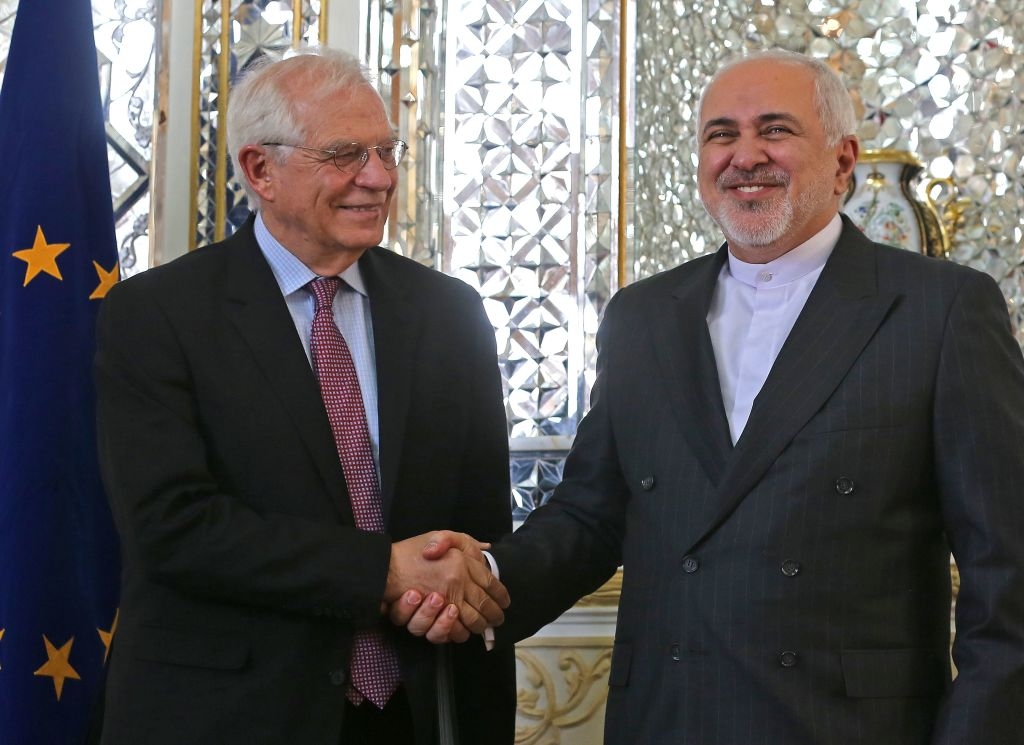
During her visit to Iran this month, Federica Mogherini (left), the current High Representative of the European Union for Foreign Affairs and Security Policy, rubbed elbows with men who have ordered the deaths of thousands of women (and men). Does she ever think about hundreds of people being executed, often after sham trials, every year, and based on the Islamist laws in this country? (Image source: European Commission)

While she shakes the hands of these men, does think of the nine-year-old girls who are "legally" being forced into marriage with the government's approval?
Where are all the women's rights, liberal moral values that she and her party stand for? They were not at the celebration, and they were certainly not represented by those selfies.

Women are dehumanized, subjugated and treated as inferior on a daily basis in Islamist state of Iran as well as other Muslim states. Many people in there are struggling every day despite all the dangers they face to obtain the few rights they can. In general, a woman's testimony in court is worth half of a man's testimony. Women need approval from their male guardian to leave the country, and in Saudi Arabia, to leave their home. Women cannot obtain a passport without a guardian's consent. In Iran, a man can marry any woman he desires. Men are allowed to have four wives and an unlimited number of temporary marriages (mut'a), but women can only marry a Muslim man. Honor killings continue while the regime turns a blind eye to them.

Based on the law of tamkin (obedience), women must provide full accessibility and unhampered sexual availability to her husband. Article 1105 of Iran's Islamist Civil Code states, "In relations between husband and wife, the position of the head of the family exclusively belongs to the husband." Article 1117 of the Iran's Islamist Civil Code states that states :
"The husband can prevent his wife from an occupation or technical profession which is incompatible with the family's interests or the dignity of him or his wife."
Men can initiate a unilateral divorce. Women receive only half of what men get in inheritance. A wife gets to receive only one-sixth of an inheritance if she has a son when her husband dies. If she has only a daughter, the inheritance would not automatically go to them. The deceased husband's family -- brothers, sibling and parents -- would have a call on it as well. Women cannot become judges... and the list goes on.

Of course, people such as Mogherini are fully cognizant of these atrocities and the discrimination which are repeatedly reported by human rights organizations. These are even possibly the same abuses that people such as Mogherini then use to rally funds at their parties and splash in disturbing images across the media. Not one of these European leaders can plead ignorance of the acts that those men commit.
Yet, there we see people like Mogherini shaking the hands that rob women of their freedom and their voices.

The fact is that these supposed feminists not only turn a blind eye to those atrocities, but their presence at these events actively endorses and legitimizes the rule of these dictators.

People like Mogherini may be calling for admission to exclusive clubs and higher salaries for women because that equality is fair. But why, if they claim that they are champions and front-runners of women all around the world, do they contribute to, and facilitate the rule of ruthless dictators against their own people?

When the subject turns to the specific cases of millions of oppressed women around the world -- such as Asia Bibi, a Christian mother on death row in Pakistan for seven years for taking a drink of water; or the 19-year-old who, this year, was raped by her cousin at gunpoint and then sentenced to death by stoning for "adultery"; or who were forced to marry their rapists; or child marriages at 12,000 a day; or women who are beaten by their husbands or who have acid thrown in their faces; or women used as suicide bombers -- they become totally silent. They disregard these women's rights.

By demonstrating their support for these regimes and the men that enforce them, people such as Mogherini significantly weaken and undermine the indigenous movements that attempt to advance precisely the human rights that people such as Mogherini claim to advocate.

When Mogherini smiles in her hijab in Iran, she is delivering a strong blow to women rights movements that attempt to remove the compulsion of the obligatory hijab and grant women equal autonomy, education and freedom. She is empowering suppression.

A true advocate of individual rights and democracy might instead have set a brave example. Women such as Mogherini are feeding into the system, not destroying it. Those who continue to give legitimacy to oppressors and Islamists need to be held accountable.

Finally, my message to people such as Mogherini and others like her is simple: Do you have any conscience or sense of decency? Or is it simply all about power, money, narcissism, and manipulations at the cost of the oppressed, including women? Can you hear that little girl's cry, or are your ears as deaf to it as the men who cause it?

Dr. Majid Rafizadeh is president of the International American Council on the Middle East. He is a Harvard-educated and Iranian-American political scientist, businessman, and author of "Peaceful Reformation in Iran's Islam". He can be reached at Dr.Rafizadeh@Post.Harvard.Edu.
  • Follow Majid Rafizadeh on Twitter
Sunday, May 14, 2017

Nonie Darwish's "Wholly Different" Half her life in Egypt, half her life in the U.S. -- an insider's insights on Islam and the West.

Nonie Darwish's "Wholly Different"

Half her life in Egypt, half her life in the U.S. -- an insider's insights on Islam and the West.


Nonie Darwish's 2017 Regnery Faith book, Wholly Different: Why I Chose Biblical Values over Islamic Values, is a wide-ranging, reader-friendly view into the thinking of an Egyptian, Muslim woman who immigrated to America at age 30 and began to compare and contrast the values she was steeped in to those found in Judeo-Christian-influenced, Western culture.

Darwish was born in 1949 in Cairo, Egypt. She grew up in Egypt and Gaza. Her father, Mustafa Hafez, created and oversaw an anti-Israel terror group. When Darwish was eight, her father was assassinated by Israel. Egyptian President Nasser praised Darwish's father as a shahid, or martyr. Darwish immigrated to the US in 1978, and she has lived here ever since. She converted to Christianity.
Wholly Different is part memoir, part sociological observation, and part prophetic clarion. Darwish's style is cozy and conversational. Her sentences are short and easy to read. Darwish paints a vast, impressionistic landscape comparing the Muslim world to the West. She makes a series of thought-provoking points in a rapid style. She quotes relevant passages from Islamic scripture and shows how that scripture plays out in modern societies. In contrast, she quotes important Biblical passages and demonstrates how those have influenced the West.

Darwish combines the maternal love one might find in a wise grandmother, the kind who bakes cookies and contains a storehouse of folkloric wisdom, with the stripped-to-the-bone truth-telling and no-time-to-waste urgency of an Old Testament prophet. With every sentence, Darwish conveys the deep care she feels for every reader with an insistence on being heard, and heard for every last syllable.
As is often the case, this book by a former Muslim is more fearlessly blunt than many a counter-jihad statement by someone who has never been a Muslim. "Islamic values versus Biblical values is a bloody collision waiting to happen. The West must be warned," she writes. Darwish has seen jihad up close and personal. She knows what is at stake, she has taken the measure of the wolf at the door, and her call bursts forth like a trumpet. Just one example of the kind of unique insights she can offer: in thirty years of living as a Muslim in the most populous Arab state, she never heard anyone question why Mohammed, at over fifty years old, took a six-year-old as his wife.

"A fish doesn't know it is in water," goes the old saying. Perhaps nothing dramatizes this point so vividly as Western women who marry Muslim men, travel with those men to their natal countries, and are shocked to discover that rights they took for granted as universal ceased to exist once they stepped across a border and put their Western homeland at their back. One can see one such woman, Stephanie, sobbing in a 2016 EXMNA video. "I was certain that I was going to find a way to bring my daughters back, so I bought them a bunch of clothes, but they haven't had a chance to wear them yet," Stephanie says, with unbearable poignancy. The camera shows Stephanie's slender fingers fondling princess dresses she had purchased for her daughters, dresses that her daughters will never wear.
Stephanie was born in Canada and married a Muslim man. She had two children by him. She convinced herself that she and her Libyan husband could create a Canadian version of Islam. She could prevent her husband from forcing hijab on her daughters, allow the girls to listen to music, and take gymnastics. "We can mix both and be happy," she thought. Islam, though, she said, demanded that her husband "protect" his children from Stephanie; indeed, to protect Stephanie from herself. Her husband, over the course of eighteen months, hatched a plot to convince Stephanie to put her daughters on a plane so that he could attend grad school in Europe. This was a lie. He had no plans for a European PhD. He lured Stephanie into Libya, at which point she had no rights whatsoever. Stephanie says that in Islamic terms, her husband was kind – because he had the right to kill her, and he did not. It's five years later, and Stephanie has not seen her children since. She may never see them again.

Why did Stephanie make decisions that doomed her to a life of heartache and regret? Especially given the bestselling 1987 book, Not Without My Daughter? And numerous websites dedicated to warning Western women about the potential pitfalls in cross-cultural marriages, websites like this one, this one, this one, this one, this one, and too many others to list? Maybe this is why. Maybe Stephanie had politically correct teachers who told her that the West is an oppressive, racist, sexist place. They told her, further, that Islam is a religion of peace. These fonts of politically correct ideology emphasized cultural relativism. All religions are the same, they told young Stephanie. All religions are about love.

Wholly Different is a three-alarm wake-up call from Nonie Darwish. Darwish informs her reader that it's not just when it comes to terrorism that Western and Muslim worldviews conflict. Rather, in a thousand little ways, daily life is different. Darwish lists fifty-three features that, for her, differentiate the Western worldview from the Muslim one. Darwish, as a trained journalist and speaker of Arabic, cites canonical Islamic sources to support her points. "Islam and democracy are contradictory and absolutely incompatible," she writes. These are not her words. She is quoting an imam.

Darwish says that every cultural feature is grounded in the foundational texts that inform each culture. The West is inspired by the Judeo-Christian Bible. God is a father who affirms his creation and wants to love us. God is rational. God wants so badly to save us that he sacrificed his only son to die for us. In contrast, the Muslim world is founded on and inspired by the Koran and the life and sayings of Mohammed. Allah is not loving and he is not a father. Allah announces that he does not need humans; if he wanted to, he could wipe humanity out and choose to create some other lifeform. Allah is not only not rational, he is the "greatest deceiver" who can grant or withhold an afterlife paradise as he sees fit. Allah demands that humans not love him, but submit to him, as slaves submit to their masters, and to sacrifice their lives for him.

Darwish is a Christian, but an observant Atheist might have written a similar book. Atheist Richard Dawkins said "I am not aware of any Christian suicide bombers … I have mixed feelings about the decline of Christianity, in so far as Christianity might be a bulwark against something worse." Atheist Bill Maher said, "The values of Western civilization are not just different, they're better. I know a whole generation has been raised on the notion of multiculturalism … Rule of law is better than autocracy and theocracy. Equality of the sexes, better," and "Islam is not like other religions. It is a unique threat. Christians do not believe that if you leave the religion you should be killed for it … If they were beheading people in Vatican City … don't you think there would be a bigger outcry? This is the soft bigotry of low expectations that we have with Muslim people." Atheist Sam Harris has been criticized for saying things like, "The truth is that Islam is quite a bit scarier and more culpable for needless human misery than Christianity has been for a very, very long time. We have to point this out. To be evenhanded … is to misconstrue the problem."

Western rights did not emerge ex nihilo. They are founded on Judeo-Christian religion and Ancient Greek civilization. Thus the Supreme Court building, for example, is modeled on the Parthenon, and while the building's frieze depicts lawgivers from various cultures, the figure at its center and apex is Moses, the Jewish lawgiver. He holds two tablets, representing the Ten Commandments. The rights we in the West take for granted are not universal, but rather are specific to the West, and based on our unique history. When we give up our foundations, we give up our rights.

Darwish, no wilting violet, brings the hammer down with her first sentence: don't you dare, she warns, replace the word "Judeo-Christian" with the politically correct neologism "Abrahamic," meant to elevate Islam to Judeo-Christian status as a co-foundation for Western civilization. She links the term "Abrahamic" to a Muslim Brotherhood document instructing followers to "present Islam as a civilizational alternative" and "destroy the Western Civilization from within." The West's capitulation to this agenda, she says, "is undermining the Biblical values of the West." As proof, she cites the Army's disciplining of a soldier who attempted to rescue a boy sex slave from an Afghan police commander, who kept the boy chained to his bed. She says that when she worked in Egypt, there were no prayer rooms or foot faucets at her workplace. Now, Muslims demand these perquisites in Western workplaces. This is part of civilizational jihad, she says.

Darwish describes Islam as a religion driven by a sense of competition with Jews and Christians. Sixty-four percent of the Koran, she maintains, is devoted to denigrating commentary about kafirs, or non-Muslims. "Do unto others as you would have them do unto you" is totally alien to Islam, she says. "Islam has nothing to do with Abraham and Biblical values. In fact, it awards the highest esteem to Muslims who kill the children of Abraham, the Jews."

Darwish charts her intellectual and spiritual journey from simple observations of quotidian reality and larger trends. "Why is it that people in the West stand in line to wait for their turn while in the Muslim world people step on each other to get to be first? Why is it that in the West government leaders leave their office at the end of their term peacefully while in the Muslim world their term ends with either natural death or assassination?" Even in asking these questions, she writes, she was violating cultural expectations. "Asking questions and doubting is taboo in Islam."
Another factor, she says, impeded her maturation in Egypt. "I came from a culture where openly talking about one's true feelings, inadequacies, and vulnerabilities was taboo." That kind of repression prevents personal growth.

Darwish's focus on her natal society's suppression of her self-awareness and admission of vulnerability segues into the portion of the book that excited me the most. Darwish argues that Allah encourages Muslims to hide sin, seeing public admission of sin to be a sign of weakness, while the West encourages individuals to acknowledge and come to terms with their own faults. When Muslims sin, Allah covers those sins to allow the Muslim to avoid public censure. Muslims are forbidden to expose each other's weaknesses to non-Muslims. "Keeping up a good front" becomes a religious obligation. Darwish writes, "Islamic logic does not see confession of sin by Jews and Christians as a virtue or as the starting point to redemption and an attempt to be better people. In Islam self-criticism, admitting sin, praying for forgiveness, and openly exposing one's vulnerabilities and imperfections in a search for the truth is worthy of punishment." Darwish quotes Mohammed, "All of my community shall be pardoned, save those who commit sins openly." If followers of a sheikh witness the sheikh committing a sin, the follower should say, "it is my eyes that committed the sin" for having witnessed a power figure do wrong. The Islamic view of public exposure of sin feeds a culture based on pride and shame. The Koran is replete with references to "shame," "disgrace," "humiliation," and "losers." There is no comparable mention of "losers" in the Bible. In the Koran, in addition to being labeled "losers," Christians and Jews are also called "pigs," "apes," and "unclean."

This emphasis on hiding sin fuels honor killing, and Turkey's refusal to acknowledge the Armenian Genocide, Darwish argues. As a contemporary, concrete example of this advice to conceal sins, Darwish cites Islamweb's 2012 Fatwa number 184937. A woman wrote to report that her husband sexually assaulted their fourteen-year-old daughter. She asked what she should do. The religious expert responded that the daughter should cover herself with hijab and the wife ought to "conceal his sin" and continue to live as his wife.

Islam on Demand, a YouTube channel, features a 2011 lecture by respected sheikh Hamza Yusuf. Yusuf reflects Darwish's words. Islam demands that an individual suppress urges, he says. In the West, Yusuf says, the attitude is "don't harm anyone." In the Islamic worldview, he says, there is a harm when forbidden behavior "emerges into the public space." "What people do behind their closed doors is their own business." Yusuf cites the example of alcohol. If people make and consume wine at home, "that's between them and God. The minute they step into the public space, then that is where sharia says no."

I wrote about this aspect of the difference between Islamic worldviews and the West in 2001:
"Ritualized, religiously mandated confession generated, in the West, a culture-wide valorization of self-examination, subjectivity, individuality, and change … Confession caused believers to examine themselves, admit their errors, work for self-improvement and to develop a linear / teleological mindset – to believe that the future could be better than the past … This absence of ritualized, valorized, narration of sin and redemption to one's fellows does not provide the Muslim with the same cognitive, social or cultural exercise." I hope that others pick up on this theme.

Darwish cites many of the Koran verses and Hadith that call for jihad. One hadith promises that killing a Jew or a Christian offers a Muslim a chance to be redeemed from ever having to go to Hell. Darwish comments on the public relations attempt to redefine "jihad" as peaceful self-improvement. In Islamic texts, she says, jihad plainly means "war with non-Muslims to establish the religion."
Wholly Different will be a rewarding read for those interested in a big-picture comparison of the Muslim world and the West, from an educated observer who has lived decades in both worlds and can support her points with key texts and contemporary examples.

http://www.frontpagemag.com/fpm/266664/nonie-darwishs-wholly-different-danusha-v-goska
================

Wednesday, May 3, 2017

Denis MacEoin : Smokescreens in Islam: Confusing the Public about the Facts


  • Qadri's admirable take on terrorism conceals another large elephant in the room. Islam has for centuries used violence against non-Muslims in what is considered a legitimate manner: through jihad. It is not simply that Muslim armies have fought their enemies much as Christian armies have engaged in war. Jihad is commanded in the later verses of the Qur'an, is endorsed in the Traditions and the biography of Muhammad, and codified in the manuals of shari'a law. Qadri knows this perfectly well, and at times inadvertently reveals as much in several ways.
  • Qadri does not just insist that Islam is a religion of peace and security. By tucking all references to jihad in footnotes in transliterated Arabic, he never has to explain what it is about and how it relates to his rulings on what is and what is not permissible.
  • It is hard to be a reasonably knowledgeable Muslim and not know that calls for violence pervade the Qur'an and sacred traditions, or that Islamic armies have been fighting European Christians, Indian Hindus, and others since the 7th century.
  • Islam, after all, conquered Persia, Turkey, North Africa and the Middle East, Greece, Spain and most of Eastern Europe -- until its armies were stopped at the gates of Vienna in 1683.
Following the terrorist attack outside Britain's Houses of Parliament on March 22, 2017, it was not surprising or wrong that many Muslims denounced the attack and declared it to be un-Islamic. Two days afterwards, Dr. Mohammed Qureshi, chairman of the Board of Trustees for the Shropshire Islamic Foundation, said:
We need to be united in this situation.
We should not give any religion a bad name and these people need to be dealt with in full force and there should be zero tolerance when it comes to dealing with them.
My heart goes out to these victims. And my heart goes out to the people's families and those who are injured. I pray they all have peace in their minds.
He added:
There is no place for these acts in the religion of Islam.
The people are being radicalised and the young and vulnerable people need to be protected.
We need to disassociate this with Islam, as Islam is a religion of peace.
This view was echoed in a press release by the Foundation, in which sympathy for the dead and their families was followed by a commitment to non-violence: "as a community, we need to come together to condemn violence and hatred and work towards cohesion and tolerance".
More recently, a document about Islamophobia published by the Green Party of the United States affirmed the purportedly peaceful character of Islam:
The highest goal of the Islamic faith is Peace. Peace is pursued over all and for Muslims the world over, 'holy war' has nothing to do with the concept of jihad. The Arabic word translates as 'struggle,' and is used a handful of times in the Quran to speak of the struggle to stay on the righteous path, to fulfill obligations to family, community and Creator, what the Islamic scholars call a higher jihad.
These claims, however, seem innocent of the verses that say:
So when you meet those who disbelieve [in battle], strike [their] necks until, when you have inflicted slaughter upon them, then secure their bonds.... And those who are killed in the cause of Allah -- never will He waste their deeds. Surah Muhammad [47:4]
Or:
And prepare against them whatever you are able of power and of steeds of war by which you may terrify the enemy of Allah and your enemy and others besides them whom you do not know [but] whom Allah knows. [Sahih International] Verse (8:60)
There are said to be 123 verses in the Quran concerning fighting and killing for the cause of Allah -- more than a few.
These claims also show that many people seem to be buying into the narrative of Islam as a perfect religion of peace, even if saying so runs counter to more than 1400 years of history and the official record of classical Islamic scholarship about jihad. Islam, after all, conquered Persia, Turkey, North Africa and the Middle East, Greece, Spain and most of Eastern Europe -- until its armies were stopped at the gates of Vienna in 1683.
At the same time, there can be no doubt that Muslim leaders who speak out against terrorism and radicalism need our support and that they must be the very people governments, churches, and the security services speak to and work with if we are to head towards the deradicalisation of Muslim communities in the West. Qureshi's remarks deserve to be taken at face value. Neither he nor his foundation and its associated mosque and academy has any known links to radicalism. They belong to the largest mainstream form of Sunni Islam, the Hanafi school of Islamic law, and there is no overt reason that Qureshi is not sincere in his belief that Islam is a religion of peace.
At the same time, however, he must know better. His own second name is Mujahid, which means "a fighter in the jihad". Not only that, but his mosque is, like most others in the UK, Deobandi in orientation; and it is out of Deobandi madrasas [Islamic religious schools] that the Taliban originated. Deobandi Islam, although mainstream, has over the years appealed to Muslims in Pakistan and abroad who have a fundamentalist disposition. Qureshi cannot be unaware of that. It is hard to be a reasonably knowledgeable Muslim and not know that calls for violence pervade the Qur'an and sacred Traditions, or that Islamic armies have been fighting European Christians, Indian Hindus, and others since the 7th century.
What we in the West know is that a string of modern politicians and churchmen in Europe and North America have, like Qureshi, insisted -- perhaps in a sometimes-desperate attempt to dissociate Islamic terrorism from the religion of Islam -- that Islam is a religion of peace. The violence, they say, is a perversion of Islam, and they say this even as terrorist after terrorist invokes Islam as his motivation and shouts "Allahu Akbar!" ["Allah is the greatest!"] while committing the crime. Terrorist groups, such as al-Qaeda and Islamic State, confidently quote the Qur'an, Traditions [Hadith] and shari'a legislation to justify their attacks.
Western leaders often turn to Muslim imams and scholars to confirm their view that Islam is essentially like modern Judaism or Christianity, if not a mirror image of the Quaker religion. A major expression of this approach is a book by a leading Pakistani scholar, Muhammad Tahir-ul-Qadri. Translated into English, this book of some 400 pages is entitled, Fatwa on Terrorism and Suicide Bombings (London, 2010). It has been widely praised as an outstanding authoritative text that demonstrates that terrorism of any kind is contrary to Islamic teachings and law -- an argument reinforced by hundreds of citations from the Qur'an, Traditions, and a host of classical Muslim authorities.
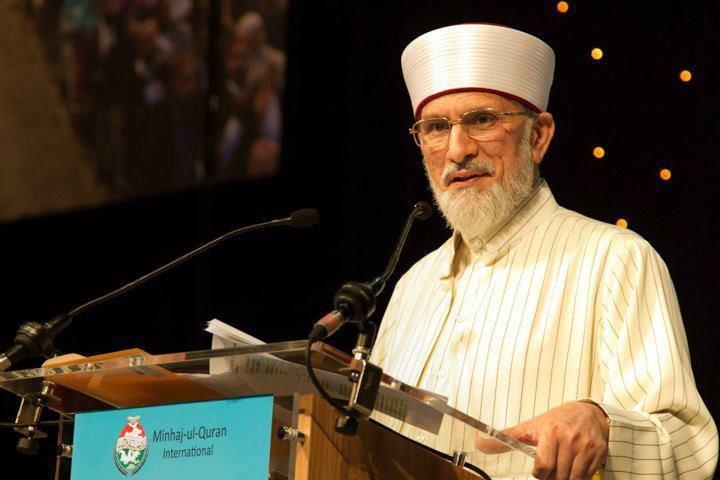
Muhammad Tahir-ul-Qadri (1951-) is a scholar and religious leader with an LLB and a PhD in Islamic Law; a politician (he founded the anti-government Pakistan Awami Tehreek party in 1989), and an international speaker. He is touted as having studied since childhood the many branches of religious studies under his father and other teachers, and having authored on Islamic topics one thousand books (not an uncommon claim among Muslim writers). He comes from a Barelvi/Sufi background, the main opposition to Deobandi Islam in Pakistan and abroad. Qadri is also the head of Minhaj-ul-Quran, an international organization that promotes Islamic moderation and inter-faith work.
Qadri and his organization have made a mark on political and religious leaders in many places. On September 24, 2011, Minhaj-ul-Quran held a large conference in London's Wembley Arena. Qadri and other speakers issued a declaration of peace on behalf of representatives of several religions, scholars and politicians. The conference was endorsed by the Rector of Al-Azhar University (the chief academy in the Sunni Islamic world); Ban Ki-Moon (Secretary General of the UN); Ekmeleddin Ihsanoglu (Secretary General of the Organisation of Islamic Cooperation); David Cameron (British Prime Minister); Nick Clegg (British Deputy Prime Minister) and Rowan Williams (Archbishop of Canterbury), among others.
It is not surprising, then, that Qadri's fatwa has made a great impression on many concerned about terrorism instigated and carried out by organizations that lay claim to a connection with Islam. There can be no doubt that a condemnation of Islamic terrorism coming from an eminent Muslim figure is an important contribution to the struggle to contain and eventually eliminate not just the terror but the radicalisation that inevitably precedes it.
At the same time, however, it may be argued that while Qadri presents strong religious rulings that reject acts such as suicide bombings that characterise modern movements as in Islamic State, he fails to prove his claim that, "Islam is a religion of peace and security, and it urges others to pursue the path of peace and protection" (p. 21). His fatwa, in fact, only proves that certain types of violence and certain types of victims are illegal within Islamic scripture and law. It does not show that Islam is, in its essence, a pacifist, peace-loving faith. Let us try to disentangle this.
The fatwa rightly devotes several chapters to important topics: "The Unlawfulness of Indiscriminately Killing Muslims" (chapter 2); "The Unlawfulness of Indiscriminately Killing Non-Muslims and Torturing Them" (chapter 3); "The Unlawfulness of Terrorism against Non-Muslims – Even During Times of War" (chapter 4); "On the Protection of the Non-Muslims' Lives, Properties and Places of Worship" (chapter 5); and "The Unlawfulness of Forcing One's Belief upon Others and Destroying Places of Worship" (chapter 6).
This is certainly a massive improvement on the rulings of Salafi sheikhs who support Islamic terrorist groups and issue fatwas to support things such as murder and suicide bombings. The leading Muslim Brotherhood ideologue, Sheikh Yusuf al-Qaradawi, for example, for a long time insisted that suicide bombings carried out by Palestinian terrorists were a legitimate form of self-defence -- and his fatwas encouraged other sheikhs to advocate suicide attacks.
The average reader is unlikely to read the entire book; even in a glance through it, much will be missed. One might well assume that Islam, as portrayed by Qadri, opposes terrorism for much the same ethical reasons that Jews, Christians and others oppose it. But a close reading shows that he is operating from a different premise to non-Muslims. His concern is to read everything in a close context of Islamic law -- not ethics. This is particularly noticeable in the legal underpinnings he gives to almost everything. He devotes chapters 8-11 (pp.171-237) to an extremely conventional discussion of the evils of rebelling against an Islamic government even if its ruler were corrupt. Terrorists, he asserts, are to be condemned because they take up arms against their governments. By this definition, the rebel groups fighting against Bashar al-Assad in Syria must be condemned because they have taken up arms against their lawful ruler.
He also devotes chapters 12-17 (pp. 239-395) to drawing a comparison between today's terrorists and the earliest Muslim rebellious group, the Kharijites. The Kharijites emerged after the first schism in Islam, following the assignation of the third Caliph, when they rebelled against both the fourth Caliph, 'Ali, and the man who became the ruler of the Umayyad Caliphate (661-750), which created the first Islamic Empire. The dissenters shocked followers of the young faith by declaring those with whom they disagreed to be apostates worthy of death. In their first years, they murdered hundreds of Muslims. Their use of terror against other Muslims and their rebellion against the Islamic state earned them a reputation as the greatest threat to the unity of the Muslim world. By focusing so narrowly on the Kharijites in his anti-terror polemic, Qadri reveals that his concerns are based purely on Islamic considerations, not broader concepts of justice. Christians, Jews, secularists, and others, for instance, condemn terrorism as a breach of human rights, Judaeo-Christian ethics, and international law. Qadri is not interested in any of those things, just the impropriety of terrorist actions in relation to Islamic law. This narrow view allows him to ignore the wider questions of violence in Islamic scripture, law, and history.
Qadri's admirable take on terrorism conceals a large elephant in the room. Islam has for centuries used violence against non-Muslims in what is considered a legitimate manner, through jihad. It is not simply that Muslim armies have fought their enemies much as Christian armies have engaged in war. Jihad is commanded in the later verses of the Qur'an, is endorsed in the Traditions and the biography of Muhammad, and codified in the manuals of shari'a law. Qadri knows this perfectly well, and at times inadvertently reveals as much in several ways.
The word jihad, for example, occurs many times in the fatwa, usually when he refers in footnotes to chapters in the great Tradition collections -- records of prophetic injunctions to holy war; the prophet's own engagements in jihad, or his sending out raiding parties to engage with non-believers. Thus, when Qadri tells us that it is unlawful to kill non-Muslim women and children, the elderly, traders and farmers, and so forth, he is citing the rules of engagement in jihad, and not that holy war against non-Muslims is foresworn in Islamic texts. Everything he cites against the use of terrorism is actually taken from classical sources that explain the rules that apply to fighting jihad; not that jihad is illegitimate.
Qadri does not merely insist that Islam is a religion of peace and security. By tucking all references to jihad in footnotes in transliterated Arabic, he never has to explain what Islam is about and how it relates to his rulings on what is and what is not permissible. He expands on this theme:
"The most significant proof of this is that God has named it Islam. The word Islam is derived from the Arabic word salama or salima. It means peace, security, safety and protection. As for its literal meaning, Islam denotes absolute peace. As a religion, it is peace incarnate." (p. 21).
A few pages later, he expands on this, writing a long passage "On the Literal Meaning of the Word Islam" (pp. 25-34), interspersed with quotations illustrating this. He correctly links the word "Islam" to the three-consonant root "s-l-m", which has undisputed connections to concepts of peace and security. He even writes at one point "... every noun or verb derived from Islam, and every derivative or word conjugated (sic) from it, essentially denotes peace, protection, security and safety".
Just a minute. Qadri is a fully trained Arabist; he even makes references to major Arabic dictionaries. So he really has no excuse for writing such nonsense. It is exactly that on at least two levels. Arabic roots create dozens of words with different meanings, and "slm" is particularly rich in vocabulary. Salma and silm may indeed mean "peace", but salam means both "forward buying" and a variety of the acacia tree. Sullam means a ladder, stairs, a musical scale, a means, instrument or tool. Salama means "blamelessness, flawlessness, and success". Salim can mean "healthy" or "sane". Sulama means the "phalanx" bone. Sulaymani is mercury chloride –there are many more examples.
At a deeper level, most Arabic verbs can have up to fifteen (more usually ten) forms, each with different meanings. The root that Qadri relates to peace has almost no forms that relate to peace at all. The fourth form, aslama, is the one that gives us the verbal noun islam. The fourth form has several meanings, none of which refers to peace. Instead, it means "to forsake, leave, abandon, to deliver up, surrender, to resign oneself or to submit". The most reliable Arabic-English dictionary by Wehr translates islam as "submission, resignation", including submission to the will of God. Unfortunately for Qadri, therefore, Islam does not mean peace. The word for peace is salam. The word Islam means, unambiguously, submission [to the will God or Allah].
Let us return to Chapter 5, where Qadri inadvertently reveals the extent of the pretence he is making that Islam is a religion of peace that cares for non-Muslim lives and property. The examples he gives are genuine, but he omits a crucial fact. Only Jews and Christians (and later, Zoroastrians in Iran) are entitled to protection within a Muslim state or empire. Qadri calls them "citizens", but the truth is that only Muslims can be regarded in that light. Jews and Christians are dhimmi peoples, tolerated under certain humiliating conditions. They are somewhat favoured on account of their having been sent scriptures and prophets, but disfavoured because they have not accepted Allah, or God's last prophet, Muhammad. Moreover, if they initially resist Muslim invaders, they must be fought through a jihad war. Once defeated, they only have the right to keep their lives, property, and places of worship on payment of a special tax known as jizya, a form of protection money. They are also forced to live under severe restrictions, penalties and mistreatment designed to humiliate them and keep them in their place as the inferiors of Muslims. By not speaking of dhimmitude, the payment of jizya, or more than one thousand years of vulnerability of Christian nations to jihad wars, Qadri again pulls the wool over unquestioning, if well-meaning, eyes of non-Muslims.
So what exactly is Qadri up to? He is concealing important information and distorting the Arabic vocabulary in order to drive home a narrative of Islam's deep connection to peace and security. His strictures against terrorism are sincere and valuable, yet his whitewashing of historical, legal and scriptural treatment of non-Muslims and the actual practice of jihad only serves to perpetuate a myth.
Qadri and many others who adopt this position are, sadly, engaged in setting up a smokescreen. The tactic, as a comment explains, may be found online:
"To get people to believe in two contradictory beliefs, present them both as part of a larger belief system where it is more important to accept the whole system than question 'minor' inconsistencies within it."
That, surely, is exactly how Qadri and so many others (even members of America's left-leaning parties) come to function.
It is crucial to be able to see and identify this smokescreen if we do not want to throw the baby (opposition to Islamic terrorism) out with the bathwater (whitewashing the truth). Nevertheless, it is vital to expose and to challenge it if we are ever to come to terms with the true nature of Islam as an expansionist, religio-political ideology.


When Muhammad Tahir-ul-Qadri conceals important information and distorts Arabic vocabulary in order to drive home a narrative of Islam's deep connection to peace and security, he is engaged in setting up a smokescreen. (Image source: ServingIslam/Wikimedia Commons)
Dr. Denis MacEoin has spent a lifetime studying Islam and related matters. He has been a Distinguished Senior Fellow at the Gatestone Institute since 2014.

Friday, April 28, 2017

A. Z. Mohamed : Open Letter to National Security Adviser Lt. Gen. H.R. McMaster


  • In other words, as al-Kalbani has confirmed -- and contrary to what McMaster has been telling his staff and his commander-in-chief, President Trump -- Muslim terrorists are Islamic, and the term "radical Islamic terrorism" is apt, accurate and extremely "helpful."
During his first "all hands" staff meeting on February 23, President Donald Trump's new national security adviser, U.S. Army Lt. Gen. H.R. McMaster, called terrorism "un-Islamic" and the term "radical Islamic terrorism" not helpful.

Prior to the meeting, retired U.S. Army Col. Peter Mansoor told Fox News that McMaster, with whom he served in Iraq during the 2007 surge of American troops, "absolutely does not view Islam as the enemy... and will present a degree of pushback against the theories being propounded in the White House that this is a clash of civilizations and needs to be treated as such."


U.S. Army Lt. Gen. H.R. McMaster, President Trump's National Security Adviser. (Image source: Center for Strategic and International Studies)

Let us put McMaster's premise -- which is antithetical not only to that of his predecessor, Michael Flynn, but to Trump himself and many of his senior advisers -- to the test.

Less than three years ago, the Grand Mufti of Saudi Arabia, Sheikh Abdulaziz bin Abdullah Al ash-Sheikh -- a grandchild of Muhammad ibn 'Abd al-Wahhab, the 18th-century founder of the Saudi school of Islam called Wahhabism -- said, in an August 19, 2014 statement, that Islamic State (ISIS), and al-Qaeda, are Islam's "enemy number one."

This would be a good sign, if not for the fact that four days earlier, Sheikh Adil al-Kalbani, a former imam of the Grand Mosque in Mecca and a Salafi (a strict sect of Sunni Islam advocating a return to the early Islam of the Quran), tweeted: "ISIS is a true product of Salafism and we must deal with it with full transparency."

Later that month, al-Kalbani published two pieces in the Saudi government-aligned daily Al Riyadh -- on August 24 and 31 -- criticizing elements "in the Salafi stream for appropriating the truth and Islam and for permitting the killing of their opponents, and... clerics and society that dared not come out against them."

This was a bold assertion on the part of al-Kalbani: the Kingdom of Saudi Arabia is based on Wahhabism, a form of Salafism embraced by the monarchy.

In January 2016, al-Kalbani gave an interview to the Saudi-owned, Dubai-based network, MBC, in which he acknowledged with regret, "We follow the same thought [as ISIS], but apply it in a refined way." He added that ISIS "draws its ideas from what is written in our own books, from our own principles." (Author's emphasis)
McMaster should have been listening.

In the BBC World Service podcast "The Inquiry" (December 2015) -- on a program called "Is Saudi Arabia to blame for IS?" -- Professor Bernard Haykel, director of the Institute for Transregional Study of the Contemporary Middle East, North Africa and Central Asia at Princeton University, said: "The Islamic State's religious genealogy comes from 'Jihadi Salafism,' a theological current that is very old in Islam that is quite literalist." Muhammad ibn 'Abd al-Wahhab's well-known short books, he added, "are used by ISIS today."

Indeed, until ISIS began producing its own textbooks in 2014, the terrorist organization relied on official Saudi ones.

In addition, many fatwas (Islamic legal decrees) issued by senior Saudi clerics are markedly similar to those issued by ISIS and other terrorist organizations. As recently as February 2017, in fact -- in a lesson aired on Saudi regime-aligned Ahwaz TV -- Sheikh Ayman Al-Anqari cited various hadiths (a collection of the Prophet Mohamed's sayings) supporting his fatwa that "coexistence in the sense of freedom of religion... is null and void." He also advocated offensive jihad and death as a punishment for apostates.

It should be noted that Al-Anqari is a professor in the Aqidah (Islamic Faith) and Current Doctrines department in the College of Sharia and Islamic Studies at Al-Imam Mohammad Ibn Saud Islamic University in Riyadh.

In other words, as al-Kalbani has confirmed -- and contrary to what McMaster has been telling his staff and his commander-in-chief, President Trump -- Muslim terrorists are Islamic, and the term "radical Islamic terrorism" is apt, accurate and extremely "helpful."
A. Z. Mohamed is a Muslim born and raised in the Middle East.

A. Z. Mohamed : Absolving Jihadis of Responsibility for Terrorism


  • More disconcerting is that leading figures in the West -- including Pope Francis and former U.S. President Barack Obama -- assert that ISIS, al-Qaeda and other jihadist organizations are "not Muslim." How would they know? Do Muslims go around telling Christians who is and is not a true Christian? The use of this rhetoric is part of an agenda to absolve Muslims of responsibility for terrorism.
  • "[T]hey [ISIS] draw their ideas from what is written in our own books, from our own principles." — Sheikh Adel Al-Kalbani, former imam of the Grand Mosque in Mecca.
The Oxford Dictionary of Islam defines takfir as "pronouncement that someone is unbeliever (kafir) and no longer Muslim." It has become a key concept in the ideology of both terrorist groups and their enemies as well in the Muslim world.
A takfiri is a Muslim who accuses another Muslim (or Christian or Jew) of apostasy. During the last few years, however, several non-Muslims, leading Western figures and even governments have been adopting that ideology. Muslims' excessive use of takfir creates a state of chaos; Westerns' use of it makes the situation more chaotic.
The following is a part of the story of "takfirism" and its repercussions.
The Islamic State (ISIS), al-Qaeda, and other terrorist groups always claim that Muslim leaders who do not rule by Islamic sharia law -- and those who obey them -- are not Muslims. The terrorists consider them "hypocrites" (the Saudis), "rejectionists," or "outsiders" (Iranians and Shias). Terrorists always use the concept of takfir to authorize and endorse violence against their enemies.

In reaction, several Muslim leaders and senior Islamic clerics have started to utilize takfir to denounce the terrorists as unbelievers. Such a development highlights the nature of Islam as a political ideology, notably in the Sunni vs. Shia and Sunni vs. Sunni hostilities.

The charge of takfir is a weapon used by all parties involved.
In June 2014, for example, Grand Ayatollah Ali al-Sistani, Iraq's chief Shiite cleric, issued a fatwa (Islamic legal opinion) encouraging his followers to take up arms against ISIS. Two months later, the Grand Mufti of Saudi Arabia, Muhammad ibn Ibrahim Al ash-Sheikh, issued a statement blasting ISIS and al-Qaeda as Islam's key enemies.

Last August in Chechnya, more than 200 Sunni clerics -- among them the Egyptian Grand Imam of al-Azhar -- referred to Wahhabism as "a dangerous deformation" of Sunni Islam.

The following month, the Saudi grand mufti said Iran's leaders are "not Muslims," a day after Iranian Supreme Leader Ayatollah Ali Khamenei described Saudi rulers as "blasphemous" and "faithless."

"Are there any Muslims left?" said Robert Spencer, a non-Muslim expert in Islam. "Is anyone a Muslim at all?... any Muslim who behaves in a way some other Muslim dislikes is simply not a Muslim."

That radical Muslim ideologues engage in takfir to attack their enemies is considered "the usual" by now. More disconcerting is that leading figures in the West -- including Pope Francis and former U.S. President Barack Obama -- adopted the practice, asserting that ISIS, al-Qaeda and other jihadist organizations are "not Muslim." How would they know? Do Muslims go around telling Christians who is and is not a true Christian? The use of this rhetoric is part of an agenda to absolve Muslims of responsibility for terrorism.

At an all-hands meeting of the National Security Council on February 23, the new U.S. National Security Adviser, H.R. McMaster, argued against using the term "radical Islamic terrorism." Jihadists, he said, are not true adherents to the religion, but rather pervert its teachings. "The phrase is unhelpful because terrorist organizations like ISIS represent a perversion of Islam, and are thus un-Islamic, McMaster said, according to a source who attended the meeting."


U.S. National Security Adviser, H.R. McMaster (left), recently argued against using the term "radical Islamic terrorism." Pictured above: President Donald Trump appears with McMaster, on February 20, 2017. (Image source: PBS News video screenshot)

What is misleading, confusing, and "unhelpful" is classifying Muslims into categories. Relying on Islamic authorities who are not objective and use or misuse Islam for political purposes is even more misleading and "unhelpful."

At least one senior Islamic cleric disturbed by this distinction is Sheikh Adil Al-Kalbani, former imam of the Grand Mosque in Mecca. A few months ago, he acknowledged with regret that, "they [ISIS] draw their ideas from what is written in our own books, from our own principles."

He is correct. Classifying Muslims into categories is not only misleading; it feeds into the hands of those who try to obfuscate the dangerous nature of Islam as a political ideology.
A. Z. Mohamed is a Muslim born and raised in the Middle East.

Lawrence A. Franklin : The Pope's Pilgrimage to Al-Azhar


  • During a meeting between the former Papal Nuncio to Cairo, Archbishop Jean-Paul Gobel, and Grand Imam Sheikh Ahmed el-Tayeb, the Grand Imam warned Gobel that "speaking about Islam in a negative manner was a 'red line' that must not be crossed." If there are any condemnations of violence against the Coptic Christians, they are likely to be articulated only by the Grand Imam and the Egyptian President.
  • If the Pope's humble bearing is excessive, however, it might be interpreted even by peaceable Muslims as a submission. If Francis is asked by the Grand Imam to pray at al-Azhar's mosque, that is a piety that el-Tayeb would not likely reciprocate in a Coptic Church in Egypt.
  • Facilitating the establishment of an Islamic-Christian relationship that excludes Judaism can only serve the Islamist goal of isolating Jews and Israel. Although relations between the Vatican and al-Azhar will improve in the near future, the honeymoon will not. The Grand Imam will doubtless protect his own theological power base and keep his distance from both the Vatican and the Egyptian regime.
The twin Palm Sunday bombings at Coptic Christian Churches by Islamic terrorists in Egypt, which killed 44 worshipers, draws attention to what is probably the principal reason for the upcoming visit of Pope Francis to Cairo on April 28-29. The Pontiff will likely seek the assistance of Egypt's Muslim hierarchy to help protect Egypt's Coptic Christians, the indigenous inhabitants of the country who now number about 9 million and constitute at least 10% of the population.
During his stay, Francis will meet with the Grand Imam of Cairo's al-Azhar Mosque, Sheikh Ahmed el-Tayeb. Al-Azhar's theological complex, which houses Islam's oldest university, is considered the most influential center of Sunni Islam.
The Pope possibly hopes that the meeting with el-Tayeb will fully repair relations between the Vatican and al-Azhar. These were restored as a result of a letter sent by Pope Francis to the Grand Imam last year. The Papal letter was followed up by a visit to the Holy See by el-Tayeb in May 2016. Relations between the Holy See and al-Azhar had been severed in 2011 by el-Tayeb after he took offense at comments made by the previous Pope, Benedict XVI, on the persecution of Christians in Muslim countries.
Grand Imam el-Tayeb now appears more disposed towards normalizing relations with the Vatican, especially since his amicable visit to the Holy See in May 2016. Al-Azhar's Grand Imam is likely to be more agreeable toward Francis than he was toward Benedict. This show of flexibility might possibly also be an effort by el-Tayeb to get in line with President Abdel Fatah al-Sisi's own call for reform within Islam. However, Al-Azhar, determined to maintain its authority over theological matters, has initiated no substantive, doctrinal reforms in response to President Sisi's declaration. In fact, Al-Azhar has pushed back against attempts by some Muslim reformists who have suggested a more liberal policy concerning women's rights, including the ability to divorce.
El-Tayeb, even if he accepted responsibility for protecting the Copts, may prove unable to prevent Islamic terrorist groups from targeting Egypt's minority Christian population. The alleged cooperation between the Islamic State and the Muslim Brotherhood makes it especially difficult for Cairo to prevent terrorist acts. Islamic terrorist cells in Alexandria and the Sinai Peninsula, where many of the attacks on Copts have occurred, act independently of Egypt's political and religious leaders. The targeting of Christians by these groups may also be part of a larger objective to destabilize the regime of al-Sisi, who has promised security to Egyptians, particularly Coptic Christians. Radical Islamists such as the Muslim Brotherhood and ISIS view the Copts as their enemies; many members of this Christian sect support the Sisi government.
It was, in any event, al-Sisi who invited Pope Francis to visit Egypt during the Egyptian president's visit to the Vatican in November 2014. Anti-regime elements might well attempt to stage a spectacular terrorist incident during the Pontiff's visit, particularly targeting Francis himself.
The Pope's upcoming visit is being organized by French Cardinal Jean-Louis Tauron, who chairs the Pontifical Council of Inter-Religious Dialogue. Cardinal Tauron is, no doubt, cognizant of the "red line" laid down by the Grand Imam if the Vatican wishes to have amicable relations with the Muslim leadership. During a meeting between the former Papal Nuncio to Cairo, Archbishop Jean-Paul Gobel, and el-Tayeb, the Grand Imam warned him that "speaking about Islam in a negative manner was a 'red line' that must not be crossed." However, given the Pope's past reluctance to condemn radical Islamic concepts, it is unlikely that, during his visit to Egypt, he will depart from this cautious public posture. Comments, if any, by Pope Francis on Muslim violence against Christians will, no doubt, be diplomatic and muted. If there are any condemnations of violence against the Coptic Christians, they are likely to be articulated only by the Grand Imam and the Egyptian President.
Nevertheless, Pope Francis will, it appears, publicly demonstrate his solidarity with fellow Christians by championing the Coptic Pope Tawadros II during memorial services for the recently martyred Copts. Francis, who is known to be fond of Tawadros, might express his deep personal concern for the welfare of the Coptic Pope -- who was celebrating Mass inside St. Mark's Cathedral when the bomber detonated his explosives just outside.
Francis is apparently most anxious to bring Copts and Catholics closer together, in the hope that the Egyptian Church will ultimately formally reunite with the Holy See. The Coptic Church first split from Rome in 451 A.D. However, the Vatican maintains deep respect for the Egyptian Church, which was established by one of the four authors of the Gospels, St. Mark, in Alexandria as early as 42 A.D.[1]


Catholic Pope Francis greets Egyptian Coptic Pope Tawadros II at the Vatican, on May 10, 2013. (Image source: News.va Official Vatican Network)

If the Pope's humble bearing is excessive, however, it might be interpreted even by peaceable Muslims as submission. If Francis is asked by the Grand Imam to pray at al-Azhar's mosque, that is a piety that el-Tayeb would not likely reciprocate in a Coptic Church in Egypt.
The public stance of the Vatican concerning Islam has been routinely cautious. The most recent example of the Pontiff's less-than-direct criticism of Islamist violence is his April 22 statement at a prayer service paying tribute to 21st Century Christian Martyrs in Rome:
Francis said the legacy of modern-day martyrs "teaches us that with the strength of love, meekness, one can combat arrogance, violence, war, and with patience, achieve peace."
A professor of Islamic Studies at the Pontifical Institute in Rome, Father Samir Khalil Samir, also an Egyptian, characterizes the Pope's diplomatic approach to Muslims, "who are the second-most important group in the world, to have a dialogue and understanding." Khalil adds:
"I think it's important to say things with charity, with friendship, but to say things as they are: that it cannot continue like this; we have to rethink Islam. This is my vision. They cannot take the texts of the seventh century literally as they are in the Quran. He [the Pope] does not dare to say something like that because he doesn't know the Quran well enough, and so on. So I understand his position, but it would be better to have a clearer and more frank discussion — with openness, but also with some realism."
This clearly modulated posture was apparent during a session of the Geneva Center of Human Rights Advancement and Dialogue. The theme of the Geneva sessions was "Islam and Christianity: The Great Convergence." The March 15 Conference, attended by Muslim and Christian delegates, studiously avoided key issues of doctrinal divergence, and stressed instead alleged areas of common interest. The key sponsors of the conference were Algeria, Pakistan, and Lebanon, all of which are Muslim majority countries. The only non-Muslim state sponsor of the Conference was Malta. One of the oft-repeated themes of the sessions in Geneva was the 'feel-good' concept of the 'common Abrahamic root' of Islam, Christianity and Judaism -- although no representatives of the Jewish faith were invited to the conference. Statements by representatives of Christian churches seemed overly optimistic about the prospects of developing positive relationships with Islamic societies.
The failure to invite Jewish or Israeli representation by conference organizers was presumably not an oversight. This omission would be consistent with the UN Arab bloc's objective of isolating Israel in an apparent effort to destroy and replace it. That campaign includes efforts by Arab states to marshal support at the United Nations for suffocating Israel through diplomatic subversion as well as through economic strangulation. Facilitating the establishment of an Islamic-Christian relationship that excludes Judaism can only serve the Islamist goal of isolating Jews and Israel.
After the visit of Pope Francis to Egypt, mass murders of Egyptian Copts are likely to continue. Although relations between the Vatican and al-Azhar will improve in the near future, the honeymoon will not. The Grand Imam will doubtless protect his own theological power base and keep his distance from both the Vatican and the Egyptian regime.
Dr. Lawrence A. Franklin was the Iran Desk Officer for Secretary of Defense Rumsfeld. He also served on active duty with the U.S. Army and as a Colonel in the Air Force Reserve, where he was a Military Attaché at the U.S. Embassy in Israel.

Thursday, April 27, 2017

Enza Ferreri : Is Universalism So Bad for Whites?


Is Universalism So Bad for Whites?


Our current disastrous situation is that the White race is rapidly declining in absolute numbers and the countries it built are being taken over by the Third World.

There are, clearly, two elements to this. The first is that Whites are disappearing of their own volition because they don’t reproduce.
The second element is unrestricted immigration and multiculturalism.

It’s my argument that universalism in general and Christianity in particular didn’t produce either (for simplicity I’m assuming that Christianity is universalist although there are exceptions). The distortions of the Left did.

The elephant in the room which nobody is too happy to mention is that the evident reason for the demographic suicide of White, Western peoples is that they have dissociated sex from reproduction, which Christianity teaches not to do. Here, far from Christianity being the cause of this White birth decrease, there is its opposite, the erosion and abandonment of Christianity, at the root of this trend.
There is a Jamie Kelso video in which he confronts young Whites about such an issue as well.

Whites have done this to themselves (I’m childless, so I’m not blaming others, just stating a fact). There is no amount of mass immigration, no number of people from alien races and foreign cultures that could have imposed sexual promiscuity, widespread use of contraception, abortion en masse and similar behaviour on our populations.

After Jesus, Judaism has taken, with the Talmud, a completely different path from its previous history and has become virulently anti-Christian — hence the deceitful ambiguity of the expressions “Judaeo-Christianity” and “Judaeo-Christian”.
For major Jewish movements and organisations in the Diaspora, the erosion of Christianity and traditional Christian sexual mores in Western societies has been a primary goal.

Christianity is what has made the West strong and united for a long time; Jews saw this as a threat.
But it’s up to Whites not to fall into this trap.

Having fun (sex without children or “strings attached”) and the ambition to make money and get influence (pursuing a career) have become more important than family. This is the Christian priority of values turned upside down.

We can forever speculate about why Whites — women in particular — decided to stop having children or greatly reduced their number, but that they did it is beyond dispute.

We have all the possible empirical evidence in the world to assert that wide use of contraceptives and abortion, starting from the mid-60s, the time when Jewish influence on the minds of the young reached its full maturity, resulted in declining Western birthrates and populations.

Patrick Buchanan, in his book The Death of the West (Amazon USA)  (Amazon UK) , is justifiably gloomy:
Only the mass reconversion of Western women to an idea that they seem to have given up – that the good life lies in bearing and raising children and sending them out into the world to continue the family and nation – can prevent the Death of the West.
Why are Western women having fewer children than their mothers or none at all? Why have so many enlisted in what Mother Theresa called “the war against the child”? Western women have long had access to the methods and means of birth control but chose not to use them to the extent they do today…
From studying the birth charts, we find that something happened in the mid-1960s, in the midst of the postwar prosperity, that changed the hearts and minds of Western women and killed in them the desire to live as their mothers had.
That something is the counter-cultural revolution of the 1960s when the movements of the left originated and dominated by ethnic outsiders achieved hegemony over the culture of the West. But there is no usefulness in always blaming someone else. We have to accept our responsibilities and change our views and behaviour.

We have been brainwashed, yes. The great battle over the last century has been a fight for the minds of the Western peoples, which was won by acquiring control over practically all of the mainstream news, information, education and entertainment media, and using that control to disseminate their message and the way they want us to think.

It has been a top-down revolution carried out originally at the highest levels of society by hostile elites motivated by hatred of and alienation from traditional Western societies. Although their rhetoric always promises a Utopian future free of sexual neurosis and ethnic strife, it is motivated first and foremost by hatred and desire for revenge against the traditional peoples and cultures of the West. It is, as Roger Scruton once noted, “a way of taking revenge on a social order from which they feel alienated.”

So the first thing is to fight the battle inside ourselves. We’ve got to stop thinking in a way that is still affected by Leftist influences, ways of thinking which we may have absorbed in our university years.

In the same way as the words ‘Nazi’ or ‘Hitler’ evoke in most people a classical, Pavlovian conditioned response of rejection of everything associated with them, developed through decades of careful conditioning, so that the conscious part of the brain is totally bypassed and — without the possibility of considering the merits of it — there is an automatic reaction, not dissimilar from a kneejerk, so words like “God”, “Christian doctrine” and “Catholic teaching” evoke conditioned negative responses, inculcated by the same sources, and similarly without the benefit of knowing or reflecting on what is being rejected.

We may have become thoroughly aware of the control of the education system and media and entertainment industries by anti-Christian elites, but are we just as thoroughly capable of neutralising and rejecting their effects on the less conscious parts of our brains?

How many of us have refused Christianity only on the basis of the scantest, most superficial knowledge, mostly coming from the distortions of the mainstream media in Christian-hating hands?

Universalism and Christianity don’t require suicide: this is an incorrect, deformed view of their meaning.

The idea that someone should suffer or die so that others can prosper has a long history.

First there are the animal and human sacrifices of some ancient — and contemporary — religions, including paganism. Animal experimentation which, although clothed in pseudoscientific garb, may be seen as a revisitation of the ritual animal sacrifices of primitive religions.
While animal and human sacrifices were immoral and just useless, animal experiments are worse: they are dangerous and harmful to the human beings whose health they are supposed to protect, due to the extreme unreliability of their outcome, on which treatments for humans are based.
But then scientific activity is much more dogmatic than people think, and wrong but well-established theories are hard to die.

The most recent incarnation of the belief in sacrifice is the problem we’re dealing with: the indigenous people of the West are supposed to sacrifice themselves, by allowing their countries to be flooded with populations from another day and age in the distant past (that’s what the Third World is), which will set the clock back for Westerners as well, in order to help these destitute, primitive populations. A modern version of the White Man’s Burden thing in which White people are implicitly seen as superior to the poor and downtrodden they are helping.
Like the other forms of sacrifice described above, it will not help the supposed beneficiaries.

For the result of this invasion of epic proportions will be the eventual destruction of Western civilisation.

Whites are declining fast and furiously in number; Arabs, Blacks and Browns are replacing them in White countries due to the rates of both their migration and their reproduction. What will happen is that the less advanced human elements with higher rates of reproduction enabled by the advanced welfare and medical care systems of the West will replace the traditional peoples of the West.

It’s easier for a more advanced state to revert to a previous one than the other way around. It may well be impossible for Third Worlders to adapt to a far more sophisticated society. But it will be relatively simple for them to destroy it from within, and that will become even more effortless as their numbers and percentage of the population increase.

There is a certain entropy in human affairs as well as in nature: disorder is easier than order, destruction is easier than construction, barbarism is easier than civilisation.

If we look long-term (rather than short), we see that the West, the civilisation created by Whites, will be no more as the same process will be repeated in every part of the West.

The image of a lifeboat that can only take a certain number of victims of a shipwreck springs to mind. It sinks when that number is exceeded so that everybody on it drowns and not even the original number can survive.
Is this a rational strategy to pursue?

Of course not. It’s not callousness, selfishness or particularism which make us realise that the West cannot take this unsustainable level of immigration and survive.
It’s realism and rationality.

From an ethical, universalist viewpoint, it’s essential, nay imperative, to preserve Western civilisation, which has established important moral principles to apply to humans and all other sentient beings. Without it, the world would — will? — be a much worse place. What other culture outlawed slavery for moral reasons? Without the West, the world descends into barbarism and  moral particularism.

Therefore, there is no contradiction between opposing mass immigration from the Third World and embracing universalism, no conflict between advocating a stop to this colonisation and believing in Christianity.
People quote Pope Francis and other representatives of the Church who say the opposite.
But we mustn’t forget that this is the post-Vatican-II Church, which is completely on board with the Third Worldization of the West and, not coincidentally, apologised to the Jews and totally changed its views on them.

The Church has for a long time been pressured by Jewish activists and infiltrated by crypto-Jews and Jewish converts. We can’t understand the contemporary Church without appreciating the impact of Jewish influence since Vatican II.
But it has not always been like this. In fact, it has been only in the last few decades of its two millennia of history. We have to understand what happened to the Church, not just with Vatican II, but during decades and centuries before.
To reject Christianity on the basis, as I have read sometimes, that it’s “not White”, it’s “Levantine” or of Jewish derivation is every bit as rational as if the Japanese, in an outburst of self-harming hypernationalism or racialism, had historically rejected Western technology because it hadn’t been created by Japanese or Orientals but Whites.

Finally, one has to ask oneself why, if Christianity were so bad for Whites as some people think, the media, entertainment industry and intellectuals are constantly bashing and deriding it. Is it atheism or Christianity that they fear?

They don’t attack and ridicule paganism or atheism. They actually promote and lionise atheism day in and day out. We don’t have Hollywood films making fun of atheism or criticising it.

This is a comment someone left to one of my posts on Facebook:
Christianity is a Roman reworking of some sand demon kult…
They [Christians] have no place being here in the heartlands of the Celto-Germanics/Nordics. The west died when Rome/Catholics tried to destroy our real heritage.
It could sound like a fairly common — if not typical — observation from a White advocate. Except, as I discuss, there were several telltale signs that he’s in fact Jewish. Not all those who trash Christianity are what they seem.
-----------

Enza Ferreri is an Italian-born, London-based Philosophy graduate, writer and journalist. She has been a London correspondent for several Italian magazines and newspapers, including Panorama, L’Espresso, La Repubblica.


====================