

The Abuse of Egypt's Coptic Christians

- The violence, and incitement to violence, directed by Egyptian Muslims against the Copts -- especially those organized sectarian campaigns by the Muslim Brotherhood and related groups -- are crimes against humanity and should be treated as such by the international community.
- We know that a few drops of lemon will curdle an entire bowl of milk. Egypt's Muslims, as many Muslims elsewhere, have poured the entire Nile River -- made toxic by their bigotry and violence -- into their faith-tradition. We, Muslims, have degraded our culture by authoritarianism and the obstinate tendency to blame others for our own failings. We have thus perverted the very Islam that we believe is the final revelation.
- Muslims in Egypt and elsewhere know from experience the extent to which Western powers have betrayed in practice what they pronounce in theory when it comes to support for people subjected to authoritarian regimes.
- What is long overdue from the West is a robust policy to defend and secure human rights for everyone, especially minorities, in Muslim-majority countries... [as in] the Helsinki Agreement of 1975.
We have seen and recoiled from the horrific footage of Coptic Christians beheaded by ISIS in 2015 in Libya and the repeated bombings over the past two decades of Coptic churches in Egypt. We read about the Maspero massacre
in 2011, when Egyptian military tanks, deployed to protect peaceful
Christian demonstrators, instead rolled over them, crushing many to
death. And we continue to receive reports of Coptic girls abducted, compelled to convert to Islam and forced into marriages with Muslims.
Each time there is news of another act of hate-filled violence against the Copts, or other religious minorities, we shudder. When there are attacks against Yazidis in the Fertile Crescent, the Baha'is in Iran and Christians and Ahmadis in Pakistan, we ask how Muslims can affirm these crimes against humanity perpetrated under the banner of Islam.
Apart from condemning the visible/demonstrable bigotry and violence -- and from appealing to Western governments for assistance -- Muslims opposed to Islamist extremism are at a loss about what needs to be done to hold the governments of Egypt and other Muslim-majority states accountable for their failure to protect their religious minorities from the sectarian violence that is regularly directed at them.
Here, regarding the Copts in Egypt, are a few preliminary observations that might serve as a proposal for how Muslims and non-Muslims, working together, might find a way out of this terrible situation and ensure their mutual survival and peaceful co-existence:
Whatever specific policy initiative is taken to deal with their plight, there is one indispensable requirement going forward. In the words of the German Catholic theologian, Hans Küng: "No survival without a world ethic. No world peace without peace between religions. No peace between the religions without dialogue between the religions."
Muslims in the public arena have one simple yet formidable task on hand: to speak the truth about the way in which Muslims across the world have been perverting God's Word into a political ideology and their religion into an unending inquisition.
During a December 2014 address to religious scholars and clerics at Cairo's Al-Azhar University -- the most renowned Sunni Muslim institution of learning in the Islamic world -- Egyptian President Abdel Fattah al-Sisi declared unambiguously:
For the political leader of present-day Egypt to understand that
Muslim religious scholars and clerics "bear responsibility" for
perverting Islam by turning it into a fierce political ideology is
extraordinary. The question, however, is whether those scholars and
clerics grasped what he was saying. More importantly, do they have the
integrity to rise to al-Sisi's challenge? And what about the West's
responsibility in this matter?
Western powers, if they are to maintain credibility regarding leadership based on human rights, cannot turn a blind eye to what is going on in the Muslim world. Muslims in Egypt and elsewhere know from experience the extent to which Western powers have betrayed in practice what they pronounce in theory when it comes to support for people subjected to authoritarian regimes.
Egypt's Muslims have a long record of struggling to modernize their society. The lack of success of religious reformers, such as Muhammad Abduh (1849-1905) and Ali Abd al-Raziq (1888-1966), and secular intellectuals, such as Taha Hussein (1889-1973), Nasr Hamid Abu Zayd (1943-2010) and Hasan Hanafi (b.1935), in bringing Egypt out of its "third world" cultural backwardness was compounded by the complicated history of the country and people caught in the grips of colonial interests, anti-colonial struggles, inter-Arab rivalries, wars against Israel, and the Cold War contest in the Middle East.
What is long overdue from the West is a robust policy to defend and secure human rights for everyone, especially minorities, in Muslim-majority countries. Ironically, it already has on hand well-tested policies of both defending and successfully advancing respect for human rights within totalitarian states in the form of the Helsinki Agreement of 1975, which in retrospect contributed to the undoing of communism in the Soviet Union and its satellites in Eastern Europe.
A policy modelled on the Helsinki Agreement and tailored to the specific situation within the Muslim world, as in Egypt, by the Western powers led by the United States should be presented as the sine qua non to the member states of the Organization of Islamic Cooperation (OIC) if they wish to maintain a relationship of mutual respect and assistance with, for instance, the G7 nations. As signatories of the UN-adopted Universal Declaration of Human Rights of 1948, the OIC member states, including Egypt, must be told in no uncertain terms that their complicity in or failure to prevent human-rights abuses will have serious consequences.
The Western powers should also make it known categorically that the 1990 Cairo Declaration of Human Rights in Islam, which was adopted by the OIC, is unacceptable, because Article 24 of the document states: "All the rights and liberties stated in this Declaration are in accordance with the precepts of the Islamic Law." In other words, the Cairo Declaration makes Shariah law the basis for rights and freedoms within Muslim-majority countries. This should be totally unacceptable to Western powers, particularly the United States, as the principal founding member of the United Nations -- just as it is unacceptable to Muslims who understand the incompatibility of Shariah with the requirements of the modern world.
Shariah is an obsolete product of the minds of men belonging to the early Middle Ages. The Copts, as other religious minorities among the member states of the OIC, and many Muslims, are victimized daily on the basis of Shariah in Egypt. There can be no reprieve for them as long as the government continues to impose Shariah-directed rules and regulations in the country as a whole, and as long as Egyptian society complies.
An incessant demand must be made of the United States to lead the G7 to adopt a Helsinki-type of agreement in their dealings with the member states of the OIC. Such an accord eventually would have a similar effect on the Muslim world -- in terms of human rights, protection of religious minorities, equal status for women and freedom of speech as essential for advancing democracy -- as the Helsinki Agreement had in liberating the people under communism in the former Soviet Union and in Eastern Europe.
The treatment of the Copts in Egypt is a moral outrage for any Muslim aware of the religious tradition bequeathed to him by his prophet. This tradition includes Muhammad's affection for the Copts through his marriage to Maria, a daughter of the Copts, who bore him the son, Ibrahim (died in infancy), he so earnestly desired. As a result of this providentially blessed relationship, the Copts as a people became Muhammad's extended family, his kith and kin. When Egyptian Muslims seek God's mercy, they need reminding that it begins with atoning for wrongdoing against the Copts, and seeking forgiveness from them. The leadership of Al-Azhar University in Cairo could make a beginning by following President al-Sisi's example when he said recently, in welcoming the Copts with open arms as members of Egypt's family:
"We too love you. You are our family, you are from us, we are one and no one will divide us."
Each time there is news of another act of hate-filled violence against the Copts, or other religious minorities, we shudder. When there are attacks against Yazidis in the Fertile Crescent, the Baha'is in Iran and Christians and Ahmadis in Pakistan, we ask how Muslims can affirm these crimes against humanity perpetrated under the banner of Islam.
Apart from condemning the visible/demonstrable bigotry and violence -- and from appealing to Western governments for assistance -- Muslims opposed to Islamist extremism are at a loss about what needs to be done to hold the governments of Egypt and other Muslim-majority states accountable for their failure to protect their religious minorities from the sectarian violence that is regularly directed at them.
Here, regarding the Copts in Egypt, are a few preliminary observations that might serve as a proposal for how Muslims and non-Muslims, working together, might find a way out of this terrible situation and ensure their mutual survival and peaceful co-existence:
- Egyptian Muslims are primarily, and fundamentally,
responsible for the worsening situation of the Coptic Christians in
Egypt. As Egypt's overwhelming majority population, Muslims have the
responsibility to secure the rights of the Copts as a religious
minority.
- The violence, and incitement to violence, directed by Egyptian
Muslims against the Copts -- especially those organized sectarian
campaigns by the Muslim Brotherhood and related groups -- are crimes
against humanity and should be treated as such by the international
community
- As part of their religious obligation, Egyptian Muslims bear an
even heavier responsibility to secure the well-being and protect the
rights and dignity of Coptic Christians. In persecuting the Copts,
Egypt's Muslims are shredding the directives of the Quran on respecting
and protecting Jews and Christians as the "People of the Book." According to the Quran, each one of us will be held accountable for our deeds on the Day of Reckoning.
It is not for God to forgive the wrong an individual does to another
unless the wrongdoer has sought and received forgiveness from the
victim. In accordance with their own beliefs, then, Egypt's Muslims are
undeniably guilty for the wrongs they have done to the Copts and will
most certainly be held accountable on the Day of Reckoning.
- The tragedy of the Copts is hugely amplified when we take into
account their unique status in the history of Islam: due to the very
special and intimate relationship that the leader of the Coptic Church
was instrumental in arranging between his people and the Prophet
Muhammad. According to the official history of the Coptic Church:
"For the four centuries that followed the Arab's conquest of Egypt, the Coptic Church generally flourished and Egypt remained basically Christian. This is due to a large extent to the fortunate position that the Copts enjoyed, for Mohammed -- the Prophet of Islam -- who had an Egyptian wife named 'Coptic Maria' (mother of Ibrahim his son), preached especial kindness towards Copts: 'When you conquer Egypt, be kind to the Copts for they are your protégés and kith and kin."'
- We know that a few drops of lemon will curdle an entire bowl of
milk. Egypt's Muslims, as many Muslims elsewhere, have poured the entire
Nile River -- made toxic by their bigotry and violence -- into their
faith-tradition. We, Muslims, have degraded our culture by
authoritarianism and the obstinate tendency to blame others for our own
failings. We have thus perverted the very Islam that we believe is the
final revelation.
- Egyptian history has been shaped greatly by the cycle of
invasions, conquests, exploitation by non-Egyptians, sectarian disputes
and religious conflicts, long before the coming of the Arabs in the
seventh century of the Common Era, and long after the Arabs had lost
their supremacy in the region to non-Arabs and non-Muslims. The negative
effects of such a long and enduring history also find expression in the
violence that makes the Copts victims of Muslim bigotry and violence in
recent history.
- Muslims in general, including those of Egypt, are a "third world"
people. As a result, they are both victims and victimizers in the
complicated history of the modern world. As a "third world" people, they
are confronted with the immense challenge of modernization, made even
more difficult with the deep involvement of, and intervention by,
outside powers in their situation. For the past century, Egypt has borne
the full imprint of this complicated history, particularly since the
failed 1882 proto-nationalist uprising
in the Nile valley, led by Ahmed Arabi. That failure led directly to
the occupation of Egypt by Britain, and in the subsequent struggle of
the Egyptian people to achieve both independence and development. It was
a failure that greatly confounded the inherent patience and nobility of
the Egyptian people, for whom wars and their devastating consequences
became a heavy burden.
- It may not be difficult to be magnanimous in victory, as the Prophet Muhammad demonstrated, following his conquest of Mecca in 630;
but it is certainly easy to become embittered, resentful and vengeful
in defeat, as has been the history of Arabs and Muslims over the past
century. This situation is when enlightened leadership becomes
essential, but such leadership has been sorely missing in Egypt and in
the wider Muslim world.
Whatever specific policy initiative is taken to deal with their plight, there is one indispensable requirement going forward. In the words of the German Catholic theologian, Hans Küng: "No survival without a world ethic. No world peace without peace between religions. No peace between the religions without dialogue between the religions."
Muslims in the public arena have one simple yet formidable task on hand: to speak the truth about the way in which Muslims across the world have been perverting God's Word into a political ideology and their religion into an unending inquisition.
During a December 2014 address to religious scholars and clerics at Cairo's Al-Azhar University -- the most renowned Sunni Muslim institution of learning in the Islamic world -- Egyptian President Abdel Fattah al-Sisi declared unambiguously:
"Honorable Imam [the Grand Sheikh of Al-Azhar], you bear responsibility before Allah. The world in its entirety awaits your words, because the Islamic nation is being torn apart, destroyed, and is heading to perdition. We ourselves are bringing it to perdition... We must take a long, hard look at the current situation we are in. It is inconceivable that the ideology we sanctify, should make our entire nation a source of concern, danger, killing, and destruction all over the world. It is inconceivable that this ideology... I am referring not to 'religion,' but to 'ideology' -- the body of ideas and texts that we have sanctified in the course of centuries, to the point that challenging them has become very difficult."
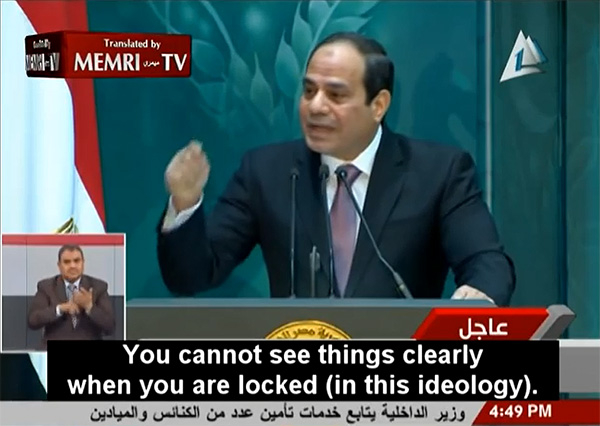
Egypt's
President, Abdel Fattah el-Sisi, delivered a historic speech to top
Islamic scholars and clergy at Al-Azhar University in Cairo, December
28, 2014. (Image source: MEMRI)
|
Western powers, if they are to maintain credibility regarding leadership based on human rights, cannot turn a blind eye to what is going on in the Muslim world. Muslims in Egypt and elsewhere know from experience the extent to which Western powers have betrayed in practice what they pronounce in theory when it comes to support for people subjected to authoritarian regimes.
Egypt's Muslims have a long record of struggling to modernize their society. The lack of success of religious reformers, such as Muhammad Abduh (1849-1905) and Ali Abd al-Raziq (1888-1966), and secular intellectuals, such as Taha Hussein (1889-1973), Nasr Hamid Abu Zayd (1943-2010) and Hasan Hanafi (b.1935), in bringing Egypt out of its "third world" cultural backwardness was compounded by the complicated history of the country and people caught in the grips of colonial interests, anti-colonial struggles, inter-Arab rivalries, wars against Israel, and the Cold War contest in the Middle East.
What is long overdue from the West is a robust policy to defend and secure human rights for everyone, especially minorities, in Muslim-majority countries. Ironically, it already has on hand well-tested policies of both defending and successfully advancing respect for human rights within totalitarian states in the form of the Helsinki Agreement of 1975, which in retrospect contributed to the undoing of communism in the Soviet Union and its satellites in Eastern Europe.
A policy modelled on the Helsinki Agreement and tailored to the specific situation within the Muslim world, as in Egypt, by the Western powers led by the United States should be presented as the sine qua non to the member states of the Organization of Islamic Cooperation (OIC) if they wish to maintain a relationship of mutual respect and assistance with, for instance, the G7 nations. As signatories of the UN-adopted Universal Declaration of Human Rights of 1948, the OIC member states, including Egypt, must be told in no uncertain terms that their complicity in or failure to prevent human-rights abuses will have serious consequences.
The Western powers should also make it known categorically that the 1990 Cairo Declaration of Human Rights in Islam, which was adopted by the OIC, is unacceptable, because Article 24 of the document states: "All the rights and liberties stated in this Declaration are in accordance with the precepts of the Islamic Law." In other words, the Cairo Declaration makes Shariah law the basis for rights and freedoms within Muslim-majority countries. This should be totally unacceptable to Western powers, particularly the United States, as the principal founding member of the United Nations -- just as it is unacceptable to Muslims who understand the incompatibility of Shariah with the requirements of the modern world.
Shariah is an obsolete product of the minds of men belonging to the early Middle Ages. The Copts, as other religious minorities among the member states of the OIC, and many Muslims, are victimized daily on the basis of Shariah in Egypt. There can be no reprieve for them as long as the government continues to impose Shariah-directed rules and regulations in the country as a whole, and as long as Egyptian society complies.
An incessant demand must be made of the United States to lead the G7 to adopt a Helsinki-type of agreement in their dealings with the member states of the OIC. Such an accord eventually would have a similar effect on the Muslim world -- in terms of human rights, protection of religious minorities, equal status for women and freedom of speech as essential for advancing democracy -- as the Helsinki Agreement had in liberating the people under communism in the former Soviet Union and in Eastern Europe.
The treatment of the Copts in Egypt is a moral outrage for any Muslim aware of the religious tradition bequeathed to him by his prophet. This tradition includes Muhammad's affection for the Copts through his marriage to Maria, a daughter of the Copts, who bore him the son, Ibrahim (died in infancy), he so earnestly desired. As a result of this providentially blessed relationship, the Copts as a people became Muhammad's extended family, his kith and kin. When Egyptian Muslims seek God's mercy, they need reminding that it begins with atoning for wrongdoing against the Copts, and seeking forgiveness from them. The leadership of Al-Azhar University in Cairo could make a beginning by following President al-Sisi's example when he said recently, in welcoming the Copts with open arms as members of Egypt's family:
"We too love you. You are our family, you are from us, we are one and no one will divide us."
Salim Mansur is a Distinguished Senior Fellow at Gatestone Institute. He teaches in the department of political science at Western University in London, Ontario, and is the author of "The Qur'an Problem and Islamism"; "Islam's Predicament: Perspectives of a Dissident Muslim"; and "Delectable Lie: A Liberal Repudiation of Multiculturalism."
This article is based on remarks the author delivered at the 9th annual convention of Coptic Solidarity, held in Washington, D.C. on June 21-22.

