.

.
Library of Professor Richard A. Macksey in Baltimore

POSTS BY SUBJECT

Labels

Showing posts with label SPAIN. Show all posts

Sunday, October 15, 2017

Fjordman : How Barcelona Became a Victim of the Barcelona Process (2017 Barcelona attacks)

  • The Barcelona Process, promoted by the EU, has helped to facilitate a greater presence of Islam and Muslim immigrants in Western Europe -- thereby also increasing the Islamic terror threat there. That result was perfectly foreseeable.
  • When the number of people who believe in Islamic Jihad doctrines rises, the likelihood of experiencing jihadist attacks increases as well.
  • It is unlikely, though, that European political leaders will point to this connection. Doing so would be an indirect admission that Europe's leaders have actively increased the Islamic terror threat against European citizens. This is the brutal truth they do not want exposed.
The murders on the pedestrian street of La Rambla in Barcelona on August 17, 2017 were not the first Islamic terrorist attack in Spain. On March 11, 2004, 192 people were killed, and around two thousand injured, in the Madrid train bombings.

In hindsight, that attack marked a new phase in the modern Islamic Jihad against Europe. After the Madrid bombings, London was hit with deadly bombings on July 7, 2005. In recent years, the frequency of jihadist attacks on European soil has increased dramatically.

It is probably not a coincidence that Spain was an early target of Islamic terror. The Iberian Peninsula, present-day Portugal and Spain, was for centuries under Islamic rule. Militant Muslims have repeatedly made it clear that for them, reconquering Spain is a priority.
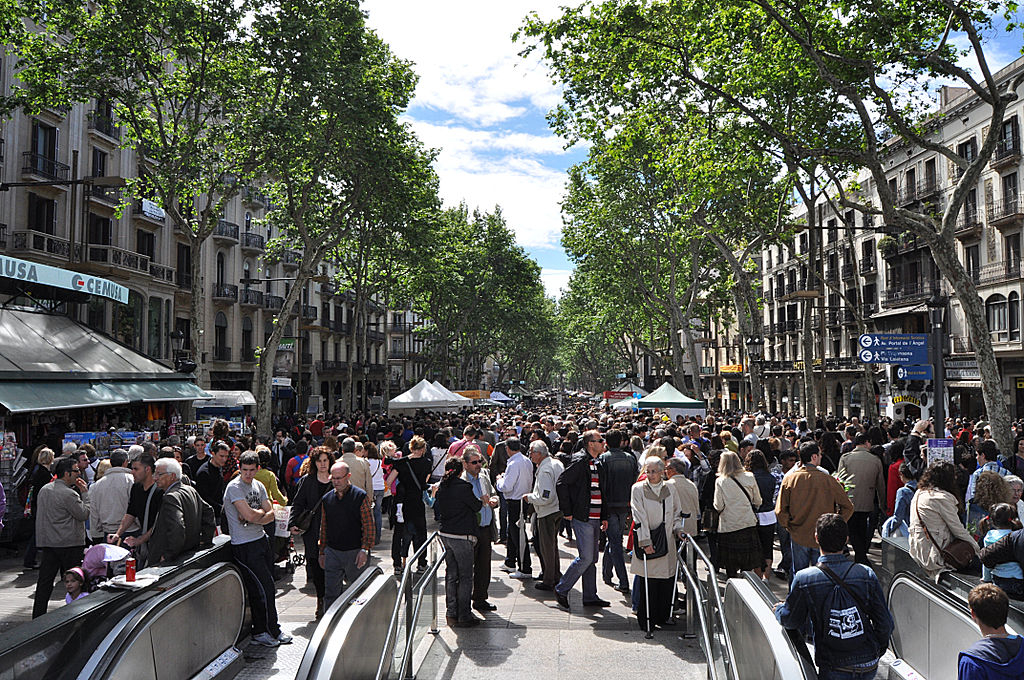

The murders on the pedestrian street of La Rambla in Barcelona on August 17, 2017 were not the first Islamic terrorist attack in Spain. (Image source: JT Curses/Wikimedia Commons)

Ironically, some people in Barcelona seem to view tourists who pay for short-term visits as a greater threat than Muslim immigrants who come to stay permanently. One can hear similar reactions among some radical left-wing activists, for instance, in Greece.

Mass tourism can potentially cause problems such as overcrowding and local pollution. Nevertheless, it is noteworthy that only a few days before the terror attack in Barcelona, some locals were complaining about an invasion of tourists. One radical left-wing group, Arran, published footage of tourist bikes in the city having their tires punctured in acts of deliberate sabotage. Of course, the problem might be even greater if there were too few tourists.

Meanwhile, a real invasion of Spain and Europe is taking place. For years, huge numbers of illegal immigrants from the Islamic world and Africa have been entering, especially through Greece or Italy. Spain, too, has seen a spike in the number of illegal immigrants. The Spanish-controlled enclaves of Ceuta and Melilla in North Africa are under increasing pressure as points of departure for migrants.
The Madrid bombings in 2004 were immediately followed by the election in Spain of the Socialist politician José Luis Rodríguez Zapatero. His policy of appeasement of Islam and the Islamic world was, sadly, not the first. Western Europe's appeasement of Islam stretches back at least to the 1970s.

With the 1973 oil embargo, Arab countries in the Organization of the Petroleum Exporting Countries (OPEC) used oil as a weapon and tool for blackmail. European countries started giving concessions to Arabs to ensure their oil supply and, they doubtless hoped, avoid terrorism. These concessions were not just limited to economic affairs. They also included opening Western Europe up to Islamic culture and Muslim immigration. The author Bat Ye'or has written extensively on this subject.

As part of the Euro-Arab Dialogue, a Euro-Mediterranean Partnership between the EU and the Arabic-Islamic world was launched in 1995 with the so-called Barcelona Process. Its purpose was to strengthen the ties between Europe and the Arab world in the fields of trade, economy, environment, energy, health, migration, education, social affairs and cultural cooperation.

This Process has been in force for decades. Despite it, the increasingly stronger ties between the EU and Arab Muslim countries rarely receive critical scrutiny from the European mass media. There is even a Union for the Mediterranean, which most Europeans have never heard of.

As the official website of the European External Action Service (EEAS), the diplomatic service of the European Union (EU), stated in October 2017:
"The Union for the Mediterranean promotes economic integration across 15 neighbours to the EU's south in North Africa, the Middle East and the Balkans region. Formerly known as the Barcelona Process, cooperation was re-launched in 2008 as the Union for the Mediterranean.... Projects address areas such as economy, environment, energy, health, migration, education and social affairs. Along with the 28 EU member states, 15 Southern Mediterranean countries are members of the UfM: Albania, Algeria, Bosnia and Herzegovina, Egypt, Israel, Jordan, Lebanon, Mauritania, Monaco, Montenegro, Morocco, Palestine, Syria (suspended), Tunisia and Turkey. Libya is an observer."
The Islamic Republic of Mauritania in western Africa, a full member of the Union for the Mediterranean, has the same formal status there as Denmark, Sweden, Germany, France, Italy and Poland. Although Mauritania was the last country officially to ban slavery, it is still widely practiced there to this day. Yet the country regularly cooperates with the EU on matters of importance to the future of the EU.

The Barcelona Process, promoted by the EU, has helped to facilitate a greater presence of Islam and Muslim immigrants in Western Europe -- thereby also increasing the Islamic terror threat there. That result was perfectly foreseeable. When the number of people who believe in Islamic Jihad doctrines rises, the likelihood of experiencing Jihadist attacks increases as well.

It is unlikely, though, that European political leaders will point to this connection. Doing so would be an indirect admission that Europe's leaders have actively increased the Islamic terror threat against European citizens. This is the brutal truth they do not want exposed.
Fjordman, a Norwegian historian, is an expert on Europe, Islam and multiculturalism.

Tuesday, August 22, 2017

Soeren Kern : Spain: Barcelona Attack Was Preventable


  • The measures to place bollards or planters in public areas were never implemented in Barcelona because the leaders of the Catalan independence movement did not want to be seen as taking orders from the central government in Madrid.
  • Far more difficult to explain is why no one reported suspicious activity at the chalet.
  • Although some Catalans are having second thoughts about the wisdom of promoting Muslim mass immigration as a strategy to achieve Catalan independence, at least 10,000 Catalans with links to the separatist movement have actually converted to Islam in recent years.
As details emerge of the August 17 jihadist attack in Barcelona, the evidence points to one overarching conclusion: the carnage could have been prevented if a series of red flags had not been either missed or ignored.
The failure to heed intelligence warnings, enhance physical security and report suspicious activity are all factors that facilitated the attack, which had been in the planning stage for more than six months.
The attack was also enabled by the idiosyncrasies of Spanish politics, especially the tensions that exist between the central government and the leaders of the independence movement in Catalonia, the autonomous region of which Barcelona is the capital.

Failure to Install Bollards on Las Ramblas

The Barcelona attack could have been prevented had municipal officials complied with an order to install bollards, vertical poles designed to prevent car ramming attacks, on the Rambla, the city's main tourist thoroughfare.
On December 20, 2016, one day after a Tunisian jihadist drove a truck into a Christmas market in Berlin, killing 12 people and injuring 56, Spanish National Police issued a circular ordering all central, regional and municipal police departments in Spain to "implement physical security measures to protect public spaces" to prevent jihadist attacks "in places with high numbers of people." The circular advised:
"Municipalities should protect these public spaces by temporarily installing large planters or bollards at access points to hinder or prevent the entry of vehicles."
The measures were never implemented in Barcelona because the leaders of the Catalan independence movement did not want to be seen as taking orders from the central government in Madrid.

After receiving the directive, Catalan autonomous police, known as the Mossos d'Esquadra, accused the central government of "alarmism" and insisted that it would not order municipalities in Catalonia to implement this "indiscriminate measure." The Mossos also claimed to have the jihadist threat under control, that local police were trained to "detect symptoms or radicalization," and that there were "no concrete threats."

After the Barcelona attack, Deputy Mayor Gerardo Pisarello blamed the absence of bollards on the Catalan Interior Ministry. "The City of Barcelona has never refused to install bollards. Whenever it has been requested, we have done so," Pisarello said. Ada Colau, Barcelona's leftwing mayor, however, has repeatedly refused to "fill Barcelona with barriers," insisting that it must remain "a city of liberty."
El Periódico de Catalunya, a paper based in Barcelona, elaborated:
"The total absence of police collaboration between the Mossos d'Esquadra, which is the police force deployed on the ground, and the National Police and the Civil Guard translates into huge security deficiencies. The relationship between police forces — influenced by the political situation — is terrible and, in the case of the Mossos and the National Police, it is open war.
"The result is that the information services of the Mossos, on the one hand, and those of the National Police and the Civil Guard, on the other, do not exchange information. The cooperation is reduced to the personal relationships of individual agents who, without the knowledge of their superiors, exchange information and put safety first."
On August 19, hours after the jihadist attack in Barcelona, Spanish Interior Minister Juan Ignacio Zoido repeated that it would be "appropriate" for all municipalities to comply with the December circular. His ministry issued a new letter calling on municipalities to install safety measures in the neuralgic points of cities. It remains to be seen if Catalan officials will now implement the recommendations.


Too little, too late.
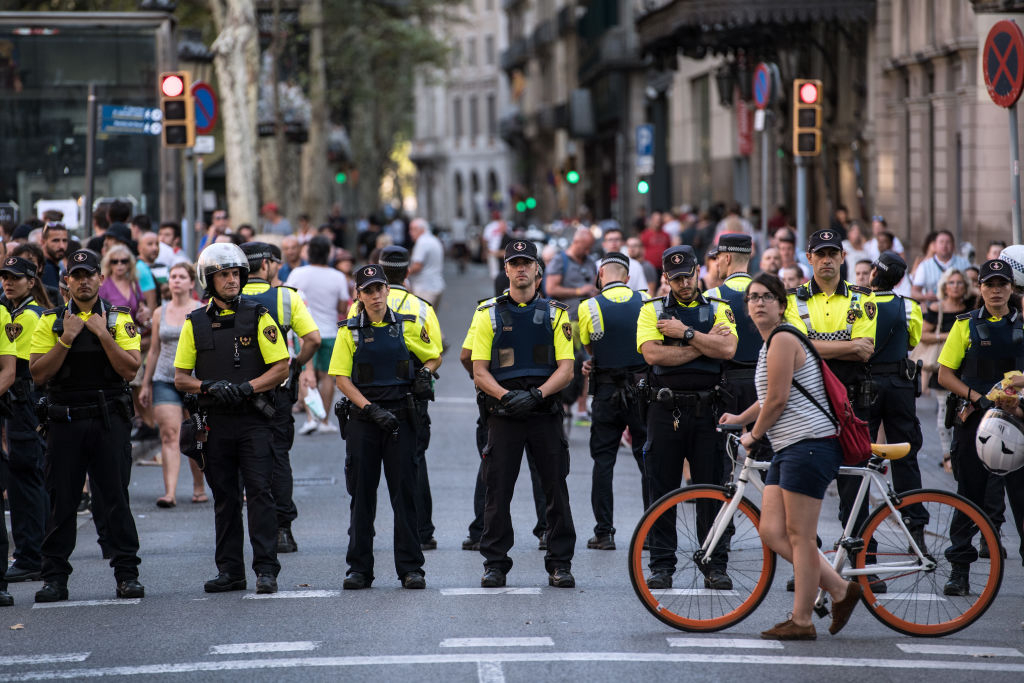
Police officers line the street on Las Ramblas on August 18, 2017, near the scene of the previous day's terrorist attack in Barcelona, Spain. (Photo by Carl Court/Getty Images)

Failure to Heed Warnings

In June, the CIA reportedly warned Catalan police that Barcelona was being targeted by jihadists: "Two months ago the Central Intelligence Agency warned Catalan police of a threat to Las Ramblas," according to El Periódico.

Additionally, on June 30, two weeks before the Barcelona attack, a Twitter account associated with the Islamic State warned of an impending attack against al-Ándalus, the Arabic name given to those parts of Spain, Portugal and France occupied by Muslim conquerors from 711 to 1492. Many jihadists believe that territories Muslims lost during the Christian Reconquest of Spain still belong to the realm of Islam and that Islamic law gives them the right to re-establish Muslim rule there.

It remains unclear why Catalan authorities failed to increase security in light of the warnings and threats. El Periódico wrote:
"In recent years Barcelona has become a city known all over the planet. Both because of its attraction as a tourist destination and because of the media impact of the Barça football club, the Catalan capital is a world icon. In the eyes of the jihadists, that makes it a priority objective, as they seek to attack sites that generate a great impact at the international level.
However, neither the authorities nor the citizens seems to have realized that their city is on the same list of targets as other major cities such as New York, Paris, London or Madrid."

Failure to Report Suspicious Activity

The jihadists prepared for the Barcelona attack at a chalet in the beachfront town of Alcanar, situated 200 kilometers (120 miles) south of Barcelona. A year ago, the terror cell "occupied" the property, which was foreclosed and had been vacant. Squatters are protected by Spanish law, so it is common for youth in Catalonia to take over vacant properties. This may explain why neighbors did not contact the police.

Far more difficult to explain is why no one reported suspicious activity at the chalet. During the course of several months, the jihadists collected more than 100 large gas canisters, which investigators believe were to be used as car bombs. An explosion on August 16, the night before the Barcelona attack, leveled the property. Investigators later found traces of the explosive triacetone triperoxide (TATP), also known as the "Mother of Satan," a substance widely used by members of the Islamic State in Europe.

Failure to Follow-Up on Leads

Police found the remains of at least two people in the rubble of the Alcanar chalet. The head of the Mossos d'Esquadra, Josep Lluís Trapero, confirmed that one of the bodies was that of Abdelbaki Es-Satti, a Muslim cleric who is suspected of organizing the terror cell and radicalizing its members.
Es-Satti, a Moroccan national who lived in the Catalan town of Ripoll, served in a local mosque. He was a convicted drug trafficker who had spent four years at a prison in Valencia, where he is believed to have met Rachid Aglif, known as "The Rabbit," one of the main plotters of the 2004 Madrid bomb attacks that killed 192 people and wounded 2,000. Police are now looking into whether Es-Satti was involved in the ISIS attacks on the Brussels airport and metro in 2016.
Ali Yassine, the director of the mosque in Ripoll, said that he had reported Es-Satti to local police more than a year ago as part of a security protocol to monitor Muslim preachers. Authorities did not place him on a watch list, however, even though he had been convicted of trafficking drugs and violating Spanish immigration laws.

Catalan Migration Policy Fuels Radicalization

Catalonia not only has the highest Muslim population in Spain, it is also one of the most Islamized regions of the country. Catalonia has 7.5 million inhabitants, including an estimated 510,000 Muslims, who account for around 7% of the total Catalan population. In some Catalan towns, however, the Muslim population is above 40% of the overall population.

In his book "Jihadism: The Radical Islamic Threat to Catalonia," Catalan terrorism analyst Jofre Montoto estimates that at least 10% of the Muslims in Catalonia are "radicals" who are hardcore believers in the "doctrine of jihadism."

A five-page diplomatic cable, dated October 2, 2007, described the link between mass immigration to Catalonia and the rise of radical Islam in the region:
"Heavy immigration — both legal and illegal — from North Africa (Morocco, Tunisia, and Algeria) and Southeast Asia (Pakistan and Bangladesh) has made Catalonia a magnet for terrorist recruiters. ... The Spanish National Police estimates that there may be upwards of 60,000 Pakistanis living in Barcelona and the surrounding area; the vast majority are male, unmarried or unaccompanied, and without legal documentation.

There are even more such immigrants from North Africa. ... They live on the edges of Spanish society, they do not speak the language, they are often unemployed, and they have very few places to practice their religion with dignity. ... Individually, these circumstances would provide fertile ground for terrorist recruitment; taken together, the threat is clear....
"There is little doubt that the autonomous region of Catalonia has become a prime base of operations for terrorist activity. Spanish authorities tell us they fear the threat from these atomized immigrant communities prone to radicalism, but they have very little intelligence on or ability to penetrate these groups."
Many of Catalonia's problems with radical Islam are self-inflicted. In an effort to promote Catalan nationalism and the Catalan language, Catalonian pro-independence parties have deliberately promoted immigration from Arabic-speaking Muslim countries for more than three decades, in the belief that these immigrants (unlike those from Latin America) would learn the Catalan language rather than speak Spanish.

Although some Catalans are having second thoughts about the wisdom of promoting Muslim mass immigration as a strategy to achieve Catalan independence, at least 10,000 Catalans with links to the separatist movement have actually converted to Islam in recent years.

It is believed that two out of every ten Catalan radicals who belong to the Republican Left of Catalonia (ERC), a far-left political party, are converts to Islam. The ERC, which now governs Catalonia, has vehemently refused to sign a cooperation agreement with the central government in Madrid to fight jihadist terrorism.
Soeren Kern is a Senior Fellow at the New York-based Gatestone Institute

Sunday, August 20, 2017

Soeren Kern : Europe: Migrant Crisis Reaches Spain

  • "The biggest migration movements are still ahead: Africa's population will double in the next decades. A country like Egypt will grow to 100 million people, Nigeria to 400 million. In our digital age with the internet and mobile phones, everyone knows about our prosperity and lifestyle." — German Development Minister Gerd Müller.
  • "Young people all have cellphones and they can see what's happening in other parts of the world, and that acts as a magnet." — Michael Møller, Director of the United Nations office in Geneva.
  • "If we do not manage to solve the central problems in African countries, ten, 20 or even 30 million immigrants will arrive in the European Union within the next ten years." — Antonio Tajani, President of the European Parliament.
Spain is on track to overtake Greece as the second-biggest gateway for migrants entering Europe by sea. The sudden surge in migration to Spain comes amid a crackdown on human smuggling along the Libya-Italy sea route, currently the main migrant point of entry to Europe.

The westward shift in migration routes from Greece and Italy implies that Spain, situated only ten miles from Africa by sea, may soon find itself at the center of Europe's migration crisis.

More than 8,300 illegal migrants have reached Spanish shores during the first seven months of 2017 — three times as many as in all of 2016, according to the International Organization for Migration (IOM).

Thousands more migrants have entered Spain by land, primarily at the Spanish enclaves of Ceuta and Melilla on the north coast of Morocco, the European Union's only land borders with Africa. Once there, migrants are housed in temporary shelters and then moved to the Spanish mainland, from where many continue on to other parts of Europe.

In all, some 12,000 migrants have arrived in Spain so far this year, compared to 13,246 for all of 2016. By comparison, 14,156 migrants have arrived in Greece so far in 2017.

Italy remains the main migrant gateway to Europe, with around 97,000 arrivals so far this year, compared to 181,436 for all of 2016. Italy has been the main point of entry to Europe since the EU-Turkey migrant deal, signed in March 2016, shut off the route from Turkey to Greece, at one time the preferred point of entry to Europe for migrants from Asia and the Middle East. Almost 600,000 migrants have arrived in Italy during the past four years.

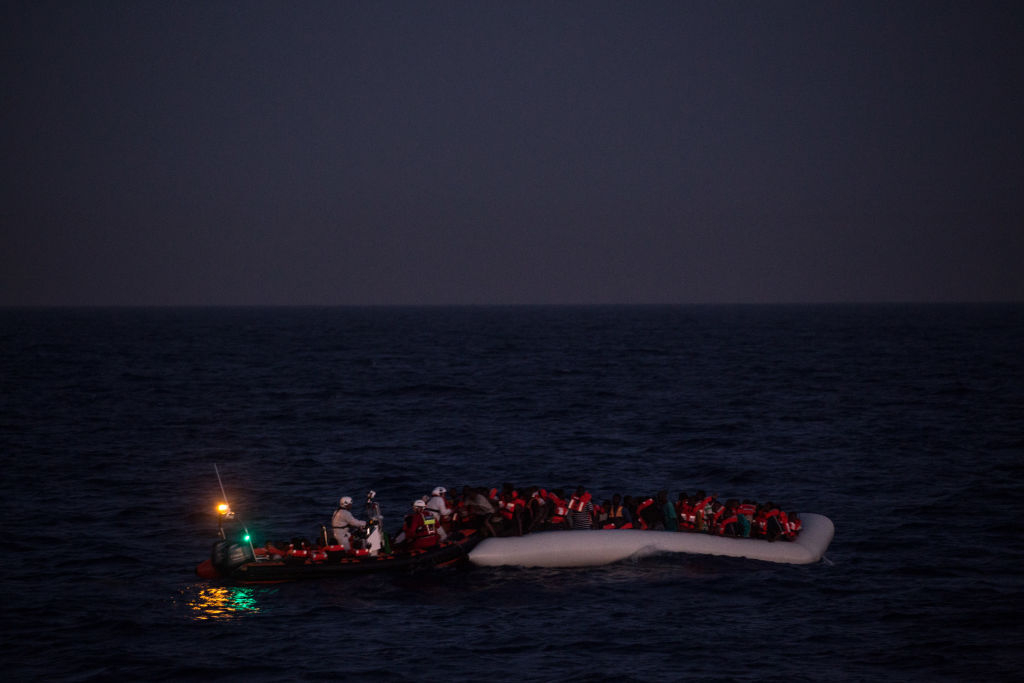
Migrants wait to be rescued by crewmembers from the Migrant Offshore Aid Station (MOAS) Phoenix vessel on June 10, 2017 off Lampedusa, Italy. (Photo by Chris McGrath/Getty Images)

In May, Italy signed a deal with Libya, Chad and Niger to stem the flow of migrants across the Mediterranean through improved border controls. In July, Italy also reached a deal with France and Germany to tighten the regulation of charities operating boats in the Mediterranean and to increase funds to the Libyan coast guard.

Since then, the Libyan coast guard has prevented thousands of migrants from leaving the Libyan coast for Italy. The crackdown, however, has sent would-be migrants scrambling for an alternative route to cross the Mediterranean. This appears to explain the increase in migrants arriving in Spain.

On August 14, Frontex, the European Union's border agency, reported that the number of African migrants arriving in Italy from Libya had dropped by more than half in July compared to the month before. During this period, the number of migrants arriving in Spain rose sharply.

Frontex said that 10,160 migrants had arrived in Italy by sea in July — 57% fewer than in June and the lowest level of arrivals for a July since 2014. According to Frontex, 2,300 migrants made it to Spain in July, more than four times as many as the year before. Most of the migrants arriving in Italy and Spain are believed to be economic migrants seeking a better life in Europe, not refugees fleeing war zones.
"The vast majority of migrants crossing to Italy from Libya come from Senegal, Gambia, Guinea and other west African countries," said Joel Millman, an IOM spokesman, in an interview with the Financial Times. "Given the crackdown on migration from Libya, it seems natural that many would forsake the dangerous dessert [sic] crossing to Libya and choose to cross from Morocco."

Julio Andrade, a city councilor in Málaga, a port city in southern Spain, called it "the balloon effect." In an interview with the Irish Times, he said: "If you squeeze one area, the air goes elsewhere. If there is a lot of police pressure and arrests of mafias around the Mediterranean routes via Greece and Italy, for example, then the mafias will look for other routes."

Spanish authorities have reported that there is a surge in African migrants attempting to cross the land border at Ceuta by scaling fences that are up to six meters (20 feet) tall and topped by razor wire. Spanish Interior Minister Juan Ignacio Zoido said there were 2,266 attempts to jump the perimeter at Ceuta during the first seven months of 2017, compared to a total of 3,472 attempts in all of 2016.

On August 7, more than 300 mostly sub-Saharan Africans ambushed Spanish and Moroccan security forces and stormed the border crossing at El Tarajal; 186 migrants made it onto Spanish territory. On August 8, more than a thousand migrants armed with spears and rocks attempted to breach the same crossing. On August 9, Spanish authorities closed the border for a week. On August 10, around 700 migrants stormed the border; 200 migrants were arrested.

Meanwhile, on August 9, a video showed a rubber boat carrying dozens of migrants arrive at a beach full of sunbathers in Cádiz. José Maraver, the head of a rescue center in nearby Tarifa, told the Telegraph that a second boat had landed on another beach in the area and that this scene was now a regular occurrence. "Every day there are boats, every day there is migration," he said. "The situation is getting very complicated."

Migrants are also using other means to reach Spain. On August 6, for example, four Moroccans reached the coast of Málaga on jet skis. During July and August, police intercepted at least two dozen migrants using jet skis to cross over to Spain. On August 10, police using motion detectors and thermal imaging sensors found 56 migrants, including 14 children, hiding inside trucks en route from Ceuta to the mainland ferry port in Algeciras.

In an August 9 editorial, Spain's El País newspaper said that it was "obvious that migratory pressure has moved to the western Mediterranean and there is no indication that this situation will change in the near future." It added:
"The migratory pressure Spain has experienced during the past several weeks is an increase of such dimensions that it exceeds all measures of surveillance and control. The massive entry of sub-Saharan people across the border of Ceuta, whether by jumping the fence or crossing the El Tarajal border, reveals the enormous difficulties in stopping the entry of those fleeing war, famine or economic hardship....
"The management of migratory flows requires a strong European policy and sufficient economic resources. Spain cannot stand alone as the guardian of southern Europe."
German Development Minister Gerd Müller recently warned that Europe must prepare for the arrival of millions more migrants from Africa:
"The biggest migration movements are still ahead: Africa's population will double in the next decades. A country like Egypt will grow to 100 million people, Nigeria to 400 million. In our digital age with the internet and mobile phones, everyone knows about our prosperity and lifestyle."
The director of the United Nations Office in Geneva, Michael Møller, has echoed those concerns:
"What we have been seeing is one of the biggest human migrations in history. And it's just going to accelerate. Young people all have cellphones and they can see what's happening in other parts of the world, and that acts as a magnet."
The President of the European Parliament, Antonio Tajani, said that in order to staunch the flow of migrants from Africa, the European Union would need to invest billions and develop a long-term strategy to stabilize the continent: "If we do not manage to solve the central problems in African countries, ten, 20 or even 30 million immigrants will arrive in the European Union within the next ten years."
Soeren Kern is a Senior Fellow at the New York-based Gatestone Institute.

Friday, August 11, 2017

“It Will Come To Blood”–What Spain’s Civil War Can Teach America’s Patriots

“It Will Come To Blood”–What Spain’s Civil War Can Teach America’s Patriots


Patrick Cloutier
June 8, 2017,
http://www.vdare.com/articles/snowflakes-spains-international-brigades-and-americas-patriots

Last weekend’s clash in Portland OR was further evidence that the Alt Right, loosely defined, can field force on the streets—a completely new development in recent American politics (Portland Breathes a Sigh of Relief after Weekend Protester Showdown. But Several Questions Persist About Police Tactics| Police cracked down on only one side—the protesters who threw red-stained tampons at officers while chanting, “All cops are bastards!” by Karina Brown and Rachel Monhanan, Williamette Week, June 6, 2017. [This is a real headline!] Which supports VDARE.com Editor Peter Brimelow’s observation, after the Inauguration Day riots, that “it will come to blood.” The lead-up to Spain’s Civil War provides some pointers to our possible future.


Portland Antifa (by which we mean communists and left-anarchists) had already openly threatened to attack ordinary Republican officials, causing Portland authorities to cancel a parade, and a hysterical media campaign directed against the Right after a recent murder caused Portland’s Mayor to call for a suspension of the Alt Right’s First Amendment rights. Not surprisingly, Republican officials had publicly discussed using organized security forces, which Main Stream Media of course characterized as “militias” .[Portland Republican says party should use militia groups after racial attack, by Jason Wilson, The Guardian, May 29, 2017]
At a time when a “comedian” can post a photo of herself beheading the President of the United States, it’s not a stretch to think America is coming apart. David Hines, in his remarkable “Days of Rage” Storify, posited that America is already in a “cold Civil War” and on the brink of violence. Critically, Hines highlighted the role established institutions play in supporting domestic terrorists on the Left. He argued the Left will have at least the initial advantage in organized violence.


That seemed indisputable—until recently. Conservative speakers have been regularly shut down on college campuses through violence, with no punishment for rioters. Antifa openly urge people to join armed gun clubs such as the John Brown Gun Club. [Lemons: Lefties with Guns Ready to Rumble with Right-Wing Militias, Says Arizona Anarchist, by Stephen Lemons, Phoenix New Times, April 5, 2017] Right-wing conferences are the victims of bomb threats The MSM habitually sides against the victims. And when Richard Spencer was attacked (repeatedly) on Inauguration Day, the MSM cheered it on. [Attack on Alt-Right Leader Has Internet Asking: Is It O.K. to Punch a Nazi?, By Liam Stack, NYT, January 21, 2017.] With adoring MM coverage, kid gloves from the authorities and heavy institutional support, Antifa were gaining in confidence and a willingness to use violence—until recently.


This pattern has repeated across centuries. In 200 Years Together, Alexander Solzhenitsyn described how Communist revolutionaries in Tsarist Russia  were supported by intellectual circles. Their young leadership often came from the privileged classes, including a significant number of Jews. (Curiously, 200 Years Together, while it is available in French and German, has never been published in English, although bootleg translations circulate on the internet.)


Now, however, there seems to be physical resistance from the American Right. Perhaps the most important case: the “Battle of Berkeley” last month, when a loose alliance of conservatives, “Alt-Lite” free speech supporters and Alt-Right activists fought and beat an Antifa attempt to shut down a demonstration. MSM reports suggest Antifa were generally stunned when patriots fought back.

David Hines urges a “National Divorce” before things get worse. I’d argue a “National Divorce” would simply allow the Left a beachhead from which eventually to secure the entire country. And it is unlikely even to work. It seems more likely there will be a larger-scale conflict and political groups willing to use violence will grow larger and more organized.


the Spanish Civil War.
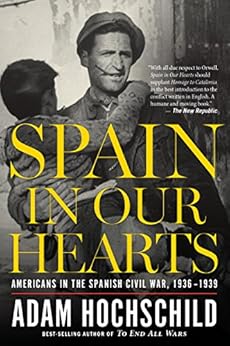
One of the most likely models of how the polity could collapse into civil strife: the Spanish Civil War. The September/October 2016 edition of Foreign Affairs, a publication of the Council on Foreign Relations, featured a review by Sebastian Faber of Adam Hochschild’s Spain in Our Hearts: Americans in the Spanish Civil War, 1936-1939, profiling the Abraham Lincoln Brigade (or 15th International Brigade), a pro-Communist force which fought for the Republic as “shock troops.”

Abraham Lincoln BrigadeAs Faber notes, then-mayor of San Francisco Gavin Newsom, now a Democratic gubernatorial contender in California, unveiled a monument to the group in 2008 and proclaimed: “The spirit of the Abraham Lincoln Brigade is a legacy we have inherited.”
One can even find praise for the Abraham Lincoln Brigade in the publications of Conservatism Inc.
Many “Lincolns” went on to support Civil Rights and other Left-wing causes.
Less publicized, they supported Communism as well.
It’s not hard to imagine the Snowflakes in the “John Brown Gun Clubs” of today developing into the “International Brigades” of tomorrow—and receiving similar adoring media coverage.

But what of the Right? If the Spanish Civil War were to serve as a template for a second American Civil War, we should examine the two main rightist paramilitary groups in Spain. They were the Carlists, a monarchist group, whose fighters were known as requetés and considered the most fanatical fighters on the Nationalist side, and the right-wing Falange (= Phalanx). They provided an important source of manpower to the Nationalist Army.

On the eve of the Spanish Civil War, the Falangists numbered about 40,000 men. The Carlists had at least 6,000 men in Pamplona, Navarre and are estimated to have had a minimum of 10,000 men.
All day long on the second day of the war, conservative farmers streamed to Pamplona to volunteer for the Carlist forces.
In the first days of the fighting, the Nationalists relied heavily on such militias: regular soldiers were often outnumbered. At the outset, the Carlists secured the region of Navarre. One column of 1,400 men, mostly requetés, marched to Saragossa, to reinforce the army garrison and secure the town.

Falangists contributed to the defense of the town of Oviedo, in Asturias. The soldiers and Falangists withstood a siege for months, until relieved in mid-October, 1936. In Toledo, Falangists contributed at least 200 men to the 1,300-man force defending the Alcázar Fortress, which held out, until relieved by Franco in late September, 1936. In August in the Saragossa region, they had at least 2,000 men.  In the advance on Madrid, the Falangists contributed a significant portion of the 20,000 men who attacked the city.

Without these highly-motivated militias, it would have been impossible for the Nationalists to succeed in the war against the Leftist government; the rebellion would have collapsed in its first week.

Similarly, should civil war visit America again, it may come down to locally-organized groups of both Left and Right, as the regular U.S. military will be spread thin (and probably divided).

In the Spanish Civil War, militias organized around political factions and regions. In the United States, it seems likely militias on the Right, like some of those which exist today, would be organized legally or quasi-legally along constitutional lines (either by the state constitution or the U.S. Constitution.) This might even go down to the county level.

Of course, there is one major difference. While the MSM and the government tolerates or even celebrates organized Leftist violence, the hammer is always ready to fall on organized forces of the right. [Posse Interruptus, Chateau Heartiste, May 30, 2017]

On an individual level, Western governments often use “exemplary sentencing”—shockingly draconian punishment—to punish Right-wingers, while shrugging at Leftist thugs.

For that reason, as Hines predicted, if there is a second American Civil War, we can expect most of the casualties in the beginning will be on the conservative side.

Finally, there is one other important point: The Right won the Spanish Civil War. Francisco Franco built a great monument to his victory and eventually Spain, saved from Communism, become a democracy. Yet now, the Spanish Left is actually voting to desecrate his grave in the name of Political Correctness. [It’s shameful for Franco’s victims, Spanish MP’s vote to exhume dictator, by Sam Jones, The Guardian, May 11, 2017]

In the end, war is just politics by other means, as Clausewitz said. All war is a media war.
And the battle is never really over.

Patrick Cloutier is the translator of Raciology (reviewed here) and the author of several books of military history.

Tuesday, April 4, 2017

Giulio Meotti : Islamists Attack Christmas, but Europeans Abolish It


  • A statue of the Virgin Mary was ordered taken away by a court in the French municipality of Publier. Senator Nathalie Goulet slammed the judges as "ayatollahs of secularism".
  • A German school in Turkey just banned Christmas celebrations: the school, Istanbul Lisesi, funded by the German government, decided that Christmas traditions and carol-singing would no longer be allowed. A Woolworth's store in Germany scrapped Christmas decorations telling customers that the shop "is now Muslim".
  • Europe is already mutilating her own traditions "to avoid offending Muslims". We have become our own biggest enemy.
  • Muslims are also reclaiming "the mosque of Cordoba". Authorities in the southern Spanish city recently dealt a blow to the Catholic Church's claim of ownership of the cathedral. Now Islamists want it back.
  • The final result of Europe's self-destructive secularism could seriously be a Caliphate.
"Everything is Christian", Jean-Paul Sartre wrote after the war. Two thousand years of Christianity have left a deep mark on the French language, landscape and culture. But not according to France's Minister of Education, Najat Vallaud-Belkacem. She just announced that instead of saying "Merry Christmas", state officials should use "Happy Holidays" -- clearly a deliberate intent to erase from discourse and the public space any reference to the Christian culture in which France is rooted.

Jean-François Chemain called it the "eradication of any Christian sign in the public landscape". A year ago, the controversy was ignited in the French town of Ploermel, where a court decided that the statue of Pope John Paul II, erected in a square, had to be removed for violating "secularism".

Then, a statue of the Virgin Mary was ordered taken away by a court in the municipality of Publier. Senator Nathalie Goulet slammed the judges as "ayatollahs of secularism".

The newspapers of the French "left", outraged by the "right's" ban on burkinis on the French Riviera, have been endorsing this anti-Christian policy.

France's Council of State has just ruled that "the temporary installation of cribs [nativity scenes] in a public place is legal if it has a cultural, artistic or festive value, but not if it expresses the recognition of a cult or a religious preference". What precautions to justify a millenary tradition!

In the town of Scaer, a nursing home has been the subject of a similar secularist complaint, for the presence of a fresco of the Virgin Mary. Then, it was the turn of the manger in the train station of Villefranche-de-Rouergue, in Aveyron. In the town of Boissettes, the church bells have been muted by court decision.

Fortunately, some ideas from the Observatory of Secularism -- the organ established by President François Hollande to coordinate his neo-secularist policies -- have not been implemented. One proposed even to eliminate some Christian national holidays to make room for the Islamic, Jewish and secular holidays.
President Hollande, on the occasion of Easter, "forgot" to express holiday wishes to the Christians of France. But a few months before, Hollande had extended his best wishes to the Muslims during the feast of Eid, which closes Ramadan. "Hollande's greeting to Muslims is opportunistic and political. For the Socialist Party, it is a crucial electoral clientele", said the French philosopher Gerard Leclerc in the newspaper, Le Figaro.

This Christianophobia is the Trojan Horse of Islam. As Charles Consigny writes in the weekly Le Point, "Through this tabula rasa of the past, France will make a clean sweep of its future". Unfortunately, France is not an isolated case. Everywhere in Europe, a weary, secularist absence of purpose and confused values damns Christianity in favor of Islam.

A jihadist terrorist, targeting a symbol of Christian tradition, last week slaughtered 12 people at a Christmas market in Berlin. But Europe is already mutilating her own traditions "to avoid offending Muslims". We have become our own biggest enemy.
The annual candlelit Saint Lucia ("Sankta Lucia") procession, a Swedish Christian tradition celebrated for hundreds of years, is "dying" out. Uddevalla, Södertälje, Koping, Umeå, and Ystad are among the growing numbers of cities no longer holding this lovely cultural event. According to Jonas Engman, an ethnologist at the Nordic Museum, the declining interest in the St. Lucia procession accompanies a more general alienation from the culture of Christian Sweden. A study conducted by Gallup International reveals that in observing the Christian religion, Sweden is "the least religious in the West". In the meantime, with a young, strong, driven sense of purpose and a set of sharia values, Islam is growing.

A German school in Turkey just banned Christmas celebrations. The school, Istanbul Lisesi, funded by the German government, decided that Christmas traditions and carol-singing would no longer be permitted. The Washington Post summarized the decision: "No teaching of Christmas customs, no celebrations and no Christmas caroling". It is not an isolated incident. A Woolworth's store in Germany also scrapped Christmas decorations, telling customers that the shop "is now Muslim".

In Britain, David Isaac, the new head of the Equalities and Human Rights Commission (EHRC), told employers that they should not suppress Christian tradition out of fear of offending anyone. Previously, Dame Louise Casey, the British government's integration "tsar", warned that "traditions such as Christmas celebrations will die out unless people stand up for British values".

In many Spanish towns, such as Cenicientos, the municipality of this Autonomous Community of Madrid removed the Christian Stations of the Cross. Then, Madrid's mayor, Manuela Carmena, decided to remove the city's traditional Nativity display at the Puerta de Alcalá.

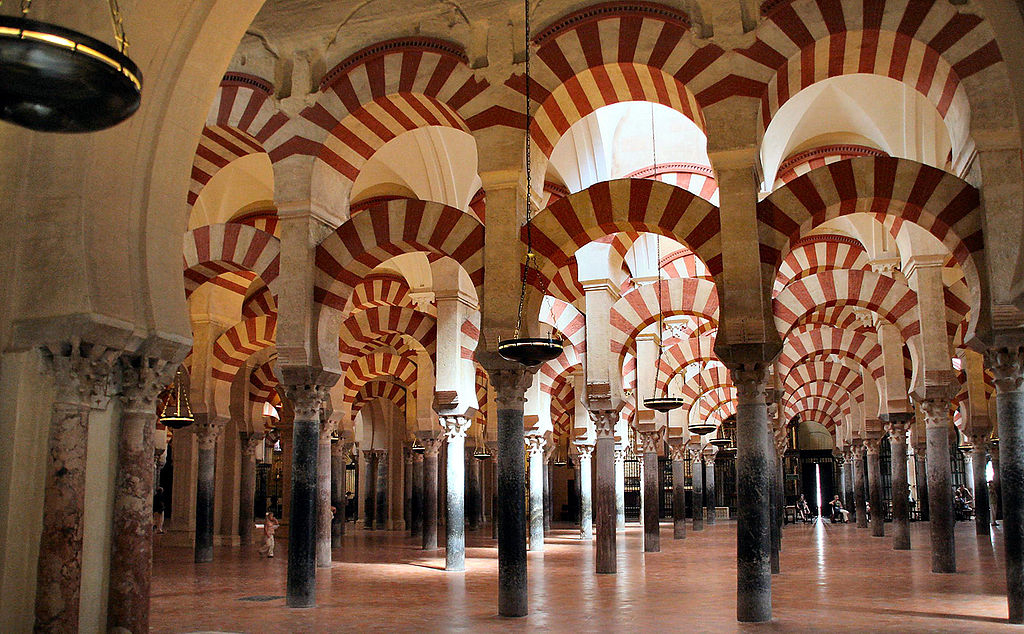
Muslims are also reclaiming "the mosque of Cordoba". Authorities in the southern Spanish city recently dealt a blow to the claim of ownership of the cathedral by the Catholic Church. Built on the site of Saint Vincent's church, it then served as a mosque for over 400 years when Islamic Spain was part of a caliphate, before the Christian kingdom of Castile conquered the city and converted it again into a church. Now Islamists want it back.

Muslims are also reclaiming "the mosque of Cordoba". Authorities in the southern Spanish city recently dealt a blow to the claim of ownership of the cathedral by the Catholic Church. Built on the site of Saint Vincent's church, it then served as a mosque for over 400 years when Islamic Spain was part of a caliphate, before the Christian kingdom of Castile conquered the city and converted it again into a church. (Image source: James Gordon/Wikimedia Commons)

Belgium, the most Islamized democracy in Europe, is also purging its Christian heritage. The Nativity, the traditional manger scene, has not been put up in the Belgian town of Holsbeek, just outside Brussels. Claims were scenes it was scrapped to "avoid offending Muslims".

As reported by the newspaper La Libre, school calendars within Belgium's French speaking community are also using a new secularized terminology: All Saints Day (Congés de Toussaint) is now be referred to as Autumn Leave (Congé d'automne); Christmas Vacation (Vacances de Noël) is now Winter Vacation (Vacances d'hiver); Lenten Vacation (Congés de Carnaval) is now Rest and Relaxation Leave (Congé de détente); and Easter (Vacances de Pâques) is now Spring Vacation (Vacances de Printemps). Then Belgium installed an abstract, de-Christianized Christmas tree in the capital, Brussels.

In the Netherlands, the Christian tradition of Black Pete is under attack and it will soon be abolished. In Italy, Catholic priests this year canceled Christmas to "avoid offending Muslims".

The final result of Europe's self-destructive secularism could seriously be a Caliphate, in which the fate of its ancient and beautiful churches recapitulates those in Constantinople, where the Hagia Sophia, for thousand years Christianity's greatest cathedral, was recently turned into a mosque.
The muezzin's call now reverberates inside this Christian landmark for the first time in 85 years.
Islamic terrorists targeted Christmas in Berlin, but it is the Christian secularists who are abolishing it all over Europe.
Giulio Meotti, Cultural Editor for Il Foglio, is an Italian journalist and author.
=================

Giulio Meotti : Is Europe Choosing to Disappear?


  • A sterile Europe apparently thought that civil liberties could be bargained away in exchange for a temporary peace. Everything became negotiable.
  • As British author Douglas Murray has asked, why were workers not brought in from European countries suffering high unemployment, such as Portugal, Italy, Greece or Spain?
  • A clear-eyed U.S. Congressman, Rep. Steve King, correctly said recently that, "You cannot rebuild your civilization with somebody else's babies." He instantly drew that white-hot fire reserved for people who tell truths that threaten treasured fantasies (think Giordano Bruno or Galileo).

 ITALY

The new data released by Italy's National Institute for Statistics for 2016 sounds again like a death knell. There has been a new negative record of births: 474,000 compared to 486,000 for 2015, which had already fallen to historic lows. There were 608,000 deaths in 2016. In one year, Italy lost 134,000 people -- the equivalent of a city of the size of Ferrara or Salerno.

The demographic "illusion" is kept only by the influx of immigration (135,000). If one needs an idea of what Italy would be without immigrants, look at Emilia-Romagna, one of Italy's most populated and affluent regions: in 2035 it will have 20% fewer residents.

Italy is sometimes thought of Europe's guinea pig: wherever Italy goes, much of Europe follows it, especially in the central and southern countries. In 1995, Antonio Golini, a professor at La Sapienza University and a former president of the National Institute of Statistics, was contacted by the director-general of Plasmon, Italy's largest producer of baby food. Looking at the declining birth rates, the firm asked him if something could be done to prevent the company from going out of business. Plasmon started to make dietary products for adults.

 SPAIN

A year ago, European geographers went in search of "the most desolate place in Europe". They discovered it not in northern and cold Lapland, but in sunny Spain, specifically in the area of Molina de Aragon, two hours from Madrid. Depopulation has not been the consequence of the climate, as in the Russian steppe or northern forests, but of a demographic crisis.

A report by the National Statistical Institute of Spain explained how the Iberian peninsula has become the sick man of Europe: Spain loses 72 inhabitants every day; 20% fewer children are born there than two decades ago. Demographers draw a line where Spain has no future and 30% of the population will be over the age of 65. In some Spanish regions, the fertility rate barely reaches one child per woman. Deaths already exceed births. Even the newspaper El Pais asked, "Are the Spanish people in danger of extinction?". The Spanish government just appointed a "sex czar" to try to figure out how to sustain the shrinking population.

Spain, in 2050, will be a depopulated nation dominated by older people and singles. The country will lose 5.3 million inhabitants: 11% of the current population. By that time, there will be 1.7 million Spanish children fewer than there are today. No children means that, in the long run, there will be no economic growth or prosperity; democracy will become a gerontocracy and Spain will embrace global irrelevance. Alejandro Macarrón Larumbe, director of the Foundation for Demographic Revival, has provided figures on the number of Spanish provinces that have already seen a loss of population.

  Islamic world

The Islamic world has launched a demographic challenge to a sterile Europe. Turkish President Recep Tayyip Erdogan recently exhorted Muslims in Europe to have five children, "because you are the future of Europe". It echoes what the President of Algeria, Houari Boumedienne, said in 1974: "The wombs of our women will give us victory". They dream of conquering Europe through demography instead of terror -- and it seems they are succeeding.


While Italian and Spanish statistics were released, another headline should have captured our attention: "Islam will surpass Christianity" -- to become the world's largest religion in 2070. There is a link not only between Europe's empty cradles and Islam's expansion, but also between Europe's demographic suicide and its passivity facing its many troubles during the last two years: mass immigration, terrorism, intimidation.

No modern, affluent society ever stopped having children before. The influx of Muslim immigrants is a symptom, not a cause of Europe's decline. Members of a healthy continent, who embrace the future in its most elementary form (raising a new generation), would have never have allowed foreign immigrants carving out separate spheres of sharia law in Europe's multicultural enclaves.

As the British author Douglas Murray, has asked, why were workers not brought in from European countries suffering high unemployment, such as Portugal, Italy, Greece or Spain? A sterile Europe apparently thought that civil liberties could be bargained away in exchange for a temporary peace. Everything became negotiable, because everything seemed perishable. An entire continent is filled with aging occupants indulging in childlike illusions of "internationalism", and claiming that all conflicts can be resolved peacefully, non-lethally and diplomatically. Europe's culture is essentially pacifist. It demonizes war, and seeks pleasure and comfort above all else.

Europe's demographic suicide also has serious consequences for the security of a society. During the transition to an elderly-majority state, democracy will be endangered. Welfare redistribution depends on younger workers providing payroll taxes to fund social security. What happens when an elderly majority can vote for itself more and more, at the expense of the dwindling young? National defense will be endangered. Today Europe already refuses to invest in the NATO alliance. Old people's entitlements will take precedence over defense spending. States that will not spend money on defense will be vulnerable to those that do.

A clear-eyed U.S. Congressman, Rep. Steve King (R-Iowa), correctly said recently that, "You cannot rebuild your civilization with somebody else's babies." He instantly drew that white-hot fire reserved for people who tell truths that threaten treasured fantasies (think Giordano Bruno or Galileo).

Decline is a choice, not a destiny. There is still time, but not much, for Europeans to choose not to disappear.
Giulio Meotti, Cultural Editor for Il Foglio, is an Italian journalist and author.
==================