.

.
Library of Professor Richard A. Macksey in Baltimore

POSTS BY SUBJECT

Labels

Showing posts with label ISLAM. Show all posts

Sunday, July 10, 2022

Giulio Meotti, Brussels: Capital of Europe or Eurabia?


  • "Molenbeek would love to be forgotten, because it is the very example of the failure of the multicultural society, which remains an untouchable dogma in Belgium". -- Alain Destexhe, former Belgian senator and general secretary of Doctors Without Borders, Le Figaro, May 3, 2022

  • "[I]n the Brussels region as a whole only a quarter of Belgians are of Belgian origin.... Molenbeek is in fact only the tip of the iceberg of the progressive Islamization in all the major Belgian cities. Islam is increasingly visible in the public space of Molenbeek, and in the month of Ramadan almost all the shops and restaurants in the city are closed during the day. In many neighborhoods, women are no longer able to dress however they want or go out at night, and homosexuals have no right of citizenship. There are, however, hardly any voices to worry about this development, as if French-speaking Belgium, anesthetized in unison by the multicultural media, had resigned itself". – Alain Destexhe, former Belgian senator and general secretary of Doctors Without Borders, Le Figaro, May 3, 2022

  • "Today the Muslim Brotherhood... continues its lobbying and blame games with its imaginary Trojan horse: Islamophobia". -- Assita Kanko, Belgian MEP, who fled Burkina Faso to look for freedom in Europe; cofoe.euractive.com, December 20, 2021

  • "The aim is clear: normalise radical Islamic codes and ways of life in order gradually to transform our Western societies instead of adapting to our European way of life. As a black woman and a secular Muslim, I know what it is to live under Islamic pressure and I know what it takes to emancipate oneself in order to finally live in dignity.... Europe must urgently pull itself together and reaffirm its commitment to its own values...." -- Assita Kanko, Belgian MEP, who fled Burkina Faso to look for freedom in Europe; cofoe.euractive.com, December 20, 2021

  • "Where will we be in 50 years? All of Europe - inshallah - will be Muslim. So, have children!" – Brahim Laytouss, president of the Islamic Cultural Center of Belgium, dhnet.be, March 5, 2019

  • The greatest form of cultural racism in Europe today is that of EU elites who censor or support this spectacular change of civilization.

  • "Of all the European capitals, Brussels is the one through which the Islamist project intends to spread to Europe. Their lobbies are powerful there, so it is much easier for Islamists to break into the system and gradually transform it". -- Djemila Benhabi, Camadian journalist, lecho.com

  • "[I]n exchange [for oil], the Saudi king asked the Belgian king Baudouin to grant Arabia a monopoly on representing Islam and appointing imams in Belgium". The Belgian government officially recognized the Islamic religion. It was the first European country to do so. There followed the inclusion of the Islamic religion in the school curriculum. -- Alain Chouet, former "number two" of the DGSE, the French counterintelligence service, from his new book: "Sept pas vers l'enfer" ["Seven Steps to Hell"]

  • "Eurabia" was born in those years, the years of an energy crisis, European weakness and the great rise of Islam. Sound familiar?
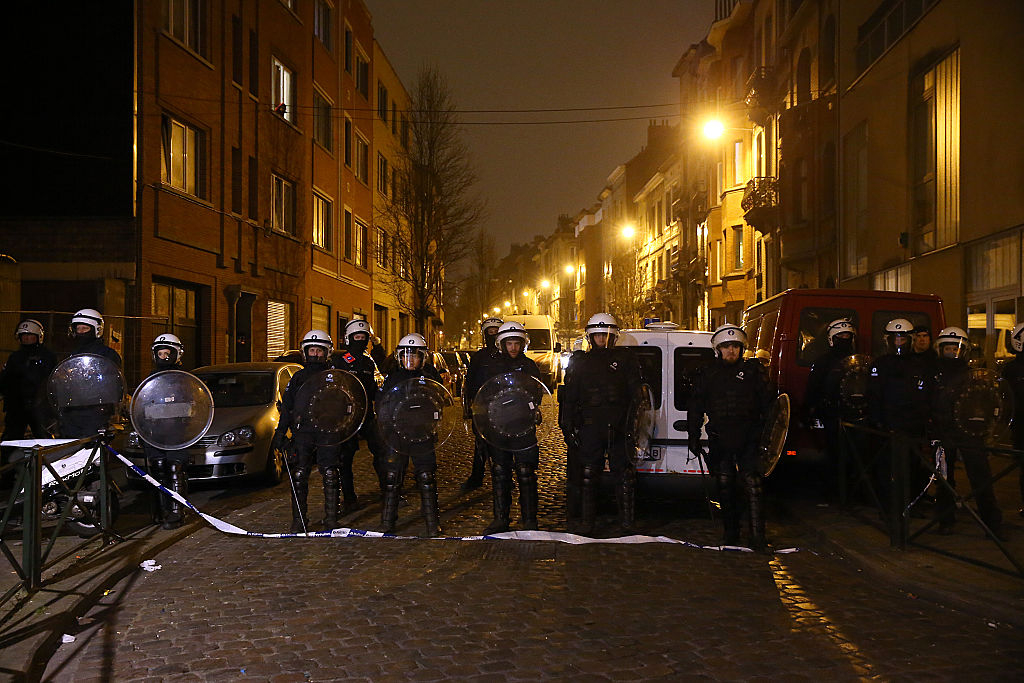
Riot police guard a road in the Molenbeek district of Brussels, after raids in which several people, including Salah Abdeslam, one of the perpetrators of the November 2015 Paris attacks, were arrested on March 18, 2016. (Photo by Carl Court/Getty Images)

While Lieven Verstraete, an acclaimed Belgian journalist who hosts the program, "De Zevende Dag" ("The Seventh Day"), was recently interviewing two members of the Green Party, he raised the issue of immigration and called Brussels "the perfect example of a city whose neighborhoods are conquered one by one by newcomers".

Newcomers? Conquered?

"How?" replied Nadia Naji, a politician of Molenbeek's Green party.

"Well," Verstraete, visibly uncomfortable, tried to explain, "more and more people with immigrant origins come to live there and claim their place. Do you feel Belgian in Molenbeek?"

A few hours after the broadcast, he apologized.

"In twenty years", the French newspaper Le Figaro predicted about Brussels, "the European capital will be Muslim".

"Almost a third of the population of Brussels already is Muslim", stated Olivier Servais, a sociologist at the University of Louvain. "Practitioners of Islam, due to their high birth rate, should be the majority 'in fifteen-twenty years'. Since 2001, Mohamed has been the most popular name among babies in Brussels".

Verstraete had told the truth -- but, as is said, in the time of universal deception, telling the truth is a revolutionary act.

"Molenbeek would love to be forgotten, because it is the very example of the failure of the multicultural society, which remains an untouchable dogma in Belgium", wrote Alain Destexhe, an honorary Senator in Belgium and former Secretary General of Doctors Without Borders. He was talking about the case of Conner Rousseau, president of Vooruit, the Flemish socialist party, who recently told Humo magazine, "When I drive around Molenbeek, I do not feel [as if I am] in Belgium".

"I no longer dare to walk hand in hand with a man in Molenbeek", Gilles Verstraeten, a gay parliamentarian, confessed.

"[I]n the Brussels region as a whole", Destexhe noted, "only a quarter of Belgians are of Belgian origin, 39 per cent of Belgians are of foreign origin and 35 per cent are foreigners."

"Molenbeek is in fact only the tip of the iceberg of the progressive Islamization in all the major Belgian cities. Islam is increasingly visible in the public space of Molenbeek, and in the month of Ramadan almost all the shops and restaurants in the city are closed during the day. In many neighborhoods, women are no longer able to dress however they want or go out at night, and homosexuals have no right of citizenship. There are, however, hardly any voices to worry about this development, as if French-speaking Belgium, anesthetized in unison by the multicultural media, had resigned itself".

It is true not just Brussels. Antwerp, the country's second-largest city, is now 25% Muslim. Another parliamentarian, Herman de Croo , revealed that 78% of Antwerp's children aged 1-6 are foreigners.

The former Brussels Secretary of State Bianca Debaets recently said, "there are too many areas where it is difficult for women and homosexuals to walk".

The Chief Rabbi of Brussels, Albert Guigui, was attacked by a group of Arabs. They insulted him, spat on him and kicked him. Since then, Guigui has not worn his skullcap in public.

No Jew lives in the Gare du Nord district anymore. "There are hardly any Jews left in this neighborhood," remarked Michel Laub, founder of the Museum of Deportation in Malines. "Yet this part of Schaerbeek near the Gare du Nord was once an important Jewish quarter."

For women, too, Brussels has become dangerous. "The Belgian political-media elites have surrendered in the face of the spread of Islamic fundamentalism", Fadila Maaroufi, a Belgian-Moroccan social worker and founder of the Observatory of Fundamentalisms in Brussels, told the French magazine Marianne.

"I grew up in a Moroccan family in a neighborhood near Molenbeek. In the 1980s, it was still quite cosmopolitan. Then, little by little, we saw the native Belgians leaving. I witnessed the rise of Islam, my sisters veiled while my parents wore flared pants. I myself have come under pressure, including from my family. It had become inconceivable that I did not veil myself .... When I tried to alert public authorities and associations, I found myself facing a wall. There have been attacks in Paris and attacks in Brussels, yet I had the feeling that we still did not grasp the extent of the problem".

In such an environment, freedom of expression also finds itself in dramatic retreat.

Belgian student associations protested the arrival in the capital of the publisher of satirical weekly newspaper Charlie Hebdo, "Riss", who survived a 2015 massacre in the paper's office.*

The Filigranes bookshop in Brussels, the largest in the country, canceled a meeting with the journalist Éric Zemmour for "security reasons".

Demonstrations against the author had been planned and a group, "Collective Against Islamophobia", had filed a complaint. The Hergé Museum took back deserted its tribute to Charlie Hebdo by censoring itself. An exhibition that had been planned was canceled "for security reasons".

"Today the Muslim Brotherhood, spearhead of political Islam and of the insidious soft Islamisation of Western societies, continues its lobbying and blame games with its imaginary Trojan horse: Islamophobia", wrote a Belgian MEP, Assita Kanko, who fled Burkina Faso to look for freedom in Europe. "The aim is clear: normalise radical Islamic codes and ways of life in order gradually to transform our Western societies instead of adapting to our European way of life. As a black woman and a secular Muslim, I know what it is to live under Islamic pressure and I know what it takes to emancipate oneself in order to finally live in dignity. The fight to preserve European civilisation is a fight to preserve humanism .... Two stones support the European temple: the Judeo-Christian heritage with the idea of human dignity and the Enlightenment, with the intellectual effervescence that accompanied it. It is from this subtle alchemy that European culture was born. European Judeo-Christian civilisation has created for itself over the centuries the conditions for its intellectual emancipation, and it can be proud of this .... Europe must urgently pull itself together and reaffirm its commitment to its own values...."

Destexhe, in his book "Immigration et Intégration: avant qu'il ne soit trop tard" ["Immigration and Integration: before it will be too late"] , recalled that from 2000 to 2010, Belgium welcomed more than a million migrants into a population of eleven million. It was a demographic tsunami that would forever change the face of Belgian society.

"Belgium was the first to recognize and subsidize Islam; it also elected the first veiled parliamentarian". Canadian journalist Djemal Benhabi told L'Echo, "Of all the European capitals, Brussels is the one through which the Islamist project intends to spread to Europe. Their lobbies are powerful there, so it is much easier for Islamists to break into the system and gradually transform it".

Journalist Marie-Cécile Royen also described the same collaboration in an article, "How the Muslim Brotherhood took Belgium hostage".

We recently saw what the "left's" alliance with Islam means in Brussels. Socialists and Greens just voted in the Brussels Parliament not to ban the ritual slaughter of animals. Le Monde called it the "community phenomenon": Brussels elects representatives who benefit from the support of one community or another in this highly multicultural region and are sometimes forced to abandon some of their convictions, or a facet of their identity, in order not to alienate voters.

Djemila Benhabib, in Le Point, noted that "in Brussels half of the Socialist electorate is Muslim." "[I]n Brussels now", she reported, "politics is in the hands of conservative Muslims".

As they say: It's the demography, stupid.

According to French demographer Michéle Tribalat, in the Brussels region (1.2 million inhabitants), 57% of those under 18 are of non-European origin; in the city of Brussels 68.4% of those under 18 are of non-European origin and in Antwerp (529,000 inhabitants), 51.3% of those under 18 are of non-European origin.

De-Christianization accompanies Islamization. 36 out of 110 churches in Brussels are destined to change their use in the face of the dramatic decline of the faithful. According to a Rtbf dossier, this is the plan of the archbishop of Brussels: "Homes, museums, hotels, climbing walls... What to do with our deconsecrated churches?"

Jean-Pierre Martin and Christophe Lamfalussy in their book "Molenbeek-sur-djihadr" disclosed that "in Molenbeek, in an area of ​​just six square kilometers, there are 25 mosques". What is that, if not Islamization?

Professor Felice Dassetto , in his book, "L'iris et le croissant", wrote that with more than 200 associations that explicitly refer to Islam, it, after football, is the most mobilizing organized reality in Brussels -- more than more than political parties, more than trade unions, more than the Catholic Church. "41 percent of public school students," noted Le Figaro, "take the Muslim religion course".

Welcome to the "European capital ... of the Muslim Brotherhood" -- and the Muslim Brotherhood know it. "Where will we be in 50 years?" the president of the Islamic Cultural Center of Belgium felt free to declare. "All of Europe - inshallah - will be Muslim. So, have children!".

The greatest form of cultural racism in Europe today is that of EU elites who censor or support this spectacular change of civilization.

Meanwhile, Islam has become a "taboo" in the European capital, Florence Bergeaud-Blackler, CNRS researcher and anthropologist, told L'Express. Certain districts of Brussels have become "a kind of sanctuary of Islam in Europe".

The answer is in Professor Felice Dassetto's book: in the mid-1970s there were only 6 mosques and Koranic schools in Brussels, in the early 1980s there were 38, now they are 80. And so, headlines Le Vif, "mosque projects are flourishing in Brussels".

How did we get here?

In the midst of the 1973 oil crisis, Belgium turned to look for supplies to Saudi Arabia. Muslims in Belgium were of the first generation: they worked in the mines and wanted spaces to pray. The Belgian king Baudouin, in exchange for oil contracts, offered the Saudis the Pavillon du Cinquantenaire in Brussels, along with a 99-year lease. The building stands two hundred meters from the Schuman Palace and the headquarters of the European Union. Saudi Arabia soon transformed it into the Grand Mosque of Brussels, which has since been the de facto Islamic authority of Belgium.

As Alain Chouet, the former "number two" of the DGSE, the French counterintelligence service, recounted in his newly published book "Sept pas vers l'enfer" ["Seven Steps toward Hell"], "in exchange, the Saudi king asked the Belgian king Baudouin to grant Arabia a monopoly on representing Islam and appointing imams in Belgium". The Belgian government officially recognized the Islamic religion. It was the first European country to do so. There followed the inclusion of the Islamic religion in the school curriculum.

"Eurabia" was born in those years, the years of an energy crisis, European weakness and the great rise of Islam. Sound familiar?

=========

*

Bruxelles : des étudiants boycottent la venue de Charlie Hebdo, journal “réactionnaire”

Deux associations d’étudiants se sont opposées à la venue du rédacteur en chef et de la DRH de l’hebdomadaire satirique qu’ils jugent “islamophobe” et “réactionnaire”. 

SIPA_AP21731131_000001
Image d'illustration © Lionel Cironneau/AP/SIPA

Ils ne sont plus « Charlie ». Ce jeudi 13 février au soir, l’Université Libre de Bruxelles organise un débat sur la liberté d’expression intitulé « Charlie Hebdo : cinq ans après, la liberté d’expression c’est fini ? ». Pour l’occasion le rédacteur en chef de l’hebdomadaire Gérard Biard et sa DRH Marika Bret sont invités, rapporte notamment le quotidien belge Sudinfo. Des intervenants que n’ont pas cautionné deux associations étudiantes de l’université. 

« Charlie Hebdo a rejoint les rangs des réactionnaires »

Ainsi, l’Union syndicale étudiante et le Cercle Féministe se sont opposés à la venue des deux représentants du journal satirique. Dans un communiqué commun, les deux associations dénoncent une invitation « qui permettra une fois de plus à la parole réactionnaire de se faire entendre sur notre campus », estimant que « Charlie Hebdo a rejoint depuis longtemps les rangs des réactionnaires de tout poil dans leur dénonciation des nouveaux censeurs ». Si cet adjectif ne colle pourtant pas vraiment à l’idéologie de Charlie Hebdo, c’est un édito de Riss que visent particulièrement les étudiants. Il y écrivait : « Hier, on disait merde à Dieu, à l’armée, à l’Eglise, à l’Etat. Aujourd’hui, il faut apprendre à dire merde aux associations tyranniques, aux minorités nombrilistes, aux blogueurs et blogueuses qui nous tapent sur les doigts comme des petits maîtres d’école ». Les récentes déclarations de Gérard Biart sont également ciblées, précise le quotidien Le Soir. Le rédacteur en chef a en effet dénoncé la « censure moderne » des « groupuscules refusant le débat » et exigeant « que l’on abandonne tout universalisme ».

Wednesday, July 18, 2018

Giulio Meotti : The Closing of the Cultural Mind?


  • In France, recently, a group of intellectuals published a manifesto asking the Islamic world to eliminate anti-Semitic verses from the Koran. The initiative followed the murder of an 85-year-old Holocaust survivor, Mireille Knoll.
  • The Turkish Council of Higher Education responded with a moratorium on establishing additional departments of French studies in Turkey.
  • There are no guarantees that curiosity, self-doubt and free speech will create a more liberal society. But closed-mindedness and censorship, in the Middle East, Europe or anywhere, are not likely to, either.
In the West, books and documentaries have been cancelled. In France, recently, a group of intellectuals published a manifesto asking the Islamic world to eliminate anti-Semitic verses from the Koran. The initiative followed the murder of an 85-year-old Holocaust survivor, Mireille Knoll. The Turkish Council of Higher Education responded with a moratorium on establishing additional departments of French studies in Turkey. For years, under the presidency of Recep Tayyip Erdogan, Turkish culture has been closing in on itself. "Going into a Turkish bookstore is like walking into a psychiatric ward," according to the British journalist Gareth Jenkins in The New Yorker. Turkey sentenced journalists and writers to prison, and put publishers of foreign novels, such as its most famous translator, Necmiye Alpay, on trial. The problem, however, may not be just Turkish, but, as the author Robert R. Reilly called it, "the closing of the Muslim mind".

A new report for the Atlantic Council written by Hossam Abouzahr, the founder of the Living Arabic Project, details the dramatic cultural change in the Arab world:
"The Arab world is now publishing only between 15,000 and 18,000 books annually, as many as Penguin Random House produces on its own. Egypt was once the largest producer of books with an output between 7,000 and 9,000 per year. Although its output was previously on the rise, it dropped by a whopping 70 percent after the 2011 revolution, and as of 2016 was only 'showing signs of recovery'. Greece translates five times as many books into Greek as all 22 Arab nations combined".
According to a report given at the Frankfurt Book Fair, "the Arab world, with its population of over 362 million people in 2012" produced about the same "number of books produced in countries like Romania (with a population of 21.3 million in 2012) and Ukraine (population 45.6 million) in 2012".  

Another report by the RAND center also notes that "the number of public libraries in Egypt is about a tenth of those in Germany, which has a comparable population". The Economist noted that Arab publishing industry is in "troubled".
Many great writers in Islam are now foreigners at home. 
Salman Rushdie, targeted by an Iranian fatwa, has become "the disappeared". At the age of 82, Naguib Mahfouz, the only Egyptian Nobel Laureate for Literature, was stabbed nearly to death by an Islamist. 
The Syrian poet Adonis exiled himself to Paris. 
The most celebrated Algerian writers, such as Kamel Daoud and Boualem Sansal, are treated as pariahs and threatened.  
Orhan Pamuk, the greatest Turkish writer, was also persecuted. 
The Lebanese Nobel laureate Amin Maalouf lives in France. 
And many writers in Bangladesh have been hacked to death. 
Iran is experiencing a devastating "brain drain" to the West. 
And images of book-burnings have become sadly popular in the Muslim world, from the historic books burned at the Cairo Institute to ISIS's destruction at the Mosul library.

At the age of 82, Naguib Mahfouz, the only Egyptian Nobel Laureate for Literature, was stabbed nearly to death by an Islamist. (Image source: Alaraby/Wikimedia Commons)

Unfortunately, Islam's cultural changes -- as attested to by the lack of producing books and translations -- may have severe consequences for the radicalization of the new generations. There are no guarantees that curiosity, self-doubt and freedom of speech will create a more liberal society. But closed-mindedness and censorship, in the Middle East, Europe or anywhere, are not likely to, either.
There is an Arabic saying: "Books are written in Cairo, printed in Beirut and read in Baghdad". Is this same cultural malaise being adopted by the West?
Giulio Meotti, Cultural Editor for Il Foglio, is an Italian journalist and author.

Majid Rafizadeh : My School's Imam: "We Love Western Anti-West Theories"


  • The purpose of brainwashing their students with inciting anger and hatred clearly seems to be to instill in them the notion that they are being victimized by the West.
  • Some members of the so-called "victim" community, such as Islamist leaders, take advantage of this victimhood status. They use it as a shield and then become the victimizers by crushing people in their own countries.
  • Such ideas and values prevent ordinary people and scholars from focusing on the crimes against humanity that Islamist leaders of state and non-state entities commit.
  • The accommodation of Muslim extremists by leaders in the West not only helps them recruit more people to target Westerners, incite anti-Western, anti-Christian, and anti-Semitic sentiments, but more importantly, it tramples the millions of ordinary Muslims who seek to promote in their homelands values such as the institutions of democracy, freedom of speech, separation of religion and state, the independence of education and the judiciary, and equal justice under the law.
In my high school in Syria, which was directed by the Iranian regime through its embassy staff in Damascus (Iran has several schools in Syria and sends teachers and imams there), every student was forced to attend daily prayer at noon. We were commanded to stand behind an extremist clergyman, mimic his actions, and recite the prayer. After the prayer, we had no choice but to listen to the preaching of a fundamentalist imam who was most likely employed by the regime to advance their ideological and political interests.
Some of the words preached by this radical cleric stuck with me, especially his sharp focus on how to capitalize on some, but not all, theories that originated in the West. We could utilize these theories, he said, to advance Islamist values. 

For example, one of the concepts, he was adamant that we learn about was "Orientalism", is a concept developed by Edward Said, a Palestinian-American who was born in 1935 in Palestine, when it was still under the British mandate.

The theory focuses on the notion that there is a fundamental flaw in the Western world, because it views the East, specifically the Muslim world and the Middle East, through a prism of superiority.

In a short time, this concept gained significant popularity in the Western academic world, and consequently it infiltrated the media and political landscapes. Inevitably it shaped and influenced public thought.

But why would an Islamist leader applaud such ideas? Why are they teaching them extensively in their madrassas, schools and universities? From the perspective of radical Muslims, such ideas automatically create two categories: the "victims", "innocents", "oppressed" and "martyrs" versus the "oppressor" or "tyrant". In other words, the whole Muslim world is given the status of victimhood, while all Westerners are supposedly tyrants.

The purpose of brainwashing their students with inciting anger and hatred clearly seems to be to instill in them the notion that they are being victimized by the West.

This is probably one of the reasons that the well-known historian Bernard Lewis, characterized the thesis of Orientalism as anti-Western -- or, as my school's imam put it, "We Love Western Anti-West Theories".

Unfortunately, such teachings help the radical Muslims and Islamist rulers to exploit an already tense situation, and to justify their terrorist attacks against the West as acts of heroism instead of atrocities.

In addition, such simplistic views that portray every Muslim as a victim harm Westerners by preventing them from acquiring the truth about the complexities and intricacies of the Muslim world.

Even more fundamentally, these views inflict incalculable harm on the lives of the ordinary people in the Muslim world, who call it: Opposite Orientalism.
Put simply, some members of the so-called "victim" community, such as the Islamist leaders, take advantage of this victimhood status. They use it as a shield and then become the victimizers by crushing people in their own countries.

Using this status as their reason to act in violent and controlling ways, they suppress domestic oppositions and Muslim dissidents who might not agree with them.

What helps these Islamist leaders even more is another idea that began in Western academic circles, and then infiltrated the media and political spectrum. If you oppose the idea of Orientalism -- meaning if you criticize any member of the Muslim world or stand with the West for any reason -- then you will be regarded by them as "uneducated", "racist", unsophisticated, or even an imperialist. If, on the other hand, you would like to be viewed by your fellow academics and self-righteous media pundits as "educated" and be respected in the mainstream social, academic and political arenas, you must refrain from criticizing the Muslim world, and instead ratchet up your criticism against the West.

Such ideas and values prevent ordinary people and scholars from focusing on the crimes against humanity that Islamist leaders of state and non-state entities commit. Take a look at the grinding human rights violations that the Islamist state of Iran commits against its own people. The ruling mullahs of Iran have been given immunity by the international community and their unspeakable violence and lawlessness has received little attention.

While enjoying the status of victimhood, Iran's mullahs have massacred nearly 30,000 political prisoners, and yet the International Criminal Court in Hague as well as other powerful international organizations have not yet investigated the cases properly. The Islamic Republic of Iran holds the world record in executing people per capita. It is also, according to Amnesty International, a leading executioner of children.

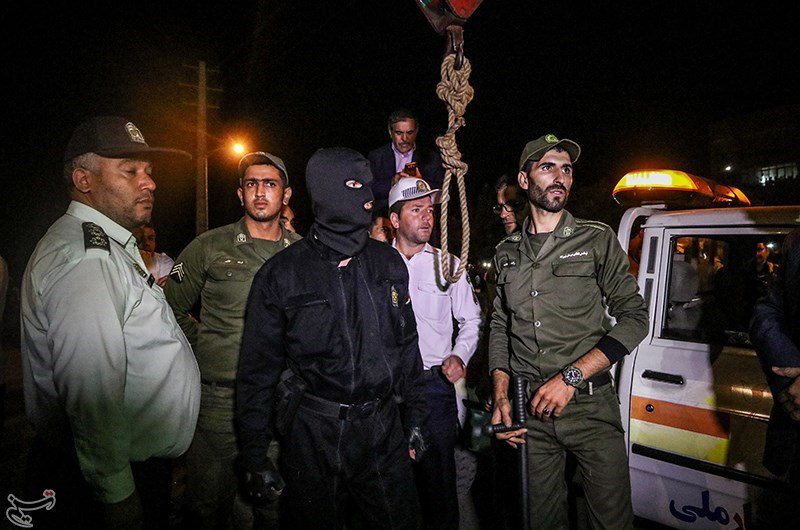
Pictured: Preparations for a public hanging in Iran, September 20, 2017. (Image source: Tasnim/Wikimedia Commons)

Theories and concepts that promote ideas such as the entire Muslim world being victims, and that "educated" people should refrain from criticizing extremist Muslims and radical Islam -- and that "intelligent" people should only blame the West for the problems in the world -- are not just simplistic; they are dangerous. They provide a platform for extremist Muslim leaders, terrorist groups, and Islamist regimes to prove to their followers that they are correct in pursuing their fundamentalist agenda.

This accommodation of extremist Muslims by leaders in the West not only helps them recruit more people to target Westerners, and incite anti-Western, anti-Christian, and anti-Semitic sentiments, but more importantly, it tramples the millions of ordinary Muslims who seek to promote in their homelands values such as the institutions of democracy, freedom of speech, separation of religion and state, the independence of education and the judiciary, and equal justice under the law.
Dr. Majid Rafizadeh, is a business strategic and advisor, Harvard-educated scholar, political scientist, board member of Harvard International Review, and president of the International American Council on the Middle East. He has authored several books on Islam and US Foreign Policy. He can be reached at Dr.Rafizadeh@Post.Harvard.Edu
  • Follow Majid Rafizadeh on Twitter

Judith Bergman : Switzerland Welcomes Radicalization


  • There are approximately 250 mosques in Switzerland, but the authorities do not know who finances them. By rejecting the proposal compelling mosques to disclose who finances them, the Swiss authorities can now remain willfully blind.
  • The Muslim World League is behind "a whole network of radically-oriented mosques in Switzerland... with the clear intention of spreading Salafist thought here". — Saïda Keller-Messahli, expert on Islam in Switzerland.
  • Above all, the Swiss government seems not to have considered the rights of Swiss non-Muslim citizens, who are the ones left to live with the consequences of the government's ill-thought-out policies.
Switzerland has just rejected a proposed law preventing mosques from accepting money from abroad, and compelling them to declare where their financial backing comes from and for what purpose the money will be used. According to the proposal, imams also would have been obliged to preach in one of the Swiss national languages.
While the proposal narrowly passed in the lower house of parliament already in September 2017, the upper house recently rejected it. The proposal was modeled on regulations in Austria, where already in 2015, a law banning foreign funding of religious groups was passed. The Austrian law aims to counter extremism by requiring imams to speak German, prohibiting foreign funding for mosques, imams and Muslim organizations in Austria, and stressing the precedence of Austrian law over Islamic sharia law for Muslims living in the country.
The Federal Council, which constitutes the federal government of Switzerland, was also against the proposal, and claimed that it constituted 'discrimination': 
"We must not discriminate against Muslim communities and imams and put them under general suspicion," Justice Minister Simonetta Sommaruga said. The Federal Council noted that in Austria, Islam is officially recognized, whereas it is not in Switzerland. According to the Swiss government, therefore, the model applied in Austria does not apply to Switzerland, as "One cannot demand obligations without rights". Instead, the Federal Council evidently believes that the risks posed by extremist Islamist preachers and communities can be combated within existing law.

There are approximately 250 mosques in Switzerland, but the authorities do not know who finances them. The authorities have no jurisdiction to collect data on the financing of Muslim associations and mosques apart from exceptional cases in which internal security is threatened. By rejecting the proposal compelling mosques to disclose who finances them, the Swiss authorities can now remain willfully blind.

Several experts have pointed out the foreign Muslim networks at work in Switzerland. In 2016, Reinhard Schulze, professor of Islamic Studies at the University of Bern, pointed out that donations from the Muslim World League, based in Saudi Arabia, and other funds from Saudi Arabia were flowing to "those mosques and organizations that are open to the Wahhabi tradition". Another expert on Islam in Switzerland, Saïda Keller-Messahli, has spoken and written widely on how "Huge sums of money from Saudi Arabia, the United Arab Emirates, Qatar, Kuwait and Turkey are flowing to Switzerland", and how the Saudi-based Muslim World League is behind "a whole network of radically-oriented mosques in Switzerland... with the clear intention of spreading Salafist thought here".

In addition to the Salafist influence, there are an estimated 35 Turkish mosques, financed by Turkey's official Religious Affairs Directorate, known as Diyanet. (Previous reports have mentioned 70 Turkish mosques in Switzerland).
According to a report published by Diyanet in 2017, Islam is "superior" to Christianity and Judaism and "Interfaith dialogue is unacceptable". Turkey supports the Muslim Brotherhood and its terrorist off-shoot Hamas.
In fact, the building of another Turkish mosque was just given the go-ahead in the Swiss town Schaffhausen. The people behind it reportedly claim that the 1.5 million Swiss francs (approx. $1.5 million) will be collected locally, and not from Turkey, but the imams for the mosque will nevertheless be sent from Turkey.
None of these facts, however, appears to bother the Swiss government, which seems to want to continue the flow of foreign funding of mosques and Islamic centers into the country.

Above all, the Swiss government seems not to have considered the rights of Swiss non-Muslim citizens, who are the ones left to live with the consequences of the government's ill-thought-out policies.
One such consequence was recently on display in Swiss courts, as three board members of the Islamic Central Council of Switzerland (ISSC) were on trial for charges of having produced illegal propaganda for al-Qaeda and related organizations. One of them, Naim Cherni, was given a suspended prison sentence of 20 months for publishing an interview he conducted with Saudi cleric Abdullah al-Muhaysini in Syria in 2015, in which al-Muhaysini called on young Muslims in Europe to join the jihad. The two other board members, chairman Nicolas Blancho and Qaasim Illi, were acquitted.
In contrast to Switzerland, Austria recently announced plans to shut down seven mosques and expelling up to 60 imams belonging to the Turkish-Islamic Union for Cultural and Social Cooperation in Austria (ATIB), a Muslim group close to the Turkish government, on the grounds of receiving foreign funding.
The response from Turkish President Recep Tayyip Erdogan's spokesman was that the policy was part of an "Islamophobic, racist and discriminatory wave" in Austria.
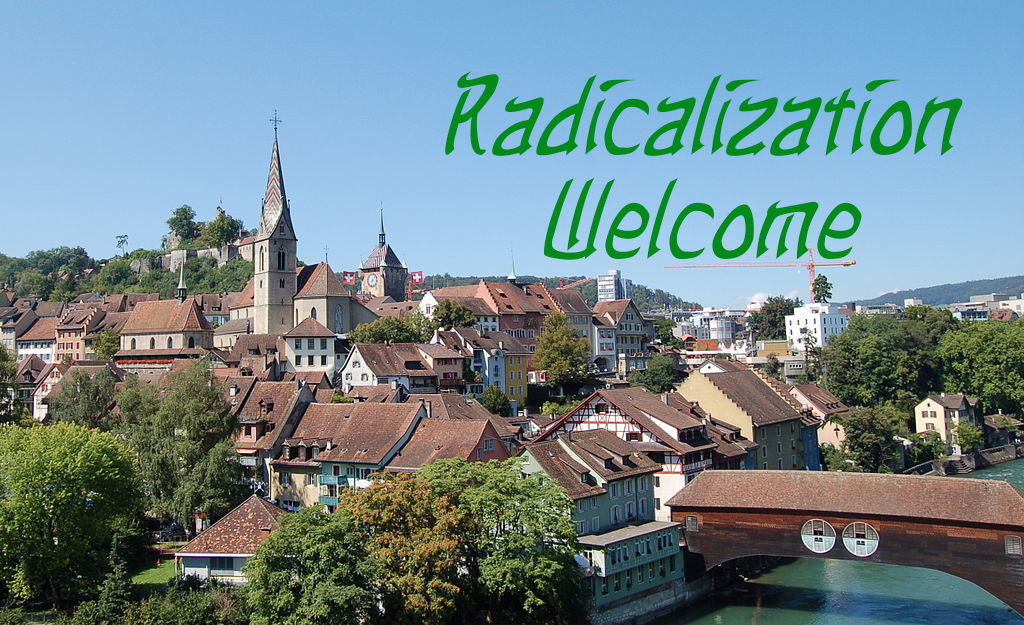
The strong message that the Swiss government is sending to those Muslim states and organizations that are fueling radicalization in Switzerland by funding Salafist, Turkish and other radical mosques, is that they are welcome to continue doing so; the Swiss government has no intention of stopping them, let alone asking any unpleasant questions. It might as well put up a sign, saying, "Radicalization Welcome".

(Switzerland photo by Monk/Wikimedia Commons)
Judith Bergman is a columnist, lawyer and political analyst.

Judith Bergman : Canada Supports, Infantilizes Jihadis


  • The Canadian government is willing to go to great (and presumably costly) lengths to "facilitate" the return of Canadian jihadists, unlike the UK, for example, which has revoked the citizenship of ISIS fighters so they cannot return.
  • Attempts at deradicalization elsewhere have frequently turned out to be ineffective. In the UK, for example, a new government report shows that the vast majority of deradicalization programs are not only ineffective, but even counterproductive, and that those tasked with executing the programs "...would refuse to engage in topics over fears of bringing up matters of race and religion without appearing discriminatory"
  • In France, the country's first and only deradicalization center closed in September 2017 after just one year, without having "deradicalized" a single individual. On the contrary, three participants reportedly behaved as if the center were a "Jihad academy".
Canadians who go abroad to commit terrorism – predominantly jihadists, in other words – have a "right to return" according to government documents obtained by Global News. They not only have a right of return, but "... even if a Canadian engaged in terrorist activity abroad, the government must facilitate their return to Canada," as one document says.
According to the government, there are still around 190 Canadian citizens volunteering as terrorists abroad. The majority are in Syria and Iraq, and 60 have returned. Police are reportedly expecting a new influx of returnees over the next couple of months.
The Canadian government is willing to go to great (and presumably costly) lengths to "facilitate" the return of Canadian jihadists, unlike the UK, for example, which has revoked the citizenship of ISIS fighters so they cannot return. The Canadian government has established a taskforce, the High Risk Returnee Interdepartmental Taskforce, that, according to government documents:
"... allows us to collectively identify what measures can mitigate the threat these individuals may pose during their return to Canada. This could include sending officers overseas to collect evidence before they depart, or their detention by police upon arrival in Canada."
Undercover officers may also be used "to engage with the HRT [High Risk Traveler] to collect evidence, or monitor them during their flight home."
In the sanitizing Orwellian newspeak employed by the Canadian government, the terrorists are not jihadis who left Canada to commit the most heinous crimes, such as torture, rape and murder, while fighting for ISIS in Syria and Iraq, but "High Risk Travelers" and "High Risk Returnees".
The government is fully aware of the security risk to which it is subjecting Canadians: According to the documents, "HRRs [High Risk Returnees] can pose a significant threat to the national security of Canada". This fact raises the question of why the government of Canada is keen to facilitate these people's "right of return" -- when presumably the primary obligation of the government is to safeguard the security of law-abiding Canadian citizens.
The government also does not appear hopeful that the returning terrorists will face criminal charges. By the end of 2017, the Trudeau government had only charged two returned ISIS fighters, and Public Safety Minister Ralph Goodale said at the time, "This is an issue that is bedeviling countries around the world in terms of how you actually... move from intelligence to evidence and make a case stick".
The documents describe terrorism cases as "complex and resource intensive," citing the difficulties of terrorism investigations and caution that "there may not be sufficient evidence for charges", and that, therefore, the government will have to "mitigate the threat through efforts outside the criminal justice system."
Such efforts might include sending an "intervention team" that can "engage with the returnee and the returnee's family to open up dialogue with the individual and to help support the returnee's disengagement from their radical ideology and past behavior... While they may have engaged in terrorism abroad and broken the law, not all returnees continue to post [sic] a threat — they may now be disillusioned with the cause" or "...may no longer be interested in violence."
How comforting for Canadians that their government is pandering to terrorists while pretending that there is a chance that returning jihadis will suddenly change their ways.
Attempts at deradicalization elsewhere have frequently turned out to be ineffective. In the UK, for example, a new government report shows that the vast majority of deradicalization programs are not only ineffective, but even counterproductive, and that those tasked with executing the programs "...would refuse to engage in topics over fears of bringing up matters of race and religion without appearing discriminatory". In France, the country's first and only deradicalization center closed in September 2017 after just one year, without having "deradicalized" a single individual. On the contrary, three participants reportedly behaved as if the center were a "Jihad academy".
The Canadian government is willing to go to great lengths to "facilitate" the return of Canadian jihadists. But attempts at deradicalization in Western countries have frequently turned out to be ineffective. In France, the country's first and only deradicalization center (pictured) closed in September 2017 without having "deradicalized" a single individual. (Image source: 28 minutes - ARTE video screenshot)
Some members of the Canadian government are evidently aware of the near-futility of such deradicalization efforts. In November 2017, Public Safety Minister Ralph Goodale said "You have to prevent the problem before it exists. Once a person has been in a war zone, once they've been actively engaged in terrorist-related activities, the capacity to turn them around is pretty remote."
These facts, however, are unlikely to bother Prime Minister Justin Trudeau, who appears to compare returning ISIS fighters to Italian and Greek immigrants who settled in Montreal in the post war years. Trudeau has said, "We know that actually someone who has engaged and turned away from ... hateful ideology can be an extraordinarily powerful voice for preventing radicalization" -- but he appears to disregard the evidence that few actually turn away from jihadism.
Perhaps the Trudeau government simply cares more for jihadists and Islamists than for Canada. In early May, the Toronto Sun revealed that the Muslim Association of Canada (MAC), which has ties to terrorist organizations, would receive 10 grants from the government's Canada Summer Jobs Grant[1] to fund its activities across Ontario.
According to the Toronto Sun, "MAC provided $296,514 between 2001 and 2010" to IRFAN-Canada. Within that period, from 2005 and 2009, "IRFAN-Canada transferred approximately $14.6 million worth of resources to various organizations associated with Hamas". Both MAC and IRFAN-Canada are considered linked to the Muslim Brotherhood. In 2014, Canada's government under Prime Minister Stephen Harper designated IRFAN-Canada a terrorist entity.
Prime Minister Justin Trudeau's government is facilitating the return of ISIS terrorists and granting government funds to Islamist organizations who end up funding banned terrorist groups. So, whose interests is the Canadian government really looking out for?
Judith Bergman is a columnist, lawyer and political analyst.

[1] Canada Summer Jobs (CSJ), according to the government website, provides wage subsidies to employers to create employment for secondary and post-secondary students. It welcomes applications from small businesses, not-for-profit employers, public sector and faith-based organizations that provide quality summer jobs for students.

Judith Bergman : Europe: "The Vision is an Islamic State"

  • "The growing religiousness is not an expression of marginalization. We are talking about people who are well-integrated, but who want to be religious". — Professor Viggo Mortensen.
  • "The vision is an Islamic state -- Islamic society... Muslims will prefer sharia rule. But the vision for twenty years from now is for sharia law to be part of Germany, that sharia will be institutionalized in the state itself". — "Yusuf", in a documentary series, False Identity.
  • "I will pick them one by one -- I will start with people around me... If every Muslim would do the same in his surroundings, it can happen with no problem... you don't confront him [the German] with force; you do it slowly... There will be clashes, but slowly the clashes will subside, as people will accept reality." — "Yusuf", in a documentary series, False Identity.
  • Europe will still exist but, as with the great Christian Byzantine Empire that is now Turkey, will it still embody Judeo-Christian civilization?
A Dutch government report published in June showed that Muslims in the Netherlands are becoming more religious. The report, based on information from 2006-2015, is a study of more than 7,249 Dutch nationals with Moroccan and Turkish roots. Two thirds of the Muslims in the Netherlands are from Turkey or Morocco.
According to the report, 78% of Moroccan Muslims pray five times a day, as do 33% of Turkish Muslims. Approximately 40% of both groups visit a mosque at least once a week. More young Moroccan women wear a headscarf (up from 64% in 2006 to 78% in 2015) and large majorities of both groups eat halal (93% of Moroccan Muslims and 80% of Turkish Muslims). 96% of Moroccan Muslims say that faith is a very important part of their lives, whereas the number is 89% for Turkish Muslims. The number of Dutch Moroccan Muslims who can be described as strictly adhering to Islam has increased from 77% in 2006, to 84% in 2015. For Turkish Muslims, the numbers have increased from 37% to 45%. There are few secular Muslims -- 7% among Turkish Muslims, 2% among Moroccan Muslims.

In Denmark, the trend of Muslims becoming more religious was apparent as early as 2004, when a poll showed that Muslims were becoming more religious than their parents, especially "young, well-educated and well-integrated women". At the time, Professor Viggo Mortensen said, "The growing religiousness is not an expression of marginalization. We are talking about people who are well-integrated, but who want to be religious".

A more detailed Danish poll from 2015 showed that Muslims had become more religious since a similar poll taken in 2006: In 2006, 37% prayed five times a day, whereas the number had gone up to 50% in 2015. In 2006, 63% believed that the Koran should be followed to the letter; in 2015, it was 77%. 

Brian Arly Jacobsen, a sociologist of religion from the University of Copenhagen, was surprised by the results. "With time we would expect [that Muslims] would become more like the rest of the Danes, who are not particularly active in the religious sphere," he said. Jacobsen thought that a possible explanation might have been the 20-30 new mosques that were built in the decade preceding 2015.

The trends expressed by these polls are corroborated by studies and polls showing that many Muslims in Europe want to live under sharia law. According to a 2014 study of Moroccan and Turkish Muslims in Germany, France, the Netherlands, Belgium, Austria and Sweden, an average of almost 60% of the Muslims polled agreed that Muslims should return to the roots of Islam. 75% thought there is only one interpretation of the Koran possible, and 65% said that Sharia is more important to them than the laws of the country in which they live. A 2016 UK poll showed that 43% of British Muslims "believed that parts of the Islamic legal system should replace British law while only 22 per cent opposed the idea". In a 2017 study, which included a poll of 400 Belgian Muslims, 29% said they believe the laws of Islam to be superior to Belgian law, and 34% said they "would definitely prefer a political system inspired by the Quran".


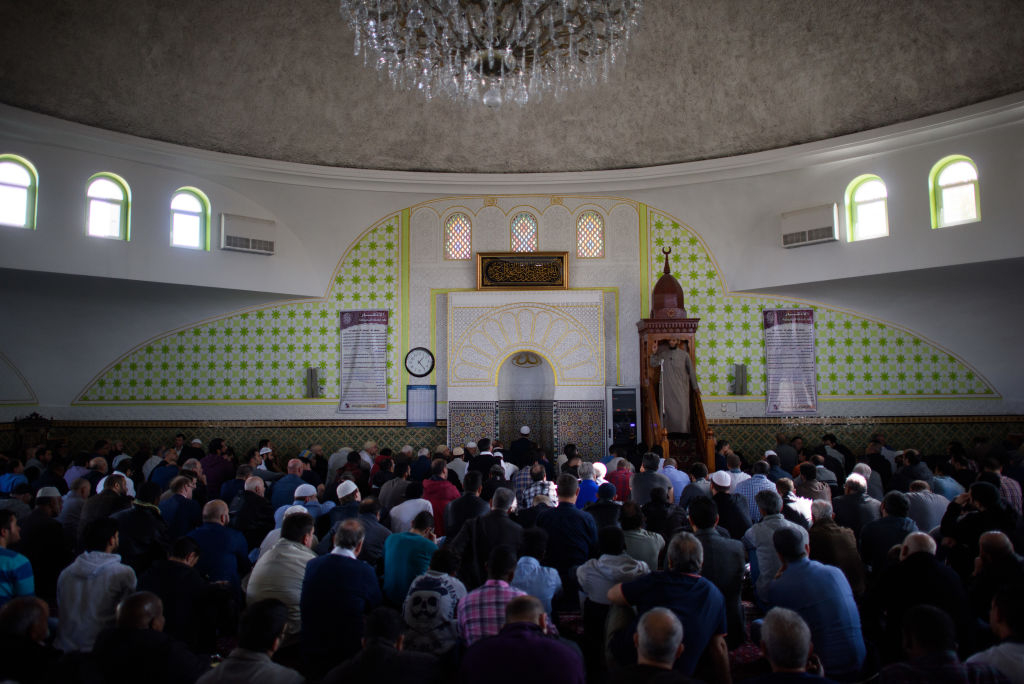
According to a 2014 study of Moroccan and Turkish Muslims in Germany, France, the Netherlands, Belgium, Austria and Sweden, an average of almost 60% of the Muslims polled agreed that Muslims should return to the roots of Islam, and 65% said that Sharia is more important to them than the laws of the country in which they live. Pictured: Friday prayers at the IZW Mosque in Vienna, Austria. (Photo by Thomas Kronsteiner/Getty Images)

The more than two million predominantly Muslim migrants that have arrived in Europe in recent years are only reinforcing the trend of growing Muslim religiosity on the continent. A 2017 study of predominantly Afghan asylum seekers in the Austrian city of Graz showed that the asylum seekers, mostly men under the age of 30, were all in favor of preserving their traditional Islamic values with 70% going to the mosque every Friday for prayers. The women were even more religious, with 62.6% praying five times a day, notably more than the men (39.7%). In addition, 66.3% of the women wore a headscarf in public. Half of the migrants said that religion now plays a larger role in their daily lives in Europe than it did in their native country, and 51.6% of the interviewees said that the supremacy of Islam over other religions was undisputed.

The tendency of many Muslims to become more religious once they arrived in Europe was also on display in a new documentary series, "False Identity," by Arabic-speaking journalist Zvi Yehezkeli, who went undercover to report on the activities of the Muslim Brotherhood in Europe and the US. In Germany, he encountered two young Muslims from Syria, who came to Germany via Kosovo, where they received help from a "British Islamic organization". They had left Syria as secular Muslims, but on the way to Germany they lived for a year in Pristina, Kosovo, where, according to Yehezkeli, "Muslim Brotherhood organizations are active in helping refugees while turning them into devout Muslims. Ahmed and Yusuf arrived [in Germany] already praying five times a day".[1]
According to Ahmed:
"When I left Syria, mentally I felt more relaxed. The Islamic charity organization played an important role in this. Look, the first time you meet them they start helping you. You sit, you stare at them, they pray in front of you and here I am a Muslim, studied the Quran, yet don't pray. Suddenly I find myself alone asking, Why shouldn't I pray like all others?"
Yehezkeli asked them what their dream is. "The vision is an Islamic state -- Islamic society," said Yusuf, "Muslims will prefer sharia rule. But the vision for twenty years from now is for sharia law to be part of Germany, that sharia will be institutionalized in the state itself".

In contrast to the growing religiousness of Muslims in Europe, Christians are becoming less religious. In a study of young Europeans, aged 16-29, published in March and based on 2014-2016 data, the author, Stephen Bullivant, a professor of theology and the sociology of religion at St Mary's University in London, concluded:
"With some notable exceptions, young adults increasingly are not identifying with or practicing religion... Christianity as a default, as a norm, is gone, and probably gone for good -- or at least for the next 100 years".
According to the study, between 70% and 80% of young adults in Estonia, Sweden and the Netherlands categorize themselves as non-religious. Between 64% and 70% of young adults consider themselves non-religious in France, Belgium, Hungary and the UK. The most religious youths were to be found in Poland, where only 17% of young adults defined themselves as non-religious, followed by Lithuania with 25%.

Young Muslims like Yusuf and Ahmed from Syria say they want to spread Islam by converting Europeans, also known as dawa. They are themselves perfect examples of having been at the receiving end of dawa -- becoming devout Muslims through the Islamic organization in Kosovo and now engaging in dawa themselves. "I will pick them one by one -- I will start with people around me. They will listen. If every Muslim would do the same in his surroundings, it can happen with no problem," said Yusuf. Asked if the Germans might resist dawa, he said:
"You don't confront him [the German] with force, you do it slowly... There will be clashes, but slowly the clashes will subside, as people will accept reality. There is no escape; every change involves clashes".
Given young Europeans' lack of a religious identity and the vacuum left by the departure of Christianity from the lives of the majority, one has to wonder how sturdy their ability will be to withstand such attempts at proselytizing. Europe will still exist but, as with the great Christian Byzantine Empire that is now Turkey, will it still embody Judeo-Christian civilization?
Judith Bergman is a columnist, lawyer and political analyst.

[1] The quote begins at 21:24 in the documentary. The statements by Yusuf and Ahmed follow immediately after.

A. Z. Mohamed : Blasphemy Laws in Pakistan


  • Many extremist Muslims are aiming at even more government submission to sharia through intimidation and terror.
  • Christians and Ahmadis continue to raise concerns regarding the government's failure to safeguard minority rights, as well as the government's persistent discrimination against religious minorities.
  • Pakistan is also where Muslim militants, such as the Pakistani Taliban, carry out assassinations and terrorist attacks. It seems no one is there to stop them.
On May 6, Ahsan Iqbal, Pakistan's Minister of the Interior, was shot during a rally in his own constituency, in the province of Punjab. Fortunately, he survived the attack, but the bullet in his abdomen could not be removed. "The bullet lodged in my body... will keep reminding me of the impending need to remove the seeds of hatred sowed in the country," Iqbal said.
An initial report suggested that the main suspect, Abid Hussain, 21, had carefully planned the attack; recently, Pakistan's Anti-Terrorism Court issued an 8-day judicial remand of four possible accomplices.

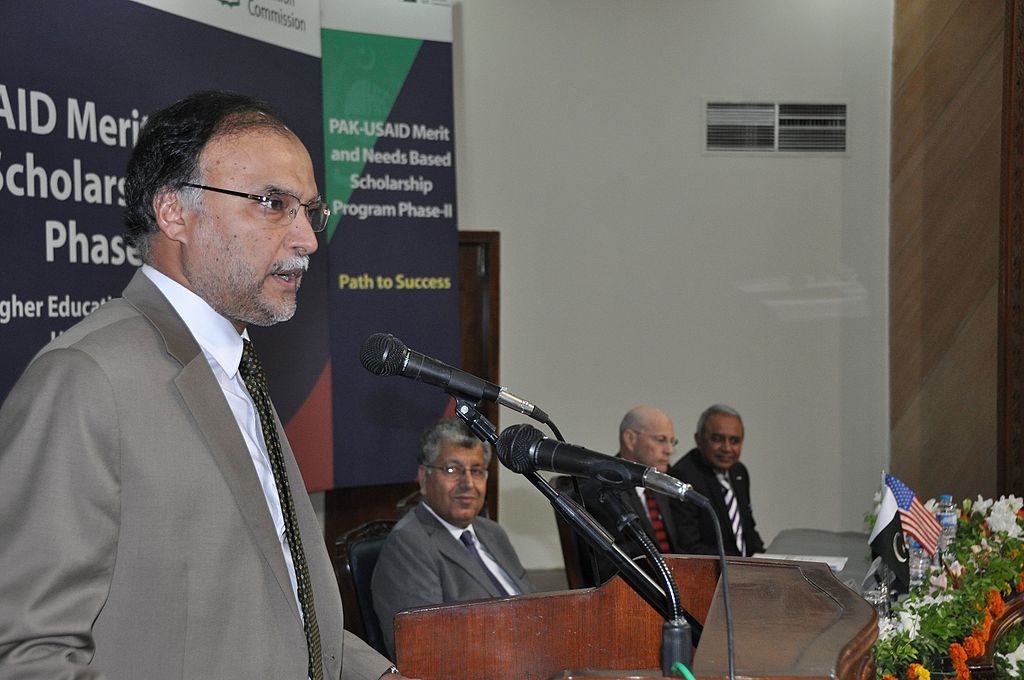
On May 6, Pakistan's Minister of the Interior, Ahsan Iqbal (pictured at left), was shot and wounded by an Islamist extremist during a rally in Punjab. (Image source: USAID Pakistan/Wikimedia Commons)

According to other reports, Hussain is linked to Tehreek-e-Labbaik Pakistan (TLP) -- also known as Tehreek-e-Labbaik Ya Rasool Allah ("Movement of the Prophet's Followers"). TLP is a new Sunni extremist party known for aggressively calling for enforcing Pakistan's blasphemy laws, which can carry the death penalty, and for opposing any relaxation of these laws.
Many fear that this assault is not an isolated incident and that other members of the cabinet are on the TLP's hit list. This apprehension, however, does not mean that the government is against sharia or blasphemy laws, or is even thinking of reforming them. Many extremist Muslims are aiming at even more government submission to sharia through intimidation and terror.
Extremist Muslims in Pakistan have been successful in achieving their objectives. according to the U.S. Department of State's 2017 Report on International Religious Freedom:
"The [Pakistani] courts continued to enforce blasphemy laws, the punishment for which ranges from life in prison to the death sentence for a range of charges, including 'defiling the Prophet Muhammad.'"
According to reports from civil society organizations, in 2017, there were at least 50 individuals imprisoned on blasphemy charges, at least 17 of whom had received death sentences, In addition, the report added, the police registered at least 17 new cases under the blasphemy laws against still other individuals.
Pakistan's TLP party activism is just one example of how extremist Muslims and official complicity combine to perpetuate sharia and blasphemy laws. TLP itself was apparently inspired by a "blasphemy killer." The party "was born out of a protest movement supporting Mumtaz Qadri, a bodyguard of the governor of Punjab who gunned down his boss in 2011 over his call to relax Pakistan's draconian blasphemy laws," Reuters reported.
In October 2017, Pakistan's president, Mamnoon Hussain, signed into law a bill that changed an electoral oath which affirmed the belief that the Prophet Muhammed is the final prophet of Islam to a "declaration" and abolished separate voter lists for Ahmadi Muslims, whom many Muslims consider non-Muslim, as Ahmadis regard Mirza Ghulam Ahmad (1835-1908) as their Mahdi (Messiah). In 1974, a constitutional amendment introduced by the prime minister at the time, Zulfikar Ali Bhutto, had declared the Ahmadiyya community a non-Muslim minority; and in 1984, President Zia-ul Haq issued Ordinance XX which makes it a criminal offense for Ahmadis to call themselves Muslims, and to practice or propagate their faith.
In any event, the law sparked weeks of protests, led by Tehreek-e-Labbaik Pakistan members, against the government. The TLP accused then-Minister for Law and Justice, Zahid Hamid, of blasphemy and demanded his resignation. The government succumbed to pressure by extremist Muslims, and attributed the change in the oath to "clerical error." Parliament reversed the provisions; Hamid was forced to resign and the government gave assurances that Asia Bibi, a Christian mother of five with a highly questionable blasphemy conviction, would not be sent abroad. Notably, Qadri had apparently also murdered governor Salman Taseer for speaking against a death sentence on Asia Bibi.
More appalling is what the U.S. Department of State report said: that government officials -- under pressure from the extremist Muslims' protests of October 2017 -- and probably to deny any support to Ahmadis -- had engaged in anti-Ahmadi rhetoric and attended events that Ahmadis said incited violence against members of their community. The Ahmadiyya Muslim Community leaders and human rights organizations "continued to express concerns about the government's targeting of Ahmadis for blasphemy, and Ahmadis continued to be affected by discriminatory and ambiguous legislation that denied them basic rights," the report added.
Christians and Ahmadi Muslims are not by any means exceptional: members of all religious minority communities in Pakistan are distressed that the government submitted to Tehreek-e-Labbaik party and other Islamists' pressure. Christians and Ahmadis continue to raise concerns regarding the government's failure to safeguard minority rights as well as its persistent discrimination against religious minorities. Authorities have also often failed to intervene during episodes of violence against religious minorities, and the police have often failed to arrest perpetrators of these abuses.
In his condemnation of the assassination attempt of the Minister of Interior, Rizvi, TLP's leader, emphasized that his party is waging an unarmed struggle to bring "the Prophet's religion to the throne," in a way that clearly identifies his party role in achieving Islamists' ultimate goal of al-hakemyah of Allah (the sovereignty of God and sharia law), a role that consists in spreading narratives such as the supremacy of Islam, the supposed religion of truth, over all other world religions (Quran 3:19); the supposed supremacy of sharia over all man-made laws, and that the Christians and Jews are supposedly conspiring against Islam and Muslims (Quran 2:109). Extremist Muslims, like Tehreek-e-Labbaik, have been able to plant seeds of intolerance, hatred and fear, lionize terrorists and lead protests to impose sharia and blasphemy laws.
Within this context of Islamists' "unarmed struggle," the goal of bringing "the Prophet's religion to the throne" is likely to take place in a country where the government, under religious pressure, was unable to defend an electoral reform bill enacted by the president last October. The government also has not followed most of the instructions issued four years ago by Pakistan's Supreme Court to protect religious minorities after a terrorist bomber murdered 127 innocent people at a church. Pakistan is also where Muslim militants, such as the Pakistani Taliban, carry out assassinations and terrorist attacks. It seems no one is there to stop them.
A. Z. Mohamed is a Muslim born and raised in the Middle East.