“I observe that men run away to other countries, because they are not good in their own.”
Ralph Waldo Emerson, Culture, 1876.
“Cast a cold eye On life, on death. Horseman, pass by!”
B. Yeats, Under Ben Bulben
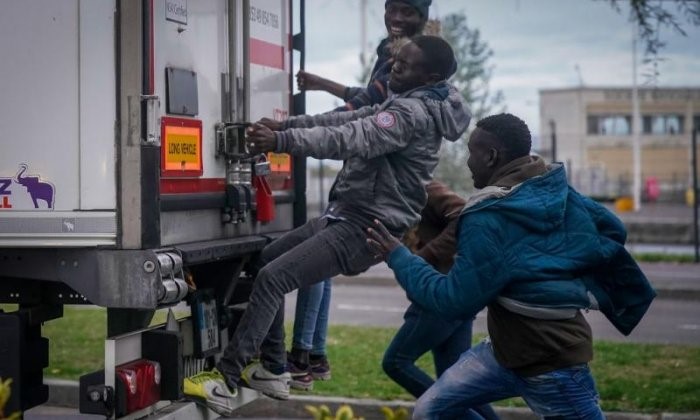
The sight and smell must have been horrific. On October 23, the
bodies of 39 East Asians were found in an airtight refrigerated truck
container in Essex in eastern England. Bloody handprints smeared the
walls, and the bodies, mostly naked, foamed at the mouth. A murder
investigation was immediately launched, but the circumstances, despite
their horrific nature, were hardly mysterious. The movements of the
haulage truck, the racial uniformity of the dead, and the conditions of
transport all pointed to a catastrophic attempt at organized illegal
entry into Britain. The driver was arrested and charged. Arrest warrants
were issued. Documentation was seized and examined. Autopsies and
collaboration with foreign police forces revealed that the deceased were
Vietnamese, and that their final journey to Britain occurred via
Belgium and Ireland. It is, as yet, undetermined at which geographic
point the process of suffocation began, though it is believed they were
alive in the container for around ten hours before they succumbed, one
by one.
It is a story that, in all its macabre and gory features, lends
itself to exploitation — and the Left has exploited it to the full. The
narrative has emerged that the corpses in Essex were the result of Third
World “desperation” and a heartless immigration system that fails to
provide “safe routes” for migrants. But is this really what’s happening,
both in Britain and across the West? Is this really the explanation for
drownings in the Mediterranean, bodies on Turkish beaches, and deaths
in the Arizona desert? Much as I empathize with the particularly nasty
deaths of the deceased Vietnamese, I argue that they were the victims of
their own materialistic and often criminal desire to live in “First
World” conditions among Whites, of a sociopathic Irish people-smuggling gang
that cared not for their illegal cargo or Europe, but for filthy profit
alone, and of a much broader and more profound phenomena — the
deepening exploitation of Europe and Europeans under manipulative
humanitarian pretexts.
“The Migrant Personality”
A common theme in mass media treatments of migrant deaths is the
emphasis on a putative “desperation” among migrants.
The term implies a
lack of choice, and implicitly suggests that migrants don’t really want
to move to the West, but have been forced to do so by circumstances.
These narrative strains, undoubtedly cultivated to provoke sympathy and
reduce opposition among European natives, are in stark contrast to the
reality that Third World migrants to the West invariably pass through
many safe and reasonably prosperous countries prior to their arrival.
This reality suggests that choice is actually a very strong feature of
migrant behavior, and reduces the likelihood that such behavior is
motivated by genuine desperation.
Perhaps because of the obvious weakness of “desperation” narratives,
much energy has been expended on the development of propaganda on the
putative migrant personality, especially aspects concerning ambitions
and motivations. For example, an extensive literature has developed in
both popular culture and academia suggesting that migration selects for
educational qualifications, motivational characteristics, and positive
risk-taking behaviors.
In line with this thinking, government, mass
media and academia in the West have invested heavily in persuading
native populations that mass migration from areas as distant as Africa
and South Asia is a net gain for receiving countries, since it involves
importing highly-motivated and capable people.
The problem with
arguments such as these is that they are based heavily in nostalgic
visions of the (predominantly American) past, and aren’t remotely based
in the contemporary global social reality.
Ideas of energetic pioneers
arriving from abroad are clearly more applicable to the pushing of a
nineteenth-century frontier populated by Northwest Europeans than they
are to mass migration to fully-established twenty-first century nations
with advanced economies and generous welfare provisions.
In 2018, a team of scholars from The Migration Observatory, Centre on
Migration, Policy and Society, at the UK’s University of Oxford,
published their findings on “arguments about a common migrant
personality.”[1]
The study was one of the first of its kind since the serious analysis
of the putative migrant personality has been rare indeed.
Rather
controversially, the Oxford team’s findings “seem to contradict the
arguments about a common migrant personality put forward by social
psychologists, as well as most of the predictions of standard economic
models. We do find, however, some support for the welfare magnet hypothesis.”
[emphasis added]
The “welfare magnet hypothesis” is, in the polite
expression of the Oxford scholars, essentially the argument that “very
generous welfare states can lead to negative skill selectivity.”
If one
wanted to be less polite, the welfare magnet hypothesis could be
usefully explained as the attraction exerted by an abundance of free
resources on large numbers of unskilled migrants with poor cultural and
behavioral aptitudes, who are thus destined to become net drains on
their target nation.
In fact, the study found Turks migrating to wealthy
European countries to be negatively selected for motivation and aptitude, meaning that only the less capable and talented among the Turks left for Europe.
******
Despite findings like these, contemporary mass migration is almost
exclusively presented to Western populations as a humanitarian matter,
and most media treatments of the issue are replete with appeals to
emotion and concepts of fairness.
It is rarely, if ever, admitted that
mass migration is often deliberately pursued by “exporting” nations as a
means of relieving the burden of criminal elements and surplus
populations, and also a means of generating revenue from money remitted
by established migrants.
And it is rarely admitted that left in Western
societies sees these immigrants as clients and a future voting base, the latter already having profound effects in the United States.
While there has been much talk about Syria as a zone of war and
destruction, little has been made of the fact that, like the Russian
Jews in 1880 (whose own migration path was eased by largely fictional
humanitarian tales of woe), it has one of the highest population growth rates in the world
(2.4%). In the seven least-developed of Syria’s 14 provinces, women
have between 3.8 and 6.2 children, and their fertility rates are not
expected to decline much in the next 15 years.
In 2010, Nabil Sukkar, a
Syrian economist formerly with the World Bank, said
“We have a population problem, no question. Unless we cope with it, it
could be a burden on our development.” Sukkar said labor supply was growing
about 4.5 percent a year, due to rapid population expansion in earlier
decades, outpacing the capacity of Syria’s economy to create jobs for
the cohort of 250,000 young people arriving on the job market every
year.
“Too big a population means a high burden on government services,
such as education, electricity and health care,” he said. “Perhaps in 20
years the growth rate will go down to 1.5 percent as in Egypt, but in
the meantime we do have a problem.”
Since Syria spent the period
2011–2019 exporting its entire surplus cohort under the cover of a
perfectly-timed civil war, Sukkar’s problem, like the similar one facing
Africa, is now Europe’s problem.
“The Migrant Contribution”
The same pattern is witnessed across the varying ethnic hues of mass
migration, even taking into account the dead Vietnamese in Essex.
In a study
of Vietnamese illegal immigration to the UK and Germany, academic Trang
Nguyen found that “immigration agencies and brokers that are affiliated
to the Vietnamese government” have been providing logistical support to
illegal Vietnamese in Europe because “illegal immigration to Europe is
widely recognized by Hanoi as a welcome solution to their unemployment
problem and as a source of growing remittances.”
Remittances from what?
The Vietnamese have rather quickly established themselves in Europe as
the dominant players in the sale of illegal cigarettes (Germany) and the
mass cultivation of cannabis in indoor plantations (UK). In 2012, more
than 60% of UK arrests for cannabis production involved Vietnamese
migrants. The title of Nguyen’s article, and his central thesis, is that
this is “government-sponsored crime” in the sense that Hanoi is
providing logistical support for the activities of its illegals plying
these illicit trades on European soil. Nguyen continues:
They developed methods to turn networks of large
houses into clandestine cannabis plantation farms (Luke, 2012).
Information from Vietnamese-language online fora in the UK indicates
that these houses are rented from housing agents using fraudulent or
stolen identity papers. Set-up costs for an operation vary between
£15,000 and £50,000 while annual profits from a single ‘grow house’ run
from £200,000 to £500,000. According to interviewees and other media
reports, Vietnamese-run cannabis farms are mainly located in the suburbs
of London, Manchester and Birmingham.
The background of Vietnamese migrants is almost uniform. Nguyen
remarks that they overwhelmingly tend to have a rural origin and low
educational attainment, and have few ambitions other than finding
illegal work in cigarette and cannabis manufacture (males) or in nail
bars (females).
Despite quasi-Romantic narratives proffered by the
Left-Liberal media, these individuals do not come to Europe with visions
of cultural synthesis and embracing European “values.” Rather, Europe
is seen as a lucrative cash cow, to be milked for welfare or criminal
proceeds. Nguyen relates how one illegal told him that “Many of them
(cannabis “gardeners”) went to the UK and made a fortune, but came back
not knowing a single English word. They probably did not even see the
Big Ben tower.”
A significant proportion of these illegal proceeds are funnelled back
to Vietnam through a network of “legitimate” Vietnamese businesses
operating in Europe, such as grocery stores, logistics companies, or
translation agencies, who receive foreign currencies from undocumented
migrants and launder it for them.
In 2017, the Ministry of Labour of
Vietnam set the target of exporting 225,000 migrant workers over a
24-month period.
The policy has resulted in Vietnam now being one of the
top ten global remittance recipients, receiving between $10 and $14
billion since 2012, accounting for 6–8% of its GDP.
Rather than warning
prospective migrants about the potentiality of their becoming engaged
with criminal elements, Nguyen found the Vietnamese government complicit
in assisting “criminal networks to lure and traffic individuals and
encourage the undocumented migrants to enter illegal markets.” In fact,
many of the same networks are actually “state-owned or
stated-affiliated.” At time of this writing, Hanoi has never reported
“any investigations, prosecutions, or convictions of officials complicit
in human trafficking offences,” and the Vietnamese government has made
it extremely difficult for European nations to deport Vietnamese
illegals back to their country of origin.
The scale and calculation behind international migration networks,
and the complicity of population-exporting governments, surely exposes,
or at the very least problematizes, the myth of a humanitarian crisis.
In the case of the Essex incident, unfortunately, a willful ignorance
has prevailed across the UK media and important sections of society.
A
good example is an awful piece of journalism that appeared in The Scotsman.
The article begins, predictably, with humanitarian and emotional
appeals: “Who could ever forget the heartbreaking picture of a toddler
lying dead on a Mediterranean shore, or the impact it had on public
consciousness? … What happened in Essex this week is simply one small
incident in a massive international problem.”
What problem? The
journalist, Christine Jardine, can’t seem to articulate it, but then she
also can’t articulate who the dead people actually were, identifying
them instead as originating in “the poor, coastal, province of Fujian,
in south-east China.” She continues:
But all victims of incidents whether here, on the
continent or on Mediterranean have at least one thing in common.
Desperation. Nobody risks their lives clinging to an inflatable raft
crossing dangerous sea routes unless they feel that is the only option
they have. None of us would put our children at risk, or gamble on
surviving thousands of miles in the back of a refrigerated truck if we
were looking for an easy life. It is too easy to blame the victims
rather than look for solutions.
All the common features of the Left-Liberal narrative are here —
desperation; lack of options; not looking for an easy life but a place
to pursue their ambitions.
But we know that these migrants risked their
lives to make a “fortune” in illegal trades, that they have absolutely
no affinity with the nation or people they hope to make their criminal
proceeds among, and that their government cynically assists them in
their efforts. These are unintelligent and otherwise unmotivated people
who chose to be criminals in foreign lands, when they could have chosen
to remain in their home nations.
Jardine adds:
If we are ever to make progress, ever to prevent
these deaths, we need to be looking at ways of providing safety for
those whose lives have become intolerable because of war or persecution.
We need to look at ways of providing safe passage and work with
international agencies, both those who deal with aid and those who
tackle crime. Tracking down the traffickers at source and tackling them
before the damage is done is vital. We also have to consider that
perhaps many of those who fall prey to the traffickers would not do so
if they felt there was a realistic hope of a safe legal means of
immigration. Looking at our own immigration system to ensure that what
we provide is fair, compassionate and effective for those who want to
come here is essential. But so is providing international aid to those
countries where the desperation for a better life is most keenly felt.
I wonder what international agencies Jardine would propose we work
with, in order to relax our borders and prevent this happening again.
Perhaps the government in Hanoi? Yes, they’d be very receptive to our
decision to open our borders, which could be very lucrative for them
indeed.
Sarcasm aside, consider the infantile level of a mind that
suggests the only ways we can prevent illegal migrants from dying while
attempting to enter our nations are to either grant them unqualified
access or to throw money at their home governments. What should we give
to Hanoi? $10 billion? $12 billion? Do we offer to make up 10% of their
GDP, to beat the 8% they already derive from us in cannabis farms and
illegal cigarette sales, in the hope they will stop operating criminal
migrant networks in Europe? Do we add this to the €6 billion
we have now pledged to Turkey in the hope they won’t flood us with more
migrants? How many nations do we agree to bribe? How many nations are
“desperate”? How many billions are at our disposal to stop bodies in
trucks and on beaches?
The truth of the matter is brutally stark: Without a massive
strengthening of border control, the West will succumb to mass migration
with devastating consequences for native populations and their culture.
Jardine’s two options are, in essence, merely the same, since both
entail eventual mass invasion and the only difference being that one
also offers the prospect of immediate national bankruptcy.
Contradictions of Opportunism
One of the most ferocious and darkly comic novels I’ve ever read is William Faulkner’s As I Lay Dying,
the text that arguably won the novelist his 1949 Nobel Prize in
Literature. The novel follows the Bundren family as they take a casket
containing the family matriarch across state lines so that she can be
buried, in accordance with her dying wishes, among the graves of her own
well-heeled kin.
As this odyssey plays out, each member of the family
is revealed as having their own perspectives and intentions. But perhaps
none of these quasi-migrants is more reprehensible than the grifting,
begging, and selfish patriarch, Anse Bundren, who fantasizes about
getting his hands on enough money for “new teeth” and, in doing so,
tragically and catastrophically betrays his children.
I won’t spoil the
ending, but Faulkner’s masterpiece came powerfully to mind when news
broke in 2015 concerning the death of the three-year-old Syrian Aylan
Kurdi, whose body washed up on a Turkish beach after a failed attempt to
cross the Mediterranean.
The Kurdi family had been living in relative
comfort in Turkey for three years but, according to a large number of
sources, a decision was taken to illegally move the family to Europe so
that Aylan’s father Abdullah could get free dental treatment and “new
teeth” from one of Europe’s welfare states.
Was the Kurdi family “desperate?” What aspects of the “migrant
personality” did they exhibit? Shortly after the death of young Aylan,
Australian politician Cory Bernardi, a Senator of the then-governing
Liberal party, told his country’s parliament that Abdullah Kurdi and his
family were not real refugees and suggested many others seeking asylum
in Europe were merely “opportunistic.” Bernardi stated, during the
course of a debate:
I find it a bit sanctimonious for [Green] Senator
[Richard] Di Natale to bring in these emotive arguments, and
particularly to characterise this as some sort of humanitarian mission
by using the terrible image of that young boy who was picked up from the
beach after having drowned at sea … The facts remain that that terrible
image was not brought about by recent events in Syria or Iraq. That boy
and his family had lived in Turkey for three years. … The money for
that boy’s father to pay the people smugglers was sent from Canada. The
father sent them on that boat so the father could get dental treatment. …
They were in no fear, they were in no persecution and they were in no
danger in Turkey. … This seems to me to be becoming an opportunistic
cycle.
Bernardi was, predictably, subjected to scathing attacks, being
described as an “embarrassment” to parliament and as worthy of being
“treated with contempt.” But was he wrong?
Bernardi was of course correct to portray mass migration as
“opportunistic” — a term that can serve as the opposite of “desperate”
in this case, since it implies the existences of choices and
opportunities and, most importantly, it returns agency to migrants.
The
truth of the matter is that non-European migrants have an abundance of
choices in their countries of origin.
Those who die on their way to
Europe or the United States will have made a sequence of bad and
ultimately fatal choices based on their material desires and wants and,
indeed, their level of intelligence. We must consider that these same
people look upon badly damaged and flimsy boats, or upon airtight
refrigerated vehicles with no internal locking mechanisms, and decide
that these are appropriate and risk-worthy methods of attempting illegal
entry to their destination of choice.
To date, no media source has
reported on a deceased migrant found to have previously been in a state
of severe malnourishment or fundamentally ill health. In other words,
deceased migrants invariably appear to have been well-fed individuals
facing no immediate threats to their existence beyond their own poor
decision-making.
The position of Left-Liberals in these matters can only be considered
fundamentally irrational, and Catholics have been notably prominent in
indulging this mindset. Sarah Teather, director of the Jesuit Refugee
Service UK, has evoked the meme of “desperation” and said:
The desperation of those in the container is an indictment of our failure to provide sanctuary to those in flight for their lives. This horrendous tragedy highlights the urgent need for more safe and legal routes
to migrate and to seek asylum. If the government wants to ensure this
does not happen again, it is not enough to focus only on criminal gangs —
it must ensure that those seeking sanctuary in Britain can get here
safely. It must build bridges, not walls. [emphasis added]
That we live in increasingly strange times is evidenced by voices
from the Marxist hard-Left, who have also pointed out the irrationality
of this position. Slavoj Žižek, for example, recently pointed out:
Pia Klemp, captain of the ship Iuventa
which was saving refugees in the Mediterranean, concluded her
explanation why she decided to refuse the Grand Vermeil medal awarded to
her by the city of Paris with the slogan: “Documents and housing for
all! Freedom of movement and residence!” If this means that — to cut a
long story short — every individual has the right to move to a country
of his/her choice, and that this country has the duty to provide him/her
with residence, then we are dealing here with an abstract vision in the
strict Hegelian sense: a vision which ignores the complex context of
social totality. The problem cannot be solved at this level.
In an ideal world, Žižek would elaborate on what precisely he means
by “the complex context of social totality,” but elaboration and
clarification are, alas, not his strong points. He is, nonetheless,
absolutely correct to counterpose Klemp’s abstract vision of open
borders with social totality, which one assumes to refer to Heidegger’s
dictum that all essential and great things can only emerge from our
having a homeland, from being rooted in tradition.
Human beings need
both home and homeland. In contrast to a social totality that inheres
the delineation and demarcation provided by national borders, the blank
openness of a borderless world offers no homeland, and dissolves all
tradition.
In a world without borders, all identities melt away. Man is
reduced to nothing more than an economic integer and, in some important
sense, ceases to exist as Man.
Again, it is ironic that Žižek, a Marxist
of the hard-Left, should be forced to make it clear
that “refugees want to have their cake and eat it. They basically
expect to get the best of the Western welfare state while retaining
their specific way of life, which is in some of its key features
incompatible with the ideological foundations of the Western welfare
state.” In other words, non-Europeans are knowingly exploiting (choosing
to exploit) the altruistic and humanitarian aspects of the European
personality without any intention (or perhaps even capability) of
reciprocation.
Where we diverge from Žižek is his insistence that mass migration can
be solved by “change to the global economic system,” by which he
obviously means Marxist revolution.
While there is undoubtedly an
economic component to contemporary mass migration (the welfare magnet,
international crime, Globalist desire for cheap and mobile labor, wealth
disparities among nations), there are other factors that cannot be
overlooked.
Mass migration can be usefully understood as a semi-organic
phenomenon that is also heavily cultivated.
The global expansion of mass
media, especially in the last three or four decades, has brought
Hollywood’s idealized visions of the multicultural West onto television
sets in Africa, the Middle East, South Asia, and the Far East, with
hundreds of millions of non-Europeans coming to the belief that they too
can potentially be part of this wealthy multicultural paradise.
Never
forget, when considering Hollywood propaganda among Whites, that these
products are inevitably pumped into countries outside our own, and that
they serve an equally devastating purpose. Muslim visions of Western
women arguably originated in Sex and the City as much as they
did in the Koran.
Hollywood debased our culture and carved it open,
before broadcasting the aftermath to the rest of the world — a dunghill
certain to attract flies.
What isn’t broadcast to the Third
World is the reality of the multicultural West — that it is a bitter and
divided condition that only grows more bitter and divided by the day.
The migrant sees that the streets aren’t paved with gold as they seem in
so many Hollywood productions, but are instead increasingly paved with
trash. Still, they are better than “home.” Western women, though you can
see their faces (and even their limbs!), aren’t really willing to have
sex with just anyone. This comes to the newcomer as a great
disappointment, and he becomes resentful and, in his resentment,
dangerous. And the native Whites, well, they are a tolerant bunch, but
they seem to prefer to live among themselves, and they have a culture
that simply baffles and confuses the migrant in those moments where he
pays it fleeting interest. What matters most is that he finally got his
hands on that welfare payment, thanks to his immigration lawyer Mr.
Cohen, and that, in some small way at least, he is living the life once
promised on his television screen. And there are grounds for optimism —
each day he sees more and more of his own kind on his street, in his
town, all across his new country in fact. These Whites really are a
tolerant bunch.
Technological advances in communication and transport have
facilitated the growth of forms of coordinated international chain
migration that would have been unimaginable even fifty years ago,
allowing potential migrants in almost every Third World country to plan
and execute their own journey to the West with relative (though not
risk-free) ease.
Since this technological genie cannot be put back in
the bottle, and economic changes are simply too gargantuan for
transformation even within this century, the only solution to mass
migration is a “revolution of the will” in migrant-receiving nations.
Tolerance in the West has been nurtured and cultivated by decades of
consistent propaganda, of which the “dead migrant” tale is but a minor
genre.
It must be rejected. And it must be rejected along with
multiculturalism which is the form of society that provides illegals
with anonymity and opportunity.
An illegal Vietnamese in a multicultural
society simply vanishes into the mass. An illegal Vietnamese in a
mono-ethnic European nation has nowhere to hide. Europe must decide that
it wants to live.
Yes, what happened in Essex was nasty and tragic for those concerned.
But what’s happening to the West is worse. Without a homeland, it is we
who will be trapped with no exit, no internal locking mechanism. We are
running out of demographic oxygen. The next time you see propaganda
about migrant deaths, cast a cold eye upon it, and pass by.
[1]
Polavieja, J. G., Fernández-Reino, M., & Ramos, M. (2018). Are
Migrants Selected on Motivational Orientations? Selectivity Patterns
amongst International Migrants in Europe. European Sociological Review.