.

.
Library of Professor Richard A. Macksey in Baltimore

POSTS BY SUBJECT

Labels

Showing posts with label Balkans. Show all posts

Thursday, May 17, 2012

Hermann Giesler: The Balkan


Ein Anderer Hitler by Hermann Giesler: Fateful Decisions

FATEFUL DECISIONS:

The Balkan

Translation and commentary by Carolyn Yeager and Wilhelm Mann
 Ein Anderer Hitler, Druffel Verlag, Leoni am Starnberger,6th edition, 1982.
Copyright 2010 Carolyn Yeager

The Balkan


Giesler: “–a few days later the putsch occurred in Belgrade. Here again, although hidden, the combined effort of the English and Russian leadership stage managed that revolt.”
Yugoslavia’s anti-Russian regent Prince Paul rides with Adolf Hitler in March 1941 when he agreed to join the Tripartite Pact (Berlin-Rome-Tokyo). The Balkan now seemed secure since Bulgaria also signed, and Hungary and Rumania were already partners. Hitler was aware of the danger of military operations by the West via a thrust from the Mediterranean towards Greece, Albania or Trieste.Two days after Yugoslavia’s formal signing of the Pact in Vienna on March 25, Paul’s regime was toppled in a military coup led by Serbian General Dusan Simovich, but initiated and planned by British officers, and certainly with the encouragement and knowledge (if not active help) of the Soviets.
Deploying the Waffen SS Leibstandarte Adolf Hitler Division from the Russian front and Gebirgsjaeger mountain divisions from Austria,Hitler attacked both Yugoslavia and Greece hard on April 6. Simovich and the newly installed pro-British King Peter fled the country, ending up in England in June. On April 10, the nation of Croatia seceded from Yugoslavia and allied itself with Germany. Yugoslavia capitulated on April 17. The British invasion troops fled to Crete, Cyprus and finally to Egypt.
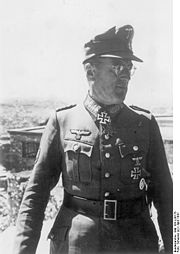
On June 2, Greece collapsed after a tough battle in which Austrian mountain battalions played a decisive role. Three or four Gebirgsjaegerdivisons accomplished a remarkable feat, first by arriving there so quickly, and then by successfully climbing around behind the Thermopylae Pass in the rocky Greek hills, carrying their equipment (guns, ammunition, food) on mules and small horses, with some motorized vehicles. Along with a shortage of water in the great heat, they met heavy resistance from the Greek Army. General Ferdinand Schoerner, pictured below, a Bavarian from Munich and the last chief of the German Army in 1945, commanded the 4thGebirgsjaegerdivision and became the “Conquerer of the Acropolis.”
It was a complete victory for the Axis forces, but it delayed the invasion of the Soviet Union, which may have been a fatal stroke in that war.
General Ferdinand Schoerner, with the Acropolis in the background.

Friday, March 23, 2012

Truly Disgusting - the West in Kosovo

Truly Disgusting - the West in Kosovo

Aleksandar PAVIC | 11.02.2012 |
 
In the tantrums thrown by the Western powers in the wake of the Russo-Chinese veto of their UN Security Council resolution on Syria, the US’s UN Ambassador, Susan Rice, expressed «disgust» at these two states’ behavior. In addition to these kinds of «hysterics» – as Russian Foreign Minister Lavrov so aptly described them – being calculated to rally the global media further against the two Eurasian giants, they also serve the purpose of directing attention away from the West’s own disastrous intervention track record. On February 8, just four days after the failed Syria resolution, the UNSC had a chance to discuss another Western interventionist «success story» – Kosovo.
Many might think that Russia’s and China’s reluctance to give a green light to foreign intervention in Syria is mostly based on the recent Libya (and Iraq and Afghanistan) experience. That is only partly true. For the occupied Serbian province of Kosovo has been under NATO/EU control for more than 12 years now – since June 10, 1999 – and offers a much better view of what Western intervention brings than the still-fresh, although already clearly disastrous, Libyan case.
The first thing that struck attention was the fact that the Assistant Secretary-General for UN Peacekeeping Operations, Edmond Mulet, referred to the situation in Kosovo at February 8 session as one of «fragile calm.» Remember – this is more than 12 years after Western powers have taken complete control of the territory, and almost four years since they have unilaterally recognized its «independence.» With tens of thousands of Western «peacekeepers» on the ground for over a decade and several billion dollars spent – we have nothing more than «fragile calm.» A «success story» – this is not.
Vuk Jeremić, the Foreign Minister of Serbia, whose province Kosovo still is according to UNSC Resolution 1244 (as well as Resolutions 1160, 1199, 1203 and 1239, all of which the Western powers have trampled in their unilateral recognition of the breakaway province), characterized the situation in Kosovo as «ghetto and barbed wire,» with the Serbian population being «the most imperiled in Europe.» Practically none of the over 200,000 people expelled from Kosovo since NATO and the EU have taken over have returned. The 100,000 or so Serbs and non-Albanians that have remained are waging a daily battle, not just for survival but for basic human rights. Pointing to this state of affairs, the Serbian FM cited reports of international organizations such as Human Rights Watch, OSCE and Transparency International, which talk of rampant corruption, discrimination against non-Albanians, politically influenced judiciary, inadequate witness protection, etc., while the European Commission has qualified the fight against corruption and organized crime as «inefficient.»
Economically as well, Kosovo is a basket case, to put it mildly. The unemployment rate is variously estimated at 40-60%, or even 70%. The territory has been identified by various international agencies as the main European center for the distribution of heroin originating in Afghanistan, as well as a center for money laundering and human trafficking. It has been referred to more than once as «Afghanistan in Europe.» In addition, the top of its ethnic Albanian leadership is currently under international investigation for human organ trafficking.
A report by Council of Europe human rights rapporteur Dick Marty published in December 2010 named Kosovo «prime minister» Hashim Tachi as the head of a «mafia-like» group, responsible for smuggling human organs, drugs and weapons. Marty accused the international community [i.e., leading NATO/EU states] of failing to act on the intelligence they possessed. According to his report, Thaci and his accomplices carried out «assassinations, detentions, beatings and interrogations» dating back more than a decade. Some members of his group are also accused of smuggling unfortunate Serb prisoners into Albania after the 1999 Kosovo war, where they were killed and their organs harvested.
At the February 8 UNSC session, Serbia, Russia and China renewed their calls to place the investigation of this morbid crime under the auspices of the UNSC. However, as has been the case for almost a year, the US and other Western Security Council members, rejected such calls, preferring to keep the investigation under EU, i.e., their own control. At a previous UNSC session in December 2011, Russia’s UN ambassador Vitaly Churkin was compelled to remark that Russia «does not understand why our Western colleagues in the UN refuse to implement» such a measure, while Serbia’s foreign minister, Vuk Jeremić added that «some [read Western] UN Security Council members are strongly opposed to the adoption of a resolution [calling for a UNSC-supervised investigation] proposed by Serbia,» calling it a «moral abdication before criminals and war criminals.» China has also backed Russia’s and Serbia’s efforts. 
Certainly, one of the keys to this sort of «disgusting» behavior can be found in the startling admission made at the end of January by former Chief Prosecutor for the International Tribunal for war crimes in The Hague (ICTY), Carla del Ponte. In an interview given to the Serbian weekly «Nedeljnik,» she charged that «NATO and UNMIK [the UN’s civilian Kosovo mission] prevented an investigation of the organ trafficking charges» and that, in addition, someone in the hierarchy had ordered the evidence destroyed. Obviously, an independent investigation under UNSC auspices would open up a highly embarrassing can of worms for the Western «humanitarians.»
In any case, Western «hysterics» regarding Syria are old hat to those who’ve been watching similar performances being played in the Balkans over the past two decades: first comes the Western media frenzy, followed by calls from Western capitals that «something must be done,» followed by threats, sanctions and, lastly, foreign [i.e., NATO/EU] intervention and the installation of dysfunctional, kleptocratic, incomparably worse regimes, such as Thaci’s «Kosovo» mafia-state.
Thus, when one reads of «unverified reports» of atrocities allegedly committed by the Syrian authorities, the first reflex ought to be – let’s verify the reports first – especially as the Arab League Observer Mission had detected the presence of an unidentified «armed entity» (which is certainly one of the reasons why its report has been rejected not just by the West but by the very states that sent it) that was responsible for provoking armed response from government forces. However, on the heels of the first thought should come a second – who would do the verifying? Just before the NATO bombing of Serbia in 1999, Western «observers/verifiers» came into the Kosovo province under the auspices of the OSCE, led by another US diplomat, William Walker, whose previous experiences included (democratically?) suppressing investigations into death squad killings of Jesuits in El Salvador during the 1980s, and accompanied by Western reporters. The result? The targets that were subsequently bombed were precisely located and marked by the «observers» (a nice name for reconnaissance agents, as it turned out) – while the Western media, with the help of several fictional «massacre stories» helped prepare the pretext for the almost 80-day bombing that ensued a few weeks later. Can anyone doubt that something similar is being planned for Syria? Can anyone blame Syrians that do not wish to become «Afghanistan of the Middle East?»
That is why it is vitally important for Russia, China and all the countries that support them, to succeed in ensuring a balanced and, above all, sustainable solution to the Syrian crisis, one that involves the active participation of the entire Syrian public, whose outcome will not be the simple installation of purportedly «pro-Western» thugs. It does not, however, appear that Western politicians and media are willing to give either Russia, China, or the Syrian people this opportunity. 
As status quo states that respect international law – one of whose chief principles is non-interference in other countries’ affairs – Russia and China are once again at a clear disadvantage. They have been put on the defensive by the extremely aggressive Western global media apparatus. There is no country in the world – and there has never been – whose government does not have flaws. But there has never been a media force that is able to exploit them to such an extent as today’s Western global media – while simultaneously ignoring cases such as Kosovo, which no longer suit their immediate interventionist purposes. It seems, thus, that, if they do not draw a line in the sand on Syria – Russia and China will just be faced with a similar scenario elsewhere – closer to their own borders. So perhaps it’s time for them to be more active and aggressive not just in defending the status quo, but in pointing to the West’s own sordid interventionist track record. The «disgusting» case of Kosovo is just one of the good places to start.
-----------------------------------------

Will Kosovo organ trafficking case be put on wrong track?

Pyotr ISKENDEROV | 12.02.2012 | 15:27
 
The situation in Kosovo was expected to become the key issue on the agenda of the UN Security Council’s meeting on February 8 in New York. Before the meeting the members of the Security Council received a report by Assistant Secretary-General for Peacekeeping Operations Edmond Mulet. In his report Mulet notes that the resumption of the talks between the authorities of Belgrade and Kosovo has «eased the tensions» but the stakeholders are facing new «significant political challenges». Among such challenges the official names the situation in the regions populated by Kosovo Serbs, which remains unsolved. 
Giving credit to the diplomatic assessments made by Mulet it is necessary to stress that the situation in Kosovo remains tense not because of the activities of Kosovo Serbs but because of the policy of the regional government headed by Hashim Thaci, the former political leader of the Kosovo Liberation Army (KLA). For the Serbian government and Kosovo Serbs KLA is a terrorist organization while Thaci is the person who is involved in many crimes. 
Thaci and other current political leaders of Kosovo are mentioned in the Kosovo organ trafficking report by the Parliamentary Assembly of the Council of Europe (PACE). According to the report a criminal group of Kosovo Liberation Army fighters had kidnapped and executed Serbian and Albanian prisoners and sold their organs on the international black market. It was expected that in the result the investigation initiated by the EU mission in Pristina all the details of the criminal activities of Kosovo separatists would become known.  
So far this has not happened. The international representatives even did not demand that Thaci should suspend his office for the period of the investigation. The investigators are trying to narrow down the case to the activities of the Medicus clinic in Pristina (closed in 2008), where transplantation of kidneys to rich patients from Europe, the US and Canada were performed. But the Medicus is not an infamous «loony bin» in the north of Albania where in the early 2000-s traces of such operations were discovered. Ilir Recaj, the former Kosovo Healthcare Secretary, one of the persons involved in the case is not Hashim Thaci. It is not a coincidence that that the EU prosecutor Jonathan Ratel, who is busy with the investigation, said recently that the investigation did not have any item of evidence pointing at the link between the Medicus case and the accusations of KLA leaders. 
Although in 2010, PACE’s member Dick Marty directly pointed at such a connection, the investigators are continuing to focus on Ilir Recaj, Israeli mediator Moshe Harel, Turkish surgeon Yusuf Soimez and Kosovo urologist Lutfi Dervishi, on anyone but not on the key actors without whose assistance the organ trafficking in Kosovo simply could not exist. Except for few cases Serbs are not mentioned among the victims.
Russia insists that the investigation on the involvement of Kosovo leaders in illegal trade with human organs should be controlled of the UN Security Council. Russia’s permanent envoy in the UN Vitaly Churkin made such a statement at a meeting of the Security Council. According to him, the facts point directly at the involvement of Kosovo’s current leaders in those crimes. But the investigation is led by the governments of the countries which earlier helped those people to come to power. Churkin stressed that Americans are playing the main role there: «What a coincidence! It is a US citizen who now heads the investigation», he said meaning the US prosecutor John Clint Williamson. All the materials including KLA leadership’s worksheets for 1998-1999 are in Williamson’s disposal. These documents remarkable notes: «A middle aged Serbian woman detained, of no interest» or «A blonde man caught, must be sent to by-products. No matter who he is - Serbian or American». 
The list of witnesses, made by the US and EU investigators, is also remarkable. First of all it is Raul Fain, a Canadian citizen, who was operated in the Medicus clinic in 2008. Somehow the prosecution managed to attach his evidence to the case unlike the claims of many local witnesses who had withdrawn their initial complaints or were «reported missing», like Jilma Altun from Turkey. In order not to let it happen to Raul Fain he was allowed to testify from Canada through video communications. 
As we can judge from the evidence of the Canadian, who needed kidney transplantation, he had initial talks with Israeli mediators who introduced him to the administration of the Medicus clinic. The operation cost € 87,000. Fain transferred the money to the account of the mediator Moshe Harel and flew to Pristina via Istanbul where he was examined by transplant surgeon Yusuf Sonmez, who is now one of the main defendants in the case. After that the Canadian patient together with a patient from Germany was taken to the clinic where they received kidney transplants. According to the prosecution’s report, two women from the CIS countries served as the donors for the Canadian and German patients. According to information leakages in some mass media, one of them was Anna Rusalenko from Russia’s Far East. It was her kidney that was transplanted to the Canadian patient but she did not receive the promised compensation of €20,000 and was sent back to Istanbul. 
Similar evidence was given by another international witness - Joseph Koralashvili, a manager from New York who in October 2008 accompanied his father, who needed a kidney transplant, to Kosovo. The safety of this witness was ensured directly by the FBI but his testimony was aimed only to confirm the EU’s official version of the events. Koralashvili said that during his six day stay in Pristina none of the local doctors had introduced himself/herself by name and he did not know whose kidney had been transplanted to his father. 
The testimonies of Fain and Koralashvili definitely prove a high level of international coordination of «black» transplant surgeons’ activities. At the same time the materials of the case still lack the main facts which were stated by the former Chief Prosecutor of the International Tribunal for the former Yugoslavia Carla del Ponte in her book and reported by Dick Marty - the involvement of the Kosovo leadership headed by Hashi Thaci in the organ trafficking business. Even taking into consideration serious accusations against Yusuf Sonmez and the officials of Kosovo Healthcare Ministry it is hard not to notice that the EU officials who supervise the investigation are trying to take the heat off the key persons involved in the case.
Meanwhile in the materials collected and published by Carla del Ponte contain names of hundreds of Kosovo Serbs who were brought to Albania in the late 1990s and became victims of organ trafficking business. The report also states that KLA leaders headed by Thaci were involved in this criminal business.
By all accounts, the EU investigators circumvent these episodes in their current investigation. The problem is not lack of evidence or West’s reluctance to put at threat the picture of the Kosovo crisis in which Albanians are seen as victims and Serbs as aggressors and criminals. This distortion of real facts served to justify bombings of Yugoslavia by NATO air forces in 1999 and the following recognition of Kosovo's independence by the US and the EU member states. It is not a coincidence that del Ponte published the materials on organ trafficking not in the early 2000s but in April 2008, after the West had recognized Kosovo's independence. If the truth on the terrible crimes had become known earlier Western public would not have made such a confession. Today the investigation led by the EU faces similar obstacles. That is why there is a probability that the court will confine itself to passing sentence upon Turkish doctor Yusuf Sonmez and all references to Serbian victims will be deleted. 
In a recent interview with Belgrade’s daily Press Carla del Ponte noted that the current investigation is lacking political will. She said that the international society does not want to know the truth about those crimes. Human Right Watch’s experts agree with her. They think that neither the EU mission nor the International Criminal Tribunal for former Yugoslavia in the Hague are capable to investigate the organ trafficking case in which Kosovo regime leaders are involved and it is necessary to establish a new international institution for it. Fred Abrahams, a representative of the Human Right Watch, is convinced that the list of hundreds of Serbs who were executed and whose organs were sold on the international black market is far from being complete. According to the documents which have been recently released by France 24 TV channel, the UN high ranking officials knew about organ trafficking and the involvement of KLA commanders in it as early as 2003.
In January, the European Commission decided to start talks with Kosovo authorities on granting its residents visa-free regime. Another transfer of financial aid to Pristina is next on agenda. I wonder how the European tax payers take such money consuming advances the EU make to the political leaders with such a dingy reputation like Hashim Thaci? 
Is Serbia strongly interested in a full scale investigation into crimes committed in Kosovo? Belgrade and Pristina avoid this topic in their talks. Speaking in the UN Security Council Vuk Jeremic, Serbia’s Security Minister said only that the spirit of truth should prevail in the talks. That sounded encouraging especially considering that Pristina authorities were presented by the delegation of the government of Hashim Thaci, the boss of the Drenica group how he was called in the report by Dick Marti.  
Here have been reports in Serbia that a personal meeting between Serbian President Boris Tadic and Hashim Thaci is to take place soon. In an interview with Alfa TV (Skopje) Thaci said that Tadic and he should shake hands. Taking into account that by March Serbia is to report to the EU on normalization of the relations with Pristina, the probability of this handshake is high. To punish Turkish doctor and an Israeli mediator for the crimes of «black» transplant surgeons, to narrow down the crimes of the Albanian leaders to tricks of a second ranking official and to make Tadic and Thaci seat at the negotiating table - the architects of the «new world order» could only dream about such a solution of the Kosovo issue...
---------------------------------------

Thursday, January 26, 2012

Super-rich party people say: Let’s go to Montenegro

Super-rich party people say: Let’s go to Montenegro

Andy McSmith – The Independent July 7, 2011

This week, it was Monte Carlo. Next week, Montenegro. Nat Rothschild, who has one of the best financial brains in a family renowned for business acumen, will be 40 next Tuesday, and intends to make this a weekend to remember.
The financier is rumoured to be splashing out £1m on a birthday bash. That is small change for a man whose personal wealth is reckoned to be about a thousand times that amount. And the little state of Montenegro is understandably delighted to be chosen as the venue.
Montenegro is a staggeringly beautiful, mountain statelet onn the c oast of the Adriatic, only just more than half the size of Wales with a population of 660,000, slightly more than that of Glasgow. It has been an independent state only since 2006, when its people voted in a referendum to sever their union with Serbia. It is probably best known to the British public as the supposed setting of the film Casino Royale, though most of it was actually shot in the Czech Republic.

Uniquely for a sovereign state, Montenegro has no currency. All transactions are conducted in euros though it is not in the EU or the eurozone. This peculiarity has made it a magnet for Russian oligarchs, and for people who want to disguise the source of their wealth, such as Irish drug barons.

It is also open for those with legitimate business interests, including Nat Rothschild, who will be combining with pleasure by flying his guests in to see for themselves the attractions of the Bay of Kotor, one of Europe’s finest natural harbours, tucked between the mountains of Montenegro.

Mr Rothschild and his main business partner, the Russian oligarch Oleg Deripaska, have sunk a lot of money in to the fresh concrete that has been laid on the water’s edge in Kotor Bay. The British media will obviously focus its attention on who is or is not a guest at the Rothschild bash, because the only social event of the summer to match this one was last week’s wedding of the billionaire Prince Albert of Monaco to the former Olympic swimmer Charlene Wittstock.

Eager to whet everyone’s curiosity, Porto Montenegro’s sales and marketing director, Colin Kingsmill, has told journalists that invitations have gone to “the ritziest, wealthiest, and most photogenic people on earth”.

It will be a glitzy occasion because Nat Rothschild has a lot of famous names in his contacts book. He was a contemporary of George Osborne at Oxford University, where they were both in the Bullingdon Club together, five years after David Cameron and Boris Johnson. It was Mr Rothschild who brought Mr Osborne and Peter Mandelson together on Oleg Deripaska’s yacht, in the summer of 2008, setting off an entertaining political furore when Mr Osborne revealed what Lord Mandelson had said in private about Gordon Brown.
When Rothschild threw a party in New York in 2008, the principal guest was Saif al-Gaddafi, son of the Libyan dictator, but no one expects him to join the party in Montenegro.

It can be assumed, though, that Nat Rothschild’s parents will be there. His father, Jacob, the fourth Baron Rothschild, is an investment banker and philanthropist, and his mother, Serena, is a racehorse owner who set a world record in 2004 by paying 4.6 million guineas (£4.7m) for the racehorse Magical Romance.

His social and business circles also include the oligarch Roman Abramovich, owner of Chelsea football club, the former head of BP, Tony Hayward, the American art dealer Larry Gagosian, Roland Rudd, co-founder of the Finsbury financial PR group, and many more.

While others of us may be nervously checking our bank statements and cutting down our overheads in these austere days, there are people in the world inhabited by Nat Rothschild with worries of a different order, including the shortage of parking spaces for exceptionally large yachts.

The marinas of southern France and Italy were designed a generation ago, when a yacht longer than about 100ft was pretty rare even in a millionaires’ playground. The Lady Ghislaine, the yacht off which the crooked tycoon Robert Maxwell fell to his death in 1991, was an exception, at 180ft, but Maxwell liked to have the biggest and best of everything, even if it meant paying for it with other people’s pensions.
These days, the Lady Ghislaine is nowhere near big enough to feature on the list of the top 100 privately owned yachts. A 240ft super-gin palace would get in at the bottom of that chart, while at No 1 there is Roman Abramovich’s Eclipse, which is three times the length of Maxwell’s.
As more of these superyachts came off the production lines, Europe’s billionaires were in danger of having to wander the Mediterranean with nowhere to dock until a group of entrepreneurs decided to create Porto Montenegro, in the Bay of Kotor, which, when it is complete in five or six years, will include a luxury hotel, a casino, 700 apartments, and 650 yacht berths.
After Nat Rothschild’s guests have quaffed his champagne and sung a chorus of “Happy Birthday” they will get a chance to look around. And that can only be good for business.

The VIP guests

* Nat Rothschild’s guest list has not been made public, but according to Montengran sources, it is so glitzy and ritzy that Tony Blair’s name was the dullest on the page. Mr Blair will not be joining the guests, though no one will be surprised to see Lord Mandelson there.
* Among the mega-rich believed to have been invited there is Oleg Deripaska, Russian owner of the world’s largest aluminium firm, Roman Abramovich, Peter Munk, Hungarian born head of the world’s largest gold mining corporation, the South African mining tycoon Mick Davis and Ivan Glasenberg, boss of Glencore, one of the world’s largest commodity companies.
* Another likely guest is Tony Hayward, who went into business with Nat Rothschild after losing his position at the head of BP over the Gulf of Mexico oil spill. The commodity trading company they founded together is valued at over £1 billion.
* But George Osborne, who has enjoyed Nat Rothschild’s hospitality before, may think it too big a political risk to be spotted enjoying the high life in Montenegro just now.

Montenegro for beginners

* In the time of Christ, Montenegro was an outpost of the Roman Empire. Later, it was ruled by the Serbs, then by the Turks. Its people are Orthodox Christian Slavs, closely related to the Serbs.
* The country’s national hero, the Montenegran Shakespeare, is Petar II Petrovic Njegos, who was a Christian Orthodox bishop and the secular ruler of the country until his early death in 1851.
* In 1878, Montenegro was recognised by the Turks as an independent state. After the 1914-18 war, it was included in Yugoslavia. The best-known 20th century Montenegran was Milovan Djilas, a communist who stood out alone not only against Stalin but against the corruption and repression under Yugoslav’s dictator, Tito. It was the last state to leave the Yugoslav Federation.
* After the break-up of Yugoslavia, Montenegro decided that it would be too expensive to create its own currency, and adopted the Deutschmark. In 2001, all the DMs in the country were gathered up, the large number of counterfeits were discarded, and the rest returned to Germany, who in return sent Montenegro an initial consignment of €30m, mostly in coins.

Tuesday, April 27, 2010

P. Buchanan: Re-Enacting Wilson’s Folly


Re-Enacting Wilson’s Folly

by Patrick J. Buchanan – October 16, 1998
Watching America march, step by step, ever deeper into the Balkans brings to mind Hegel’s observation that the only thing we learn from history is that we do not learn from history.
“My mind-set is Munich,” Secretary of State Madeleine Albright has exclaimed. Yet she and the Clintonites seem to have misread the deeper lesson of that ill-fated conference between Adolf Hitler and British Prime Minister Neville Chamberlain.
To liberal internationalists, the lesson of Munich is that we must stand up to every new Hitler, go to war, if necessary, to deny aggression any reward, and never again “isolate America” from any crisis or conflict on the continent of Europe. But the road to Munich began back in 1919 at Versailles, where 3 million Sudeten Germans were put under Czech rule in flagrant violation of Woodrow Wilson’s own principle of self-determination. Unless Germany was to be forever occupied by Allied soldiers, the Germans were going to rise up one day and take back what had been stripped from them in violation of Wilson’s Fourteen Points.
The Versailles treaty was the first blunder. The second was in Britain’s ever going to Munich. After the British had allowed Hitler to overturn the terms of Versailles with his march into the Rhineland and his Anschluss unification with Austria, no vital British interest was left in Eastern Europe to justify another all-out war with Germany.
Hitler, after all, was now heading away from France and the Channel — toward Josef Stalin. Yet when Hitler marched into Prague in 1939, Chamberlain began handing out war guarantees — as America is today — all over Eastern Europe. Foreign Secretary Lord Halifax urged Poland to reject Berlin’s d emand for secure road and rail lines to Danzig, a city that was 90 percent German. Halifax promised the Poles that if they rebuffed Hitler, Britain would fight at their side.
It was these British war guarantees to Poland that ex-Prime Minister David Lloyd-George at that time called “the most reckless commitment any country has ever entered into. I say more — they are demented.” Thus did Britain go to war in a near-hopeless cause that had little to do with its vital interests. Poland lost 6 million people and was Stalinized for 45 years. Western Europe was overrun. France got Vichy, and Britain lost 400,000 soldiers and an empire. That is what comes of handing out war gu arantees to regions where one’s vital interests do not lie and where one’s military power does not extend.
Had Britain isolated itself from the coming clash in Eastern Europe, Hitler would have had no cause to attack the West to secure his back door. The first great blows of the Nazi war machine would have fallen on Stalin. Instead, Britain and France, by declaring war on Germany, drew Hitler’s attack on the West, giving Stalin two years to prepare and thereby saving Russia for Bolshevism.
U.S. policy in the Balkans replicates the folly of Versailles. True nations are not created by treaties, as Czechoslovakia was in 1919 and Bosnia was in 1995. They grow organically, out of a people’s history, traditions, faith and culture.
Bosnia is as artificial a creation as the so-called “international community,” for which no sane nation would risk its life. When NATO departs, Bosnia will dissolve along its ethnic frontiers. In trying create an autonomous Kosovo, America will only interrupt the inevitable struggle between Albanians and Serbs for control. We will end up being hated — either as the power that presided over the severing from Serbia of its cradle land or as the power that denied Kosovar Albanians their independence.
In their hubris, our internationalists cannot see the world as others see it or see themselves as others see them. What they see as reasonable, Serbs view as intolerable, what they call stability, Kosovars reject as a perpetuation of injustice. As in Vietnam, our Balkan antagonists have captured the banners of nationalism, while we lecture them about a democratic order that appeals to the rational mind but not to the passions, the heart or the soul of a people. As in Lebanon in 1983, we will one day discover that the real superpower in the Balkans is the one willing to pay the most for its dreams — in the currency of blood.
The Wilsonian temptation, whether at Versailles, Yalta or Dayton, or whether rooted in a League of Nations, a United Nations or a New World Order, almost always ends in disillusionment.
That the temptation recurs in every generation suggests this malady of Western man is incurable. Let us pray that the price in American lives for our having yielded to this temptation yet again is not high.