.

.
Library of Professor Richard A. Macksey in Baltimore

POSTS BY SUBJECT

Labels

Showing posts with label IRAN. Show all posts

Sunday, September 18, 2022

Iran and Russia: The New Alliance


Iran and Russia: The New Alliance

by

https://www.gatestoneinstitute.org/18903/iran-russia-alliance

  • Significantly, Russia and Iran's cooperation extends to the military and space fields, with Russia recently helping Iran to launch a new satellite into space.

  • Iran's Khayyam satellite "will greatly enhance Tehran's ability to spy on military targets across the Middle East... [and give] Tehran "unprecedented capabilities, including near-continuous monitoring of sensitive facilities in Israel and the Persian Gulf." — The Washington Post, August 4, 2022.

  • "Iran could share the imagery with pro-Iranian militia groups across the region, from the Houthi rebels battling Saudi-backed government forces in Yemen to Hezbollah fighters in southern Lebanon and Shiite militias in Iraq and Syria." — Unnamed Middle Eastern official, The Washington Post, June 10, 2021.

  • "As Iran perfects its missile arsenal... alongside its growing UAV capability throughout the Middle East –being able to sync those capabilities with satellite capabilities and surveillance will only increase the lethality of the Iranian threat." — Richard Goldberg, former Iran analyst in the Trump administration's National Security Council, The Washington Post, August 4, 2022.

  • Iran has also become a major developer and producer of drones.... Most recently, Iran claimed that it had developed a long-range suicide drone "designed to hit Israel's Tel Aviv, Haifa."

  • Despite this acknowledged "profound threat" emanating from the mutually beneficial alliance between Russia and Iran, the Biden administration nevertheless has been making dangerous concessions to revive the nuclear deal, which would only deepen the threat and benefit not only Iran, but also Russia.

  • Let us hope that the new "Iran nuclear deal," reportedly "off the table for the time being" is off the table for good.
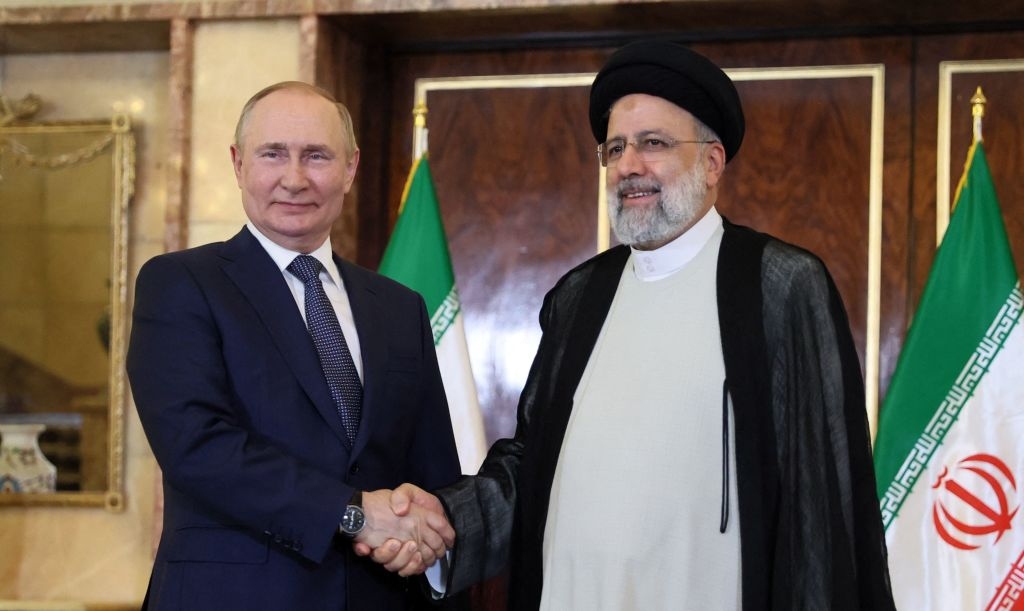
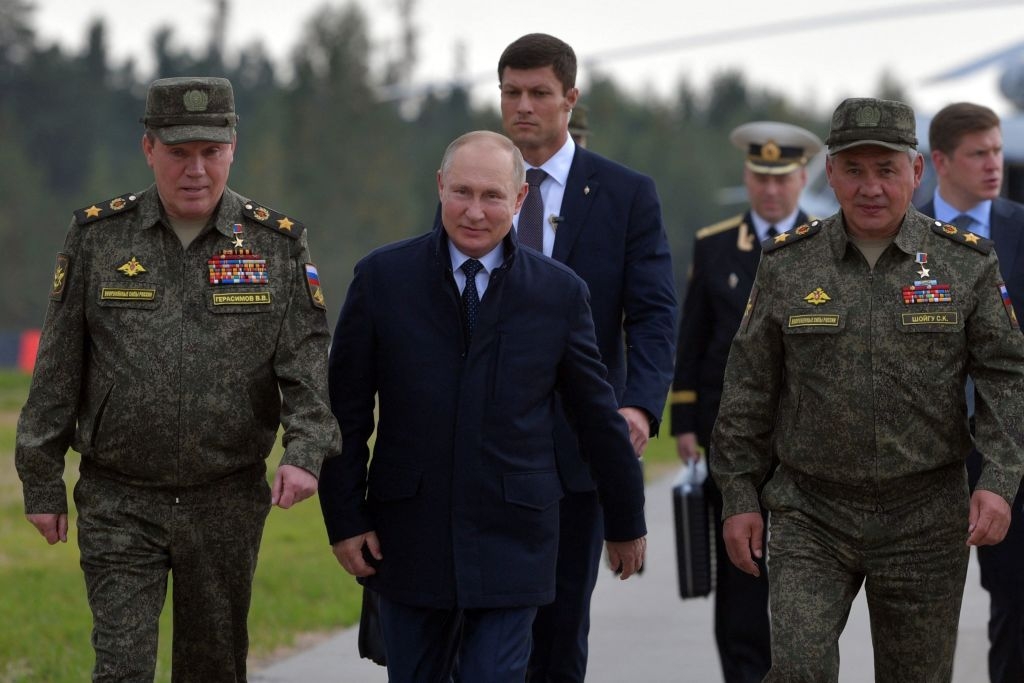
Russia and Iran's cooperation extends to the military and space fields, with Russia recently helping Iran to launch a new satellite into space. Pictured: Russian President Vladimir Putin and Iran's President Ebrahim Raisi hold a meeting in Tehran on July 19, 2022. (Photo by Sergei Savostyanov/Sputnik/AFP via Getty Images)

Iran and Russia have been strengthening their alliance recently, growing it gradually to such an extent that the Wall Street Journal wrote on August 27 that the two countries were "forging tighter ties than ever," as both countries face continued international isolation.

In recent months, Russia and Iran have signed a multitude of agreements, especially in trade, oil and gas, and military cooperation.

In June, an agreement on the establishment of mutual trade centers in St. Petersburg and Tehran was signed, to generate further trade between the two countries in the sectors of energy, transportation, electronics, agriculture, food, pharmaceuticals and construction, by helping Iranian and Russian businessmen establish contacts and conduct financial transactions.

In May, Russia and Iran signed agreements on settling their trade and energy payments in their national currencies instead of the US dollar. In addition, they agreed to continue talks to connect their electronic payment systems as well as their financial messaging systems. Since then, Russia and Iran have gradually begun trading in their national currencies.

In 2021, the volume of bilateral trade between Russia and Iran increased by 81% from the previous year, rising to $3.3 billion. In January, after a two-day visit to Moscow, Iranian President Ebrahim Raisi said that the two countries would increase trade even further.

"We agreed to remove trade barriers and boost the economic exchanges between the two countries. Currently, the level of mutual trade is not acceptable, so the two countries agreed to increase trade to $10 billion a year. The two countries can take steps to break the dominance of the dollar over monetary and banking relations and trade with the national currency."

During Raisi's visit, the two countries also signed agreements to deepen energy cooperation and in July, Russia announced that it would invest $40 billion in Iran's oil industry, Russia's largest ever investment in Iran. Russia announced the investment deal as Russian President Vladimir Putin was visiting Iran for talks.

According to Iranian state news outlet IRNA, Putin and Raisi "discussed ways for expansion of bilateral relations in different areas, including energy, transit, trade exchanges and regional developments as well."

Significantly, Russia and Iran's cooperation extends to the military and space fields, with Russia recently helping Iran to launch a new satellite into space: On August 9, Russia launched Iran's new Khayyam surveillance satellite from the Baikonur space station in Kazakhstan.

The launch of the satellite is a telling example of the kind of dangers that a strengthened Russian-Iranian alliance poses to US interests.

Iran's Khayyam satellite "will greatly enhance Tehran's ability to spy on military targets across the Middle East," according to unnamed Western and Middle Eastern officials quoted by the Washington Post. The satellite's high-resolution camera apparently gives Tehran "unprecedented capabilities, including near-continuous monitoring of sensitive facilities in Israel and the Persian Gulf."

Iran will also be able to "task" the new satellite to spy on locations of its choosing, as often as it wishes, according to the officials.

"It's not the best in the world, but it's high resolution and very good for military aims," a Middle Eastern official familiar with the hardware of the satellite told the Washington Post in June 2021.

"Iran could share the imagery with pro-Iranian militia groups across the region, from the Houthi rebels battling Saudi-backed government forces in Yemen to Hezbollah fighters in southern Lebanon and Shiite militias in Iraq and Syria."

"This is obviously a clear and present danger to the United States and our allies in the Middle East and abroad," said Richard Goldberg, a former Iran analyst in the Trump administration's National Security Council.

"As Iran perfects its missile arsenal – from short-, medium- to longer-range missiles, alongside its growing UAV capability throughout the Middle East –being able to sync those capabilities with satellite capabilities and surveillance will only increase the lethality of the Iranian threat."

For the time being, however, the Iranian satellite is meant to be helping Russia's war effort in Ukraine, another example of the mutual benefits accruing to both Russia and Iran from their alliance.

"Russia, which has struggled to achieve its military objectives during its five-month-old assault on Ukraine, told Tehran that it plans to use the satellite for several months, or longer, to enhance its surveillance of military targets in that conflict," the Washington Post wrote.

Equally significantly, Iran is now actively helping Russia with its war effort in Ukraine, which puts on display the extremely negative effects of the new Russian-Iranian alliance.

Russia has ordered hundreds of Iranian military drones as Russia suffers from a severe lack of attack drones that are precision-capable. Russia has bought at least two kinds of drones from Iran, the Mohajer-6 and the Shahed-series drones. The first batch of drones, according to the Washington Post, was picked up by Russian cargo flights in late August. Iran reportedly has been training Russian soldiers in using them in Russia's war in Ukraine. On September 13, Ukraine said that it had shot down an Iranian-produced Shahed drone.

Iran has become a major developer and producer of drones. In October 2021, the Wall Street Journal reported the concern of defense officials from the United States, Israel and Europe that Iran's progress in developing, building and deploying drones was changing the security situation in the Middle East region.

"The drones themselves are often made with widely available components used in the ever-growing commercial drone market and by hobbyists, the officials say," the Wall Street Journal reported.

"Some mimic the designs of Israeli and American military drones... Tehran's engineers rely on imported components to create aerial vehicles that can accurately strike targets at long distance and rapidly change direction to avoid air defenses and radar, say European and Middle Eastern security officials who have studied wreckages of the drones."

Most recently, Iran claimed that it had developed a long-range suicide drone "designed to hit Israel's Tel Aviv, Haifa."

In July, US National Security Adviser Jake Sullivan denounced the new cooperation between Russia and Iran:

"Russia deepening an alliance with Iran to kill Ukrainians is something that the whole world should look at and see as a profound threat."

Despite this acknowledged "profound threat" emanating from the mutually beneficial alliance between Russia and Iran, the Biden administration nevertheless has been making dangerous concessions to revive the nuclear deal, which would only deepen the threat and benefit not only Iran, but also Russia.

"Several of Russia's top state-controlled nuclear companies stand to gain billions of dollars in revenue as part of a new nuclear accord with Iran that will waive sanctions on these firms so that they can build up Tehran's nuclear infrastructure," the Washington Free Beacon reported in April.

"Russia's state-controlled Rosatom energy firm and at least four of its major subsidiaries will receive sanctions waivers under a new accord so that they can complete nuclear projects in Iran worth more than $10 billion, according to the 2019 document, which details all the Russian entities involved in these projects. With a new nuclear accord being finalized, the Biden administration has repeatedly guaranteed Russia that it will not face sanctions for its work on Iranian nuclear sites, even as Moscow faces a barrage of international penalties for its unprovoked war in Ukraine. The Biden administration renewed a series of sanctions waivers to permit Russia's nuclear work in Iran as part of a package of concessions meant to entice both countries into signing a new accord."

Let us hope that the new "Iran nuclear deal," reportedly "off the table for the time being" is off the table for good.

Judith Bergman, a columnist, lawyer and political analyst, is a Distinguished Senior Fellow at Gatestone Institute.


Sunday, June 4, 2017

Majid Rafizadeh : Death of a Religious Minority Under Radical Islam - the persecution of the Baha'i faith

  • How can a religion seize so much power in a country? Before Islamists come to power, they make sham promises to every faith and political party. Using charm, manipulation, and community infiltration, they give the impression that they will be defenders of minorities, the poor, and local politics. Once they are in power, when it is too late to stop them, anyone who does not comply with their narrow view of religion and politics will be eliminated under the name of God and Islam.
  • The authorities engaged in hate speech and allowed hate crimes to be committed with impunity against Baha'is, and imprisoned scores of Baha'is on trumped-up national security charges, imposed for peacefully practicing their religious beliefs. Allegations of torture of 24 Baha'is in Golestan Province were not investigated. The authorities forcibly closed down dozens of Baha'i-owned businesses and detained Baha'i students.
  • It is not an "Iran problem", it is an epidemic of hatred and violence that will continue to spread if something is not done to stop it.
They were quiet family, not politically minded, and they did not get involved in community unrest or gossip. Fear of people knocking on the door, or of a stranger showing up in the neighborhood with unknown intentions, drove them to withdraw from society. They were careful, so careful, that they barely mingled with anyone. They were our neighbors in Iran and trusted us enough to visit with us, until one day, they no longer did.

We checked on them out of concern. Their house was empty. There was no note, no goodbyes to anyone; they were just gone. Despite being our friends, they had never mentioned their last name. We had no way to track them down, to make sure they were safe and unharmed.

Then someone mentioned that they were from the Baha'i religious minority. He explained that the government had finally come for them. All of their fear and seclusion now had a reason. You could see how protective and careful the father was, how fearful and silent the mother was, and how their daughter would never venture far from home. I had thought their problem was just paranoia. In that moment, you see that you, too, have reason to be afraid.

May 14 is the ninth anniversary of the arrest of Bahai's leadership which included the arrest of seven Baha'i leaders known as "Yaran" or "Friends in Iran".
The Baha'i faith is monotheistic, but a religious minority in Iran. The Baha'i community has been peaceful and apolitical for a long time.

What is important to know is that despite all those slogans by Islamists who claim acceptance and tolerance, if you are living under radical Islamist laws, you are at risk, particularly if you are not a Muslim. You are then viewed by the ruling Islamist imams and clerics as a national security and religious threat. There will be a dark undercurrent of harassment, cruelty, and attacks against any member of a religious minority.

How can a religion seize so much power in a country?

Before Islamists come to power, they make sham promises to every faith and political party. Using charm, manipulation, and community infiltration, they give the impression that they will be defenders of minorities and the poor. Once they are in power, when it is too late to stop them, anyone who does not comply with their narrow view of religion and politics will be eliminated under the name of God and Islam.

That is what happened to, and will continue to happen to, those in the Baha'i community.

Told to believe that it was an inclusive and democratic revolution, many Baha'is participated in Iran's 1979 revolution. Once the Islamist party of Ayatollah Ruhollah Khomeini took power, however, its members began eliminating anyone who did not share their religious or political views.

Since the establishment of the Islamic regime, the Baha'i communities have been systematically persecuted socially, economically, religiously and politically. Tens of thousands have been executed, tortured and imprisoned.

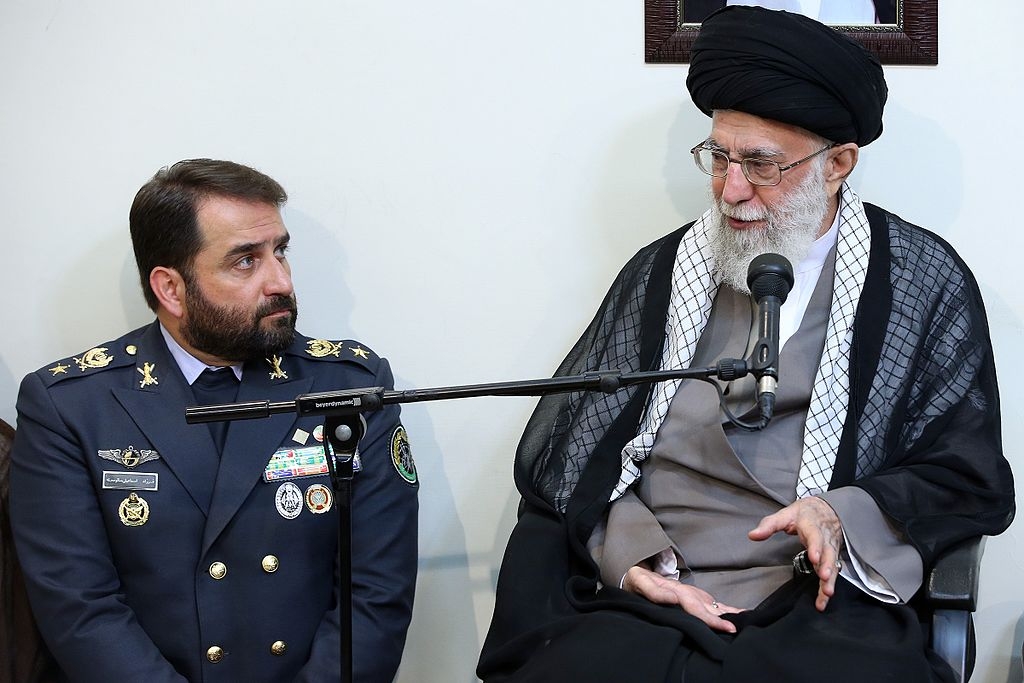
Since the establishment of Iran's Islamic regime, the minority Baha'i communities have been systematically persecuted socially, economically, religiously and politically. Pictured at right: Iran's Supreme Leader, Ayatollah Ali Khamenei. (Image source: Khamenei.ir via Wikimedia Commons)

Why are the Baha'is targeted? Because of their faith. The Baha'i community, with barely 300,000 members in Iran, became one of most persecuted religious minorities, along with Christians, in Iran.

Discrimination permeates every sector, and hate speech against the Baha'is is allowed under Iran's Islamist law. According to the 2016/2017 Iran report by Amnesty International, Baha'is face:
"discrimination in law and practice, including in education, employment and inheritance, and were persecuted for practising their faith.
"The authorities engaged in hate speech and allowed hate crimes to be committed with impunity against Baha'is, and imprisoned scores of Baha'is on trumped-up national security charges imposed for peacefully practising their religious beliefs. Allegations of torture of 24 Baha'is in Golestan Province were not investigated. The authorities forcibly closed down dozens of Baha'i-owned businesses and detained Baha'i students who publicly criticized the authorities for denying them access to higher education."
The situation of the Baha'is has recently undergone an extreme deterioration, under the so-called moderate government of Iran. According to the Human Rights Activist News Agency (HRANA), the businesses of 17 Baha'is in the province of Kerman, and 25 Baha'is in the city of Rafsanjan, were sealed shut by the Iranian regime since the April 29, 2015. Why? Because the stores had "one day closure for a religious holiday."

Last month, three Baha'i residents of Mashhad. Khashayar Taffazoli, Shayan Taffazoli, and Sina Aghdaszadeh were sentenced to one year of prison each, on charges of "acting against national security by teaching the Baha'i Faith." Their crime was their religion; there is no question that they will be tortured as they serve out their sentence.

In addition, according to Bahai News, 18 Baha'i-owned businesses in Shaheen-Shahr, Isfahan Province, were sealed by Iranian officials on May 1, 2017. Although the owners complied with the law, their businesses were closed down without notice. According to a source for Bahai News:
"the officers only targeted the Baha'i businesses and accused them of not complying with the labour law of their trade; but they have sealed the shops because of the Baha'i Holy Day festivities, a time when Baha'is close their businesses of their own volition. This sealing of the Baha'i shops happens systematically every year."
To persecute further those of the Baha'i faith, many of their sacred places have been demolished. This act was carried out by men who are reportedly affiliated with the Iranian regime and its intelligence forces.

The objectives of the Islamist law of the Iranian regime appear to be to eliminate the culture, history, faith, and community of the Baha'is. These oppressive acts of hostility go unchecked due to the stranglehold Iran's regime has on its people, created by fear. Families, like our neighbors, simply vanish.

There are currently two resolutions in the U.S. House of Representatives, House Resolution 274, and in the Senate, Senate Resolution 139. According to the Office of Public Affairs of the Baha'is of the United States:
"These resolutions shine a light on the actions of the Iranian authorities, and they contribute to an international outcry that has helped to mitigate the severity of the persecution."
...
"These resolutions detail the systematic and brutal persecution of the Baha'i community in Iran, and condemn the actions of the Iranian government toward its Baha'i citizens. They call for the release of all Baha'i prisoners – including the Baha'i leaders – and all other religious prisoners in Iran. They also express the desire of the Congress that the President and Secretary of State demand the release of these individuals. Finally, they call on the President and Secretary of State to impose sanctions on individual officials within the Iranian government who are responsible for serious human rights abuses."
Anyone who advocates peace and human rights, anyone who stands for victims of radical Islamist laws, should come to the aid of this religious minority. It will take the action and influence of outside forces to save this community from having its own government destroy it. It is not an "Iran problem", it is an epidemic of hatred and violence that will continue to spread if something is not done to stop it.

I hope that that nice Baha'i family that lived next to us are now living in peace somewhere and practicing their faith without fear of who might knock on the door. There are still entire families, hiding from the threat of persecution, torture, and death that hangs over them in their own country. They deserve to practice their faith, not in the shadows and with fear of imprisonment and torture, but with the ability to rejoice. This should be a basic right for all of us.
Dr. Majid Rafizadeh is president of the International American Council on the Middle East. He is a Harvard-educated and world-renowned Iranian-American political scientist, business advisor, and author of "Peaceful Reformation in Iran's Islam". He can be reached at Dr.Rafizadeh@Post.Harvard.Edu.
  • Follow Majid Rafizadeh on Twitter

Saturday, May 27, 2017

Stefan Frank : German Companies Boycott Breitbart, Not Ayatollahs

German Companies Boycott Breitbart, Not Ayatollahs

by
  • Sadly, there seems to be no benefit in opposing this extortion: No one in Germany will praise anyone for protecting freedom of speech — on the contrary. As far as the American market is concerned, they seem to think: America is far away, no one will ever know about it.
  • For those who do not like self-appointed "morality police" entering the political arena and taking part in "boycott" actions against freedom of opinion, they themselves may consider boycotting those companies or reporting about them on Twitter.
  • The Breitbart boycotters seem to have no qualms about dealing with dictatorial regimes that habitually imprison and torture their citizens. In Iran, Daimler (owner of Mercedes-Benz) wants to become market leader in commercial vehicles. Lufthansa, which allegedly opposes "violence-glorifying, sexist, extremist as well as radical political content," not only offers flights to Tehran, but praises the torture- and stoning-metropolis on its website.

Reports in January noted how Gerald Hensel, a high-ranking employee of Scholz & Friends, one of the two largest advertising agencies in Germany, used his professional position to launch a private war against the freedom of expression, under the slogan "No Money for the Right Wing!"

"Right wing" websites — those which have criticized the German government for its policies on, for example, Muslim mass-migration, the euro rescue or climate policy — should, according to Hensel, be cut off from advertising revenues. If they have no more money, so the thinking goes, it will be more difficult for them to stay in business; perhaps they would give up, and opinions differing from the mainstream would not be put into circulation.

Hensel explained his strategy on his private blog, which featured a red Soviet star: Large conglomerates that want to advertise on the Internet usually do not directly contact specific websites. Instead, computer programs recognize who is interested in a particular product or service, based on the user's search behavior. The advertisement is personalized: a car maker will only approach users who are looking for cars. The advertisement, however, will not only appear on car websites, but on all sites the user visits in the following hours or days.
Hensel urged all of those who are disturbed by diverse views on the internet to exert pressure on companies, by branding particular websites as "right wing." This pressure alone, according to his calculation, would ensure that the company would block the website in question.

His strategy succeeded: Within a few days, the website "Achse des Guten" (Axis of the Good) — one of the most popular German political blogs, which daily exposes the insanity of German politicians and journalists from a common-sense point of view — lost its entire advertising business. Advertising agencies simply cut off the website from their ads.

Those who are leading this war against the freedom of expression often claim innocence: the standard argument is that a company must be able to choose where it wants to place its advertisements, and that this choice has nothing to do with censorship.

The censorship, in fact, takes place elsewhere: where the thought police put pressure on companies to block certain websites. The threat — implicit or explicit — is that if you do not do what we say, we will tell the public that you are advertising with the "right wing," and you know what that would mean for your business.

An internet petition aimed at forcing Amazon to boycott Breitbart News, shows how these activists view freedom of expression:
"Breitbart's advertisers are dropping like flies. ... People power has already forced BMW, T-Mobile and Kellogg's and hundreds of other corporations to drop Breitbart — and now we are going to force Amazon to follow suit. Amazon is receiving loads of pressure already, and if we add our voices from across the planet together now, we can make sure Amazon cannot ignore us anymore."
Activists such as these are not consumers who appeal to a company to meet legitimate ethical demands; rather, they act like a mafia against a restaurant owner who refuses to pay protection money. They occupy the tables with aggressive behavior and scare away the guests — until the owner capitulates, because the economic damage is too great and out of fear of penalties still to come.

Questions to German Boycotters

Gatestone Institute asked some of the large German companies boycotting Breitbart what had caused them to do so: Are there internal guidelines? Are other websites or newspapers boycotted? The answers came quickly and were, in most instances, clearly prefabricated. Inquiries proved fruitless.

AXA, for example, a multinational insurance company based in France, wrote: "AXA Deutschland avoids sites with content that does not fit our brand. The website you mention is part of this."

When Gatestone asked about the criteria, and, with Breitbart, what was the decisive factor for the decision, the answer was: "Please understand that we do not disclose strategies and details of our advertising activities."
Deutsche Telekom / T-Mobile wrote:
"Deutsche Telekom does not advertise on Breitbart.com. ... Deutsche Telekom expressly only allows advertisements to be placed on established networks via 'white listings.' In addition, Telekom regularly defines and updates exclusion lists, so-called 'black listings' of internet pages with undesirable content. We react immediately if we are made aware of Telekom advertising on internet pages with undesirable content, or we ourselves notice Telekom advertising on such sites. I hope the information will be of help. Please understand that we do not comment on our media strategy."
A follow-up question regarding "undesirable content" was answered by a repetition of the previous sentence.

Daimler AG (owner of Mercedes-Benz) sent a "corporate statement," that looked pre-formulated, a kind of encyclical that defines the objectives of the politically correct automobile manufacturer:
"Daimler generally dissociates itself from all forms of discrimination and extremism. Mercedes-Benz has strict advertising guidelines, which are also adhered to by our market and media agencies. These advertising guidelines basically exclude platforms and channels which are not compatible with our principles. These include platforms with content that is extremist or politically polarizing, discriminatory, sexist or criminal in nature. Daimler has also called on its market and media agencies to demand compliance with the strict Mercedes-Benz advertising guidelines for the relevant ad networks."
Criminal content? Extremist? Has Daimler made a mistake? We asked:
"Are you sure that the classification as 'extremist' is not perhaps due to a misunderstanding or a translation error? Could you perhaps mention a few examples of Breitbart articles that spread extremist thought? This would help readers better understand your position."
As with the other companies, there was only a cut-and-paste type of response:
"As we have written, this includes platforms with content that is extremist or politically polarizing, discriminatory, sexist or criminal in nature.... Please understand that we will not name individual items."
The press officer of BMW, responding by telephone, explained that BMW does not have "blacklists" but rather "whitelists," which stipulate exactly where the group's advertising should appear (he mentioned the New York Times as an example of a publication where BMW advertises). When told that German- and English-language newspapers had reported that BMW was boycotting Breitbart, he explained:
 With respect to the "No Money for the Right Wing" campaign launched by Gerald Hensel, journalists had repeatedly called and asked whether BMW advertised on Breitbart. BMW denied this. The journalists might have interpreted this as a "boycott."
Lufthansa, when asked, responded:
"Our principles clearly exclude advertising on websites that represent violent, sexist, extremist and radical political content. The placement of Lufthansa advertising on Breitbart does not meet the stated principles. That is why we have blocked the page for banners that are automated through specialized agencies. The 'blacklist' also includes other websites that do not comply with the above principles."
Does this mean that there is "violent, sexist, extremist and radical political content" on Breitbart? And why is it that answers on the subject of Breitbart always come so fast that they seem to have been shot from a gun? Do journalists frequently ask them about this? Lufthansa's reply:
"We have defined these principles and decided that Lufthansa banners on Breitbart would not be appropriate. And your guess is correct, that your query was not the first on the subject."

Lufthansa, which has Breitbart News on its advertising blacklist, claims to oppose "violence-glorifying, sexist, extremist as well as radical political content." However, Lufthansa not only offers flights to Tehran, but praises the torture- and stoning-metropolis on its website. (Image source: Alexander Hassenstein/Getty Images)

The answer from Volkswagen was:
"Volkswagen of America does not place advertisements on Breitbart.com. However, our Volkswagen trading companies in the USA are privately owned. Our dealers therefore decide independently where they place advertising."
That sounded reasonable. The press officer of Audi (a Volkswagen subsidiary) with whom we also spoke was almost unintelligible:
"Audi of America has in the past not directly placed any advertising on Breitbart. However, the online banner of our American subsidiary was apparently on Breitbart. This happened by means of customer-specific targeting measures. They involved individual users whose surfing behavior resulted in a high degree of automotive interest, and were not bound to specific websites. Audi of America then blocked Breitbart from implementing the targeting measures."
Gatestone: "You said that Audi targets users with high automotive interest. What about someone who shows a strong automotive interest, but who is also a reader of Breitbart News? Can one say that Audi would rather sell fewer cars than to advertise on Breitbart?"
Audi: "The question you asked does not arise for us."
Gatestone: "What can I write in my article about why Audi has blocked the website Breitbart News?
Audi: "I can only refer to our previous statements. We generally do not communicate details of our advertising and communication planning."

Boycott Hysteria and Censorship

Even some left-wing activists have now turned against the boycott hysteria that is spreading among major German conglomerates. On a pacifist site, "War Reporting" (Kriegsberichterstattung), a blogger named "Tom" warned: "Advertising boycott against Trump's Breitbart portal" is "nonsense and dangerous for Daimler AG":
"More than 36 million Americans read Breitbart.com as a news and debate forum — actually, almost every tenth American. To reduce the Breitbart portal to 'racism' or to brand it as 'reactionary,' 'right-wing' or 'extremist,' as some on the left, including advertising specialists, advertising portals and journalists are currently trying to do, misses the point."
With regard to the statement by Daimler, which indirectly accuses Breitbart as a "platform with extremist or politically polarizing, discriminating ... content," the blogger wrote: "It is absurd to dismiss 36 million Americans as being polarized." It is not clear where his number originated.

A commentator at the Frankfurter Allgemeine Zeitung (FAZ) wrote about the German boycott:
"It is currently in fashion to brand and denounce people with incorrect views as being 'right wing.' Companies do not want anything to do with that label and immediately reverse course — as you can follow on Twitter — if they are accused of supporting the wrong sites with their advertising... An advertising boycott is, by the way, not only a measure against allegedly dangerous [opinion] blogs and web portals, but above all against critical press coverage. Anyone who relies on such a thing, especially as a strategist of an advertising agency, positions economic power against the diversity of opinion and freedom of the press."
That German companies immediately comply when someone asks them to boycott an American website is not only because they are accustomed to dance to the whistle of the "left," but also due to German anti-Americanism and the German media campaign against Donald Trump — which is based on precisely that anti-Americanism.

Counter-Pressure is Necessary

It appears that none of the German corporations that have committed themselves to boycotting Breitbart understands what is at stake — protecting freedom of speech. It is highly probable that none of their decision-makers has ever read a single article on Breitbart. The only thing they appear to know is that this is an American website that has something to do with Trump and is unpopular with left-wing German journalists. From there, it is a simple business decision: with a few mouse-clicks, opponents of Breitbart — or of any policy with which they might disagree — can harm the image of a brand and thereby sales in Germany. To many, this might seem a bit too close to what Germany did in the 1930s and early 1940s.

Sadly however, there seems to be no benefit in opposing this extortion: No one in Germany will praise anyone for protecting freedom of speech — on the contrary. As far as the American market is concerned, they seem to think: America is far away, no one will ever know about it.

The only thing that could cause them to surrender to the pressure from activists is counter-pressure — people saying to them, "We are not pleased that you, without even informing yourselves, are submitting to activists who believe they have the right to determine which opinions may be published." If there were such pressure, the decision to boycott would not be so pleasant. For those who do not like the self-appointed "morality police" entering the political arena and taking part in "boycott" actions against freedom of opinion, they themselves may consider boycotting those companies or reporting about them on Twitter.

"Have fun in Tehran"

The Breitbart boycotters, incidentally, seem to have no qualms about dealing with dictatorial regimes that habitually imprison and torture their citizens. During an annual meeting of Daimler AG, a shareholder asked the board of directors to which countries the company was exporting military vehicles. The answer was: Abu Dhabi, Algeria, Bahrain, Kuwait, Qatar, Saudi Arabia and Turkey, among others.
In Iran, Daimler wants to become market leader in commercial vehicles.

In January 2016, Daimler Trucks CEO Wolfgang Bernhard arrived in Tehran "just a few hours" after the official lifting of sanctions against Iran. According to the Iranian news agency IRNA, Daimler paid 42 million euros in compensation to the Iranian state company Khodro because Daimler was no longer able to manufacture vehicles in Iran, as a result of sanctions imposed in 2010. Has Daimler never heard of the Iranian regime being rather "extremist, politically polarizing, discriminatory, sexist, and criminal"?

Similarly, Lufthansa, which allegedly opposes "violence-glorifying, sexist, extremist as well as radical political content," not only offers flights to Tehran, but praises the torture- and stoning-metropolis on its website with the words: "The hustle and bustle on the streets has everything you expect from a megacity. ... Have fun in Tehran before you have to catch your Lufthansa flight back home."
Stefan Frank is a journalist and author based in Germany.

Wednesday, April 12, 2017

Barry Shaw : The Consequences of Inaction


  • The reality is that the actors who are replacing a once powerful and influential America are malevolently reshaping both the Middle East and Asia in their own image.
  • "I announce my separation from the United States... I've realigned myself in your ideological flow, and maybe I will also go to Russia to talk to Putin and tell him that there are three of us against the world -- China, Philippines and Russia." — Philippines President Rodrigo Dutere, in a speech to China's leaders in Beijing, Oct. 20, 2016.
  • Statements that relations were "steady and trusted" by US Assistant Secretary of State, David Russel did nothing to hide the fact that America's self-imposed impotence is being felt in Asia.
Action, including inaction, has consequences. We have seen this in the failure of the US to respond to:
  • Syria's effective genocide of its own people;
  • Russia's unhindered aggression in the Ukraine, Crimea, Syria and in the oil-rich Arctic circle;
  • China building military islands in the South China Sea in an apparent attempt to control international maritime routes
  • ISIS's metastization into 18 countries in three years;
  • Iran, now billions of dollars richer, stepping up its aggression into Yemen, continuing work on its offensive military program, and holding new Americans hostage for ransom;
  • North Korea continuing to develop its nuclear weapons for both itself and Iran;
  • Turkey now threatening adventures in both and Syria and Iraq, where it will probably be thwarted respectively by Russia and Iran.
Most recently, on October 9th, 12th and 15th, missiles were launched against US Navy ships off the coast of Yemen. They were launched by Iranian-backed Houthi rebels and were deliberately fired at American warships.
These attacks followed one aimed at the HSV Swift on October 1. The missiles were all identified by the US Naval Institute as being Chinese-produced C-802 anti-ship missiles, sold to Iran, and now being fired at United States vessels by proxy fighters of Tehran.
Then, Turkish President Recep Tayyip Erdogan responded to Iraqi demands that Turkey withdraw its troops from northern Iraq by telling Iraqi Prime Minister, Haider al-Abadi at the Eurasian Islamic Council meeting in Istanbul:
"It's not important at all how you shout from Iraq. You should know that we will do what we want to do. First, know your place. The army of the Republic of Turkey had not lost its standing so as to take orders from you!"
This is the direct consequence of a deal done between the US State Department and Erdogan whereby the US is allowed to use the Turkish airbase at Incirlik in return for Washington turning a blind eye to Turkish actions against the Kurds. Turkey has been allowed to trespass into Iraq and Syria by the US Administration, under the pretext of adding Istanbul to an Obama coalition of nations fighting ISIS. However, facts on the ground clearly show that Turkey has disproportionately been targeting Kurds rather than Islamic State. Turkish warplanes bombed Kurdish fighters, who were fighting ISIS in northern Syria, on October 20.
Egypt and Russia held a week-long joint military exercise in Egypt at the end of October. That followed renewed Russian supplies of military equipment to Cairo after Obama's refusal to restock the government of Egypt's Abdel Fattah el-Sisi with US-made weapons and equipment. The US had apparently been upset when in 2013 el-Sisi overthrew the Morsi-led government, backed by the Muslim Brotherhood, with whom the US would apparently and incomprehensibly like to be allied.
Philippines President Rodrigo Dutere announced his country's separation from the United States on October 20, by declaring that he has realigned it with China as the two nations agreed to resolved their South China Sea dispute. Dutere made his remarks in Beijing on an official visit to which he brought two hundred business people, saying in his address to China's leadership: "I announce my separation from the United States... I've realigned myself in your ideological flow, and maybe I will also go to Russia to talk to Putin and tell him that there are three of us against the world -- China, Philippines and Russia."
Statements that relations were "steady and trusted" by US Assistant Secretary of State David Russel did nothing to hide the fact that America's impotence is being felt in Asia.

Back to Iran, where a top admiral, Ali Fadavi, said that the US lacks the power to confront Iran militarily. He backed that up by having four Iranian naval speedboats harass US naval ships in the Persian Gulf.


Four armed speedboats of Iran's Islamic Revolutionary Guards Corps harass the US Navy destroyer USS Nitze, on August 24, 2016. (Image source: Fox News video screenshot)

Alon Ben David, chief military correspondent for Israeli TV Channel 10 News, wrote that American foreign policy is turning Iran into a world power by allowing it free range to act in Syria and Yemen, and even having the Obama Administration allow Iran to supply and support a Shi'ite militia taking part in the battle for Mosul.
The acts of global aggression are all the result of an American policy to do little or nothing to stop other actors from strutting the global stage in a dangerous and shifting world.
Many countries evidently believe that America's role in recent years has been one of damaging everything it touches -- or does not touch -- leaving them nervously sitting on the sidelines, criticizing what they perceive as the mistakes of others. The reality is that the actors who are replacing a once powerful and influential America are malevolently reshaping both the Middle East and Asia in their own image.
The result has not been a more peaceful world but one in which the vacuum left by America vacating strategically important areas is rapidly being filled by troublesome power-players that leave countries once dependent on US protection feeling increasingly vulnerable.
The consequences of inaction can only soon be damaging to US interests at home as well as abroad.
Barry Shaw is a Senior Associate for Public Diplomacy at the Israel Institute for Strategic Studies.
==============

Saturday, April 8, 2017

Najat AlSaied : Middle East: A Shift from Revolution to Evolution


  • The lesson the Trump administration might learn from the disastrous mistakes of its predecessor is that the main sources of terrorism in the region are political Islam and all its related religious groups. All these radical groups, including ISIS, Al-Qaeda, Jabhat Al-Nusra and Hamas have been spawned by a political Islam driven by the ideology of the Muslim Brotherhood.
  • The fight, therefore, should not be against Islam, but against political Islam. Islam needs to be practiced the way other religions are, as a private personal faith that should be kept separate from public life and politics, and whose expression should be confined to worship only.
  • Mosques, whether in the Arab and Muslim world or in the West, should be places of worship only and must not transformed to centers for polarizing society or for recruitment by political religious groups.
After each Islamist terrorist attack in the West, the public is divided into two camps: one angry and one indifferent. The problem with defeating Islamist terrorism seems to be that either it is attacked by conservatives who call Islam an evil cult or it is forgiven entirely by liberal apologists. What, then, is the answer?

One of the main failures in Western analyses of the origins of terrorism in the Middle East and North Africa is that the West attributes them to a lack of democracy and a lack of respect for human rights. This is, indeed, part of the cause, but the root of the problem is a lack of development and modernity. U.S. President Donald Trump did not exaggerate when he said that the Obama administration's foreign policy was disastrous. It was catastrophic mainly for two reasons. One was the knee-jerk support for the "Arab Spring" and for extremist Islamic political groups such as the Muslim Brotherhood. The second was the alliances the Obama administration built with unreliable countries such as Qatar, which supports radical political groups such as the Muslim Brotherhood. In addition, Obama made the mistake of continuing to try to appease Iran's theocratic regime.

The Arab Spring's uncalculated, hasty attempt to establish so-called democracy only generated more turmoil and chaos in the region. 

Certain radical political groups simply exploited the elections to serve their own political and sectarian agendas; that swoop for power only resulted in more authoritarian and dictatorial regimes, as have played out, for instance, in Egypt, where we have witnessed the murder of civilians and police officers by the Muslim Brotherhood. In other countries, the situation is even worse; attempts to install democracy have totally destroyed the state and facilitated the spread of terrorist militias, as in Libya.

It is ironic that Western countries and their advocates stress the need to apply democratic practices in Arab countries, but evidently do not recall that development and secularism preceded democracy in Western Europe. The United Kingdom, which has the oldest democratic system, did not become fully democratic until 1930. France became fully democratic only in 1945, 150 years after the French Revolution.


The Emir of Qatar, Sheikh Tamim bin Hamad Al-Thani, at the Arab Summit in Jordan on March 28, 2017 delivered a speech in which he indicated his continuous support for the Muslim Brotherhood:
"If we are serious about focusing our efforts on armed terrorist organizations, is it fair to consider any political party we disagree with as terrorist? Is our goal to increase the number of terrorists?"
Many Arab leaders were infuriated by his speech; at the forefront was President Abdel Fattah el-Sisi of Egypt, who left the Arab Summit Hall during the speech to meet King Salman of Saudi Arabia.
Most Arab leaders and analysts, in fact, are enraged by Qatar's continuous support for Islamist political groups such as the Muslim Brotherhood, because these groups are a threat to their national security.


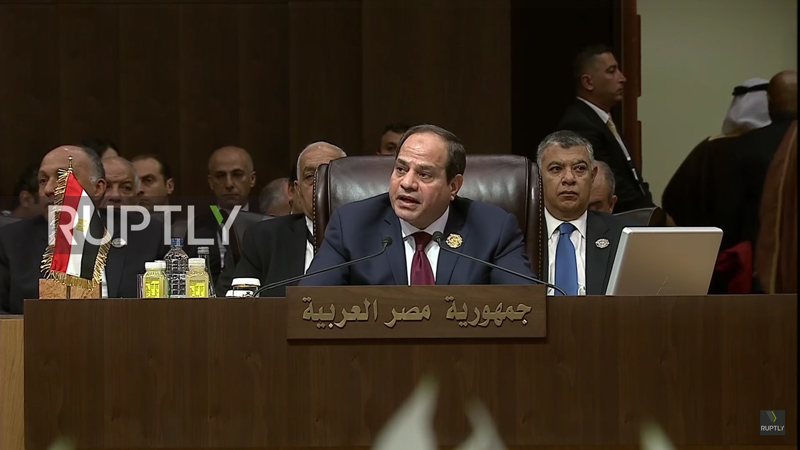
President Abdel Fattah el-Sisi of Egypt speaks at the Arab Summit, on March 29. The previous day, Sisi walked out of a speech by the Emir of Qatar, Sheikh Tamim bin Hamad Al-Thani. Sisi was infuriated by Al-Thani's declaration of support for the Muslim Brotherhood. (Image source: Ruptly video screenshot)

Another consequence of Obama's foreign policy -- in particular attempts to get close to Iran's hostile regime -- has been a fraying of relationships with old Arab allies of the United States. Some of Obama's advisors thought that replacing Saudi Arabia with Iran was somehow "better" for the United States, if Iran "is beginning to evolve into a very civilized and historically important country" -- an analysis that can be described as completely short-sighted.

The Saudi regime, with all its flaws, is a monarchy run by princes; the Iranian regime is a theocracy run by clerics. The Saudi regime is not a theocratic regime but a hybrid structure, which is neither wholly secular nor wholly religious. As such, the religious class functions under the authority of the ruling class. Princes are driven by self-interest; clerics are driven by ideology. In terms of extremism, the Iranian regime is pushing for hegemony, whilst Saudi Arabia has been taking only a defensive, rather than an expansionist, position.

The motivation of Saudi Arabia in exporting mosques world-wide and installing radical Saudi imams is defensive, not expansionist as in Iran. Saudi Arabia's impetus is to confront Iran's hegemony and the spread of its hostile ideology.
It is this strategy, which Saudi Arabia has practiced since 1979 to balance Iran's power and to combat its rebellious ideology, that must change.

That Iran's Khomeini regime sought to embarrass Saudi Arabia -- a country that is home to Islam's two holiest mosques, in Mecca and Medina -- by portraying it as not sufficiently Islamic, meant that the foundational Islamic Wahhabism of the Saudi Kingdom was aggressively reinforced.
This emphasis resulted in even more constraints being put in place in Iran: especially on entertainment. Since the Khomeini revolution in 1979, all plays, fashion shows, international events, and cinemas have been banned.
As for women, the Commission for the Promotion of Virtue and Prevention of Vice has increasingly harassed them.
As for minorities, especially Shia challenging the Iranian Shia regime and its support for Shia militias -- particularly the dominant Revolutionary Guards -- books were published attacking the Shia:
More books appeared, attacking the Shias and especially Khomeini's views. These books – like the arguments of Khomeini's followers – rejected modern thinking as an "intellectual invasion." Saudi Arabia, considered the guardian of Sunni Islam, spent billions of dollars on challenging the Khomeini-backed Shiites.
This religious one-upmanship -- a competition over which body can be the "most religious" -- must stop.
Saudi Arabia would do well to understand that in order to confront the hegemony of the Iranian theocratic regime, the answer is not to radicalize Saudi society but to return to the way it was before 1979.

The best way to defeat the rebel hostile regime in Iran might be through creating an inclusive and tolerant society in Saudi Arabia. Saudi Arabia needs to change its approach towards Iran because the current strategy has not worked. The current strategy has done nothing except to strengthen the Iranian regime's dominance; distort, globally, the image of Saudi Arabia and accelerate terrorism.

The lesson the Trump administration might learn from the disastrous mistakes of its predecessor is that the main source of terrorism in the region are political Islam and all its related religious groups. All these radical groups including ISIS, Al-Qaeda, Jabhat Al-Nusra and Hamas have been spawned by a political Islam driven by the ideology of the Muslim Brotherhood. Extremist jihadists such as Osama bin Laden, Abdullah Azzam and Ayman al-Zawahiri were all taught by the Muslim Brotherhood.

Political Islam practiced by the Iranian theocratic regime has been comfortably generating Shia radical militias, including the terrorist group, Hezbollah. The fight, therefore, should not be against Islam, but against political Islam.

 Islam needs to be practiced the way other religions are, as a private personal faith that should be kept separate from public life and politics, and whose expression should be confined to worship only. Mosques, whether in the Arab and Muslim world or in the West, should be places of worship only and must not transformed to centers for polarizing society or for recruitment by political religious groups. Unfortunately, Western countries have turned a blind eye to the political activities inside these mosques.

The danger of these religious political groups is that they do not believe in democracy or human rights; they just use elections to grasp power in order to impose a system of "Islamic Caliphate" as their only form of government. Most of these groups use religion as an ideology to oppose governments other than their own, and when they are criticized or attacked, they play the role of the oppressed.
The Trump administration needs to take advantage of the fact that the majority of people in the Middle East and North Africa have lost faith in religious political groups, especially since the failure of the Muslim Brotherhood in Egypt and Tunisia.
Before the Arab Spring, support for these groups was huge; now it stands at less than 10% of the population. This study was conducted in the Arab world, not including Turkey. The Muslims who support Turkish President Recep Tayyip Erdogan are the Muslim Brotherhood.

Most recent polls indicate that the majority of people in Arab and Muslim countries prefer religion to be kept separate from politics.

The country that is working the most systematically to fight these religious political groups in the region is the United Arab Emirates (UAE). There are several institutes and think tanks researching how to combat these groups. Dr. Jamal Sanad Al-Suwaidi, Director General of the Emirates Center for Strategic Studies and Research (ECSSR), has given a robust analysis of these groups and how to combat them in his book, The Mirage. In it, he cites a study on public opinion on political religious groups: A survey of the UAE population, on how these groups are able to influence the public by taking advantage of certain flaws in the system: 53.9% because of corruption; 47.9% because of poverty and 29.1% because of an absence of civil society groups that confront these opportunists.

The Middle East-North Africa region will undoubtedly have to go through several stages before it can successfully establish democracy. An evolutionary developmental approach will definitely be better than the failed revolutionary democratic one pursued by the Obama administration.

Secularization is also crucial in the fight against terrorism. Trying to build a democracy before going through the stages of secularism and political reformation -- which includes rectifying existing flaws, such as corruption; modernization which means the liberation of the region from extremist totalitarian religious dogma and all other forms of backwardness in order to kick-start a renaissance; and scientific development -- will not only be inadequate but will actually generate more terrorism by helping radicals to keep gaining power. It would be like a farmer who wants to plant roses in arid desert soil full of thorns.
Najat AlSaied is a Saudi American academic and the author of "Screens of Influence: Arab Satellite Television & Social Development". She is an Assistant Professor at Zayed University in the College of Communication and Media Sciences in Dubai-UAE. She can be reached at: najwasaied@hotmail.com
===================

Majid Rafizadeh : Sentenced to Death for "Insulting Islam"


  • Can you imagine making a joke and facing death as a result?
  • "During his interrogation, Sina was told that if he signed a confession and repented, he would be pardoned and let go," said the source in an interview with CHRI on March 21, 2017. "Unfortunately, he made a childish decision and accepted the charges. Then they sentenced him to death." "Later he admitted that he signed the confession hoping to get freed," said the source. "Apparently the authorities also got him to confess in front of a camera as well." -- Center for Human Rights in Iran (CHRI).
  • When the Islamists gain power, they immediately create their own "judiciary system" in order to "legitimize" their implementation of sharia law. In fact, the judiciary system is used less as a tool for bringing people to justice, and more as a tool to suppress freedom of speech and of the press.
To radical Islamist groups, Islam is not a religion which all are free to pursue; it is a weapon. It is the most powerful tool that can be wielded with manipulative skill to control entire populations. 

Beneath their fierce rule, every aspect of daily life is dictated. What is worn, what is eaten, what you say and what you write are all scrutinized; violations of these stringent laws are met with extreme punishments. Can you imagine making a joke and facing death as a result? Can you imagine the constant fear of doing the wrong thing, saying the wrong thing, when you have seen people beaten, stoned, or killed in the street for nothing more than a mild transgression?

Freedom of speech and press are the Islamists' top enemies. They are targeted on a regular basis, making it difficult or impossible for the truth to be revealed to the world. While others may take their privacy for granted, the people living under this kind of tyranny must think about everything they say and do. Sometimes even the bravest of souls turn away in the face of such intimidation. Can it really be as restrictive as described? Yes, and far worse than you can imagine.

Sina Dehghan, 21, for example, was arrested by Iran's Islamic Revolutionary Guard Corps (IRGC) when he was 19 for "insulting Islam". Charges were brought against him for insulting the Prophet Muhammad on the messaging app LINE.
According to the Center for Human Rights in Iran (CHRI):
"During his interrogation, Sina was told that if he signed a confession and repented, he would be pardoned and let go," said the source in an interview with CHRI on March 21, 2017. "Unfortunately, he made a childish decision and accepted the charges. Then they sentenced him to death." "Later he admitted that he signed the confession hoping to get freed," said the source. "Apparently the authorities also got him to confess in front of a camera as well."
Such a sentence may seem like madness, but in fact there is a cold and calculated pattern to these actions. 
When extremist Muslims gain power, they immediately create their own "judiciary system" in order to "legitimize" their implementation of sharia law. This judiciary system is, in fact, used less as a tool for bringing people to justice, and more as a tool to suppress freedom of speech and freedom of the press. Once this silence is ensured, they are able to oppress the entire society, restrain any budding opposition, imprison and torture innocent people and sentence thousands to death.


Sina Dehghan, 21, has been sentenced to death in Iran for "insulting Islam". There are many people like him in Iran who are currently imprisoned, tortured on a daily basis, or awaiting their execution for "insulting Islam", "insulting the prophet", "insulting the Supreme Leader" -- the examples are endless. (Image source: Center for Human Rights in Iran)

By imprisoning, torturing and hanging idealistic and rebellious young people, the ruling politicians and the Islamist judiciary system are using them as an example to send a message to millions of people that they will not tolerate anyone who opposes their religious or political view.

Radical Islamist groups have been using the same tactic in other nations to impose fear and shock in the public. They aim at silencing people and making them subservient. Once they have control, they will stop at nothing to keep it.

For the Islamists, once you submit to their religion, your freedom of speech and of the press belong to Allah. Your only job is to exercise silence and obedience, and follow your religious leader, imam, sheikh, or velayat-e faqih ("guardianship of the Islamic jurist").

As the Center for Human Rights in Iran pointed out:
"Security and judicial authorities promised Sina's family that if they didn't make any noise about his case, he would have a better chance of being freed, and that talking about it to the media would work against him," added the source. "Unfortunately, the family believed those words and stopped sharing information about his case and discouraged others from sharing it as well." "Sina is not feeling well," continued the source. "He's depressed and cries constantly. He's being held in a ward with drug convicts and murderers who broke his jaw a while ago."
For the ruling Islamists, it does not matter if you have been a loyalist all your life. If you speak up or oppose them just once, you will be eliminated. 

As CHRI quoted one source: "He was a 19-year-old boy at the time (of his arrest) and had never done anything wrong in his life."

One of Dehghan's co-defendants, Mohammad Nouri, was also sentenced to death for posting anti-Islamic comments on social media. Another co-defendant, Sahar Eliasi, was sentenced to seven years, and later the sentence was reduced to three years.

What does the term "anti-Islamic" mean exactly in an Islamist judiciary system? If it carries a death sentence, you might assume that the parameters of the law would be well outlined. However, that is not the case. For the ruling Islamists, the term "anti-Islamic" is completely ambiguous and subjective, and can relate to anything that opposes their view or their power. What might seem like an innocent remark, could change a life forever.

If they are such violent and oppressive people, you might wonder how they are ever able to gain power. They do this through manipulation, charm and countless false promises.

Some radical Islamists, before they gain power, promise people equality, justice, peace, and a far better life. They appeal to the young, to the traditional, and to the hopeful. But once they seize power, they close an iron grip around any and all freedoms, available to their people -- in particular freedom of speech.

Once radical Islam has gained power, established its own judiciary system, or infiltrated the legal system with its sharia law, no one is capable of criticizing the government or the political establishment. In a social order ruled by radical Islam, the government is Islam; the government is the representative of Allah and the Prophet Muhammad. Ruling politicians who decide the laws are "divine" figures supposedly appointed by God. They are not to be questioned.

There are many people like Sina Dehghan who are currently imprisoned, tortured on a daily basis, or awaiting their execution for "insulting Islam", "insulting the prophet", "insulting the Supreme Leader" -- the examples are endless. The issue is that we do not hear about these cases.

Some media outlets refuse to report on them in order to appease the Islamic Republic of Iran -- just further proof of how coercive their power can be. The only way to reduce it -- and the oppression and slaughter of so many people -- is to bring attention to the human rights abuses conducted under the Islamic banner of religious "legitimacy " and "authenticity".

This type of tyranny is a danger, not just for those enduring it, but for the world.
Dr. Majid Rafizadeh, political scientist and Harvard University scholar is president of the International American Council on the Middle East. He can be reached at Dr.rafizadeh@post.harvard.edu.
  • Follow Majid Rafizadeh on Twitter
=======================

Wednesday, April 5, 2017

Heshmat Alavi : Iran: Why the Mullahs Will Not Reform from Within


  • Iran's entire power structure and most of its civil society is centralized under the personal control of the Supreme Leader. In this way, Iran's dictatorship is every bit as entrenched as North Korea's, making the idea of traditional regime change a pipe dream.
  • The mullahs created a regime -- an entrenched revolution -- specifically designed to resist change or reform, adopting a unique theocratic structure that uses both Islamic ideology and brutal force to maintain absolute power.
  • There is but one regime, and it has no interest in "reform."
  • The membership of every single one of the many official-sounding bureaucratic organs is personally approved by the Supreme Leader. Indeed, any individual, or coalition of individuals who might serve as a check on his absolute power is, in fact, completely beholden to Khamenei's whims, making him the most complete and powerful dictator on the planet.
  • Elections in this regime are not indicative of any form of "democracy". Instead, they are merely a process of choosing among individuals vetted by the Supreme Leader. There are no factions based upon ideological differences, there is mere jockeying for position and the personal favor of the Supreme Leader.
  • Western governments' policy of providing concessions to the Iranian regime in order to empower "reformist" factions is based on a fantasy -- a fantasy which the Iranian regime deliberately encourages in order to fool naïve foreign leaders into easing sanctions and turning a blind eye to the nuclear program. In reality, Western concessions are strengthening Khamenei -- further reducing the possibility of change, and increasing the likelihood of outright war.

Ever since Iran's mullahs rose to power in 1979 and established an "Islamic Republic", they have worked to consolidate power both at home and abroad. Given Iran's growing belligerence toward its neighbors, persistent crackdowns on domestic dissidents, and frightening nuclear ambitions, foreign analysts often talk about the possibility of regime change in Tehran. But there is very little understanding of the obstacles to dethroning the mullahs -- namely, that the entire power structure and most of civil society is centralized under the personal control of the Supreme Leader. In this way, Iran's dictatorship is every bit as entrenched as North Korea's, making the idea of traditional regime change a pipe dream.

The mullahs created a regime -- an entrenched revolution -- specifically designed to resist change or reform, adopting a unique theocratic structure that uses both Islamic ideology and brutal force to maintain absolute power.

The official name of this system is Velayat-e Faqih ("custodianship of the clergy") and it places all religious and legal authority in the hands of the Supreme Leader. What this means, in both theory and in practice, is that the Grand Ayatollah Sayyed Ali Hosseini Khamenei (like Ruhollah Khomeini before him) plays a direct role in all the country's affairs; and no individual, group, or committee in the country has the right to question or hold him accountable.

Khamenei exercises his authority through a morass of official-sounding bureaucratic organs, including the "Guardian Council", "Expediency Council", "Supreme Council of Leader, "Supreme National Security Council", "Strategic Council of Foreign Policy", and of course a "Council of Cultural Revolution". What one must understand is that the membership of every single one of these organizations is personally approved by the Supreme Leader. Indeed, any individual, or coalition of individuals who might serve as a check on his absolute power is, in fact, completely beholden to Khamenei's whims, making him the most complete and powerful dictator on the planet -- perhaps exceeding even Kim Jong-un in unrivaled control of North Korea.

The Guardian Council is the Khamenei's most important instrument; it has titular oversight of both the executive and legislative branches. All candidates for presidential or parliamentary election must be approved by this council, allowing him to exert his personal control over the outcome of elections. Likewise, all acts of parliament and new legislation must be confirmed by the Guardian Council.
Even decisions of the Guardian Council are subject to the Grand Ayatollah's veto; he reserves the right to reject legislation or winning candidates. And some decisions, like senior judicial appointments, do not go through the Council at all. Meanwhile, the entire domestic and foreign financial system is controlled through a parallel system of committees and "foundations" which are likewise under Khamenei's personal control.

While the Khamenei is the commander-in-chief of all the armed forces, his most feared weapon is the parallel army founded by his predecessor: the Islamic Revolutionary Guards Corps (IRGC). Fiercely loyal to the Supreme Leader and brutally ruthless, the IRGC is lethally efficient in protecting the regime at home and exporting the "revolution" abroad, in places as varied as Yemen and South America.

As commander-in-chief of all armed forces Khamenei appoints the joint chiefs of staff, commander of the IRGC, and senior commanders of the army and all security forces, making the possibility of a military coup extremely unlikely.
Iranian civil society is an illusion; all of the government and by extension most of the private sector are mere extensions of the Grand Ayatollah's personal will. Velayat-e Faqih is the only state ideology; the only differences of opinion are about how it should be implemented.

Therefore, elections in this regime are not indicative of any form of "democracy". Instead, they are merely a process of choosing among individuals vetted by the Supreme Leader. There are no factions based upon ideological differences, there is mere jockeying for position and the personal favor of the Supreme Leader.
Traditional "regime change" in Iran is inconceivable. The Western obsession of labeling the regime's factions as "reformists" or "hardliners" is laughable. There is but one regime, and it has no interest in "reform".


Traditional "regime change" in Iran is inconceivable. The Western obsession of labeling the regime's factions as "reformists" or "hardliners" is laughable. There is but one regime, and it has no interest in "reform".

This regime will only change if the entire Supreme Leadership structure, along with all its linked organs, especially the IRGC, are annulled and dissolved. Otherwise, whether the president is the "hardliner" Mahmoud Ahmadinejad or the "reformist" Hassan Rouhani, the regime's policies will remain the same.

Western governments' policy of providing concessions to the Iranian regime in order to empower "reformist" factions is based on a fantasy -- a fantasy which the Iranian regime deliberately encourages in order to fool naïve foreign leaders into easing sanctions and turning a blind eye to the nuclear program. In reality, Western concessions are strengthening Khamenei -- further reducing the possibility of change, and increasing the likelihood of outright war.
Heshmat Alavi is a political and rights activist. His writing focuses on Iran, ranging from human rights violations, social crackdown, the regime's support for terrorism and meddling in foreign countries, and the controversial nuclear program. He tweets at @HeshmatAlavi & blogs at IranCommentary
=======================