.

.
Library of Professor Richard A. Macksey in Baltimore

POSTS BY SUBJECT

Labels

Wednesday, April 5, 2017

Giulio Meotti : Islamists Won: Charlie Hebdo Disappears


  • "The newspaper is no longer the same, Charlie is now under artistic and editorial suffocation." — Zineb el Rhazoui, French-Tunisian intellectual and journalist, author of Destroying Islamic Fascism.
  • "We must continue to portray Muhammad and Charlie; not to do that means there is no more Charlie." — Patrick Pelloux, another cartoonist who left the magazine.
  • "If our colleagues in the public debate do not share part of the risk, then the barbarians have won." — Elisabeth Badinter, philosopher, who testified in court for the cartoonists in the documentary, "Je suis Charlie."
  • After the Kouachi brothers slaughtered Charlie Hebdo's journalists, they ran out into the street and cried: "We have avenged Muhammad. We killed Charlie Hebdo." Two years later, it appears that they won. They succeeded in silencing the last European magazine still ready to defend freedom of expression from Islamism.
Over twenty years, fear has already devoured important pieces of Western culture and journalism. They all disappeared in a ghastly act of self-censorship: the cartoons of a Danish newspaper, a "South Park" episode, paintings in London's Tate Gallery, a book published by the Yale University Press; Mozart's Idomeneo, the Dutch film "Submission", the name and face of the US cartoonist Molly Norris, a book cover by Art Spiegelman and Sherry Jones's novel, "Jewel of Medina", to name just a few. Most of them have become ghosts living in hiding, hidden in some country house, or retired to private life, victims of an understandable but tragic self-censorship.

Only the French satirical magazine Charlie Hebdo was missing from this sad, long list. Until now.
The disappointment with what Charlie Hebdo has become is reflected in the words of the French journalist, Marika Bret: "From Italy we receive many threats." The reference is not to some Italian jihadist cell, but to a September Charlie Hebdo cover that mocked victims of the earthquake in Italy. It seems that the satirical weekly, almost destroyed by French Islamists two years ago, has been "normalized".
Take Charlie's recent covers. Against terrorists? No. Against those who called them "racists"? No. It was against Éric Zemmour, the brave French journalist at Le Figaro who has led a public debate about French identity. "Islam is incompatible with secularism, incompatible with democracy, and incompatible with republican government," Zemmour wrote.

Laurent Sourisseau, aka "Riss," now the publishing director and majority owner of Charlie, was shot during the 2015 attack on the magazine, and lives under police protection. He depicted Zemmour on the cover with an explosive vest, effectively comparing him to a terrorist.
Charlie Hebdo also recently satirized Nadine Morano, a critic of Islam, depicting her as a baby with Down Syndrome.
Riss also recently published a comic book attacking another easy target of submissive conformists, entitled "The Dark Side of Marine Le Pen." Le Pen leads France's National Front party, with a platform fighting for national sovereignty and Europe's Judeo-Christian identity. In Charlie, the political leader of the French "right" is dressed as Marilyn Monroe.
For the first anniversary of the massacre at Charlie Hebdo's office, Riss released a cover not with Mohammed, but depicting a murderous Judeo-Christian God, as if Riss's colleagues had not been butchered by Islamists but by Catholics. Riss had, in fact, announced earlier that the magazine would "no longer draw Mohammed".
The first person at Charlie to capitulate was "Luz", a well-known cartoonist. He surrendered, saying: "I will no longer draw Muhammad".


Charlie Hebdo, after Islamist terrorists murdered much of its staff in 2015, announced it would "no longer draw Mohammed." Instead, the magazine now focuses on attacking critics of Islamism, and mocking the Judeo-Christian God.

"The transplant that works worst," said Jeannette Bougrab, the companion of Charlie's late editor Stéphane Charbonnier, "is the transplant of balls."
Bougrab charged the attack's survivors with bowing to terrorism and threats by betraying the legacy of free speech for which these truthful men were murdered.

After the massacre of January 7, 2015, the cartoonist "Luz" cried in front of the cameras after presenting a cover depicting the survivors, in which Muhammad was portrayed as saying, "All is forgiven". Luz then appeared in Le Grand Journal along with Madonna, and in a gesture of sad voyeurism, displayed his genitals, covered by the logo "Je suis Charlie".

Charlie's "normalization" was also reflected in the recent dramatic decision to terminate the magazine's relationship with another survivor, the French-Tunisian intellectual and journalist Zineb el Rhazoui, who also now has to live under police protection for her criticism of Islamic extremists.

"The newspaper is no longer the same, Charlie is now under artistic and editorial suffocation," she told Le Monde. Rhazoui is the author of a new book, "Détruire le Fascisme Islamique" ("Destroying Islamic Fascism").

"We must continue to portray Muhammad and Charlie; not to do that means there is no more Charlie", said Patrick Pelloux, another cartoonist who left the magazine.

There were seven cartoonists at Charlie Hebdo. Five were killed on January 7, 2015: Charb, Cabu, Honoré, Tignous and Wolinski. The other two, Luz and Pelloux, resigned after the massacre. The headline of the monthly Causeur captured the atmosphere: "Charlie Hebdo Commits Hara-Kiri," playing with the Japanese form suicide and the previous name of Charlie (which was "Hara-Kiri"). Between murders, desertions and self-censorship, Charlie's story is almost over.

What is happening? Sadly, the Islamists' threats and attacks are working.
A similar crisis affected the Jyllands-Posten, the Danish newspaper that first published the 12 cartoons of Muhammad, which Charlie Hebdo immediately, to show solidarity, reproduced. "The honor of France was saved by Charlie Hebdo," wrote Bernard-Henri Lévy when the magazine republished the Danish cartoons, while many "right thinking" media blasted the "Islamophobia" of those caricatures.
"The truth is that for us it would be totally irresponsible to publish the cartoons today," the director of Jyllands-Posten, Jorn Mikkelsen says to justify his self-censorship. "Jyllands-Posten has a responsibility to itself and its employees." Such as Kurt Westergaard, author of the caricature of Mohammed with a bomb in his turban, who now lives in a house-fortress, with cameras and security windows and machine-gun toting guards outside.

An ideological clash inside Charlie Hebdo developed well before the terror attack. Zineb el Rhazoui arrived at the weekly magazine through editor Stéphane Charbonnier, "Charb", the brave journalist who lead the battle against Islamist intimidation in Europe. Even from his grave, he penned an "Open Letter to the Fraudsters of Islamophobia Who Play Into Racists' Hands."
But, as Libération writes, "Riss opposed Charb; he is less politically identified, more introverted than him."
Charbonnier belonged to the generation of Philippe Val and Caroline Fourest, the libertarian journalists determined to criticize Islam, who, from 1992 to 2009, shaped the weekly magazine.
"Charb? Where is Charb?", shouted the terrorists in Charlie Hebdo's office, to make sure they found the journalist they considered responsible for the Mohammed cartoons controversy.
Philippe Val, who as a former Charlie Hebdo editor, was put on trial in Paris for printing those cartoons, published a book "Malaise dans l'inculture" ("Sickness in the Lack of Culture"), which attacks "the ideological Berlin Wall" that has been raised by the Left.

In 2011, after a firebombing that destroyed Charlie's offices, an appeal by frightened, intimidated journalists announced their refusal to support the magazine's stance on Islam.
Two years later, one of the signatories, Olivier Cyran, a former editor of Charlie Hebdo, charged the magazine with being "obsessive about the Muslims." So did a former Charlie journalist, Philippe Corcuff, who accused his colleagues at the magazine of fomenting "a clash of civilizations."

The attacks continued with another former cartoonist at Charlie Hebdo, Delfeil de Ton, who, in Le Nouvel Observateur, after the 2015 massacre, shamefully accused Charb of "dragging" the staff into the slaughter by continuing to satirize Mohammed.

After the Kouachi brothers slaughtered Charlie Hebdo's staff, they ran out into the street and cried: "We have avenged Mohammed. We killed Charlie Hebdo."

Two years later, it appears that they won. They succeeded in silencing the last European magazine still ready to defend freedom of expression from Islamism. And they sent a special warning to all the others. Because after Charlie Hebdo, writing articles critical of Islam, or penning a cartoon, make them a target for assassination attempts and intimidation campaigns.

The feminist and philosopher Elisabeth Badinter, who testified in court for the French cartoonists in the documentary, "Je suis Charlie," said: "If our colleagues in the public debate do not share part of the risk, then the barbarians have won."

The magazine Paris Match asked Philippe Val if he could imagine the disappearance of Charlie Hebdo. Val replied:
 "This would be the end of a world and the beginning of Michel Houellebecq's 'Submission'". 
After attacks comes self-censorship: submission. If Charlie Hebdo is tired and fleeing from responsibilities, who can blame it? But the others, the rest?
Giulio Meotti, Cultural Editor for Il Foglio, is an Italian journalist and author.
===============

Judith Bergman : "Nothing to do with Islam"?

  • "Until religious leaders stand up and take responsibility for the actions of those who do things in the name of their religion, we will see no resolution." — The Archbishop of Canterbury, Justin Welby.
  • "The Islamic State is a byproduct of Al Azhar's programs... Al Azhar says there must be a caliphate and that it is an obligation for the Muslim world. Al Azhar teaches the law of apostasy and killing the apostate. Al Azhar is hostile towards religious minorities, and teaches things like not building churches... Al Azhar teaches stoning people. So can Al Azhar denounce itself as un-Islamic?" — Sheikh Muhammad Abdullah Nasr, a scholar of Islamic law and graduate of Egypt's Al Azhar University.
  • The jihadists who carry out terrorist attacks in the service of ISIS, for example, are merely following the commands in the Quran, both 9:5, "Fight and kill the disbelievers wherever you find them..." and Quran 8:39, "So fight them until there is no more fitna [strife] and all submit to the religion of Allah."
  • Archbishop Welby -- and Egypt's extraordinary President Abdel Fattah el-Sisi -- has finally had the courage to say in public that if one insists on remaining "religiously illiterate," it is impossible to solve the problem of religiously motivated violence.
For the first time, a European establishment figure from the Church has spoken out against an argument exonerating ISIS and frequently peddled by Western political and cultural elites. The Archbishop of Canterbury, Justin Welby, speaking in France on November 17, said that dealing with the religiously-motivated violence in Europe
"requires a move away from the argument that has become increasingly popular, which is to say that ISIS is 'nothing to do with Islam'... Until religious leaders stand up and take responsibility for the actions of those who do things in the name of their religion, we will see no resolution."
Archbishop Welby also said that, "It's very difficult to understand the things that impel people to some of the dreadful actions that we have seen over the last few years unless you have some sense of religious literacy".

"Religious literacy" has indeed been in short supply, especially on the European continent. Nevertheless, all over the West, people with little-to-no knowledge of Islam, including political leaders, journalists and opinion makers, have all suddenly become "experts" on Islam and the Quran, assuring everybody that ISIS and other similarly genocidal terrorist groups have nothing to do with the purported "religion of peace," Islam.

It is therefore striking finally to hear a voice from the establishment, especially a man of the Church, oppose, however cautiously, this curiously uniform (and stupefyingly uninformed) view of Islam. Until now, establishment Churches, despite the atrocities committed against Christians by Muslims, have been exceedingly busy only with so-called "inter-faith dialogue." Pope Francis has even castigated Europeans for not being even more accommodating towards the migrants who have overwhelmed the continent, asking Europeans:
"What has happened to you, the Europe of humanism, the champion of human rights, democracy and freedom?... the mother of great men and women who upheld, and even sacrificed their lives for, the dignity of their brothers and sisters?"
(Perhaps the Pope, before rhetorically asking Europeans to sacrifice their lives for their migrant "brothers and sisters" should ask himself whether many of the Muslim migrants in Europe consider Europeans their "brothers and sisters"?)
A statement on Islam is especially significant coming from the Archbishop of Canterbury, the senior bishop and principal leader of the Anglican Church and the symbolic head of the Anglican Communion, which stands at around 85 million members worldwide, the third-largest communion in the world.


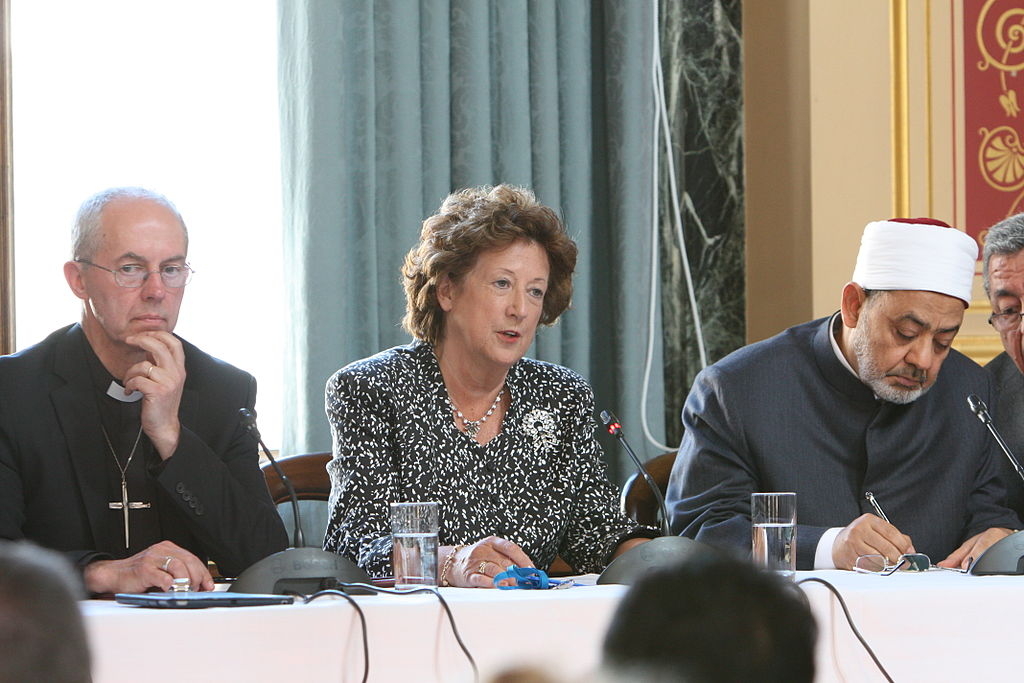
The Archbishop of Canterbury, Justin Welby (left), recently said that dealing with the religiously-motivated violence in Europe "requires a move away from the argument that has become increasingly popular, which is to say that ISIS is 'nothing to do with Islam'... Until religious leaders stand up and take responsibility for the actions of those who do things in the name of their religion, we will see no resolution." (Image source: Foreign and Commonwealth Office)

Only a year ago, commenting on the Paris massacres, the Archbishop followed conventional politically correct orthodoxy, pontificating that, "The perversion of faith is one of the most desperate aspects of our world today." He explained that Islamic State terrorists have distorted their faith to the extent that they believe they are glorifying their God. Since then, he has clearly changed his mind.

Can one expect other Church leaders and political figures to heed Archbishop Welby's words, or will they be conveniently overlooked? Western leaders have noticeably practiced selective hearing for many years and ignored truths that did not fit the "narrative" politicians apparently wished to imagine, especially when spoken by actual experts on Islam. When, in November 2015, Sheikh Muhammad Abdullah Nasr, a scholar of Islamic law and graduate of Egypt's Al Azhar University, explained why the prestigious institution, which educates mainstream Islamic scholars, refused to denounce ISIS as un-Islamic, none of them was listening:
"The Islamic State is a byproduct of Al Azhar's programs. So can Al Azhar denounce itself as un-Islamic? Al Azhar says there must be a caliphate and that it is an obligation for the Muslim world. Al Azhar teaches the law of apostasy and killing the apostate. Al Azhar is hostile towards religious minorities, and teaches things like not building churches, etc. Al Azhar upholds the institution of jizya [extracting tribute from non-Muslims]. Al Azhar teaches stoning people. So can Al Azhar denounce itself as un-Islamic?"
Nor did Western leaders listen when The Atlantic, hardly an anti-establishment periodical, published a study by Graeme Wood, who researched the Islamic State and its ideology in depth. He spoke to members of the Islamic State and Islamic State recruiters and concluded:
"The reality is that the Islamic State is Islamic. Very Islamic. Yes, it has attracted psychopaths and adventure seekers, drawn largely from the disaffected populations of the Middle East and Europe. But the religion preached by its most ardent followers derives from coherent and even learned interpretations of Islam".
In the United States, another establishment figure, Reince Priebus, Chairman of the Republican National Committee and Donald Trump's incoming White House Chief of Staff, recently made statements to the same effect as the Archbishop of Canterbury. "Clearly there are some aspects of that faith that are problematic and we know them; we've seen it," Priebus said when asked to comment on incoming National Security Adviser former Lt. Gen. Michael Flynn's view that Islam is a political ideology that hides behind being a religion.

In much of American society, Flynn's view that Islam is a political ideology is considered controversial, despite the fact that the political and military doctrines of Islam, succinctly summarized in the concept of jihad, are codified in Islamic law, sharia, as found in the Quran and the hadiths. The jihadists who carry out terrorist attacks in the service of ISIS, for example, are merely following the commands in the Quran, both 9:5, "Fight and kill the disbelievers wherever you find them..." and Quran 8:39, "So fight them until there is no more fitna [strife] and all submit to the religion of Allah."

The question becomes, then, whether other establishment figures will also acknowledge what someone like Archbishop Welby -- and Egypt's extraordinary President Abdel Fattah el-Sisi -- has finally had the courage to say in public: that if one insists on remaining "religiously illiterate," it is impossible to solve the problem of religiously motivated violence.
Judith Bergman is a writer, columnist, lawyer and political analyst.
===================

Giulio Meotti : The Dutch Death Spiral


  • "It would have been better if the Dutch state had sent a clear signal [to terrorists] via a Dutch court that we foster a broad notion of the freedom of expression in the Netherlands." — Paul Cliteur, Professor of Jurisprudence, Leiden University.
  • The historic dimension of Wilders's conviction is related not only to the terrible injustice done to this MP, but that it was the Netherlands that, for the first time in Europe, criminalized dissenting opinions about Islam.
  • "I will never be silent. You will not be able to stop me... And that is what we stand for. For freedom and for our beautiful Netherlands." — Geert Wilders, Dutch MP and leader of the Party for Freedom (PVV).
  • "We have a lot of guests who are trying to take over the house." — Pym Fortuyn, later shot to death to "defend Dutch Muslims from persecution."
  • Before being slaughtered, clinging to a basket, Theo van Gogh begged his assassin: "Can we talk about this?" But can we talk?
A country whose most outspoken filmmaker was slaughtered by an Islamist; whose bravest refugee, hunted by a fatwa, fled to the U.S.; whose cartoonists must live under protection, had better think twice before condemning a Member of Parliament, whose comments about Islam have forced him to live under 24-hour protection for more than a decade, for "hate speech." Poor Erasmus! The Netherlands is no longer a safe haven for free thinkers. It is the Nightmare for Free Speech.

The most prominent politician in the Netherlands, MP Geert Wilders, has just been convicted of "inciting discrimination and insulting a minority group," for asking at a really if there should be fewer Moroccans in the Netherlands. Many newly-arrived Moroccans in the Netherlands seem to have been responsible for a disproportionate amount of crime there.

Paul Cliteur, Professor of Jurisprudence at Leiden University, who was called as an expert witness, summed up the message coming from the court: "It would have been better if the Dutch state had sent a clear signal [to terrorists] via a Dutch court that we foster a broad notion of the freedom of expression in the Netherlands."

Here are just a few details to help understand what Wilders experiences every day because of his ideas: No visitors are allowed into his office except after a long wait to be checked. The Dutch airline KLM refused to board him on a flight to Moscow for reasons of "security." His entourage is largely anonymous. When a warning level rises, he does not know where he will spend the night. For months, he was able to see his wife only twice a week, in a secure apartment, and then only when the police allowed it. The Parliament had to place him in the less visible part of the building, in order better to protect him. He often wears a bulletproof vest to speak in public. When he goes to a restaurant, his security detail must first check the place out.

Wilders's life is a nightmare. "I am in jail," he has said; "they are walking around free."

The historic dimension of Wilders's conviction is related not only to the terrible injustice done to this MP, but that it was the Netherlands that, for the first time in Europe, criminalized dissenting opinions about Islam.

The Netherlands is a very small country; whatever happens to this enclave is seen in the rest of Europe. The Netherlands refused to surrender to the Spanish invasion. It was from Rotterdam, the second-largest Dutch city, that the Founding Fathers left to create the United States of America. It was to the Netherlands that some of the most brave, original European philosophers and writers -- Descartes, Rousseau, Locke, Sade, Molière, Hugo, Swift and Spinoza -- had to flee to publish their books. It is also the only corner of Europe where there were no pogroms against Jews, and where Rembrandt painted Jesus with the physical traits of Jews.

Take Leiden: "Praesidium Libertatis" ("Bastion of Freedom") is the motto of the Netherlands' most ancient university. Leiden was the university of Johan Huizinga, the great historian who opposed the Nazis and died in a concentration camp. Leiden was also the university of Anton Pannekoek, the mentor of Martinus Van der Lubbe, the Dutch hero who torched the Nazi Parliament in 1933.

In Leiden today, you meet brave intellectuals such as Afshin Ellian, an Iranian jurist who fled Khomeini's Revolution in Iran and who also now lives under police protection for his observations on Islam. Ellian's office is close to the former office of Rudolph Cleveringa. When the Nazis invaded the Netherlands and called on Dutch public officials to fill out a form in which they had to declare whether they were "Aryans" or "Jews", everyone but Cleveringa capitulated. He understood the consequences of such commands.

Twelve years ago, the Netherlands was again plunged into fear for the first time since World War II. In Linnaeusstraat, a district of Amsterdam, Mohammed Bouyeri, a Muslim extremist, ambushed the filmmaker Theo van Gogh and slaughtered him, then pinned on his chest a letter threatening the lives of Geert Wilders and Ayaan Hirsi Ali. Before that murder, Pim Fortuyn, a professor who had formed his own party to save the country from Islamization, was shot to death to "defend Dutch Muslims from persecution."


Twelve years ago, Dutch filmmaker Theo van Gogh (left) was assassinated by an Islamist who pinned on van Gogh's chest a letter threatening the life of Geert Wilders (right). Today Wilders, the most prominent politician in the Netherlands, lives in hiding under round-the-clock protection.

Fortuyn had said, "We have a lot of guests who are trying to take over the house."
Since then, many Dutch artists have capitulated to fear.

Sooreh Hera, from Iran, submitted her photos to the Gemeentemuseum Museum in The Hague. One of these works depicted Mohammed and Ali. After many threats, the museum proposed that it would acquire the photos without publishing them and that one day, perhaps, when the situation was calmer, they might show them then. Hera refused: it would have been self-censorship, a sad day for the West.

Rants Tjan, director of Museum Gouda, bravely offered to exhibit her censored images, but that event was later cancelled, too. Hera was forced to go into hiding.
Paul Cliteur, a critic of multiculturalism, announced that he would no longer write for Dutch newspapers about Islam, for fear of reprisals: "With the murder of van Gogh, everyone who writes takes a certain risk. That is a scary development. What I am doing do is self-censorship, absolutely...."

Then a columnist, Hasna el Maroudi, from the newspaper NRC Handelsblad, stopped writing, after receiving threats.

The Dutch artist Rachid Ben Ali, irreverent about Islam, no longer satirizes Muslims.
Amsterdam, a city famous for its exuberant cultural life, had already lived through threats to artists: the occupation by the Nazis during World War II.

Several artists still refuse to mention Theo Van Gogh, so as not to "contribute to... divisions", according to the New York Times. Translation: They are afraid. Who would not be?

In the Oosterpark, a steel sculpture by the artist Jeroen Henneman, dedicated to Van Gogh, is entitled "De Schreeuw" ("The Scream"). But it is a scream you hardly hear in the Dutch society.

What you do hear is the defiant protest after the conviction of a brave MP, Geert Wilders: "I will never be silent. You will not be able to stop me... And that is what we stand for. For freedom and for our beautiful Netherlands."

Before being slaughtered, clinging to a basket, Theo van Gogh begged his assassin: "Can we talk about this?"

But can we talk?
Ask Geert Wilders, just the latest brave victim of Europe's Bolshevik thought police.
Giulio Meotti, Cultural Editor for Il Foglio, is an Italian journalist and author.
==============

Judith Bergman : Europe: Illegal to Criticize Islam


  • While Geert Wilders was being prosecuted in the Netherlands for talking about "fewer Moroccans" during an election campaign, a state-funded watchdog group says that threatening homosexuals with burning, decapitation and slaughter is just fine, so long as it is Muslims who are making those threats, as the Quran tells them that such behavior is mandated.
  • "I am still of the view that declaring statistical facts or even sharing an opinion is not a crime if someone doesn't like it." - Finns Party politician, Terhi Kiemunki, fined 450 euros for writing of a "culture and law based on a violent, intolerant and oppressive religion."
  • In Finland, since the court's decision, citizens are now required to make a distinction, entirely fictitious, between "Islam" and "radical Islam," or else they may find themselves prosecuted and fined for "slandering and insulting adherents of the Islamic faith."
  • As Turkey's president, Recep Tayyip Erdogan, said, "These descriptions are very ugly, it is offensive and an insult to our religion. There is no moderate or immoderate Islam. Islam is Islam and that's it." There are extremist Muslims and non-extremist Muslims, but there is only one Islam.
  • It is troubling that Western governments are so eager to crack down on anything that vaguely resembles what has erroneously been termed "Islamophobia," which literally means an irrational fear of Islam.
  • Considering the violence we have been witnessing, for those Westerners who have studied Islam and listened to what the most influential Islamic scholars have to say, there are quite a few things in Islam of which one legitimately ought to be fearful.
Several European governments have made it clear to their citizens that criticizing European migrant policies or migrants is criminally off-limits and may lead to arrest, prosecution and even convictions. Although these practices constitute police state behavior, European governments do not stop there. They go still farther, by ensuring that Islam in general is not criticized either.

Finland is the European country most recently to adopt the way that European authorities sanction those who criticize Islam. According to the Finnish news outlet YLE, the Pirkanmaa District Court found the Finns Party politician, Terhi Kiemunki, guilty of "slandering and insulting adherents of the Islamic faith" in a blog post of Uusi Suomi. In it, she claimed that all the terrorists in Europe are Muslims. The Court found that when Kiemunki wrote of a "repressive, intolerant and violent religion and culture," she meant the Islamic faith.

During the trial, Kiemunki was asked why she did not make a distinction between Islam and radical Islam. She replied that she meant to refer to the spread of Islamic culture and religion, and that she "probably should have" spoken of radicalized elements of the religion instead of the faith as a whole. Kiemunki was fined 450 euros. Her lawyer has appealed the verdict.
Kiemunki issued a press release after the verdict, in which she said:
"I am still of the view that declaring statistical facts or even sharing an opinion is not a crime if someone doesn't like it... I wrote that I don't want our country to be overtaken by a culture and law based on a violent, intolerant and oppressive religion."
According to YLE, she added that her essay did not generalize about Muslims, but pointed out that not all Muslims are terrorists. "In these times, specifically in the recent past and today, all of the perpetrators of terrorist acts have turned out to be Muslim," she said.

In Finland, Terhi Kiemunki, a Finns Party politician, was found guilty by a court of "slandering and insulting adherents of the Islamic faith." (Image source: YouTube video screenshot)

So in Finland, since the court's decision, citizens are now required to make a distinction, entirely fictitious, between "Islam" and "radical Islam," or else they may find themselves prosecuted and fined for "slandering and insulting adherents of the Islamic faith." As Turkey's President, Recep Tayyip Erdogan said, "These descriptions are very ugly, it is offensive and an insult to our religion. There is no moderate or immoderate Islam. Islam is Islam and that's it." There are extremist Muslims and non-extremist Muslims, but there is only one Islam.

It is a pity that Kiemunki did not present the court with quotes from the Quran, such as, "Fight and kill the disbelievers wherever you find them..." (9:5), and "So fight them until there is no more fitna [strife] and all submit to the religion of Allah." (8:39). Perhaps, then, the court could have at least tried to explain to the public in more concrete detail the differences between "Islam" and "radical Islam."

In the Netherlands, a state-funded hotline, run by the anti-discrimination bureau MiND, said that it could not act on a complaint about death threats against homosexuals posted to an online forum, in which the Muslim poster called for homosexuals to be "burned, decapitated and slaughtered." The reason why this anti-discrimination watchdog group could not act on the complaint was that, "The remarks must be seen in the context of religious beliefs in Islam, which juridically takes away the insulting character." MiND concluded that the remarks were made in
"the context of a public debate about how to interpret the Quran... some Muslims understand from the Quran that gays should be killed... In the context of religious expression that exists in the Netherlands there is a large degree of freedom of expression. In addition, the expressions are used in the context of the public debate (how to interpret the Koran), which also removes the offending character."
So, while Geert Wilders was prosecuted in the Netherlands for talking about "fewer Moroccans" during an election campaign, a state-funded watchdog group says that threatening homosexuals with burning, decapitation and slaughter is just fine, so long as it is Muslims who are making those threats, as the Quran tells them that such behavior is mandated. This might be one of the most astounding examples of voluntary submission to sharia law in the West thus far.
A spokesman for the MiND hotline later admitted that, after "further research" on the issue, it had concluded that the complaint had been "unjustly assessed" -- after Dutch MPs called for the hotline to be stripped of public funding.
In February 2016, a Danish district court found a man guilty of making statements on Facebook that the court found to be "insulting and demeaning towards adherents of Islam." The man had written:
"The ideology of Islam is as loathsome, disgusting, oppressive and as misanthropic as Nazism. The massive immigration of Islamists into Denmark is the most devastating thing to happen to Danish society in recent history."
He was fined for "racism." The High Court subsequently overturned the verdict in May 2016. The court found that the man was in fact innocent of racism, as his statements were "directed at the ideology of Islam and Islamism."

It is troubling that Western governments are so eager to crack down on anything that vaguely resembles what has erroneously been termed "Islamophobia," which literally means an irrational fear of Islam. Considering the violence we have been witnessing, it would be irrational not to have fear of its threats. As Shabnam Assadollahi recently pointed out in an open letter to Canadian Members of Parliament, there are quite a few things in Islam of which one legitimately ought to be fearful.

All these governments need to do is consult the speeches of one of the most influential living Islamic scholars of Sunni Islam, the spiritual leader of the Muslim Brotherhood, Yusuf al-Qaradawi. Qaradawi hosts one of Al Jazeera's most popular programs, Sharia and Life, which reaches an estimated 60 million viewers worldwide. Already in 1995, Qaradawi told a Muslim Arab Youth Association convention in Toledo, Ohio, "We will conquer Europe, we will conquer America! Not through the sword, but through dawa [outreach]."
Dawa, the Islamic call to conversion, is the Islamic summons for the non-violent conquest of non-Muslim lands, including Europe. As explained by Qaradawi in a recording from 2007, the aim of the conquest consists mainly the introduction of sharia law. According to Qaradawi, sharia law should be inserted gradually, over a five-year period in a new country, before implementing it in full. This sharia law includes chopping off hands for theft; killing apostates and homosexuals, denigrating and oppressing women, as in polygamy, beating them as a means of "disciplining" them, and so on. For those Westerners who have studied Islam and listened to what the most influential Islamic scholars have to say, there is quite a bit to be "phobic" about. It would be refreshing to hear the views of European leaders and courts on these aspects of sharia law instead of their almost ritual condemnations of those who have actually studied Islamic sources and seek to raise awareness of the nature of sharia law.
While prosecuting and sanctioning people who criticize Islam is becoming more common in Europe, this practice used to be reserved only for Muslim countries officially governed by sharia law, such as Saudi Arabia or Pakistan, where it is forbidden to insult Islam.
It is a pity that European courts and other state bodies have begun taking their cues from Islamic law. Apparently, European judges and politicians are no longer capable of appreciating the immense freedoms that used to be the norm on the continent, and which they seem all too willing, of their own free will, to abolish.
Judith Bergman is a writer, columnist, lawyer and political analyst.
===============

Mohshin Habib : Violence Against Non-Muslims Increases in Bangladesh


  • "Since 2013, Bangladesh has experienced a series of violent attacks by extremists. The victims have included besides atheists, secular bloggers, liberals and foreigners -- many Buddhists, Christians and Hindus as well as Ahmadis and Shia Muslims." — Minority Rights Group International.
  • "A new school of Islam from Saudi Arabia is transforming South Asia's religious landscape. Wahhabism, a fundamental Sunni school of Islam originating in Saudi Arabia, entered South Asia in the late 1970s. With public and private Saudi funding, Wahhabism has steadily gained influence among Muslim communities throughout the region. As a result, the nature of South Asian Islam has significantly changed in the last three decades. The result has been an increase in Islamist violence in Pakistan, Indian Kashmir, and Bangladesh." — Georgetown Security Studies Review, 2014.
Minority communities across Bangladesh are once again facing violence and persecution by the Sunni Muslim majority. In the last month or so, dozens of Hindu temples have been vandalized and hundreds of houses burned down by Muslims in different districts across the nation.
In one incident alone, a group of Muslims carried out attacks that left more than 100 injured and several hundred victims homeless. Hindus, at 9% of the total population the largest religious minority in Bangladesh, were targeted in the attack on October 30, about 120 km from the capital city, Dhaka. Muslims, led by two Islamic organizations -- the Tawheedi Janata ("Faithful People") and Ahle Sunnat-Wal-Jamaat --vandalized more than 15 temples and 200 houses belonging to Hindus. Violence continued a few days later, when, on November 5, extremists repeated similar attacks in the same area despite police "vigilance."
A day before the attacks began, a rumor circulated that a 27-year-old Hindu man named Rasraj Das edited a photograph superimposing the Hindu God Shiva onto an image of the Kaaba (the holiest site in Islam) and posted it on his Facebook page. Within hours of the post, he was caught by local Muslims and handed over to the police. Prior to his arrest, Das pleaded his innocence on his Facebook page, saying:
"At first I am apologizing to Muslim brothers because someone has posted a photograph from my facebook account without my knowledge. When I came to know yesterday night (October 28), I deleted it immediately. Here we live side by side as Hindu-Muslim brothers, I have no such mentality and of course I don't have such imprudent courage."
Yet the uproar of the Muslim community was not appeased, and on October 30, shortly after the early morning prayer, religious Muslims, in the name of "hurting Muslims' feelings," called on fellow Muslims, using loudspeakers from the neighboring mosques, to come out to retaliate. According to some witnesses, the local administration and police had a nonchalant attitude and did not intervene to protect the minority community.
After this episode, unrest spread across Bangladesh; many Hindu areas experienced attacks of similar religious oppression. Muslim fundamentalists vandalized idols, set fire to Hindu temples in several districts and, in some instances, looted the valuables from temples. Hindus traditionally use gold for the ornamental artifacts of Goddesses, which are sometimes hundreds of years old. These sacred items are extremely valuable; in one incident, a stolen idol of Lakshmi (Hindu Goddess of wealth and fortune) was later recovered from a mosque. Eleven months earlier, Muslim fundamentalists from the same district destroyed a museum containing a legendary Sarod (a musical instrument) belonging to the revered Alauddin Khan, who inspired many famous musicians including Pandit Rabi Shankar. For many, this had been the biggest assault on the region's culture since the 2001 destruction of the twin Buddha statues at the hands of the Taliban in Bamiyan, Afghanistan.


Pictured above: A Hindu temple in Bangladesh that was recently vandalized by Muslims. The idol on the left was decapitated. (Image Source: FM Hindu video screenshot)

India has expressed concern over the safety of the Hindu community in Bangladesh, which houses the third-largest Hindu population in the world. In a tweet, India's External Affairs Minister Sushma Swaraj wrote:
"I have asked Indian High Commissioner in Dhaka to call on the Prime Minister and express grave concern about the safety and wellbeing of the Hindus in Bangladesh."
Minority Rights Group International summarizes the escalating acrimony:
"Since 2013, Bangladesh has experienced a series of violent attacks by extremists. The victims have included besides atheists, secular bloggers, liberals and foreigners -- many Buddhists, Christians and Hindus as well as Ahmadis and Shia Muslims. A large number of the attacks targeting religious minorities have been claimed by... Islamic State (IS) – a claim vigorously denied by the Bangladeshi government, which has attributed the attacks to domestic militant groups. Regardless...the authorities have visibly failed to ensure the protection of those targeted. Besides the rising death toll, including civilians killed indiscriminately in bombings or individually selected by armed assailants with machetes in premeditated attacks, the... insecurity has diminished the ability of civil society to operate freely... Communal violence -- long a problem for religious minorities -- continues to take place on a regular basis, driven by political rivalries, expropriation and the apparent impunity enjoyed by perpetrators."
In another incident, on November 6, the staff of a sugar mill in Rangpur district, accompanied by local people, attacked indigenous Santal people. Three Hindu tribesmen were killed, and scores injured, when one of the five magistrates on the scene ordered police to open fire on them. Later, the mill's management blamed local villagers for the attack on the Santals.
The cascade of Hindu persecution seems only to be gaining momentum; furthermore, it appears that the government of Bangladesh is incapable or unwilling to protect their Hindu citizenry from torment. Recently, on November 29, ten idols of Hindu Gods and Goddesses at family temples were vandalized not far from Dhaka, and in the same month, 60 more human rights violations occurred. The result is a laundry list of abuses by Islamists -- with only one perpetrator incarcerated.
The growing tide of Islamic fundamentalism in Bangladesh has also seen an increase in Islamic terrorism tied to the Islamic State. Last July, gunmen stormed a Dhaka cafe and killed 20 guests, including 9 Italians, 7 Japanese, one American and one Indian, before the six attackers were killed by Bangladeshi troops. The attackers tortured and killed anyone who was unable to recite the Quran, the holy book for Muslims.
Islamic State claimed responsibility for the attack. According to SITE Intelligence Group, which monitors jihadist networks, all the attackers were Bangladeshi.
The rise of Islamic fundamentalism and terrorism and radical activity in Bangladesh in recent years has taken on the form of bombings, machete attacks and in general generating fear between Muslim and non-Muslim communities. Prior to the events of September 11, 2001, political Islam and other forms of extremisms were already on the rise in the region. According to a 2014 Georgetown Security Studies Review:
"A new school of Islam from Saudi Arabia is transforming South Asia's religious landscape. Wahhabism, a fundamental Sunni school of Islam originating in Saudi Arabia, entered South Asia in the late 1970s. With public and private Saudi funding, Wahhabism has steadily gained influence among Muslim communities throughout the region. As a result, the nature of South Asian Islam has significantly changed in the last three decades. The result has been an increase in Islamist violence in Pakistan, Indian Kashmir, and Bangladesh."
===================

Raymond Ibrahim : "The Crescent Must be Above the Cross"


  • Three Christians were sentenced to be flogged for sipping wine during a communion Mass. "In a shock move," however, "oppressive officials in Tehran have charged the three with 'acting against national security' for taking part in the Christian ritual." — Iran.
  • "One begins to wonder if Catholic priests have become an endangered species." Clergyman discussing latest murder of priest. — Nigeria.
  • "We are at a breaking point. People can't put up with any more of this." — Christian bishop, Egypt.
  • "They said all Christians should be killed. They said we were evil demons and made Pakistan impure." — Christian survivor of Muslim mob attack, Pakistan.
  • Officials arrested 27 Christians -- including several women and children -- for the crime of "conducting Christian prayers" and being "in possession of Bibles." — Saudi Arabia.
In September 2016, a group of escaped ISIS sex slaves finally revealed the true fate of Kayla Mueller -- the 26-year-old American aid worker in Syria whom ISIS had reported dead more than a year ago. Her former fellow captives said Mueller had "refused to deny Jesus Christ despite being repeatedly raped and tortured." In February 2015, ISIS claimed their captive had been killed during a Jordanian airstrike and sent photos of her dead body in a white burial shroud, apparently as a sign of respect. One former sex slave said that Mueller "put others before herself," and once even refused a chance to escape with the other girls because she thought her American appearance would stand out and endanger the others.
Kayla Mueller was a 26-year-old American Christian aid worker in Syria. The Islamic State abducted her, and repeatedly raped and tortured her, then claimed that she was killed during a Jordanian airstrike. Above, Mueller is shown before her enslavement and death (left), and during her captivity (right), taken from an ISIS propaganda video.

An ISIS-related plot to butcher Christians with chainsaws in a Belgian shopping center was exposed in September after authorities interrogated a Muslim youth. The teen -- the son of a man being described as a "radical imam" -- was arrested for calling for the execution of Christians while walking down a street. Theo Francken, a Belgian official, said:
"I already signed the order to remove the Imam from Belgian soil. But he appealed the decision, so I can only hope for a quick sentence. Clearly radicalism runs in the family."
Speaking for the first time about the slaughter of the 86-year-old French priest Jacques Hamel, eyewitness Guy Coponet -- who was himself stabbed several times, including in the neck, and was not expected to survive -- revealed how the jihadi murderers also forced him to hold a camera and record them slitting the throat of the elderly priest: "They even checked the quality of the image and that I wasn't trembling too much. I had to film the assassination of my friend Father Jacques!" He said the assailants planned on using the video as propaganda, "which would allow them to earn their fame as a 'martyr' of Allah."
Meanwhile, Hungary became the first government in Europe to open an office specifically to address the persecution of Christians in the Middle East and Europe. Zoltan Balog, Hungary's Minister for Human Resources, said:
"Today, Christianity has become the most persecuted religion, where out of five people killed [for] religious reasons, four... are Christians. In 81 countries around the world, Christians are persecuted, and 200 million Christians live in areas where they are discriminated against. Millions of Christian lives are threatened by followers of radical religious ideologies."
This move came weeks after Prime Minister Victor Orban drew criticism in the EU by saying, "If we really want to help, we should help where the real problem is.... We should first help the Christian people before Islamic people."
Around the same time -- and despite the many instances of Muslim migrants raping, murdering, and terrorizing Europeans -- Pope Francis urged Europeans to take in more Muslim refugees, including into their homes. He explained that the best way to combat terrorism is by warmly welcoming migrants and helping them integrate into the "European context."
The rest of the bloody month of September's worldwide Muslim persecution of Christians includes, but is not limited to, the following:


Muslim Attacks on Christian Churches

Kosovo: On September 10, Albanian Muslims in Pristina set fire to Christ the Savior Cathedral, "Immediately after the fire," notes the report, they "started using it [the church] as a toilet.... Since the Albanian Muslims took possession of this Orthodox land, hundreds of churches and monasteries have been burnt to the ground."
Spain: On September 8, a Muslim refugee from North Africa "attacked and burned several images of the Virgin in the Church of Fontellas." One of the side chapels was completely destroyed and several statues were torched. Part of the ornamentation of the chapel ceiling fell, and the nave was blackened by soot. Two days later, a judge issued an order banning the North African from being within ten meters of all religious centers of Catholic worship. According to the report, the man remains unrepentant and claims to have earned heaven by his actions, and police suspect he may be responsible for "other attacks on churches in nearby locations in the Ribera de Navarre, doing damage to Catholic religious symbols, such as defacing sacred books." (According to a canonical hadith attributed to Muhammad, "Do not leave any image without defacing it or any built-up grave without leveling it.")


Iran: Three Christians were sentenced to be flogged for sipping wine during a communion Mass. "In a shock move," however, "oppressive officials in Tehran have charged the three with 'acting against national security' for taking part in the Christian ritual," said the report. "[S]acramental wine is used by billions of Christians worldwide in celebration of the Eucharist. It is often watered down and is used during Holy Communion alongside small bread wafers." However, because the judicial system of the Islamic Republic of Iran is based on sharia (Islamic law), which forbids the consumption of alcohol, all Christians who seek to partake of communion risk being arrested and flogged.


Indonesia: Muslims interrupted a funeral ceremony in a Catholic church in Purwosari, where 200 Christians were assembled. During a Bible reading over the dead, two Muslims who had mixed in with the congregation began heckling and cursing the priest and crowd. The police were able to remove them, but they came back with a Muslim mob, then threatened and pushed the priest and his assistant to the point where they fled the church and suspended the funeral ceremony.
In a separate incident, an angry Muslim mob, led by the Islamic Defenders Front, surrounded and protested against a Protestant church on the false accusation that it did not have the proper papers to renew its permit. "The presence of the Church in this area does not have the approval of most of the Muslim population," explained a local Muslim spokesman. "Residents said they never gave permission for the renewal of the project." However, the reverend of the church explained, "after we laid the first stone of the church, the mayor visited the site and officially recognized the project."


Syria: In September, a prominent Syriac Catholic church in Aleppo sustained significant damage from military shelling. At least 20 other Christian churches in Aleppo have been destroyed by ISIS and other "freedom fighters." Many of the churches destroyed were historically important -- such as St. Mary's, which ISIS detonated on Easter Day, 2015. Before the war, there were well over a million Christians in Aleppo; today, about 30,000 remain.


Pakistan: On the morning of September 2, four Taliban-linked Islamic terrorists wearing suicide vests stormed the church of a small Christian community of approximately 30 families in Peshawar. According to the report, "Thanks to the actions of a church security guard [who died in the shootout] and local security forces, a massacre of Christians was averted."


Yemen: Unidentified armed militants attacked the Church of Banjasar in Aden. A local source said, "Armed militants accompanied by youths from the village broke into the church after morning prayers and looted the contents of the church." Although Christian churches in Yemen are few in number, attacks on them have been on the rise. Not long ago, Houthi militias had stormed the St. Anthony Church in al-Tawahi, also in Aden, and plundered it of all its contents. Later, Saudi forces -- purportedly fighting the militants -- bombed and seriously damaged the church.


Egypt: Despite the recently passed church construction law, which was supposedly designed to relieve tensions by making church construction legally more acceptable, authorities are actually "sending a message that Christians can be attacked with impunity," according to Joe Stork of Human Rights Watch. The new law still allows governors to deny church-building permits, requires that churches be built "commensurate with" the number of Christians in an area, and contains security provisions that subject decisions on whether or not a church can be built to the whims of violent mobs. Although the diplomatic Coptic Church publicly welcomed the law, "many other Christian clergy, activists, local human rights groups, and Christian members of parliament criticize the law for upholding restrictions that continue to discriminate against Christians." The status of hundreds of churches that were used for years but then denied license renewals remains unresolved by the new law.


Violence, Prison, and Death for Christian "Blasphemers" and "Apostates"
Jordan: Nahed Hattar, a Christian writer and activist, was killed on September 25 outside of a courthouse in Amman. The 56-year-old man was earlier arrested for sharing a "blasphemous" cartoon about the prophet Muhammad. As he was walking into court to stand trial for "contempt of religion" and "inciting sectarian strife," a man dressed in traditional Muslim garb shot him dead. The report adds:
"Approximately 70 percent of Muslim-majority countries in the Middle East and North Africa have blasphemy laws that make it illegal to criticize or dishonor religious symbols and teachings. In practice, many of these laws apply exclusively to Islam."

Uganda: A Muslim convert to Christianity was killed, and two others beaten, in three separate incidents:
1) The blood-stained body of 32-year-old Enoch Shaban -- a Muslim convert to Christianity and member of the Church of Uganda -- was found hanging from a tree. A local resident of the village said he heard Shaban shouting for help after another man said, "We have warned you several times of being a disgrace to our religion, and you have not taken seriously our warnings." The witness added: "Two weeks before meeting his death, he had mentioned several messages on his phone warning him to recant the Christian faith and return to Islam." The slain apostate appeared to have been struck on the head with a metallic object. The morning before his death, Muslims were reportedly seen loitering around his workshop, a mile away from the murder scene. Although Uganda is majority-Christian, the area where Enoch was killed is predominantly Muslim.
2) On the same day Shaban was killed, Aisha Twanza, 25 -- another Muslim convert to Christianity -- was poisoned by Muslim family members who put insecticide in her food. After their conversion last January, Aisha and her husband were forced to flee their village because relatives threatened to kill them. On August 10, family members informed Aisha that her mother was dying; she rushed to the village only to find that it was a lie to lure her back. Questioned about her conversion to Christianity, she refused to deny her new faith. "They were very disappointed with me for deserting Islam." Her family then served her food and allowed her to return home:
"Reaching home, I started feeling stomach upset that continued... Soon the pain intensified, and my husband rushed me to Mbale hospital, then I was taken to Pallisa, where poisoning was discovered after several tests. I never expected my parents to do such a thing to me, but I thank God for saving me."
3) A Muslim husband savagely beat his wife after she attended church. Neighbors found Fatuma Baluka, 21, unconscious and rushed her to a hospital: "When I arrived home, my husband shouted at me as an 'infidel,' and then and there started hitting me with a metallic object. I fell down, only to find myself in a hospital bed." She has since been abandoned by her husband and extended Muslim family.
Ethiopia: Six weeks after a Muslim man discovered that his wife, who is mother to his three children, had converted to Christianity, he locked her in the house and beat her with sticks; during her ordeal, neighbors heard him shouting -- including that she "should die for forsaking Islam." Neighbors found her soaked in blood from a deep gash in her forehead and rushed her to the hospital.
Pakistan: A 16-year-old Christian youth was arrested and could be executed for the crime of "blasphemy." He allegedly posted or liked on Facebook a picture of the Kaaba, Islam's sacred temple in Mecca, with a pig on top of it. Infuriated Muslims who saw the image immediately reported it to authorities, an act leading to his arrest. Authorities also removed the image in an effort to calm local Muslims and prevent them from rioting. The arrested youth's family fled their home in fear of reprisals. Accusations of blasphemy against Pakistan's minorities are common and often false. Religious hatred, personal score-settling, and economic gain are just a few of the motives behind false accusations of blasphemy.


Muslim Slaughter of Christians in Nigeria
The ongoing jihad on Christians by both Boko Haram, an Islamic jihad group, and allied Muslim herdsmen, left many dead in its wake:
  • At least eight Christians were randomly shot dead by militants on motorbikes as they were exiting Sunday church service. A couple of weeks earlier, Boko Haram had said it would begin "booby-trapping and blowing up every church that we are able to reach, and killing all of those who we find from the citizens of the cross."
  • Another senior priest was kidnapped after his car was ambushed by Muslim herdsmen; during the attack they violently beat and tried to kill two other members of the clergy in the car; one was shot in the head. On the same day, a Vincentian priest was kidnapped along with his brother. Discussing these and other attacks on Christian clergy in recent weeks and months, several fatal, the communications director of the local diocese said: "One begins to wonder if Catholic priests have become an endangered species."
  • Boko Haram insurgents killed at least two people during raids on Christian villages. They tied up one man with a rope and slaughtered him in front of his wife and children. They also burned homes and set the market square of one village ablaze.
  • A group of Fulani Muslim tribesmen attacked a 60-year-old Christian farmer while he was working his land and hacked him to death with machetes. He is "the latest victim of attacks by Muslim Fulani herdsmen in Nasarawa State who have burned church buildings and homes and destroyed crops in the past four years," said the report.
  • According to a separate report, Muslim Fulani tribesmen also killed another Christian pastor; raided Ningon village-- murdering two Christians as they slept in their homes, and seriously wounding a girl with gunshots; and raided the Christian village of Ungwar Mada, forcing their way into a married couple's home and slaughtering them.
  •  
Muslim Contempt for and Abuse of Christians

Saudi Arabia: Officials arrested 27 Christians -- including several women and children -- for the crime of "conducting Christian prayers" and being "in possession of Bibles." The group of Christians, most if not all of whom were Lebanese nationals, were celebrating a feast day for the Virgin Mary when authorities stormed their residence and arrested them. Authorities, the dreaded "religious police," proceeded to strip them of their visas and deport them back to Lebanon. Ironically, this is a much better fate than that suffered by other Christians caught engaging in "acts of Christianity" in the Islamic kingdom. In 2012, a group of 35 Christian Ethiopians were arrested and abused in prison for almost a year, simply for holding a private house prayer. One of them reported after being released: "They [Saudis] are full of hatred towards non-Muslims."
Iran: At least 25 Christians were arrested in Kerman for unknown reasons. Security forces broke into the Christians' homes, searched them, seized various objects, and then took the Christians in. Officials did not reveal the reason for the arrest nor where the Christians were taken, leaving family and friends in distress.
In another incident, authorities raided a family garden party after they noticed it wasn't closely observing conservative Islamic norms; without a warrant, they arrested five men, former Muslims who had converted to Christianity. Then they searched the premises and confiscated several items, including three Bibles. The arrested men were taken to an unknown location, though later reports suggest they were sent to Evin Prison, where Iran's worst criminals are held.

Uzbekistan: Eight Christians were arrested and fined for possessing Christian literature, which is illegal in the Muslim majority nation. One Baptist, Stanislav Kim, was sentenced to two years in a "corrective-labor" camp for being caught with Christian literature a second time in one year. The Christian literature was ordered to be handed over to the state-backed Muslim Board.

Malaysia: After Ben-Hur, originally a novel, was made into a 2016 film, moviegoers were left disappointed and confused: authorities had cut out all scenes that portrayed Christ or had anything to do with Christianity, making the movie unintelligible. "I felt cheated," said one viewer:
"The novel from which this movie is adapted is Ben-Hur: A Tale of Christ. It means Jesus is central to the plot. It was censored so much the storyline made no sense! How did Judah's mother and sister get cured from leprosy? They just appeared at the end of the movie healed."
Such anti-Christian edits are consisted with the government's ban on and confiscation of Bibles in the majority Muslim nation.
Separately, three Muslims who sought legally to convert to Christianity were denied conversion by the court system, due to the implementation of sharia (Islamic law), which maintains that anyone born into Islam -- namely, whose father was Muslim -- must remain Muslim. According to a source discussing this report, those trying to convert are often sent to a "purification center," where they are made to recite different Islamic creeds so they are again considered Muslim: "This purification center utilizes torture, beatings, and psychological attacks to terrify new believers into recanting their faith in Jesus Christ."

Egypt: After weeks of attacks more frequent than usual on the Christian minority in Minya, Upper Egypt, the government responded by appointing a Muslim cleric, Mahmoud Gomaa, to investigate the situation. Gomaa then appeared in a televised interview insisting that "Everything was good.... No one has been killed. No one has even been wounded. There's no conflict. The problem is really with the journalists writing about it."
Bishop Makarios of Minya responded by saying, "I have nothing to do with Mahmoud Gomaa. We are at a breaking point. People can't put up with any more of this." He explained how in recent weeks Christians have indeed been killed -- including a priest who was gunned down at the entrance of his church and a man who was stabbed to death by an angry mob -- as well as numerous incidents of mob violence on Christians which left many injured and their properties looted and burned.

United States: In September, when Coptic Christians were suffering abuses "every two or three days" in Egypt, an Egyptian Muslim woman living in America made a video calling for more Muslim hostility against Egypt's Christian minority, in the guise of an economic boycott. In a video, Ayat Oraby -- a Muslim Brotherhood sympathizer who has nearly 1.5 million followers on Facebook -- called the Coptic Church a "bunch of gangsters," a "total mafia" that "rules [Egypt] behind the curtains." Oraby claimed that Copts are "stockpiling weapons in churches" and "striving to create a Coptic statelet" in order to continue waging "a war against Islam." That Oraby hates Copts simply because they are Christian came out clearly towards the end of her tirade, when she said: "They [Copts] must learn very well that the Crescent [Islam] must be above the Cross [Christianity]." In fact, Copts pose no danger to Egypt's Muslims -- but they dare to want equal rights, when they should be content with second-class status.


Pakistan: Hate, Rape, and Murder of Christians

"Christian girls are being 'systematically' kidnapped and abuse[d] in Pakistan," according to a September report, causing even "a Supreme Court justice to express alarm."
"But as far as the Pakistani police and government are concerned, this is not happening. They are claiming that the more than 1,000 children reported missing last year in just one province alone, in Punjab, actually left their home on their own free will."
Some of the missing children are boys. Christian leaders in Faisalabad accused local police of covering up the sexual assault and murder of Zeeshan Masih. The 14-year-old Christian boy was sexually molested, murdered, and then left hanging on a tree. Police reluctantly filed a complaint before declaring it to be a "natural" death -- despite the fact that autopsy reports clearly showed signs of sexual abuse and witnesses pointed to unidentified Muslim men. According to a local human rights group:
We now know that other children are complaining about sexual abuse and it is believed that Zeeshan was killed for threatening to tell his parents.... The manner in which police officers have attempted to camouflage this crime has hurt and angered them. They are calling for an independent inquiry into the handling of their son's death... The (incidence) of rape, sodomy and murder in Pakistan (is) reaching unprecedented levels. Christians and other minorities are natural targets as they are disenfranchised by the country's laws and statutes, which confer second-class citizenship upon them.
In a separate incident, because he refused to drop charges against them, Muslims shot and critically injured the father of a 27-year-old Christian woman they had earlier kidnapped, raped, and held for four months until she escaped. This happened three days after police refused to comply with a court order to arrest the four guilty Muslim men. Gulzar Masih, the father, was in an empty plot of land when the attack occurred:
"I was immersed in thoughts regarding the case when I saw Ghulam Hussain and Akram [two of the rapists] running towards me, hurling threats and abuses. As soon as they came near me, Hussain whipped out a pistol and fired a shot aimed at my chest. He then fired two more bullets at my legs, after which I fell down on the road. He then asked Akram to break my skull with a metal object that he was carrying. I was hit in the head, after which I lost consciousness.... They may try again to kill me, but I will not stop from knocking on the doors of justice to avenge my daughter's dishonor. Hussain and his friends are also threatening my three sons with dire consequences, but we have resolved not to sit quiet and let them get away with such a heinous crime."
Separately, a drunken Muslim mob stormed the homes of Christians and savagely beat their residents after a Christian woman asked the drunken revelers -- who were shouting loudly and saying lewd things to young girls passing by -- to quiet down. The Muslims instantly became enraged at "the audacity of 'ritually impure' Christians making demands on them," said the report: "The drunk Muslim men gathered up at least a dozen of their friends and grabbed sticks, metal rods and other assorted weapons." The mob stormed Christian homes and indiscriminately attacked men, women, and children. According to a Christian witness:
"They said all Christians should be killed. They said we were evil demons and made Pakistan impure. I thought I and my family would be killed. It was very frightening."
Seven Christians were injured, five of whom had to go to the hospital to receive treatment for their injuries.

About this Series

While not all, or even most, Muslims are involved, persecution of Christians by Muslims is growing.
The report posits that such Muslim persecution is not random but rather systematic, and takes place irrespective of language, ethnicity, or location.
Raymond Ibrahim is the author of Crucified Again: Exposing Islam's New War on Christians (published by Regnery with Gatestone Institute, April 2013).
=================

Heshmat Alavi : Iran: Why the Mullahs Will Not Reform from Within


  • Iran's entire power structure and most of its civil society is centralized under the personal control of the Supreme Leader. In this way, Iran's dictatorship is every bit as entrenched as North Korea's, making the idea of traditional regime change a pipe dream.
  • The mullahs created a regime -- an entrenched revolution -- specifically designed to resist change or reform, adopting a unique theocratic structure that uses both Islamic ideology and brutal force to maintain absolute power.
  • There is but one regime, and it has no interest in "reform."
  • The membership of every single one of the many official-sounding bureaucratic organs is personally approved by the Supreme Leader. Indeed, any individual, or coalition of individuals who might serve as a check on his absolute power is, in fact, completely beholden to Khamenei's whims, making him the most complete and powerful dictator on the planet.
  • Elections in this regime are not indicative of any form of "democracy". Instead, they are merely a process of choosing among individuals vetted by the Supreme Leader. There are no factions based upon ideological differences, there is mere jockeying for position and the personal favor of the Supreme Leader.
  • Western governments' policy of providing concessions to the Iranian regime in order to empower "reformist" factions is based on a fantasy -- a fantasy which the Iranian regime deliberately encourages in order to fool naïve foreign leaders into easing sanctions and turning a blind eye to the nuclear program. In reality, Western concessions are strengthening Khamenei -- further reducing the possibility of change, and increasing the likelihood of outright war.

Ever since Iran's mullahs rose to power in 1979 and established an "Islamic Republic", they have worked to consolidate power both at home and abroad. Given Iran's growing belligerence toward its neighbors, persistent crackdowns on domestic dissidents, and frightening nuclear ambitions, foreign analysts often talk about the possibility of regime change in Tehran. But there is very little understanding of the obstacles to dethroning the mullahs -- namely, that the entire power structure and most of civil society is centralized under the personal control of the Supreme Leader. In this way, Iran's dictatorship is every bit as entrenched as North Korea's, making the idea of traditional regime change a pipe dream.

The mullahs created a regime -- an entrenched revolution -- specifically designed to resist change or reform, adopting a unique theocratic structure that uses both Islamic ideology and brutal force to maintain absolute power.

The official name of this system is Velayat-e Faqih ("custodianship of the clergy") and it places all religious and legal authority in the hands of the Supreme Leader. What this means, in both theory and in practice, is that the Grand Ayatollah Sayyed Ali Hosseini Khamenei (like Ruhollah Khomeini before him) plays a direct role in all the country's affairs; and no individual, group, or committee in the country has the right to question or hold him accountable.

Khamenei exercises his authority through a morass of official-sounding bureaucratic organs, including the "Guardian Council", "Expediency Council", "Supreme Council of Leader, "Supreme National Security Council", "Strategic Council of Foreign Policy", and of course a "Council of Cultural Revolution". What one must understand is that the membership of every single one of these organizations is personally approved by the Supreme Leader. Indeed, any individual, or coalition of individuals who might serve as a check on his absolute power is, in fact, completely beholden to Khamenei's whims, making him the most complete and powerful dictator on the planet -- perhaps exceeding even Kim Jong-un in unrivaled control of North Korea.

The Guardian Council is the Khamenei's most important instrument; it has titular oversight of both the executive and legislative branches. All candidates for presidential or parliamentary election must be approved by this council, allowing him to exert his personal control over the outcome of elections. Likewise, all acts of parliament and new legislation must be confirmed by the Guardian Council.
Even decisions of the Guardian Council are subject to the Grand Ayatollah's veto; he reserves the right to reject legislation or winning candidates. And some decisions, like senior judicial appointments, do not go through the Council at all. Meanwhile, the entire domestic and foreign financial system is controlled through a parallel system of committees and "foundations" which are likewise under Khamenei's personal control.

While the Khamenei is the commander-in-chief of all the armed forces, his most feared weapon is the parallel army founded by his predecessor: the Islamic Revolutionary Guards Corps (IRGC). Fiercely loyal to the Supreme Leader and brutally ruthless, the IRGC is lethally efficient in protecting the regime at home and exporting the "revolution" abroad, in places as varied as Yemen and South America.

As commander-in-chief of all armed forces Khamenei appoints the joint chiefs of staff, commander of the IRGC, and senior commanders of the army and all security forces, making the possibility of a military coup extremely unlikely.
Iranian civil society is an illusion; all of the government and by extension most of the private sector are mere extensions of the Grand Ayatollah's personal will. Velayat-e Faqih is the only state ideology; the only differences of opinion are about how it should be implemented.

Therefore, elections in this regime are not indicative of any form of "democracy". Instead, they are merely a process of choosing among individuals vetted by the Supreme Leader. There are no factions based upon ideological differences, there is mere jockeying for position and the personal favor of the Supreme Leader.
Traditional "regime change" in Iran is inconceivable. The Western obsession of labeling the regime's factions as "reformists" or "hardliners" is laughable. There is but one regime, and it has no interest in "reform".


Traditional "regime change" in Iran is inconceivable. The Western obsession of labeling the regime's factions as "reformists" or "hardliners" is laughable. There is but one regime, and it has no interest in "reform".

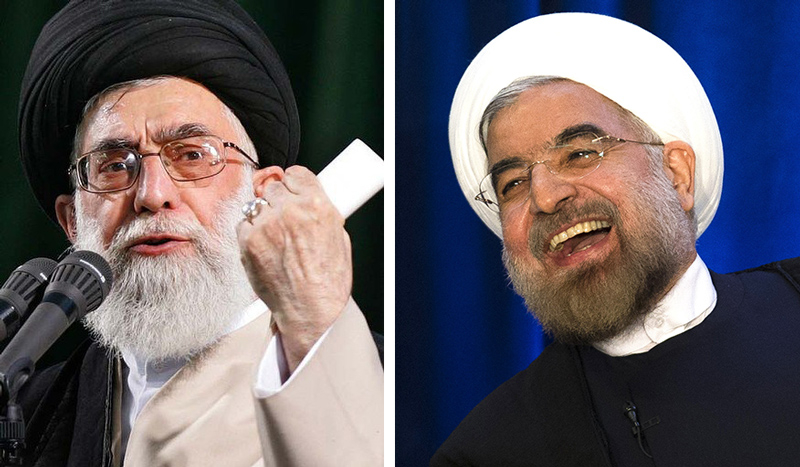
This regime will only change if the entire Supreme Leadership structure, along with all its linked organs, especially the IRGC, are annulled and dissolved. Otherwise, whether the president is the "hardliner" Mahmoud Ahmadinejad or the "reformist" Hassan Rouhani, the regime's policies will remain the same.

Western governments' policy of providing concessions to the Iranian regime in order to empower "reformist" factions is based on a fantasy -- a fantasy which the Iranian regime deliberately encourages in order to fool naïve foreign leaders into easing sanctions and turning a blind eye to the nuclear program. In reality, Western concessions are strengthening Khamenei -- further reducing the possibility of change, and increasing the likelihood of outright war.
Heshmat Alavi is a political and rights activist. His writing focuses on Iran, ranging from human rights violations, social crackdown, the regime's support for terrorism and meddling in foreign countries, and the controversial nuclear program. He tweets at @HeshmatAlavi & blogs at IranCommentary
=======================