.

.
Library of Professor Richard A. Macksey in Baltimore

POSTS BY SUBJECT

Labels

Wednesday, July 18, 2018

Salim Mansur : The Abuse of Egypt's Coptic Christians


  • The violence, and incitement to violence, directed by Egyptian Muslims against the Copts -- especially those organized sectarian campaigns by the Muslim Brotherhood and related groups -- are crimes against humanity and should be treated as such by the international community.
  • We know that a few drops of lemon will curdle an entire bowl of milk. Egypt's Muslims, as many Muslims elsewhere, have poured the entire Nile River -- made toxic by their bigotry and violence -- into their faith-tradition. We, Muslims, have degraded our culture by authoritarianism and the obstinate tendency to blame others for our own failings. We have thus perverted the very Islam that we believe is the final revelation.
  • Muslims in Egypt and elsewhere know from experience the extent to which Western powers have betrayed in practice what they pronounce in theory when it comes to support for people subjected to authoritarian regimes.
  • What is long overdue from the West is a robust policy to defend and secure human rights for everyone, especially minorities, in Muslim-majority countries... [as in] the Helsinki Agreement of 1975.
We have seen and recoiled from the horrific footage of Coptic Christians beheaded by ISIS in 2015 in Libya and the repeated bombings over the past two decades of Coptic churches in Egypt. We read about the Maspero massacre in 2011, when Egyptian military tanks, deployed to protect peaceful Christian demonstrators, instead rolled over them, crushing many to death. And we continue to receive reports of Coptic girls abducted, compelled to convert to Islam and forced into marriages with Muslims.
Each time there is news of another act of hate-filled violence against the Copts, or other religious minorities, we shudder. When there are attacks against Yazidis in the Fertile Crescent, the Baha'is in Iran and Christians and Ahmadis in Pakistan, we ask how Muslims can affirm these crimes against humanity perpetrated under the banner of Islam.
Apart from condemning the visible/demonstrable bigotry and violence -- and from appealing to Western governments for assistance -- Muslims opposed to Islamist extremism are at a loss about what needs to be done to hold the governments of Egypt and other Muslim-majority states accountable for their failure to protect their religious minorities from the sectarian violence that is regularly directed at them.
Here, regarding the Copts in Egypt, are a few preliminary observations that might serve as a proposal for how Muslims and non-Muslims, working together, might find a way out of this terrible situation and ensure their mutual survival and peaceful co-existence:
  • Egyptian Muslims are primarily, and fundamentally, responsible for the worsening situation of the Coptic Christians in Egypt. As Egypt's overwhelming majority population, Muslims have the responsibility to secure the rights of the Copts as a religious minority.
  • The violence, and incitement to violence, directed by Egyptian Muslims against the Copts -- especially those organized sectarian campaigns by the Muslim Brotherhood and related groups -- are crimes against humanity and should be treated as such by the international community
  • As part of their religious obligation, Egyptian Muslims bear an even heavier responsibility to secure the well-being and protect the rights and dignity of Coptic Christians. In persecuting the Copts, Egypt's Muslims are shredding the directives of the Quran on respecting and protecting Jews and Christians as the "People of the Book." According to the Quran, each one of us will be held accountable for our deeds on the Day of Reckoning. It is not for God to forgive the wrong an individual does to another unless the wrongdoer has sought and received forgiveness from the victim. In accordance with their own beliefs, then, Egypt's Muslims are undeniably guilty for the wrongs they have done to the Copts and will most certainly be held accountable on the Day of Reckoning.
  • The tragedy of the Copts is hugely amplified when we take into account their unique status in the history of Islam: due to the very special and intimate relationship that the leader of the Coptic Church was instrumental in arranging between his people and the Prophet Muhammad. According to the official history of the Coptic Church:
    "For the four centuries that followed the Arab's conquest of Egypt, the Coptic Church generally flourished and Egypt remained basically Christian. This is due to a large extent to the fortunate position that the Copts enjoyed, for Mohammed -- the Prophet of Islam -- who had an Egyptian wife named 'Coptic Maria' (mother of Ibrahim his son), preached especial kindness towards Copts: 'When you conquer Egypt, be kind to the Copts for they are your protégés and kith and kin."'
  • We know that a few drops of lemon will curdle an entire bowl of milk. Egypt's Muslims, as many Muslims elsewhere, have poured the entire Nile River -- made toxic by their bigotry and violence -- into their faith-tradition. We, Muslims, have degraded our culture by authoritarianism and the obstinate tendency to blame others for our own failings. We have thus perverted the very Islam that we believe is the final revelation.
  • Egyptian history has been shaped greatly by the cycle of invasions, conquests, exploitation by non-Egyptians, sectarian disputes and religious conflicts, long before the coming of the Arabs in the seventh century of the Common Era, and long after the Arabs had lost their supremacy in the region to non-Arabs and non-Muslims. The negative effects of such a long and enduring history also find expression in the violence that makes the Copts victims of Muslim bigotry and violence in recent history.
  • Muslims in general, including those of Egypt, are a "third world" people. As a result, they are both victims and victimizers in the complicated history of the modern world. As a "third world" people, they are confronted with the immense challenge of modernization, made even more difficult with the deep involvement of, and intervention by, outside powers in their situation. For the past century, Egypt has borne the full imprint of this complicated history, particularly since the failed 1882 proto-nationalist uprising in the Nile valley, led by Ahmed Arabi. That failure led directly to the occupation of Egypt by Britain, and in the subsequent struggle of the Egyptian people to achieve both independence and development. It was a failure that greatly confounded the inherent patience and nobility of the Egyptian people, for whom wars and their devastating consequences became a heavy burden.
  • It may not be difficult to be magnanimous in victory, as the Prophet Muhammad demonstrated, following his conquest of Mecca in 630; but it is certainly easy to become embittered, resentful and vengeful in defeat, as has been the history of Arabs and Muslims over the past century. This situation is when enlightened leadership becomes essential, but such leadership has been sorely missing in Egypt and in the wider Muslim world.
So what is to be done given the situation of Coptic Christians in Egypt, and religious minorities across the Muslim ummah (community)?
Whatever specific policy initiative is taken to deal with their plight, there is one indispensable requirement going forward. In the words of the German Catholic theologian, Hans Küng: "No survival without a world ethic. No world peace without peace between religions. No peace between the religions without dialogue between the religions."
Muslims in the public arena have one simple yet formidable task on hand: to speak the truth about the way in which Muslims across the world have been perverting God's Word into a political ideology and their religion into an unending inquisition.
During a December 2014 address to religious scholars and clerics at Cairo's Al-Azhar University -- the most renowned Sunni Muslim institution of learning in the Islamic world -- Egyptian President Abdel Fattah al-Sisi declared unambiguously:
"Honorable Imam [the Grand Sheikh of Al-Azhar], you bear responsibility before Allah. The world in its entirety awaits your words, because the Islamic nation is being torn apart, destroyed, and is heading to perdition. We ourselves are bringing it to perdition... We must take a long, hard look at the current situation we are in. It is inconceivable that the ideology we sanctify, should make our entire nation a source of concern, danger, killing, and destruction all over the world. It is inconceivable that this ideology... I am referring not to 'religion,' but to 'ideology' -- the body of ideas and texts that we have sanctified in the course of centuries, to the point that challenging them has become very difficult."
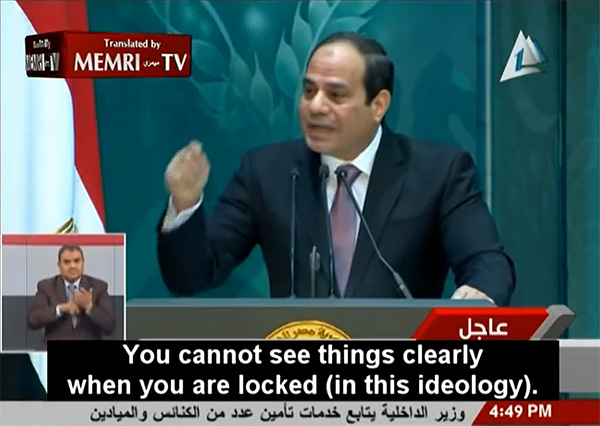
Egypt's President, Abdel Fattah el-Sisi, delivered a historic speech to top Islamic scholars and clergy at Al-Azhar University in Cairo, December 28, 2014. (Image source: MEMRI)
For the political leader of present-day Egypt to understand that Muslim religious scholars and clerics "bear responsibility" for perverting Islam by turning it into a fierce political ideology is extraordinary. The question, however, is whether those scholars and clerics grasped what he was saying. More importantly, do they have the integrity to rise to al-Sisi's challenge? And what about the West's responsibility in this matter?
Western powers, if they are to maintain credibility regarding leadership based on human rights, cannot turn a blind eye to what is going on in the Muslim world. Muslims in Egypt and elsewhere know from experience the extent to which Western powers have betrayed in practice what they pronounce in theory when it comes to support for people subjected to authoritarian regimes.
Egypt's Muslims have a long record of struggling to modernize their society. The lack of success of religious reformers, such as Muhammad Abduh (1849-1905) and Ali Abd al-Raziq (1888-1966), and secular intellectuals, such as Taha Hussein (1889-1973), Nasr Hamid Abu Zayd (1943-2010) and Hasan Hanafi (b.1935), in bringing Egypt out of its "third world" cultural backwardness was compounded by the complicated history of the country and people caught in the grips of colonial interests, anti-colonial struggles, inter-Arab rivalries, wars against Israel, and the Cold War contest in the Middle East.
What is long overdue from the West is a robust policy to defend and secure human rights for everyone, especially minorities, in Muslim-majority countries. Ironically, it already has on hand well-tested policies of both defending and successfully advancing respect for human rights within totalitarian states in the form of the Helsinki Agreement of 1975, which in retrospect contributed to the undoing of communism in the Soviet Union and its satellites in Eastern Europe.
A policy modelled on the Helsinki Agreement and tailored to the specific situation within the Muslim world, as in Egypt, by the Western powers led by the United States should be presented as the sine qua non to the member states of the Organization of Islamic Cooperation (OIC) if they wish to maintain a relationship of mutual respect and assistance with, for instance, the G7 nations. As signatories of the UN-adopted Universal Declaration of Human Rights of 1948, the OIC member states, including Egypt, must be told in no uncertain terms that their complicity in or failure to prevent human-rights abuses will have serious consequences.
The Western powers should also make it known categorically that the 1990 Cairo Declaration of Human Rights in Islam, which was adopted by the OIC, is unacceptable, because Article 24 of the document states: "All the rights and liberties stated in this Declaration are in accordance with the precepts of the Islamic Law." In other words, the Cairo Declaration makes Shariah law the basis for rights and freedoms within Muslim-majority countries. This should be totally unacceptable to Western powers, particularly the United States, as the principal founding member of the United Nations -- just as it is unacceptable to Muslims who understand the incompatibility of Shariah with the requirements of the modern world.
Shariah is an obsolete product of the minds of men belonging to the early Middle Ages. The Copts, as other religious minorities among the member states of the OIC, and many Muslims, are victimized daily on the basis of Shariah in Egypt. There can be no reprieve for them as long as the government continues to impose Shariah-directed rules and regulations in the country as a whole, and as long as Egyptian society complies.
An incessant demand must be made of the United States to lead the G7 to adopt a Helsinki-type of agreement in their dealings with the member states of the OIC. Such an accord eventually would have a similar effect on the Muslim world -- in terms of human rights, protection of religious minorities, equal status for women and freedom of speech as essential for advancing democracy -- as the Helsinki Agreement had in liberating the people under communism in the former Soviet Union and in Eastern Europe.
The treatment of the Copts in Egypt is a moral outrage for any Muslim aware of the religious tradition bequeathed to him by his prophet. This tradition includes Muhammad's affection for the Copts through his marriage to Maria, a daughter of the Copts, who bore him the son, Ibrahim (died in infancy), he so earnestly desired. As a result of this providentially blessed relationship, the Copts as a people became Muhammad's extended family, his kith and kin. When Egyptian Muslims seek God's mercy, they need reminding that it begins with atoning for wrongdoing against the Copts, and seeking forgiveness from them. The leadership of Al-Azhar University in Cairo could make a beginning by following President al-Sisi's example when he said recently, in welcoming the Copts with open arms as members of Egypt's family:
"We too love you. You are our family, you are from us, we are one and no one will divide us."
Salim Mansur is a Distinguished Senior Fellow at Gatestone Institute. He teaches in the department of political science at Western University in London, Ontario, and is the author of "The Qur'an Problem and Islamism"; "Islam's Predicament: Perspectives of a Dissident Muslim"; and "Delectable Lie: A Liberal Repudiation of Multiculturalism."
This article is based on remarks the author delivered at the 9th annual convention of Coptic Solidarity, held in Washington, D.C. on June 21-22.

Raymond Ibrahim : International Community Ignores Genocide of Christians in Nigeria


  • This brings the death toll of Christians to more than 6,000 since the start of 2018.
  • "The Islamists of northern Nigeria seem determined to turn Nigeria into an Islamic Sultanate and replace Liberal Democracy with Sharia as the National Ideology. The object of course, is to supplant the Constitution with Sharia as the source of legislation." — National Christian Elders Forum, a wing of the Christian Association of Nigeria.
  • The Nigerian government and the international community, however, have from the start done little to address the situation. This lack of participation is not surprising: they cannot even acknowledge its roots, namely, the intolerant ideology of jihad.
In what the Christian Association of Nigeria is calling a "pure genocide," 238 more Christians were killed and churches desecrated by Muslims last week in the west African nation. This brings the death toll of Christians to more than 6,000 since the start of 2018.
According to a joint statement by the Christian Association, an umbrella group of various Christian denominations, "There is no doubt that the sole purpose of these attacks is aimed at ethnic cleansing, land grabbing and forceful ejection of the Christian natives from their ancestral land and heritage."
The statement condemned the recent attacks, "where over 200 persons were brutally killed and our churches destroyed without any intervention from security agencies in spite of several distress calls made to them."
The statement adds that the majority of those 6,000 Christians massacred this year were "mostly children, women and the aged... What is happening in ... Nigeria is pure genocide and must be stopped immediately."
The details of the murder of these thousands, though seldom reported, are often grisly; many were either hacked to death or beheaded with machetes; others were burned alive (including inside locked churches or homes); and women are often sexually assaulted or raped before being slaughtered.
Both the Nigerian government and the U.S. government have long sought to present this protracted jihad as territorial clashes between the haves (apparently always Christians) and haves-not (apparently always Muslims).
In 2012, for instance, President Bill Clinton said that "inequality" and "poverty" are "what's fueling all this stuff" (the "stuff" being a reference to the ongoing Muslim slaughter of Christians in Nigeria). Former U.S. Assistant Secretary of State for African Affairs, Johnnie Carson, said after an Easter Day bombing in 2012 of a Nigerian church left 39 worshippers dead, "I want to take this opportunity to stress one key point and that is that religion is not driving extremist violence". The Obama administration reportedly agreed to spend $600 million in a USAID initiative launched to ascertain the "true causes" of unrest and violence in Nigeria -- which naturally lay in the socio-economic, supposedly never the religious, realm.
In its recent statement, however, the Christian Association of Nigeria denied these claims. After saying that those responsible for slaughtering Christians are always allowed to "go scot free" by the Nigerian government—which further portrays the attacks as "farmers/herdsmen clashes"—it inquired:
"How can it be a clash when one group [Muslims] is persistently attacking, killing, maiming, [and] destroying, and the other group [Christians] is persistently being killed, maimed and their places of worship destroyed? How can it be a clash when the herdsmen are hunting farmers in their own villages/communities and farmers are running for their lives?"
On May 2, the National Christian Elders Forum -- a wing of the Christian Association, the members of which average the age of 75 and come from Nigeria's six geopolitical zones -- met with the British High Commission in an effort to receive support. (Days before the meeting, around 30 Muslim herdsmen had stormed a church during early morning Mass and murdered nearly 20 parishioners and two clergymen.) The group's executive summary of issues included:
It is clear to the Christian Elders that JIHAD has been launched in Nigeria by the Islamists of northern Nigeria led by the Fulani ethnic group [the "herdsmen"]. This Jihad is based on the Doctrine of Hate taught in Mosques and Islamic Madrasas in northern Nigeria as well as the supremacist ideology of the Fulani. Using both conventional (violent) Jihad, and stealth (civilization) Jihad, the Islamists of northern Nigeria seem determined to turn Nigeria into an Islamic Sultanate and replace Liberal Democracy with Sharia as the National Ideology. The object of course, is to supplant the Constitution with Sharia as the source of legislation. The current 1999 Constitution is plagued with dual conflicting ideology of Democracy and Sharia. There are certain values which are non-negotiable in a pluralistic society and it seems the advocates of the Caliphate do not respect this. A dual-ideology-driven Nigeria cannot be the Nigeria of our dream. We want a Nigeria, where citizens are treated equally before the law at all levels.... Bearing in mind that Christians constitute over 50% of the Nigerian population, the goal of the Islamists is bound to create serious conflicts which if not checked is capable of escalating into another civil war. Already, the Islamists are murdering Christians with impunity and destroying vulnerable Christian places of worship and communities at an alarming and inhuman rate.
That 6,000 Christians, "mostly children, women and the aged," have been butchered in just the first six months of this year is a reminder of how violence only escalates when left unchecked. That is the story of the Muslim persecution of Christians in Nigeria.
It took three times as long (a year-and-a-half, between December 2013 to July 2015), for example, for the same Muslim herdsmen to slaughter a total of 1,484 Christians (532 men, 507 women, and 445 children), critically wound 2,388 Christians (1,069 men, 817 women, and 502 children), and burn or destroy 171 churches.
The Nigerian government and the international community, however, have from the start done little to address the situation. This lack of participation is not surprising: they cannot even acknowledge its roots, namely, the intolerant ideology of jihad. As a result, the death toll of Christians has only risen -- and will likely continue to grow exponentially -- until such time that this reality is not only acknowledged but addressed.

The governor of Nigeria's Anambra State, Willie Obiano (center), visits a wounded survivor of a deadly attack on St. Philip Catholic Church in Ozubulu, August 11, 2017. (Image source: Channels TV video screenshot)
Raymond Ibrahim is the author of Crucified Again: Exposing Islam's New War on Christians (published by Regnery with Gatestone Institute, April 2013).

A. Z. Mohamed : Is Islam "Exceptional"?


  • "Western observers... will need to accept Islam's vital and varied role in politics and formulate policies with that in mind, rather than hoping for secularizing outcomes that are unlikely anytime soon, if ever." — Shadi Hamid, author of Islamic Exceptionalism: How the Struggle Over Islam Is Reshaping the World.
  • "'Islamic exceptionalism' is neither good nor bad. It just is." — Shadi Hamid.
  • "As the transition from pre-modernity to modernity proceeds with its twists and turns, the Muslim world, over time will progress and develop to the point that eventually there will arise a theology, as occurred in Christendom, consistent with the needs of Muslims and reconciled with modernity." — Salim Mansur, author of The Qur'an Problem and Islamism: Reflections of a Dissident Muslim.
In early May, the Brookings Institution held a lecture and panel discussion in India on the question of whether Islam is "exceptional" and what it means for the future of Western democracy. A main speaker at the event was Shadi Hamid, author of a 2016 book, Islamic Exceptionalism: How the Struggle Over Islam Is Reshaping the World.
Hamid, an American Muslim, repeated the thesis of his book, summarized in an op-ed in Time magazine.
"Because of its outsize role in law and governance, Islam has been — and will continue to be — resistant to secularization," he wrote. He explained:
"Unlike Jesus Christ, the Prophet Muhammad was a theologian, a preacher, a warrior and a politician, all at once. He was also the leader and builder of a new state, capturing, holding and governing new territory. Religious and political functions, at least for the believer, were no accident. They were meant to be intertwined in the leadership of one man.
"Second, more than merely the word of God, for Muslims, the Quran is God's direct and literal speech. It is difficult to overstate the centrality of divine authorship. This does not mean Muslims are literalists; most are not. But it does mean the text cannot easily be dismissed as irrelevant."
This means, he added, that "Western observers... will need to accept Islam's vital and varied role in politics and formulate policies with that in mind, rather than hoping for secularizing outcomes that are unlikely anytime soon, if ever."
To clarify that his position is not necessarily critical, he wrote, "'Islamic exceptionalism' is neither good nor bad. It just is."
Islamists might be likely to welcome Hamid's understanding of Islamic "exceptionalism" more than his value-neutral assertion that it is "neither good nor bad."
Muslims frequently describe Islam as the "religion of truth" -- superior to all others. As it is written in the Quran (3:19):
"Indeed, the religion in the sight of Allah is Islam. And those who were given the Scripture did not differ except after knowledge had come to them -- out of jealous animosity between themselves. And whoever disbelieves in the verses of Allah, then indeed, Allah is swift in [taking] account."
Many of the Western world's politicians, academics and members of the media tend to treat Islam differently from other religions and ideologies. They claim it is a "religion of peace" -- abused by a small minority of radicals to justify terrorism -- and that it is compatible with democratic values.
Hamid, however, appears to do neither.
According to Middle East Institute scholar Hassan Mneimneh:
"Hamid's work can be understood as an invitation to sober the discussion about Islam and politics on two connected fronts: 1) disabusing some Western circles of the reductionist and patronizing notion that Muslim societies will eventually follow the Western template toward liberal democracy, and 2) calling for an acceptance of the depth of the cultural and conceptual differences between Muslim and Western societies."
Mneimneh nevertheless added that, "Hamid seems to accept the Islamist notion of the uncontested primacy of a totalitarizing religion, and that 'universal' values are basically a Western import."

Hassan Mneimneh (left) and Shadi Hamid (right) at a panel discussion for The Middle East Institute, July 27, 2016. (Image source: Middle East Institute video screenshot)
It should be of great concern that even a self-described liberal such as Hamid -- one who said he feels "a bit uncomfortable making this claim, especially now with anti-Muslim bigotry on the rise" -- leaves little room for optimism where the ability of Islam to undergo a reformation is concerned. He does not appear even to think it is necessary.
Salim Mansur, author, among other works, of The Qur'an Problem and Islamism: Reflections of a Dissident Muslim, disagrees. In a recent article, he wrote:
"The Muslim world currently appears trapped within the parameters of the pre-modern world, based on its quasi-nominalist view of God. The Sufi understanding of God as universal love seems not fully to meet the Muslim world's urgent need to figure out how to negotiate modernity without abandoning the God of the Qur'an.
"The fury of the internal upheaval inside the Muslim world -- the Muslim rage that is incomprehensible to non-Muslims -- will eventually exhaust itself when a sufficiently large segment of the Muslim population reconciles reason and revelation to discover that God never meant any religion, including Islam, to be a burden preventing man from threading a relationship with Him in harmony with human nature.
"As the transition from pre-modernity to modernity proceeds with its twists and turns, the Muslim world, over time will progress and develop to the point that eventually there will arise a theology, as occurred in Christendom, consistent with the needs of Muslims and reconciled with modernity."
A. Z. Mohamed is a Muslim born and raised in the Middle East.

Nonie Darwish : "Jihad Allowance": Views of Work in the Middle East


  • After the ruling class, the highest respect and wealth is given to the jihadist class or military leadership class. Otherwise, the jihadist or military class might turn against the leadership and Islamic system itself. That is one reason why the highest pensions in most Muslim countries, as in Gaza and the West Bank, go to widows, parents and children of jihadists and military retirees.
  • "We [the Muslim world], don't work and if we work, we don't do it professionally. We do not produce . . . and we import everything from the needle to missiles... Muhammad ordered us to excel in everything 'if you kill, do it properly, and if you slaughter, do it properly...' How come the Zionist gang has managed to be superior to us? They have become superior through knowledge and technology and work ethics." — Sheikh Yusuf al-Qaradawi, Chairman of the International Union of Muslim Scholars.
  • Today, as Muslims are escaping their vast, poverty-stricken Islamic territories in 54 Islamic nations for the greener lands of Europe and America, Westerners seem to think they are rescuing refugees. Many times they are, but other times this is just the latest version of a story that has been repeating itself for 1,400 years.
Recently, the President of Iran, Hassan Rouhani, dismissed President Trump as just a "tradesman" who lacked the qualifications to handle political and international affairs. At face value, the criticism might sound similar to that of an opposition party alleging that Trump lacks political experience. Coming from an Islamic leader, however, it reflects a much deeper meaning: on how differently the Islamic culture views the work ethic and the means of acquiring wealth.
Although there are many Muslims who work tirelessly and are immensely successful, Islamic culture in general has little respect for manual labor and even for business owners. People who engage in legitimate "trade" for a living are often viewed with scorn or as "having" to labor for a living.
Historically, Islamic society has given the highest respect and wealth not to the innovators or hardest workers; rather, is usually been bestowed on the ruling class, their families and associates. After the ruling class, the highest respect and wealth is given to the jihadist class, or military leadership class.
According to the Koran and the example of Muhammad, the spoils of war (acquired wealth through jihad) is to be given to the jihadists. Jihadists need to be kept busy against the outside world at all times to expand or maintain the power of Islam. Otherwise, the jihadist or military class might turn against the leadership and Islamic system itself. Congress recently pulled more than $300 million a year from the Palestinian Authority that the US was paying in a "pay to slay" arrangement that incentivized murder -- a "jobs program".
Muhammad rewarded Muslim fighters who died with Paradise; these are the only people guaranteed admittance. Those who survived jihad were given wealth:
"Allah guarantees that He will admit the 'mujahid' in His cause into Paradise if he is killed, otherwise He will return him to his home safety with rewards and war booty" (Bukhari 4:52:46).
The example of Muhammad and his Muslim fighters rests in stark contrast to the example of the pre-Islamized Meccan merchants who rejected Muhammad, and to the Jews who lived in Medina, who engaged in trade and earned their living from hard labor.
The contrast between the lifestyle of Muhammad and his fighters and that of the Jewish tribes probably alarmed the Jews -- with good reason. Muhammad's eyes were set on taking the power, wealth and control from the Jews and from the Arab leaders of Mecca -- and he succeeded.
"Spoils of war" -- also the name of a chapter in the Koran, Al-Anfāl, mostly about the Badr war -- became the lure used to attract more and more fighters to the side of Islam against wealthy Jews and the merchants of Mecca.
Spoils of war or booty, or taking the wealth of Muhammad's enemies after killing them became a big business. Anyone who was caught stealing booty was punished by Muhammad gave his fighters four-fifths of the spoils and one fifth was given to Muhammad and Allah. Anyone caught stealing booty was punished by Muhammad
Capturing wealth from others, rather than creating wealth, became an Islamic value, established as an honorable and holy legal right of Muslims. As Muhammad said in the hadith, "Booty has been made legal for me" (Bukhari 53:351).
This has been, in general, the Muslim economic model, set by the example of Muhammad, for building wealth. The most prestigious and privileged position in society for any Muslim man is the position of the jihadist. Islam became an ever-expanding machine of conquest that could not stop -- or else it would run out of money. It took as the spoils of conquest the wealth of many great civilizations including Persia, Syria, Turkey, Iraq, Coptic Christian Egypt, and the Biblical lands in and around Jerusalem -- demonstrating why manual labor and those who work in both farming and trade are looked down upon in Muslim culture as not putting jihad as number one to earn a living.
Today, as Muslims are escaping their vast, poverty-stricken Islamic territories in 54 Islamic nations for the greener lands of Europe and America, Westerners seem to think they are rescuing refugees. Many times they are, but other times this is just the latest version of a story that has been repeating itself for 1,400 years.
Muslim clerics today are still advocating jihad for the acquisition of wealth. For example, the prominent Egyptian Sheikh, Abu-Ishaq al-Huwayni, is still lecturing at Al Azhar University on how Muslims' financial difficulties are due to the fact that they have abandoned jihad and the wealth and slaves that could be acquired from it.
At least one Muslim leader -- the Chairman of the International Union of Muslim Scholars, Sheikh Yusuf al-Qaradawi -- has noticed the lack of a work ethic in Islamic society. He tried to recommend a solution to the lack of a work ethic in Muslim society, but he could not find one quote in the Quran regarding the subject except in doing jihad well. Referring to the Muslim world, he said: "We don't work and if we work, we don't do it professionally. We do not produce... and we import everything from the needle to missiles." He gave the only Islamic reference he could find regarding proper work ethic:
"Muhammad ordered us to excel in everything 'if you kill, do it properly, and if you slaughter, do it properly...' How come the Zionist gang has managed to be superior to us? They have become superior through knowledge and technology and work ethics."
The lack of a proper work ethic in Islamic culture is possibly a large cause behind the refugee movement and helps to explain why Muslims' eyes are always focused on the outside, non-Muslim world, the greener pastures, for more and more to conquer or expand into.
Islam's long history of wealth creation through acquisition continues today. In 2013, the British Muslim cleric, Anjem Choudary, who was sentenced prison for "urging support" for ISIS, called it a "Jihadi allowance," as if it were, or should be, an entitlement. By the age of 45, and with four children, Choudary said that according to Islamic law, this is the way it is supposed to work.
Reported by both the U.K. Sun and Telegraph, Choudary said:
  • "We are on Jihad Seekers Allowance, we take the Jizya [protection money paid to Muslims by non-Muslims] which is ours anyway."
  • "The normal situation is to take money from the [non-Muslims] isn't it? So this is the normal situation."
  • "They give us the money. You work, give us the money. Allah Akbar, we take the money. Hopefully there is no one from the DSS [Department of Social Security] listening."
  • "Ah, but you see people will say you are not working. But the normal situation is for you to take money from the kuffar [non-believers]. So we take Jihad Seeker's Allowance."
Only the West, still in denial, seems to have trouble believing it.


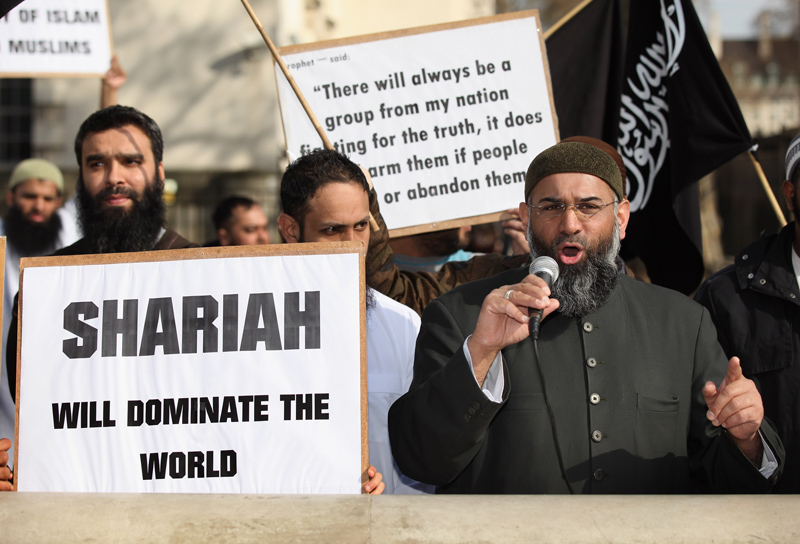
British Muslim cleric Anjem Choudary, who was sentenced prison for "urging support" for ISIS, called unemployment and welfare benefits for Muslims a "Jihadi allowance," as if it were, or should be, an entitlement. (Photo by Oli Scarff/Getty Images)
Nonie Darwish, born and raised in Egypt, is author of "Wholly Different; Why I Chose Biblical Values Over Islamic Values".

Judith Bergman : The Relentless Radicalization of Sweden


  • Swedish police report that Muslim children have told their classmates they will cut their throats, while showing them beheadings on their mobile phones, according to the new study of Salafism in Sweden by the Swedish Defence University.
  • "Many women live worse [lives] here than they would have in their former countries" — Swedish care worker.
  • The inability -- willful blindness is probably a more apt description -- to see that jihadist terrorism does not emerge from a vacuum, but is nurtured in particular environments, is hardly an exclusively Swedish situation. The insistence of so many European and other Western authorities on describing terrorist attacks as instances of "mental illness" illustrate it perfectly.
A new study[1] of Salafism in Sweden, conducted by the Swedish Defence University, paints a bleak picture of the ongoing radicalization of Muslims in Sweden.
The Salaf are the "pious ancestors" during the first three generations of the followers of Mohammed; its ideology has come to be associated over the last few decades with al-Qaeda and ISIS, as well as with local al-Qaeda affiliates. According to the study, Salafists, who believe in Islam as Mohammed's early followers practiced it, tend to reject Western society in favor of a "pure" Islam: "Not all Salafists are jihadists, but all jihadists are Salafists". [2]
Although the study does not give an estimate of how many Salafists are in Sweden, it does describe how Salafist milieus there have evolved and grown stronger, especially during the past decade, and lists several examples of the influence they wield in different Swedish cities and localities.


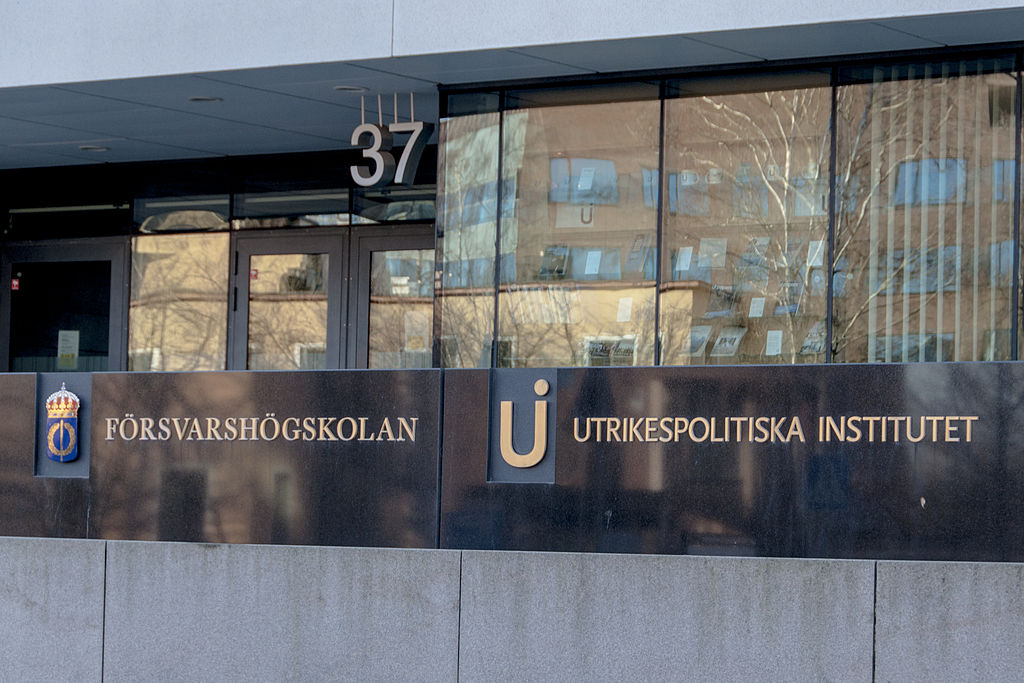
The Swedish Defence University has published a new study that paints a bleak picture of the ongoing radicalization of Muslims in Sweden. (I99pema/Wikimedia Commons)

"Salafists", the authors of the study conclude, "...advocate gender segregation, demand that women veil themselves to limit 'sexual temptation', restrict women's role in the public sphere and strongly oppose listening to music and some sports activities"[3].
According to the study, many Salafists also tell Muslims not to have Swedish friends, and refer to them as "kufr", the Arabic term for a non-Muslim or "disbeliever". One Salafist preacher, Anas Khalifa, said:
"Does that mean that if you meet a Christian or Jew you should beat him or threaten him? No. There is no war between you and Christians and Jews in your school, for example. You hate him for Allah's sake. You hate that he does not believe in Allah. But you want from your heart that he will love Allah. So you have to work with them, talk with them, because you want Allah to guide them". [4]
The Salafists, apparently, have divided Sweden geographically between them. According to the study:
"It is interesting that the Salafist preachers, on which the study focuses, appear to be more in cooperation with each other, rather than rivals. Instead, these preachers seem to divide their da'wa (mission) into different geographical areas..."[5].
The study's findings from different cities where Salafists are active include:
In Borås, some children will not drink the water at the school or paint with watercolors there, because they say the water is "Christian". The police report that Muslim children have told their classmates they will cut their throats, while showing them beheadings on their mobile phones. There are examples of "adolescents arriving at mosques at the end of a school day to 'wash' themselves after having interacted with [non-Muslim] society". Care workers [health care, child care, etc.] in the city have testified to how men exercise control over women, checking on them even in waiting rooms[6]. One care worker said:
"I realized that there is a network that controls the women so they won't be left alone with the care workers. They are not given a chance to tell anyone about their situation. Many women live worse [lives] here than they would have in their former countries".
This kind of control of women appears to be taking place in practically all the Swedish cities mentioned in the study.
In Västerås, religious influence is mixed with crime. "It could be a bunch of guys coming into the grocery store. If the woman at the cashier is not veiled, they take what they want without paying, they call the cashier 'Swedish whore' and spit on her," said a police officer in the study. Other examples include Syrians and Kurds who run stores and restaurants in the area and are questioned by young Muslims about their religion. If the answer is not Islam, they are harassed. In other cases, boys as young as 10-12 years have approached older women in the area, asking them whether they are Muslim, telling them "this is our area".[7]
In Gothenburg, according to the study[8], Salafists told Muslims not to vote in the most recent elections because it is "haram" (forbidden). "They said that on the day of judgment you will be responsible for the actions of all stupid politicians if you vote. They stood at polling stations... At one polling station they waved an IS [Islamic State] flag", a local official told the authors of the study. According to one imam in the city, Gothenburg has been the capital of Wahhabism (a Saudi version of Salafism) in Europe since the 1990s.[9]
Out of the 300 Swedish Muslims who joined ISIS in Syria and Iraq, almost one third came from Gothenburg.[10] (In relation to their total population, more people have traveled from Sweden to join jihadist groups in Syria and Iraq than from most European countries -- only Belgium and Austria have a higher proportion[11]). Somali-Canadian preacher Said Regeah, speaking at the Salafist Bellevue Mosque in Gothenburg, has "raised the importance of people being born 'pure' and that only Muslims are pure. All are born as Muslims, but it is the parents who shape them to become 'Jews, Christians, or Zoroastrians'".[12]
The study also reports that non-Muslim business owners have experienced having their facilities vandalized with Islamic State graffiti and that Christian priests have received threats of decapitation[13]. One man, Samir, said, "If you do not follow Islam, people ostracize you. There are parents here who put veils on their three-year-olds. It is unreal. We are not in Iraq".[14]
Another man, Anwar, was denied service in a Muslim restaurant because he is not religious. He points out that society is letting secular Muslims down: "I don't need a Bible or a Koran in my life. The only book I need is... the [Swedish] law. But if society isn't even on your side, what can you do?"[15]
In the Stockholm area, the study estimates that there are currently up to 150 Salafist jihadists[16]. Salafists are especially concentrated in the Järva area, a "no go zone". Sometimes the jihadist and the criminal elements overlap, and these Muslims terrorize other people who live in the area. One woman said that Salafists and Islamists have come to dominate businesses, basement mosques, and cultural associations during the past ten years, and that "Swedes have no idea how much influence political Islam has in the suburb". She described how even children are gender segregated and that religious leaders tell women not to tell the authorities if their husband abuses them. "Swedish laws are not applied in the suburbs".[17]
The study concludes with a critique of Swedish authorities for their apparent inability to link individual radical Muslims to the "environments that form their ideas and in certain cases have facilitated the will to join more radical and violent groups". The study mentions the following as an example:
"When the then-National Coordinator Against Violent Extremism said that the question of why so many people chose to travel to IS from Sweden was 'a million dollar question', it is an illustration of the overall inability of Swedish authorities (with the exception of police and security police) to see that this problem has not emerged from a vacuum".[18]
This inability -- or possibly willful blindness -- to see that jihadist terrorism does not emerge from a vacuum, but is nurtured in particular environments is hardly an exclusively Swedish situation. The insistence of so many European and other Western authorities to describe terrorist attacks as instances of "mental illness" illustrate it perfectly.
The authors of the study also mention that schools and other local authorities do not know how to deal with the challenges created by the Salafists. The study mentions, for example, that a Muslim schoolgirl wanted to take off her headscarf to play hairdresser with the other children, but the Swedish personnel did not allow it out of respect for her parents' wishes. In an example from a Swedish preschool, a little girl did not want to wear her headscarf but the Swedish personnel forced it on her, "even though it felt wrong", because it was the parents' wish. Swedish school personnel have also described that they do not know how to act when children want to eat and drink during Ramadan, but the parents have instructed that they must fast.[19]
The study is an important first step in Sweden finally acknowledging that there is a problem, but unless the relevant Swedish authorities -- including the Swedish government and the political leaders, who refuse to acknowledge reality in Sweden -- read and internalize it, the study will have been done in vain.
Judith Bergman is a columnist, lawyer and political analyst.

[1] "Between Salafism and Salafist Jihadism - Impact and Challenges for Swedish Society", published on June 28. The study was commissioned by the Swedish Civil Contingencies Agency.
[2] Between Salafism and Salafist Jihadism - Impact and Challenges for Swedish Society, p 14.
[3] Ibid., p 24
[4] Ibid., p 132
[5] Ibid., p 223
[6] Borås is described on pp162ff of the study.
[7] Västerås is described on pp 168ff.
[8] Ibid., p 186
[9] Ibid., p 182
[10] Ibid., p 103
[11] Ibid., p 107
[12] Ibid., p 131
[13] Ibid., p 186
[14] Ibid., p 187
[15] Ibid., p 187
[16] Ibid., p 210
[17] Ibid., p 213
[18] Ibid., p 109
[19] Ibid., p 194

Giulio Meotti : Mass Migration: "The Fatal Solvent of the EU"

  • Today, 510 million Europeans live in the European Union with 1.3 billion Africans facing them. If the Africans follow the example of other parts of the developing world, such as the Mexicans in the US, "in thirty years... Europe will have between 150 and 200 million Afro-Europeans, compared with 9 million today". Smith calls this scenario "Eurafrique".
  • The controversial quota system for migrants has already failed. The European Court of Human Rights condemned Hungary for detaining migrants. European governments cannot stop, deport, arrest or repatriate the migrants. What do the authorities in Brussels suggest? Bring everyone to Europe?
  • French Jews have fallen victim to a form of ethnic cleansing, according to a manifesto signed by, among others, former French President Nicholas Sarkozy and former French Prime Minister Manuel Valls.
"Far from leading to fusion, Europe's migration crisis is leading to fission", Stanford's historian Niall Ferguson recently wrote. "Increasingly, I believe that the issue of migration will be seen by future historians as the fatal solvent of the EU". Week after week, Mr. Ferguson's prediction seems to be turning into a reality.
Not only does Europe continue to fragment as anti-immigration sentiment gathers political strength, but, as a result of the migrant crisis, the EU's border-free internal zone, Europe's most cherished prize after the Second World War, is now defined as "at risk" by the Italian government, among other governments, such and Austria.
Immigration is also redefining the intra-EU contract.
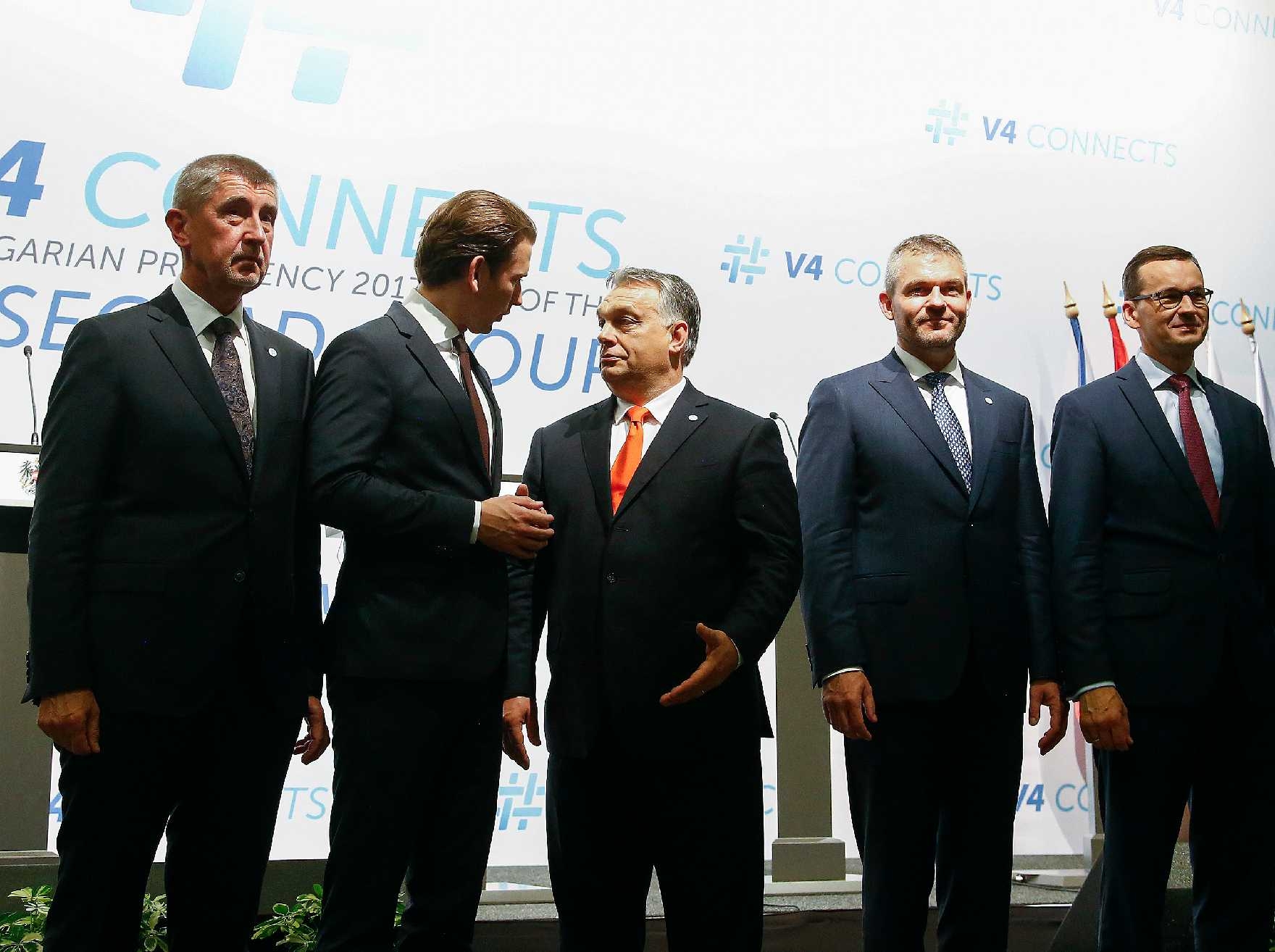
The Czech Republic, Hungary, Poland and Slovakia, the so called "Visegrad Group", recently called for EU border defense. "We have to have a Europe capable of defending us", Austrian Chancellor Sebastian Kurz said as well, after he was invited to join the Visegrad meeting.
 

This year, Austrian Chancellor Sebastian Kurz (second from left) was invited to join the leaders of the four "Visegrad Group" countries (Czech Republic, Hungary, Poland and Slovakia) at their June 21 summit meeting. High on the agenda were the issues of mass-migration and border protection. (Image source: Austrian Federal Chancellor's Office)
The new Italian populist government, after Italy saw more than 700,000 migrants arrive on its shores in the past five years, also embraced a hard-line policy. Italian Interior Minister Matteo Salvini recently closed Italy's ports to migrant vessels. In Germany, after the German chancellor clashed on immigration with her interior minister, Horst Seehofer, migrant policy could also lead to the "end of Merkel's tenure".
"Italy's new populist government signals a major challenge to the European status quo, but not in the way most observers initially expected", the author Walter Russell Mead recently commented in The Wall Street Journal. "The governing coalition has put the challenge to its euro policy on hold. Instead it is turning to a subject on which the European establishment is more vulnerable: migration".

The entire European political consensus is fracturing under the seismic impact of the migrant wave. Migration to Europe has become a political issue "as toxic as ever", the New York Times just noted about the current debate inside the European Union. 
The EU's current trouble seems to come from a deafness among the policy elites, who refuse to take into account the problems for their citizens that have followed unvetted mass immigration.
Mass migration in the last years has simply created major troubles for Europe's internal stability. First, there has been a security challenge. According to a new report by the Heritage Foundation:
"Almost 1,000 people have been injured or killed in terrorist attacks featuring asylum seekers or refugees since 2014. Over the past four years, 16 percent of Islamist plots in Europe featured asylum seekers or refugees. ISIS has direct connections to the majority of plots, with Germany targeted most often, and Syrians more frequently involved than any other nationality. Nearly three-quarters of plotters carry out, or have their plans thwarted, within two years of arrival in Europe.
...
"Since January 2014, 44 refugees or asylum seekers have been involved in 32 Islamist terror plots in Europe. These plots led to 814 injuries and 182 deaths."
There is also a severe challenge to ethnic and religious coexistence posed by immigration. French Jews have fallen victim to a form of ethnic cleansing, according to a manifesto signed by, among others, former French President Nicholas Sarkozy and former French Prime Minister Manuel Valls. "Ten per cent of the Jewish citizens of the Paris region have recently been forced to move because they were no longer secure in certain council estates" the manifesto said. "This is a quiet ethnic cleansing".

The threat Europe is facing if it refuses to close and control the borders is examined by Stephen Smith, an expert on Africa and admired by French President Emmanuel Macron, in his new book, The Rush to Europe: Young Africa on the Way to the Old Continent. Today, he notes, 510 million Europeans live in the European Union with 1.3 billion Africans facing them. "In thirty-five years, 450 million Europeans will face some 2.5 billion Africans, five times as many", Smith predicts. If the Africans follow the example of other parts of the developing world, such as the Mexicans in the US, "in thirty years", according to Smith, "Europe will have between 150 and 200 million Afro-Europeans, compared with 9 million today". Smith called this scenario "Eurafrique". Europe's largest migration wave since World War II has also become an increasingly urgent problem as Europe's indigenous populations continue to age and diminish in number.

The controversial quota system for migrants has already failed. The European governments also cannot really deport migrants. In 2012, the European Court of Human Rights (ECHR) condemned the Italian government and ordered it to pay thousands of euros to two dozen immigrants it deported to Libya. Italian authorities had intercepted the migrants in the Mediterranean Sea when they were trying to get to the Italian island of Lampedusa from Libya. Three years later, the European Court again condemned the Italian government for deporting migrants. The European Court of Human Rights also condemned Spain in its judgment to expel of a group of 75-80 migrants from the Melilla enclave. The ECHR then condemned Hungary for detaining migrants. Europe cannot stop, deport, arrest and repatriate the migrants. 
What do the authorities in Brussels suggest? Bring everyone to Europe?

Andrew Michta, dean of the College of International and Security Studies at the George C. Marshall European Center for Security Studies, recently wrote that, under this mass migration, European democracies risk their own "decomposition". We will not only see the "fission" of the already fragile European Union, but that of the Western civilization as well.
Giulio Meotti, Cultural Editor for Il Foglio, is an Italian journalist and author.

Friday, July 6, 2018

Ron Unz : Does Race Exist? Do Hills Exist?

http://www.unz.com/runz/does-race-exist-do-hills-exist/

Does Race Exist? Do Hills Exist?
• May 22, 2014

Although my own academic background is in theoretical physics, I’m the first to admit that field seems in the doldrums these days compared with human evolutionary biology.
The greatest physics discoveries of the last couple of years—the Higgs Boson and strong evidence for Cosmological Inflation—merely confirm the well-established beliefs that physicists have had since before I entered grad school. It’s nice that such experimental evidence means that individuals such as Peter Higgs, Alan Guth, and Andrei Linde, whose names have been prominent in the standard textbooks for decades, have received or will surely soon receive their long-deserved Nobel Prizes, but little new has been learned. Or so is the impression of a lapsed theoretician who left that field over twenty-five years ago and who mostly follows it through the pages of the major newspapers.
Meanwhile, human evolutionary biology has been on a tear, partly due to the full deciphering of the human genome over the last couple of decades and our increasing technical ability to effectively read archaic DNA from thousands or even tens of thousands of years in the past. In recent years we have seen shocking discoveries that most humans possess small but probably significant Neanderthal ancestry and that important genetic changes have regularly swept through our genome. On the theoretical side, it was long assumed that human genes had changed little since Cave Man days, but we now understand that in some respects human evolution may have actually accelerated during the last ten thousand years as our rapidly growing population provided a much larger source of potentially favorable mutations, while agriculture and civilization were simultaneously applying strong selective pressures.
Although my other projects have prevented me from following these developments except through newspapers, blogs, and books, such evolutionary issues have long fascinated me. During the early 1980s I even participated in the field, studying under Harvard’s E.O. Wilson and felt that if physics had not been an option, evolutionary biology would have been my next choice. I remember telling all my skeptical friends in 1979 that Richard Dawkins’ The Selfish Gene was probably one of the most important books of the decade, and I stand by that opinion today.
Yet although our understanding of the origins of modern humans and their biologically-influenced behavior has grown by leaps and bounds over the last couple of decades, these world-changing developments seem to have received extremely scanty coverage in the mainstream press, meaning that many of them have probably not penetrated into the public consciousness of those who are not academic specialists. The assumptions and world-views of most American intellectuals and journalists often seem stuck in the 1980s, clinging to ideas that are almost completely outmoded and incorrect, much like Soviet biology into the 1960s was still crippled by the Stalinist legacy of Trofim K. Lysenko, who had argued for the inheritance of acquired characteristics and purged all those biologists who disagreed.
America’s own Lysenko is surely the late Harvard paleontologist Stephen Jay Gould, whose platform in the prestige media and widely assigned books have massively influenced entire generations of college students and thinkers. Unfortunately, just like his Soviet counterpart, Gould promoted ideologically motivated misrepresentations of reality, sometimes backed by outright scientific fraud, and people who read his books are regularly absorbing falsehoods.
In a further parallel to the Soviet case, Gould and his Marxist circle of friends and allies, including Richard Lewontin, Steven Rose, and several others, regularly sought to purge or otherwise silence their most honest and courageous colleagues. During the 1970s, Harvard’s Wilson became their particular target for daring to publish his landmark book Sociobiology: The New Synthesis, and their wild ideological charges led radical student demonstrators to demand the university fire one of its brightest tenured stars and even to physically assault the mild-mannered Wilson at a meeting of the American Academy of Sciences. Although Gould seems to have been a rather mediocre scientist, some of his radical allies such as Lewontin were first-class researchers, but also ideologues who allowed their politics to dictate their science.
While I was a graduate student at Cambridge University during the mid-1980s, these events occasionally came up in casual discussions across the dining tables. On one such occasion, a former grad student of Lewontin’s said that during the height of the sociobiology controversy he had asked his mentor why he was leveling such ridiculous accusations against a colleague, with the reply being that those accusations were admittedly scientific nonsense, but they served the political interests of Marxism, which was far more important. Meanwhile, given Gould’s strength in words but his weakness in thinking, I find it reasonably likely that he simply believed many of the absurdities he was spouting.
As the years and the decades have gone by, I’ve always assumed that Gouldism was about to lose its grip on American intellectual life, but that assumption has always proven wrong. The totally absurd notion that genetics plays a relatively small role in influencing most human behaviors represents a zombified doctrines, absorbing endless seemingly fatal scientific wounds at the hands of prominent scholars but remaining almost unkillable, more like a religious dogma than a scientific doctrine.
For example, in 2002 Harvard’s Steven Pinker, one of America’s most prominent evolutionary psychologists, published The Blank Slate, an outstanding critique of this incorrect reigning dogma, which specifically included a lengthy debunking of Gould, Lewontin, and their circle. Not only was the book a huge seller and glowingly discussed throughout the MSM, but I was stunned to read an equally favorable review in The Nation, pole-star of America’s political Left. I naturally assumed that the full collapse of Gouldism was underway, an impression enhanced once the august New York Times later published an article describing an important instance of Gould’s scientific fraud.


But a year or two ago, when I heard smart intellectuals still citing Gould, I asked a prominent academic how that would possibly be the case. He explained that whereas in the 1990s, probably 99% of intellectuals believed in Gould, the massive revelations of recent years had merely reduced that support to 95%, leaving Gouldism almost as entrenched as ever. Whereas worldwide support for Stalinism substantially collapsed following Khrushchev’s 1956 “Secret Speech” Gouldian nonsense seems to have largely avoided that fate.

But perhaps that is now about to change.
One of the oddities of American intellectual life is that although a full-fledged scientific revolution in human genetics and evolution has been taking place for the last couple of decades, very little of this has been reported in the mainstream media, perhaps because the findings so totally contradict the numerous falsehoods that so many senior editors presumably imbibed during the introductory anthropology courses they took to satisfy their science distributional requirement as undergraduates.

Indeed, when I consider the major news stories on evolutionary breakthroughs I have read in our MSM over the last dozen years, the overwhelming majority seem to have been written by a single individual, Nicholas Wade of The New York Times, who recently retired after twenty years as a editor and reporter at our national newspaper of record, following previous decades of work at top scientific publications such as Nature and Science.

When I asked around a little, my impression was confirmed. Our nation of over 300 million may be in the forefront of evolutionary discovery, but Wade has long been almost the only reporter seriously covering these fascinating developments in the mainstream print media. Meanwhile, the weekly New York Times Science Section seems to be moving in the direction of People Magazine, with so much of the coverage seemingly focused on phone apps, dieting, and phone apps to assist with dieting. For example, fully half of the Letters page in this morning’s print edition was devoted to a heated debate on the “Science of Overeating.”
But while his former colleagues often focus on the transient and the trivial, Wade has spent the last couple of years producing an outstanding book to bring awareness of the revolutionary discoveries of modern genetic research to a broader American audience. Generations of Soviets had been taught the inheritance of acquired characteristics in their universities, and I assume they must have been shocked to discover it was all an ideologically motivated hoax. I suspect that many complacent American intellectuals may have a similar reaction to Wade’s book, which focuses on the highly touchy subject of the genetic nature of our distinct human races and the implications for society and history, bearing the descriptive title A Troublesome Inheritance: Genes, Race, and Human History. I’d certainly rank Wade’s book as the most important popular presentation of these ideas at least since Pinker’s Blank Slate. In the interests of full disclosure, I should say that I was also very pleased to see him substantially cite my own major articles from the last couple of years on race, IQ, and wealth and the Social Darwinist roots of modern China.

All too many socially-conditioned Americans have absorbed the Lewontin-Gould mantra that “Race Does Not Exist” which from a scientific perspective is roughly similar to claiming that “Teeth Do Not Exist” or perhaps “Hills Do Not Exist,” with the latter being an especially good parallel. It is perfectly correct that the notion of “hill” is ill-defined and vague—what precise height distinguishes a pile of dirt from a hill and a hill from a mountain?—but nevertheless denying the reality or usefulness of such a concept would be an absurdity. Similarly, the notion of distinct human races—genetic clusters across a wide variety of scales and degrees of fuzziness—is an obviously useful and correct organizing principle, and one which was probably accepted without question by everyone in the history of the world except for deluded Americans of the last fifty years.
Anyway, let us suppose that the Gouldians rising up to denounce the heretic, such as anthropologist Agustin Fuentes, are given their way and the common term “race” is purged from our scientific vocabulary as being meaningless. Well, large-scale genetic population clusters obviously continue to exist in the real world and are an important element in ongoing research, both medical and evolutionary. So it would make sense to conveniently replace an overly cumbersome multisyllabic phrase with a short single-syllabic word now suddenly gone unused, namely “race.”

Indeed, I would suggest that one of the sources of present-day confusion is that the very term “race” has undergone an unfortunate metamorphosis over the course of the 20th century. Today, when people speak of “races” they are almost invariably referring to the continental-scale mega-races such as Asians, Africans, and Europeans. These “races” certainly exist and are highly meaningful and distinct in genetic terms, with blogger Steve Sailer slyly noting that the cover of Prof. Luca Cavalli-Sforza definitive tome on human genetic diversity displays a colored worldwide map looking much like what Sen. Strom Thurmond in his dotage might have drawn on a napkin with crayons.

But I would argue that restricting the term race to merely that small handful of huge groupings is extremely wasteful and we are far better off also applying the term to its traditional meaning, typically aimed at much smaller population groups. One hundred years ago, every educated individual casually used phrases such as “the Anglo-Saxon race,” “the Hungarian race,” and “the Chinese race,” and this is exactly the usage to which we should restore. To be sure, these particular genetic population clusters are naturally grouped into higher-level clusters as well—with Russians, Ukrainians, and Poles all being branches of the larger Slav race, itself a component of the European mega-race, but the word can remain flexible in scale without producing any serious confusion. All these groups are exactly the sort of natural statistical clusters that regularly appear during genetic population analysis, and we might as well use the traditional popular term for them rather than inventing an entirely new one.
As for the full contents of Wade’s book, several reviews have already noted a few small glitches here and there and I myself certainly took issue with some of his arguments. For example, I think he is much too accepting of Gregory Clark’s influential 2007 book arguing that the Industrial Revolution occurred in Britain because the British had undergone nearly a thousand years of uniquely strong selection for economic success, a thesis I find extremely doubtful. I also think Wade should have given far more attention to the seminal Cochran-Harpending theory that the rapid growth of human population after the development of agriculture has produced an equally rapid acceleration in mutation-driven evolution during the last ten thousand years, and Wade’s omission surely explains why the notoriously arrogant and irascible Gregory Cochran published such an unfriendly review on his own blogsite. Certainly everyone should explore all sides of the ongoing debate and a small racialist website has conveniently gathered together annotated links to the dozens of reviews across the web, favorable, unfavorable, and mixed. But reading the book itself is essential for anyone interested in the current state of human evolutionary science.

I’d originally intended to publish my own perspective several weeks ago and was delayed by other pressing matters. But I have been very pleased to see that Wade’s book is beginning to receive the major attention it so greatly deserves. American intellectuals must begin shedding a half-century of lies and dishonesty based on the dismally unscientific dogma of Stephen Jay Gould and instead start to discover what modern evolutionary biologists and genetic researchers have all known for years or even decades. A Troublesome Inheritance by Nicholas Wade of the New York Times may represent a huge step forward in achieving this important goal.

================================