 "A
civilization is everything that gathers around a religion," said André
Malraux. And when one religion declines, another takes its place.
Comparing only the weekly frequency of Friday prayers in the mosque and
Sunday Mass in the church, the future is clear: 65% of practicing
Catholics in France are over 50 years old. By contrast, 73% of
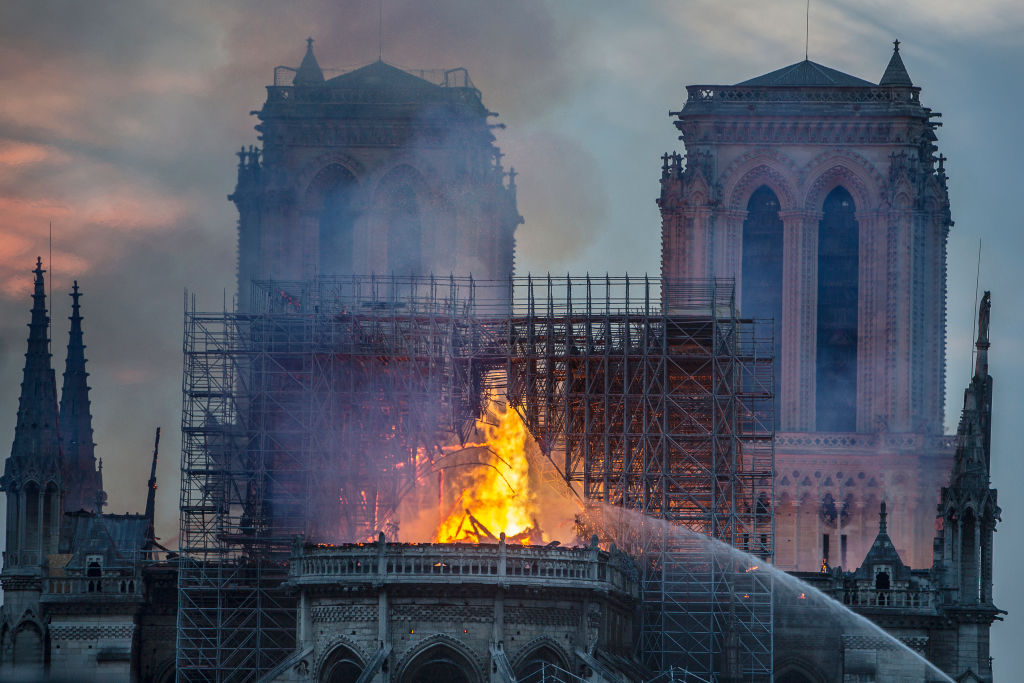
practicing Muslims are under the age of 50. Pictured: Fire consumes
Notre-Dame Cathedral in Paris, on April 15, 2019. (Photo by Veronique de
Viguerie/Getty Images) |
French writer André Malraux
said it: "A civilization is everything that gathers around a religion".
And when one religion declines, another takes its place.
Sarcelles, Saint-Denis, Mulhouse, Nantes, Chambéry, Strasbourg, La Rochelle... The impressive images
of stadiums full of Muslim faithful, who arrived from all over France
for the feast of Eid Al Kabir, seventy days after the end of Ramadan. In
Saint-Denis, the city where the kings of France rest; in Nantes, the
city of the Dukes of Brittany; in Strasbourg, the city of the cathedral
and seat of the European Parliament, in Mulhouse, in the heart of
Alsace.
"In forty years, France has become the Western European nation where
the population of Muslim origin is the most important," wrote Vatican Radio.
"It is not difficult to hypothesize that we are now close to Islam
overtaking Catholicism." What if the overtaking has already taken place?
"France is no longer a Catholic country", writes Frederic Lenoir, editor of the magazine Le Monde des Religions. Le Figaro wondered if Islam can already be considered "the first religion in France." We are in the country where up to 5,000 churches are at risk of demolition by 2030, Le Figaro
noted last month. Five thousand churches are at risk of disappearing
within eight years, in a country lacking the political, religious and
cultural will to keep alive a millennial heritage that represents
France's deepest soul. Perhaps the imam of the Grand Mosque of Paris
understood what was evolving when he suggested using abandoned churches as mosques.
German writer Martin Mosebach
observed that the "the loss of religion destabilizes a country". When a
society no longer knows how to give itself a reason to exist, others
find one and the void left by Christianity is soon filled. Even an
atheist like Richard Dawkins acknowledged that "the sound of the [church] bells is better than the song of the [mosque] muezzin".
Islam is taking over Europe's post-Christian ruins. It is estimated
that today in France, for each practicing Muslim, there are three
practicing Catholics. But if you dig deeper into this analysis, that
relationship is about to be reversed. Comparing only the weekly
frequency of Friday prayers in the mosque and Sunday Mass in the church,
the future is clear: 65% of practicing Catholics are over 50 years old.
By contrast, 73% of practicing Muslims are under the age of 50.
Hakim El Karoui, President Emmanuel Macron's advisor on Islam and a researcher at the Montaigne Institute, states
that Islam is now the most practiced religion in France. "There are
more practicing Muslims, between 2.5 and 3 million, than practicing
Catholics, 1.65 million".
The same applies to the construction of new religious sites. Today,
in France, there are 2,400 mosques, compared to 1,500 in 2003: "This is
the most visible sign of the rapid growth of Islam in France," notes the
weekly Valeurs Actuelles.
In an essay on L'Incorrect
Frédéric Saint Clair, political scientist and analyst, explains that
"the milestone of 10,000 mosques, at the current rate, will be reached
around 2100". Will we have 10,000 full mosques and 10,000 practically
empty churches?
Not only has the Catholic Church built merely 20 new churches in France in the past decade, according to research conducted by La Croix.
Edouard de Lamaze, president of the Observatory of Religious Heritage
in Paris, the most important organization that monitors the state of
places of worship in the country, revealed:
"Although Catholic monuments are still ahead, one mosque
is erected every 15 days in France, while one Christian building is
destroyed at the same pace... It creates a tipping point on the
territory that should be taken into account."
Annie Laurent, essayist and scholar author of several books on Islam, and whom Pope Benedict XVI wanted as an expert for the synod on the Middle East, recently said in an interview published in Boulevard Voltaire:
"Despite the repeated assurances of firmness of the state
towards Islamism and its rejection of every separatism, the opposite is
happening: the advance of Muslim culture in different forms. A progress
that seems to find no more limits and obstacles. There is the cowardice
of public authorities who give in to electoral calculations or clients,
and also the complacency of a part of our elites whose militancy is
steeped in progressive ideology...
"During my first trips to the Middle East, in the early 1980s, I did
not see veiled women and gradually the veil spread everywhere. It is the
sign of the re-Islamization of Muslim societies and, in this sense, it
takes on a political and geopolitical dimension. It is part of a
conquest strategy...
"France is in a state of self-dhimmitude. What is dhimmitude? It is a
legal and political status applicable to non-Muslim citizens in a state
governed by Islam according to a prescription of the Koran (9:29).
[Dhimmis] do not enjoy equal citizenship with the 'true believers,' who
are Muslims. The dhimmi can maintain his religious identity but must
undergo a series of discriminatory measures that can affect all aspects
of life, public, social and private. Not all Muslim states apply all of
these provisions today, but they are in force in some countries. However
that may be, the principle remains as it is based on a 'divine' order.
"Muslims translate 'dhimmitude' with protection, which tends to
reassure us, but the most appropriate translation is
'protection-submission': in exchange for the freedoms of worship or
other freedoms more or less granted to them, they may be subject to
special provisions, including Sharia, with the aim of making them aware
of their inferiority.
"If I speak of self-dhimmitude, it is to express the idea that
France, due to a colonial complex and a sense of guilt, anticipates a
legal and political situation that is not (yet) imposed on it but which
could be a day in which Islam it will be a majority and therefore able
to govern our country. It should also be noted that Islam lives off the
weakness of the societies in which it settles".
How far will we go? "I don't know, but the situation is really worrying," concludes Laurent.
"Before it becomes dramatic, it is urgent to put an end
to the concessions we are multiplying to Islamism by hiding behind our
values. Because by doing so we erase our own civilization".
Just two months ago, we had seen the same scenes for the end of Ramadan. Six thousand
of the faithful celebrated at the Delaune Stadium in Saint-Denis,
outside Paris. "Allahu Akbar" resounded from the loudspeakers placed in
the four corners of the stadium. The same scenes could be seen in dozens
of other stadiums throughout France, and in small and medium-sized
cities: in Garges; in Montpellier (10,000 of the faithful in prayer); in Vandœuvre-lès-Nancy, a town of 30,000 inhabitants, 5,000 gathered in prayer at the stadium. The celebration also took place in Gennevilliers.
You can see the same advance of de-Christianization and the growth of Islam, with different intensities, everywhere in Europe.
In a dramatic article in the Frankfurter Allgemeine Zeitung,
essayist Markus Günther explains that Christianity in Germany "seems
stable, but in reality it is on the verge of collapse. Pastors and
bishops, but also many actively involved lay people, see landscapes in
bloom where in reality there is nothing but the desert".
"We are turning our backs on our culture" writes Volkert Resing in the latest issue of the magazine Cicero, speaking of the end of Christianity in Germany.
"In 2021, an average of 390 children were baptized every
day in Germany. Ten years ago there were 800 baptisms a day. Last year,
359,338 people left the Catholic Church and 280,000 people left the
Protestant Church. In both cases it is a new record. Last year 21.6
million people belonged to the Catholic Church and 19.7 million were
Protestants. The number of Christians in Germany who are members of one
of the two largest churches fell below the 50 percent mark for the first
time. The fall of the Christian West? And who cares".
"For the first time in centuries," according to the German magazine Stern, "most of the people in Germany are no longer in the two great churches. A projection
assumes that in 2060 only 30 percent will be Catholic or Protestant".
For that date, all Christian denominations will have lost half of their
current members. And if in 1950 one in two Catholics participated in
Sunday services, notes the largest German weekly Die Zeit, today only one in ten people who say they are Christians participate in religious services.
"The importance of Islam in Germany will increase and that of
Christianity will decrease, explains Detlef Pollack, professor of
sociology of religion at Münster University and the country's foremost
expert on religious trends, in the Neue Zürcher Zeitung.
"In 2022, for the first time, less than half of the
Germans will belong to one of the great churches. There is a
liquefaction. Muslim communities in Germany are undoubtedly vital
compared to most Christian communities. By contrast Islam is a highly
dynamic religion that aims at visibility".
For some time now, German public schools have been offering classes on Islam.
A Dresdner Bank
study in 2007 predicted that "half of the churches in the country will
close" and another that half of all Christians in the country will disappear. Within thirty years, according to the Pew Forum, there will be 17 million Muslims in Germany, compared to 22 million Christians between Catholics and Protestants, many of whom are only nominal (already today one-third
of all Catholics are thinking of leaving the church) . The Muslim
faithful settled in Germany will equal the total number of Catholics and
Protestants.
This is a trend across the West. "Muslims, the winners of demographic change," headlined Die Welt.
"US researchers predict that for the first time in history there will
be more Muslims than Christians. Societies change. Even Germany's".
Between 1996 and 2016, Germany lost more than 3,000 parishes, down from 13,329 to 10,280. In Trier, Germany, where Karl Marx was born, the diocese announced
an unprecedented cut in the number of parishes which, in the next few
years, will be reduced from 900 to 35. Compared to their Christian
counterparts, Islamic places of worship are growing; in the last 40
years, they went from non-existent to between 2,600 and 2,700. We realize how our world has changed only at the end of an epochal transformation.
Practically every day in the German press there are articles like this in the Frankfurter Allgemeine Zeitung:
"Generations of believers got married in the Kreuzkirche
in the Lamboy area of Hanau, they had their children baptized and
there they mourned the dead. But the days when the rows of chairs were
occupied even during the classic Sunday functions are long gone. The
upcoming sale is a bitter new experience for Hanau. The culprit is the
continuing decline in membership. This is due to demographic change and
the numerous Muslim residents no longer provide a basis for a Christian
community".
538 abandoned churches and 49 newly built: this is the sad balance of Catholic churches in Germany in the last 20 years.
In Bonn, 270 churches will be abandoned, some of which can already be purchased on the diocesan online service.
"The Ruhr diocese wants to keep only 84 churches and 160
will have to be used for a new purpose... Mainz and Hildesheim want to
halve their churches. Aachen has started a process of reducing buildings
by 30 percent. The archdiocese of Berlin has also decided to reduce the
number of churches by a quarter".
From the diocese of Münster this month:
"87 churches have been deconsecrated. In various
locations, churches are used as retirement and nursing homes for the
elderly. Two churches in Marl alone are used as urn burial places.
Apartments are being built in the St. Mariä Himmelfahrt church in
Greven. Similar projects already exist, for instance, in Dülmen, Gescher
and Herten-Bertlich. The former church of Sant'Elisabetta now serves as
a sports hall".
In the entire archdiocese of Munich,
the hometown of former Pope Benedict XVI, there are today just 37
seminarians in the various stages of formation compared to about 1.7
million Catholics. By comparison, the American diocese of Lincoln,
Nebraska currently has 49 seminarians for about 100,000 Catholics.
You can see the same disintegration happening in Spain. "Spain is the
third country with the greatest abandonment of Christianity in Europe,"
reported Spain's major newspaper, El Pais.
Cardinal Juan José Omella, archbishop of Barcelona, has sent to all
parishes a message announcing the suppression of 160 parishes in
Barcelona, so that each can make its own contribution before the plan is
implemented. A headline in El Mundo reads: "Barcelona closes parishes due to the loss of faithful... The archbishopric will leave only 48 of the 208".
In 2015, there were 1,334 mosques
in Spain -- 21% of the total number of all places of worship in the
country. During a six months period in 2018, 46 new mosques were built,
bringing the number to 1,632 mosques for that year. Mosque numbers are growing at a rate of 20 percent each year. In 2004, there were 139 mosques in Catalonia and in 2020 there were 284, or 104% more, according to the Catalonia Department of Justice.
In Andalusia the number of mosques in one decade increased
from 27 to 201; in Valencia, from 15 to 201 and in Madrid, from 40 to
116. Demography is the engine of cultural change. "By 2030," according
to El Pais, "the Muslim population in Spain will increase by 82 percent".
The same situation exists in Austria. According to Die Welt:
"In Austria, the Catholic faith is in decline, Islam is
on the rise. There will be far fewer Catholics in the future, while the
number of Muslims and non-denominational people will increase
significantly, experts predict. In 2046, one in five Austrians will
profess Islam. In Vienna, Islam will be the strongest religion: in 30
years, one in three Viennese will be Muslim. The percentage of Catholics
will be only 42 percent in the country, dropping to 22 percent in
Vienna". In 1971, Catholics represented 78.6% of the population of
Vienna; in 2001, just over half; in 2011, 41.3% and in thirty years
Catholics will be only one third of the total."
If the churches are empty, 3,000 people gather for Friday prayers in Floridsdorf,
the first mosque in Vienna. The mosque was officially erected in 1979
in the presence of the then President Rudolf Kirchschläger, Chancellor
Bruno Kreisky and Cardinal Franz König. Today the muezzin can call to prayer three times a day.
Christianity is no longer the first religion; Islam has taken its
place. This shift should be grounds for discussion, not to say of
concern -- certainly not of cheerful indifference.
L'Echo,
the main Belgian economic newspaper, says: "Brussels was at the
forefront of secularization before confronting an active Muslim
minority. The first religion in Brussels today is Islam".
The monthly Causeur reminds us that Le Vif-L'Express
(the main French-language newspaper) published a provocative front page
entitled "Muslim Brussels in 2030". Belgian anthropologist Olivier
Servais confirmed a Muslim presence in Brussels at 33.5 percent,
predicting a majority in 2030.
In Saint-Chamond,
a French town of 35,000, the town hall recently ordered the disposal of
the main church of the city, Notre-Dame, built in the 19th century.
Closed for worship since 2004, deprived of the crosses that proudly
towered over its spiers, this church, in view of its transformation into
a cultural project, has just been condemned to deconsecration.
Meanwhile, last week, near what remains of Notre-Dame, the muezzin called over the loudspeakers for the Muslim faithful to come to prayers.
Giulio Meotti, Cultural Editor for Il Foglio, is an Italian journalist and author.