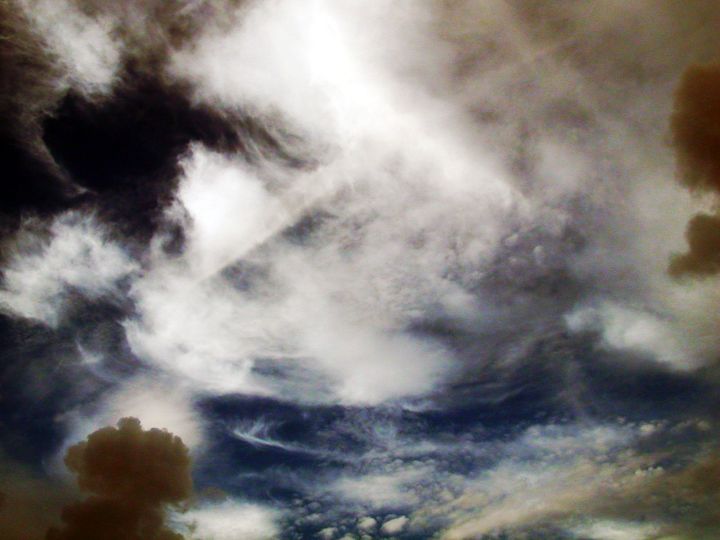
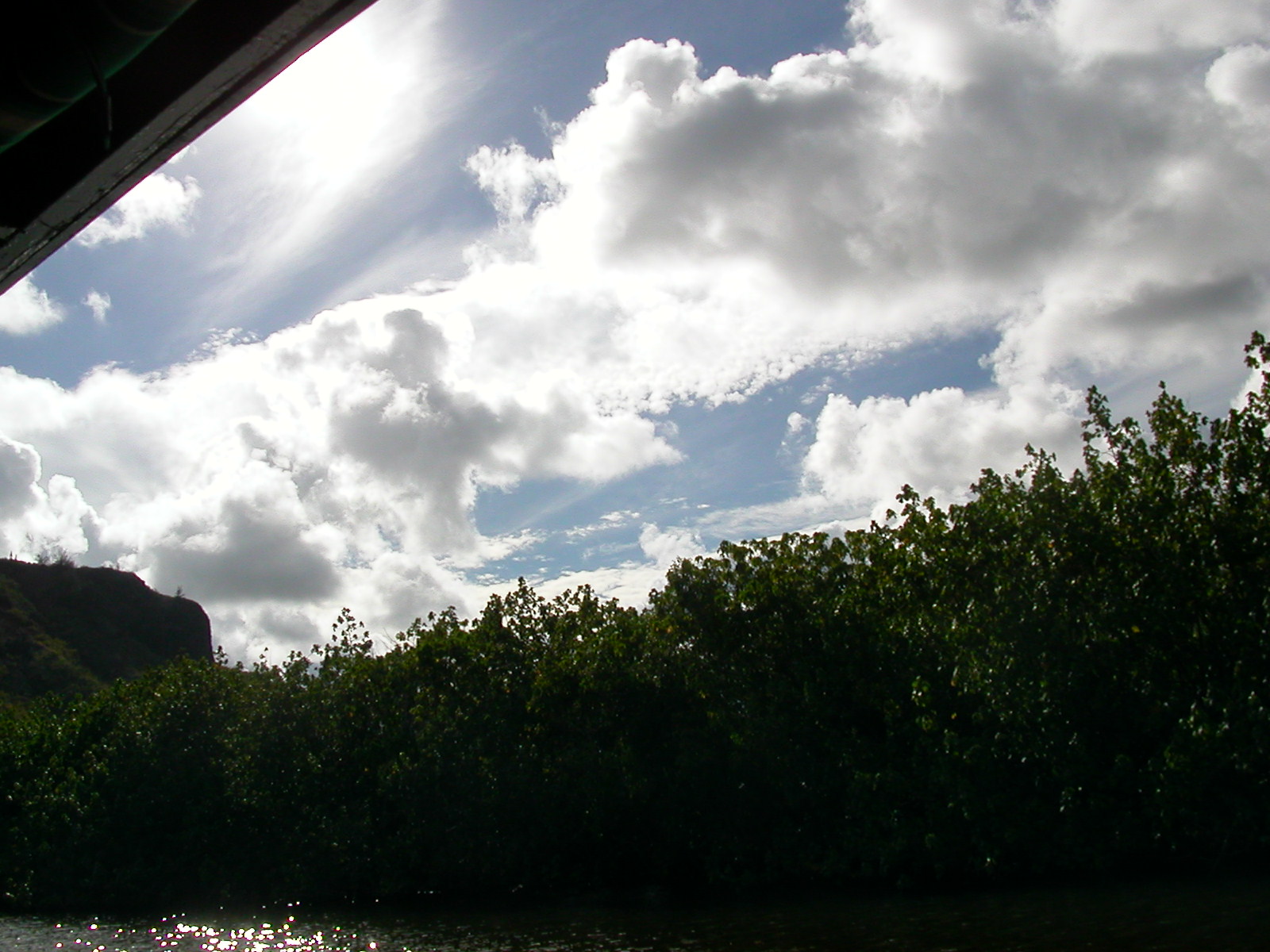
UFOs in the clouds
William C. Treurniet, Jan/Feb, 2008
Summary. A photograph taken in Ottawa, Canada, appears to show a large physical object partially hidden behind cloud material. An apparently artificial solid object projects below the cloud layer, and an outline of a 60-degree sector of a circle appears in the clouds beside it. The sector has internal structure and is estimated to be about 277 m across at its widest point. Another six photos taken on the Hawaiian islands each showed evidence of a similar triangular object partially hidden in the clouds. Two of the objects were also accompanied by seemingly artificial components extending below the clouds. The seven objects were tentatively divided into three classes based on size. The average triangle edge lengths for the three classes were 60 m, 134 m, and 413 m. The lengths ranged from 52 m to 550 m. The triangular objects were interpreted as novel spacecraft barely hidden behind the cloud layer.
Introduction
Recent photographs of the sky show geometrical objects that are not completely covered by clouds and seem to be machines. Their similar properties suggest that they are constructed and their appearance is not due to some chance organization of cloud material. Specifically, most have the equilateral triangle or sector shape. For the remainder, the equilateral shape may be masked by an orientation not parallel to the frontal plane of the camera. All have tori positioned at vertices and elsewhere. In several cases, components possibly attached to the objects were visible below the cloud layer.
Seven individual cases are described in this document. If you like, go directly to any one of them.
Case 1: Ottawa
Case 2: Honolulu
Case 3: Kauai
Case 4: Maui
Case 5: Kauai
Case 6: Honolulu
Case 7: Kauai
The idea that spacecraft may be hidden behind cloud material was also suggested in earlier reports. Please see
2007a and
2007b for specific cases where a possible UFO camouflaged by cloud cover appeared to affect its environment. Also see a
report by Ann Druffel on UFO activity originating in anomalous clouds off the southern coast of California beginning in 1962.
Case 1
A
photograph taken on October 25, 2007, near Ottawa International Airport, Ottawa, Canada, shows several objects in the clouds that are thought to be artificial primarily because of their geometry. The images in this section were cropped from the original photo. The following image shows the most obvious anomaly, an apparently solid object projecting below the cloud. It's shape appears to represent the three orthogonal directions in space. This
axis object, which models the abstract concept of frame-of-reference, is most likely a constructed object.
The next image includes the
axis object and draws attention to an area adjacent to it. On the left is a contrast-enhanced section of the original image, and on the right the image is marked with lines to show the
axis object and the other objects of interest. Specifically, obvious features in the image outline two adjacent sectors of a circle, where the angle subtended at the center of the circle is exactly 60 degrees for each sector.
The sector to the left of the
axis object has characteristics that make it the more interesting of the two sectors. Notice the rib-like pattern inside this sector, which suggests the form of an object underneath the covering cloud material. There are also toroidal objects between the ribs of the pattern and at the center of the circle (i.e., at the vertex of the sector). Closer examination shows many tori scattered over the surface of the underlying object. When the following image on the left was printed on a laser printer, the tori were more easily detected on the printed copy with the aid of a magnifying glass. The tori were enhanced manually on the printed page using a pencil, and the page was scanned at 150 dots/inch. The image on the right shows the result. The concentration of tori in the sector appears to increase from the center of the circle to the circumference. The method employed is admittedly subject to perceptual bias, so anyone who wishes can replicate the result to their own satisfaction using the described process.
 |  |
If the observed anomalies are aspects of an object hidden under the cloud layer, do we have sufficient information to infer what the object might be? Many recent reports indicate that UFOs often have a triangular shape. An earlier
report on tori accompanying UFOs suggested that the observed tori may be associated with the UFO propulsion system. Therefore, the triangular outline in the clouds covered with tori could be due to the proximity of a massive spacecraft. The tori scattered over the surface of the barely hidden object could be visible effects of this technology. The highest concentration at the widest part of the craft indicates that the suggested propulsion mechanism is most active at this location.
It is possible to estimate the size of the spacecraft given the properties of the camera as well as knowledge of the cloud altitude on the day the picture was taken. From information available at the
Weather Underground, we know that the cloud altitude on October 25, 2007, was approximately 2500 ft. One side of the spacecraft in the original picture was about .33 of the overall picture width. The empirically determined field of view of the camera is about 60 degrees, so we can say that the object subtended an angle of about 19.8 degrees (.33 x 60 degrees). Given a distance of 2500 feet from the camera to the cloud, the spacecraft must have been about 900 ft across at its widest point, or 277 m.
Case 2
This
photograph showing similar objects in the clouds was taken on Waikiki Beach in Honolulu on October 12, 2007, sometime in the afternoon. Details in this photo are easier to see when the contrast is increased by equalization. The
equalized image shows the presence of several equilateral triangle shapes in the clouds.
The following image on the left is a crop of the most interesting triangle and its immediate environment. The middle image shows the same information but with the contrast enhanced. The right image is marked with lines to emphasize the objects of interest. There we see the equilateral triangle similar to the sector shape in the Ottawa photo. Then there is the intriguing, apparently solid object beside the triangle. The shape is a bit different from the
axis object in the Ottawa photo, but it still appears to represent the three dimensions in space. That is, the object also models the abstract concept of frame-of-reference, and we can call it an
axis object as well. There appears to be a torus near each of the lower two vertices, and a number of other tori are scattered on and around the object as in
Case 1.
The cloud elevation on that afternoon in Honolulu was roughly 3200 feet. The object subtended about 5.66 degrees, so the estimated length of one side of the triangle is approximately 317 ft, or 97 m. Thus, the Honolulu object was about one-third the size of the Ottawa object, assuming the approximations are reasonably correct.
Case 3
This
photograph taken on the island of Kauai in the mid-afternoon of October 15, 2007, contains an object at the edge of a cloud that appears to be a triangular craft of some kind. The following cropped image shows that the end we can see has an exact 60 degree angle. There is a hint of an arc between the ends of the lines marking this angle in the right image, so the object may have the sector shape seen in
Case 1. Because of the thickness of the cloud cover, we cannot be sure. The
axis object, however, is not visible. Rather, it appears to have been replaced with a complex of tori. Note that the vertex of the triangle is centered exactly on a torus outlined in the right image. Recall that the center of the circle in
Case 1 was also marked by a torus.
The cloud elevation on that afternoon in Kauai was roughly 2600 feet. The object subtended about 3.7 degrees, so the length of one side of the triangle is approximately 168 ft, or 52 m.
Case 4
This
photograph taken on the island of Maui in the late afternoon of October 18, 2007, contains an object very similar to the triangular object of
Case 3. The following cropped image shows that the vertex is again exactly 60 degrees. This time the arc joining the lines is more obvious and it is outlined as well in the right image. It seems clear that this object has the sector shape seen in
Case 1. As in
Case 1 and
Case 3, the vertex of the sector is aligned with the center of a torus.
The cloud elevation in the late afternoon in Maui was roughly 5500 feet. The object subtended about 2.28 degrees, so the length of one side of the triangle is approximately 219 ft, or 67 m. Thus, this object is similar in size to the object of
Case 3. If this object and the object of
Case 3 are spacecraft, they are probably the same model.
Case 5
This
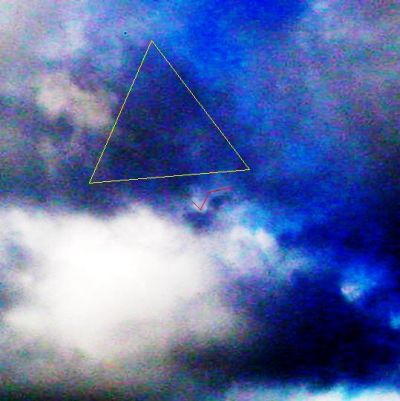
photograph was taken on the island of Kauai in the mid-morning of October 17, 2007. As in the previous cases, the following cropped image shows an equilateral triangle or sector shape in the cloud. A torus is prominently positioned near one vertex as shown with yellow graphics in the right-hand image. As in
Case 1, the side opposite this vertex seems to be exuding a stream of tori. Another similarity to
Case 1 is the faint ribbed pattern emphasized by the red lines in the interior of the triangle. Click on the center and right images to see larger versions.
The three blue rectangles in the above right image identify objects that appear to be manufactured. Each is reproduced below slightly enlarged.
The left image below shows three intersecting rings partly occluded by the main object and the surrounding cloud material. These rings are positioned approximately at the middle of the triangle edge.
The middle image below shows two or three long extensions leading from the main object to a partly visible hexagonal structure. The long extensions appear to be connected to an additional structure at the center of the hexagon.
The right image below shows a cupped, triangular structure at the upper-right vertex of the main object. The surface is textured with tori of different sizes and orientations. Although it is more obscured by cloud material, a similar structure is recognizable at the lower left vertex in the image above. One could speculate that the object is some kind of craft and that these structures are landing pads. If so, there would need to be a support for the craft at the remaining upper-left vertex. In fact, an object suitable for this purpose extends through the center of the torus at that vertex.
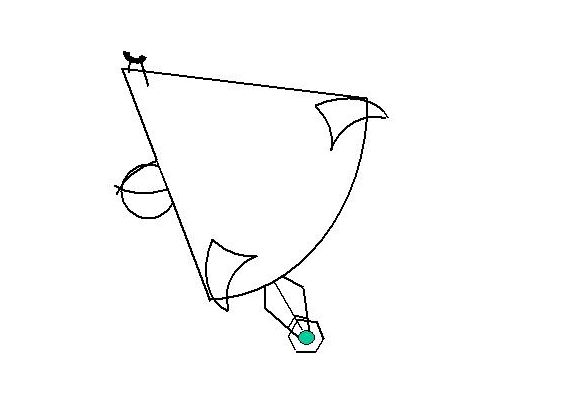
The following schematic drawing summarizes the interesting features in this photograph. It shows a sector-shaped main object which could be some kind of spacecraft body. At each vertex are structures that could function as landing pads. Finally, there are two mysterious, tubular extensions from the craft. One consists of circular shapes, while the other includes a hexagonal object.
The cloud elevation around that time in Kauai was roughly 1300 feet. The object subtended about 20.5 degrees, so the estimated length of one side of the triangle is approximately 487 ft, or 150 m.
Case 6
This
photograph was taken on Waikiki Beach in Honolulu in the afternoon of October 12, 2007, the same afternoon as the photo of Case 2. The following image shows a well-defined triangle vertex extending from the cloud as in
Cases 3 and
4. If an equilateral triangle were tilted away from the frontal plane by about 60 degrees, its projection would be approximately as shown. Also as in the previous cases, a torus is positioned on the vertex. From the curved side opposite this vertex, there seems to be a stream of tori demarcated by the red lines in the right-hand image. Again, there is faint ribbed pattern marked by the red lines in the interior of the triangle.
As indicated previously in
Case 2, the cloud elevation at that place and time was roughly 3200 feet. The object subtended about 9.0 degrees, so the estimated length of one side of the triangle is approximately 508 ft, or 156 m.
Case 7
This
photograph was taken on the island of Kauai in the late afternoon of October 16, 2007. The image shows what seems to be a triangle object partially hidden in the cloud. The most obvious edge is clearly defined by a thin layer of cloud material streaming across it. Another edge is inferred from the bright linear band of cloud material in the right of the image just above the material shaped like a cluster of tori. The location of the bottom edge is estimated simply by joining these two sides. If the triangle were equilateral and if it were tilted away from the frontal plane by about 45 degrees, its projection would be approximately as shown. Consistent with the other cases, the vertex on the left is approximately aligned with the center of a torus.
The blue rectangles in the above right image identify areas in the photograph that contain particularly interesting details. These are reproduced in the following magnified images. The left image shows seemingly orthogonal bands of shade on the bottom and up the side of the object that appear to identify the three coordinate axes. Yellow lines were superimposed parallel to the shade bands to assist identification. Recall that
axis objects were also found in
Case 1 and
Case 2. The right image is a closeup of the cluster of toroidal shapes over the right vertex of the triangle. These are reminiscent of the vertex in Case 5 which was heavily textured with toroidal shapes.
The cloud elevation at this time in Kauai was roughly 2500 feet. The object subtended about 35.6 degrees, so the estimated length of one side of the triangle is approximately 1787 ft, or 550 m.
Conclusion
These cases offer compelling evidence that constructed objects may be found hidden among the clouds. The objects appear to have the shape of either an equilateral triangle or a circle sector with a 60-degree vertex. The bottom of the object sometimes has a ribbed structure, one vertex is always closely associated with a torus, and the edge opposite this vertex is usually associated with a mass of tori extending away from the object. In three cases, one or more apparently solid extensions from the object were visible just below the cloud layer. An obvious interpretation of these objects is that they are novel spacecraft with the ability to float among the clouds.
The objects seem to vary in size as summarized in Table 1. Accepting some measurement error, three classes based on the length of the triangle edges are suggested; Class 1 (
Case 3,
Case 4), Class 2 (
Case 2,
Case 5,
Case 6), and Class 3 (
Case 1,
Case 7). The mean lengths for these classes are 60 m, 134 m, and 413 m, and the lengths range from 52 to 550 m. These measurements indicate that different classes of spacecraft were captured in the photographs.
Table 1. Estimated sizes of objects
| Case # | Estimated size (m) |
| 1 | 277 |
| 2 | 97 |
| 3 | 52 |
| 4 | 67 |
| 5 | 150 |
| 6 | 156 |
| 7 | 550 |
The craft appear to use existing clouds as cover, and they may be able to generate their own cloud material as required. The objects are not easily noticed by unsuspecting people on the ground because they merge so well with natural clouds. However, they can be detected by anyone armed with knowledge of the consistent clues marking their presence. The airspace around Hawaii seems to be one place where these objects can be found, perhaps because the clouds needed for camouflage are always present near the mountains.