.

.
Library of Professor Richard A. Macksey in Baltimore

POSTS BY SUBJECT

Labels

Wednesday, July 18, 2018

Giulio Meotti : European Terrorism: The 'Batman Syndrome'


  • "It is the 'Batman syndrome': the hero refuses to kill, he systematically saves his enemy who escapes and kills new victims until the hero catches up with him, and so on". — Causeur magazine.
  • "These crimes will continue so long as the Republic leaves the enemy in peace". — Ivan Riofoul, Le Figaro.
  • In the end, there might be still a region called "Europe", but it may no longer enfold European culture.
The European Union lost €180 billion (USD $210 billion) in GDP due to terrorism between 2004 and 2016. The United Kingdom (€43.7 billion) and France (€43 billion) suffered the highest losses, followed by Spain (€40.8 billion) and Germany (€19.2 billion), 
according to a Rand Corporation study.
"Beyond those who have been directly physically affected by terrorist attacks, the extensive coverage of terrorist attacks through multiple media and social media channels has substantially increased the amount of people and companies that could be psychologically affected. This subsequently affects their economic behaviour".
New statistics have also come from the Britain's anti-terrorism office. 441 people have been arrested in the UK for terrorism in the last year alone, and 4,182 since the attacks of September 11, 2001. The threat of terrorism is exhausting Europe.

According to the Spanish "black book" of terrorism, 658 Europeans have been murdered in terror attacks on European soil, while 1,029 Europeans have been killed by them abroad.  
Half of the French army has been deployed within the French Republic to protect the civilian targets, such as schools, monuments, and religious sites. Europe's armies are exhausted from patrolling the streets, to the point that NATO planners now fear that, over time, European armies "may get better at guarding railway stations and airports than fighting wars". An officer who recently returned from Afghanistan for guard duty in Belgium said: "We are standing around like flowers pots, just waiting to be smashed". Germany also sent troops into the streets for the first time since the Second World War.
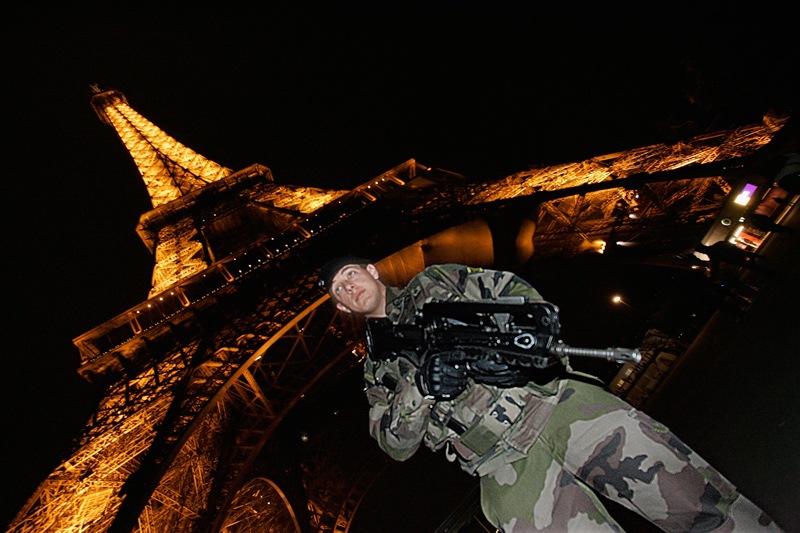
A soldier stands guard in front of the Eiffel Tower in Paris, France. (Photo by Franck Prevel/Getty Images)

One has to ask: Is Europe really serious about its war on terror? The French magazine Causeur just called it "the Batman Syndrome":
"How can we respect a society that is too cowardly to fight those who threaten its citizens, and that demonstrates its weakness by systematically seeking appeasement at the price of the most unreasonable accommodations? It is the 'Batman syndrome': the hero refuses to kill, he systematically saves his enemy who escapes and kills new victims until the hero catches up with him, and so on."
France is now close to freeing at least 50 terrorists from prison. The UK is also due to free 80 Islamic fundamentalists from prison. According to a new French report, nearly 10% of the 512 prisoners incarcerated for terrorism are likely to be released by the end of 2018. Their release may well pose a major threat.

 Khamzat Azimov, a terrorist who stabbed a man to death and injured four other people with a knife in central Paris, was known to counter-terrorism forces. Belgium released from prison a terrorist who had gone on a "bloody rampage" in the city of Liege two days before he killed two policewomen and a passerby.

Unless it gets serious about arresting not only the terrorists but also their deadly ideology, Europe will not see the end of the jihadist siege. A few days after the attacks in Liege, France thwarted another jihadist plot "with either explosives or ricin, this very powerful poison". 
After that, there was another terror attempt to strike the French gay community.

"France is the priority target of the terrorism unleashed in Europe by conquering Islam" wrote Ivan Rioufol in Le Figaro.
"Since 2015, 247 people have been killed in France in attacks by Islamists. The 'knife intifada' is no longer reserved just for Israel. In Magnanville, a couple of policemen, Jean-Baptiste Salvaing and Jessica Schneider, were stabbed in front of their three-year-old child. Father Jacques Hamel was slaughtered in his church. In Marseille, Laura and Maurane had their throats slashed. These crimes will continue so long as the Republic leaves the enemy in peace".
The level of threat in France remains alarmingly high. "9,157 people were subjected to at least one surveillance measure by the intelligence services in 2017 in the name of the prevention of terrorism", an official French report recently revealed. In 2017, 20 major terror attacks in France were foiled.
Regarding the West's current "war on terror," American historian Victor Davis Hanson wrote:
"The result is the present age of serial Punic conflict, perhaps intolerable to the psyche, but in amoral terms tolerable as long as casualties are kept to a minimum and defeat is redefined as acceptable strategic wisdom. In the past, such periods of enervating war have gone on for a century and more. Ultimately, they too end — and with consequences."
In the end, there might be still a region called "Europe", but it may no longer enfold European culture.
Giulio Meotti, Cultural Editor for Il Foglio, is an Italian journalist and author.

Giulio Meotti : Is Guilt Killing the West from Within?


  • "The fact is that we have no idea what would have become of the world's 'looted' antiquities if they hadn't been preserved in Western collections. Would the treasures of Beijing's Summer palace have survived Mao's Cultural Revolution? Would the Elgin marbles have survived Turkish tour guides chopping off chunks to sell as souvenirs? Would Daesh [ISIS] have spared those Middle Eastern artefacts that survive in European museums?" — Zareer Masani, historian.
  • When Christians in Iraq were exiled, murdered or persecuted en masse by the so-called Islamic State, the West stood silent -- as if these Christians were the agents of Western colonialism and not the legitimate and oldest inhabitants of the Middle East, long before the Arabs converted to Islam.
  • When a mob destroyed the French Institute in Cairo, burning books and collections, those who now want to return the "colonial artifacts" stood silent. Where are our Monuments Men now?
A "sense of guilt" for colonialism is debasing the West from within, according to Professor Bruce Gilley, and authoritarian regimes such as Iran, Russia, China and Turkey are profiting from this weakness.

The Romans called it damnatio memoriae: the damnation of memory that resulted in destroying the portraits and even the names of the fallen emperors. 

The same process is now underway in the West about its colonial past. The cultural elite in the West now seem so haunted by feelings of imperialist guilt that they are no longer confident that our civilization is something to be proud of.

A sense of guilt now seems a kind of post-Christian substitute religion that seduces many Westerners. The French scholar Shmuel Trigano suggested that this ideology is turning the Westerners into "post-colonial subjects" who no longer believe in their own civilization, but instead what will destroy it: multiculturalism. 
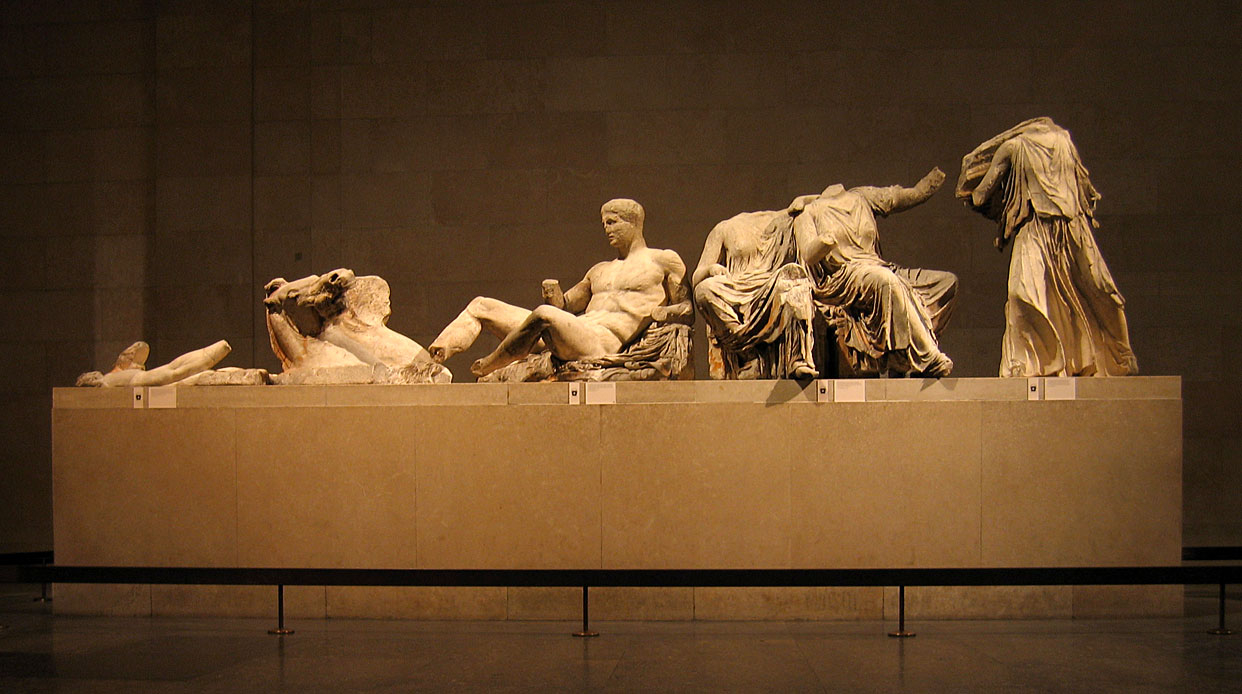
In France, for example, a manifesto was launched for "a multicultural and post racial republic". The result would be, in the words of the anthropologist Jean-Loup Amselle, a "war of identities" and a clash between communities. Last month, the UK Labour Party leader Jeremy Corbyn said that, if elected Prime Minister, he would order the British Museum to return to Greece the Elgin Marbles, the frieze that had surrounded the Parthenon of Athens and one of the major attractions of the British Museum. "This whole campaign is sheer lunacy," wrote Richard Dorment. But it is a lunacy spreading all over Europe.

Pictured: Figures from the East Pediment of the Parthenon, exhibited as part of the Elgin Marbles in the British Museum. (Image source: Andrew Dunn/Wikimedia Commons)

French President Emmanuel Macron announced that he wants to change the rules that make French public collections untouchable, and allow the return to Africa of dozens of historical artifacts now in the Louvre Museum. Macron has appointed two commissioners, the writer Senegalese Felwine Sarr and the art expert Bénédicte Savoy, to prepare a report.
Tanzania is asking for the return of the famous skeleton of a prehistoric Brachiosaurus, the main attraction of Natural History Museum of Berlin. New guidelines guide on restitution of "colonial objects" were recently unveiled by Germany's Minister of Culture, Monika Grütters.

Most historians are now taking the side of the campaign for returning these objects. One is David Olusoga, a historian of Nigerian origins, who has claimed that these colonial artifacts were "thefts" committed by the colonial powers at the time. Writing in The Telegraph, Zareer Masani, a historian of Indian origins, took a different position. It was the colonialists, he said, who had a decisive role in preserving the antiquities of the civilization:
"It was their dedication, often at huge personal sacrifice, that unlocked the wonders of many lost classical civilisations... The fact is that we have no idea what would have become of the world's 'looted' antiquities if they hadn't been preserved in Western collections. Would the treasures of Beijing's Summer palace have survived Mao's Cultural Revolution? Would the Elgin marbles have survived Turkish tour guides chopping off chunks to sell as souvenirs? Would Daesh [ISIS] have spared those Middle Eastern artefacts that survive in European museums?".
In 1969, the BBC aired Kenneth Clark's "Civilization", the series exploring Western art and culture. Then, civilization was something to be glorified. In 2018, the BBC aired the remake of Clark's classic, "Civilizations" -- note the plural. "This year, the 21st century version of the landmark show is to turn a critical eye to the history of British civilisation, questioning whether it is built on 'looting and plunder' and who, really, are the barbarians," writes Hannah Furness in The Telegraph. One of the new presenters is David Olusoga, the historian who called the Elgin Marbles "a very clear case of theft".

Thirty years ago, in a book, The Tears of the White Man, the French philosopher Pascal Bruckner wrote that, "the remorseless and self-righteous critic who endlessly denounces the deceptions of parliamentary democracy is suddenly rapt with admiration before the atrocities committed in the name of the Koran, the Vedas, the Great Helmsman..." Since then, Western elites have excused many crimes committed in the name of political Islam, as if these were the consequences of our own colonial crimes.

When Christians in Iraq were exiled, murdered or persecuted en masse by the so-called Islamic State, the West stood silent -- as if these Christians were the agents of the Western colonialism and not the legitimate and oldest inhabitants of the Middle East long before the Arabs converted to Islam.

When a mob destroyed the French Institute in Cairo, burning books and collections, those who now want to return the "colonial artifacts" stood silent. When Iran's President Rouhani visited Rome, the Italian authorities covered the naked statues in the Capitoline Museums. Are we covering our own culture to please the Islamic world?

Unfortunately, what we are "returning" are not only the colonial artifacts, but our very pride in Western civilization. A new "damnation of the memory" is taking place in our own museums, academia and chattering classes -- and it has deep consequences for our ability to deal with the enemies of civilization. "Postcolonial material provides an important fuel for jihadism," stated France's most important scholar of Islamism, Gilles Kepel.

"The Monuments Men", a film made in 2014 by George Clooney, is about a group of Western curators and art experts who traveled to Europe to rescue the artistic masterpieces stolen by the Nazis. It was a story of Western bravery and moral clarity during the Second World War.
In 2015, ISIS destroyed Palmyra, one of the most important cities of the ancient world. But the West watched this cultural destruction passively and no "Monuments Men" were dispatched to save Palmyra and other threatened sites.  
The Russians, profiting from the Western passivity, entered Palmyra and Russia's most famous conductor, Valery Gergiev, on performing a triumphal concert in the Palmyra arena, said: "We protest against barbarians who destroyed wonderful monuments of world culture". The Westerners then recreated a banal copy of the arch of Palmyra in London.
Where are our Monuments Men now?
Giulio Meotti, Cultural Editor for Il Foglio, is an Italian journalist and author.
Judith Bergman : Europe: "The Vision is an Islamic State"

  • "The growing religiousness is not an expression of marginalization. We are talking about people who are well-integrated, but who want to be religious". — Professor Viggo Mortensen.
  • "The vision is an Islamic state -- Islamic society... Muslims will prefer sharia rule. But the vision for twenty years from now is for sharia law to be part of Germany, that sharia will be institutionalized in the state itself". — "Yusuf", in a documentary series, False Identity.
  • "I will pick them one by one -- I will start with people around me... If every Muslim would do the same in his surroundings, it can happen with no problem... you don't confront him [the German] with force; you do it slowly... There will be clashes, but slowly the clashes will subside, as people will accept reality." — "Yusuf", in a documentary series, False Identity.
  • Europe will still exist but, as with the great Christian Byzantine Empire that is now Turkey, will it still embody Judeo-Christian civilization?
A Dutch government report published in June showed that Muslims in the Netherlands are becoming more religious. The report, based on information from 2006-2015, is a study of more than 7,249 Dutch nationals with Moroccan and Turkish roots. Two thirds of the Muslims in the Netherlands are from Turkey or Morocco.
According to the report, 78% of Moroccan Muslims pray five times a day, as do 33% of Turkish Muslims. Approximately 40% of both groups visit a mosque at least once a week. More young Moroccan women wear a headscarf (up from 64% in 2006 to 78% in 2015) and large majorities of both groups eat halal (93% of Moroccan Muslims and 80% of Turkish Muslims). 96% of Moroccan Muslims say that faith is a very important part of their lives, whereas the number is 89% for Turkish Muslims. The number of Dutch Moroccan Muslims who can be described as strictly adhering to Islam has increased from 77% in 2006, to 84% in 2015. For Turkish Muslims, the numbers have increased from 37% to 45%. There are few secular Muslims -- 7% among Turkish Muslims, 2% among Moroccan Muslims.

In Denmark, the trend of Muslims becoming more religious was apparent as early as 2004, when a poll showed that Muslims were becoming more religious than their parents, especially "young, well-educated and well-integrated women". At the time, Professor Viggo Mortensen said, "The growing religiousness is not an expression of marginalization. We are talking about people who are well-integrated, but who want to be religious".

A more detailed Danish poll from 2015 showed that Muslims had become more religious since a similar poll taken in 2006: In 2006, 37% prayed five times a day, whereas the number had gone up to 50% in 2015. In 2006, 63% believed that the Koran should be followed to the letter; in 2015, it was 77%. 

Brian Arly Jacobsen, a sociologist of religion from the University of Copenhagen, was surprised by the results. "With time we would expect [that Muslims] would become more like the rest of the Danes, who are not particularly active in the religious sphere," he said. Jacobsen thought that a possible explanation might have been the 20-30 new mosques that were built in the decade preceding 2015.

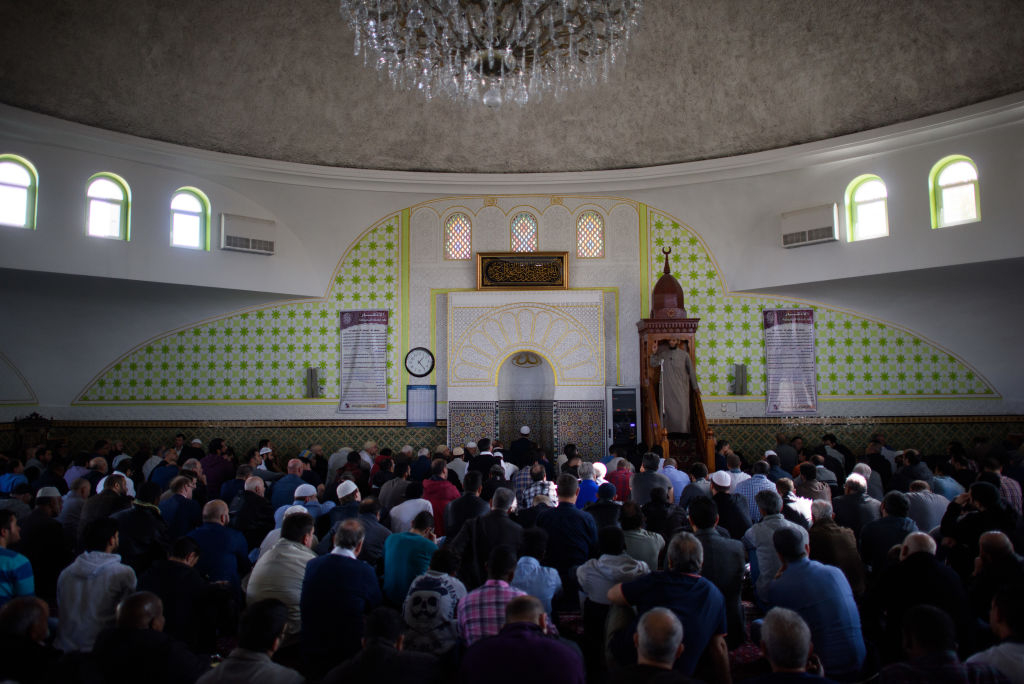
The trends expressed by these polls are corroborated by studies and polls showing that many Muslims in Europe want to live under sharia law. According to a 2014 study of Moroccan and Turkish Muslims in Germany, France, the Netherlands, Belgium, Austria and Sweden, an average of almost 60% of the Muslims polled agreed that Muslims should return to the roots of Islam. 75% thought there is only one interpretation of the Koran possible, and 65% said that Sharia is more important to them than the laws of the country in which they live. A 2016 UK poll showed that 43% of British Muslims "believed that parts of the Islamic legal system should replace British law while only 22 per cent opposed the idea". In a 2017 study, which included a poll of 400 Belgian Muslims, 29% said they believe the laws of Islam to be superior to Belgian law, and 34% said they "would definitely prefer a political system inspired by the Quran".


According to a 2014 study of Moroccan and Turkish Muslims in Germany, France, the Netherlands, Belgium, Austria and Sweden, an average of almost 60% of the Muslims polled agreed that Muslims should return to the roots of Islam, and 65% said that Sharia is more important to them than the laws of the country in which they live. Pictured: Friday prayers at the IZW Mosque in Vienna, Austria. (Photo by Thomas Kronsteiner/Getty Images)

The more than two million predominantly Muslim migrants that have arrived in Europe in recent years are only reinforcing the trend of growing Muslim religiosity on the continent. A 2017 study of predominantly Afghan asylum seekers in the Austrian city of Graz showed that the asylum seekers, mostly men under the age of 30, were all in favor of preserving their traditional Islamic values with 70% going to the mosque every Friday for prayers. The women were even more religious, with 62.6% praying five times a day, notably more than the men (39.7%). In addition, 66.3% of the women wore a headscarf in public. Half of the migrants said that religion now plays a larger role in their daily lives in Europe than it did in their native country, and 51.6% of the interviewees said that the supremacy of Islam over other religions was undisputed.

The tendency of many Muslims to become more religious once they arrived in Europe was also on display in a new documentary series, "False Identity," by Arabic-speaking journalist Zvi Yehezkeli, who went undercover to report on the activities of the Muslim Brotherhood in Europe and the US. In Germany, he encountered two young Muslims from Syria, who came to Germany via Kosovo, where they received help from a "British Islamic organization". They had left Syria as secular Muslims, but on the way to Germany they lived for a year in Pristina, Kosovo, where, according to Yehezkeli, "Muslim Brotherhood organizations are active in helping refugees while turning them into devout Muslims. Ahmed and Yusuf arrived [in Germany] already praying five times a day".[1]
According to Ahmed:
"When I left Syria, mentally I felt more relaxed. The Islamic charity organization played an important role in this. Look, the first time you meet them they start helping you. You sit, you stare at them, they pray in front of you and here I am a Muslim, studied the Quran, yet don't pray. Suddenly I find myself alone asking, Why shouldn't I pray like all others?"
Yehezkeli asked them what their dream is. "The vision is an Islamic state -- Islamic society," said Yusuf, "Muslims will prefer sharia rule. But the vision for twenty years from now is for sharia law to be part of Germany, that sharia will be institutionalized in the state itself".

In contrast to the growing religiousness of Muslims in Europe, Christians are becoming less religious. In a study of young Europeans, aged 16-29, published in March and based on 2014-2016 data, the author, Stephen Bullivant, a professor of theology and the sociology of religion at St Mary's University in London, concluded:
"With some notable exceptions, young adults increasingly are not identifying with or practicing religion... Christianity as a default, as a norm, is gone, and probably gone for good -- or at least for the next 100 years".
According to the study, between 70% and 80% of young adults in Estonia, Sweden and the Netherlands categorize themselves as non-religious. Between 64% and 70% of young adults consider themselves non-religious in France, Belgium, Hungary and the UK. The most religious youths were to be found in Poland, where only 17% of young adults defined themselves as non-religious, followed by Lithuania with 25%.

Young Muslims like Yusuf and Ahmed from Syria say they want to spread Islam by converting Europeans, also known as dawa. They are themselves perfect examples of having been at the receiving end of dawa -- becoming devout Muslims through the Islamic organization in Kosovo and now engaging in dawa themselves. "I will pick them one by one -- I will start with people around me. They will listen. If every Muslim would do the same in his surroundings, it can happen with no problem," said Yusuf. Asked if the Germans might resist dawa, he said:
"You don't confront him [the German] with force, you do it slowly... There will be clashes, but slowly the clashes will subside, as people will accept reality. There is no escape; every change involves clashes".
Given young Europeans' lack of a religious identity and the vacuum left by the departure of Christianity from the lives of the majority, one has to wonder how sturdy their ability will be to withstand such attempts at proselytizing. Europe will still exist but, as with the great Christian Byzantine Empire that is now Turkey, will it still embody Judeo-Christian civilization?
Judith Bergman is a columnist, lawyer and political analyst.

[1] The quote begins at 21:24 in the documentary. The statements by Yusuf and Ahmed follow immediately after.

A. Z. Mohamed : Blasphemy Laws in Pakistan


  • Many extremist Muslims are aiming at even more government submission to sharia through intimidation and terror.
  • Christians and Ahmadis continue to raise concerns regarding the government's failure to safeguard minority rights, as well as the government's persistent discrimination against religious minorities.
  • Pakistan is also where Muslim militants, such as the Pakistani Taliban, carry out assassinations and terrorist attacks. It seems no one is there to stop them.
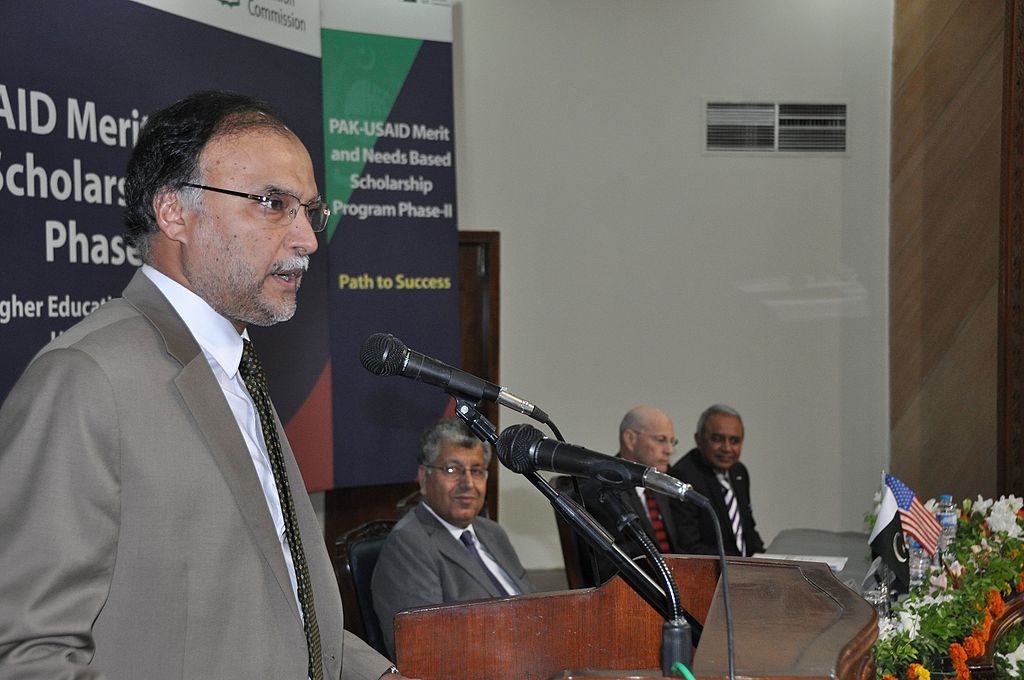
On May 6, Ahsan Iqbal, Pakistan's Minister of the Interior, was shot during a rally in his own constituency, in the province of Punjab. Fortunately, he survived the attack, but the bullet in his abdomen could not be removed. "The bullet lodged in my body... will keep reminding me of the impending need to remove the seeds of hatred sowed in the country," Iqbal said.
An initial report suggested that the main suspect, Abid Hussain, 21, had carefully planned the attack; recently, Pakistan's Anti-Terrorism Court issued an 8-day judicial remand of four possible accomplices.

On May 6, Pakistan's Minister of the Interior, Ahsan Iqbal (pictured at left), was shot and wounded by an Islamist extremist during a rally in Punjab. (Image source: USAID Pakistan/Wikimedia Commons)

According to other reports, Hussain is linked to Tehreek-e-Labbaik Pakistan (TLP) -- also known as Tehreek-e-Labbaik Ya Rasool Allah ("Movement of the Prophet's Followers"). TLP is a new Sunni extremist party known for aggressively calling for enforcing Pakistan's blasphemy laws, which can carry the death penalty, and for opposing any relaxation of these laws.
Many fear that this assault is not an isolated incident and that other members of the cabinet are on the TLP's hit list. This apprehension, however, does not mean that the government is against sharia or blasphemy laws, or is even thinking of reforming them. Many extremist Muslims are aiming at even more government submission to sharia through intimidation and terror.
Extremist Muslims in Pakistan have been successful in achieving their objectives. according to the U.S. Department of State's 2017 Report on International Religious Freedom:
"The [Pakistani] courts continued to enforce blasphemy laws, the punishment for which ranges from life in prison to the death sentence for a range of charges, including 'defiling the Prophet Muhammad.'"
According to reports from civil society organizations, in 2017, there were at least 50 individuals imprisoned on blasphemy charges, at least 17 of whom had received death sentences, In addition, the report added, the police registered at least 17 new cases under the blasphemy laws against still other individuals.
Pakistan's TLP party activism is just one example of how extremist Muslims and official complicity combine to perpetuate sharia and blasphemy laws. TLP itself was apparently inspired by a "blasphemy killer." The party "was born out of a protest movement supporting Mumtaz Qadri, a bodyguard of the governor of Punjab who gunned down his boss in 2011 over his call to relax Pakistan's draconian blasphemy laws," Reuters reported.
In October 2017, Pakistan's president, Mamnoon Hussain, signed into law a bill that changed an electoral oath which affirmed the belief that the Prophet Muhammed is the final prophet of Islam to a "declaration" and abolished separate voter lists for Ahmadi Muslims, whom many Muslims consider non-Muslim, as Ahmadis regard Mirza Ghulam Ahmad (1835-1908) as their Mahdi (Messiah). In 1974, a constitutional amendment introduced by the prime minister at the time, Zulfikar Ali Bhutto, had declared the Ahmadiyya community a non-Muslim minority; and in 1984, President Zia-ul Haq issued Ordinance XX which makes it a criminal offense for Ahmadis to call themselves Muslims, and to practice or propagate their faith.
In any event, the law sparked weeks of protests, led by Tehreek-e-Labbaik Pakistan members, against the government. The TLP accused then-Minister for Law and Justice, Zahid Hamid, of blasphemy and demanded his resignation. The government succumbed to pressure by extremist Muslims, and attributed the change in the oath to "clerical error." Parliament reversed the provisions; Hamid was forced to resign and the government gave assurances that Asia Bibi, a Christian mother of five with a highly questionable blasphemy conviction, would not be sent abroad. Notably, Qadri had apparently also murdered governor Salman Taseer for speaking against a death sentence on Asia Bibi.
More appalling is what the U.S. Department of State report said: that government officials -- under pressure from the extremist Muslims' protests of October 2017 -- and probably to deny any support to Ahmadis -- had engaged in anti-Ahmadi rhetoric and attended events that Ahmadis said incited violence against members of their community. The Ahmadiyya Muslim Community leaders and human rights organizations "continued to express concerns about the government's targeting of Ahmadis for blasphemy, and Ahmadis continued to be affected by discriminatory and ambiguous legislation that denied them basic rights," the report added.
Christians and Ahmadi Muslims are not by any means exceptional: members of all religious minority communities in Pakistan are distressed that the government submitted to Tehreek-e-Labbaik party and other Islamists' pressure. Christians and Ahmadis continue to raise concerns regarding the government's failure to safeguard minority rights as well as its persistent discrimination against religious minorities. Authorities have also often failed to intervene during episodes of violence against religious minorities, and the police have often failed to arrest perpetrators of these abuses.
In his condemnation of the assassination attempt of the Minister of Interior, Rizvi, TLP's leader, emphasized that his party is waging an unarmed struggle to bring "the Prophet's religion to the throne," in a way that clearly identifies his party role in achieving Islamists' ultimate goal of al-hakemyah of Allah (the sovereignty of God and sharia law), a role that consists in spreading narratives such as the supremacy of Islam, the supposed religion of truth, over all other world religions (Quran 3:19); the supposed supremacy of sharia over all man-made laws, and that the Christians and Jews are supposedly conspiring against Islam and Muslims (Quran 2:109). Extremist Muslims, like Tehreek-e-Labbaik, have been able to plant seeds of intolerance, hatred and fear, lionize terrorists and lead protests to impose sharia and blasphemy laws.
Within this context of Islamists' "unarmed struggle," the goal of bringing "the Prophet's religion to the throne" is likely to take place in a country where the government, under religious pressure, was unable to defend an electoral reform bill enacted by the president last October. The government also has not followed most of the instructions issued four years ago by Pakistan's Supreme Court to protect religious minorities after a terrorist bomber murdered 127 innocent people at a church. Pakistan is also where Muslim militants, such as the Pakistani Taliban, carry out assassinations and terrorist attacks. It seems no one is there to stop them.
A. Z. Mohamed is a Muslim born and raised in the Middle East.

Lawrence A. Franklin : Indonesia: Falling to Radicals


  • If Indonesia's repatriated foreign fighters have their way, all of the country's churches will be destroyed.
  • If the repatriated foreign fighters are able to radicalize Indonesia's Muslims, all of the country may eventually resemble Aceh Province, where, after a lengthy reign of terror by Islamic militias, most Christians have been driven out.
An Indonesian family of six, repatriated from former Islamic State (ISIS)-controlled territory in Syria, separately targeted three Christian sites in Surabaya, Indonesia, in May. The suicide bombings killed at least 11 people, as well as all of the attacking family members. Indonesian authorities suspect the bombers are affiliated with Jamaah Ansharut Daulah (JAD), the Congregation of the Islamic State. While anti-Christian incidents are common in majority-Muslim Indonesia, until now, suicide bombings by Islamists were not often seen there.
The same day, May 14, a second family, affiliated with the same terrorist JAD cell, also staged a suicide attack at Surabaya's police headquarters. A third family was killed in a town outside Surabaya when bombs prematurely exploded inside their home. All three families met regularly for radical Islamic religious sessions.
Indonesia's National Police Chief, Tito Karnavian, indicated that the suicide family that attacked the churches were among an estimated 500 people who had been deported from former ISIS-occupied land in Syria back to Indonesia.
A sizeable Indonesian terrorist group, JAD, designated a terrorist entity by the U.S. Department of State, has already pledged loyalty to ISIS, which, through their Amaq News Agency, claimed responsibility for the Surabaya attack. A JAD terrorist cell was also behind the May prison riot in Jakarta, an incident that claimed the lives of five policemen. JAD's leader, Aman Abdurrahman (a.k.a. Oman Rochman), is currently in prison, facing the death penalty for urging his followers to attack a Starbucks and a police post in Jakarta in 2016.
Indonesian author and counterterrorism expert Al Chaidar believes that some of Indonesia's ISIS volunteers to Syria are legacy terrorists, following in the paths of their Jihadi fathers. He also claims that some of these jihadists favor the al-Qaeda linked Al-Nusra, while others favor ISIS. Police Chief Karnavian describes JAD as even more radical than Indonesia's al-Qaeda-affiliated Jaamah Islamiyah (JI/Islamic Congregation), the terrorist group responsible for killing 200 people in Bali in 2002.
On another ominous note, Suhardi Alius, Indonesia's Chief of Counterterrorism Operations, said that about 40 JAD volunteers who joined the Jihad in the Philippines in 2017, gained combat experience in the process. These Indonesian JAD terrorists had evidently joined with Filipino terrorists to fight against Philippine army troops who were trying to liberate the town of Marawi in the southern Philippines from terrorist control. JAD's decision to dispatch some of its members to fight in the Philippines indicates that, like its predecessor, Jaamah Islamiyah, it might be interested in re-establishing the 15th century Sulu Islamic Sultanate throughout the archipelagos of Southeast Asia.
Other mostly non-violent but conservative Indonesian Muslim organizations groups -- such as the Islamic People's Forum and the Islamic Defenders Front -- can simply count on Indonesia's restrictive religious legislation to block Christian interests. These include the 2006 JOINT Decree on Houses of Worship, which requires the signatures of 60 neighboring households of non-Christian families to approve initiating church construction. Occasionally, however, the Islamic Defenders Front, through vigilante action, harasses Muslims who it accuses of not being sufficiently orthodox.
Both Christians and moderate Muslims are also often accused of violating Indonesia's blasphemy law. However, Islam's watchdog agency for doctrinal unity, the Council of Indonesian Ulama, continues to stir up intolerant feelings by issuing restrictive religious judgments concerning the rights of minorities. These judgements include helping convicting people who convert from Islam to Christianity of blasphemy despite Indonesia's civil Constitution, which pledges to protect the interests of minority religions.
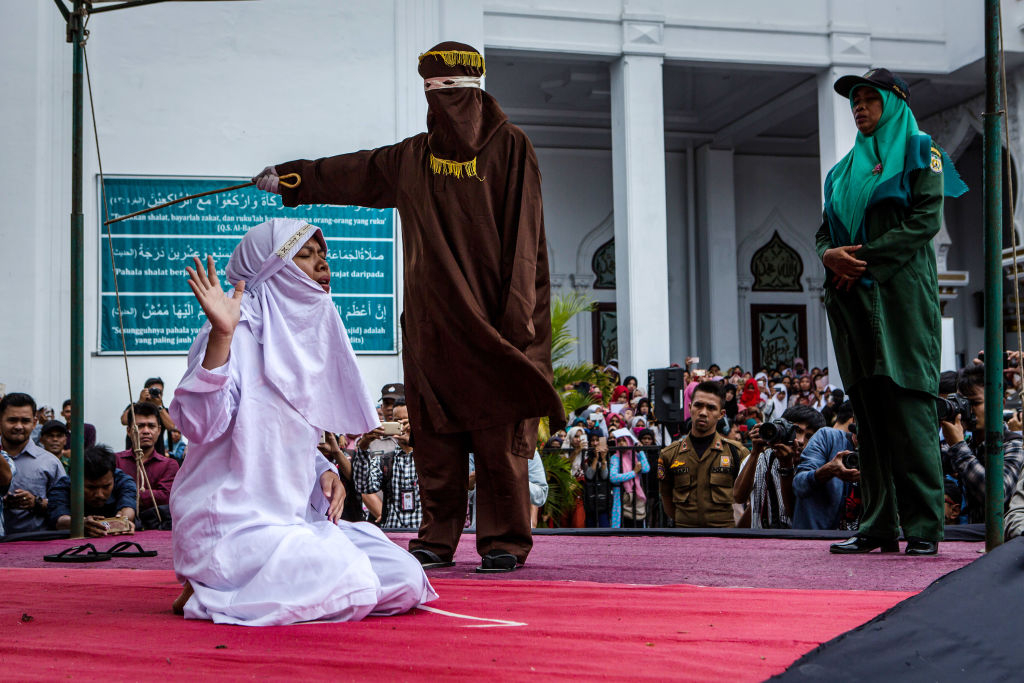
Only one of Indonesia's provinces, Aceh is governed by Sharia law. In Aceh, Koranically approved physical punishments are meted out to "sinners" -- Christians and Muslims alike.

Pictured: A woman receives a public caning in Aceh, Indonesia -- a sentence for spending time with a man who is not her husband, which is a violation of Sharia law. (Photo by Ulet Ifansasti/Getty Images)

Nevertheless, both of Indonesia's largest Islamic organizations, Nahdlatul Ulama and Muhammadiyah, roundly condemned JAD's murderous assault on Christians.
JAD might not be successful in attracting many Indonesian Muslims to join its ranks; suicide bombings may be too extreme for most Indonesian Muslims. As more Indonesian foreign volunteers navigate their way back to this Southeast Asian nation, however, acts of terror, like these recent attacks, may become the new normal. Because of JAD's affiliation with ISIS and its global resources, the terrorist group is likely to have a much larger impact than its numbers indicate.
Finally, Indonesian General Gatot Nurmantyo predicts a dark future for the Indonesian state's rendezvous with terrorism. He says there are sleeper terrorist cells in virtually every one of Indonesia's provinces except Papua. If Indonesia's repatriated foreign fighters have their way, all of the country's churches could well be destroyed. If the repatriated foreign fighters are able to radicalize Indonesia's Muslims, all of the country may eventually resemble Aceh Province, where, after a lengthy reign of terror by Islamic militias, most Christians have been driven out.
Dr. Lawrence A. Franklin was the Iran Desk Officer for Secretary of Defense Rumsfeld. He also served on active duty with the U.S. Army and as a Colonel in the Air Force Reserve.

Stefan Frank : Germany: 'Decapitating' Freedom of the Press?


  • If it was indeed the authorities' plan to censor the news and keep the information of the beheading under wraps, then it backfired. Due to the reports about the raid, thousands of people have seen the video, and hundreds of thousands have heard about the botched censorship attempt.
  • Hamburg's government is still trying to conceal the beheading. Among other things, they [the AfD party] wanted to know whether the child had been beheaded. The administration -- in breach of its constitutional duty -- refused to answer. It also censored the questions by blacking out whole sentences.
  • Why the beheading should be kept a secret is anyone's guess. What has become clear is how easily authorities in Germany can censor the news and punish bloggers who spread undesired information. They have a vast toolbox of laws at their disposal. It does not seem to bother them that the law invoked in this case stipulates explicitly that it shall not be applied to the "reporting of contemporary events."
In an apparent attempt to sweep under the rug a recent double homicide in Hamburg, Germany, authorities there censored the story. They also raided the apartments of a witness who filmed a video describing the murder, and a blogger who posted the video on YouTube.
The murder, which made headlines worldwide, occurred on the morning of April 12. The assailant, Mourtala Madou, a 33-year-old illegal immigrant from Niger, stabbed his German ex-girlfriend, identified as Sandra P., and their one-year-old daughter, Miriam, at a Hamburg subway station. The child died at the scene; her mother died later, at the hospital. The woman's three-year-old son witnessed the murders.
According to the prosecutor's office, Madou -- who initially fled the scene, but then called the police and was arrested shortly thereafter -- acted "out of anger and revenge," because the day before the incident, the court had denied him joint custody of his daughter.
It later emerged that for months Madou had been threatening to harm Sandra P. and the baby. A senior public prosecutor told reporters that the police investigated the woman's charges, but had concluded that the "threats were not meant seriously" and did not pursue the case.
Furthermore, half a year earlier, in October 2017, a judge revoked a restraining order that Sandra P. had obtained against Madou two months earlier, on the grounds that he saw "no evidence" that Madou had threatened her. That was when Madou's threats increased and he explicitly announced: "I'm going to kill our daughter, and then I kill you!"
A detail of the murders that has never officially been revealed, is that Madou apparently attempted to decapitate the baby. This detail was mentioned by a commuter -- Ghanaese citizen Daniel J., a gospel singer at an evangelical church in Hamburg -- who happened to arrive at the subway station moments after the attack and filmed the scene on his phone. In the video, police officers can be seen questioning witnesses, and paramedics are surrounding what appears to be the baby girl. Daniel J. says, in English, "Oh my God. It's unbelievable. Oh Jesus, oh Jesus, oh Jesus. They cut off the head of the baby. Oh my God. Oh Jesus."

Police question witnesses to the double-murder in Jungfernstieg subway station in Hamburg, Germany. (Image source: Daniel J./Heinrich Kordewiner video screenshot)

Heinrich Kordewiner, a blogger from Hamburg who discovered the video on Daniel J.'s Facebook page, uploaded it to YouTube.

A few days later, a team of state prosecutors and officers of the cybercrime unit of the Hamburg police arrived at Kordewiner's apartment with a search warrant, and confiscated his computer, mobile phone and other electronics, allegedly to find "evidence" of the "crime". He was -- and still is -- accused of: uploading the video.
Kordewiner and his flatmate told Gatestone about the raid, which took place at 6.45 a.m. They recounted that when they first refused to open the door, police forced it open -- and even searched the flatmate's room, although it was apparently not covered by the search warrant.
"The police officer said that he could also search for SD (secure digital) cards," the flatmate told Gatestone. "While he fumbled through the books on my shelf, he suggested that he could turn my whole apartment upside down. He told me to relax."

According to the search warrant, Kordewiner is accused of having "invaded the private sphere" of the murder victim, in breach of §201a of Germany's Criminal Code. This so-called "paparazzi paragraph" -- the legislation of which was launched by Heiko Maas (currently Germany's Foreign Minister), who as Minister of Justice was responsible for Germany's internet censorship law -- is a barely known and rarely applied law, passed in 2015. Among other things, it makes it illegal to take pictures that "display someone in a helpless situation." 

Supposedly aimed at protecting victims of traffic accidents from being filmed by curious onlookers, the law was already highly controversial when it was debated in 2014, and journalist associations criticized it for jeopardizing freedom of the press.

When the German parliament debated the law, one of the 10 experts invited to give their opinions on the matter was Ulf Bornemann, head of the "Hate and Incitement" department of Hamburg's public prosecution office. A former MP and member of the East German civil rights movement, Vera Lengsfeld, wrote at the time that Bornemann was the only one to embrace the law without reservations: "Why," she reported he had said, "should the data of a supposed inciter be protected?"

In a written statement, Bornemann praised the censorship law for sending "a clear political message that the administration is willing to act against hate crime in social networks." Bornemann was also part of the team that raided Kordewiner's apartment.

The stated reason for the raid -- a breach of privacy rights -- is flimsy. Only the victim's feet can be seen in the video, and even those for only a brief moment. As the daily newspaper Hamburger Abendblatt pointed out, the footage "is blurred, taken from a distance and doesn't allow the identification of any person."

Meanwhile, the German publication Welt online posted a video that shows close-up footage of the victim -- something that did not spur state prosecutors into action. The main difference between the two videos seems to be the verbal comment on the beheading in Daniel J's video. The alleged breach of "privacy rights," then, would appear to be a pretext.

The "Beheading"

"We don't comment on this rumor," state prosecutor Nana Frombach said to Gatestone when asked about the beheading. All she was willing to acknowledge was that the child had suffered "severe neck injuries." When Gatestone said that §201a could not be applied to the video in question because it did not show anybody's face, she replied that this had "yet to be decided," and that the raid was based on an "initial suspicion." Gatestone then mentioned that Kordewiner, instead of uploading the video anonymously (which would have been easy for him to do), had uploaded it to his YouTube channel, along with his full name and address, rendering the raid's stated goal of "finding evidence" not merely disproportionate but entirely unnecessary. Frombach said that she was not allowed to "comment on details of an ongoing investigation," but that she could "guarantee" that the search warrant had been "approved by a judge."

How can any journalist, under such censorship, report the news? Would it be illegal to film the scene of a terrorist attack? Frombach said that she could "not tell" whether this would still be legal in today's Germany. "I can only judge specific cases, not ones that lie in the future," she said.
The libertarian website Achse des Guten (Axis of the Good) was the first media outlet to report the raid. Two days later, the daily Hamburger Abendblatt wrote:
"Hamburg's state prosecutor rabidly prosecutes a blogger who has published pictures of the tragedy at Jungfernstieg... The raid was based on paragraph 201a, a law that the council of the press and journalist associations view as being problematic with regard to free reporting."
The Abendblatt criticized the "nebulous phrasing" of the law and the "even more nebulous interpretation by the state prosecutor," stating, "The law stipulates that no pictures of helpless persons may be taken. However, the cell phone footage does not show such persons."

According to the Abendblatt, sources "from within the security apparatus" had been "surprised" by the raids of the homes of the blogger and Daniel J. The state prosecutor who ordered the raids had been "very hot on this case," these sources said, and was "shooting out of cannons into sparrows... it is surprising how quickly the search warrant was issued, given the high obstacles we face every day, even when dealing with serious crime."

In an accompanying comment, Abendblatt editor Matthias Iken called the raid "foolish," because "it supports the conspiracy theories of right-wingers." Where, he asked, "do the prohibitions start? And where do they stop?"
In the meantime, the incriminated video has been deleted from all German websites and made inaccessible for German visitors to YouTube (although Germans can still view it on websites that are out of reach of the German authorities).

Censorship Backfired

If it was indeed the authorities' plan to censor the news and keep the information of the beheading under wraps, then it backfired. Due to the reports about the raid, thousands of people have seen the video, and hundreds of thousands have heard about the botched censorship attempt. Even worse for the would-be censors, they unwittingly revealed the very detail that they wanted to keep from the public. This is because the search warrant -- a copy of which was handed to Kordewiner -- happens to provide a detailed account of the murders. It elaborates that Madou had "wanted to punish the mother of the child" and "enforce his claim to power and ownership." With an "intent to kill," Madou "suddenly" took a "knife from the backpack he was carrying, stabbed the child in the belly and then almost completely cut through the neck."

The office of the state prosecutor is under the authority of Hamburg's state government, a coalition of Social Democrats and the Green Party. The state's Minister of Justice, Till Steffen, is a member of the Green Party and has for years been accused of being behind many scandals in his ministry. Among these are that alleged murderers repeatedly have had to be released from pre-trial detention because their trials have taken too long. In 2016, Steffen prevented police from sharing pictures of the Berlin truck terrorist, Anis Amri when he was still at large, out of fear that sharing images of jihadist terror suspects could incite racial hatred.

Censorship in Parliament

Hamburg's government is still trying to conceal the beheading. This became clear when, in May, MPs of the anti-immigration party Alternative for Germany (AfD) made a parliamentary enquiry about the police raid and details of the murder case. Among other things, they wanted to know whether the child had been beheaded. The administration -- in breach of its constitutional duty -- refused to answer. It also censored the questions by blacking out whole sentences. The newspaper Die Welt noted: "That the text of an enquiry and the questions are blackened out without consultation" is something "that almost never happens."

When Gatestone contacted Alexander Wolf, one of the MPs who made the enquiry, to find out what exactly was censored, he sent the original enquiry (the first two pages from the left) as well as the senate's answer (pages 3, 4 and 5) in which parts of the questions were censored. Every hint of a beheading that might have taken place was blacked out, as was the link to the article that first broke the news about the beheading and the subsequent police raid. Wolf told Gatestone:
"In the session of the interior committee, the Senator of the Interior and the responsible state prosecutor both replied very evasively to the repeated questions of our speaker, Dirk Nockemann, and imputed a lack of respect [for the murder victim]. In my opinion, this was designed to cause indignation against the enquirer on the part of the other MPs. Apparently, the Senator wants to sweep the issue under the rug."
The speakers of the other opposition parties were also contacted by Gatestone: Dennis Gladiator of the Christian-Democrats (CDU) and Anna von Treuenfels-Frowein of the centrist Free Democrat Party (FDP). Treuenfeld-Frowein replied:
"Of course, the public has a right to information. But for us as a party committed to the rule of law, personal rights do not end with death. We therefore consider the decision to black out parts of the enquiry to be appropriate. Right now, there is no need to make details of the crime public."
Gladiator did not respond to Gatestone's repeated requests for comment.
Why the beheading should be kept a secret is anyone's guess. What has become clear is how easily authorities in Germany can censor the news and punish bloggers who spread undesired information. They have a vast toolbox of laws at their disposal. It does not seem to bother them that the law invoked in this case stipulates explicitly that it shall not be applied to the "reporting of contemporary events." The state prosecutor, however, argues that this murder case – which was reported, among others, in France, India, Pakistan, South Africa and the United States – does not constitute such a "contemporary event."

"For Hamburg's ministry of justice," the Abendblatt wrote, "the double murder is a crime of passion that must not be of any interest to the public."
Stefan Frank is a journalist and author based in Germany.

Salim Mansur : The Abuse of Egypt's Coptic Christians


  • The violence, and incitement to violence, directed by Egyptian Muslims against the Copts -- especially those organized sectarian campaigns by the Muslim Brotherhood and related groups -- are crimes against humanity and should be treated as such by the international community.
  • We know that a few drops of lemon will curdle an entire bowl of milk. Egypt's Muslims, as many Muslims elsewhere, have poured the entire Nile River -- made toxic by their bigotry and violence -- into their faith-tradition. We, Muslims, have degraded our culture by authoritarianism and the obstinate tendency to blame others for our own failings. We have thus perverted the very Islam that we believe is the final revelation.
  • Muslims in Egypt and elsewhere know from experience the extent to which Western powers have betrayed in practice what they pronounce in theory when it comes to support for people subjected to authoritarian regimes.
  • What is long overdue from the West is a robust policy to defend and secure human rights for everyone, especially minorities, in Muslim-majority countries... [as in] the Helsinki Agreement of 1975.
We have seen and recoiled from the horrific footage of Coptic Christians beheaded by ISIS in 2015 in Libya and the repeated bombings over the past two decades of Coptic churches in Egypt. We read about the Maspero massacre in 2011, when Egyptian military tanks, deployed to protect peaceful Christian demonstrators, instead rolled over them, crushing many to death. And we continue to receive reports of Coptic girls abducted, compelled to convert to Islam and forced into marriages with Muslims.
Each time there is news of another act of hate-filled violence against the Copts, or other religious minorities, we shudder. When there are attacks against Yazidis in the Fertile Crescent, the Baha'is in Iran and Christians and Ahmadis in Pakistan, we ask how Muslims can affirm these crimes against humanity perpetrated under the banner of Islam.
Apart from condemning the visible/demonstrable bigotry and violence -- and from appealing to Western governments for assistance -- Muslims opposed to Islamist extremism are at a loss about what needs to be done to hold the governments of Egypt and other Muslim-majority states accountable for their failure to protect their religious minorities from the sectarian violence that is regularly directed at them.
Here, regarding the Copts in Egypt, are a few preliminary observations that might serve as a proposal for how Muslims and non-Muslims, working together, might find a way out of this terrible situation and ensure their mutual survival and peaceful co-existence:
  • Egyptian Muslims are primarily, and fundamentally, responsible for the worsening situation of the Coptic Christians in Egypt. As Egypt's overwhelming majority population, Muslims have the responsibility to secure the rights of the Copts as a religious minority.
  • The violence, and incitement to violence, directed by Egyptian Muslims against the Copts -- especially those organized sectarian campaigns by the Muslim Brotherhood and related groups -- are crimes against humanity and should be treated as such by the international community
  • As part of their religious obligation, Egyptian Muslims bear an even heavier responsibility to secure the well-being and protect the rights and dignity of Coptic Christians. In persecuting the Copts, Egypt's Muslims are shredding the directives of the Quran on respecting and protecting Jews and Christians as the "People of the Book." According to the Quran, each one of us will be held accountable for our deeds on the Day of Reckoning. It is not for God to forgive the wrong an individual does to another unless the wrongdoer has sought and received forgiveness from the victim. In accordance with their own beliefs, then, Egypt's Muslims are undeniably guilty for the wrongs they have done to the Copts and will most certainly be held accountable on the Day of Reckoning.
  • The tragedy of the Copts is hugely amplified when we take into account their unique status in the history of Islam: due to the very special and intimate relationship that the leader of the Coptic Church was instrumental in arranging between his people and the Prophet Muhammad. According to the official history of the Coptic Church:
    "For the four centuries that followed the Arab's conquest of Egypt, the Coptic Church generally flourished and Egypt remained basically Christian. This is due to a large extent to the fortunate position that the Copts enjoyed, for Mohammed -- the Prophet of Islam -- who had an Egyptian wife named 'Coptic Maria' (mother of Ibrahim his son), preached especial kindness towards Copts: 'When you conquer Egypt, be kind to the Copts for they are your protégés and kith and kin."'
  • We know that a few drops of lemon will curdle an entire bowl of milk. Egypt's Muslims, as many Muslims elsewhere, have poured the entire Nile River -- made toxic by their bigotry and violence -- into their faith-tradition. We, Muslims, have degraded our culture by authoritarianism and the obstinate tendency to blame others for our own failings. We have thus perverted the very Islam that we believe is the final revelation.
  • Egyptian history has been shaped greatly by the cycle of invasions, conquests, exploitation by non-Egyptians, sectarian disputes and religious conflicts, long before the coming of the Arabs in the seventh century of the Common Era, and long after the Arabs had lost their supremacy in the region to non-Arabs and non-Muslims. The negative effects of such a long and enduring history also find expression in the violence that makes the Copts victims of Muslim bigotry and violence in recent history.
  • Muslims in general, including those of Egypt, are a "third world" people. As a result, they are both victims and victimizers in the complicated history of the modern world. As a "third world" people, they are confronted with the immense challenge of modernization, made even more difficult with the deep involvement of, and intervention by, outside powers in their situation. For the past century, Egypt has borne the full imprint of this complicated history, particularly since the failed 1882 proto-nationalist uprising in the Nile valley, led by Ahmed Arabi. That failure led directly to the occupation of Egypt by Britain, and in the subsequent struggle of the Egyptian people to achieve both independence and development. It was a failure that greatly confounded the inherent patience and nobility of the Egyptian people, for whom wars and their devastating consequences became a heavy burden.
  • It may not be difficult to be magnanimous in victory, as the Prophet Muhammad demonstrated, following his conquest of Mecca in 630; but it is certainly easy to become embittered, resentful and vengeful in defeat, as has been the history of Arabs and Muslims over the past century. This situation is when enlightened leadership becomes essential, but such leadership has been sorely missing in Egypt and in the wider Muslim world.
So what is to be done given the situation of Coptic Christians in Egypt, and religious minorities across the Muslim ummah (community)?
Whatever specific policy initiative is taken to deal with their plight, there is one indispensable requirement going forward. In the words of the German Catholic theologian, Hans Küng: "No survival without a world ethic. No world peace without peace between religions. No peace between the religions without dialogue between the religions."
Muslims in the public arena have one simple yet formidable task on hand: to speak the truth about the way in which Muslims across the world have been perverting God's Word into a political ideology and their religion into an unending inquisition.
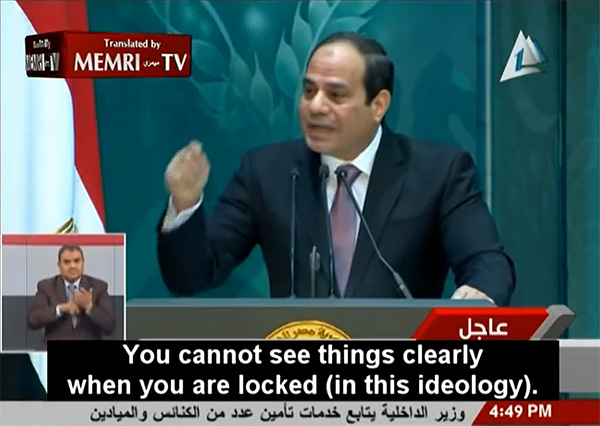
During a December 2014 address to religious scholars and clerics at Cairo's Al-Azhar University -- the most renowned Sunni Muslim institution of learning in the Islamic world -- Egyptian President Abdel Fattah al-Sisi declared unambiguously:
"Honorable Imam [the Grand Sheikh of Al-Azhar], you bear responsibility before Allah. The world in its entirety awaits your words, because the Islamic nation is being torn apart, destroyed, and is heading to perdition. We ourselves are bringing it to perdition... We must take a long, hard look at the current situation we are in. It is inconceivable that the ideology we sanctify, should make our entire nation a source of concern, danger, killing, and destruction all over the world. It is inconceivable that this ideology... I am referring not to 'religion,' but to 'ideology' -- the body of ideas and texts that we have sanctified in the course of centuries, to the point that challenging them has become very difficult."
Egypt's President, Abdel Fattah el-Sisi, delivered a historic speech to top Islamic scholars and clergy at Al-Azhar University in Cairo, December 28, 2014. (Image source: MEMRI)
For the political leader of present-day Egypt to understand that Muslim religious scholars and clerics "bear responsibility" for perverting Islam by turning it into a fierce political ideology is extraordinary. The question, however, is whether those scholars and clerics grasped what he was saying. More importantly, do they have the integrity to rise to al-Sisi's challenge? And what about the West's responsibility in this matter?
Western powers, if they are to maintain credibility regarding leadership based on human rights, cannot turn a blind eye to what is going on in the Muslim world. Muslims in Egypt and elsewhere know from experience the extent to which Western powers have betrayed in practice what they pronounce in theory when it comes to support for people subjected to authoritarian regimes.
Egypt's Muslims have a long record of struggling to modernize their society. The lack of success of religious reformers, such as Muhammad Abduh (1849-1905) and Ali Abd al-Raziq (1888-1966), and secular intellectuals, such as Taha Hussein (1889-1973), Nasr Hamid Abu Zayd (1943-2010) and Hasan Hanafi (b.1935), in bringing Egypt out of its "third world" cultural backwardness was compounded by the complicated history of the country and people caught in the grips of colonial interests, anti-colonial struggles, inter-Arab rivalries, wars against Israel, and the Cold War contest in the Middle East.
What is long overdue from the West is a robust policy to defend and secure human rights for everyone, especially minorities, in Muslim-majority countries. Ironically, it already has on hand well-tested policies of both defending and successfully advancing respect for human rights within totalitarian states in the form of the Helsinki Agreement of 1975, which in retrospect contributed to the undoing of communism in the Soviet Union and its satellites in Eastern Europe.
A policy modelled on the Helsinki Agreement and tailored to the specific situation within the Muslim world, as in Egypt, by the Western powers led by the United States should be presented as the sine qua non to the member states of the Organization of Islamic Cooperation (OIC) if they wish to maintain a relationship of mutual respect and assistance with, for instance, the G7 nations. As signatories of the UN-adopted Universal Declaration of Human Rights of 1948, the OIC member states, including Egypt, must be told in no uncertain terms that their complicity in or failure to prevent human-rights abuses will have serious consequences.
The Western powers should also make it known categorically that the 1990 Cairo Declaration of Human Rights in Islam, which was adopted by the OIC, is unacceptable, because Article 24 of the document states: "All the rights and liberties stated in this Declaration are in accordance with the precepts of the Islamic Law." In other words, the Cairo Declaration makes Shariah law the basis for rights and freedoms within Muslim-majority countries. This should be totally unacceptable to Western powers, particularly the United States, as the principal founding member of the United Nations -- just as it is unacceptable to Muslims who understand the incompatibility of Shariah with the requirements of the modern world.
Shariah is an obsolete product of the minds of men belonging to the early Middle Ages. The Copts, as other religious minorities among the member states of the OIC, and many Muslims, are victimized daily on the basis of Shariah in Egypt. There can be no reprieve for them as long as the government continues to impose Shariah-directed rules and regulations in the country as a whole, and as long as Egyptian society complies.
An incessant demand must be made of the United States to lead the G7 to adopt a Helsinki-type of agreement in their dealings with the member states of the OIC. Such an accord eventually would have a similar effect on the Muslim world -- in terms of human rights, protection of religious minorities, equal status for women and freedom of speech as essential for advancing democracy -- as the Helsinki Agreement had in liberating the people under communism in the former Soviet Union and in Eastern Europe.
The treatment of the Copts in Egypt is a moral outrage for any Muslim aware of the religious tradition bequeathed to him by his prophet. This tradition includes Muhammad's affection for the Copts through his marriage to Maria, a daughter of the Copts, who bore him the son, Ibrahim (died in infancy), he so earnestly desired. As a result of this providentially blessed relationship, the Copts as a people became Muhammad's extended family, his kith and kin. When Egyptian Muslims seek God's mercy, they need reminding that it begins with atoning for wrongdoing against the Copts, and seeking forgiveness from them. The leadership of Al-Azhar University in Cairo could make a beginning by following President al-Sisi's example when he said recently, in welcoming the Copts with open arms as members of Egypt's family:
"We too love you. You are our family, you are from us, we are one and no one will divide us."
Salim Mansur is a Distinguished Senior Fellow at Gatestone Institute. He teaches in the department of political science at Western University in London, Ontario, and is the author of "The Qur'an Problem and Islamism"; "Islam's Predicament: Perspectives of a Dissident Muslim"; and "Delectable Lie: A Liberal Repudiation of Multiculturalism."
This article is based on remarks the author delivered at the 9th annual convention of Coptic Solidarity, held in Washington, D.C. on June 21-22.