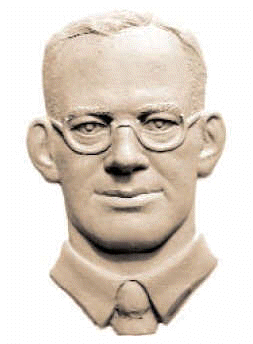
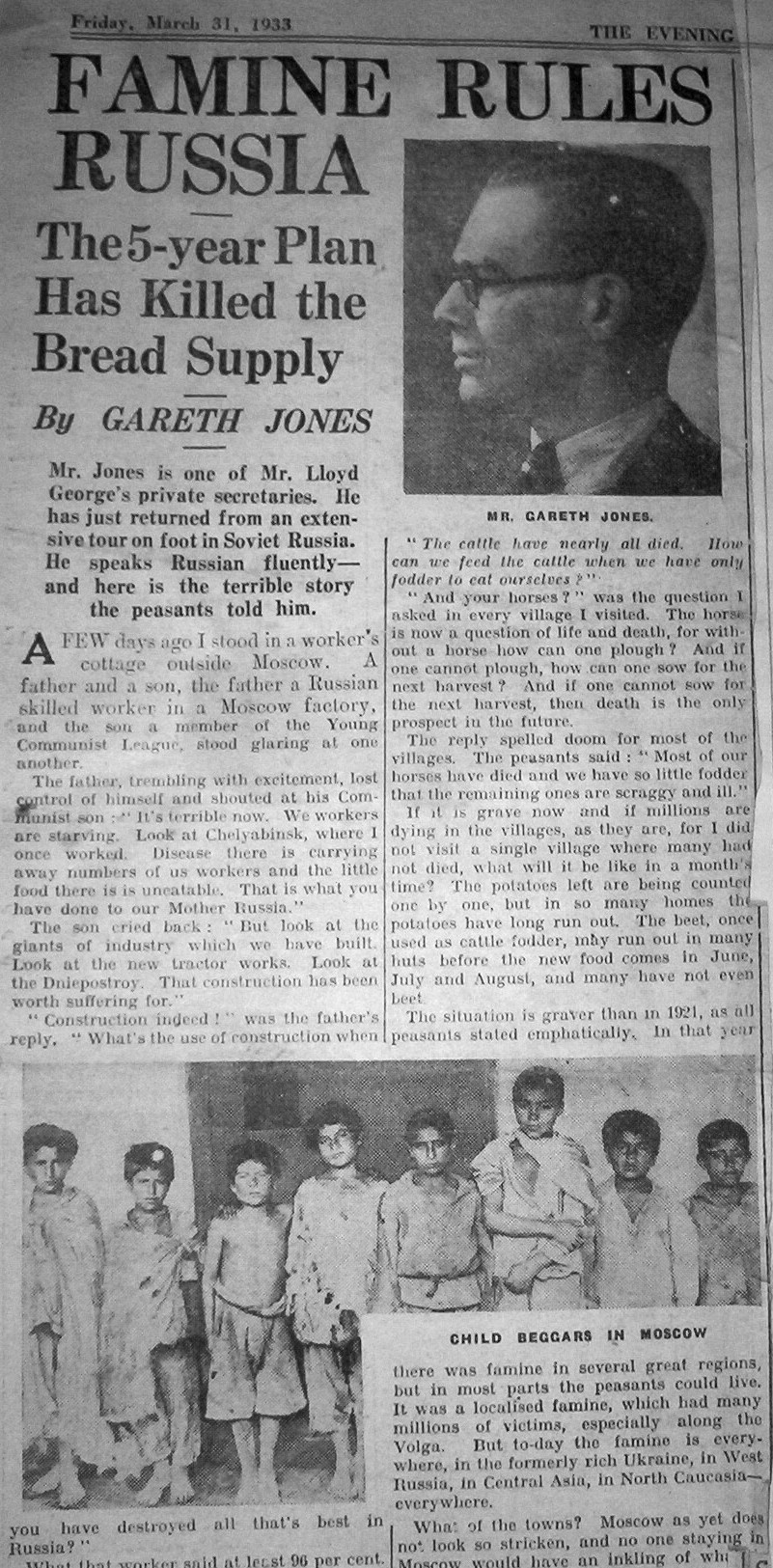
Gareth Jones left Cambridge University in 1929, having gained a
First-Class Honours in French, Russian and German to join Mr. David
Lloyd George, former Prime Minister to Great Britain (1916-1922). He
commenced his new employment as a Foreign Affairs Advisor on January
1st, 1930.
From 1930 to 1933, Gareth visited the Soviet Union on three
occasions and after each, he wrote articles for a number of newspapers
regarding conditions he observed resulting from Stalin's Five-Year Plan.
On the first occasion in 1930, Gareth reported back to Lloyd George
at his country retreat in Churt, Surrey . There he met Lord Lothian, a
former wartime secretary to Lloyd George (and later the British
Ambassador to the U.S. ), who recommended that Gareth should publish his
articles in The Times.
His second independent visit to ' Russia ' in 1931 (as the USSR was
widely known at the time in the West) occurred after being head-hunted
for his Soviet expertise by the leading American public relations
expert, Dr Ivy Lee. It was at Lee's request that Gareth accompanied a
young Jack Heinz II (heir to the food manufacturing empire) to Russia
and Ukraine , whereby sleeping on the 'bug-infested floors' of Soviet
peasantry, they personally experienced the onset of starvation in
Ukraine . Heinz took Gareth's copious diary notes and in early 1932
anonymously published (though containing a foreword under Gareth's name)
a damning appraisal of 'starving' peasant life in the USSR . Due to the
Great Depression, Gareth's one year contract with Lee was terminated
and he returned from New York in mid-1932 to rejoin David Lloyd George's
employ.
In October 1932, there were increasing rumours within informed
London circles and other circumstantial evidence which Gareth had
gleamed from recently acquired copies of Izvestia of an on-going
famine. As a result he wrote two newspaper articles in a series entitled
"Will there be soup?" to highlight the forthcoming winter crisis,
before arranging his affairs so as to observe it for himself at his
earliest opportunity in the following March..
Early in 1933, Gareth made an extensive tour of Europe . In
February one month after Adolf Hitler had been made Chancellor of
Germany (and just 3 days before the burning of the Reichstag), Gareth
was afforded the 'privilege' to become the first foreign journalist to
fly with the newly elected dictator to a rally in Frankfurt-am-Main.
The following month in early March 1933, after an 'off-limits'
walking tour of the Soviet Ukraine, Gareth, a young man of just 27
years, exposed to the world the terrible famine-genocide that had
befallen the Soviet Union and gave reasons for this tragic state of
events. It was in the same week that Malcolm Muggeridge had three
unsigned famine articles in the Manchester Guardian published, though at
the time, due to the more reported Jewish problems in Germany , they
went almost unnoticed. Gareth's story however, broke world-wide with
much credence (by virtue of his position with Lloyd George) from a
Berlin press interview on the 29th March 1933, and was published in the
USA as 'exclusives' on the same day by Pulitzer prize winners; H. R
Knickerbocker (1931) and Edgar Adsel Mowrer (1933)..
Even though Gareth revealed the truth, he was publicly denounced as
a liar by several Moscow resident Western journalists, including The
New York Times' and incumbent 1932 Pulitzer Prize Winner,
Walter Duranty. In 1937, Eugene Lyons, a Moscow based correspondent, who
repudiated Gareth four years earlier, was apologetic for his actions in
his book Assignment in Utopia:
"Throwing down Jones was as unpleasant a chore as fell to any
of us in years of juggling facts to please dictatorial regimes—but throw
him down we did, unanimously and in almost identical formulas of
equivocation. Poor Gareth Jones must have been the most surprised human
being alive when the facts he so painstakingly garnered from our mouths
were snowed under by our denials."
Undaunted, in a published letter to the New York Times, Gareth
reasserted his observations of famine and also stingingly rebutted
Duranty describing Moscow-based foreign correspondents as being "masters
of euphemism".
This was to be Gareth's final visit to the USSR , no doubt
personally countenanced by the Soviet Foreign Minister, Maxim Litvinov,
with whom he had a private audience just before leaving Moscow . It is
now known that Gareth's diary notes of the meeting note the single
word "prevarication" to simply comment upon Litvinov's flat denial of a
famine actually raging in the villages.
The consequences of Gareth's unilateral actions, were evinced in 1934, in a letter to a friend of his where Gareth wrote:
“Alas! You will be very amused to hear that the inoffensive little
'Joneski' has achieved the dignity of being a marked man on the black
list of the O.G.P.U. and is barred from entering the Soviet Union . I
hear that there is a long list of crimes which I have committed under my
name in the secret police file in Moscow and funnily enough espionage
is said to be among them… As a matter of fact Litvinoff sent a special
cable from Moscow to the Soviet Embassy in London to tell them to make
the strongest of complaints to Mr. Lloyd George about me.”
Following a forced year in the political reporting wilderness;
having been virtually ostracised by all his former political and
newspaper contacts within the British 'Establishment', including his
former employer Lloyd George, Gareth found a job as a local reporter for
the Cardiff Western Mail, covering stories about rural Welsh arts &
crafts.
Fortune often favours the brave and in June 1934 during the course
of his local Welsh reporting, Gareth interviewed Randolph Hearst, the
world's leading press baron, who happened to own a castle outside
Cardiff called St. Donat's, which he used as his British base. Hearst
was in the process of removing his support for the Bolsheviks in his
fears that F.D. Roosevelt's 'New Deal' was too left wing and knowing of
Gareth's previous Soviet reporting, wanted to meet him again so as to
spearhead Hearst's then forthcoming anti-Red campaign of 1935.
In December 1934, Gareth travelled across the USA and delivered a
key note speech at The Institute of World Affairs in which it would not
have gone unnoticed in Moscow that he he accused them of;
‘ The exile of five million Kulaks was one of the most brutal crimes in
European history.' On the New Years Day, 1935, Gareth met Randolph
Hearst for lunch on the terraces of his palatial estate of St. Simeon in
California, Gareth was personally commissioned to repeat his 1933
famine observations in three very heart-rending and most vitriolic
anti-Stalin articles for the Hearst stable of US papers - in which he
also correctly recognised that Kirov's recent murder in the USSR was
probably committed by Communists themselves and as a result, a new wave
of Stalinist terror ensued, now known as the beginning of the Stalinist
Purges.
Instead of again trying to publicly deride Gareth's articles, a
month later, and conveniently for the Soviets, whether by accident or
more probably by design, Hearst was 'furnished' with a series of
fraudulent articles and bogus famine photo claiming an on-going
Ukrainian famine in 1934, by one 'Thomas Walker,' a then unknown,
convicted-conman who had absconded from Colorado prison. Walker, whose
real name was Robert Green, was easily exposed as a complete charlatan
by Louis Fischer (armed with evidence that Green had only spent 5 days
in the USSR in 1934, and therefore could not visited Ukraine -
information readily supplied to him by the Soviet authorities). Without
ever-mentioning Gareth's name, Fischer was thus able to destroy the
credibility of all of Hearst's reporting of any Soviet famine.
Gareth would have been completely unaware of Fischer's 13th March
1935 letter (entitled 'Hearst's Russian 'Famine'') in the US weekly, The
Nation exposing Thomas Walker's fake reporting, otherwise one would
have expected him to contribute to the debate in the US, especially as
he had spearheaded Hearst's first series of anti-Soviet articles in 1935
. The precise timing of Fischer's article coincided with the exact
start of a period when Gareth became effectively incommunicado whilst
'back-packing' around South East Asia in Search of News. Prior to this
journey and whilst residing in Japan , Gareth had been provided with
free accommodation by a fellow journalist Günter Stein, who himself had
just arrived in Tokyo from London . However, unbeknown to Gareth, Stein
was actually an alleged Soviet spy, loosely but not exclusively
associated with the famous Richard Sorge spy ring. One might perhaps
wonder whether Stein not only reported Gareth's immediate itinerary to
his spy masters in Moscow, but if it possibly resulted in the 'go-ahead'
for Fischer's 4th March dated letter to be 'safely 'published (just two
days after Gareth left Stein's apartment on 11th March)?
What is not up for conjecture is that Gareth's Far Eastern
movements were being closely monitored by the Soviets. Within five
months, he had been kidnapped by 'Japanese-controlled' Chinese bandits
and two weeks afterwards was suspiciously murdered in Inner Mongolia .
His last mode of transport and from which he was kidnapped was 'kindly'
provided gratis by a German company called Wostwag - now known to have
been a trading front of the OGPU / NKVD... [He was kidnapped along with
the German journalist, Dr. Herbert Mueller, who had invited him on the
trip to Inner Mongolia . Mueller was 'unusually' released, unharmed
after two days in captivity - British Intelligence records at the Public
Records Office now reveal that they had a secret dossier on Mueller for
34 years citing him as; a known Communist, a representative of the
Third International (Comintern) in China, at one time lived in the
Soviet Consulate in Hankow, under the alias of 'Gordon' and also ran a
covert Soviet courier business within China.]
With his murder under mysterious
circumstances, Gareth Jones had effectively been silenced; the only
reliable indepenent witness to arguably Stalin's greatest atrocity had
been convenient;y liquidated and both the Holodomor and Gareth's
truthful reporting were effectvely airbrushed out of history for more
than half a century. [Though one man however did not forget Gareth, and
this man was George Orwell, who clearly alluded to Gareth in his own
famine chapter in 'Animal Farm']
In November 2009, Gareth's old alma mater of Trinity College
Cambridge eventually recognised the true historical importance of
Gareth's journalist diary notes of his observation of famine conditions
in Ukraine in 1933, when they prestigiously exhibited his pocket diaries
at the Wren Library and side-by-side with fellow alumni, Sir Isaac
Newton's personally annotated copy of his fundamental 'laws of motion'
masterpiece, 'Principia'. 180 newspapers worldwide covered the story
(bar the New York Times!), finally vindicating that Gareth's pen was
indeed mightier than the Soviet sword...
Famine Exposure Newspaper Articles
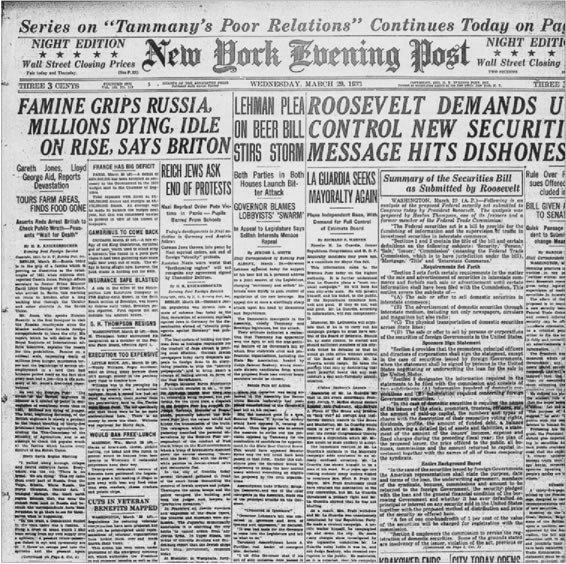
Evening
Post Foreign Service New York 1933
Famine grips Russia
Millions Dying. Idle on Rise, Says Briton
Gareth Jones, Lloyd
George Aid, Reports Devastation
TOURS
FARM AREAS, FINDS FOOD GONE
Asserts Reds Arrest British to Check Public Wrath-Peasants. “Wait for Death”
BERLIN, March.
29th , - Russia today is in the grip of a famine which is proving as disastrous
as the catastrophe of 1921 when millions died, reported Gareth Jones, Foreign
Affairs secretary to former Prime Minister David Lloyd George of Great Britain,
who arrived in Berlin this morning en route to London after a long walking tour
through the Ukraine and other districts in the Soviet Union.
Mr. Jones, who speaks Russian fluently, is the first foreigner to visit the
Russian countryside since the Moscow authorities forbade foreign correspondents
to leave the city. His report, which he will deliver to the Royal
Institute of International Affairs tomorrow, explains the reason for this
prohibition. Famine on a colossal scale, impending death of millions From
hunger, murderous terror and the beginnings of serious unemployment in a land
that had hitherto prided itself on the fact that every man had a job - this is the
summary of Mr. Jones’s first-hand observations.
He told the EVENING POST: “The arrest of the British engineers in Moscow is a
symbol of panic in consequence of conditions worse than in 1921. Millions
are dying of hunger. The trial, beginning Saturday, of the British
engineers is merely a pendant to the recent shooting of thirty-five prominent
workers in agriculture, including the Vice-Commissar of the Ministry of
Agriculture, and is an attempt to check the popular wrath at the famine which
haunts every district of the Soviet Union.
"Everywhere was the cry, ‘There is no bread. We are dying.
This cry came from every part of Russia, from the Volga,. Siberia, White Russia,
the North Caucasus, Central Asia. I tramped through the black earth region
because that was once the richest farm land in Russia and because the
correspondents have been forbidden to go there to see for themselves what is
happening.
“In the train a Communist denied ‘to me that there was a famine. I
flung a crust of bread which I had been eating from my own supply into a
spittoon. A peasant fellow-passenger fished it out and ravenously ate it.
I threw an orange peel into the spittoon and the peasant again grabbed it and
devoured it. The Communist subsided. I stayed overnight in a village
where there used to be 200 oxen and where there now are six. The peasants
were eating the cattle fodder and had only a month’s supply left. They
told me that many had already died of hunger. Two soldiers came to arrest
a thief. They warned me against travel by night as there were too many
‘starving’ desperate men.
“‘We are waiting for death’ was my welcome, but See, we still, have our
cattle fodder. Go farther south. There they have nothing. Many
houses are empty of people already dead,’ they cried.
“A foreign expert returning from Kazakstan told me that 1,000,000 out of
5,000,000 there have died of hunger. I can believe it. After Stalin, the
most hated man in Russia is Bernard Shaw among those who read his glowing
descriptions of plentiful food in their starving land. “The future is
blacker than the present. There is insufficient seed. Many peasants
are too weak physically to work on the land. The new taxation policy,
promising to take only a fixed amount of grain from the peasants, will fail to
encourage production because the peasants refuse to trust the Government.”
In short, Mr. Jones concluded, the collectivization policy of the
Government and the resistance of the peasants to it have brought Russia to the
worst catastrophe since the famine of 1921 and have swept away the population of
whole districts.
Coupled with this, the prime reason for the breakdown, he added, is the terror,
lack of skill and collapse of transport and finance. Unemployment is
rapidly increasing, he declared, because of the lack of raw materials. The
lack of food and the ‘wrecking of the currency and credit system have forced
many of the factories to close or to dismiss great numbers of workers.
The Jones report, because of his position, because of his reputation for
reliability and impartiality and because he is the only first-hand observer who
has visited the Russian countryside since it was officially closed to
foreigners, is bound to receive widespread attention in official England as well
as among the public of the country.
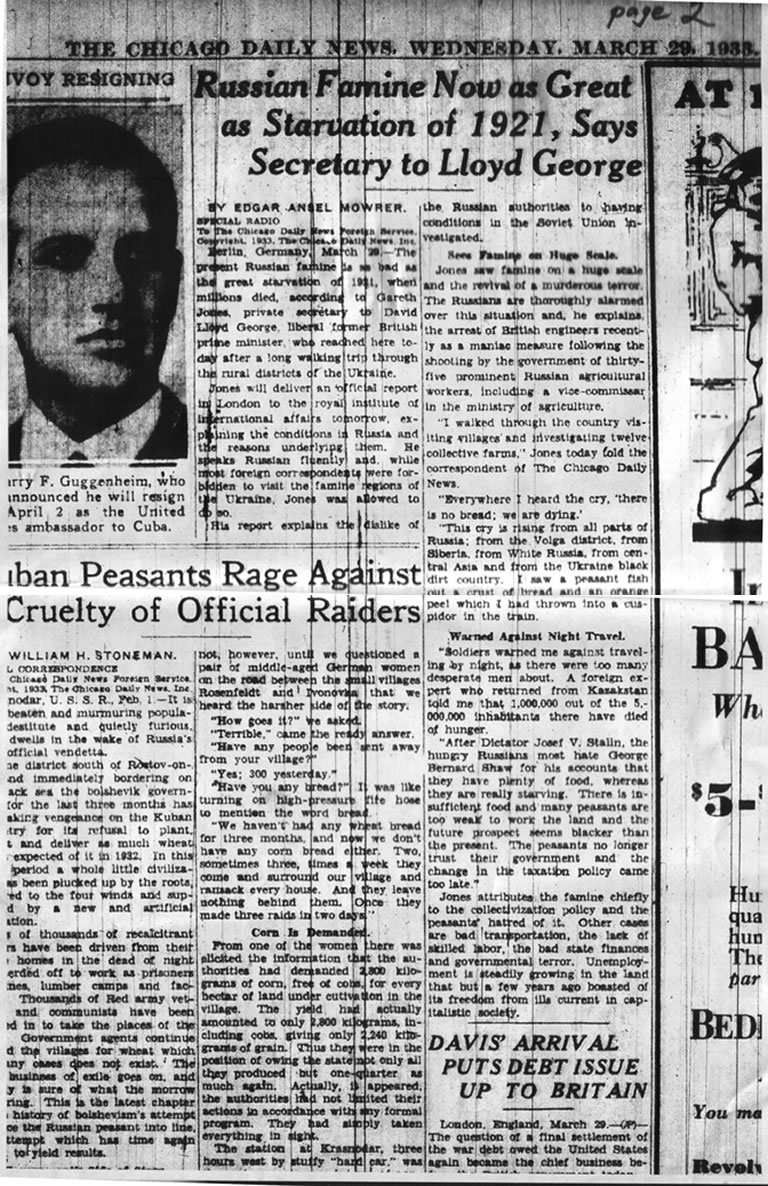
The
Chicago Daily News
Wednesday
29th March 1933
(Page2)
Click on the image above for a more detailed legible copy of Edgar Mowrer's article- plus perhaps in my my mind as interesting,, an unfortunately cropped copy of William Stoneman's February 1st filed article from Moscow of exiled Kuban Villages for some reason published on the same day - which to me beggars the question, "Why did Stoneman's article sit on his editor's desk for almost two months without publication?" [Nigel Linsan Colley - 1st August 2005]
Russian
Famine Now as Great as Starvation of 1921,
Says Secretary of Lloyd George
BY
EDGAR ANSEL MOWRER
SPECIAL
RADIO
The
Chicago Daily News Foreign Service. Copyright 1933. The Chicago Daily News Inc.
Berlin,
Germany, March 29 – The present Russian Famine is as bad as the great
starvation of 1921, when millions died, according to Gareth Jones, private
secretary to David Lloyd George, liberal former prime minister, who reached here
today after a long walking trip through the rural districts of the Ukraine.
Jones
will deliver an official report in London to the royal institute of
international affairs tomorrow, explaining the conditions in Russia and the
reasons underlying them. He speaks Russian fluently and while most foreign
correspondents were forbidden to visit the famine regions of the Ukraine, Jones
was allowed to do so.
His
report explains the dislike of the Russian authorities to having conditions in
the Soviet Union investigated.
Sees
Famine on Huge Scale
Jones
saw famine on a huge scale and the revival of murderous terror. The Russians are
thoroughly alarmed over this situation and, he explains, the arrest of the
British engineers recently as a maniac measure following the shooting by the
government of thirty-five prominent Russian agricultural workers, including a
vice-commissar in the ministry of agriculture.
“I
walked through the country visiting villages and investigating twelve collective
farms,” Jones today told the correspondent of The Chicago Daily News.
“Everywhere
I heard the cry, ‘there is no bread, we are dying.’
“This
cry is rising from all parts of Russia; from the Volga district, from Siberia,
from White Russia and from the Ukraine black dirt country. I saw a peasant fish
out a crust of bread and an orange peel which I had thrown into a cuspidor in
the train.
Warned
Against Night Travel
“Soldiers
warned me against travelling by night, as there were too many desperate men
about. A foreign expert who returned from Kazakstan told me that 1,000,000 out
of 5,000,000 inhabitants there have died of hunger.
“After
Dictator Josef v. Stalin, the hungry Russians most hate George Bernard Shaw for
his accounts that they have plenty of food, whereas they are really starving.
There is insufficient food and many peasants are too weak to work the land and
future prospect seems blacker than the present. The peasants no longer trust
their government and he change in the taxation policy came too late.”
Jones
attributes the famine chiefly to the collectivization policy and the peasants’
hatred of it. Other cases are bad transportation, the lack of skilled labor, the
bad state finances and government terror. Unemployment is steadily growing in
the land that but a few years ago boasted of its freedom from ills current in
capitalistic society.
[One
should note that on 29th March 1933, two Pulitzer Prize Winners for
Correspondence; H. R. Knickerbocker - New
York Evening Post for 1931 and the 'soon--to-be' 1933 winner, Adsel
Mowrer - Chicago Daily News, simultaneously exposed the the Famine in
the USA for their respective newspapers by immediately reporting
Gareth's Berlin Press Conference, whilst Duranty, who one should remember was
the Pulitzer 'incumbent', just a day later and from 'on the spot' in Moscow
knowingly chose to denigrate Gareth's truthful observations...]
The
Morning Post. March 30th 1933
[This Newspaper was later merged with the London Daily Telegraph.]
RUSSIA
IN GRIP OF FAMINE
Death
and Despair Stalk the Land
EVIDENCE
AT FIRST HAND
“There
Is No Bread: We Are Dying”
BERLIN,
March 29. [1933]
“Russia
today is in the grip of famine, which is proving as disastrous as the
catastrophe of 1921, when millions died,” said Mr. Gareth Jones Former
Political Secretary of Mr. Lloyd George, when he arrived in Berlin this morning
en route for London. He had been on a long walking trip through the
Ukraine and other districts of the Soviet Union.
Mr.
Jones, who speaks Russian fluently, was the first foreigner to visit the Russian
countryside since the Moscow authorities forbade foreign correspondents to leave
the city. His report which will be delivered to the Institute of
International Affairs to-morrow, explains the reason for this s prohibition.
In
an interview with the New York Evening Post, “Mr. Jones said that famine on a
colossal scale was impending. It meant death to millions by hunger, and
the beginnings of serious unemployment in a land which has hitherto prided
itself of every man having a job. The arrest of the British engineers in
Moscow is a symbol of panic and is a consequence of worse than in 1921 when
millions died of hunger,” declared Mr. Jones. The trial beginning on
Saturday of British engineers is merely a sequel to the recent shooting of
thirty-five prominent agricultural workers, including the Vice-Commissar in the
Ministry of Agriculture, in an attempt to cheek the popular wrath at the famine
which haunts every district of the Soviet Union.
“I
walked alone through villages and twelve collective farms. Everywhere
was the cry, ‘There is no bread; we are dying!’. This cry came to me
from every part of Russia.
“In
a train a Communist denied to me that there was a famine. I flung into the
spittoon a crust of bread I had been eating from my own supply. The
peasant, my fellow passenger fished it out and ravenously ate it. I threw
orange peel into the peasant again grabbed and devoured it. The Communist
subsided.
A
MILLION DEAD
“A
foreign expert returning from Kazakstan told me that a million out of five
million have died of hunger. I can believe it. “After Stalin, the
most hated man in Russia is Bernard Shaw. To many of those who can read
and have read his glaring descriptions of plentiful food in their starving laud
the future is blacker than the present.
“
There is insufficient seed. Many of the peasants are too weak to work the
land. The new taxation policy which promised to take only a fixed amount
of grain from the peasants will fail to encourage production because the
peasants refuse to trust the Government.”
In
short, concluded Mr. Jones, the Government’s policy of collectivisation and
the peasants’ resistance to it had brought Russia to the worst catastrophe
since the famine of 1921 swept away the population of entire districts.
Coupled
with this, the prime reason for the breakdown was the lack of skilled labour and
the collapse of transport and finance.
Daily
Express. March 30th 1933
Millions
Starving In Russia
‘THERE
IS NO BREAD WE ARE DYING’
BERLIN, Wednesday,
March 29th.
Russia
to-day is in the grip of famine, which is proving disastrous as the catastrophe
of when millions died,’’ said Mr. Gareth Jones, formerly political secretary
of Mr. Lloyd George when he arrived in Berlin today on his way to London after a
long walking trip through the Ukraine and other districts of the Soviet Union.
Mr.
Jones who speaks Russian fluently, was the first foreigner to visit the Russian
countryside since the Moscow authorities forbade foreign correspondents to leave
the city.
In
an interview with the “New York Evening Post’’ Mr. Jones said the famine
on a colossal stale was impending. It meant death to millions by hunger,
and the beginning of serious unemployment in a land which has hitherto prided
itself on every man having a job.
“I
walked alone through villages and twelve collective farms,” he said.
“Everywhere was the cry, ‘There is no bread; we are dying!’ This cry came
to me from every part of Russia.
TOO
WEAK TO WORK
“In
a train a Communist denied to me that there was a famine. I flung into the
spittoon a crust of bread I had been eating from my own supply. A peasant,
my fellow-passenger, fished it out and ravenously ate it. I threw orange
peel into the spittoon ; the peasant again grabbed and devoured it.
“The
Communist subsided
“A
foreign expert returning from Kazakstan told me that a million out of five
million have died of hunger.
“‘There
is insufficient seed. Many of the peasants are too weak to work.”
In
short, concluded Mr. Jones, the Government’s policy of collectivization and
the peasants’ resistance to it had brought Russia to the worst catastrophe
since the famine of 1921swept away the population of whole district.
The London Evening Standard, March 31st, 1933
FAMINE
RULES RUSSIA
The
5-year Plan Has Killed the Bread Supply.
By GARETH JONES.
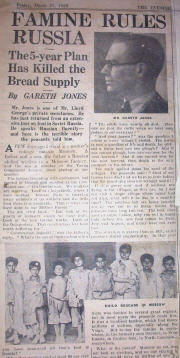 |
[Click on image to open 450kb
legible copy of the article which can then be saved to disk and viewed
with any photo editor] |
Mr.
Jones is one of Mr. Lloyd George’s private secretaries. He has just returned from an extensive tour on foot in Soviet Russia.
He speaks Russian fluently - and here is the terrible story the
peasants told him.
A
few day sago I stood in a worker’s cottage outside Moscow. A father and a son, the father, a Russian skilled worker in a Moscow
factory and the son a member of the Young Communist League, stood glaring at
one another.
The
father trembling with excitement, lost control of himself and shouted at his
Communist son. It is terrible now. We
workers are starving. Look at
Chelyabinsk where I once worked. Disease
there is carrying away numbers of us workers and the little food there is
uneatable. That is what you have
done to our Mother Russia.
The
son cried back: “But look at the giants of industry which we have built.
Look at the new tractor works. Look
at the Dniepostroy. That has
construction has been worth suffering for.”
“Construction
indeed!” Was the father's
reply: “What’s the use of
construction when you have destroyed all that’s best in Russia?”
What
that worker said at least 96 per cent. of the people of Russia are
thinking.
There has been construction, but, in the act of building, all that was
best in Russia has disappeared. The
main result of the Five Year Plan has been the tragic ruin of Russian
agriculture. This ruin I saw in
its grim reality. I tramped
through a number of villages in the snow of March. I saw children
with swollen bellies.
I slept in peasants’ huts, sometimes nine of us in one room. I talked
to every peasant I met, and the general conclusion I draw is
that the present state of Russian agriculture is already catastrophic
but that
in a year’s time its condition will have worsened tenfold.
What
did the peasants say? There was
one cry which resounded everywhere I went and that was: “There is no
bread.” The other sentence, which as the leitmotiv of my Russian
visit was: “All are swollen.” Even
within a few miles of Moscow there is no bread left. As I was going through the countryside in that district I chatted to
several women who were trudging with empty sacks towards Moscow. They all said: “It is terrible.
We have no bread. We have to go all the way to Moscow to get bread
and then they will only give us four pounds, which costs three roubles (six
shillings nominally). How can a
poor man live?”
“Have
you potatoes?” I asked. Every
peasant I asked nodded negatively with sadness.
“What
about your cows?” was the next question. To the Russian peasant the cow means wealth, food and happiness.
It is almost the centre-point upon which his life gravitates.
“The cattle have nearly all
died. How can we feed the cattle
when we have only fodder to eat ourselves?”
“And
your horses?” was the question I asked in every village I visited.
The horse is now a question
of life and death, for without a horse how can one plough?
And if one cannot plough, how can one sow for the next harvest?
And if one cannot sow for the next harvest, then death is the only
prospect in the future.
The
reply spelled doom for most of the villages.
The peasants said: “Most of our horses have died and we have so little
fodder that the remaining ones all scraggy and ill.”
If
it is grave now and if millions are dying in the villages, as they are, for I
did not visit a single village where many had not died, what will it be like in
a month’s time? The potatoes left are being counted one by one, but in so
many homes the potatoes have long run out.
The beet, once used as cattle fodder may run out in many huts before the
new food comes in June, July and August, and many have not even beet.
The
situation is graver than in 1921, as all peasants stated emphatically.
In that year there was famine in several great regions but in most parts
the peasants could live. It was a
localised famine, which had many millions of victims, especially along Volga.
But today the famine is everywhere, in the formerly rich Ukraine, in Russia, in
Central Asia, in North Caucasia - everywhere.
Child Beggars in Moscow
What
of the towns? Moscow as yet does not look so stricken, and no one staying
in Moscow would have an inkling of what is going on in the countryside, unless
he could talk to the peasants who have come hundreds and hundreds of miles to
the capital to look for bread. The
people in Moscow warmly clad, and many of the skilled workers, who have their
warm meal every day at the factory, are well fed.
Some of those who earn very good salaries, or who have special
privileges, look even, well dressed, but the vast majority of the unskilled
workers are feeling the pinch.
I
talked to a worker who was hauling a heavy wooden trunk.
“It is terrible now” he said. “
I get two pounds of bread a day and it is rotten bread.
I get no meat, no eggs, no butter. Before
the war I used, to get a lot of meat and it was cheap.
But I haven’t had meat for a year.
Eggs were only a kopeck each before the war, but now they are a great
luxury. I get a little soup, but it
is not enough to live on.”
And
now a new dread visits the Russian worker.
That is unemployment. In the
last few months very many thousands have been dismissed from factories in many
parts of the Soviet. Union. I asked
one unemployed man what happened to him. He
replied: “We are treated like cattle. We
are told to get away, and we get no bread card.
How can I live? I used to
get a pound of bread a day for all my family, but now there is no bread card.
I have to leave the city and make my way out into the countryside where
there is also no bread.”
The Five-Year
Plan has built many fine factories. But
it is bread that makes factory wheels go round, and the Five-Year Plan has
destroyed the bread-supplier of Russia.
The denigration of Gareth Jones by Walter Duranty in The New York Times, Friday March 31st 1933.
RUSSIANS
HUNGRY, BUT NOT STARVING
Deaths
From Diseases Due to Malnutrition High, Yet the Soviet is Entrenched
LARGER
CITIES HAVE FOOD
Ukraine,
North Caucasus and Lower Volga Regions Suffer From Shortages.
KREMLIN'S
'DOOM' DENIED
Russian
and Foreign Observers In Country See No Ground for Predications of Disaster
By
WALTER DURANTY
Special
Cable to THE NEW YORK TIMES
MOSCOW,
March 30---In the middle of the diplomatic duel between Great Britain and the
Soviet Union over the accused British engineers there appears from a British
source a big scare story in the American press about famine in the Soviet Union,
with "thousands already dead and millions menaced by death and
starvation."
Its
author is Gareth Jones, who is a former secretary to David Lloyd George and who
recently spent three weeks in the Soviet Union and reached the conclusion that
the country was "on the verge of a terrific smash," as he told the
writer.
Mr.
Jones is a man of a keen and active mind, and he has taken the trouble to learn
Russian, which he speaks with considerable fluency, but the writer thought Mr.
Jones's judgment was somewhat hasty and asked him on what it was based. It
appeared that he had made a forty-mile walk through villages in the neighborhood
of Kharkov and had found conditions sad.
I
suggested that that was a rather inadequate cross-section of a big country but
nothing could shake his conviction of impending doom.
Predictions
of Doom Frequent.
The
number of times foreigners, especially Britons, have shaken rueful heads as they
composed the Soviet Union's epitaph can scarcely be computed, and in point of
fact it has done incalculable harm since the day when William C. Bullitt's able
and honest account of the situation was shelved and negatived during the
Versailles Peace Conference by reports that Admiral Kolchak, White Russian
leader, had taken Kazan - which he never did - and that the Soviet power was
"one the verge of an abyss."
Admiral
Kolchak faded. Then General Denikin took Orel and the Soviet Government was on
the verge of an abyss again, and General Yudenich "took" Petrograd.
But where are Generals Denikin and Yudenich now?
A
couple of years ago another British "eyewitness" reported a mutiny in
the Moscow garrison and "rows of corpses neatly piled in Theatre
Square," and only this week a British news agency revealed a revolt of the
Soviet Fifty-fifth Regiment at Duria, on the Manchurian border. All bunk,
of course.
This
is not to mention a more regrettable incident of three years ago when an
American correspondent discovered half of Ukraine flaming with rebellion and
"proved" it by authentic documents eagerly proffered by Rumanians,
which documents on examination appeared to relate to events of eight or ten
years earlier.
Saw
No One Dying
But
to return to Mr. Jones. He told me there was virtually no bread in the villages
he had visited and that the adults were haggard, guant and discouraged, but that
he had seen no dead or dying animals or human beings.
I
believed him because I knew it to be correct not only of some parts of the
Ukraine but of sections of the North Caucasus and lower Volga regions and, for
that matter, Kazakstan, where the attempt to change the stock-raising nomads of
the type and the period of Abraham and Isaac into 1933 collective grain farmers
has produced the most deplorable results.
It
is all too true that the novelty and mismanagement of collective farming, plus
the quite efficient conspiracy of Feodor M. Konar and his associates in
agricultural commissariats, have made a mess of Soviet food production.
[Konar was executed for sabotage.]
But---to
put it brutally---you can't make an omelette without breaking eggs, and the
Bolshevist leaders are just as indifferent to the casualties that may be
involved in their drive toward socializaton as any General during the World War
who ordered a costly attack in order to show his superiors that he and his
division possessed the proper soldierly spirit. In fact, the Bolsheviki are more
indifferent because they are animated by fanatical conviction.
Since
I talked to Mr. Jones I have made exhaustive inquiries about this alleged famine
situation. I have inquired in Soviet commissariats and in foreign embassies with
their network of consuls, and I have tabulated information from Britons working
as specialists and from my personal connections, Russian and foreign.
Disease
Mortality Is High
All
of this seems to me to be more trustworthy information than I could get by a
brief trip through any one area. The Soviet Union is too big to permit a hasty
study, and it is the foreign correspondent's job to present a whole picture, not
a part of it. And here are the facts:
There
is a serious shortage food shortage throughout the country, with occasional
cases of well-managed State or collective farms. The big cities and the army are
adequately supplied with food. There is no actual starvation or deaths from
starvation, but there is widespread mortality from diseases due to malnutrition.
In
short, conditions are definitely bad in certain sections- the Ukraine, North
Caucasus and Lower Volga. The rest of the country is on short rations but
nothing worse. These conditions are bad, but there is no famine.
The
critical months in this country are February and March, after which a supply of
eggs, milk and vegetables comes to supplement the shortage of bread - if, as
now, there is a shortage of bread. In every Russian village food conditions will
improve henceforth, but that will not answer one really vital question---What
about the coming grain crop?
Upon
that depends not the future of the Soviet power, which cannot and will not be
smashed, but the future policy of the Kremlin. If through climatic
conditions, as in 1921, the crop fails, then, indeed, Russia will be menaced by
famine. If not, the present difficulties will be speedily forgotten.
The New York
Times. Date: May 13th, 1933.
Mr. Jones Replies:
Former
Secretary of Lloyd George Tells of Observations in Russia
To
the Editor of The New York Times:
On
my return from Russia at the end of March, I stated in an interview in Berlin that everywhere I went in the Russian
villages I heard the cry; “There is no bread, we are dying,” and that there
was famine in the Soviet Union, menacing the lives of millions of people.
Walter
Duranty, whom I must thank for his continued kindness and helpfulness to
hundreds of American and British visitors to Moscow, immediately cabled a denial
of the famine. He suggested that my
judgment was only based on a forty-mile tramp through villages. He stated
that he had inquired in Soviet commissariats and in the foreign embassies and
had come to the conclusion that there was no famine, but that there was a
“serious food shortage throughout the country … No actual starvation or deaths from starvation, but there is widespread
mortality from diseases due to malnutrition.”
Evidence From Several Sources.
While
partially
agreeing with my statement, he implied that my report was a “scare
story” and compared it with certain fantastic prophecies of Soviet
downfall. He also made the strange suggestion that I was forecasting
the doom of
the Soviet régime, a forecast I have never ventured.
I
stand by my statement that Soviet Russia is suffering from a severe
famine. It would be foolish to draw this conclusion from my tramp
through a small
part of vast Russia, although I must remind Mr. Duranty that it was my
third
visit to Russia, that I devoted four years of university life to the
study of
the Russian language and history and that on this occasion alone I
visited in
all twenty villages, not only in the Ukraine, but also in the black
earth
district, and in the Moscow region, and that I slept in peasants’
cottages, and did not immediately leave for the next
village.
My
first evidence was gathered from foreign observers. Since Mr. Duranty introduces consuls into the discussion, a thing I am
loath to do, for they are official representatives of their countries and should
not be quoted, may I say that I discussed the Russian situation with between
twenty and thirty consuls and diplomatic representatives of various nations and
that their evidence supported my point of view. But they are not allowed to
express their views in the press, and therefore remain silent.
Journalists Are Handicapped.
Journalists,
on the other hand, are allowed to write, but the censorship has turned them into
masters of euphemism and understatement. Hence
they give “famine” the polite name of “food shortage” and “starving to
death” is softened down to read as “widespread mortality from diseases due
to malnutrition.” Consuls are not
so reticent in private conversation.
My
second
evidence was based on conversations with peasants who had migrated into
the towns from various parts of Russia. Peasants
from the richest parts of Russia coming into the towns for bread. Their
story of the deaths in their villages from starvation and of the
death of the greater part of their cattle and horses was tragic, and
each
conversation corroborated the previous one.
Third,
my evidence was based upon letters written by German colonists in Russia,
appealing for help to their compatriots in Germany. “My brother’s four
children have died of hunger.” “We
have had no bread for six months.” “If
we do not get help from abroad, there is nothing left but to die of hunger.” Those are typical passages from these letters.
Statements by Peasants.
Fourth,
I gathered evidence from journalists and technical experts who had been in the
countryside. In The Manchester
Guardian, which has been exceedingly sympathetic toward the Soviet régime,
there appeared on March 25, 27 and 28 an excellent series of articles on “The Soviet and the Peasantry” (which had not been
submitted to the censor). The
correspondent, who had visited North Caucasus and the Ukraine, states: “To say
that there is famine in some of the’ most fertile parts of Russia is to say
much less than the truth: there is not only famine, but - in the case of the North
Caucasus at least - a state of war, a military occupation.” Of the Ukraine, he writes: “The population is starving.”
My
final
evidence is based on my talks with hundreds of peasants. They were not
the “kulaks”- those mythical scapegoats for the hunger
in Russia-but ordinary peasants. I
talked with them alone in Russian and jotted down their conversations,
which are
an unanswerable indictment of Soviet agricultural policy. The peasants
said emphatically that the famine was worse than in 1921
and that fellow-villagers had died or were dying.
Mr.
Duranty
says that I saw in the villages no dead human beings nor animals. That
is true, but one does not need a particularly nimble
brain to grasp that even in the Russian famine districts the dead are
buried and
that there the dead animals are devoured.
May
I in conclusion congratulate the Soviet Foreign Office on its skill in
concealing the true situation in the U.S.S.R.? Moscow is not Russia, and the sight of well fed people there tends to
hide the real Russia.
GARETH
JONES.


 Holodomor in Ukraine and Food Insecurity Today: “Implications for the Media, NGOs, and International Organizations”